This morning I almost blew my top. I was listening to the radio. A usually decent station. Usually decent and, like all of us, imperfect.
The news anchor was interviewing an ‘expert’. An Ivy League Professor of International Relations and other blah-blahs. I’m not giving their names because I want them forgotten, not even more famous than they already are.
‘Is there any chance for this conflict to end in a negotiated manner?’ ‘Yes, if/when both sides will find a mutually acceptable solution. For example, if the Ukrainian side would accept a referendum in Donbass – and in Crimea, and if the Russian side would accept UN inspectors to validate the process. This would be in line with the general accepted policy of self-determination and ….’
OK, and where’s the difference between what Putin keeps saying and what I’ve just heard?!?
Two non-Ukrainians telling Ukraine what to do…
I’m going to set aside, for now, what these two – wait, three! – people are saying. That Ukraine, the Ukrainian People, should give up a piece of their land. My immediate interest lies in ‘who these three guys think they are’?!?
OK, only those who don’t want to see haven’t yet found out that Putin is a dictator. But for a renowned Ivy League Professor to elaborate a scenario according to which the UN would supervise a referendum where an occupied population would have the opportunity to vote whether they want ‘their’ aggressor to maintain its control over the already occupied territory….
Would that distinguished Professor be comfortable with a referendum – equally supervised by the UN, taking place in California? Which California had already been occupied by Mexico? For which referendum, the Californians were asked where they want to live? Whether Mexico should continue its occupation or should the Mexican army retreat behind the internationally recognized border?
No, I don’t think the Professor has been paid by Putin. Or ‘compensated’ in any other way by the ‘red Satan’. I just consider he was not paying real attention to what he was saying. He had just opened his mouth and verbalized what his mind was churning. The current ‘events’ have disturbed his pleasant existence to such a degree that he really needs this ‘fly in the ointment’ to ‘fly away’.
He is so ‘driven’ by his ‘need’ that he is no longer ‘patient’. He just can’t ‘stop talking’ for long enough to realize how fast Putin’s propaganda machine will make ‘good’ use of his ‘verbalizations’…
‘See, the good Professor confirms what our Beloved Leader has already done. It’s the Ukrainians who are not reasonable! They should first change their leadership then come back into Mother Russia’s arms.’
When are we going to understand?
Don’t tell others what to do unless you are prepared to ‘take advice’ yourself… And, for your own good, don’t trade your future freedom for your present comfort!
Being an agnostic, somewhat simplifies things. For me. At the emotional level, I prefer the second interpretation. At the rational level, I appreciate the effort made by the first interpretation towards finding a logical explanation for the whole thing. Which explanation might actually be true. In the sense that the evangelists, all four of them, might have indeed tried to lessen the Roman responsibility for Christ’s death.
What bothers me is why so many of the readers have accepted the story as plausible? A crowd to send a bandit to freedom and an innocent to death? How likely is this?
But what if the crowd was biased?
Well, not the crowd, since the episode was most likely invented. The individuals who had a message to convey to their readers. To us.
Let’s start with the beginning. The Old Testament. According to this writing, the covenants were made between God and the people of Israel. Which gave the people of Israel a special place. They were His people. The chosen ones. The New Testament changes all this. Jesus died for all of those who accept his sacrifice. The Jews are no longer the only chosen ones.
The way I see it, the ordinary Jews have no problem with this. I have no knowledge of Jews discriminating against Christians. Except for the claims made by the anti-Semites… I’m not so sure though about the likes of Caiaphas… “a member of the council when he gave his opinion that Jesus should be put to death “for the people, and that the whole nation perish not”“ After all, Caiaphas – and all those in the same position, were the only ones who had anything to lose as a consequence of Jesus’s teachings. As a consequence of all people, not only those who followed the likes of Caiaphas, being able to consider themselves as being children of the same God. Only the likes of Caiaphas had anything to lose from all followers of Christ considering themselves equal among themselves.
Not at all different from what had happened after Luther had nailed his famous theses to the door of the Wittenberg church. The established hierarchy felt it’s throne was becoming wobbly and reacted forcefully…
What if the real meaning of the whole Barrabas story is for us, the readers of the Gospels, to be extra careful when we evaluate the ‘recommendations’ given to us by the ‘authorities’ of the moment? Specially when those ‘authorities’ are about to loose their clout…
1. Sow doubt. 2. Drop a loud fact. Or two… This will simultaneously ‘water’ the previously planted seed and act as a ‘foot in the door’ for your next move. 3. ‘Miss-interpret’ another fact. 4. Mention an universal human emotion, inviting your audience to identify itself with the ‘victim’. 5. Squarely state what you want your audience to believe.
1. ‘The Soviet Union didn’t crumple under its own weight. It was dissolved by Yeltsin so that Gorbachev’s position would disappear. Leaving Yeltsin as the top dog of the day. Even if at the helm of a little smaller empire…’
2. ‘After the Cold War had ended, the West should have treated the ‘defeated’ as Germany, Italy and Japan had been treated after WWII. The West should have helped the Soviet Union to overcome the transition hurdles by extending to it an equivalent of the Marshall Plan. Instead of that, the Americans had come up with the Wolfowitz – later Bush, Doctrine.’
3. ‘Gorbatchev was told by James Baker that NATO will not move an inch eastward’
4. “…1998, Yeltsin, late Yeltsin: ‘you promised not to do this! So, how do we trust you, if you make a promise?’ “
5.1. Vladimir Putin has been created by the United States. 5.2. The so called free media in general – and New York Times in particular, cannot be trusted to provide honest information.
Pozner’s discourse is far more ‘byzantine’ than the ‘stream-lined’ version I used to illustrate what skillful propaganda looks like. Skillful maskirovka, more likely?
This post has become long enough. Let me wrap it up.
The main question here being ‘did he actually say it? Did Baker actually promised Gorbachev that “NATO will not move an inch eastward” ‘?
The Soviet Union is long gone, all the states which have been admitted into NATO are ‘in’ because they had asked themselves to join – and are now extremely glad to be protected by the famous 5th article – … while the only (frustrated) ‘agent’ who ever cried foul was Putin. Not only cried foul but eventualy acted out his frustrations!
History teaches us that each and every empire has collapsed. Usually under it’s own weight. Pareto has given us a valid explanation – each structure which doesn’t have to ‘refresh’ itself tends to become clogged with self serving individuals, near-sighted enough to ‘forget’ that none of them (none of us, actually) is able to survive ‘outside’. Yet each ’emperor’ allows themselves to believe that this time is different. I’m better than all my predecessors. And their followers allow this to happen, just as Pareto had taught us.
‘They is a rational operator hence they must have a reasonable objective’. That’s how people raised/educated in a reasonable environment think/interpret the actions of other people. This being the reason for democratically groomed leaders having such a hard time when they need to understand how dictators operate. This being the reason for democratically groomed political operators having such a hard time when it comes to identify skillful would be dictators.
I’ve trained to be an engineer. And practiced being one. Then I felt the need to understand. And studied sociology. That’s how I learned, the hard way, the difference between ‘hard’ science and ‘soft’ science. Between ‘bona fide’ science and ‘bogus’ science…
Those of us still convinced that soft science is bogus have yet to grasp the whole meaning of ‘science’. A collection of ‘special’ data, a ‘special’ method of gathering data and a ‘special’ state of mind.
We all know what ‘scientific data’ and ‘scientific method’ mean. But there is almost no talk about ‘scientific state of mind’. Most people consider that ‘scientific thinking’ is solelly about applying the scientific method when dealing with the ‘reality’. With what happens ‘outside’ of us. Outside of our individual consciences…
Historically, science – the concept of science, had sprung up in the minds of people concerned primarily with physics and chemistry. Hence the subsidiary concept of ‘consistency’. Data can be considered to be scientific only if it had been gathered in a ‘consistent’ manner. If by applying the same method, in the same circumstances, the end results will be the same – regardless of who had happened to be at the helm of the experiment. And a method can be considered to be scientific only if it produces the same data whenever it is applyed, in the same circumstances, by no matter whom.
I’m sure that, by now, at least some of you have figured out what I’m driving at. The main difference between ‘hard’ and ‘soft’ science is, of course, related to the relative inconsistency of the data yielded by the ‘soft’ sciences. This being the reason for which some people cannot even accept the ‘scientific’ nature of the soft sciences…
Hence the need to discuss about the ‘scientific’ ‘state of mind’… Let me start by pointing out the fact that we, people, are rationalizers. We pretend to be rational, true, but in reality we are nothing but very astute rationalizers. So astute that we are not even aware of the fact. We are so convinced of our rational nature that we are fooling ourselves.
Accepting that we are deep enough into rationalization that we need to pay special attention when trying to be objective is the first step towards attaining a scientific state of mind. The second, and just as important, step being the respect we need to extend towards our peers. Towards our fellow experimenters.
Changing tack – and approaching ‘scientific state of mind’ from another angle, I might try to describe it as a ‘work in progress’. A never ending attempt at self improvement made by someone fully aware of the fact that they’ll never get there. Yet still striving towards that goal. A never ending attempt made by somebody who knows they’ll never get ‘there’ yet they continue to encourage others to go further and further up that road. A never ending attempt made by people who know they’ll never get there yet they respectfully help each-other towards their common goal.
And now, that I’ve done my best to explain what I mean by ‘scientific state of mind’ let me delve in the main subject. The real difference between soft and hard science.
By their very nature, hard sciences are defined by the fact that an explanation constitutes a very good prediction. If you are capable of explaining the Earth rotation around the Sun you are also able to compute where the Earth will be 10 seconds from now. As well as ten centuries from now… If you are capable of explaining radio-activity you are also able to build an atomic bomb. By understanding how DNA works we have been able to come up with a mRNA vaccine against the SarsCOV-2 virus. https://www.cdc.gov/coronavirus/2019-ncov/vaccines/different-vaccines/mrna.html
The problem with soft sciences being that in their case, explanations – no matter how precise, cannot predict much. We know why a maniac behaves like one – because …, but we don’t know what a maniac will actually do. Nor when… We know that a free market works better than a monopoly but we cannot agree upon how free a market should be. Nor can we agree upon what a ‘free market’ really looks like… We know what will eventually happen to an empire – it will fall, because of ‘negative selection’, but we never know exactly when and how that will happen… nor what will occur between the establishment of the empire and its eventual demise.
Plants transform water, minerals and sunshine into organic matter. Herbivores transform plant matter into meat. Predators cull the misfit among the herbivores. Scavengers return the ‘discrete components’ back to where they belong. At the start of the cycle.
Please note that this train of transformations happens both above and below water. That it includes all living organisms we know about. And that it constantly reshapes the environment.
The oxygen we breathe had been produced, at first, by some primitive bacteria. The soil which currently nurtures the plants which feed everybody else is a ‘by product’ of past and present organisms.
And so on.
Life is a web. Each of the species, a knot in this web.
Each member of a species gives some and takes some from the web. And, in doing this, keeps the web alive. Gives strength to each knot and keeps the entire web in one piece. In one functional piece.
At first, we – humans, as well at the rest of the apes, have been playing ‘top dog’. We’ve always taken more than we’ve been giving back. Apes have very few natural predators, except for viruses and bacteria. But what we used to take wasn’t that much out of proportion as to make a noticeable dent. As to endanger the big picture.
Until we, humans, have invented agriculture. Have actually enslaved plants and animals to serve us. Shaped the world to cater for our needs. Transformed forests into savannas to feed our animals and savannas into fields for our crops. Then fields into cities for our dwellings and industrial parks for our factories.
Enslaving the nature hasn’t been enough. We have enslaved our own brethren to work in our place. To take care of our animals, to tend our crops, to clean our houses, even to nurse our new-born.
And we have started to fight among ourselves. Attempting to control more and more of the Earth, we have stepped on each-other’s toes. Then ‘we’ have started to push back against ‘them’. By force, if necessary. By deadly force, if we saw fit.
Here’s were we stand now.
Our current contribution is negative. We have polluted the planet way beyond its short term capacity to cope with all the refuse we’re stacking on its back. We have burned enough of the fossil fuel which had been accumulated during hundreds of millions of years that we have thus changed the composition of the atmosphere. Changed it in the wrong direction… By hunting and by ‘repurposing’ the land we have contributed to the huge bio-diversity loss we are currently witnessing.
Some of us have started to understand what’s going on. Not only to understand but also to attempt to remedy the situation.
When one country had fallen under the ‘spell’ of terrorists – and a danger for all other countries, a large coalition of ‘interested parties’ have stepped in. And tried to make things right. For a host of reasons, that effort turned sour. And the ‘interested parties’ have decided to leave.
Amid all that mayhem, a lonely soul had remained steadfast. And spun the Earth in the other direction in his desperate attempt to save his protegees from the advancing Taliban. In his successful attempt to save his protegees from the advancing Taliban…
The way I see it, we – humans, are here to impart meaning to everything we get in contact with.
Now, what’s the meaning of the ‘story’ above?
Are we finally understanding the responsibility we have towards the rest of the living world? Or we’re still arrogant enough to do as we please? Without any consideration for what’s going to happen next?
As I said before. Humans don’t have any natural predators. Except for bacteria, viruses … and other people.
A little over three centuries ago, a certain Thomas Malthus maintained “that infinite human hopes for social happiness must be vain, for population will always tend to outrun the growth of production.” Let me add that Malthus had been educated at the Jesus College in Cambridge – where he had received his master of arts degree in 1791, and had taken his “holy orders” in 1797. Had been elected a fellow of the Royal Society in 1821, elected a member of the French Academie des Sciences Morales et Politiques, to the Royal Academy of Berlin… and so on… Until now, Malthus has been proven wrong. We somehow managed to feed ourselves. In fact, despite the fact that we’re now roughly 8 times more numerous than we were in 1800, most of us eat far better than most of Malthus’ contemporaries. Live way longer. Lead far happier lives. Not without ‘associated’ costs. Borne mainly by the environment. And by some of the ‘others’.
The problem being that the things which had worried Malthus – population growth and the limited nature of the Earth, are true only in part. Yes, population growth puts indeed a lot of pressure on the limited Earth we currently inhabit, but the main thing which limits our “social happiness” is our limited understanding of what’s going on here.
Our self centered and self serving image of the world. Our own inability to find a long term, life preserving meaning for the things which happen around us.
As much as I love writing, I do have to eat. And to provide for my family. Earning money takes time. If you’d like me to write more, and on a more regular basis, hit the button. Your contribution will be appreciated! Another very efficient way to help would be to share my posts.
As much as I love writing, I do have to eat. And to provide for my family. Earning money takes time. If you’d like me to write more, and on a more regular basis, hit the button. Your contribution will be appreciated!
As much as I love writing, I do have to eat. And to provide for my family. Earning money takes time. If you’d like me to write more, and on a more regular basis, hit the button. Your contribution will be appreciated!
Basically, Adam Smith and Ayn Rand had the same thing in their minds.
How society works and how individuals meet their needs in a social context.
And both of them had reached the same solution. That capitalism was good.
Unfortunately – for Ayn Rand’s fans, any similitude between them stops here.
Adam Smith had described a reality. Something which had evolved, naturally, in the cultural milieu to which he had happened to belong.
Ayn Rand was trying to push a social model.
The fact that what Rand was trying to push was very close to what Smith had described is, indeed, important. But the difference between something which had evolved naturally and the very same something which had been imposed, by force, is also important.
Let me give you an example.
Christianity. Much of what we have today – from ‘human rights’ to the very concept of ‘science’, has it’s roots down in the principles exposed in the Bible. South America is, now, a Christian territory. Populated by people who had immigrated as Christians and by people – just as Christian as the first category, who had been born to parents having other beliefs. Parents who had been forcefully ‘conversed’ to Christianity.
It’s easy to notice that people in South America don’t fare as well as those in Europe, North America or Australia. Why? They are Christians, South America uses the same capitalism and the same democracy as the rest of the ‘civilized’ world… why are the results so different?
Don’t bring ethnicity into discussion! The explanation is simple and has nothing to do with ethnicity.
While in Europe, North America and Australia Christianity and capitalism had evolved naturally – in the sense that they had occurred in Europe and had been translated by the European immigrants to North America and Australia, in South America – and in other places, Christianity and capitalism had been forcefully imposed by the immigrants upon the much larger local populations.
Just as Communism had been forcefully imposed by the Lenin led Bolsheviks upon the Russian People.
Forget about the fact that communism had failed, no matter how hard some people have tried to make it work, while capitalism works for real – when used properly. My point is that whenever somebody tries to force something upon somebody else, the results will never rise to the expected level. No matter how good that ‘something’ might be.
Are you familiar with ‘you can lead a horse to water but you cannot make it drink’? Leading it to water is enough. Whenever somebody becomes ‘enthusiastic’ enough to try to force a horse to drink, the results …. no matter how skillful the ‘enthusiast’ might be…
And there’s another ‘small’ thing which makes a hell of a difference. Adam Smith’s main point was that the whole society benefits from the functioning of the free market. Where each ‘agent’ competes with the others towards meeting his own goal. Which competition – as long as it remains free, results in everybody – well, almost, having a better life. Ayn Rand’s point being that the free market is there only for the benefit of the ‘strongest’. Which is in line with Lenin’s view on the matter… ‘The Bolsheviks merit to lead the revolution because they are the strongest…’
Most steps ‘forward’ had been made at the expense of those daring to put one foot in front of the other. Fernao de Magalhaes and Marie Sklodowska Curie had been but two of the examples.
But what kind of ‘moving forward’ is to find yourself shackled en route to a plantation in the ‘Brave New World’? Or nuked?
That’s the whole point. How do you balance the urge to explore with the need to survive?
What convinced Fernao de Magalhaes – and his men, that it was a good thing – for them, at least, to climb aboard those primitive ships and attempt to reach the Indies by sailing towards the ‘wrong’ direction? What made Marie Sklodowska Curie – and other scientists, overcome barriers previously considered insurmountable in their quest for knowledge? Putting themselves, and us, in great danger?
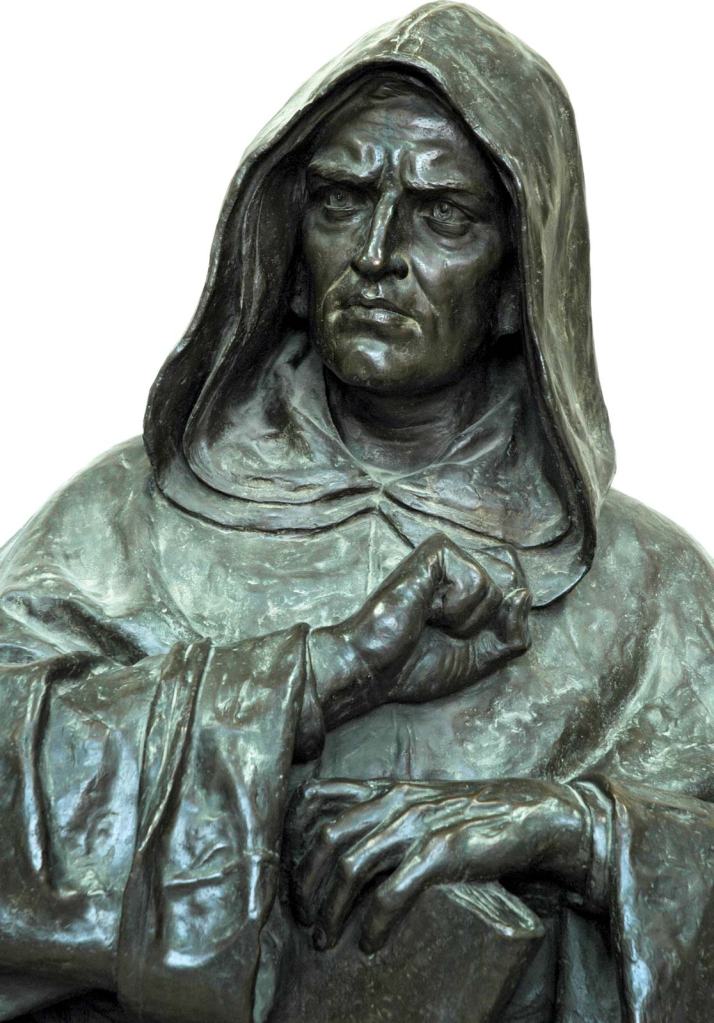
Fast forward to the XXI-st century. Following in the steps of de Magalhaes, Bruno and Curie, we’ve explored almost all corners of the Earth, peered into the womb of the Universe, named the entire table of Mendeleev, and reached the present state of civilization. In doing so, we’ve changed the composition of the atmosphere we breathe, polluted the water we drink, exhausted the soil which grows our food and, the worst, have soured whatever mutual understanding ever existed among ourselves.
After some 75 years of relative peace we’ve become more callous than ever. Judging by what’s being said on TV, shared on social media… and, most importantly, by how we react when our fellow human beings are in danger. Or in need…
We refuse to wear a mask – because it doesn’t offer perfect protection and it has been mandated by the government. We refuse to give up fossil fuel – because ‘it has not yet been scientifically proven beyond any reasonable doubt that all the global warming has been produced by us’. We refuse to pay taxes – because they are ‘theft sanctioned by the government.’
All these in the name of ‘defending our God sanctioned liberty’…
We steal much of the help we send to those in need. We pay those who work for us as little as we can, regardless of the consequences. And we declare, nonchalantly, that ‘greed is good’. We continue to notice the skin color of those we interact with. And to pass judgement on them starting from this ‘piece of information’. We continue to consider that women should ‘behave properly’ and ‘mind their own business’.
We allow ‘spin doctors’ into our minds. We welcome them, even. And let them ‘fine tune’ our biases…
How are we going to survive this huge amount of ‘progress’? That which we’ve brought upon our own heads? When are the ‘spin doctors’ going to realize the Earth is finite? Not flat. Limited!
What are they going to do when the shit they’ve sown into our heads will finally hit the fan? Where are they going to hide?
One-Time
Monthly
Yearly
Make a one-time donation
Make a monthly donation
Make a yearly donation
Choose an amount
$5.00
$15.00
$100.00
$5.00
$15.00
$100.00
$5.00
$15.00
$100.00
Or enter a custom amount
$
As much as I love writing, I do have to eat. And to provide for my family. Earning money takes time. If you’d like me to write more, and on a more regular basis, hit the button. Your contribution will be appreciated! Another very efficient way to help would be to share my posts.
As much as I love writing, I do have to eat. And to provide for my family. Earning money takes time. If you’d like me to write more, and on a more regular basis, hit the button. Your contribution will be appreciated!
As much as I love writing, I do have to eat. And to provide for my family. Earning money takes time. If you’d like me to write more, and on a more regular basis, hit the button. Your contribution will be appreciated!






 nicichiarasa