Someone asked me a few months ago: ‘These guys who spread misleading information on the internet, whether out of sheer stupidity or out of personal interest, will at some point understand how many people they have killed. Directly or indirectly. How will they feel? In that moment…’
Until then, none of my vaccinated acquaintances have kicked the bucket. Nor seen the inside of any hospital… after being infected with Covid. Among those who have not been vaccinated… the situation is somewhat different… Although the unvaccinated are, among the people I’m personally acquainted to, about 4 times less frequent than the others, 8 of them are missing already. All 8 of them are no longer with us after having been diagnosed with Covid.
I hope you’ll have a ‘light’ conscience when we’ll arrive at the end of this mess.
In the sense that for that person, ratings – a.k.a. ‘money’ – are far more important than presenting an as accurate as possible version of reality…
Hence the public belief that ‘media are not to be trusted’.
A reality created by the greed with which we, as a cultured species, attempt to transform everything into money…., power…, or any other kind of ‘influence’/relevance we happen to covet….
A. A proposition is ‘true’ if what’s being said there is in perfect correspondence with reality. B. A proposition is ‘true’ if the proposition encompasses everything the ‘communicator’ knows about the subject at hand.
‘OK, you promised us a discourse about science and here you are babbling about truth…’
Impatient as always! How do you determine whether something being said, a proposition, is in (perfect) correspondence with the reality of the fact described there?
To be able to do that, you need first to determine the reality itself. You know what’s being said – more about that later, and, if you are to determine whether what’s being said is true, you now need to know the truth itself. How are you going to do that? You either know it already or you proceed to determine that particular truth.
I’ll leave aside the ‘already known truth’ and proceed towards the ‘future truth’.
A particular individual has two possible approaches towards finding out a ‘new’ truth. A piece of ‘true’ information which is new for that particular person. Consult a reliable source or investigate the reality.
‘Consulting a reliable source’ brings us back to square one. How do you determine whether a source is reliable or not…. ‘Investigate the reality’… Easier said than done!
How do you do that? How do you investigate the reality in a reliable manner? How do you determine the truth of the matter when ‘things’ are a tad more complicated than touching a stove to determine whether it’s hot or not?
You use the scientific approach? Start from the scientific data base which already exists on the subject(s) closer to your object of interest then proceed using the proven scientific method of trial and error? Emit a hypothesis, try to prove it, formulate a theory and then challenge your peers to tear apart the results of your investigation?
Results you have chased being convinced from the beginning that you’ll never reach the ‘pinnacle’? Convinced from the beginning that the ‘absolute truth’ – even about the merest subject, is out of reach? For us, mere mortals, anyway?
‘But if ‘absolute truth’ is out of reach, then how can we determine whether the simplest proposition is actually true? And why continue to bother about the whole subject, anyway?!?’
Before attempting to find an answer to your question, let me formulate another one.
Let’s consider that you have reached a conclusion about something. That you are in possession of ‘a truth’. How are you going to share it? With your brethren/peers? I must remember you at this stage of our discussion that language is beautiful but rather inexact. Are you sure that you’ll be able to communicate everything you want to say? To cover every minute aspect of the truth you have just found? So that the proposition you are about to put together will be in absolute correspondence with the piece of reality you have just discovered?
You are not going to use language at all? You’re just going to point to your discovery? And let everybody else to discover the truth for themselves? And how many are going to take you seriously? To pay attention? To what you have pointed? And how many are going to suspect that you just want to take their focus off what’s really important? To lead their attention away of what you want to keep under wraps?
I’ve got your head spinning? Then you must understand my confusion. I’m so deep in this that I have to go back and read again what I’ve been writing…
So. ‘Science’ tells us that the ultimate truth is out of our grasp, linguistics/theory of communication tells us no messenger will ever be able to be absolutely precise nor convey the entire intended meaning … what are we going to do? Settle down and wait for the end to happen to us?
OK, let me introduce you to an absolute truth.
WE ARE HERE!
Who is here? ‘Us’. We are here.
What are we doing here? ‘Are’. We are here.
Where are we? ‘Here’. We are here!
I’ve been recently reminded that mathematics, the most exact language we have at our disposal, is based on a number of postulates. On a small number of axioms – pieces of truth we consider to be self evident, which have constituted a wide enough foundation for mathematics to become what it is today. But mathematics is far more than a simple language. It is also a ‘virtual space’. A space where special rules apply. A space where our thoughts move according to certain and specific ‘instructions’. A space where we enter holding our arms around a problem we need to solve and which we exit, if successful, with a solution inside our head.
A little bit of history. Our ancestors had a problem. A class of problems, actually. How to build something – a house, a temple, a boat, and how to ‘manage’ property – arable land, in particular, but also crops and other ‘stocks’. Problems easier to formulate, and solve, using numbers. To solve this class of problems, some of our ancestors have invented ‘mathematics’. Had ‘discovered’ the self evident truths – axioms, and then ‘carved’ an entire (virtual) space using the axioms as the foundation upon which they, and those who have followed in their steps, have built – and continue to build, the scaffolding of rules which keep that space ‘open’.
Through thinking, our ancestors have carved a space in which to solve some problems they have encountered in the ‘real’ world…
‘Please stop! I don’t understand something. Do you want to say that mathematics is not real?’
To answer this question, this very good question, we need to settle what ‘real’ means. To us, at least…
Let’s examine this rock. Is it real? Why? Because you can feel it? If you close your eyes, I can make it so that you experience the same feeling by touching something else to your stretched out fingers than the original rock. In a few years, I’ll be able to produce the same sensation in your brain by inserting some electrodes in your skull and applying the ‘proper’ amount of electric current. What will ‘reality’ become then?
Forget about that rock, for a moment, and consider this table.
Is it real? Even if it’s not as natural as the rock we were analyzing before? ‘Artificial’ – as in man made, starting from natural ‘resources’, might be a good description of the difference between a table and a ‘simple’ rock. Both ‘real’ in the sense that both imply consequences. Your foot will hurt if you stumble in the dark on either of them. Regardless of the rock being natural and the table happening to be artificial…
‘But what about things which are not of a material nature? Are they real?’
Are you asking me whether ‘metaphysical’ objects – God, for instance, are real? Then how about ‘law’. Is it real? As an aside, does law belong also to the metaphysical realm? Alongside God? Who determines which thing belongs there?
Or have you glimpsed the fact that ‘truth’, the concept of truth, is a metaphysical ‘object’? Something which, like God, has a ‘real’ side but makes no sense (to us) unless we think about it? Something which we have extracted – someway, somehow, from the surrounding reality – where else from? – then ‘carved’ a virtual space around it? So that we may examine it without the distractions of the rest of the ‘real’ world?
Or have you glimpsed also that even the concept of ‘reality’ is a figment of our self-reflecting conscience?
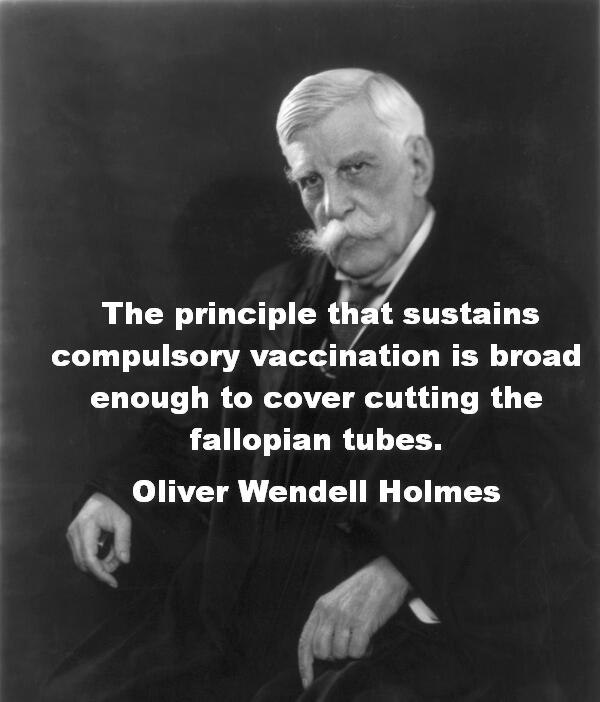
Having no previous intel about this guy, my ‘jerked’ reaction was simple.
‘Leaving aside any principle, a society which cuts ‘fallopian’ tubes will have a lower birth rate while that which vaccinates its children will notice a decrease in healthcare costs. And a lower mortality across the entire age spectrum!’
OK, let’s calm down and google. To find out who was this Oliver Wendell Holmes, after all.
“In that long span of (30) years on the Supreme Court he became acknowledged as one of the most notable jurists of the age—in the opinion of many the foremost. Often he has been called The Great Dissenter because of the brilliance of his dissenting opinions, but the phrase gives a falsely negative emphasis, and his penetration and originality are seen as fully in the opinions in which he expressed or concurred in the majority view of the court as in those in which he was in dissent.”
“Perhaps his best-known phrase is from Schenck v. United States, where he introduced the ‘clear-and-present-danger’ test as a means of limiting the power of the state to restrict speech and illustrated it by reference to a person’s ‘falsely shouting fire in a theater.’ His later development of this test, coupled with his emphasis on a basically unregulated ‘marketplace of ideas,’ was seminal for the development of modern free-speech law. His retirement in 1932 was a national event, and he has remained, along with John Marshall, among the best known of all those who have served on the Supreme Court.”
“Few American jurists are as revered as Oliver Wendell Holmes Jr. A United States Supreme Court justice for close to 30 years, Holmes wrote seminal opinions that were clear and clever and elegantly phrased. It was Holmes who defined the limits of free speech in 1919 by noting that the law did not protect someone “falsely shouting fire in a theater.” And it was Holmes who thoughtfully amended those words a decade later by writing that nothing in the Constitution was more sacred than “the principle of free thought — not free thought for those who agree with us but freedom for the thought that we hate.” By most accounts, Holmes, an upper-crust Bostonian, served the nobler instincts of America’s privileged classes. That is why his reckless majority opinion supporting forced sterilization in a 1927 case remains an enigma. Was it an isolated misstep or something more: an indictment of Justice Holmes and the Progressive movement he appeared to embrace?”
“We have seen more than once that the public welfare may call upon the best citizens for their lives. It would be strange if it could not call upon those who already sap the strength of the State for these lesser sacrifices, often not felt to be such by those concerned, in order to prevent our being swamped with incompetence. It is better for all the world if, instead of waiting to execute degenerate offspring for crime or to let them starve for their imbecility, society can prevent those who are manifestly unfit from continuing their kind. The principle that sustains compulsory vaccination is broad enough to cover cutting the Fallopian tubes. Three generations of imbeciles are enough.“ . . .
Perhaps worst of all, Carrie Buck was not an imbecile. Both she and her mother were deemed “social undesirables” due to a perception of promiscuity which, in Carrie’s case, partially resulted from an illegitimate child who was the product of incestuous rape. This was fairly typical. The linked article describes how “people as young as 10 in North Carolina were sterilized for not getting along with schoolmates, being promiscuous or running afoul of local social workers or doctors.”
In all, more than 60,000 people—including 7,600 in North Carolina—were forcibly sterilized in the United States in the name of “progress.” Progressives of the time lauded the decision in Buck. Individual rights, they firmly believed, should not be allowed to stand in the way of collective progress. Justice Brandeis called Buck an example of properly allowing states the freedom to “meet modern conditions by regulations which a century ago, or even half a century ago, probably would have been rejected as arbitrary and oppressive.””
So. Who was the ‘real’ Oliver Wendell Holmes? That one whose teachings we choose to put forward, of course! Exactly as Justice Holmes had done himself. And why is it our responsibility to choose? Simple. It’s us, and our children, who will bear the consequences. Who will have to live in the environment shaped by those choices.
Cassandra by Evelyn De Morgan (1898, London); Cassandra in front of the burning city of Troy
“Oh God, please make it so that my prophecies won’t come to life!” “I’m sorry Cassandra, that’s what I made Man for. Now, it’s Their job to heed to your warnings!”
The larger your ‘skull’ is, the more ideas – sometimes conflicting ones, you are able to ‘harbor’.
This guy, a 31 years old father of two, is looking forward for a heart transplant.
Meaning that he, and his family, trust the doctors who are going to perform the surgery. Who are going to open up his chest, take his failing heart out, sew the ‘re-cycled’ one in and patch him up again. Doctors who need to hook him up to various machines and to pump him full of chemicals in order to maintain him alive – but unconscious, during the procedure. And who are going to closely monitor him – and, again, administer him a lot of vital drugs, during the rest of his life.
Meanwhile he, and his family, don’t trust the doctors who tell him he needs to get a Covid jab first.
I came across this over the internet. I couldn’t have said it better myself, hence I ‘borrowed’ it. Click on it and read the whole post, it’s very interesting on its own.
Below is the comment I left on the FB wall where it all happened. Don’t see any need to change anything.
“The key words here being “are recognized for”. Real mastery involves knowing your limits. Being recognized as a master by somebody else – the more ‘recognizers’, the worse, tends to annihilate any ‘master’s’ ability to own the very existence of their limits. The intellectual limits are the hardest to notice/accept. ‘Accrued’ age brings about crystal clear evidence about our physical limitations. Accrued knowledge enlarges one’s vision. Puts distance between the observers themselves and the limits of their ability to ‘observe themselves in the act of observing‘.
And if/when the above mentioned accrued knowledge becomes recognized/admired by the (naive) ‘general public’… You don’t have to trust me on this because of my white beard. I have a better argument. I’m an engineer!”
‘OK, and the point of this post is …?’
The fact that there’s no such thing as ‘personal improvement’. Any ‘improvement’ which we might ‘inflict’ upon ourselves derives from our intercourse with the others. Through ‘learning’. All change which happens to us, actually, comes from our ultimately aleatory intercourse with the environment in which we happen to live. From being taught to being ‘influenced’ by the passage of time. All that is ‘personal’ in ‘personal improvement’ is that we do it ‘willfully’.
Much of the change which happens to us goes either unnoticed – up to a point, or is merely accepted by us. ‘Personal improvement’ is chosen by us. And imposed by us upon our own selves.
To do it – ‘improve’ ourselves, that is, we follow ‘suggestions‘. We should keep in the back of our mind that it’s our call to follow – or not, those suggestions.
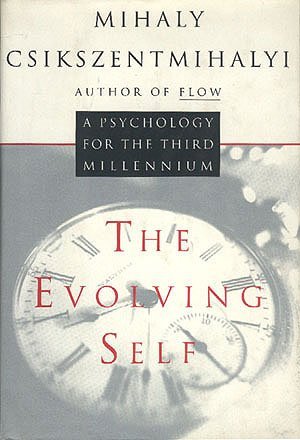
Disclaimer. I have no idea who the ‘suggested’ guy is. Just googled ‘personal improvement books’ and chosen the most visually appealing – for me, obviously, link. Just wanted to illustrate the deluge of suggestions which is constantly directed at us.
The way I see it, it makes more sense to tax those who don’t want to get a jab than to bribe people to accept the vaccine. The vaccinated individual enjoys the benefits, the jab is already paid for by the community… and the community, as a whole, is safer. You don’t want to be jabbed, for whatever reasons, you should pay for the privilege.
After all, this is a matter of personal choice.
There are three kinds of personal choice which impact the wider community. Regardless of who covers the financial costs of healthcare, people being sick is a burden shouldered by the entire society.
Eating too much. It can have a whole series of consequences but most of them are of a ‘personal’ nature. You can be a bad example for your kid but that’s about all you can do to negatively impact the health of others through eating too much. Except for the financial implications, of course.
Smoking. Still a personal choice. But the consequences of your bad habit directly affect those who happen to be around you when you exercise your ‘right’. Smoke travels freely…
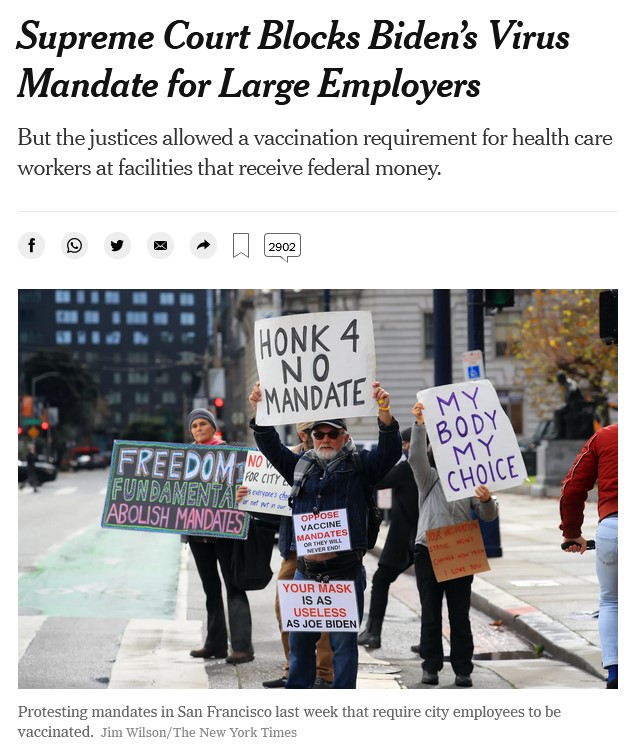
“My body, my choice.” Refusing to ‘put experimental substances into my body’ is, again, a personal choice. But getting sick with Covid has far wider consequences for the wide community than smoking. Let alone the fact that smoke is visible while the virus is not. Smoking in a plane won’t give a lung cancer to each of the passengers present but a person infected with Covid breathing inside such a cramped place can directly infect many. And god only knows how many more after the passengers reach their final destinations …
Since the above mentioned decision of the Supreme Court – that government should not tell ‘the people’ what to do with their bodies (unless federal money is involved) – things are getting murkier. Smoking seats might return on planes. Smoking tables in pubs. And who knows what else…
What I think of you and what you are in reality are two different things. But this is another kettle of fish.
A ‘different’ kettle of fish, you mean.
Have it your way. But you have to take into consideration that the kettle itself remains the same. Only the fish inside are different, one catch at a time. Even when the fish belong to the same species, are of the same size and you take the pain to add the same number of fish to the kettle. Let’s go back to Solomon splitting babies. The ‘official’ story, the one presently belonging to the “Hebrew lore” and “recorded at 1 Kings 3:16-18“, had been redacted. From what had actually happened:
As we all know, Solomon had many wives. An a few concubines. 700 and 300, respectively. In these circumstances, he rarely had a full night’s sleep. No wonder that whenever he had to make a judgment, specially early in the morning, he used to send for his trusted personal advisor. When the two women, both pretending to be the mother of the disputed child, had come to seek justice before king Solomon, he was rather sleepy. But the faithful – and very discreet, ‘coach’ was there. As always. The first woman was asked to tell her side of the story. Solomon, at some point, waived his hand. ‘Enough, you seem convincing enough. Take your baby and scram’. ‘But sir, shouldn’t you also listen what the other woman has to say? Before deciding the fate of the poor baby?’ whispered the adviser in Solomon’s ear? ‘Wait. Come back, both of you! Now, the other one, what’s your story?’ ‘….’ ‘You’re also very convincing… you have the child…’ ‘But sir, they cannot both be right! At the same time… There’s only one child…’ Solomon, suddenly awaken, turns back to face the counselor: ‘You are absolutely right too!’ And only then, after realizing that sometimes – when there’s only one child to be had, for example – two people cannot entertain two different opinions and be right at the same time, Solomon did put his mind to work. In earnest. And came up with his famous solution. “Split the child!”
Same thing here. Both J.P. Morgan and Friedrich Nietzsche had been partially right. There is a difference between ‘real’ – a.k.a. ‘golden’, and fiat money but the difference is made by us!
See, no need to split the child. Not this time, anyway. But we have to keep in mind that, no matter what any of us thinks, for money to retain their value – no matter whether those money are ‘real’ or ‘fiat’, we need to be able to make good use of those money.
A heap of gold and a suitcase of dollars are equally useless if there’s nothing to be bought!












 nicichiarasa