And the Lord God said, Behold, the man is become as one of us, to know good and evil: and now, lest he put forth his hand, and take also of the tree of life, and eat, and live for ever: Therefore the Lord God sent him forth from the garden of Eden, to till the ground from whence he was taken.
“They’re extremely simple and accessible objects, which is not always the case with math research,” Schwartz said. “It’s the kind of thing that you could explain … to an eight-year-old.”
This doesn’t make much sense, does it? Driving ‘man’ “forth from the garden of Eden”, that is… The Mobius band, as stated above, is a simple thing!
After all, knowing good and evil is a natural thing. For humans… ‘Man’ doesn’t need to ‘raise a hand and eat some fruit’… Living among like-minded peers is enough. As long as they talk to each other, of course. As for ‘living for ever’… that’s impossible. Not only for ‘men’ but also for gods. So many of them are nothing more than memories… like ‘ordinary’ deceased people, right?
So. Somebody mentioned it in one of the most interesting books known to ‘man’. Not only interesting but also extremely consequential. Then it must mean something. Despite not making much sense, on the face of it…
What if we look at the whole thing as a metaphor? As the story of how ‘man’ has become a conscious human being? Instead of a mere historical rendition…
‘But I was under the impression that all cosmogonies were exactly that. Stories meant to impart sense to the Universe. To make it acceptable to the conscious ‘man’…’
Indeed. That’s exactly what cosmogonies do. Did… Only calling them cosmogonies shreds the magic. To use another metaphor, using the wrong name transforms a swan into a lame duck.
OK, the Bible is a cosmogony. One of many. But there are many ways to read it. From the inside, as a ‘bible’. And from the outside. As a cosmogony…
Which brings us to the point. Science – cold, rational observation performed by conscious agents – can be made only from the ‘outside’. Any personal involvement of the observing agent, any feelings towards the observed subject, will only add layers of bias on top of the ‘desired’ knowledge.
Ouch?!?
How can a ‘rational conscious agent’ observe the world they live in as if they were on the outside?!? Not only ‘banished outside’ but also made ‘to till the ground from whence he was taken’? …
No hard feelings allowed! No feelings at all, actually…
We live in the world of our own making. Literally!
This is a picture. A man-made picture. God is depicted, by Michelangelo, as being very intent while ‘man’ seems to be casual about the whole thing. Disinterested. Somewhat absent. Let me remind you, in this context, that Michelangelo’s painting was named “The Creation of Adam”.
The world we live in, very much like Michelangelo’s painting, has been made by us.
Unlike his predecessors – those who had painted the walls of Lascaux – Michelangelo had adorned a man made structure. A ceiling. Unlike his predecessors – who had, most likely, painted on their own volition – Michelangelo was hired, ‘commissioned’ is the PC word to be used in these circumstances, by the pope, to interpret the Genesis Creation Narrative. Very much like his ancestors, Michelangelo was also made of flesh and bones. Had to breathe, eat, drink and painted using substances ‘borrowed’ from the ‘nature’.
The point I’m trying to make here is both simple. And very hard to swallow.
We live inside ‘something’. We use ‘reality’, the word, to describe a portion of that ‘something’. The portion we ‘control’. We think we know about and are able to interact with. Very few of us accept the fact that what we call ‘reality’ is ‘tainted’ by us. That we have a growing contribution in the process of ‘reality’ becoming what it is. And what it’s going to be. To become…
The ‘something’ we inhabit is far wider that what we call ‘reality’. It’s full of everything we do not know about. And choke full of everything we have invented and does not fit in what we call ‘reality’. Choke full of gods, spirits, ghosts, ideologies, theories, explanations, narratives and so on and so forth. ‘Metaphysics’, if you know what I mean.
‘Another atheist. I should have known better…’
“It’s full of everything we do not know about”…. I never said there is no God. It might very well be. Or not… All I have to say about this is that what we consider to be ‘our god’ exists nowhere but in our imagination. Beyond the ‘physical’ world.
‘According to what your saying, we’re involved not only in ‘reality’. We’ve also ‘constructed’ a sizeable portion of the ‘netherworld’…’
As a matter of fact, yes. We’ve not only ‘created’ what we call ‘reality’, we’ve also created the ‘netherworld’ itself. Both inside the ‘something’ which encompasses everything.
‘ “Created…” how did we ‘create’ anything?!? Least of all ‘reality’…’
Language is a very powerful tool. And naming is a very powerful feature of that tool! By naming something, anything, we separate that something. From the rest. We actually establish a barrier, in our collective mind, between that something and the rest of whatever there might exist. And I leave aside the fact that our language coordinated efforts have drastically altered our portion of ‘something’, our ‘reality’, since the days when Michelangelo’s ancestors, ours, used to paint the walls of the Lascaux cave.
‘Reality’ itself is a very interesting word/concept. Until not so long ago, Gods were real. And still are, for some of us. But even in those times, people felt the need to make the difference between the real, hands on, reality and the rest of the things they believed into existence. ‘Metaphysics‘, the word itself, was coined by Aristotle’s editor. A certain Andronicus of Rhodes, sometimes in the first century BC. As a consequence, everything was real, in those times, but some portion of what was real existed only in people’s minds. “ta metá ta phusiká“… 1500 years later, when science was budding – again, in our Medieval forefathers minds, the ‘tables had been turned’. The scientific state of mind demands that only the factual/physical things can be deemed as belonging to ‘reality’ while all the rest, including the metaphysical realm, belongs someplace else…
Nowadays… things have become rather complicated. Science tells us we don’t know everything. Worse still, that we’ll never know everything. On the other hand, everyday life proves, beyond any doubt, that things which exist only in our heads/minds do shape, dramatically, our daily lives. I’ll give you but two examples.
The church and the traffic light.
People go to the church because they believe. Most of them. Very few people visit churches, ordinary churches, out of touristic curiosity. People ‘obey’ the traffic light because they actually believe life has been made simpler, and safer, since the traffic lights have been invented/installed. Like churches, we don’t ‘obey’ them because they are there! We install them because we’ve understood our lives have improved since their inception.
Total BS. ISS distance from Earth is 408 km. So, the Moon should be… I don’t know. You do the math. In this picture, it looks like ISS is orbiting the Moon, not the Earth.” Somebody on the Internet
“I don’t know. You do the math!” But you do have the right to express your opinion, right? Me
Oui maître, mais… ‘I will defend to the death your right to make a fool of yourself. To demonstrate your ignorance…’ OK, I get it. Only your attitude stems from your conviction that everybody who is able to read is also able to understand the meaning of what they read… Which is no longer valid!
What do we need to do? Educate? The readers… Censor? The aberrant? And who will ‘put the stamp’?!? Who will be the trusted arbiter playing God? Wait till the consequences of our laisez-faire will rattle their skulls against our crossed bones?
Or simply wake up? Remember that mutual respect is paramount for our collective survival. And that asking before sentencing is the smart thing to do….
So. We’ve figured out that dreams are something which happen inside our heads. When sleeping. Then called them names. ‘Dreams’ if they were OK, ‘nightmares’ if not. Interesting, isn’t it? Then we have hallucinations. A sort of daydreaming – if you think of it – only less pleasant.
My point being that our consciousness – “our ability to observe ourselves observing” – opens up a new realm inside what we call ‘reality’. That we live, in fact, inside a world of our own making.
‘But this is valid for all living things, right?’
In the sense that all living things collaborate – albeit involuntarily – towards the continuous reshaping of what we call ‘biosphere’… yes! Life does indeed reshape the portion of space/time where it happens.
The way I see it, life is responsible for the ‘second layer’ of what we call reality. While we, the conscious observing cum living inhabitants, are responsible for the ‘third layer’ of what we call reality.
‘You keep saying “what we call reality”. Would you care to elaborate?’
You see, we have developed two concepts. ‘God’ and ‘Reality’. God is something which had suposedly made us. According to those who believe in God, we have been brought to life – along with the world we inhabit, in a voluntary manner, by the agent we call God. On the other hand, reality – according to those who believe in ‘science’ – is the ‘place’ where we have happened to ‘evolve’.
God is something we are told about by others. Something the ‘worthy among us’ might experience first hand through ‘rapture’. Those who believe in God consider that the original information about God had been delivered, through divine inspiration, to ‘prophets’. Or had been acquired one way or another by ‘elders’. Those who believe in God consider that God – and his will – are inaccessible to humans. That we, ordinary human beings, are only meant to simply experience ‘God’s will’. And adapt our behaviour accordingly.
Reality is something we, the present ones, are told about by our predecessors. And something we experience through observation. Those who believe in science consider that nobody – individually and collectively – will ever be able to know everything. Basically, those who believe in science are also convinced that reality is ultimately inaccessible to us. Those who believe in science consider that it’s our job, as conscious human beings, to find out as much as we can about ‘reality’ and adapt our behaviour accordingly.
For somebody unwilling to take sides, there’s not much practical difference between the two sides mentioned above. Both are states of mind. Convictions. Weltanschauungs which shape human action. Furthermore, both mandate us to do the very same thing. Adapt our behavior to what we ‘see’! Does it really matter whether what we ‘see’ was handed out to us by somebody or is the consequence of happenstance? Would our reaction be different? Why?
‘But God has handed out a series of commandments! For us to follow in order to be saved. Science doesn’t provide any ‘spiritual guidance”!
I beg to differ. The Bible – and all other sacred texts – have been written by people. Taught by people to other people. Science – everything we know about things, including what we call ‘best practices’ – has been put together by people. And taught by people to other people. Furthermore, technology – the manner in which we have put in practice what we know about the world, regardless of how we have acquired the information – has been put together by us. We’ve designed each and every tool we have used to transform our world into what it is today. And it was still us who have use those tools according to our own goals.
So it is us, collectively, who are responsible for the world we live in. For the dream we live. And for the nightmares experienced by some of us.
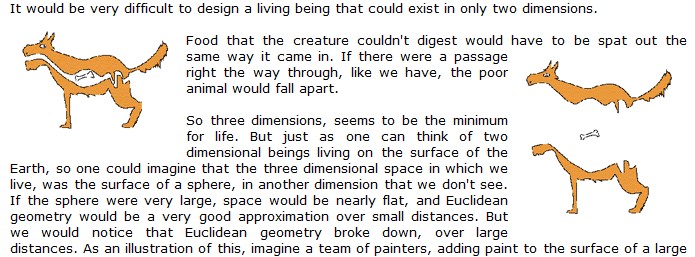
Life needs ‘thickness’. As suggested in the drawing above, if animals had only two dimensions they would have had to make do without any digestive systems.
Hence we live in a 3 dimensional environment. But we, the only fully conscious beings on Earth, live ‘on a surface’. We’ve learned to fly rather late in our evolution. Most of us behave as if able to fully process only two and a half dimensions. We make good use of height and length, the things we ‘face’, but depth is rather tricky for most of us. OK, we’ve climbed up and down trees and mountains since only ‘god’ knows when but we’re basically runners. And runners run on a surface. Runners run along a mostly linear trajectory which happens mostly on a surface. This whole thing takes place in a three dimensional environment, true, but our ‘running’ nature has left some influences on the way we think.
The most obvious one being the discursive nature of our reasoning. We start from ‘premises’, go along a logical path and end up with conclusions. We very much like the things which fit into a narrative. And we hate going back to reconsider our ways.
Since Einstein has noticed that things were ‘relative’ – to the manner in which we measured them – we have started to add dimensions. To the previously 3 dimensional environment into which we used to live. The first dimension which had been added was time. Nowadays, many scientists believe that ‘the universe operates with 10 dimensions but 6 of them are very tiny‘.
I’m not going to contradict them. For the very simple reason that I don’t know – and don’t care – about the other 6. Dimensions. I’m sure that they are out there, somewhere, and that those who have discovered those dimensions knew what they were doing.
What I’m going to do is to propose a new manner of counting. ‘Dimensions’. Redefine them, first, and only then (re)count.
What do you think about mass? Is is a dimension? How about energy? ‘White’ (aka ‘visible’), ‘dark‘ … whatever…
Since the ‘jury is still out’…
I’m going to pause the narrative here to make a point.
‘The jury is still out’ means two things. The obvious and the one which stops us from sleeping at night. The fact that the jury – us – hasn’t (yet) been able to fulfill the task.
Back to our main thread.
How about we return to our good old 3 dimensional Universe?
Where space is what separates ‘things’, time is what separates ‘events’ and opportunity is what sets the stage for ‘things’ to evolve into ‘events’?
Easier said than done? In the sense that it’s very easy to put it into words but there’s no mathematics available to describe in ‘absolute’ terms what I’ve just narrated? They key word hasn’t been mentioned in the phrase above. There’s no mathematics available yet… The mathematics used by Einstein to demonstrate his theories wasn’t available to Newton… Mathematics – a form of artificial language – is invented by those capable to do that as soon as the opportunity arises. As soon as there’s a need for new ways to express new perceptions of reality.
And no, don’t expect me to come up with new mathematical expressions of anything. I’m no artist. I have enough trouble expressing my using with mere words.
Since this post is about dimensions, not about my limitations, I’ll end up remembering the three (meta?) dimensions. In a more ‘natural’ order.
Opportunity.
Anything which makes things possible. Mass – visible and/or dark, energy – visible and/or dark – and anything else which ‘works’ in this sense. I’m going to make a second – and a lot shorter – ‘transgression’ here and remind you how ‘relative’ things are. How right Einstein was. We speak about visible matter being “normal” and about “dark” (invisible to us) energy/matter having to exist in order for us to be able to make sense of the Universe as we are able to perceive.
Space
Whatever it is that separates, and also harbours, ‘islands of concentrated opportunity’. Mainly ‘mass’ but who knows (yet) what else might be ‘separated/harboured’ by space. Energy – as we know it, is somewhat distributed ‘along’ space rather than ‘separated’ by space.
Time
Whatever it is that separates, and also sequences, events. Happenings. ‘Notable’ ‘intersections’ between matter and energy. Here, again, we have a difference between matter and energy. While matter seems to ‘survive’ better ‘in time’, energy seems to be more ‘vulnerable’ to the passage of time. Entropy….
Time, like everything else human, has two sides. Like a coin.
A ‘base’ and an interpretation.
There’s no interpretation without a base – even hallucinations are based on ‘something’ – and there’s nothing which has penetrated human conscience and ever managed to evade interpretation. In fact, human conscience needs to interpret, to assign meaning to, everything it ‘sees’. Everything it perceives. Anything which is uninterpretable, which has no meaning, cannot be controlled.It is, hence, dangerous. If you don’t know what’s going to happen next, you can assume anything. And since assuming the worst – and preparing for it – is far more useful towards survival than sleeping over it, we are biased towards erring on the side of caution. And towards relentlessly searching for meaning.
Time, like everything else human, is both a phenomenon – it happens – and a concept. The difference between the ‘time’ of a star and the human time being that ours has a name – given by us – and that the star cannot do anything about it. While we do!
We can do things to and about time!
We named it, we measure it, we attempt to interpret it…. and we try to do the best of it! We try to do, while alive, what we consider to be ‘the best’.
The best (?!?) for whom?
Tao.
The ‘road’. If everything flows, it has to flow ‘somewhere’. Not only from the start/spring to the ‘end’ (?!?)/never tranquil sea. Everything flowing needs a ‘riverbed’ to flow ‘through’. A plant needs soil to sprout, grow, bear fruit and ‘return to nature’. Even a star needs an Universe in order to shine… besides enough ‘fuel’, of course! I have started this post by saying that there’s no interpretation without a ‘base’ and that we, conscious human beings, need to attach meaning (a.k.a. interpretations) to everything of which we become aware. Same thing here. For anything to happen, a venue is needed. Some wise people in our past have used ‘Tao’ as a name for THE venue. For the venue where everything takes place.
Karma.
At first, when conscience had dawned on us, we were alone in the ‘dark’. And afraid about what was going to happen to us. To assuage that fear, we have identified God. As the ‘the meaning’ of the world. At first, when both the world and time seemed to be endless – to us, consequences came from God. We had to behave. Or else… God was there to punish each and every transgression. Sometimes using one of us as his proxy. After a while, some of our ancestors have learned to write. To reliably transfer information over generations. Very soon, those ancestors of ours have learned the link between cause and effect. Between behavior and consequence. Very soon God had become an outside observer. Or was out-rightly forgotten. But Karma survived.
Future.
I keep hearing that ‘evolution has no purpose’. Like many other human utterances, this one conveys far more information about the utterer than about the phenomenon described by the utterer.
‘This wooden table has 4 legs’. We learn about the table that it is in front of us, that it is made of wood and ‘has’ 4 legs. We learn about the utterer that: It was conscious when uttering those words. Only conscious agents are capable of ‘speaking like a human’. It has, at some point, learned to speak. English, and possibly other languages. It has, at some point, learned to count. At least up to four. And it had conserved that ability up the moment when it uttered those words. It was capable of identifying ‘wood’ as a material. When uttering that phrase, it was in a ‘casual’ state of mind. A ‘scientifically minded person’, a ‘grammar nazy’, for example – when in that mood, would not attribute human ‘abilities’ to a table. Which table is a mere object and objects cannot posses other objects. Tables cannot ‘have’, hence that person was speaking colloquially. Or, given the current ‘technological’ developments, those words might have very well been uttered by a statistically ‘minded’ AI application…. A man made ‘parrot’!
See what I mean?
Let’s go back to the presumably purposeless evolution.
Evolution is a phenomenon. Like a thunder. It takes a lot more time to unfold than a thunder, it’s about as hard as a thunder to predict the exact point where it will ‘strike’ but we know enough about both to be able to point out, quite reliably, a few ‘rules’ about how both phenomena take place. About where, when and how they will unfold. What’s the purpose of thunder? To ‘close the circuit’? To discharge the energy pent up in the cloud? I’m afraid that attributing purpose to thunder is akin to allowing tables to ‘have’ legs. What we have here is a ‘figure of speech’. An ‘implicit’ figure of speech… so implicit that it’s not even considered as such… Same thing when it comes to evolution.
Which evolution is paramount to survival. Just as no cloud can accumulate ad infinitum electric energy – hence thunder – no living thing ever – no species, more exactly – has yet been able to survive ‘everything’. Everything mother nature has thrown at it. Hence ‘evolution’! Which is a mere process which makes life possible. In certain conditions – in a certain Tao – after it had sprung up. And, again, attributing purpose to evolution is akin to allowing a table to own legs.
Then what about ‘future’? If God no longer decides for us – the God we have identified – and if evolution is ‘pointless’… then ‘future is blind’?!?
Not so fast!
Question: Where was God at Auschwitz? Answer: Where was man at Auschwitz?
Could any of those present at Auschwitz have done anything to fundamentally change the outcome? Probably not. Could we, as a species, have done – have behaved, actually – in such a manner as to avoid Auschwitz altogether? Specially after the Armenian Genocide had already taken place? Should we, as a species, have done differently when so many Tutsi had been killed in Rwanda? When 8000 Muslim Bosniak men and boys had been murdered in Srebrenica?
See what I mean? About the future? About our future?
What do we have here? “Eternity and endless return?” Or past mistakes haunting us through time? Until we figure out the way forward? Or else…
Well, last time I checked, there were more than a dozen onions in my cellar. And since my cellar is orbiting the Sun… along with the rest of the Earth…
As for who says what about who made what…
This morning I had to shovel some snow. I live near a kindergarten so the sidewalks should be clean. Along with the snow, I also had to shovel some dog turds.
Snow coming down from the sky and dogs dropping turds are natural occurrences. People shoveling snow so that other people may walk on the sidewalks is de rigueur. Also de rigueur is to pick up the turds dropped by the pet you take out at least twice a day.
People have a clear idea about who is responsible for the dog turds on the side-walk. Even if they were dropped by dogs, the responsibility lies with the owners. It’s the owners who have raised the dogs, who take them out to poo and who ‘forget’ to pick up the droppings.
In the last couple of centuries, people – well, some of them – have also developed a rather clear understanding regarding the snow. Regarding the water coming down from the sky. About evaporation, clouds, condensation… etc. God is no longer held responsible for these matters.
Which brings us to the real subject.
There is a guy, Richard Dawkins, who tries to demonstrate there is no God.
And here we go again… I have at least a large china teapot. And since my house, along with the rest of the planet, does follow an orbit in the solar system…
More about who made what, if you care about the subject, can be found here:
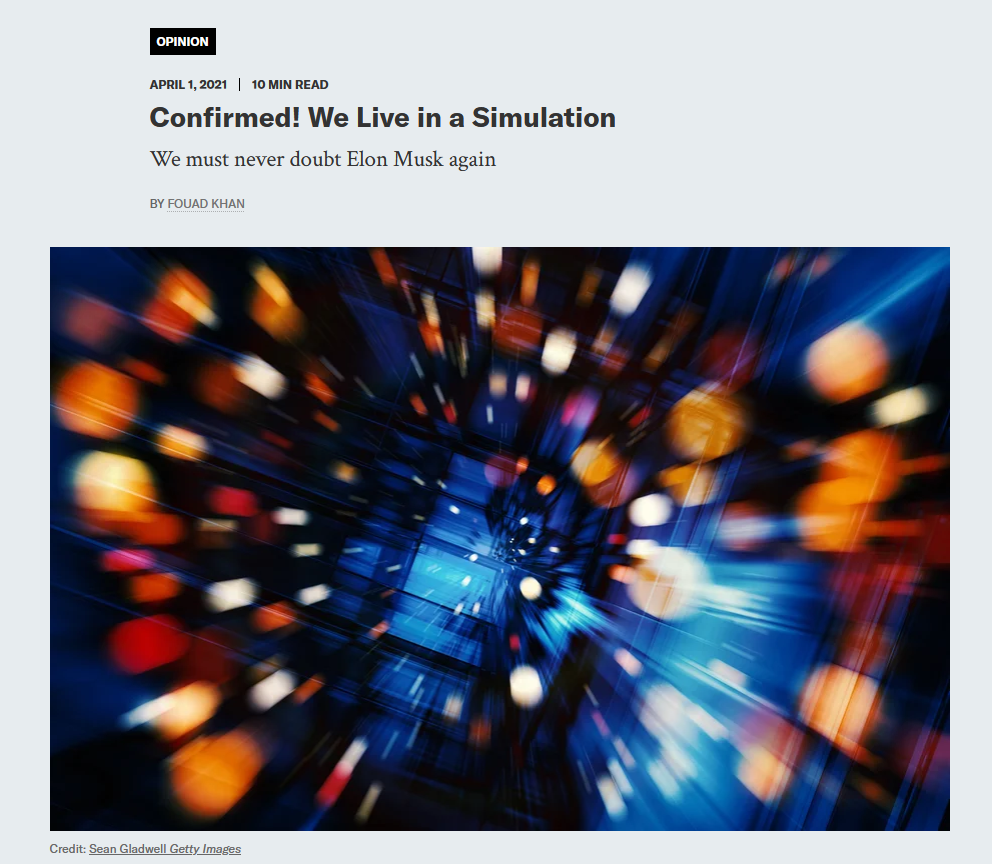
I have to start by confessing that until yesterday evening I’ve never seriously considered this possibility. Why would anyone bother?
Then somebody – thank you, Jeffrey Mercer – introduced a whole new twist into this conundrum. ‘What if this whole (computer) simulation thing is nothing but yet another attempt to make sense of the Universe? To attribute sense to the Universe? Which whole thing, if anything, is the epitome of anthropomorphism…’ I took the liberty to rephrase Jeffrey Mercer’s words. To make them more ‘suitable’. To fit better my preexisting answer. Yet another ‘anthropomorphic’ thing….
My immediate answer was ‘our world is indeed a simulation. Or maybe not as much a simulation as an artifact.’
Before delving into the matter, I’m going to formulate two questions. Hence ‘the furcula’. If we live in a simulation, what kind of world does the simulator live in? Why would anyone bother? To study us responding to its simulating our senses/minds? Why doesn’t it study itself? Its own self/persona?
Coming back to my initial answer, I have to point out that the key word here is ‘our’. We’re speaking here about ‘our world’. The world we live in. Our reality!
We, the ones trying to make sense of this world/reality, have a few characteristics. We’re made of matter and we have, each of us, a conscience. Having a material nature introduces certain limitations and being conscious widens those limitations. Us being conscious widens those limitations, by introducing a ‘new dimension’, but this doesn’t mean those limitations disappear. A bucket is ‘wider’ than the circle at its base – the bucket has height, hence volume, while the circle is ‘flat’ – but the bucket itself continues to have limits.
Let’s examine the consequences of us being conscious agents of a material nature. Limited conscious agents of a material nature…
Us being conscious means us being aware of our material nature. Of our limits. Having a material nature means the most powerful instinct we have is our ‘need to survive’. Both as a biological organism – a.k.a. animal – and as a conscious agent.
Our consciences – I’m speaking about the individual ones here – are very crafty ‘devils’. They can accept our individual material fate – death – but have a problem accepting their own dependency on the ‘bodies/brains’ they need to inhabit. Hence ‘the soul’.
Which ‘soul’ has been invented – by our conscious selves – as the first step towards building a sense for this world. For the reality we inhabit. Which soul is the building block for all religion. For all religion known/built to/by man.
Are you still here? I have to make a pause here. And to mention the fact that I’ve already cut a few corners… A lot of corners… What I say is probably rather hard to follow. Mostly because I don’t have time/space to explain myself. Not now but certainly in due time.
And yes, what we call ‘religion’ is of our own doing. The Bible itself has been written by us, regardless of the origin of the ideas mentioned there. It doesn’t matter whether we have been the interface between (a) God and ‘the world’, we are the ones who have written the Bible. And all other sacred texts. We have written them, we have believed in them and we have shaped the reality we live in.
We have done all that according to how we have interpreted the teachings we have inherited from our forefathers. And we continue to. Even those of us who consider themselves to be ‘free of religion’. We might not believe but we continue to act as if. Believers and nonbelievers alike hold the same things as being valid. Don’t kill, don’t steal, respect the values which keep society together…
What about where we started from? What about the ‘original’ simulation?
One moment please, I haven’t yet finished with ‘God’. If (a) God made us who/what we are, then who made God?
If someone took the trouble to build the simulation we consider to be ‘home’, what about the ‘real’ world? What about the reality harboring the simulating agent?
There’s no need for an outside agent? The world we live in, our world, is the world we have built for ourselves? Using the things which were at our disposal and the information we have gleaned about how things work? Maybe not always fully aware of what we were doing?
You got it! That’s exactly what I was trying to say!
According to Schoppenhauer’s take on the matter, we make sense of the world by carefully (?) ruminating the “pictures in our head”. The information which has already reached our ‘inner forum’. Which means that we should be very careful when letting something ‘in’! When reading a text, for example…
‘You should follow science, not scientists. Because scientists can be sold.’
Logically speaking, the phrase makes a lot of sense. Right?
Practically… not so much.
Do we learn everything about medicine before taking the pill prescribed by the doctor? Simply because the doctor might have been sold to the big pharma? Do we learn everything about microwaves before using a microwave oven? Simply because the physicist who had invented the thing might have been sold to the makers of household appliances? Do we stop using planes because they are used to spray our skies?
Literary speaking, what do you make of “scientists can be sold to the highest bidder”?!? Sold by whom? How can anybody sell a scientist? I might understand the notion of a scientist being bought… of a scientist selling his soul, his scientific soul, to the highest bidder… but selling one… Is there a market for scientists?
only because it happens to resonate with something you are already inclined to believe.





 nicichiarasa