And it thus becomes obvious that Nietzsche has been falsely accused. It wasn’t he who had murdered God! He was simply the first who had the guts to write His death certificate…
My point being that what we call ‘God’ is a man made image. A concept. It doesn’t matter, for this analysis, whether there is an actual god or not. What we call God is nothing more than our image of one.
And it had been enough. For a while. For as long as we have followed the rules we ourselves had established to guide our own behavior – as in written them down – the God we’d imagined worked as intended. ‘Religion’ did what it was supposed to do. People had a ‘spiritual environment’ in which they behaved both coherently and cohesively. Coherently and cohesively enough to evolve from slaves – owned and/or owners – to equal rights owning/yielding citizens. Coherently and cohesively enough to evolve from horse driven war chariots to the M1A3 Abrams tank. Coherently and cohesively enough to ‘be fruitful and multiply’ to the tune of 8 billion. Give or take. Not all of them following ‘the rules’ but all of them benefiting from the results of those rules having been followed for a while.
Yet, when things were unfolding so smoothly, why have we given up following those rules?
Have we outgrown the need for a shepherdly Father? For a Ghost to frighten us unto doing the right thing? Or have we become so infatuated with our own ability to think, to reason, that we have turned it into an idol? Against all odds… Despite having been warned about it!
Pascal’s wager is about turning the tables on ‘God’. The image we made for ourselves about God, the ‘Holy Gost who frightened us unto staying on the straight and narrow’, convinced us to behave in a constructive manner. Benefiting the entire community. The argument made by Pascal was made to convince us, individually, that we – each of us – should believe in God for their own sake. For their own benefit! Effectively transforming each individual belief into an idol… ‘Graven’ by each individual, upon their own soul, in the likeness of things in heaven, for their individual use… Transforming the community creating God into an individual tool designed and believed to ‘give’ each of us ‘everything’. Individually. As opposed to making it possible for everybody to exist.
As Nietzsche observed, by making Pascal’s wager – by transforming faith into a rational thing – we have collectively killed God. The same God which has made us possible. Against everything we have been warned about, by our wise ancestors, we have replaced God with ourselves. So that we “gain all”. Individually. Each of those who had made the rational decision…
It is a truism that almost any sect, cult, or religion will legislate its creed into law if it acquires the political power to do so, and will follow it by suppressing opposition, subverting all education to seize early the minds of the young, and by killing, locking up, or driving underground all heretics. Robert A. Heinlein, Postscript to Revolt in 2100.
Religion is the metaphusical ‘thing’ inside which people who hold a set of tenets to be true are able to build a community.
Religion is sociological phenomenon. Something belonging to the realm studied by those who try to understand how large number of people work together.
Religions – on the other hand – are ‘sets of tenets’ put in practice by various groups of people. Sets of tenets which survive for as long as they continue to help the people who uphold them in their quest to survive as a group. As a community.
Religion cannot be ‘changed’. Religion can be studied. May be better understood. Like physics. You can’t ‘change’ physics! With what? With chemistry? Things don’t work like this. The only thing you may do about physics is to ‘deepen’ your knowledge about it.
Religions can, and sometimes have to, be changed. By the very people who ‘use’ them to survive.
Since nobody can survive on their own, each and everyone of us needs to belong. To a community. To a religion, actually!
And what do people do when they realize survival is impossible in certain conditions? Die or do something about it, right?
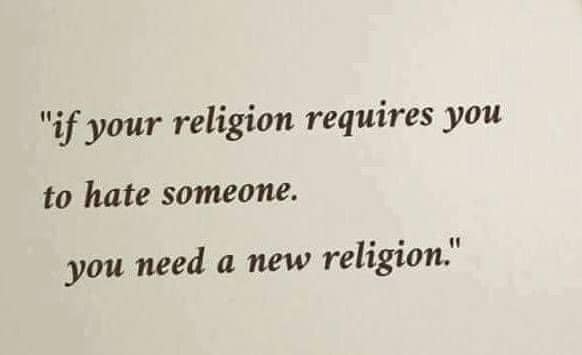
Now, which community can survive based on hate? It doesn’t matter whether you are asked to hate somebody inside or outside your community. Whether you hate individually or collectively. Hating – or despising – somebody blinds you and exhausts you. Puts a huge burden on your back. Focuses your attention so tight that you are no longer able to notice the real dangers. Those which actually make you less likely to survive.
And this is valid both for you as an individual and for you as a hating community.
What happened to our capacity to compromise? When did life become nothing but a zero sum game?
Our capacity to compromise – in the good sense of the word – has diminished when religion – the thing which keeps us together – has been split into religions.
And it completely drained out when we’ve become too confident in our ability to think things over.
We’re so confident now that our solution/decision is not only better than any other but the only one possible that we’re no longer capable of considering a compromise.
While religion taught us to respect and trust each-other, religions have split us into factions. Our intellectual arrogance has done the rest.
Well, last time I checked, there were more than a dozen onions in my cellar. And since my cellar is orbiting the Sun… along with the rest of the Earth…
As for who says what about who made what…
This morning I had to shovel some snow. I live near a kindergarten so the sidewalks should be clean. Along with the snow, I also had to shovel some dog turds.
Snow coming down from the sky and dogs dropping turds are natural occurrences. People shoveling snow so that other people may walk on the sidewalks is de rigueur. Also de rigueur is to pick up the turds dropped by the pet you take out at least twice a day.
People have a clear idea about who is responsible for the dog turds on the side-walk. Even if they were dropped by dogs, the responsibility lies with the owners. It’s the owners who have raised the dogs, who take them out to poo and who ‘forget’ to pick up the droppings.
In the last couple of centuries, people – well, some of them – have also developed a rather clear understanding regarding the snow. Regarding the water coming down from the sky. About evaporation, clouds, condensation… etc. God is no longer held responsible for these matters.
Which brings us to the real subject.
There is a guy, Richard Dawkins, who tries to demonstrate there is no God.
And here we go again… I have at least a large china teapot. And since my house, along with the rest of the planet, does follow an orbit in the solar system…
More about who made what, if you care about the subject, can be found here:
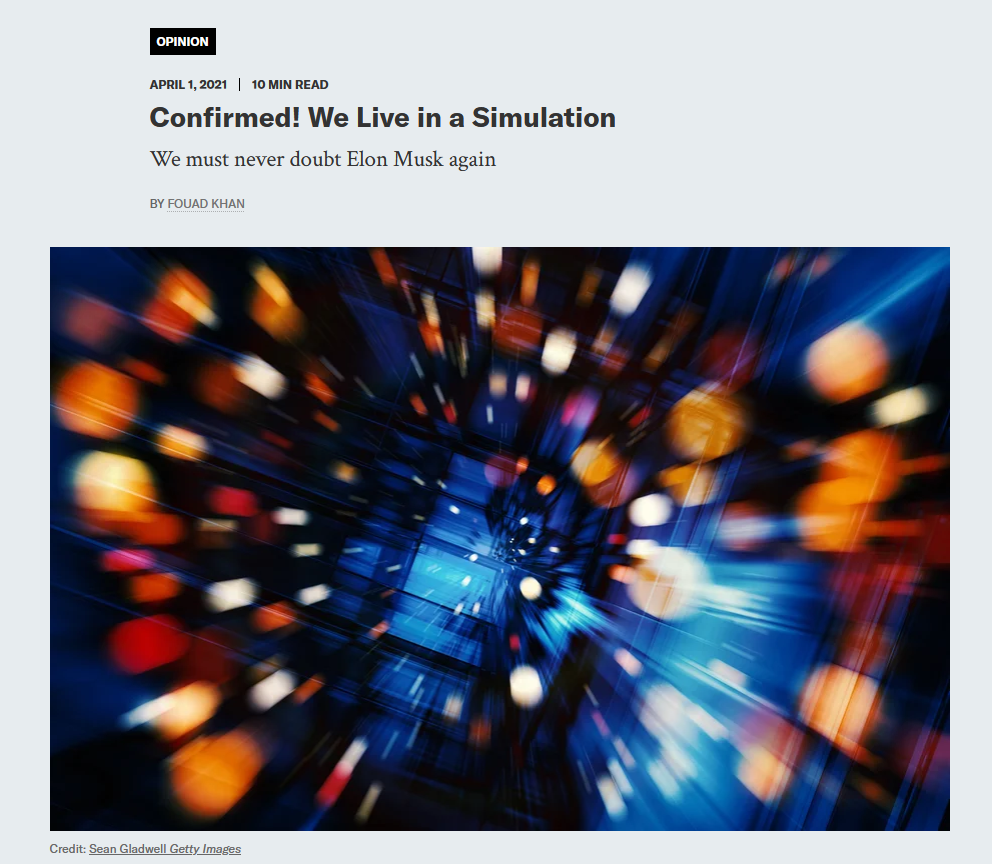
I have to start by confessing that until yesterday evening I’ve never seriously considered this possibility. Why would anyone bother?
Then somebody – thank you, Jeffrey Mercer – introduced a whole new twist into this conundrum. ‘What if this whole (computer) simulation thing is nothing but yet another attempt to make sense of the Universe? To attribute sense to the Universe? Which whole thing, if anything, is the epitome of anthropomorphism…’ I took the liberty to rephrase Jeffrey Mercer’s words. To make them more ‘suitable’. To fit better my preexisting answer. Yet another ‘anthropomorphic’ thing….
My immediate answer was ‘our world is indeed a simulation. Or maybe not as much a simulation as an artifact.’
Before delving into the matter, I’m going to formulate two questions. Hence ‘the furcula’. If we live in a simulation, what kind of world does the simulator live in? Why would anyone bother? To study us responding to its simulating our senses/minds? Why doesn’t it study itself? Its own self/persona?
Coming back to my initial answer, I have to point out that the key word here is ‘our’. We’re speaking here about ‘our world’. The world we live in. Our reality!
We, the ones trying to make sense of this world/reality, have a few characteristics. We’re made of matter and we have, each of us, a conscience. Having a material nature introduces certain limitations and being conscious widens those limitations. Us being conscious widens those limitations, by introducing a ‘new dimension’, but this doesn’t mean those limitations disappear. A bucket is ‘wider’ than the circle at its base – the bucket has height, hence volume, while the circle is ‘flat’ – but the bucket itself continues to have limits.
Let’s examine the consequences of us being conscious agents of a material nature. Limited conscious agents of a material nature…
Us being conscious means us being aware of our material nature. Of our limits. Having a material nature means the most powerful instinct we have is our ‘need to survive’. Both as a biological organism – a.k.a. animal – and as a conscious agent.
Our consciences – I’m speaking about the individual ones here – are very crafty ‘devils’. They can accept our individual material fate – death – but have a problem accepting their own dependency on the ‘bodies/brains’ they need to inhabit. Hence ‘the soul’.
Which ‘soul’ has been invented – by our conscious selves – as the first step towards building a sense for this world. For the reality we inhabit. Which soul is the building block for all religion. For all religion known/built to/by man.
Are you still here? I have to make a pause here. And to mention the fact that I’ve already cut a few corners… A lot of corners… What I say is probably rather hard to follow. Mostly because I don’t have time/space to explain myself. Not now but certainly in due time.
And yes, what we call ‘religion’ is of our own doing. The Bible itself has been written by us, regardless of the origin of the ideas mentioned there. It doesn’t matter whether we have been the interface between (a) God and ‘the world’, we are the ones who have written the Bible. And all other sacred texts. We have written them, we have believed in them and we have shaped the reality we live in.
We have done all that according to how we have interpreted the teachings we have inherited from our forefathers. And we continue to. Even those of us who consider themselves to be ‘free of religion’. We might not believe but we continue to act as if. Believers and nonbelievers alike hold the same things as being valid. Don’t kill, don’t steal, respect the values which keep society together…
What about where we started from? What about the ‘original’ simulation?
One moment please, I haven’t yet finished with ‘God’. If (a) God made us who/what we are, then who made God?
If someone took the trouble to build the simulation we consider to be ‘home’, what about the ‘real’ world? What about the reality harboring the simulating agent?
There’s no need for an outside agent? The world we live in, our world, is the world we have built for ourselves? Using the things which were at our disposal and the information we have gleaned about how things work? Maybe not always fully aware of what we were doing?
You got it! That’s exactly what I was trying to say!
I’ve been struggling for a while to understand why God is still relevant for us. Why so many of us continue to believe in him and why so many of us struggle to demonstrate he doesn’t exist. Why so many of those convinced he doesn’t exist blame him for so many of our own follies…
Because we’re ‘escape artists’!
So many of us continue to smoke. Since not everybody who smokes develops a cancer or dies of COPD – Chronic Obstrusive Pulmonary Disease, those addicted to nicotine find ways to rationalize their habit. For it’s simpler for them to hope they are among the lucky ones than to accept the fact that they’ve acted foolishly for so long. I know what I’m talking about, I’m one of these people.
Similarly, it’s a lot simpler to use God as a scapegoat than to accept full responsibility for your destiny. The less control/resources you have, the simpler it is to ask for God’s help. To lay your fate in his hands.
‘He must have had his reasons. The fact that I don’t know what they are doesn’t change anything. He’s in charge, I can do nothing but accept my fate!’
Same thing for the disbelievers. It’s simpler to blame (a) God, or (a) religion for aberrant/abhorrent behavior than to accept that human beings can be manipulated – in certain conditions – into such behavior. Into such inhuman behavior.
‘If they could have been manipulated in such a manner then I might be manipulated in the same manner. This is not acceptable. It’s their God/religion which is at fault. Something like this cannot happen to me. I don’t belong to any religion – or to a different one, so I’m immune to all this.’
No, I’m not going to argue with Freud. I’m not going to compare his opinion on religion with that of Durkheim. Which makes more sense to me. You may find them here, at #e., and compare them yourself. If you wish, of course.
What I’m trying to point out in this post is that reason is over-rated. That reason is an extremely powerful tool but, like all other tools, the consequences of yielding it depend on the yielder. On the person using reason in order to get somewhere. To find the intended meaning…
People act as if the world is as each of them sees it.
Nobody does anything unless they are convinced that there is some merit in ‘that’ particular something being put into practice. Otherwise put, nobody starts doing anything before believing that the thing being started is well worth the effort.
In fact, doing – anything, in a voluntary manner – is an act of faith.
‘OK, I can live with that. But which faith? Cause there are many…’
This is the moment when I’ll start commenting on the difference between creed and faith. Creed is very specific. Personal creed, Christian creed, Islamic creed, even professional creed… Faith, on the other hand, is more general. The concept itself encompasses creed and goes a lot further.
Personal faith is both the conviction which drives each of us to do something and the specifics about how we implement that something. Those of us who are faithful Christians derive their energy from their faith and the particulars of their action from their Christian creed. Those of us who are faithful Muslims derive their energy from their faith and the particulars of their action from their Islamic creed. Those of us who are agnostics – or atheists, derive their energy from their faith and the particulars of their action from their specific creed. In this sense, faith is more like a state of mind – shared by all faithful people, while creed is specific to each category of people. Down to each individual.
The human head works like an organic computer. It has a ‘hard’ component. Which is actually soft. The brain tissue. And many levels of ‘software’.
You might want to skip this introductory part if you’re not familiar with/interested in how computers work The ‘machine code’. The inner workings of the brain. The ‘things’ which continue to function when we’re not at all conscious. Breathing, coordination of the of various organs which keep us alive, etc. ‘Assembly language’. The level which works on ’emotions’/’feelings’. A not yet conscious baby suckles when hungry and cries when uncomfortable. A patient with dementia is not a ‘fully functional human being’ but can learn/retain many human functions. ‘High-level language’. Human conscience. While the ‘machine code’ and the ‘assembly language’ levels run in the ‘background’, human conscience constantly evaluates ‘what’s going on’ and decides ‘the next move’.
Humans, like computers, work a lot better when ‘put together’. Each individual’s human conscience develops only ‘in concert’ with other people while the most powerful computer chip is ‘dead’ before the operating system has been installed. A (mature) individual human being might survive in isolation, but not for very long. A computer is completely useless if not ‘put to work’ by an ‘operator’. Alone or ‘inside’ a network.
Computers can ‘cooperate’ because we made them so. Even if using various operating systems and communication protocols, we – humans, have developed them – computers, in such a way that we can communicate with them and they can communicate among themselves.
For humans to be able to communicate among themselves, they need a common language.
Computers do not need to coordinate among themselves. We’ve made them, instructed them, in such a manner that they (still) do what they are told.
For humans to be able to coordinate themselves – to act in a congruent manner, they need to use – or at least to acknowledge, the same referential system.
To think ‘alike’ or, at least, to acknowledge that ‘those who do not think like me/us might have a point’.
Historically speaking, humankind has achieved ‘coherence’ through the use of ‘religion’.
‘Reality’ – which was far more complex ‘before’ simply because the unknown is the place where fantasy is free to give birth to anything, had to be tamed. Translated into ‘operable’ things. Into generally accepted concepts. Into generally accepted ‘myths’. And for as long as a given set of ‘foundational myths’ had maintained their ‘magic’, the religion which had been developed starting from those myths had continued to be ‘the coalescing factor’ for the community which believed those myths. Or, at least, behaved as if those myths were still ‘valid’. Whenever those myths had failed – or were no longer enough, the corresponding religion had been quickly replaced. By another. This was the heave-ho approach. Wholesale replacement of the referential system, which is both ‘wasteful’ and time-consuming.
In time, people have learned that it was far more ‘efficient’ to pay ‘lip service’ to each-other’s opinions when the other side was too ‘strong’ for outright ‘coercion’. Read “conversion”.
When/where things had become ‘ripe’, some people had invented ‘science’.
Science, like religion, is a manner of thinking. A manner of translating reality into something which can be managed by the human brain.
Religion relies on a set of ‘axioms’. Which had been considered true – by those who had established any given religion, at the moment when that particular religion had been established. When freshly acquired knowledge diverges too far – and too convincingly, from the until then generally accepted ‘founding myths’, the religion which depends on those myths conserving their ‘allure’ is abandoned in totum.
Science, on the other hand, relies on a different set of ‘beliefs’. Derived from the basic tenet of the Judaeo-Christian creed and no less axiomatic but still different. The point being that instead of trying to fit any new information into the previously held set of ‘teachings’ science mandates the diligent use of the ‘scientific method’ whenever we attempt to evaluate any ‘piece of knowledge’:
Reproducibility: ‘do I find/learn the same thing each and every time I examine this phenomenon/class of objects using this particular procedure?
Peer review: Does everybody else who examines the same subject, using the same procedure, reach the same results? In earnest?
Falsifiability: Does the subject of our musing have a correspondent in reality? Are we concerned about something which has consequences? Can this particular ‘piece of knowledge’ be proven wrong? Or, at least, incomplete?
The three paragraphs above have described the scientific method yet I still have to mention the Judaeo-Christian belief without which science makes absolutely no sense.
According to the Old Testament, God had made man to “rule… over all the earth itself”. Which means that God was going to refrain himself from performing other miracles. The Earth being entrusted to the rule of man means that man was going to ‘see’ the same thing each and every time he was looking at the same thing. From that moment, ‘things’ were going to ‘happen’ in a ‘rigorous’ manner. No more ‘hanky-panky’, no more divine intrusion. From then on, things were going to happen according to the ‘law’. ‘Regularly’, hence ‘reproduciblely’. In a consistent manner! Again according to the Old Testament, ‘God had made man in His image’. Hence all men – and women, had been created equal. In the same image, that is. And all men – and women, harbor something ‘special’. A spark of divinity! They have all been created in the image of God itself, hence they all should respect each-other. And each-others’ opinions! Hence ‘peer-review’. All that remains to be ‘explained away’ is the small matter of falsifiability. Of science concerning itself only with verifiable subjects. Which brings us back what was the man supposed to rule over. ‘The earth itself’. The realm of reality. Man – men and women, were supposed to rule over ‘reality’, not over other people. They were supposed to concern themselves with ‘evident’/measurable things found ‘on earth’, not with ‘fancy’ figments of ‘unaccountable imagination’.
Ooops! If both religion – well, at least the Judaeo-Christian one, and science depend on the same axiom/fundamental myth, then where’s the difference? As I mentioned before, whenever fresh knowledge contradicts ‘irreparably’ the before held religious convictions, the community who upholding those convictions reaches a ‘passage rite’. Has to either ‘close its eyes’ – actually denying reality, or change its religion. The very definition of the ‘heave-ho’ approach. For those using the ‘scientific method’, things are a lot simpler. And smoother. For them, reality suffers a constant change. Piece-meal instead of wholesale. ‘Easy-does’ it instead of ‘gung ho’.
One other thing before I let you go.
“If you’re not a scientist, and disagree with scientists about science, that’s not disagreement! You’re just wrong!”
Well, this is the most unscientific thing I’ve read for a long time. What comes next makes absolute sense. If you apply the scientific method to “Science is not truth. Science is finding the truth.” you determine that the message is consistent, agreed among the peers and falsifiable. Science can be misused and, potentially, the very meaning of the word can change in time. For now, the generally accepted meaning of ‘science’ is, indeed, ‘the path towards truth’. And, by definition, all scientific knowledge is considered to be ‘improvable’. Hence forever ‘not yet true’. Coming back to the ‘disagreement’ part, this is an obvious ‘sleigh of hand’. For starters, ‘scientists’ do not concern themselves with ‘science’. Each of them controls an area of expertise. Which is not the entire science… Furthermore, what does it mean ‘you’re not a scientist’?!? You don’t have a formal accreditation? Anybody who uses the scientific method when examining the reality is a scientist, regardless of their credentials. I presume the author meant well. There are quite a few people out there who are in the ‘business’ of sowing doubt. Who contradict whatever ‘starts their ire’. Who very ‘skillfully’ spin apparently convincing words about subjects of utmost importance. But if we want to remain true to our words, if we want to remain on the straight and narrow path to truth, we must convince our audience with arguments. We must un-spin those ‘words’ in a rigorous manner. Using the very same set of ‘spinning skills’ downgrades us to ‘their’ level. As the saying goes, ‘Don’t allow your opponents to drag you to their level of expertise. Remain on yours. Any attempt to beat the other guy using their weapons will, more often than not, yield the undesired result. For the obvious reason that they have used those weapons for far longer than you’.
You can’t have religion without faith. But not all faith is beneficial to the believers…
Religion is when a community comes together/works better because its members share a common set of beliefs. Of explanations about how the world works. Of ‘values’ which guide day to day life.
Faith, on the other hand, is unchallenged belief in a narative. Can be good – as the Christian faith had been so useful for the Northern Atlantic area of the Earth until recently, but it can also be bad.
It’s not as much the content of the belief which is bad but the fact that the content is unchallenged. Sacrosant! Christian faith had been good because it had taught us that we were both equal and of divine nature – made in the image of God, and had become bad when nobody was allowed to challenge it. When people were literally burned at stake after being perceived as challenging the established order.
As it had happened to William Tyndall. For translating the Bible into English…
As much as I love writing, I do have to eat. And to provide for my family. Earning money takes time. If you’d like me to write more, and on a more regular basis, hit the button. Your contribution will be appreciated! Another very efficient way to help would be to share my posts.
As much as I love writing, I do have to eat. And to provide for my family. Earning money takes time. If you’d like me to write more, and on a more regular basis, hit the button. Your contribution will be appreciated!
As much as I love writing, I do have to eat. And to provide for my family. Earning money takes time. If you’d like me to write more, and on a more regular basis, hit the button. Your contribution will be appreciated!








 nicichiarasa