Archives for posts with tag: Reality

“WE ARE GOING TO CONTINUE TO FOCUS ON SOLVING PROBLEMS
FOR HARDWORKING AMERICAN TAXPAYERS”

LEADER JEFFRIES

(You might want to read my previous post before this one.
If you haven’t already done that, of course…)

Democrit’s atoms come with a clear cut set of rules. ‘Trapping’ them into a very predictable ‘future’. ‘If conditions are such and such, each of them atoms will do this and that’.
Furthermore, and as far as we know, that set of clear cut rules is valid everywhere. Was since the start of time and will remain valid for as long as the world will remain ‘as such’.
Our current understanding of the world – leaving aside various religiously motivated cosmogonies – actually depends on that set of clear cut rules being consistent over space and time.

At some point in time, and space, another set of rules had appeared. Even if we weren’t there to notice the event… Meaning that that appearance was a natural occurrence. We don’t yet know how that happened – not exactly, any-way – but we are satisfied that the first set of rules didn’t have to be broken in order for the second to appear. We consider that no miracle was necessary for life to happen. That happenstance and the first set of rules are a sufficient explanation.

This second set of rules is somewhat laxer than the first one.
It still traps those who have to obey it into a certain behavior but those respecting it enjoy a way wider ‘lee-way’ than Democrit’s atoms. The second set of rules makes it possible for evolution to happen.

While the individuals involved – atoms in the first case and individual living organisms in the second – don’t have any say in the matter, the first set of rules is consistent in space and time while the second one depends on the specifics of each region of the space and evolves in time.
Still trapped, but differently. The limitations pertaining to the first set of rules are drastic – life needs a very ‘narrow’ ‘window of opportunity’ in order to remain viable – yet the second set of rules ‘enshrines’ a certain amount of ‘individual freedom’. In the sense that individual living organisms do have a certain say when it comes to their own survival while the individual species have the ability to adapt to whatever changes happen where they have to survive.

Very recently – in the cosmological time-frame – yet another set of rules. Opening yet another space/place. Consciousness.
Not unlike a Matryoshka…, the first set of rules ‘opens’ the space where everything happens. Exists, but somehow ‘insulated’ when it comes to the passage of time.
The second set of rules opens a ‘narrower’ space. Narrower in the sense that life needs a very ‘narrow’ set of temperature, atmospheric pressure and the presence of certain substances. But a lot wider in the sense that the individuals involved have a certain autonomy and a certain sensitivity in the passage of time.
The third set of rules, the one opening up the space we call ‘consciousness’ is ‘written on the go’.

It does have a certain consistency.
For the simple reason that it is ‘written’ by statistically similar ‘authors’.
Take language, for example. One of the sub-sets belonging to the third set. It is shared solely by members of a single species, wielding more or less similar brains. OK, different languages have appeared in different geo-historical conditions but every human being who happens to be alive is potentially able to learn any of the languages ever spoken on Earth…
This third set of rules is usually referred to as ‘culture’. In the wider sense of the word. Information which is passed from one generation to the next one. Information which, shared among the members of the living generation, makes them conscious human beings.

I know, this is a startling manner of looking at things.
Please allow me to shed some light on the matter from another angle.
We have – we have noticed, more exactly – a ‘First Set of Rules’. FSR, let’s call it. Ingrained into the building blocks of the ‘real world’. Which rules will, hopefully, remain as they are for the entire foreseeable future… otherwise life, as we know it, will cease to exist in a jiffy.
We have also noticed, while attempting to understand ‘life’, a SSR. Second Set of Rules. Describing/making possible what we call life. Which life is, by nature/definition an evolving process. Hence the rules themselves not only allow a certain lee-way but also are bound to be rewritten whenever possible. Whenever the ‘altered version’ doesn’t jeopardize the survival of the individual harboring that version.
And whenever the accumulated alterations happen to be beneficial … a new rule is in place. Or a new species, according to the biologists.
The TSR is a work in process. A lot more so than the SSR. In the sense that each individual ‘rule’ – piece of information added to the corpus of work usually known as culture – has been put there teleologically. On purpose. Never fully aware of all the implications but always as the consequence of a conscious act.

This being the moment when I remind you that this blog is about “exploring the consequences of our limited conscience”.

https://books.google.ro/books/about/What_Evolution_Is.html?id=i8jx-ZyRRkkC&redir_esc=y

https://constructivist.info/1/3/091 regarding self awareness/consciousness

We live in the world of our own making.
Literally!

This is a picture.
A man-made picture.
God is depicted, by Michelangelo, as being very intent while ‘man’ seems to be casual about the whole thing. Disinterested. Somewhat absent.
Let me remind you, in this context, that Michelangelo’s painting was named “The Creation of Adam”.

The world we live in, very much like Michelangelo’s painting, has been made by us.

Unlike his predecessors – those who had painted the walls of Lascaux – Michelangelo had adorned a man made structure. A ceiling.
Unlike his predecessors – who had, most likely, painted on their own volition – Michelangelo was hired, ‘commissioned’ is the PC word to be used in these circumstances, by the pope, to interpret the Genesis Creation Narrative.
Very much like his ancestors, Michelangelo was also made of flesh and bones. Had to breathe, eat, drink and painted using substances ‘borrowed’ from the ‘nature’.

The point I’m trying to make here is both simple. And very hard to swallow.

We live inside ‘something’.
We use ‘reality’, the word, to describe a portion of that ‘something’. The portion we ‘control’. We think we know about and are able to interact with.
Very few of us accept the fact that what we call ‘reality’ is ‘tainted’ by us. That we have a growing contribution in the process of ‘reality’ becoming what it is. And what it’s going to be. To become…

The ‘something’ we inhabit is far wider that what we call ‘reality’.
It’s full of everything we do not know about.
And choke full of everything we have invented and does not fit in what we call ‘reality’. Choke full of gods, spirits, ghosts, ideologies, theories, explanations, narratives and so on and so forth. ‘Metaphysics’, if you know what I mean.

‘Another atheist. I should have known better…’

“It’s full of everything we do not know about”….
I never said there is no God. It might very well be. Or not… All I have to say about this is that what we consider to be ‘our god’ exists nowhere but in our imagination. Beyond the ‘physical’ world.

‘According to what your saying, we’re involved not only in ‘reality’. We’ve also ‘constructed’ a sizeable portion of the ‘netherworld’…’

As a matter of fact, yes. We’ve not only ‘created’ what we call ‘reality’, we’ve also created the ‘netherworld’ itself. Both inside the ‘something’ which encompasses everything.

‘ “Created…” how did we ‘create’ anything?!? Least of all ‘reality’…’

Language is a very powerful tool. And naming is a very powerful feature of that tool!
By naming something, anything, we separate that something. From the rest. We actually establish a barrier, in our collective mind, between that something and the rest of whatever there might exist.
And I leave aside the fact that our language coordinated efforts have drastically altered our portion of ‘something’, our ‘reality’, since the days when Michelangelo’s ancestors, ours, used to paint the walls of the Lascaux cave.

‘Reality’ itself is a very interesting word/concept.
Until not so long ago, Gods were real. And still are, for some of us.
But even in those times, people felt the need to make the difference between the real, hands on, reality and the rest of the things they believed into existence. ‘Metaphysics‘, the word itself, was coined by Aristotle’s editor. A certain Andronicus of Rhodes, sometimes in the first century BC.
As a consequence, everything was real, in those times, but some portion of what was real existed only in people’s minds. “ta metá ta phusiká“…
1500 years later, when science was budding – again, in our Medieval forefathers minds, the ‘tables had been turned’. The scientific state of mind demands that only the factual/physical things can be deemed as belonging to ‘reality’ while all the rest, including the metaphysical realm, belongs someplace else…

Nowadays… things have become rather complicated.
Science tells us we don’t know everything. Worse still, that we’ll never know everything.
On the other hand, everyday life proves, beyond any doubt, that things which exist only in our heads/minds do shape, dramatically, our daily lives.
I’ll give you but two examples.

The church and the traffic light.

People go to the church because they believe. Most of them. Very few people visit churches, ordinary churches, out of touristic curiosity.
People ‘obey’ the traffic light because they actually believe life has been made simpler, and safer, since the traffic lights have been invented/installed. Like churches, we don’t ‘obey’ them because they are there! We install them because we’ve understood our lives have improved since their inception.

Greeks, the Ancient ones, has been the first people which had allowed its culture to waste its civilization.

By considering their neighbors as being ‘barbaric’, the Ancient Greeks have isolated themselves from the rest of the world. From the rest of the reality.
Shutting themselves out from the exterior, they turned their attention towards their own interior. Towards themselves.
Found differences among themselves.
Ranked themselves.
And ended up fighting among themselves.

Allowed themselves to be conquered.

First by home grown tyrants. Pericles, Alexander the Great…
And then by foreign emperors. Persian, Roman, Ottoman…

Establishing a pattern.
And constituting a warning.

Every time when people become complacent, somebody will seize the opportunity.

Every time people will stop – for whatever reasons and under whatever pretexts – respecting each other in earnest, scheming con-artists will step in. Identify the situation and taking the opportunity to deepen the differences between the people into chasms. Into unbridgeable chasms which make it impossible for people to reconnect.
Unbridgeable chasms which destroy the community.
Rendering it to the mercy of tyrants.
To the mercy of tyrants who constantly lurk in what we call reality and which, under ‘normal circumstances’ – a.k.a. ‘democracy’, are kept in check. In a normal, functional, social setting. By a functional community.

The fact that all tyrannies end up badly, for all those involved, is no consolation.

And all these – social settings, democracies, tyrannies, etc, – are as real as it gets.
Only this level of reality is being created by us. By us, people.
By ‘the people’ who not only creates the reality but also has to make do with the consequences derived from the reality it has created for themselves. Knowingly or ignorantly.

“Despite this advancing scientific knowledge,
there is much that remains unknown about both sleep
and dreams.
Even the most fundamental question
— why do we dream at all? —
is still subject to significant debate.”

Dreaming is normal and healthy, but frequent nightmares can interfere with sleep.

So.
We’ve figured out that dreams are something which happen inside our heads. When sleeping.
Then called them names. ‘Dreams’ if they were OK, ‘nightmares’ if not.
Interesting, isn’t it?
Then we have hallucinations. A sort of daydreaming – if you think of it – only less pleasant.

My point being that our consciousness – “our ability to observe ourselves observing” – opens up a new realm inside what we call ‘reality’.
That we live, in fact, inside a world of our own making.

‘But this is valid for all living things, right?’

In the sense that all living things collaborate – albeit involuntarily – towards the continuous reshaping of what we call ‘biosphere’… yes! Life does indeed reshape the portion of space/time where it happens.

The way I see it, life is responsible for the ‘second layer’ of what we call reality.
While we, the conscious observing cum living inhabitants, are responsible for the ‘third layer’ of what we call reality.

‘You keep saying “what we call reality”.
Would you care to elaborate?’

You see, we have developed two concepts.
‘God’ and ‘Reality’.
God is something which had suposedly made us. According to those who believe in God, we have been brought to life – along with the world we inhabit, in a voluntary manner, by the agent we call God.
On the other hand, reality – according to those who believe in ‘science’ – is the ‘place’ where we have happened to ‘evolve’.

God is something we are told about by others. Something the ‘worthy among us’ might experience first hand through ‘rapture’.
Those who believe in God consider that the original information about God had been delivered, through divine inspiration, to ‘prophets’. Or had been acquired one way or another by ‘elders’.
Those who believe in God consider that God – and his will – are inaccessible to humans. That we, ordinary human beings, are only meant to simply experience ‘God’s will’. And adapt our behaviour accordingly.

Reality is something we, the present ones, are told about by our predecessors. And something we experience through observation.
Those who believe in science consider that nobody – individually and collectively – will ever be able to know everything. Basically, those who believe in science are also convinced that reality is ultimately inaccessible to us.
Those who believe in science consider that it’s our job, as conscious human beings, to find out as much as we can about ‘reality’ and adapt our behaviour accordingly.

For somebody unwilling to take sides, there’s not much practical difference between the two sides mentioned above.
Both are states of mind. Convictions. Weltanschauungs which shape human action.
Furthermore, both mandate us to do the very same thing. Adapt our behavior to what we ‘see’!
Does it really matter whether what we ‘see’ was handed out to us by somebody or is the consequence of happenstance? Would our reaction be different? Why?

‘But God has handed out a series of commandments! For us to follow in order to be saved.
Science doesn’t provide any ‘spiritual guidance”!

I beg to differ.
The Bible – and all other sacred texts – have been written by people. Taught by people to other people.
Science – everything we know about things, including what we call ‘best practices’ – has been put together by people. And taught by people to other people.
Furthermore, technology – the manner in which we have put in practice what we know about the world, regardless of how we have acquired the information – has been put together by us. We’ve designed each and every tool we have used to transform our world into what it is today.
And it was still us who have use those tools according to our own goals.

So it is us, collectively, who are responsible for the world we live in.
For the dream we live.
And for the nightmares experienced by some of us.

“Twelve-year-old Carly Nix of Lakeland
says breaking the wishbone from the turkey is a silly tradition,
but that won’t hold her back from testing her luck this year.”

I have to start by confessing that until yesterday evening I’ve never seriously considered this possibility.
Why would anyone bother?

Then somebody – thank you, Jeffrey Mercer – introduced a whole new twist into this conundrum.
‘What if this whole (computer) simulation thing is nothing but yet another attempt to make sense of the Universe?
To attribute sense to the Universe?
Which whole thing, if anything, is the epitome of anthropomorphism…’
I took the liberty to rephrase Jeffrey Mercer’s words. To make them more ‘suitable’.
To fit better my preexisting answer. Yet another ‘anthropomorphic’ thing….

My immediate answer was ‘our world is indeed a simulation. Or maybe not as much a simulation as an artifact.’

Before delving into the matter, I’m going to formulate two questions. Hence ‘the furcula’.
If we live in a simulation, what kind of world does the simulator live in?
Why would anyone bother? To study us responding to its simulating our senses/minds? Why doesn’t it study itself? Its own self/persona?

Coming back to my initial answer, I have to point out that the key word here is ‘our’.
We’re speaking here about ‘our world’. The world we live in. Our reality!

We, the ones trying to make sense of this world/reality, have a few characteristics.
We’re made of matter and we have, each of us, a conscience.
Having a material nature introduces certain limitations and being conscious widens those limitations.
Us being conscious widens those limitations, by introducing a ‘new dimension’, but this doesn’t mean those limitations disappear. A bucket is ‘wider’ than the circle at its base – the bucket has height, hence volume, while the circle is ‘flat’ – but the bucket itself continues to have limits.

Let’s examine the consequences of us being conscious agents of a material nature.
Limited conscious agents of a material nature…

Us being conscious means us being aware of our material nature. Of our limits.
Having a material nature means the most powerful instinct we have is our ‘need to survive’.
Both as a biological organism – a.k.a. animal – and as a conscious agent.

Our consciences – I’m speaking about the individual ones here – are very crafty ‘devils’. They can accept our individual material fate – death – but have a problem accepting their own dependency on the ‘bodies/brains’ they need to inhabit.
Hence ‘the soul’.

Which ‘soul’ has been invented – by our conscious selves – as the first step towards building a sense for this world. For the reality we inhabit.
Which soul is the building block for all religion. For all religion known/built to/by man.

Are you still here?
I have to make a pause here. And to mention the fact that I’ve already cut a few corners… A lot of corners… What I say is probably rather hard to follow. Mostly because I don’t have time/space to explain myself. Not now but certainly in due time.

And yes, what we call ‘religion’ is of our own doing.
The Bible itself has been written by us, regardless of the origin of the ideas mentioned there.
It doesn’t matter whether we have been the interface between (a) God and ‘the world’, we are the ones who have written the Bible. And all other sacred texts.
We have written them, we have believed in them and we have shaped the reality we live in.

We have done all that according to how we have interpreted the teachings we have inherited from our forefathers.
And we continue to.
Even those of us who consider themselves to be ‘free of religion’. We might not believe but we continue to act as if. Believers and nonbelievers alike hold the same things as being valid. Don’t kill, don’t steal, respect the values which keep society together…

What about where we started from? What about the ‘original’ simulation?

One moment please, I haven’t yet finished with ‘God’.
If (a) God made us who/what we are, then who made God?

If someone took the trouble to build the simulation we consider to be ‘home’, what about the ‘real’ world? What about the reality harboring the simulating agent?

There’s no need for an outside agent?
The world we live in, our world, is the world we have built for ourselves? Using the things which were at our disposal and the information we have gleaned about how things work?
Maybe not always fully aware of what we were doing?

You got it! That’s exactly what I was trying to say!

If you’re still interested:

Are you living in a computer simulation by Nick Bostrom

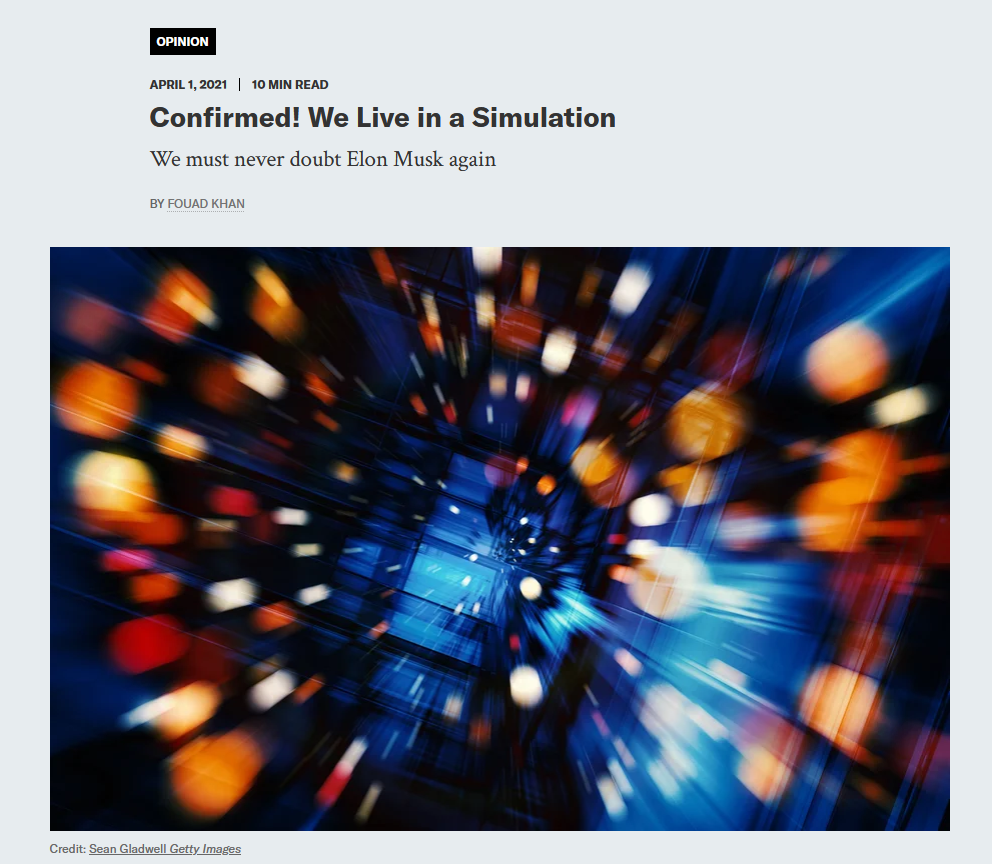
Confirmed! We live in a simulation. by Fouad Khan

Of course we live in a simulation by Jason Kehe

The first ‘virtual’ tool invented by Man, language made it possible for humans to become conscious.
By sharing information among them, individual human beings learned to speak to themselves. To think. To evaluate their activity. To evaluate themselves. Their own selves.
Speaking to each-other, people have developed self-awareness.

The process is a work in progress.

Words are ‘stamps’.
Images.
‘Commodified snapshots’ of the thing we call reality.

Which reality is simultaneously a word and the place we live in.

A word/concept into which – like in all other words – we’ve crammed everything we know about the thing itself. Which everything is nowhere near enough to actually cover the entire thing.

Reality, the word, covers everything we know about the thing but the thing itself, the thing we call reality, is far wider/deeper than that.

Hence the problem we’re stuck with.

We instinctively consider that words are apt representations for the things we attempt to describe using those words. Which, most of the time, isn’t exactly true.
We – most of us, most of the time – consider that those of us we talk to understand the words we share in the same way we understand them. Which is never the case!

As a man thinks, so he is; as he continues to think, so he remains.”
James Allen

Sometime ago – more than 45 years, when food was still plentiful in communist Romania – I heard for the first time that ‘many people dig their graves with their teeth’.
I was too young to understand the deeper meaning of this. That sooner or later each of us will meet the consequences of our previous decisions.

15 years ago I read a book written when I was a toddler. Almost 60 years ago.
The Social Construction of Reality by Berger and Luckmann.

In it, they argued that society is created by humans and human interaction, which they call habitualization. Habitualization describes how “any action that is repeated frequently becomes cast into a pattern, which can then be … performed again in the future in the same manner and with the same economical effort” (Berger and Luckmann 1966). Not only do we construct our own society but we also accept it as it is because others have created it before us. Society is, in fact, “habit.”

Nowadays, the social media is full of messages stating that the posters actually don’t care about what other people think of them.

What happened to “society is, in fact, habit”?

Have we become self-sufficient enough to live, each of us, on their own?
Really?

Do we really think like this?
Cocky enough to give the finger to everybody else?
Don’t we realize that we’re building a new pattern here? A new habit?

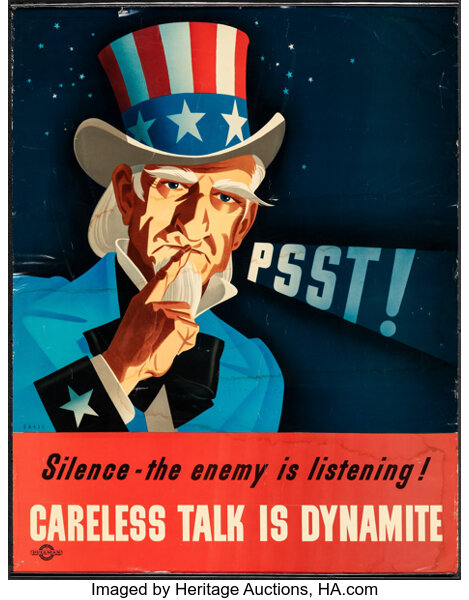
Will our children say that we’ve built the hell they’ll be living in by carelessly talking about it?

After all, the most dangerous enemy is that who worms its way from within.
Conceit cannot be survived!

People act as if the world is as each of them sees it.

The world is as it is.
Only nobody knows how…
And, probably, never will.

What we act upon, and interfere with, is the world as we see it.
Here being the interesting part.

All other living things mostly react to the world.
Even our brain uses much – some say ‘most – of its processing power to react rather than act.
Our body is able to survive even when our frontal cortex – the portion of the brain where thinking takes place, has been knocked out of action. When we’re fast asleep, drunk, ‘high’, low, in a coma…
In fact, an organism doesn’t need to ‘see’, in order to react. To breathe, to eat, to perform bodily functions, to reproduce…

Things become more and more complicated, indeed, as we climb the evolutionary ladder.
Complicated for us… who attempt to understand what’s going… not for those living on each of the steps… Things are complicated only for those trying to ‘see’!

It’s easy, for us, to consider that a dung beetle which carries food for its future offspring is acting instinctively.
It’s a little bit more complicated when we observe a troop of chimpanzee and notice how deliberately the alpha male leads his ‘subjects’ and the complex social life of the community …

But the difference between how the chimpanzee and the humans interact with reality is wide enough for us, humans, to consider ourselves as having risen ‘above the fray’. As being special enough to deserve a special status!

And what is it which makes us so special?
Our ability to speak? To walk on two legs? To write?
None of the above!

It’s our ability to ‘see’ the difference between us and the rest of the world!

All other living organisms behave as if they belong to nature. To the reality surrounding them.
We humans, behave as if we own reality.

While the rest of the living things react to what’s happening to them – even when they plan ahead – we, humans, deliberately – and presumably in a conscious manner – transform the reality according to what we consider to be our needs.

According to what we ‘see’ as being our needs…

What WE know about the reality WE are speaking about drives ME to the following ‘inkling’:

We are living inside a three layered reality.

The ‘real’ one, the ‘perceived’ one and the ‘result’.

We ‘measure’ reality using our conscience. Through our senses.
Very much like when we gauge a length using a tape measure.
We apply the tape measure over the length and ‘read’ the number.

We apply the standards we’ve been groomed into over the underlying reality and we decide according to those standards.

Then we attempt to deal with the consequences of our decisions.

“Sheer hatred of the regime”….

Who’s painting the pictures we’re hanging on our walls? Who chooses them? Who has to make do with the ‘aftermath’?

We learn about what we call reality by
analyzing the information we acquire through our senses.

We.
We, the human people.
We, the conscious human people.
We, because nobody has ever been able to become conscious – as in aware of their own self, by their own. Alone…

Learn.
We are not the only ones who are able to learn.
Our dogs learn our ways. And we continuously learn about more and more living organisms being able to learn. And to remember what they have learned. To fine tune their behavior according to the circumstances into which they happen to live.

What we call reality.
First and fore-most, reality is a concept. We call it ‘reality’. And many other names…
Believers call it ‘god’, scientists call it ‘physical world’ and the scientists who happen to believe are convinced that by studying the reality they will eventually divine the will of the Lord.
The believers being convinced that whatever exists, is here because the Lord wished it into existence.
So, basically, the main difference between the believers and the nonbelievers is the fact that the believers are convinced that the ‘out-there’, the ‘source of it all’, has a conscience of it’s own. A will of it’s own…

By analyzing.
We have been able to build our conscience – our ability to ‘observe ourselves while observing other phenomena’ (Maturana, 2005), because we have a big enough brain, the ability to share complex and meaningful information using language and the ability to put in practice some of our wishes/thoughts through the use of our hands.
At a certain point in its evolution, human conscience has become sophisticated enough to need explanations. It was no longer satisfied with mere ‘connections’ – If… then…, it had started to wonder about why-s. ‘Why does this happen as it does?’ ‘Will it happen again tomorrow?’
Using our by then already established ability to speak up their minds, our ancestors shared among themselves these ‘anxieties’. Discussed them around the fire-place. Started to analyze. The reality. What they perceived to be real. The ‘thing’ which continuously generates the circumstances in which we – all of us, have to make do.

Information.
In order to analyze, the analyst – each and everyone of us, has to separate the meaningful information from the surrounding noise. In order to do that, we have started by coining the very concept of (useful/meaningful) information. As being different from ‘noise’. The difference consisting, obviously, in us being able to find its use and/or pinpoint its meaning.

We acquire.
Information is acquired on an individual basis. For an ‘event’ to become information, it has to be ‘noticed’ by an individual. It has not only to be sensed but also identified as useful/meaningful. Different from ‘noise’.
Which process of identification implying methods which had been agreed upon by the members of the community. Music would be a good example of how various groups of people make the difference between sublime/abhorrent and white-noise. While ‘use of language’ is a very poignant example of how people can both share information and mislead one-another.

Senses.
Everything that we know, had entered our mind through our senses.
Before setting it aside as information or discard it as noise, we have to get in contact with it as a sensation.
Or as a thought. A conjecture. A few pieces of information which put together have given birth, inside our individual mind, to new information. To ‘something else’ which passes the threshold into being information. At least according to our own mind…

Which transforms our minds into our famous sixth sense.
In the sense that our individual minds are capable of building ‘sensations’ on their own. Starting from information that has already been stashed in our memory.
Which brings us to the third reality.

We have – in the sense that we have agreed upon its existence, the surrounding reality. The things we – as in most of us, consider to be real. The mountains we climb, the air we breathe, the pebbles which happen to sneak into our shoes. The reality which is being studied by science. The reality to which we have access through our senses. Our minds and our sense enhancers – scientific instruments, included.

We also have the ‘out-there’. The things we know we’ll never be able to grasp. During our lives! The things our followers might be able to figure out…

And each of us has their own reality.
Individually built even if ‘carved’ from the same (type of) material as the reality shared by the rest of us.
Individually built even if using more or less the same (culturally accrued) methods.
Individually built even if neither of us is alone.

H.M. Romesin, 2005, The origin and conservation of self‐consciousness: Reflections on four questions by Heinz von Foerster

A planned after-thought.
Rumsfeld is both wrong and right. There are unknown unknowns but they are no longer unknown since we speak about them…
Which actually proofs the limits of our languaging.
The imprecision of the manner in which we gather, share and analyze information.