Archives for posts with tag: information

“Weaver pointed out that the word “information”
in communication theory is not related to what you do say, but to what you could say.
That is, information is a measure of one’s freedom of choice when one selects a message”

Space is where ‘evolution’ happens.
Where interaction shapes whatever is.

For space to exist, something must be there. Space needs ‘limits’. Which define it.
‘There’s a gap between these two bricks’.
‘This pile of bricks blocks the way’

‘Space’ is, simultaneously, a place, a concept and a word.
We, writing and reading about it, exist. Somewhere. Somewhere in ‘space’…
We’ve realized that. That we exist. Hence we came up with the concept.
We needed to share that knowledge. To discuss it. We needed the word!

A wise man, using tools crafted by his predecessors, has calculated that whatever exists in space shapes its form. The heavier the object, the deeper the dent.
Which depth of the dent influences the flow of time…

Time… the metric we use to measure ‘evolution’. The order and speed of happening…
Time… Another ‘thing’ which exists, simultaneously, as a ‘reality’, a concept and a word.

Einstein, the wise man with the calculus, did his thing trying to understand. To put together an explanation for everything.
Reading his findings, the results of his calculating, we can push our imagination.
How about switching time for space?

How about considering ‘time’ as being the place where events exist? Interact, producing the ‘space’ needed for that process?
Where the ‘weight’ of events, their ‘importance’, shapes the form of time. Which form of time influences the space ‘becoming’ as a consequence of those events existing/interacting in the place called time…

My point being …
You see, Einstein’s predecessors had developed what we call ‘mathematics’.
Our predecessors, also called ‘ancestors’, had developed a thing called language. Used it to communicate.
Among themselves, as individuals, and among themselves – as a cultural species – and the surrounding reality.
Language as the tool we use to digest and reshape the reality… Before we ‘do’ anything, we think about it. Using language to parse pertinent information stored in memory. Using language to consult with others. Using language to coordinate with others…

One of the languages we’ve developed is mathematics.
Einstein, using this language, reached a ‘conclusion’. Wrote a story. Others call it a theory.
Convincing enough for interested people to try. To try to prove it, to try to disprove it. To attempt to implement it into practice…

We exist.
In space, using whatever resources we can identify and building time as a consequence of our actions. We do this using language. To explore, think and coordinate.
That’s how we’re calling things. Space is where things happen and time is the ‘conclusion’ of whatever we do. Mathematics suggest that time and space are interchangeable.

So what?!?

Have we already solved all our immediate problems?

After all, we’re the only adults in the room. In the limited space called planet Earth.
Or, at least and for all that it might matter, we’re the only adults in the room who care. Who should care about our own fate…
Time’s running out, faster on the route we’re currently using!

Each of us expects the others to behave rationally.
While each of us rationalizes their own biases.
And considers this to be normal!

Not so long ago – evolutionary speaking, things were free. As in ‘up for grabs’.
Our not so distant forefathers fed and clothed themselves by picking ‘things’ from nature.

By talking to each other they had become conscious human beings.
Then came up with the notion of property.

‘If I/we have this thing, you cannot have it too’.

Using this notion, they introduced some order unto the social stage.
Some things, albeit fewer and fewer, remained free/up for grabs while the rest – specially ‘the things of interest’ had become private.

Entertaining the notion of property means that individuals are able to link an object to its owner.
This link is a piece of information.
Discussing and remembering who owns what, our forefathers realized that information is important. Not only the information regarding the link between owners and their property but also information in general. Whatever ‘useful’ things had been learned, remembered and passed around.
Thus information became ‘a thing’.

The order created by the communities using the concept of property and by actively circulating information among the members had become the premise for those communities to thrive.

Somewhat naturally, the members of those communities had reached the conviction that:
Property is good. And that more property is better.
Old people are precious. For the simple reason that they deposit what had happened. By sharing their memories, old people make it so that the younger ones don’t need to learn again and again.

Since property and remembered information were good for the community, the communities using them developed faster and had a way better survival rate than those who didn’t. For whatever reasons.

Since in reality people rationalize rather than think rationally, they have reached the conclusion that the rich and old people were the ultimate cause for the well being of the community.
The individuals, not the modus operandi of the community.


Individual organisms, working in concert, for a while, organize themselves in such a manner as to be able to keep the inside it, the outside out, to ingest what ever they need to survive from outside and to excrete the byproducts of their living. Also known as the by-products of their metabolism.

In order to perform the above, the individual organisms use information gathered by their ancestors and transmitted over generations. Which information has been shaped in time, through an evolutionary process, in order to remain useful for the currently surviving organisms.
Which said shaping has happened through the natural culling of the individuals bearing information no longer fitting to the then existing natural circumstances.

For life to continue, individuals living at anyone time must engage in reproduction.

‘From virus? What?!? And from which one?’

From none in particular.
From all of them, since all viruses are nothing but information!

‘Huh???’

Most biologists consider viruses to be something ‘in between’. Not exactly ‘life’, since they cannot replicate themselves, but something more than mere matter.

Only this approach sets very straight limits to how we understand life itself.
Or should I rather use ‘narrow’ instead of ‘straight’?
‘Narrow’ as in ‘not wide enough’ minded?

“Information which perpetuates itself”.

Does this sound right for you?

We. humans, are individual human beings. ‘Social’, indeed, but, nevertheless, individual. It’s our individual-ness which sets us apart from our nearest cousins. Chimps and bonobos.
It’s our individual-ness which sets the parameters of our world-view. That being the reason for our attempt to define life as a characteristic of the individual organisms which happen to be alive.

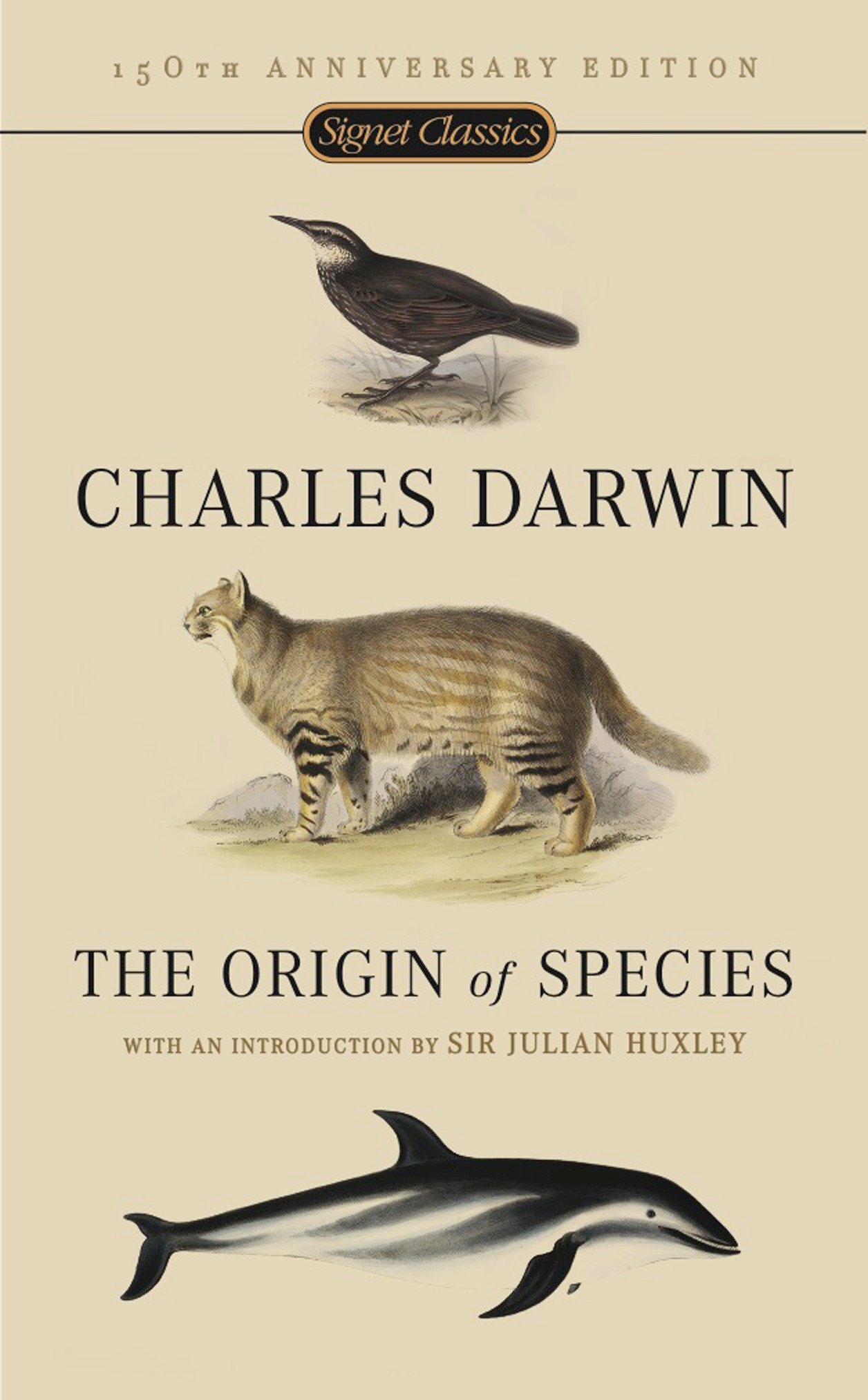
This being the moment when I feel the urge to direct your attention upon a seminal book.

Hmmm… the Origin of Species…

If evolution is about ‘Species’, then what about life itself being more about species than about individuals?

What about life being more about the process through which information is passed along from one generation to another than about an individual organism being alive or not?

In this sense, ‘virus’ would belong to the realm of the living, right?

Existence takes place ‘inside’ while things happen in-between.

Survival is a matter of preserving, ‘as is’, what already exists while evolution is about change and might involve ‘dismissal’.

Everything may survive while only ‘living’ things are capable of evolving on their own.

At some point, evolving organisms became complex enough to ‘feel’.
Not only complicated enough to react in an orderly – a.k.a. pre-programmed, manner but also to generate emotional reactions – which can be remembered, when certain things happen in their vicinity. Things which are important for the survival of the feeling organisms. As a consequence of the ‘feeling’ process, data regarding the happened occurrences are stored by the feeling organisms as information. Which information may help the organism in its struggle to survive. Using that information, that organism might become a ‘better version’ of itself.

At a further point in the evolution of ‘things’, organisms have added another layer of complexity.
They have become complex enough to ‘think’. As in complex enough to attempt to maximize the effects of the information they have at their disposal.

That was when ‘facts’ had been identified as being ‘things’ which had had consequences, when data had been identified as being information and when the thinkers had discovered that thinking was driven by sentiment.

Which sentiment is nothing but an evolution of the ‘survival instinct’.
Present in any living organism.
Which survival instinct is nothing but the living equivalent of something the physicists have identified as inertia.

Go figure….

Knowledge is being constantly (re)generated by us.

Everything we know, individually and collectively, has been first felt, then interpreted and finally communicated by us.

For something which has happened inside our sensorial sphere to become a piece of information we have to first notice it, then evaluate it and, finally, deem it important enough to remember. To codify it as information.

For something to make sense – whatever that means, the information we have about that something has to fit in to the rest of information we already have.

These three premises, which I hold to be self evident, lead me to the conclusion that:

Individual human beings will always have but a limited knowledge/understanding about/of the world.
A group of people are able to develop an aggregate understanding of the world which might be wider than those belonging to the individual members.
In time, a community of people will cobble together an even more complex weltanschauung. But still an incomplete one. For no other reason than the fact that the sum of a finite number of finite quantities will always be finite.

Consequences.

Since our understanding of the world is finite, determinism doesn’t make sense.
This being the reason for all authoritarian regimes/monopolistic arrangements caving in sooner rather than later. For the simple reason that those regimes/monopolies use but the brain power of those in power and waste the rest.
Our understanding of the world being finite, there is no way to demonstrate or refute God.

Which God is, anyway, nothing but a figment of our imagination.
Because of the very reasons I mentioned above.
Even if God itself would appear right now in a public square and on all the TV monitors in the world, the impression/understanding of him we would be left with after the experience would be of our own making.

Incomplete and inexact. Heavily dependent on everything else we already know.

Information is like bricks while knowledge is like buildings.
One can make his own bricks from the available mud and then proceed to build his own hut.
Inevitable all bricks made by man will have something in common – after all they are made from the same material, for the same purpose, by individuals belonging to the same species, but will also vary considerably – depending, among others, on the skills of the makers and on the quality of the available mud.
Inevitably the houses will also have something in common – again, they are made for the same broad purpose by individuals belonging to the same species – but they will vary more widely than the bricks do because they have to fulfill a wider selection of purposes in a variety of climates. (All bricks are made to be used as building blocks but buildings are used for many more purposes than simply sleeping in them.)
In conclusion information is something that was gleaned by an individual from his environment while knowledge is a patchwork put together by the same individual using the pieces of information he has acquired previously.
Also please note that while all information is gleaned using one’s senses this process can be a direct one – the senses probe the reality in a direct mode, the observer watches birds in his back yard, or it can be mediated by an information source – the passionate reads, using the ‘same’ eyes as the observer, a book about the same birds.
And any consideration about the difference between information and knowledge would be incomplete if we forget to mention ‘sensations’.
Which are nothing but the raw material – the mud, if you like – from where our brain extracts what we call ‘information’ – which, in its turn, will end up being attached, by the same brain, to the patchwork commonly known as knowledge.