Archives for posts with tag: God

We live in the world of our own making.
Literally!

This is a picture.
A man-made picture.
God is depicted, by Michelangelo, as being very intent while ‘man’ seems to be casual about the whole thing. Disinterested. Somewhat absent.
Let me remind you, in this context, that Michelangelo’s painting was named “The Creation of Adam”.

The world we live in, very much like Michelangelo’s painting, has been made by us.

Unlike his predecessors – those who had painted the walls of Lascaux – Michelangelo had adorned a man made structure. A ceiling.
Unlike his predecessors – who had, most likely, painted on their own volition – Michelangelo was hired, ‘commissioned’ is the PC word to be used in these circumstances, by the pope, to interpret the Genesis Creation Narrative.
Very much like his ancestors, Michelangelo was also made of flesh and bones. Had to breathe, eat, drink and painted using substances ‘borrowed’ from the ‘nature’.

The point I’m trying to make here is both simple. And very hard to swallow.

We live inside ‘something’.
We use ‘reality’, the word, to describe a portion of that ‘something’. The portion we ‘control’. We think we know about and are able to interact with.
Very few of us accept the fact that what we call ‘reality’ is ‘tainted’ by us. That we have a growing contribution in the process of ‘reality’ becoming what it is. And what it’s going to be. To become…

The ‘something’ we inhabit is far wider that what we call ‘reality’.
It’s full of everything we do not know about.
And choke full of everything we have invented and does not fit in what we call ‘reality’. Choke full of gods, spirits, ghosts, ideologies, theories, explanations, narratives and so on and so forth. ‘Metaphysics’, if you know what I mean.

‘Another atheist. I should have known better…’

“It’s full of everything we do not know about”….
I never said there is no God. It might very well be. Or not… All I have to say about this is that what we consider to be ‘our god’ exists nowhere but in our imagination. Beyond the ‘physical’ world.

‘According to what your saying, we’re involved not only in ‘reality’. We’ve also ‘constructed’ a sizeable portion of the ‘netherworld’…’

As a matter of fact, yes. We’ve not only ‘created’ what we call ‘reality’, we’ve also created the ‘netherworld’ itself. Both inside the ‘something’ which encompasses everything.

‘ “Created…” how did we ‘create’ anything?!? Least of all ‘reality’…’

Language is a very powerful tool. And naming is a very powerful feature of that tool!
By naming something, anything, we separate that something. From the rest. We actually establish a barrier, in our collective mind, between that something and the rest of whatever there might exist.
And I leave aside the fact that our language coordinated efforts have drastically altered our portion of ‘something’, our ‘reality’, since the days when Michelangelo’s ancestors, ours, used to paint the walls of the Lascaux cave.

‘Reality’ itself is a very interesting word/concept.
Until not so long ago, Gods were real. And still are, for some of us.
But even in those times, people felt the need to make the difference between the real, hands on, reality and the rest of the things they believed into existence. ‘Metaphysics‘, the word itself, was coined by Aristotle’s editor. A certain Andronicus of Rhodes, sometimes in the first century BC.
As a consequence, everything was real, in those times, but some portion of what was real existed only in people’s minds. “ta metá ta phusiká“…
1500 years later, when science was budding – again, in our Medieval forefathers minds, the ‘tables had been turned’. The scientific state of mind demands that only the factual/physical things can be deemed as belonging to ‘reality’ while all the rest, including the metaphysical realm, belongs someplace else…

Nowadays… things have become rather complicated.
Science tells us we don’t know everything. Worse still, that we’ll never know everything.
On the other hand, everyday life proves, beyond any doubt, that things which exist only in our heads/minds do shape, dramatically, our daily lives.
I’ll give you but two examples.

The church and the traffic light.

People go to the church because they believe. Most of them. Very few people visit churches, ordinary churches, out of touristic curiosity.
People ‘obey’ the traffic light because they actually believe life has been made simpler, and safer, since the traffic lights have been invented/installed. Like churches, we don’t ‘obey’ them because they are there! We install them because we’ve understood our lives have improved since their inception.

Logos continuously chiseling
new Reality
out of whatever Opportunity is at hand….

At the beginning there was nothing but Chaos.
Then Gods were born. One way or another.

The birth of Gods sowed order into Chaos.
Thus Cosmos was born.

And the LORD God said,
Behold, the man is become as one of Us,
to know good and evil;
and now, lest he put forth his hand,
and take also of the tree of life,
and eat, and live for ever.

“And the LORD God called unto Adam, and said unto him, Where art thou?

Adam called back and we all what happened next.

The serpent was cursed for his role, Eve was cursed for tempting Adam and Adam was cursed for….
In the end, all those involved – including the serpent, for whatever reason – were banished from the heaven. “Lest he put forth his hand…”

What are we to understand from all this?
That God, the omniscient and all powerful Father, was ‘evil’?
He must have known what was going to happen… he was omniscient, wasn’t he?

There are people who believe the Bible to be an accurate rendering of the past.
I happen to be one of them.
Only I don’t interpret what I read in the literal sense… the narrative is true, those things did happen, only not in the ‘real’ world. The Bible is not the story of flesh but a story of mind.

It is the story of what has happened in our minds. In our collective mind!

Genesis is the story of how we’ve grown conscious!
Starting from the sensations perceived during our interaction with the ‘real’ world – read ‘serpent’ – and using the evolutionary accrued ability to speak among ourselves – we’ve learned to identify ‘information’.
We, like all other living things, were already able to make the difference between good and ‘bad’. All living things ‘know’ what’s good for them and what to avoid. Or, at least, act as if…
We, like all other primates and along many other animals, were already adept at ‘reading minds’. Were already able to figure out intentions.
As conscious ‘human beings’ we have started to attribute intent! “To know good and EVIL”!

So evil is of a conscious nature, right?

‘How about ‘God’? Is it real?’

Sorry, I don’t have a reasonable answer for this question.
All I know is that the God so many of us believe in is nothing but a representation.
A figment of our collective imagination. And since we cannot imagine things but starting from the real world, there is a strong possibility that there is something, somewhere, which fits, however loosely, our concept. Our concept of a God…

Humberto Maturana, The origin and conservation of Self
https://constructivist.info/radical/pub/hvf/papers/maturana05selfconsciousness.html
Frans de Waal, Are we smart enough to know how smart animals are?
https://www.goodreads.com/book/show/30231743-are-we-smart-enough-to-know-how-smart-animals-are

OK, I can give you this.
God may have done all this.
But is He aware of His creation?

But He loves us!
Otherwise why make us in the first place
?!?’

What if it was us who had come up with this notion?
The way I see it, we may very well be an unintended consequence of His activity. So unintended that He isn’t even aware of our existence…

But He knows everything…

That’s what we think… about Him. And about the relation between Him and His Creation.
Take us for example.
Do we know everything? About our body. About what’s going on inside us.

No, of course we don’t!’

Think again.
For an outside observer – specially one that lives significantly less than we do – our bodies are ‘perfection in motion’. They work ‘perfectly’. As if minutely controlled by somebody who perfectly knows what they’re doing. Right?
We know this isn’t the case… because we are the ones who ignore what’s going on inside our bodies…
Well, ignore is too strong. Not fully aware, at least for as long as things go on in an acceptable manner, would be a more accurate description.
Same might be happening with God.
And this is a far more sensible explanation for what’s going on. We’re the ones responsible for our behavior, not an inscrutable God.
Who, despite being our Creator, allows us to defile His Creation.

“statuuntque latiores terminos scientiae Dei quam potestatis,
vel potius ejus partis potestatis Dei (nam et ipsa scientia potestas est)
qua scit, quam ejus qua movet et agit:
ut praesciat quaedam otiose, quae non praedestinet et praeordinet”

Francis Bacon, 1597
“and they set wider limits for the knowledge of God than for power,
or rather for that part of God’s power (for knowledge itself is power)
by which he knows, than that by which he moves and acts”
Google Translate

scientia potentia est
Thomas Hobbes, 1668

E=mc2
Einstein, 1905

In fact, power produces; it produces reality;
it produces domains of objects and rituals of truth.
Michel Foucault, 1991

“They” – as in ‘the knowing people’ – ‘set the limits for the knowledge of God’.
Then it was ‘they’ who had the real power over (their) God…

A little later, another thinker simplified the whole thing into ‘knowledge is power’.

Which, already collective, state of mind morphed into the socio-cultural environment into which Einstein was able to notice that E=mc2. That apparently different things can morph one into the other, given the right circumstances.

Which brings us to Foucault noticing that power produces reality. Including knowledge…

But is there a real difference between ‘power produces reality’ and ‘they set different limits for God’s knowledge than for God’s power’?
In fact, there is.

According to Foucault power is exercised directly.
According to Bacon, people exercise power by ‘fine tuning’ their ultimate tool. Their God. Which god, like all others, acts like an agent. Its powers might be limited – it is able to do/know only as much as those who have faith in it believe it to be able to know/do – but inside those limits it is as free as each of those who believe in it.

And the difference is huge.
As soon as Nietzsche had noticed that ‘God was dead’, ‘reality’ had shattered.
While God was alive, power created one reality. Also known as “God”.
As soon as there was no more God to mediate between reality and those gathering knowledge about it and exercising power while recreating it… reality became many!

And not only many versions of reality are competing for our attention, each of these realities are farther and farther away for the ‘hard’ one. The one harboring Einstein.

“People know what they do; frequently they know why they do what they do; but what they don’t know is what what they do does.”

Michel Foucault, Madness and Civilization:

Congress shall make no law respecting an establishment of religion,
or prohibiting the free exercise thereof;
or abridging the freedom of speech, or of the press;
or the right of the people peaceably to assemble,
and to petition the Government for a redress of grievances.

Doesn’t make much sense?
Mentioning ‘God’ on money is the first step towards the establishment of an officially sanctioned religion?

Well…

In my previous post I posited that property, the concept, is the stepping stone for social order.
I’ll add to that a simple observation. Whenever too much property gets hoarded by a too small number of people, the community which had allowed that to happen is in great danger.

Same thing here.
We have religion – a social phenomenon – and religions.

We have a certain understanding of the world, shared by the members of a community – which allows the community, as a whole, to behave in a coherent manner. Not that much different from what happens when people use a common language. They can communicate. Same thing happens with people partaking in a religion. They ‘see’ things in a coherent manner. Hence can coordinate their efforts.

And we have religions…
To reach the ‘certain understanding of the world’ I mentioned before, each community had traveled a road. A particular road through the particular circumstances in which each cultural community – currently known as ‘nation’ – had had to build their culture. Their identity.
Some communities had put together certain scenarios to accompany them along this road. To help them make sense of what was happening to them.
Some communities have used more than one scenario during that journey while others use more scenarios simultaneously.

Sociologically speaking, all that matters is social coherence.
All is well as long as the community conserves its ability to function. To survive.
As long as the individuals who compose that community continue to have a common enough understanding of the world in which they live.

For the simple reason that they, we, live in the same world!
And if we, individually or in small ‘gangs’, start behaving as if the world is different for each of us…

The Founding Fathers had a common understanding of the world. They belonged to the same (functional) religion despite belonging to different ‘denominations’. For them, the First Amendment was about reigning in the powers of the Government. They had realized that a Government able to impose a certain religion – a certain scenario – upon the entire community would eventually bring destitution.
The Founding Fathers could not foresee a situation in which a few of us would deny the practical daily realities of this world. Invoking their particular scenario as an argument… As the supreme argument for refusing to see the reality.

The reality as it is.
And as it is seen by a majority of us.

I mentioned earlier that some communities have changed their scenario along their history.
They did it when they have found new meanings. They have seen new things about the reality and they have integrated those new things into their newer scenario.
By changing the scenario they have actually built a new reality.
Societies which have clung to their scenario to the bitter end… are no longer with us.
Societies which have somehow found it in their collective minds to adapt their scenarios to the reality changed by their own efforts continue to survive. To thrive, even.

“Hoarded by a too small number of people” means controlled by a handful of people.
Sometimes coordinated.
As it happens in any dictatorial regime. It doesn’t matter who formally ‘owns’ something if the use of that something is tightly controlled by somebody else.
Furthermore, a certain ideology may end up having a lot of clout without being imposed by an authority. Nevertheless, the fact that an ideology dominates, for a while, makes it so that the community which allows this to happen to experience a dictatorial regime.
For whatever reason, some people were convinced that witches were real. And burned them at the stake.
For whatever reason, a lot of people continue to believe that communism might be a good thing.
For whatever reason, some people continue to believe that they are entitled to determine whether a woman may or may not abort a fetus.

What is the difference between an ideology and a scenario?
The manner in which people relate to it.

Having been told that they were the children of the same God made it possible for the believers to stick together. To act like brothers. To respect each-other. To invent and implement capitalism and democracy. Both relying on trust. On mutual trust and on the freedom of the market. Both the market where goods and services are traded and the public forum. Where ideas are traded…

Being told that only one particular understanding of a certain text/idea/concept is correct some people remove themselves from the ‘general population’. Which ‘general population’ becomes ‘the others’.

‘The others with whom we don’t have anything in common’.

Quite an untenable situation, given the fact that the world is becoming smaller and smaller.

“Despite this advancing scientific knowledge,
there is much that remains unknown about both sleep
and dreams.
Even the most fundamental question
— why do we dream at all? —
is still subject to significant debate.”

Dreaming is normal and healthy, but frequent nightmares can interfere with sleep.

So.
We’ve figured out that dreams are something which happen inside our heads. When sleeping.
Then called them names. ‘Dreams’ if they were OK, ‘nightmares’ if not.
Interesting, isn’t it?
Then we have hallucinations. A sort of daydreaming – if you think of it – only less pleasant.

My point being that our consciousness – “our ability to observe ourselves observing” – opens up a new realm inside what we call ‘reality’.
That we live, in fact, inside a world of our own making.

‘But this is valid for all living things, right?’

In the sense that all living things collaborate – albeit involuntarily – towards the continuous reshaping of what we call ‘biosphere’… yes! Life does indeed reshape the portion of space/time where it happens.

The way I see it, life is responsible for the ‘second layer’ of what we call reality.
While we, the conscious observing cum living inhabitants, are responsible for the ‘third layer’ of what we call reality.

‘You keep saying “what we call reality”.
Would you care to elaborate?’

You see, we have developed two concepts.
‘God’ and ‘Reality’.
God is something which had suposedly made us. According to those who believe in God, we have been brought to life – along with the world we inhabit, in a voluntary manner, by the agent we call God.
On the other hand, reality – according to those who believe in ‘science’ – is the ‘place’ where we have happened to ‘evolve’.

God is something we are told about by others. Something the ‘worthy among us’ might experience first hand through ‘rapture’.
Those who believe in God consider that the original information about God had been delivered, through divine inspiration, to ‘prophets’. Or had been acquired one way or another by ‘elders’.
Those who believe in God consider that God – and his will – are inaccessible to humans. That we, ordinary human beings, are only meant to simply experience ‘God’s will’. And adapt our behaviour accordingly.

Reality is something we, the present ones, are told about by our predecessors. And something we experience through observation.
Those who believe in science consider that nobody – individually and collectively – will ever be able to know everything. Basically, those who believe in science are also convinced that reality is ultimately inaccessible to us.
Those who believe in science consider that it’s our job, as conscious human beings, to find out as much as we can about ‘reality’ and adapt our behaviour accordingly.

For somebody unwilling to take sides, there’s not much practical difference between the two sides mentioned above.
Both are states of mind. Convictions. Weltanschauungs which shape human action.
Furthermore, both mandate us to do the very same thing. Adapt our behavior to what we ‘see’!
Does it really matter whether what we ‘see’ was handed out to us by somebody or is the consequence of happenstance? Would our reaction be different? Why?

‘But God has handed out a series of commandments! For us to follow in order to be saved.
Science doesn’t provide any ‘spiritual guidance”!

I beg to differ.
The Bible – and all other sacred texts – have been written by people. Taught by people to other people.
Science – everything we know about things, including what we call ‘best practices’ – has been put together by people. And taught by people to other people.
Furthermore, technology – the manner in which we have put in practice what we know about the world, regardless of how we have acquired the information – has been put together by us. We’ve designed each and every tool we have used to transform our world into what it is today.
And it was still us who have use those tools according to our own goals.

So it is us, collectively, who are responsible for the world we live in.
For the dream we live.
And for the nightmares experienced by some of us.

It is a truism that almost any sect, cult, or religion will legislate its creed into law
if it acquires the political power to do so,
and will follow it by suppressing opposition,
subverting all education to seize early the minds of the young,
and by killing, locking up, or driving underground all heretics.
Robert A. Heinlein, Postscript to Revolt in 2100.

Religion is the metaphusical ‘thing’ inside which people who hold a set of tenets to be true are able to build a community.

Religion is sociological phenomenon. Something belonging to the realm studied by those who try to understand how large number of people work together.

Religions – on the other hand – are ‘sets of tenets’ put in practice by various groups of people.
Sets of tenets which survive for as long as they continue to help the people who uphold them in their quest to survive as a group. As a community.

Religion cannot be ‘changed’.
Religion can be studied. May be better understood.
Like physics. You can’t ‘change’ physics! With what? With chemistry? Things don’t work like this. The only thing you may do about physics is to ‘deepen’ your knowledge about it.

Religions can, and sometimes have to, be changed.
By the very people who ‘use’ them to survive.

Since nobody can survive on their own, each and everyone of us needs to belong.
To a community.
To a religion, actually!

And what do people do when they realize survival is impossible in certain conditions?
Die or do something about it, right?

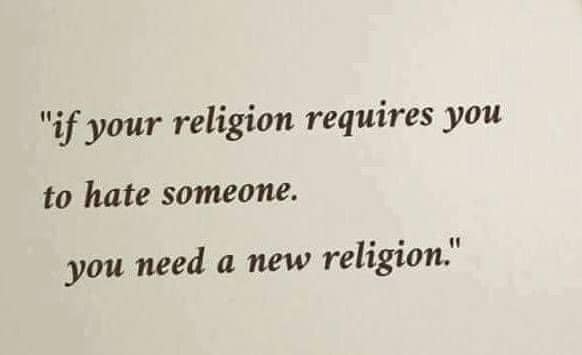
Now, which community can survive based on hate?
It doesn’t matter whether you are asked to hate somebody inside or outside your community.
Whether you hate individually or collectively.
Hating – or despising – somebody blinds you and exhausts you. Puts a huge burden on your back. Focuses your attention so tight that you are no longer able to notice the real dangers.
Those which actually make you less likely to survive.

And this is valid both for you as an individual and for you as a hating community.

Tao, Karma, Future

Time, like everything else human, has two sides. Like a coin.

A ‘base’ and an interpretation.

There’s no interpretation without a base – even hallucinations are based on ‘something’ – and there’s nothing which has penetrated human conscience and ever managed to evade interpretation.
In fact, human conscience needs to interpret, to assign meaning to, everything it ‘sees’. Everything it perceives.
Anything which is uninterpretable, which has no meaning, cannot be controlled. It is, hence, dangerous.
If you don’t know what’s going to happen next, you can assume anything. And since assuming the worst – and preparing for it – is far more useful towards survival than sleeping over it, we are biased towards erring on the side of caution. And towards relentlessly searching for meaning.

Time, like everything else human, is both a phenomenon – it happens – and a concept.
The difference between the ‘time’ of a star and the human time being that ours has a name – given by us – and that the star cannot do anything about it. While we do!

We can do things to and about time!

We named it, we measure it, we attempt to interpret it…. and we try to do the best of it!
We try to do, while alive, what we consider to be ‘the best’.

The best (?!?) for whom?

Tao.

The ‘road’.
If everything flows, it has to flow ‘somewhere’.
Not only from the start/spring to the ‘end’ (?!?)/never tranquil sea. Everything flowing needs a ‘riverbed’ to flow ‘through’. A plant needs soil to sprout, grow, bear fruit and ‘return to nature’. Even a star needs an Universe in order to shine… besides enough ‘fuel’, of course!
I have started this post by saying that there’s no interpretation without a ‘base’ and that we, conscious human beings, need to attach meaning (a.k.a. interpretations) to everything of which we become aware.
Same thing here. For anything to happen, a venue is needed. Some wise people in our past have used ‘Tao’ as a name for THE venue. For the venue where everything takes place.

Karma.

At first, when conscience had dawned on us, we were alone in the ‘dark’. And afraid about what was going to happen to us. To assuage that fear, we have identified God. As the ‘the meaning’ of the world.
At first, when both the world and time seemed to be endless – to us, consequences came from God. We had to behave. Or else…
God was there to punish each and every transgression. Sometimes using one of us as his proxy.
After a while, some of our ancestors have learned to write. To reliably transfer information over generations. Very soon, those ancestors of ours have learned the link between cause and effect. Between behavior and consequence. Very soon God had become an outside observer. Or was out-rightly forgotten. But Karma survived.

Future.

I keep hearing that ‘evolution has no purpose’.
Like many other human utterances, this one conveys far more information about the utterer than about the phenomenon described by the utterer.

‘This wooden table has 4 legs’.
We learn about the table that it is in front of us, that it is made of wood and ‘has’ 4 legs.
We learn about the utterer that:
It was conscious when uttering those words. Only conscious agents are capable of ‘speaking like a human’.
It has, at some point, learned to speak. English, and possibly other languages.
It has, at some point, learned to count. At least up to four. And it had conserved that ability up the moment when it uttered those words.
It was capable of identifying ‘wood’ as a material.
When uttering that phrase, it was in a ‘casual’ state of mind. A ‘scientifically minded person’, a ‘grammar nazy’, for example – when in that mood, would not attribute human ‘abilities’ to a table. Which table is a mere object and objects cannot posses other objects. Tables cannot ‘have’, hence that person was speaking colloquially.
Or, given the current ‘technological’ developments, those words might have very well been uttered by a statistically ‘minded’ AI application…. A man made ‘parrot’!

See what I mean?

Let’s go back to the presumably purposeless evolution.

Evolution is a phenomenon. Like a thunder. It takes a lot more time to unfold than a thunder, it’s about as hard as a thunder to predict the exact point where it will ‘strike’ but we know enough about both to be able to point out, quite reliably, a few ‘rules’ about how both phenomena take place. About where, when and how they will unfold.
What’s the purpose of thunder? To ‘close the circuit’? To discharge the energy pent up in the cloud?
I’m afraid that attributing purpose to thunder is akin to allowing tables to ‘have’ legs. What we have here is a ‘figure of speech’. An ‘implicit’ figure of speech… so implicit that it’s not even considered as such…
Same thing when it comes to evolution.

Which evolution is paramount to survival.
Just as no cloud can accumulate ad infinitum electric energy – hence thunder – no living thing ever – no species, more exactly – has yet been able to survive ‘everything’. Everything mother nature has thrown at it.
Hence ‘evolution’! Which is a mere process which makes life possible. In certain conditions – in a certain Tao – after it had sprung up. And, again, attributing purpose to evolution is akin to allowing a table to own legs.

Then what about ‘future’?
If God no longer decides for us – the God we have identified – and if evolution is ‘pointless’… then ‘future is blind’?!?

Not so fast!

Question: Where was God at Auschwitz?
Answer: Where was man at Auschwitz?

Could any of those present at Auschwitz have done anything to fundamentally change the outcome?
Probably not.
Could we, as a species, have done – have behaved, actually – in such a manner as to avoid Auschwitz altogether? Specially after the Armenian Genocide had already taken place?
Should we, as a species, have done differently when so many Tutsi had been killed in Rwanda?
When 8000 Muslim Bosniak men and boys had been murdered in Srebrenica?

See what I mean?
About the future?
About our future?

What do we have here?
“Eternity and endless return?”
Or past mistakes haunting us through time?
Until we figure out the way forward? Or else…

Question: Where was God at Auschwitz?
Answer: Where was Man at Auschwitz?

What do Jews think about God not intervening in the Holocaust to save His chosen people?

“An old Jewish Rabbi dies and goes to heaven. He stands in line for a while for his chance to meet God in person.
His turn comes and he steps forward.
God says “Welcome. Do you have any questions for me?”
Rabbi: “No, I just want to tell you a joke about my time in that concentration camp.”
God: “How can you joke about such a thing?”
Rabbi: “I guess you had to be there.” “