Archives for posts with tag: Democracy

I argued in my previous post that corruption is akin to decay.
Going forward, evolutionary speaking, we need to figure out what’s driving it. It’s ‘raison d’etre’.

Decay, also known as decomposition, re-allocates resources. Frees resources. Resources previously used in an currently ‘dead process’. Building blocks currently stuck in a corpse. Waiting to be freed, in order to participate in the next living process.
Corruption does more or less the same thing. Only less naturally. Way less naturally, sometimes bordering malignancy…

I mentioned corruption taking place in two environments. In a closed, abandoned, fridge – in an authoritarian environment, or in an open forest. A free society. In the fridge, corruption begets ‘hairy’, aberrant, ‘things’ while in an open society corruption plays a more nuanced role.

‘Intensity’ wise, at the individual level, there is ‘grass-roots’ corruption – like tipping your restaurant server or your hairdresser – and white-collar corruption. Which culminates in ‘pork-barrel’ politics.

‘Consequence’ wise, at the social level, grass-roots corruption sets the stage for the white-collar variety. ‘Educates’ people. Accustoms individuals exposed to it with the phenomenon. White-collar corruption weakens the entire society. Prepares it for take-over. Softens it for ‘revolution’. Not very different from an insidious rot weakening a seemingly strong tree before it is knocked over by wind.

Historically speaking – as in looking back in time – it’s easy to notice that corruption weakens both kind of societies. Open as well as the authoritarian ones.
The difference being that it works in opposite ways!

Corruption frees, eventually, those living in authoritarian societies.
The same process weakens the open, democratic, societies which allow it to grow malignantly.

Let’s remember.
Hitler’s Germany was defeated not only by the valor of those resisting its aggression but also by its inability to adapt. By its absolute corruption.
USSR collapsed, under it’s own weight, like all other empires. The British one included.
No authoritarian regime had ever survived for the long run. Each change of dynasty was, in reality, the advent of a new authoritarian regime. People had no alternative in those times.
On the other hand, no democratic regime had ever collapsed as long as it had managed to preserve its democratic character. What had happened in Eastern Europe after communism had caved in is ample proof for my thesis.

“How is capitalism better than socialism and communism?”

First of all, capitalism, socialism and communism are four different things.
Socialism, per se, is two things.
Funny, right?

There is the democratic socialism. A social arrangement where ‘nobody is left behind’ and where the economy is run according to capitalist principles.
And there is the ‘stepping stone’ socialism. The ‘prep class’ a Marxist society was supposed to graduate from before acceding to communism. In fact, the former USSR – as well as all the other former ‘communist’ countries had never reached that stage. Stepping stone socialism is something nobody has yet been able to graduate from.

‘Stepping stone’ socialism and communism are bad. For the simple reason that both are authoritarian regimes. Run by a small group of people according to their own whims. Pretending to mind the best interests of the entire people but, in reality and like all other dictatorships, minding exclusively their own businesses.

Capitalism? Nazi Germany was capitalist. Not good. Because it was Nazi…

‘Capitalism’, the entire gamut covered by the blanket term, is neither good nor bad. People collaborating using capitalist principles can reach for the stars – literally – while people obsessed with amassing money will, eventually, end up in a cul de sac. Remember what happened in 2008?
Free market capitalism, run by a democratic society, makes wonders. The USA until 2008, Canada, Australia, New Zealand, Japan and South Korea after they had regained their freedom, W. Europe. Great Britain.
The problem with free-market capitalism being the freedom of the market. In order to make wonders, the market must remain functionally free. Free from obsessions, free from monopolies, free from political heavy handed interventions. And equipped with a sturdy social safety net. The US used to have one. W. Germany also. Unfortunately, that kind of capitalism is very hard to find nowadays… Too many oligopolies have cornered too much of the former free market and too many safety nets have been transformed into pampering devices for dependent people. Some of whom are already rich!

We’re currently experiencing a tug-of-war.
Frustrated people have been harnessed to pull in diametrically opposed directions.
Some have somehow been convinced that the free market should be allowed to become a MMA cage. A no holds barred free for all fighting place. And what if the whole thing will eventually be dominated by your local bully? We’ll deal with that if/when it will happen.
Others have been duped to believe that capitalism is bad. That usury is not an abuse but the defining characteristic of capitalism. Hence a compelling reason for capitalism to be rejected lot, stock and barrel!

OK, for the sake of the argument, let’s look for a replacement. A replacement for Adam Smith’s capitalism.

Let me remind you that bona fide socialism relies on redistributing wealth created using capitalist principles.
That stepping stone socialism is a mockery. An undercover capitalism where all significant property is owned by the state. Where all decisions are made by the government. By the revolutionary government which pretends to know better, as advertised by Marx. Karl, not Groucho.
And that ‘real communism’ is nothing more than a thought experiment! Wouldn’t it be nice if? Yes, it might have been nice if the practical aspects of the whole thing didn’t prevent those who have tried it from reaching their goals.

Things happen.
The consequences of which

reshape what we call ‘reality’.

‘Things happening’ is how ‘reality’ works.
Is how we came about…

Believers and nonbelievers alike, all of us are consequences of ‘things happening’. ‘Naturally’ or ‘as commanded by God’.

‘Reality’, on the other hand…
What we call ‘reality’ is determined by ‘us’.

(What we call) reality is the consequence of things happening inside itself.
Consider a huge cauldron full of ‘events’. What’s going on inside that cauldron, each stage ‘reached’ by its content depends on what happened inside that cauldron. And to that cauldron if we accept the ‘god’ hypothesis.
Which ‘god hypothesis’ only compounds the reality. Which can be construed as being simple, evolving in an unhindered manner, or being run by a (bunch of) god(s).
Examined in this manner, the existence of a putative god doesn’t change much, does it?

Reality being shaped by what’s happening inside it leads to further considerations:
We, humans as part of this reality, have had played a role in all this. And continue to contribute to the process.
We, humans, as part of this reality, are one of the many consequences engendered by this whole ‘evolutionary’ process.

Another way of looking at this produces another train of thoughts.
Until we had reached the conscious state, things had happened exclusively in a ‘natural’ manner.
Furthermore, until that moment there was no difference between ‘natural’ and ‘non-natural’.
For the simple reason that there was nobody to make it…
Nobody able, let alone willing, to make that difference!

The gist of today’s post being the fact that we are shaping reality according to our wishes.
Not entirely, not fully aware of what we’re doing, yet our actions have more and more important consequences.

Let me give you an example.
Until not so long ago – historically speaking, all empires – most socio-political arrangements, usually known as ‘states’, functioned as authoritarian regimes – used to crash under their own weight, had been crushed by the competing empires ‘happening’ in their vicinity or a combination thereof. The Western part of the Roman empire, weakened by the mistakes perpetrated by its rulers, had been ‘dismantled’ by the nomadic people who fancied the riches accumulated inside its borders.
The process had many iterations. An aggressor, a would be ‘imperator’, noticed an opportunity. What he considered to be an opportunity…
Mounted an aggression. And was either successful or defeated…

Until Napoleon Bonaparte had stirred so thoroughly the hornets nest that enough people noticed what was going on. Were aggravated enough to spring into action.
So they banded together, twice, and sent the initially successful aggressor where he belonged. In exile!

For the first time in modern history – as far as I know it – an aggressor had been ‘tamed’ by a ‘coalition of the willing’.
The same process had unfolded during WWI, WWII and WWIII. Otherwise known as the Cold War.

The only other example which comes to my mind – but I’m no historian – was the Persian Empire being defeated by a coalition led by Athens. Some 2500 years ago…

What’s keeping us from understanding this simple thing?
That unless we band together, we’re at the mercy of whoever puts up a fierce enough aggression?

https://www.britannica.com/event/Greco-Persian-Wars

Commodities are things produced for exchange, with a market value,
rather than for their intrinsic use or benefit.
Commodification prioritizes exchange value over use value,
meaning things are valued primarily for their potential to be sold and generate profit,
not for their inherent purpose or usefulness. 
AI Overview

US soldiers kneeling for Putin? Viral red carpet photo triggers backlash…” The Times of India

We’ll never know how many people have watched, mesmerized, the ‘breaking news’ detailing what had happened yesterday in Anchorage.

Otherwise put, we’ll never know how many people have watched exactly nothing.

On the other hand, there are some who know. How many people have already watched and how many continue to watch. The countless interpretations offered by the talking-heads regarding what had happened. Regarding the nothing which had been breaking the news all day yesterday…

What’s going on?

Until not so long ago – until Robert Murdoch has launched the first 24-hours news channel, Sky News, UK 1989 – ‘fresh information’ was provided to the general public mixed up with other ‘things’. TV channels used to air, some of them still do, a carefully choreographed mix of entertainment, sports, movies and news. And news…
TV watchers used to be treated as people. As individual human beings. With various tastes, indeed, but also with a common interest. A common interest in the well being of the place where they happened to live…
The common denominator uniting the audience was, even if never stated in plain language, the understanding that all of them cared for the important things. Country, values, tomorrow…society…

Not any longer.
Nowadays the audience is considered/treated as a herd of consumers.
How many times have you heard “welcome to the show” at the start of a news bulletin?
News bulletin which is meant to keep you riveted to the TV set for long enough so that you’ll be exposed to the commercial messages being ‘trafficked’ by the TV stations…

I argued in the previous post that democracy is a weeding out mechanism.
That in a functional democracy the informed citizen will, eventually, weed out inefficient politicians. Those who had allowed themselves to become ‘corrupted’. Not necessarily in the direct sense, as in taking bribes and all that. Political corruption takes many forms, all of them drastically diminishing the efficiency of government.

The informed citizen…
But what kind of information is currently available?
And, furthermore, who initiates the ordinary TV watcher in the fine art of watching the news?
Remember, in this context, that the ‘ordinary TV watcher’ is considered to be a ‘consumer’, no longer a ‘concerned citizen’.

And who are the people who know exactly how many viewers have watched yesterday’s news bulletins? And today’s interpretations of what had happened yesterday?
The ‘media watchers’, of course. Those who measure the audience for the sole purpose of extracting as much money from selling commercials as possible…


The resistance that had been everywhere at first faded as the years went on.
The spectacles were exciting. Being amid the crowds was exciting.
The certainty, the unity—the pleasure in being superior to the scorned minority,
as well as the Dostoevskyan pleasure in overthrowing everything
—was exactly what had been missed.
Politicians, business leaders and others who should have known better
—and some who later deeply regretted it—drifted to his side, quietly,
often one by one, drawn by the thrill of power, plus the useful patronage it could give.
There also was the pleasure, relief, in not being targeted themselves.
David Bodanis, The Art of Fairness: The Power of Decency in a World Turned Mean (2021)

Life, in general, is about species evolving in a given set of circumstances. If the circumstances allow it, live will appear. And survive for as long as the circumstances remain livable. We must keep in mind that life changes the environment in which it evolves.
Social life, the human kind in particular, is about cultural species evolving in given sets of circumstances. For as long as the circumstances remain livable, cultural species will continue to evolve. To put their culture to work and to build civilizations. Each set of circumstances influencing both the culture which inhabits the circumstances and the civilization being built there.

Currently, there are three main categories of cultures. Imperial, democratic and incomplete.

I will start by noting that those cultures which are ‘incomplete’ have remained so because they didn’t have enough time to make ‘full use’ of the limited resources they had at their disposal.
The difference between the imperial and the democratic cultures being the fact that the imperial ones stagnate as soon as they reach a certain level of development while the democratic ones continue to evolve for as long as they manage to remain democratic. To retain their ability to change as soon and as far as they need in order to survive. To maintain their democratic character.

Need proof?
Are you familiar with any empire which had lasted for long?
The Egyptian? 33 dynasties covering 3 millennia? Is that long enough for you?
Well, not so fast. ’33 dynasties’ actually means 33 different empires. It was very seldom that a dynasty ended when/because there was no available successor… Most dynasties were removed from power rather than petered out. And, nevertheless, who cares about why a certain dynasty was replaced by the next one?!? The simple fact that it was replaced is enough for me. The replaced dynasty was no longer able to cope! Hence it had to make place for the next one. Another set of decision makers, naturally following a (however slightly) different mantra.

Don’t believe me? Consider any other empire. Evaluate the duration for which each dynasty had managed to hold the helm. And compare it with the fact that the Roman Republic had survived, as a functional democracy, for almost 5 centuries.

And no, Europe isn’t the only place where democratic forms of self-rule had happened during human history. Kurultai, Loya-Jirga… The mere existence of the concepts is proof enough for the budding democracies which might have developed in those places, given enough time and resources.

Then, if democracy is so much ‘better’ – as in more helpful towards the survival of a certain set of mores/culture – then why is it so ‘scarce’?

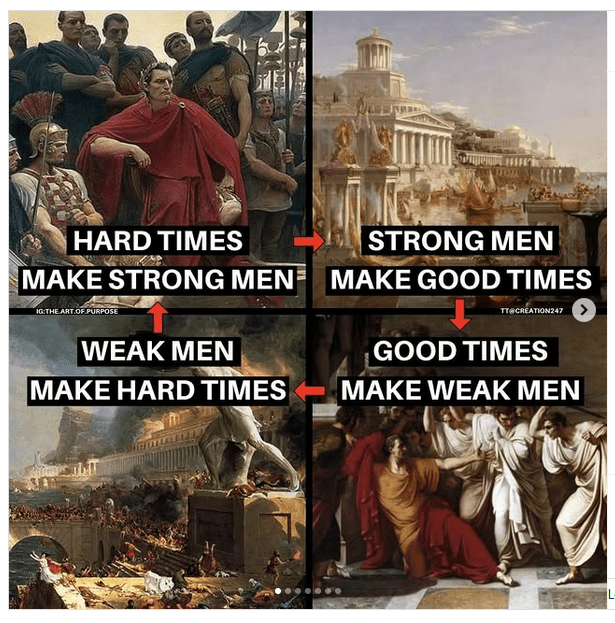
Well, for democracy to remain functional, at least some wise men need to remain both strong and focused on the job at hand. Otherwise, the helm will be confiscated by the would be strong but not so wise….

And why is it that good times tend to make weak people?
First of all, good times tend to weaken ‘the people’. Not as much to weaken the individuals living a good life as to make them careless. To take the good times for granted. To convince them that ‘times’ will continue to remain good regardless…..

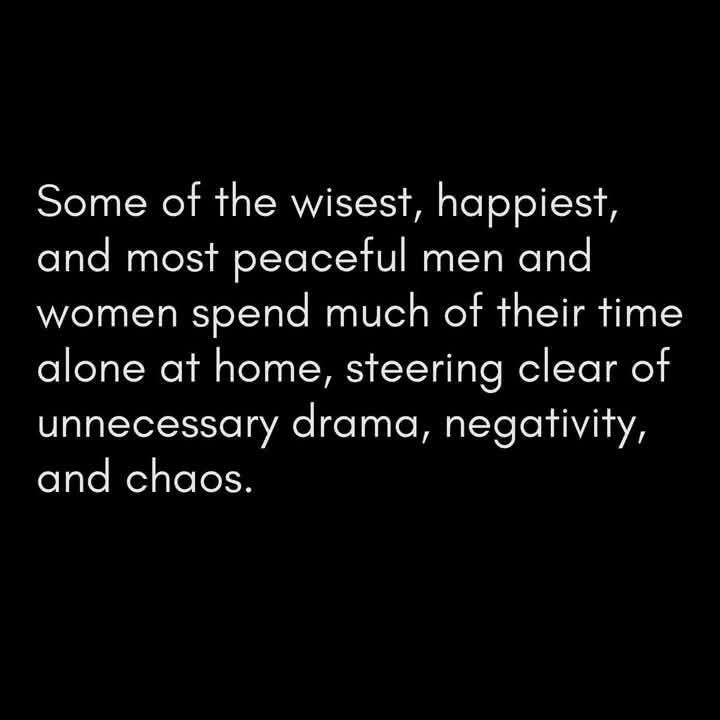
Not having to struggle for their day to day existence tends to make ‘some of the wisest, happiest, and most peaceful men and women to spend much of their time alone at home, steering clear of UNNECESSARY drama, negativity and chaos’.

This being how successful democracies sometimes succumb to tyranny and how empires eventually crumble under their own weight.

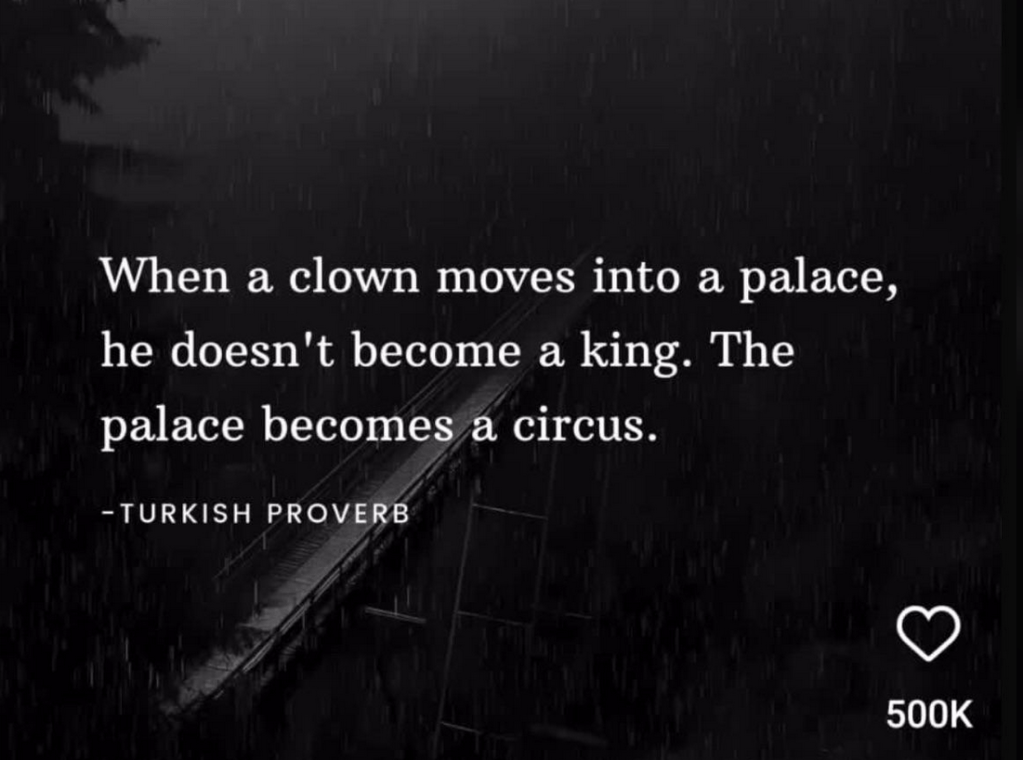
Indeed, but only a clown has enough gumption to tell the king that ‘he’s got no clothes on’!

Furthermore, every respectable palace has both a king and a jester.
The jester overpowering the king doesn’t change the palace into a circus. Only refocuses the attention of those paying attention…

My first hand experience has driven me to understand:
That ‘government’ – which is nothing but an instrument – will be hijacked whenever ‘the people’ doesn’t pay enough attention. Or has been incapacitated. One way or another.
That communism is just another pretext used by those yearning to hijack the government. And that those people would use any pretext to ‘prime’ the attention of those they want to use in their quest. In their quest to hijack the government.
That democracy – the kind that works – is not about electing the best man for the job. For the simple reason that there’s no way to determine what that person will have to do! The actual things they will be confronted with! In practice, the really useful kind of democracy is that which makes it simple for the people to remove from power/refuse those obviously unfit for the task.

For instance, what’s currently going on in Venezuela. The people tries to remove Maduro from office and the incumbent president refuses to go.

Sounds familiar?
Happened, tentatively, even where democracy was considered ‘too deep rooted to collapse’?

The third thing I understood living under a communist regime was that reproductive rights are very important. That if you want women to have more children, you have to make them ‘feel good’ about it!
That banning abortion will get you nowhere. That banning abortion – and books – will only show your true nature.

I’m vocal about these three things. Including on FB.
Exposing these ideas on FB made it so that I have friends who love Trump and friends who hate Trump.
As a matter of fact and all things considered, I’d describe myself as a Republican rather than as a Democrat. A never-Trumper Republican…

A couple of days ago, the meme above had been shared by a FB friend of mine. A Democrat.
Yesterday it was shared by a Trump die-hard.

Is this strange?

No, not really. We’re all people. Normal people concerned about the future.
The current situation is the consequence of what we’ve done.
Allowed ourselves to be divided into camps.
By those willing to do anything in order to hijack the government. Even if only temporarily.

How many of you cringe when hearing ‘X party/candidate has won the elections’?
Why do we continue to listen when the talking head/would be influencer makes such a horrible mistake?
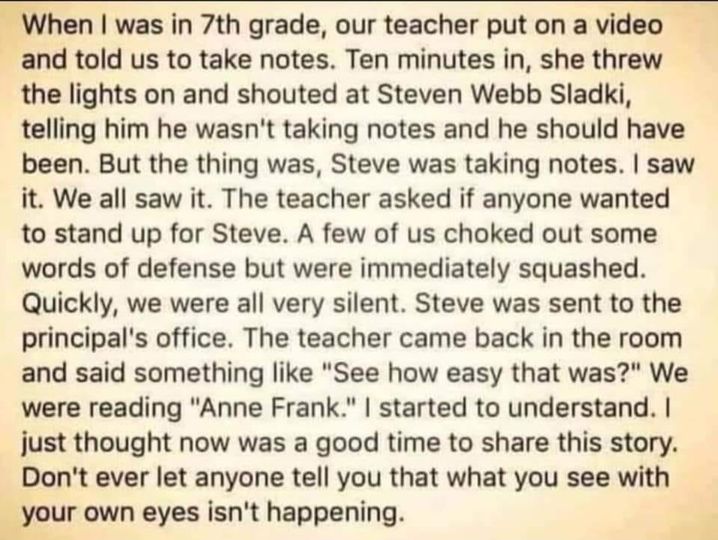
An electoral process is about us deciding our fate, not a pageant!
Our collective fate!
We, as a community/people, are supposed to be the winners, not any of the candidates/parties…

“To use rules or laws to get what you want in an unfair but legal way”
From Longman Dictionary of Contemporary English

Having a name for ‘it’ means that we’re aware of it’s existence.
We’re still using it, though.
It is wise?

We’re not the first ones to use the method.
The HIV virus has somehow ‘learned’ to hide itself inside our immune system.
Not only to ‘bend the rules of life’ – all viruses do that for a living – but to bend the very rules of immunity!
But we are the first ones to use ‘it’ knowingly!

Not fully aware of the consequences but nevertheless on purpose!

How did we get here?

By ‘gaming’ the laws of nature!
Our ancestors believed flying was reserved for birds. By making good use of what we’ve learned about the ‘system’, we’ve been able to overcome many of our limitations.
We’ve also overcame our common sense…

We forget our planet is limited.
Vast but still limited.
We also tend to forget that our knowledge/understanding is also limited.
We’ve become so confident in our ability to game the system that we tend to ignore the two facts I’ve just mentioned.

Even worse, we’ve given up ‘the brotherhood of man’.
We’ve become humans by talking to each-other. By hunting together. By tilling the earth together.
Then we’ve started to fight. For the same earth we’ve been tilling together…
We’ve invented ‘capitalism’. A manner of doing business which relies mostly on trust. On the rational expectation that the partners will rather fulfill their respective parts of the deal than becoming known as fraudsters.
About the same time, we’ve also invented ‘democracy’. A social arrangement relying on mutual respect.

And we “saw that it was good“.
It lasted for a while…

Recently, capitalism has been gamed into a relentless hunt for profit.
Currently, democracy is being played with alternative facts.

We’re becoming viruses!
Some of us, anyway.


What is going now in China – and in Russia, for that matter –
has nothing to do with the ‘left’.
With what is understood as “left” in Europe…
Instead, it has many similarities with fascism.
‘Corporatist’ states imbued with revindicative nationalism.

Nassim Nicholas Taleb has introduced the concept of “Skin in the Game“.
In short, it is about the fact that the decisions made by people who do not directly and immediately ‘enjoy’ the consequences of their choices have a high probability of being bad. A phenomenon that is accentuated as bad decisions are not immediately sanctioned by those who suffer.

Taleb’s observation only confirms the fact that all dictatorships/authoritarian regimes have collapsed.
Without exception!
Alternatively, it is very easy to see that democracies ONLY last as for long as they manage to maintain their ‘functionality’. That is, for as long as people can – and undertake – to voice their grievances. And for as long as people listen to each other. Respectfully! In vain, some shout about being ‘hungry’ if nobody listens/cares ..

Returning to the idea of ​​’leadership’, yes, countries are led. By some who consider themselves/are considered to be ‘elite’. ‘Led’ only from the operational point of view, however…
Countries are living things, ‘natural selection’ still has the last word!
Ernst Mayr, a biologist, said that ‘evolution is not about the survival of the fittest, but about the disappearance of those who cannot find their ‘right’ place. The misfits. ‘. That’s right, countries have big problems if/when they don’t manage to take down the ‘misfits’ who happen to have clambered into power.
Why countries don’t succeed to do this in a timely manner? How did they clambered there in the first place…
Everything starts when the popular dissatisfaction reaches a critical level. Which dissatisfaction is engendered when the members of that country no longer care for each-other. When mutual respect has disappeared.

I will conclude by returning to the major difference between communism and fascism.
Both of them appeared in situations when enough dissatisfied people were ‘wandering aimlessly’ while looked down by the rest of the society.
Some low-life profiteers seized the occasion and ‘grabbed the helm’. Profiteers who have been able to operationalize the dissatisfaction festering in the society. And the lack of vision of those who hated the others. I repeat myself, both communism and fascism had appeared when various sections of the society despised, and sometimes hated, the ‘others’.
The minor difference consists in the fact that the proto-communist dissatisfied looked up without having any chance to get there, while the proto-fascist ones wanted to return to where they had once been. The Russian muzhiks dying during WWI versus the unemployed German workers who had just lost WWI.

This being where the difference appears.
The difference which makes it hard to recognize what’s going on now in Russia/China as being a form of fascism.
Both the Russians and the Chinese have a lot better lives now than they had under communist rule. Statistically and from the material point of view! Psychologically speaking…
Those who live in well-established democracies – people who respect each other – have a greater tolerance for ‘insecurity’. Each of them knows they can rely on the others. In that environment, failure is temporary. People try as many times as they need to succeed. Or that’s how it used to be…
In communism, we had learned – the hard way, that one was not allowed to make mistakes.
When Russia and China switched to ‘capitalism’ and people saw what could happen to them – to make mistakes while trying – they had become frightened!
And, at least some of them, chose to return – especially psychologically, in the past. Where they felt safe…

“Only freedom of speech with repercussions isn’t anything special.
That has existed throughout every dictatorship.
If we consider freedom of speech as a value,
it must be something else.”

Whenever somebody opens their mouth, they reveals things about themselves.

That’s a repercussion.

Whenever somebody acts upon information gleaned this way, those acts also have repercussions.

The repercussions belonging to the second category are the ones which ensure that, in the end, every dictatorship ends up in failure. In abject failure.

Out of fear, everybody shuts up. So nobody yells anymore ‘The emperor is naked. And about to be run over by a bus’. So the emperor, and his henchmen, end up hanged by an angry mob. Process usually called retribution. Or revolution?

““We are not extremists. We are just angry,” explains Lazar Potrebic, a 25-year-old from a Hungarian minority in Serbia who is entitled to vote.

He – and many of his peers – are worried about the future, and feel that the more traditional parties are not listening to their concerns.

“We feel like our needs are not being met. People our age are taking really important life steps. We’re getting our first jobs, thinking about starting a family…but if you look around Europe, rent prices are going through the roof – and it’s hard to get work.”

.

.

Of course the feeling of not being listened to when you’re young, of not being part of the equation, is nothing new. But many of the parties on the far right are actively courting the young vote, says Dave Sinardet, a professor of political science at the Free University of Brussels.

“The radical right channels anti-establishment feelings,” he told the BBC. “They have a bit of a rebellious vibe – especially when it comes to their anti-woke agenda – and that appeals to young people.””