Archives for posts with tag: Culture

“As a white family, [we were] being told we’re racist
and not given the same opportunities because of the colour of our skin,”
“My daughters growing up in this world — we just couldn’t have it.”
In a bid to expedite his family’s citizenship applications,
Mr Huffman joined Russia’s military.

As living organisms, we are defined by the genes inherited from our parents.
As socialized human beings, our thoughts are shaped by the particular culture seeping through our consciences.
As politically governed inhabitants of various countries, our destinies depend on the wisdom of those calling the shots. On more than one level…

We don’t have much to say when it comes to our genes.
We can always interpret the tenets of the above mentioned cultures.
As citizens, and very much depending on the particulars of each ‘polity’, we can always try to influence the decision making process.

We cannot do much about our genes for a very simple reason. They are part and parcel of our ‘inner-workings’. The immutable part of what we are.
We can interpret culture and attempt to influence others because of our consciousness. Our ability to develop a certain kind of awareness.

Consciousness, the ability, can be construed as a space. The place where our individual consciences exist, meet and interact.
Our individual consciences can be understood as atoms inhabiting the consciousness.
Like all other spaces. consciousness has dimensions. Hence regions. Each region ‘functioning’ according to certain sets of rules. Sets of rules otherwise known as ‘cultures’.
Culture, in general and each of the individual ones, is ‘alive’. Just as life itself is ‘alive’.

Unfortunately, life is only ‘aware’. Not yet aware of it’s own self. Not yet conscious. Only a certain species of individual living organisms has, as far, developed this ability.
‘Culture’ – a living thing because it is animated by individual living organisms, the conscious ones – is also ‘aware’. Just as life is ‘aware’. But, again like life, culture has not yet developed a full consciousness. And awareness of

Atoms, in the real world as well as the individual consciences inhabiting consciousness, ‘cooperate’.
Democrit’s atoms, in various combinations, constitute the ‘real’ world. Including here the individual living organisms harboring individual consciences.
Conscious ‘atoms’, the individual consciences harbored by the living organisms which have been able to develop one, are about to take over a portion of the above mentioned ‘real’ world.

Unless they destroy it first…


Observe the abnormal.
The out of ordinary.
That’s how you might figure out the regular…

Psychology 101

We live on faith.

Without faith, one cannot even raise from their bed in the morning…
‘What’s the use?’

Animals start looking for food whenever hungry.
Human beings, for as long as they remain conscious, check whether there’s any chance of finding food before attempting to find it.

Faith in what?

Living organisms are made of matter.
Atoms and molecules stacked in a certain order and interacting according to certain rules. Rules being preserved, managed and passed over from generation to generation as ‘genes’.
Individual organisms have very little influence about the whole process, except for some ‘checks and balances’. Which checks and balances work according to some rules also contained in the genes.
Species, generations and generations of individual organisms, evolve. The genetic information passed over from generation to generation becomes slightly altered as evolution forces it to fit the changes in the environment.
According to Ernst Mayr, evolution is about the demise of the unfit. Individuals need to be able to survive in the environment where they happen to have been born. If the genetic information inherited from the parents is suitable for that environment, the individual has a fighting chance. To live and to pass over the genetic information which made survival possible.
The nature of life – the existence of successive generations and the mechanisms which pass genetic information from one generation to the next one – makes it so that genetic information may be slightly altered when copied into the new organism. The alterations appear haphazardly and ‘survive’ only if they don’t jeopardize the existence of the individual organism harboring them. If the organism survives for long enough, the alteration is passed over to the new generation. If the alteration happens to be beneficial for the organism in the context of circumstances where it needs to survive, that alteration has increased the chances of survival for the organism. And its own chances to be passed over to the next generation. Please note that no agency is involved in this process. Nobody and nothing but happenstance has anything to do with what’s going on here!

Conscious organisms are made of animals plus conscience.
You need a living organism in order to have a functional conscience.
Which conscience is nothing but a set of rules learned from the other members of the ‘species’ to which the individual belongs. In fact, conscience – individually speaking, is nothing but a set of ‘cultural’ genes.
Lumps of information passed on from generation to generation which allow us to actively interact amongst us, people, and between us and the environment where we happen to live.
Each individual conscience is like a ‘cultural’ organism riding on top of a biological one.

The difference between the cultural organism and the biological one being the fact that the cultural organism is aware of itself.
Of its mortal nature!

Being an organism, conscience has only one job. To survive for as long as it can and to pass over the information it has gathered to the next generation.
Just as a biological organism is driven by a ‘vital force’ – named ‘survival instinct’ by those trying to make sense of this whole thing – conscience is driven by hope.

Biological organisms have a symbiotic relationship with their environment. They ingest substances and excrete the consequences of their metabolism. They also notice information and react to it. Individually as well as collectively.
As a consequence, the world we currently live in is the ‘byproduct’ of 3 billion years of countless biological organisms having already lived on this planet. Without this teeming life we wouldn’t be here and the planet would be barren.

Cultural organisms have deepened and accelerated the process.
Not only they have physically transformed the planet but they have also built meaning.

As I mentioned before, consciences need hope in order to survive.
In order to have hope, you need meaning.
Things have to make sense.
Out of sheer necessity, we’ve built explanatory scenarios for what’s going on around us.

A process, a space and some consequences.

The process through which individual agents transmit and receive information.

The space inside which the above mentioned individuals do what ever they set their minds to do.
The stage used by each of us, according to our own goals and abilities, to perform our self assigned roles. Inside and/or outside the roles bestowed upon us by ‘fate’.

Consequences?
The shapes and content of our individual consciences.
Consciousnesses.
Culture, as the historically accrued trove of knowledge more or less accessible – through language and subjected to interpretation – to each of us.
Civilization, as the result of our cooperative effort to ‘make good’ the knowledge we have inherited and/or gleaned ourselves.


Individual organisms, working in concert, for a while, organize themselves in such a manner as to be able to keep the inside it, the outside out, to ingest what ever they need to survive from outside and to excrete the byproducts of their living. Also known as the by-products of their metabolism.

In order to perform the above, the individual organisms use information gathered by their ancestors and transmitted over generations. Which information has been shaped in time, through an evolutionary process, in order to remain useful for the currently surviving organisms.
Which said shaping has happened through the natural culling of the individuals bearing information no longer fitting to the then existing natural circumstances.

For life to continue, individuals living at anyone time must engage in reproduction.

Exploring the consequences of our limited consciences

A truth is, first and foremost, an expression.
A message, formulated by an observer, describing a portion of what the person expressing themselves considers to be a ‘portion’ of ‘reality’. Being a message, any truth is formulated by means of a language.

Does anybody know everything about any subject? About anything, actually?
No, nobody knows everything about anything. Hence there is no such thing as a complete truth.

Furthermore, being expressed by means of a language, a truth – any expression, actually – will never be able to convey to the person receiving the message everything the transmitter intended to say. The transmitter is never able to cram ‘everything’ inside an inherently limited message, no language is absolutely ‘precise’ and no receiver will ever interpret any message the way the transmitter intended it to mean. Hence even if anybody will ever learn everything about anything, that person will never be able to convey that knowledge to anybody else. Let alone to everybody else…

What next?
‘Never ever believe anything? Anymore?!?’

Is it possible for us, humans living in concert, to cooperate in this manner?
Knowing that nothing which is being said, one way or another, is ‘true’? Completely true?

Well, we did get this far, didn’t we?
We’ve been expressing ourselves, in the imperfect manner I described above, since we’ve learned to use language. Since we’ve learned to speak…

70 000 years ago, give or take a few millennia, is when some scientists believe we’ve started to communicate more or less like we do now. The people living then had the same genes we have now and the bones they have left us to dig up and stare at are similar to ours. Hence the only thing which differentiates us from our ancestors is our culture. A treasure of knowledge which has been noticed – bit by bit, formulated using language – message by message, and remembered, one way or another. Hence the only difference between us and our ancestors is a collection of incomplete – and imperfectly interpreted – pieces of truth.

Then again, is it possible for us – humans living in concert – to cooperate by means of incomplete and ‘misinterpreted’ pieces of truth?
Well, we came this far going (up?) this way, didn’t we?
It seems that as long as we do it ‘in good faith’ things will, eventually, ‘mesh up’ just fine!

Which leads us to ‘the truth’. ‘The’ as different from ‘A’ truth.

While a truth is a message, the truth is a state of mind.
The understanding of the fact that what we call ‘reality’ can be learned only ‘in concert’.
Only as long as we help each-other along the process. Only as long as each time we formulate ‘a message’ we do our best to ‘speak the truth’.

https://www.ontology.co/heidegger-aletheia.htm

Yesterday you’ve been babbling about painting an elephant. One which was already present in the room. Doesn’t make that much sense, does it?

In my childhood there was a certain emperor. Who had been duped by a couple of crooks to wear a suit of clothes so special that they were in fact invisible. Hence the emperor walked around naked, convinced he was wearing the coolest set of rags available on this Earth. Pun intended, of course. I forgot to mention the price. Not only hefty but also recurrent. Each set of clothes, of in-existent clothes, could be worn only once. They were too fragile for ‘second helpings’. The courtiers kept congratulating the emperor for his beautiful attire so the scam went on for quite a while. Until he took to the streets of his capital city to show off his clothes to the ordinary people. And a child exclaimed: “Look. the emperor is naked”. And those present started to laugh.

Same thing here. Everybody senses that something’s amiss. Except for those who should know better. Who, for various reasons – I’ll get there, soon enough, don’t believe what they see. Or, more exactly, refuse to ‘go to the bottom of it’.

Back in the ‘good old days’, emperors had jesters. Courtiers who were allowed to speak the uncomfortable truth. Cloaked under a thick layer of funny words, true, but well worth saying.
This is what I mean when I ‘babble’ about ‘painting the elephant’.

I’ve already mentioned the story about the naked emperor. Now it’s time for that about the four blind men being led to learn about the elephant. One got to feel the hind legs, one the huge belly, the third got acquainted with the ears and the last with the tip of the elephant’s trunk. When later asked to share what they had learned, the first said the elephant was a pair of tall columns, the second said the elephant was a huge barrel, the third contradicted the first two maintaining that the elephant was a leathery curtain of sorts while the last was convinced that the elephant was a thick snake ending with a finger.

As I said before, ‘same thing here’. For ideological reasons, we consider some things and disconsider others. Furthermore, for psychological reasons, we tend to coalesce into ‘bubbles’. Those who consider the same things tend to stick together. And to disconsider those who consider other things.

I’m afraid this is too hard for me to follow. You first want to paint an elephant, then come up with a naked emperor and end up with parts of an elephant. Is there any elephant at all? Or all we have is a collection of disparate impressions? Man made illusions, vaguely resembling parts of an elephant and involving nakedness?

Well, you got the gist of it but you’re afraid to say it out loud.
The elephant is indeed of our own making.
An image. Not an illusion, mind you! Just an incomplete image of what’s going on around us.
Let me try to spell it differently.

The world was complicated to start with. Both wide and deep. Too wide and too deep for any of us to be able to comprehend it in earnest. But for most of our history, we didn’t have to. We used to live ‘locally’. Both geographically and ‘spiritually’. Each of us, individual human beings, belonged to a place. To a village and to a tradition. When one of us happened to move to another village, they, more or less naturally, translated their ‘spirit’ into the local tradition.
Nowadays, the world has become even more complicated. We made it even more complicated than it was at the beginning. We uncovered many of the previously unknown nooks and crannies. Building the illusion of knowledge in the process. Then we assumed tradition. Called it culture and made it our own. Took it with us where ever we went. Shared it with others and, sometimes, even imposed it – or parts of it, upon others.

The world itself is no longer straightforward. For us…
Our ancestors didn’t make any distinction between the physical world and the tradition which made sense of it. The world – ‘Cosmos’, as they used to call it, was whole. ‘Reality’ was made of ‘objects’, the names of those objects and the rules between them. The point being that our ancestors did not make any difference between an object, its name and its place in the order of things. Between the physical reality and tradition. Between the objects per se and the meaning – name and connecting ties, we’ve attached to each object.
Only after the Ancient Greeks had come up with the concept of “phusis” things were separated into natural and man-made. Into real and illusory…

That being the moment when the elephant had been born.
When we have started to steer our fate. Not to determine it – we’ll probably never be able to do this in a comprehensive manner, but to influence it.
Which influence has two dimensions. Size and … there’s no words for what I have to say right now. ‘Awareness of what’s going on’?!? Our ancestors did what they used to do because they had to do it and they did it as things were done at that time. We, on the other hand, get to choose among the many things which should be done and the manner in which we see fit to do it. Meanwhile, we entertain the illusion of doing all these things in a fully conscious manner.

A part of the elephant I have in mind consists of the fact that our consciousness is limited. But our illusion about our consciousness is bigger than the reality of the matter.
Another part of the elephant consists of the fact that more and more of us no longer consider advice. From those who entertain different opinions (illusions?!?) than us.

And why should I accept advice from somebody who promotes illusions?

I didn’t say you should accept advice from a peddler of illusions. From a con artist or from a snake-oil distributor.
What I said was ‘be careful, your own convictions are nothing but, ultimately, illusions. Man made illusions. Some of them, maybe, closer to reality than those entertained by other people. Meanwhile, others of your illusory convictions – most of them, probably, are more distanced from reality than those entertained by those who ‘control’/master each particular realm of ‘knowledge’.
This being the reason for which we go first to the doctor instead of raiding a pharmacy when our child gets sick.

I didn’t say you should accept advice from any peddler of illusions.
All I said was that we should pay more attention to what other people have to say. More considerate attention to what other people say, bearing in mind that our own convictions – about anything, are nothing but ultimately illusory.

What if there’s no reason, per se?

What if there are only individual reasons for each of the experiences each of us passes through?

Many of those reasons belonging to the ‘experimenters’ themselves and all reasons – even if the individuals who provide the actual causes are not aware of all the consequences, belong to us. To us, humans.

I have no way of determining whether there is any ‘supreme being’ but what I understand of this world has led me to the conclusion that this ‘aspect’ is irrelevant. For us. For those of us who are currently alive.

That supreme being, if it exists, has done nothing more than to provide a set of opportunities.
The world in which our ancestors – some 1500 generations ago, have become conscious human beings. The rest is of our own doing.

Influenced a lot by the specific circumstances in which each culture has been developed – by those having to make do in those specific circumstances, but still ultimately ours.

This ‘conclusion’ is the sole solution I had been able to come up with to the conundrum which opposes the notions of ‘free will’ and karma/fate/you name it.

Getting out of a relationship before entering the next one makes sense, right?
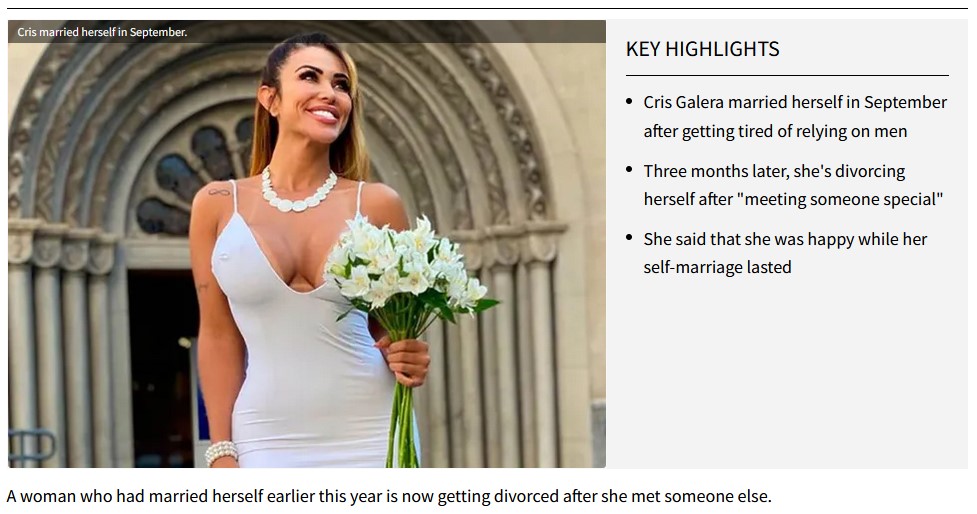
But why would anyone marry his/her own self in the first place?

To send a signal? ‘I have removed myself from the (singles) market’?
As a publicity stunt? Proving – unintentionally, that marriage continues to be an important institution, at least at the symbolical level….

On the other hand, why bother? At all…
Specially now, after the advent of the ‘prenuptial arrangement‘….

So, marriage is, in reality, only about ‘property’? Who gets what after the couple separates? ‘Naturally’ or otherwise?
But, again, why make it a special thing? Property had been formally ‘coded’ about the same time as marriage was… why introduce another set of regulations, on top of those pertaining to the ‘mere’ individual property?

There must be something else…

And that something must be in our heads!
‘Property’ has more or less the same meaning all over the world.

Culturally, there are many forms of property ‘out there’ but the most ‘advanced’ cultures ‘use’ the same three main types of property, each in it’s own ‘mix’. Private property, state property, communal property…

Meanwhile, each culture/civilization has it’s own type of marriage. Or used to have, until very recently. Which types of marriage differ widely and in many ways.
From who can enter a marriage – number of people, ethnicity, religion, caste, etc., to how a marriage ends.
From the conditions which must be met before the marriage to the consequences of the act. And to the consequences of the marriage being ended ‘before time’, if possible.
Not to mention the wide gamut of rights and duties each member of a marriage might have, according to local rules and (by)laws.

If you think of it, ‘property’ is almost ‘natural’. It makes a lot of sense, ‘functionally’ speaking, to be precise about which is which. And about which is whose.
Life is a lot simpler when each member of a community knows what/how much can be had/used/eaten without anybody else having any say about the matter, what must be left alone and whose ‘permission’ you must ‘acquire’ before ‘trespassing’.

Meanwhile, ‘marriage’ is a lot more artificial than ‘property’. Leave alone the fact that the rules are far more complicated – and far more diverse.
In practice, marriage has been really important only for the ‘top’ members of any given society…
And the ‘fun’ fact is that the higher the rank of the individuals concerned, the more ‘leeway’ they used to have…

Henry the VIII had ‘invented’ a ‘new religion’ in his attempt to bend ‘the rules’ according to his wishes, the French monarchs had been famous for their mistresses… and a ‘modern’ financier had been recently convicted for ‘lending’ underage members of his ‘harem’ to some of his buddies…

That ‘something’ is, definitely, in our heads!

NB!
I’m not implying that that ‘something’ is good or bad!
We are the ones who attach ‘values’ to things/concepts.
We are the ones who ‘notice’ things and relationships, use them – properly, for a while, and then experiment in ‘abusing’ them.

A (beautiful) woman marrying – and divorcing, her own self is perceived as being a ‘fun thing to read about’ while gay couples becoming able to establish a formal family is perceived, by so many, as being ‘a threat’.

There are some things each of us must do.

Breathe, drink, eat, take cover.

There are some things each of us should do in moderation.

Drink, eat, ‘rest’…

There are some things each of us should never do.

Lie, steal, kill.

The things we must do ‘depend’ upon our DNA.
Unless we do what our DNA tells us to do, we die.

The things we shouldn’t do have been determined culturally.
Our fore-fathers have noticed that not doing ‘those things’ helped a lot.
That communities who taught their members to not do those things survived a lot easier and fared a lot better than those communities who had been ‘lax’ about ‘things’.
Teaching what to do and what to not do across generations transformed learned information into culture.

In time, culture has fulfilled the same function as DNA.

DNA had made it possible for life to exist. For species to survive. And to evolve when needed. When the environment had changed.

Culture had made it possible for communities to survive.
Individuals belonging to each generation didn’t had to reinvent fire each time they were cold. Or afraid. Or hungry.
They just remembered what their ancestors had taught them and put it into practice.

But there’s also a huge difference between DNA and culture.
Both consist of information passed over generations and both are instrumental in the survival of those who depend on that information being put to use.
The difference consists in the fact that DNA actually demands a certain behavior while culture only recommends certain ‘answers’.

There’s more.

DNA is a ‘language’. It has ‘letters’, ‘syntactic’ rules and even means to correct errors.
Culture uses languages as a vehicle.

Both code information using ‘letters’ and ‘words’ but they differ in how that information is passed to the next generation.
DNA passes that information in a way more ‘rigid’ manner than culture does.

While it is true that slight differences occur whenever genetic information is passed from one generation to another – that’s how evolution works, those ‘directly interested’ in the process have nothing to say about this whole thing. The differences occur accidentally and survive only if they don’t harm the organisms where they appear.

With cultural information things happen in the exact opposite manner.
Differences occur only when enough individuals notice that it would be beneficial for them to change that particular habit in that particular manner.

And now we have reached the moment to contemplate another similarity.

As the DNA has become more elaborate, the ‘superior’ organisms had enjoyed more individual ‘freedom’. Or ‘lee-way’.
Insects have more lee-way than worms, fish have more lee-way than star-fish, dogs have more lee-way than frogs and humans have more freedom than the rest of the apes have lee-way.
Similarly, people belonging to the hunter-gatherer culture had accrued a lot more freedom when they had learned – and taught it to their children, how to make fire. And so on.
Those who had learned how to grow their own food – and passed the information to the next generations, had far less chances of dying of hunger. And a lot more lee-way to conduct war…
Those who had learned how to make metal tools were a lot freer than those who shaped their tools out of stone. And very soon the stone-shapers had been ‘subdued’ by those yielding bronze weapons.

And so on to the present day.
Those who have become adept users of mass-media are seeding ‘change’ into the minds of the naive.

I only hope that they will eventually find out what Ernst Mayr had to say about this process.

Evolution is in no way about ‘the survival of the fittest’.
It is only about the demise of the unfit.

The problem with the ‘lee-way’ generated by culture being that whenever it becomes too wide the whole system becomes fragile.

Whenever people get high enough on freedom they forget that in order to survive we need to remain inside the ‘straight and narrow’ mandated by DNA and endorsed by culture.

Otherwise put, being torn between musts and don’ts is far better than being stuck. In a grave.

One-Time
Monthly
Yearly

Make a one-time donation

Make a monthly donation

Make a yearly donation

Choose an amount

$5.00
$15.00
$100.00
$5.00
$15.00
$100.00
$5.00
$15.00
$100.00

Or enter a custom amount

$

As much as I love writing, I do have to eat.
And to provide for my family.
Earning money takes time.
If you’d like me to write more, and on a more regular basis, hit the button.
Your contribution will be appreciated!
Another very efficient way to help would be to share my posts.

As much as I love writing, I do have to eat.
And to provide for my family.
Earning money takes time.
If you’d like me to write more, and on a more regular basis, hit the button.
Your contribution will be appreciated!

As much as I love writing, I do have to eat.
And to provide for my family.
Earning money takes time.
If you’d like me to write more, and on a more regular basis, hit the button.
Your contribution will be appreciated!

DonateDonate monthlyDonate yearly

Basically, Adam Smith and Ayn Rand had the same thing in their minds.

How society works and how individuals meet their needs in a social context.

And both of them had reached the same solution.
That capitalism was good.

Unfortunately – for Ayn Rand’s fans, any similitude between them stops here.

Adam Smith had described a reality.
Something which had evolved, naturally, in the cultural milieu to which he had happened to belong.

Ayn Rand was trying to push a social model.

The fact that what Rand was trying to push was very close to what Smith had described is, indeed, important.
But the difference between something which had evolved naturally and the very same something which had been imposed, by force, is also important.

Let me give you an example.

Christianity.
Much of what we have today – from ‘human rights’ to the very concept of ‘science’, has it’s roots down in the principles exposed in the Bible.
South America is, now, a Christian territory. Populated by people who had immigrated as Christians and by people – just as Christian as the first category, who had been born to parents having other beliefs. Parents who had been forcefully ‘conversed’ to Christianity.

It’s easy to notice that people in South America don’t fare as well as those in Europe, North America or Australia.
Why? They are Christians, South America uses the same capitalism and the same democracy as the rest of the ‘civilized’ world… why are the results so different?

Don’t bring ethnicity into discussion!
The explanation is simple and has nothing to do with ethnicity.

While in Europe, North America and Australia Christianity and capitalism had evolved naturally – in the sense that they had occurred in Europe and had been translated by the European immigrants to North America and Australia, in South America – and in other places, Christianity and capitalism had been forcefully imposed by the immigrants upon the much larger local populations.

Just as Communism had been forcefully imposed by the Lenin led Bolsheviks upon the Russian People.

Forget about the fact that communism had failed, no matter how hard some people have tried to make it work, while capitalism works for real – when used properly.
My point is that whenever somebody tries to force something upon somebody else, the results will never rise to the expected level. No matter how good that ‘something’ might be.

Are you familiar with ‘you can lead a horse to water but you cannot make it drink’?
Leading it to water is enough.
Whenever somebody becomes ‘enthusiastic’ enough to try to force a horse to drink, the results …. no matter how skillful the ‘enthusiast’ might be…

And there’s another ‘small’ thing which makes a hell of a difference.
Adam Smith’s main point was that the whole society benefits from the functioning of the free market. Where each ‘agent’ competes with the others towards meeting his own goal. Which competition – as long as it remains free, results in everybody – well, almost, having a better life.
Ayn Rand’s point being that the free market is there only for the benefit of the ‘strongest’. Which is in line with Lenin’s view on the matter… ‘The Bolsheviks merit to lead the revolution because they are the strongest…’