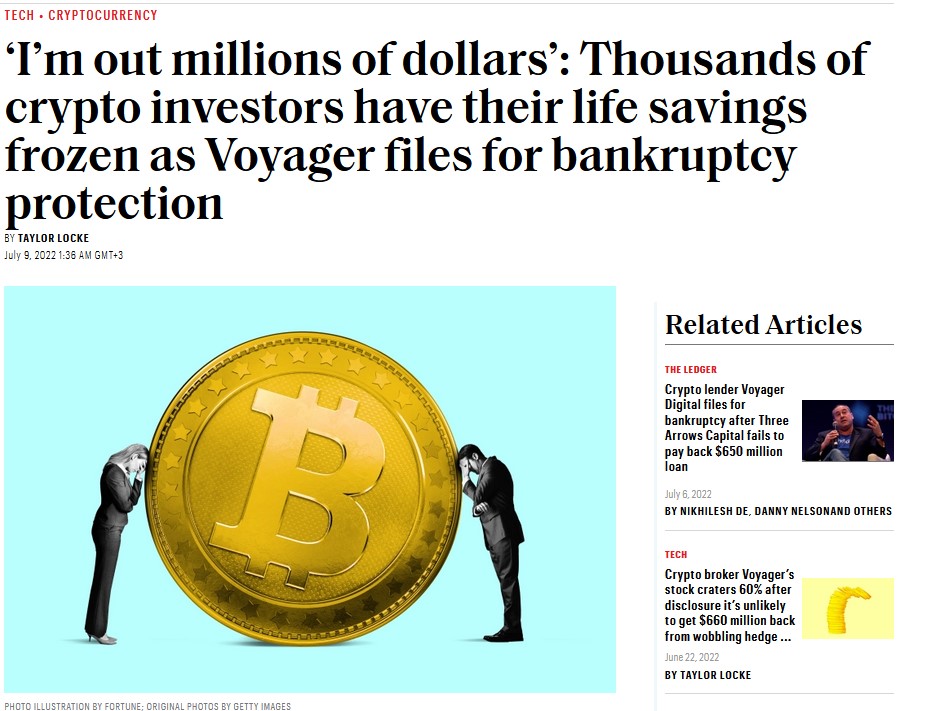
Why on Earth would anybody invest their ‘life savings’ in ‘crypto’?!? Furthermore, why would anybody who has millions of dollars to invest would use a ‘custodial wallet‘?!?
Linkedin took the trouble to inform me that Frontex is looking to hire an Executive Director.
As far as I know, the ‘marks’ for this kind messages are chosen by some ‘algorithms’. Which are supposedly driven by something called ‘artificial intelligence’.
Which makes me wonder…
Are these algorithms intelligent enough to determine that I have the slightest chance of being selected for this position? That I have the slightest intention of applying for it? Alternatively, dumb enough to bother?!? Or are these algorithms intelligent enough to, for whatever reason, attempt to pull my leg?
‘So you’d better stop trying! Why don’t you just enjoy life as it is?’
‘What about Copernicus? Did he change the world?’
No, he only offered us an ‘alternative’ interpretation of it! It was us, those who had accepted his interpretation, who did the actual change. By acting as if Copernicus’ teachings were true.
‘But Copernicus hadn’t been the first to utter those ideas!’
Indeed! But until Copernicus, the world didn’t actually need that version of the facts. Up until those times, for ‘regular Joe’ it made no actual difference whether the Sun circled around the Earth or the whole shebang moved the other way around. The Sun dawned as advertised and spring always came as it was supposed to. Which circled around who made no difference but for the academics!
Only when ‘regular Joe’ had started to sail around the Earth – and needed to accurately plot the course of his ship on a map, the relative motion between Earth and Sun had become relevant. For those belonging to/living in the ‘real’ world!
For the last 15 last years or so I have pushed myself to understand what was going on around me. Each time I had the impression that I had discovered anything new I was soon disappointed. Very shortly afterwards I most often found out that somebody else had written about the subject. Describing it more or less in the same way as I understood it. Not to mention the fact that the vast majority of the answers I had found had been reached by reading. My quest changed accordingly.
‘Why has this trove of knowledge been left aside for so long?’
Because regular Joe didn’t have any use for it? Until now, that is…
But, surely, the elite should have done something about this! After all, ‘understanding’ – a.k.a. ‘making sense of things’ – is our only reason to be, right?
Not so fast! The elite did something about ‘it’. As I’ve already mentioned, there’s nothing much to add to the things already understood by others and passed along to us from the depths of history. The very fact that all these pieces of information have been carefully preserved by countless generations of scribes and ‘book keepers’ is the living proof that the elite fulfilled its calling. It’s up to us to make good of their dedicated work. For our own sake.
And for that of our children!
So yes, I cannot change the world. Neither can either of you! Alone.
Quite a large number of people are complaining about how hot it is nowadays. So uncomfortably hot that they have to stay indoors until late in the evening.
And no, they are not pensioners. They work from home, earning enough money to be able to have everything delivered to them.
Which reminds me of my first job, right out of university. A big factory building where water almost froze in winter and temperatures rose to 41-42 degrees Celsius in August. Inside that building were, among other ‘run of the mill’ machine-tools, 3 top of the art automated Czech-built lathes. This story goes back to 1986 and happened in communist Romania. The lathes were very precise but couldn’t be used all the time. In winter they stopped working altogether and in summer they faltered. No amount of fine tuning could bring them back to yielding usable parts. It took a few years for the brass to figure-out what was going on. The lathes were designed to work in a ‘controlled environment’. The temperature was supposed to hover between 15 and 25 degrees for the lathes to function normally. Hence the lathes were ‘sheltered’ in an auxiliary building. A shed built inside the factory. And provided with efficient enough ‘temperature control’.
We, the people, had been left on the outside. Outside the shed but still inside the factory…. freezing in winter and sweat-drenched in summer. Still working, because we were sturdier than the top of the line machinery…
This morning I came across a FB post.
This brought about another memory.
Sometime in 1990-1991 I happened to lay my hands on a Newsweek magazine. Or a the Economist… I don’t remember exactly. Anyway… the article I was going to discuss with you was about the hard life endured by the American poor people. And was illustrated with a color picture. I’m going to make a small break here and inform you that in the 1990 Romania colored magazines – let alone glossy, were hard to get by. That picture, taken somewhere in the Bronx, contained a color TV and three pre-teen kids. All of them clad in blue-jeans and wearing ‘sports shoes’. You know, the likes of Puma/Adidas/ you name it. In those times, in Romania, bluejeans or ‘sports-shoes’ could be had mostly on the black market. Where you had to fork out the wage earned in a whole month if you wanted to buy a pair of each. Or you could buy them in a brand store. For twice the price….
You see, the communist regimes have crumbled because the leaders had lost contact with reality. The brass in the factory where I had started working couldn’t figure out – nor really cared about, the reason for which those lathes didn’t work properly. And didn’t care about the fact that the workers had a very hard life. On the factory floor and outside its premises.
The liberal-democratic and capitalist regime has created huge opportunities. People used to live incomparably better there than in the rest of the world. And continue to do so. On the other hand, in many of the ‘affluent’ countries people have lost contact with each other. The haves have no idea about how the poor live. Nor the poor have any idea about what it means to be rich.
We live in different worlds. In different realities.
Each of us on their own ‘tin roof’.
The problem being that all of them are becoming increasingly ‘hot’. And I’m not thinking ‘global warming’ now…
Communism had crumbled because the rulers couldn’t understand what was going on. Couldn’t react efficient enough to changes brought about by normal evolution. Because the rulers had gradually lost contact with reality. Which inevitably happens in all authoritarian settings.
We are currently living in different realities. In ‘bubbles’. For now, these bubble still have something in common. We are still able to talk to each other. Sometimes we have a hard time understanding what the other has to say – or don’t really care, but the dialog is still possible.
I’m afraid of the day when the dialog will no longer be possible.
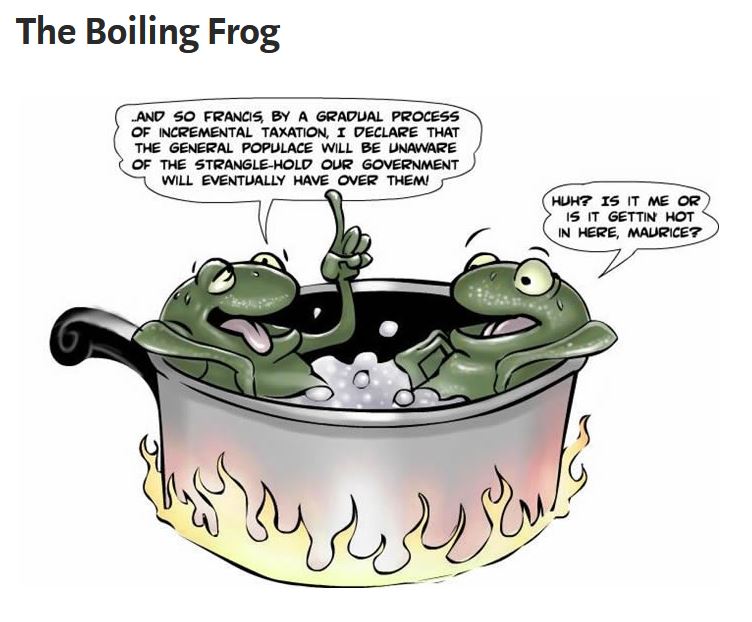
The guys in the pan are so obsessed about the taxes they have to fork out that they actually don’t pay attention to anything else. The guys attempting to collect those taxes are so obsessed about what they want to do with the money that they actually don’t pay attention to anything else.
Meanwhile, the world is growing apart. The bubbles lose contact with each other. And with the hard core reality…
The cats can always jump down from the roof. Whenever it grows too hot or too cold. Where are those two frogs going to jump when things will become uncomfortable?
The common sense definition for an inflationary situation is ‘when too much money chase an inherently limited amount of goods and services’.
The ‘limited amount of goods and services’ part is easy. We live on a finite planet, we have a limited capacity to transform whatever resources we are able to identify into usable goods and services … so… OK, we can always identify new resources and build new capacity but we cannot do any of this ‘on the spot’. We need time. And, even more importantly, we need to put ourselves to it!
Then ‘who does the chasing’? After all, money is ‘inert’. It doesn’t do anything if let alone in a drawer. On under the mattress… In reality, we – buyers and investors, are the true ‘inflationary agents’. ‘But it would be completely stupid to sit on a pile of money when inflation rages! You have to buy something otherwise you’ll loose a lot of value! At least, you need to invest that money…’ This is one of the best examples of a self-fulfilling prophecy! Indeed. Buying or investing during an inflationary bout is the reasonable thing to do! Yet we need to understand that our actions will, temporarily, exacerbate the very inflation we are trying to ‘tame’.
After a while, economy had become ‘complicated’ enough to demand ‘paper money’. The amount of goods and services produced had become so large – and insufficient bullion was added to the money pool, that prices would have had to shrink if the balance was to be maintained. Unsustainable! Nobody would have bought anything and everybody would have jealously guarded their precious money while waiting for the prices to fall further. This process is known as ‘deflation’ and is considered even more malign than a decent amount of inflation. We have to note at this point that ‘paper money’ had been made possible by the advent of the ‘nation’. This is a rather complicated discussion, for the present purpose it’s enough for me to mention that ‘paper money’ being accepted as ‘tender’ means that the general population has enough trust in the issuer of the bills. That the individual user of the paper money trusts/believes he is part of ‘something bigger’. In those times, it was the issuer of paper money who practically controlled the amount of money which existed on the market.
Wrong! For banks to be able to ‘create’ new money, they have to extent credit! For new money to be created in this way, somebody must walk into a bank with a business proposition. That somebody might want to buy a house, a car or whatever else. Or that somebody might want to start a business. If that somebody convinces the bank that they is solvent or that their idea is worthy enough, then and only then new money is created! Money doesn’t appear out of the blue! It is born out of trust. That somebody not only trusts themselves but they are convincing enough to determine the banker to extend that much needed credit!
But wait! We’ve developed yet another mechanism which churns out money. The stock market. After developing the business started with the loaned money, the somebody we’ve been talking about above decides to make an IPO. To sell part of his business to investors. To monetize his initial investment. Depending on the moment chosen for the IPO – and the economic data in the prospect, the IPO can be a huge success. For ‘somebody’ and for the early buyers. You see, each time the price of the stock goes higher, new money is created. Based more on the ‘market’s expectations’ than anything else…
‘But people who put their money on the financial markets are rational agents! They are experts in their field…’
Yeah, right… You’re talking about the experts who had put together the collateralized debt obligations debacle… And many others. Too many others… Also, you’re talking about the experts who had bought those papers! Who had trusted the expertise of the first batch of ‘specialists’!
Thinkers, from Freud to Kahneman and Ariely, have proven than humans are very good at rationalizing and less so at being truly rational. That for a market to behave in a reasonable manner, it must preserve its freedom. That it must be free from ‘bullies’ – individual agents who muster a lot of ‘clout’, and free from any mania.
The 1637 Dutch Tulip Mania is a very good example of what might happen when a market gets obsessed with something. When too many people – not even a majority, forget about the fact that economy (oikonomia) is about making ends meet and that getting rich may be a nice consequence but is a terrible goal.
‘OK, nice try. But what about inflation?’
We have an inherently limited amount of goods and services. A relentless mechanism which churns out money. Meanwhile, some of us obsess about their need to conserve the money denominated portion of their stashed away fortunes.
Inflation is nothing but another mechanism. Which re-balances the market. Piece-meal – adjusting for daily changes, in normal times. When things evolve ‘freely’. Suddenly when the market – the people who ‘man’ the market, find out about ‘the dark side of the moon’.
Regardless of their ‘ignorance’, these dudes had somehow managed to put together a constitution which served well for more than 250 years. It was under the guidance of this Constitution that the “huddled masses yearning to breathe free” have been welcomed. It was under the guidance of this Constitution that the “homeless, tempest-tost” have found the inspiration to learn about atoms, to heal disease, to unearth – and understand, dinosaurs, to master the light-bulb witchcraft… and to build machine guns!
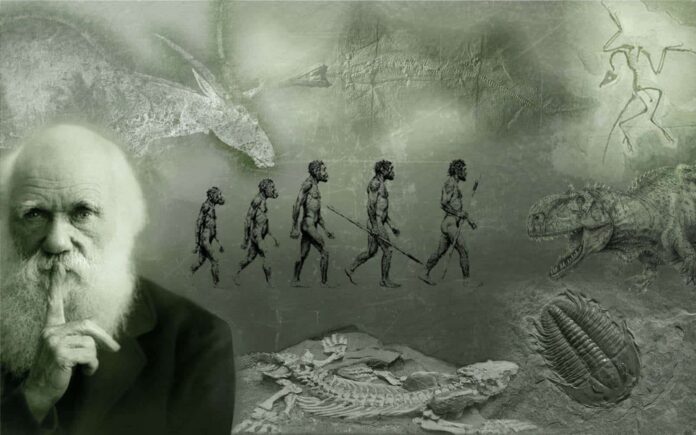
Darwin was also a ‘rich dude’. He didn’t have to ‘work’ to make ends meet. It would have been enough for him to follow in his father’s footsteps and he would have led a plentiful life. He had chosen instead to embark in a lifelong quest for knowledge…
OK, his theory was far from perfect! Yet his breakthrough did put us on the right track!
I could go on for ever. There are innumerable examples of instances when people have punched above their weight. And came out with wonderful results. Not only for them but mostly for us!
For us, to stand on their shoulders.
Are we up to the task?
Are we able to appreciate the US Constitution for its true value? Are we able to understand, once and for all, that Darwin’s “On the Origin of Species” is about way more than ‘the survival of the fittest’?
According to Ernst Mayr, evolution is about the ‘demise of the unfit‘. Which is a way more ‘inclusive’ reading of Darwin’s theory than that which ‘promotes’ the ‘survival of the fittest’.
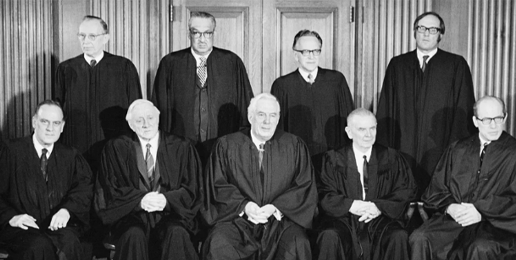
Thurgood Marshall’s ancestors had been slaves. That was how the US constitution was read in those times. And I’m sure that at least some of his fellow Justices’ ancestors had been slave owners.
Yet under the US Constitution the members of the 1973 Scotus had found it in them to sit together and read the principles minted by the Founding Fathers in a manner wide enough to encompass the women’s right to decide about their bodies. And every individual’s right to privacy. To a privacy ‘wider’ than that expressly formulated in the Constitution and in the XIV-th Amendment.
Fast forward to 2022. To when ‘survival of the fittest’ has almost been replaced by ‘the winner takes it all’. To when a far more inclusive Scotus has determined that abortion is something which should be legislated by each state. That a woman’s right to determine what happens to/with her body can be influenced by somebody else’s opinion.
Are we going backwards? Darwin gave us Evolution. We use his theory as a theoretical justification for why some people are ‘more equal’ than the others. The ‘rich dudes’ had given us the Constitution. As a protection against abuse. As a shield for us to use whenever the momentarily powerful attempt to rule our lives. And some of our contemporaries use it as a Trojan horse. To open the door for very oppressive pieces of legislation.
How was this possible?!?
Both sides of the ‘divide’ have lost their ‘perspective’. Their focus. The Constitution, which used to be the mortar which has given coherence to the entire building, has become a ‘bone of contention’. Evolution – which made us what we are today, has become a cuss.
Being rational – and trusting one’s reasoning powers, leads to being convinced that one’s conclusions are right. True! Reached at the end of a due process, hence above and beyond any possibility of error.
Each of us belongs. To a family, to one or more groups, to a nation. To a culture! The closer we belong to a ‘place’, the closer our thinking conforms to that which is common in that ‘place’. The closer we belong to a place, the more we assume the conclusions reached in that ‘place’ are correct.
‘But this has nothing to do with being rational!’
Unfortunately, we’re not rational. In reality, we are mere rationalizers. We use whatever tools ration has invented in order to give our decision a rational shine. At best, we are reasonable.
Reasonable means finding rational arguments for behaving properly. In a manner which helps longtime survival and does its best to avoid unnecessary ‘pain’.
Reasonable also means finding ways to communicate across barriers. NB. Attempting to communicate across ‘barriers’ is reasonable only if it’s done with an open heart. If the message contains a ‘trojan virus’, that communication might be rational but it’s no longer reasonable.
We’re at a cross roads.
We’re split. On one hand, into ‘activists’ and ‘as yet indifferent’. The difference between the ‘activists’ and the ‘as yet indifferent’ being that the activists are actively preaching their rationally obtained mantra while the ‘as yet indifferent’ have not yet reached that stage. On the other hand, both ‘activists’ and most of the ‘as yet indifferent’ come in many ‘incompatible flavors’. And the ‘flavors’ being ‘incompatible’, these people cannot engage in meaningful conversation. The messages sent across the barrier are layered with ‘trojan viruses’. Hence honest conversation – a.k.a. exchanging useful, workable information, is almost impossible.
Until we’ll find a way to do away with ‘activism’, real conversation among us will remain ‘lip service’. Until we’ll find a way to do away with activism, ration will have killed reasonable.
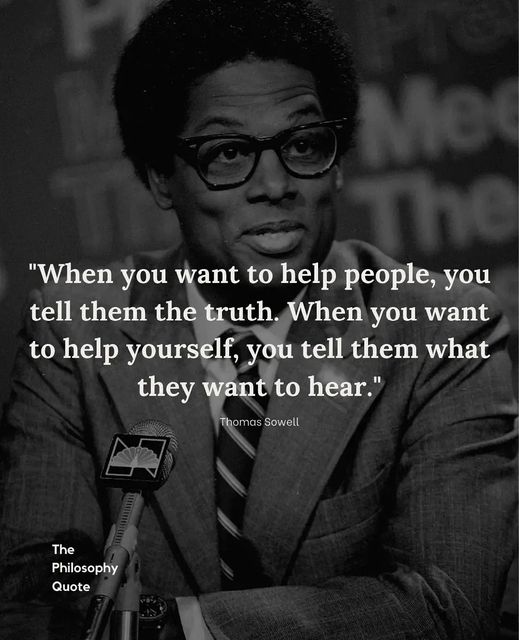
Can’t argue with Sowell… he’s right, right? As usual!
But there’s problem! For me, at least…
According to Orwell, there are people who refuse to acknowledge the truth. Which doesn’t bother the truth, of course. But it bothers us…
If there are people who refuse to acknowledge the truth, then truth isn’t self evident. There isn’t an immediate and direct ‘relation’ between not acknowledging the truth and ‘retribution’.
And for good reason! Truth is extremely elusive. And complex. Impossible to find, actually.
All we can lay our hands on is ‘relative’ truth. A truth we have all labored to find and which continues to remain ‘incomplete’. Against our best efforts! And which, from time to time, is found to be completely false.
Remember how so many of our ancestors were convinced that the Sun was circling around the Earth? Which Earth used to be flat?
Which Flat Earth brings us back to Sowell. I basically agree with him.
“If you want to help somebody, tell them the truth. If you want to help yourself, tell them what they want to hear…”
But do I know what the truth of the matter really is? Do I actually know what they really want to hear? And what if/when they find out? My strategy?
That I was telling them what they wanted to hear in order to help myself?
Sowell didn’t mean this as an ‘advice’? Only as a warning?
Well, I don’t dispute his intentions. Only the underlining assumption. That truth is accessible.
That we can reach it! And manipulate it according to our wishes….
And, if you pay enough attention, the cartoon capitalists represent nothing but the reprehensible side of real life capitalism.
The ‘fat man smoking a cigar in a greasy suit while counting $$$ peeled of the sweated back of his workers’ checks on all counts. On all counts defining ‘real-life capitalism’…
Besides all which have already been said about them, they is also an entrepreneur, risking their money, working crazy hours to build their version of a business, providing work for others – at a price, helping their team – whichever that might be…
And what takes place there has consequences all over the planet.
The first two world wars had been fought by soldiers from almost every corner of the Earth. Almost all countries have declared war on each other, even though not all of them have participated in military operations. The third world war – the Cold One, had been fought ‘virtually’. And was the first to divide the world into three. The ‘liberal-democratic’ camp, the ‘popular democracy’ camp and the non-aligned camp. As always, World War III had been lost by the least flexible among the combatants. By the more dictatorially run camp. By the camp, which, precisely because of the authoritarian manner in which its decisions were adopted, had failed to mobilize all the resources it had, potentially, at its disposal.
I’ll make a parenthesis. Any act of aggression is an idiocy. Regardless of the short-term, medium-term and long-term outcome, the aggressor has more to lose than the victim. This does not need to be demonstrated. The most perfunctory glance at history is eloquent enough. Here I’m concerned about war as an ‘ongoing phenomenon’, I am not trying to integrate it into the narrative. Any war, any act of aggression, is initiated under certain conditions determined by the history spent until then and will be, at some point, integrated into the history written afterwards. And the way it will be integrated into history will determine the conditions under which the next war will be initiated. Or not…
Let’s go back to the present moment. This, the fourth one, is the first mixed world war. The first ‘lukewarm’ war. The consequences are felt around the globe, almost all states take part in it – also divided into three camps, while the act of ‘actual’ aggression is somewhat limited. The reactions to this act of aggression – the way in which those who have to bear its consequences relate to the conflict, constitute the beginning of the way in which this episode of physical aggression will be integrated into history. The liberal-democratic camp is helping the victim as much as it can – this could be the subject of a very long discussion. The authoritarian-populist camp helps the aggressor. As far as it can, lest it shows its true colours… The self declared ‘non-aligned’ camp claims it is one of the victims and urges negotiations.
Here’s the place where I need to make another parenthesis. The aggressor is ‘Putin’. A collective character that has at its center the current Kremlin ‘gate-keeper’. The fact that the collective character known as ‘Putin’ is currently leading Russia’s destinies is a matter of history. It has to do with Russia and the Russian people indeed, but placing all the responsibility for the atrocities which are taking place in Ukraine on Russia’s shoulders would be a mistake. A mis-diagnosis which would lead to a ‘counterproductive’ treatment. Many of the analysts and commentators who write on this subject are ‘mesmerized’ by the ‘master of disaster’. By Putin. Some ‘highlight’ his actions and others want to distract us from what Putin is doing by trying to argue that Putin was forced to do what he had done because the ‘others’ had acted as they had done. As if the mistakes already committed could provide any justification for future atrocities…
Back to the subject. The main idea which emerges from the ‘messages’ we are bombarded with – regardless of the motivations attributed to Putin, is that any surrender to the aggressor’s claims will be eventually ‘underwritten’ by all those involved. For the simple reason that Putin will interpret the smallest crumble ceded by the victim of the aggression as a personal victory. Victory that will be attempted again, sooner rather than later. Meanwhile, all the other Putins in this world, all those animated by authoritarian whims, will feel encouraged by any shred of victory which Putin will have enjoyed.
‘Are we stupid?!? He pulled it through, didn’t he? We should try it too!’
Well, so far, so simple. Putin is not the first dictator to be scrutinized by psychologists. Or by political scientists. ‘Nothing new under the sun’ and no original contribution. Almost everything Putin had ever ‘accomplished’ has already been analyzed and can be explained away with the help of quotes pulled from more or less famous authors. Sun Tzu, Clausewitz, Marx, Ivan Ilyin. Unfortunately – or fortunately? – Putin is ‘transparent’. He becomes more than ‘obvious’ after the briefest analysis. And, in fact, dictators – all dictators, are very ‘simple’. Single minded individuals effectively enslaved by a single thought. Concentrated exclusively on how to obtain and preserve absolute power. Everything else about them is bullshit. Make belief and propaganda.
Personally, I’m interested in something else than ‘what drives Putin to…’ Putin does what he does because he has the opportunity. Because he ‘enjoys’ a set of circumstances in which he can act his ‘fantasies’. And Putin got into this situation because those around him – those who could have done something about ‘this thing’, did not understand at the time what was going on before their eyes. I can understand that! ‘Temporary blindness’ is not an ‘exceptional’ thing. But still. From a certain point onward – after ‘the milk spilled over’ and after reality had slapped you over your face, to continue with your head buried in sand… to remain ‘temporary blind’ only because you ‘enjoy’ your current position and/or your current paycheck… without realizing that you are being led to the abyss…
‘Putin’ doesn’t take prisoners. Even if you considered yourself his ally, or his faithful servant, and no matter how many promises he has made to you, when he no longer needs you…. you’re toast! When he no longer needs you, you become a cost. And in their world, in the world of dictators, costs must be cut! No other arguments will ever be considered. Aside from the fact that you have a good chance of getting sacked as Putin becomes more and more powerful/callous, associating yourself with this kind of people is dangerous by definition. No matter how strong they seem to be at any given point, all ‘things Putin’ end up badly. The more powerful the Putin becomes, and the higher they get, the worse they fall. They along with those who ‘waited’ on him!….
Does anyone know a dictator who ended up on the throne? Lenin?Stalin? Khrushchev? Brezhnev? Andropov? Is this what we want?!?
The conclusion drawn by some observers, “In the end the outcome has only two valences: Putin loses or Putin wins” is valid only for the short term. Very short! In the long run, Putin loses. In the longer run Putin has always lost. And it was us who had to endure! The ‘excesses’ committed while the dictator was at the helm and the ‘vagaries’ of the ‘transition period’ which followed. The point being that the more we endure ‘it’ – for the sake of momentary comfort or out of fear for what might happen, the more we will have to pull. In the near future!
As for the five dictators enumerated above, yes, four of them did die on their throne. Khrushchev had been deposed and lived for a while under ‘close supervising’. But after each of them had ‘transitioned’, their ‘close associates’ had been thoroughly ‘epurated’.
What happened to Russia during their ‘tenure’?
Whence my question. Do we really want to take part, any part, in anything even remotely similar?