Archives for category: Trust

Conserving the subjective self-perception

“Objective through shared subjectivity”

‘Popular belief’ posits that ‘objective’ is based on facts while ‘subjective’ is based on whim.
True enough but facts need to be identified as such first and then agreed upon before they become ‘facts’. Before they are recognized as facts by the interested parties. Before they become the foundation for objective knowledge.
On the other hand, ‘subjective’ is indeed personal. A personal ‘take’ on something which has happened inside the same reality where facts take place. In fact, all the facts we agree upon have started their lives as subjective impressions. Which had been shared with other people and eventually stated as facts after ‘negotiation’.
Furthermore, no matter how subjective a perception, all perceptions are perceived using the same senses. And ‘processed’ using the same brains. According to culturally accrued ‘habits’.
Even a hallucination will conserve some degree of normalcy. If of a visual nature, for example, the hallucinatory perception will be experimented and described in visual terms. Pondered upon and discussed with others using the same brain which usually deals with facts. Shared with others using language and evaluated according to ‘customs’.

Self-preservation

According to the Cambridge Dictionary, a rationalization is “an attempt to find reasons for behaviour, decisions, etc., especially your own“.

According to my research, all conscious agents will first attempt to arrange all information at their disposal in such a manner as to conserve the subjective impression they have already acquired about themselves.

Salvation

According to Merriam-Webster, salvation is “deliverance from the power and effects of sin
Having to do with religion, some people will say salvation is subjective by its very nature.
Being understood in the very same way across various cultures and religions, salvation becomes objective.
Not real in the materialistic sense of the word but real in the sense that belief in salvation has very real consequences. Real enough to become material. Set in stone!
Shared belief in Christian salvation has driven people to build churches while shared belief in Buddhist salvation has driven people to build monasteries. The fact that people involved in so different religions as Christianity and Buddhism share their faith in salvation makes salvation an objective ‘thing’.
Makes salvation something ‘natural’.

Self-actualization

According to Abraham Maslow, an American psychologist, for a person to be able to attempt self-actualization that person must have fulfilled all other needs they might have had.
Having fulfilled those ‘previous’ needs is no guarantee for self-actualization being a success, only a prerequisite.

Copernican Revolutions

In a sense, each Copernican revolution humankind has sailed through – of which there have been many – has been a self-actualization.
I’m going to mention three and wrap up this post.

Instrument and possession

Many animals – relatively speaking, are able to use tools. To purposefully alter pieces of matter in order to be more useful towards the intended goal. But nobody except us carry them around.
Furthermore, a lion will defend its pray. And its hunting ground. In a sense, a lion behaves as if it defends its possessions. But only us, humans, talk about possession.
It was us who have conceptualized possession. Who have instrumentalized the notion of property.
This has happened more or less simultaneously with the advent of organized agriculture. Which needs instruments and order. Tools to work the land and the expectation to be able to enjoy at least some of the end-results of your work.

Money and nation

Systematic agriculture has thoroughly transformed human society.
Or, more exactly, the humans who had invented systematic agriculture had to adapt themselves to the new reality brought upon their heads by their own invention.
The spoils of systematic agriculture – abundant food – have created vast opportunities. Some of the people involved in the process were ‘free to do other things but toiling the fields. Hence specialization of work and social division. ‘Professional people’, priests, soldiers.
The source of this new found abundance, and the spoils themselves, had to be protected. And organized…. a.k.a. taken advantage of! Hence ‘rulers’. Arable land had been taken into possession along with the people working the fields. Nation building had begun.
The hoarded produce could be traded. Hence they were. Along with the ‘things’ produced by the ‘professionals’ fed with the accumulated ‘excess’ food.
Trading would have been easier if money was available. Hence it was invented. And used. By traders as a tool for trading merchandise and by rulers as a tool for ruling ‘their’ nations. Which weren’t yet called as such. Only functioning as such…

Rights and reason

Systematic agriculture and trading had been the stepping stones for the advent of ‘industry’. For professional people producing things for sale.
Oekonomy – the art of making ends meet on a yearly bases, as understood by the Ancient Greeks – had become ‘the Economy’. The engine moving society along the passage of time. A process so complicated that a single agent was no longer able to control it. L’etat had become so complex that even Louis XIV could no longer claim it as his own. For the ‘system’ to maintain its ability to function, to go forward, individual agents had to be freed.
Hence the freedom of the market and the human rights.
Hence individual human beings indulging in the habit of thinking for themselves…

Salvation no longer came in an organized manner. According to rules.
To each their own. Reason had been freed once and for all.
Each of us has assumed the freedom to rationalize according to their own wish.
To their own purposes.

To which end?
Only history will tell…
But before proceeding we’d better remember Ernst Mayr’s words.
‘Evolution has nothing to do with the survival of the fittest.
There’s no such thing as ‘the fittest’! The fittest to what since everything changes all the time?!?
Evolution is about the demise of the unfit.’

Until now, evolution has been ‘blind’.
Increasingly, some have become cocky enough to consider they know better. To consider they know where they should lead ‘their subjects’. Lenin, Hitler and Stalin are but a short selection from a long list.
Those who have followed the advice and have facilitated the ‘pestilence’ put in practice by this kind of people are those who have forgotten the deeper meaning of “You must not make any idols. Don’t worship or serve idols of any kind, because I, the LORD, am your God”.

Which ‘God’ brings us back to where we started.
To ‘objective as something agreed upon by many subjective agents’.
You see, I quote the Bible and I mention God quite a lot. And still define myself as being ‘agnostic’.
The fact that I don’t know whether God had actually created the world doesn’t alter the fact that the Bible is a trove of knowledge. As for God’s very existence… things are complicated!
How do you determine whether something exists? You check for the consequences of its existence, right?
A table exists only if you can ‘touch’ it. Since you cannot touch something which doesn’t exist, the fact that you can touch it is a consequence of its existence.
Same with God. Irrespective whether it has actually created the world – or anything else, as a conscious agent – God does exist. People acting as if God was real – people’s faith in God – had and continue to have consequences.
People acting as if God was real have brought God to life. The God we know, talk about and have faith in…

My last affirmation is rather hard to swallow?
Then how about money?
What makes them so valuable? Except for our ‘faith’ in them? Except for our belief, our shared belief, in the ‘fact’ that we are able to get things by paying for them?
And how about ‘rights’?
Do we respect human rights because we believe in them? Or only because ‘that’s the law and there is no other alternative, at least in public’?

See what I mean?
We live in the reality of our own making. And we tinker with it incessantly.
Attempting to make it more and more comfortable. To us!
Each of us tries to make the world ‘a better place’. Each of us working for themselves, each of us according to their ‘own advice’.

Which brings us to ‘how things work’.

Time and time again, reality has told us that we cannot survive, let alone thrive, individually.
That everything we have done is the consequence of us working in concert.
It was our shared belief in ‘money’ which has given us capitalism. Economic effervescence and elevated life standards.
It was our shared belief in God which had convinced us that ‘we were brothers’. And, as brothers, that we should respect each-other. That we should respect each-other’s rights.

Now, that ‘God is dead’ and it has become obvious that ‘capitalism is no better than those who put it into practice’, we have arrived at an inflection point.
Are we able to preserve the true nature of the things which have brought us here?
Or are we going to transform them into idols?

If you don’t fight like hell, you’re not going to have a country anymore!
Donald J. Trump, President of the USA, January 6, 2021,
Save America March, Washington DC
“The J6 hostages, I call them.
Nobody has been treated ever in history
so badly as those people nobody’s ever been treated in our country.”

Donald J. Trump, GOP Presidential candidate, January 5, 2024, Iowa.

A group of Colorado voters contends that Section 3 of the
Fourteenth Amendment to the Constitution prohibits for-
mer President Donald J. Trump, who seeks the Presidential
nomination of the Republican Party in this year’s election,
from becoming President again. The Colorado Supreme
Court agreed with that contention. It ordered the Colorado
secretary of state to exclude the former President from the
Republican primary ballot in the State and to disregard any
write-in votes that Colorado voters might cast for him.
Former President Trump challenges that decision on sev-
eral grounds. Because the Constitution makes Congress,
rather than the States, responsible for enforcing Section 3
against federal officeholders and candidates, we reverse.

Read carefully, this means that the Supreme Court of the USA is telling the Colorado Supreme Court:
‘Stand down, this is a matter too important to be decided state by state! This has to be settled at the federal level’!
Nota Bene, the gist of the matter – was Trump involved in insurrection? – remains in limbo!
The Supreme Court says nothing which might enlighten us about this subject.

“In interpreting what is meant by “liberty,” the
Court must guard against the natural human tendency to confuse
what the Fourteenth Amendment protects with the Court’s own ardent
views about the liberty that Americans should enjoy. For this reason
the Court has been “reluctant” to recognize rights that are not men-
tioned in the Constitution. Collins v. Harker Heights, 503 U. S. 115, 125.
Guided by the history and tradition that map the essential compo-
nents of the Nation’s concept of ordered liberty, the Court finds the
Fourteenth Amendment clearly does not protect the right to an abor-
tion. Until the latter part of the 20th century, there was no support in
American law for a constitutional right to obtain an abortion. No state
constitutional provision had recognized such a right. Until a few years
before Roe, no federal or state court had recognized such a right. Nor
had any scholarly treatise. Indeed, abortion had long been a crime in
every single State. At common law, abortion was criminal in at least
some stages of pregnancy and was regarded as unlawful and could
have very serious consequences at all stages. American law followed
the common law until a wave of statutory restrictions in the 1800s ex-
panded criminal liability for abortions. By the time the Fourteenth
Amendment was adopted, three-quarters of the States had made abor-
tion a crime at any stage of pregnancy. This consensus endured until
the day Roe was decided. Roe either ignored or misstated this history,
and Casey declined to reconsider Roe’s faulty historical analysis.

The Constitution does not confer a right to abortion; Roe and Casey are overruled; and the authority to regulate abortion is returned to the people and their elected representatives.

Do I have to remind you that up to 1865 it was legal, in some US states, for people to own other people?
People could be lawfully owned as slaves…
And “the people and their elected representatives” were OK with that. In some states!
So OK that a war had to be won by those who were not OK with “elected representatives” having the power to determine whether people could be owned. Only after the conclusion of that war the 13th Amendment could be adopted!
Enshrining each individual’s freedom to steer their own fate, within the confines of the law!

Fast forward back to our days.

When “elected representatives” – at state level – have been given back the power to determine how wide is the lawful space inside which a woman can dispose of her own body.
When “elected representatives” – at the same state level – are denied the power to ascertain whether a president, after losing an election, has incited his supporters to storm the Capitol.

And who has done that?
Who’s been determining what “the people and their elected representatives” might do at which level?
A team of nine individuals named by various presidents and only vetted by the Senate? Who are judging according to their “own ardent views about the liberty that Americans should enjoy.“?!?

“Weird” is not enough to describe this!

If ye continue in my word, then are ye my disciples indeed;
And ye shall know the truth, and the truth shall make you free.

John, 8:32

Bruno, Giordano Bruno, was speaking the truth.
Something we consider to be true…
Yet he ended his career as a definitely unfree person! At the hands of people who considered themselves to be disciples of Christ…

Something doesn’t add up!
Either at least some of the truth mentioned here isn’t actually true… or we’re dealing with altogether different truths!

The way I see it, Giordano Bruno had died because he was defending an absolute truth while his killers had never realized that the truth pronounced by Christ was relative.

Let me elaborate.

An absolute truth – there are many – is a piece of truth of the kind which will eventually trips over you.

‘Reckless driving will kill you’.
‘High water will knock down the levy’.
‘A red hot iron will brand a cow’.

Relative truth, which has many faces but is essentially one, depends on us.
According to Christ, those who follow his word – who remain his disciples – will know the truth. And will become free.

According to Christ, it is not possible for an individual to know the truth – nor become free – in an individual manner. To accomplish the feat, WE have to follow his word.

We have to ‘love’ each-other. To respect each-other!
To turn the other cheek…

For us to be able to get near the truth – near the many absolute truths that are there – we need to share whatever knowledge we have.
Keeping anything hidden from our brethren – not turning the other cheek for ‘inspection’ – means disrespect. Means distrust. Lack of love. Inability to be in communion with the rest. Incapacity – or unwillingness – to partake in the same piece of reality. To partake in the same piece of absolute truth.

This is why Christ, who was right, has been killed. By those who didn’t want to share freedom. Who wanted to keep freedom for their own use. Who wanted to restrict the freedom of others.
This is why Bruno, who was right, has been killed. By people who behaved exactly – and for the same reasons – like those who have killed Christ. Despite declaring themselves to be the disciples of Christ…

Truth and freedom are human concepts. Words.
Both need us, human action, to become reality.
Both need us, working in communion, to become practice!

Individual absolute truths are relative to us. Are relative to us noticing, formulating, sharing and validating each of them.
‘Relative truth’, the ‘only one’, is absolute. In the sense that the only absolute – and definitive – truth is the fact that we can learn, and become free, only in concert. Respectfully helping each-other.

Truth used to be based on reason.”
J.P.Moreland, Introduction to
Escape From Reason 2006
by Francis A. Schaeffer

Etymologically speaking, reason comes from ratio.
‘Reason’ in Latin but also having to do with ‘reckoning’.
With dividing the ‘big picture’ into easier to understandable slivers. Slivers meant to be analyzed and later assembled back into meaning. Into ‘truth’.

Currently we understand reason as “the intellectual faculty that adopts actions to ends“.

Now, which of the two reasons gives birth to the ‘genuine’ truth?

The analytical/synthetic one which attempts to develop reality into meaning or the one which defends and embellishes the already known truth? The revealed truth?

The whole thing depends on the “ends” of the reasoning agent?

Reason, hence truth, depends on the intention of the individual performing the act of reasoning?!?

Quite unreasonable, don’t you think?
Truth was supposed to be anchored in reality, right?!? Not on ‘intention’….

Truth as unhiddenness… is a concept developed by Heidegger.
Basically, this whole thing is about individuals being unable to discover nor formulate the ‘entire’ truth so a ‘bigger’ truth may be reached only through cooperation. Everybody ‘says’ – unhides – everything they know about a subject and that’s how the most complete truth available at that moment is ‘uncovered’.

‘But this means the Truth becomes fluid.
No longer ‘fixed’. Unreliable!’

I’m afraid you’re right!
Except for the ‘unreliable’ part.
As long as enough people do their part, and honestly speak up their minds, the most reliable truth knowable at any given moment will become apparent to everybody.
To everybody who cares to look for it!
To everybody who accepts that their reason, while imperfect, can and should contribute to the common effort to get closer to truth.
To everybody who accepts that other people’s reason, while imperfect, can and should be listened to in the common effort to get closer to truth.
To everybody who accepts to continue this effort knowing very well that no matter how hard they will try, people will never find the entire truth

The Supreme Court on Monday ruled that states cannot disqualify former President Donald Trump from the ballot for his role in the Jan. 6, 2021, attacks on the U.S. Capitol.

The Supreme Court on Friday eliminated the constitutional right to obtain an abortion, casting aside 49 years of precedent that began with Roe v. Wade.
the decision permits states to implement far more restrictive abortion laws

I’m not going to discuss any of these ‘calls’.
In a normal world, it doesn’t matter who makes a decision. At which level.

In the present world, which is far from normal, something jumps at any open minded observer.

‘States are good enough when it comes to setting rules about when a woman might have – or rather not – an abortion but they shouldn’t be allowed to decide, individually, whether a would-be president has been involved in insurrection.’

I agree with the legal minded among my readers that there are sound arguments, legal-wise, for each of those decisions. Unfortunately, most people are ‘legal-blind’. Instead of delving into the obscure paragraphs which shed light into the nook and crannies of any judicial sentence they prefer to decide based on what they see at the first glance.
And what’s staring at us is the fact that the President of the USA is elected state-side. Each state sends a number of people to Washington with a clear mandate about who should be the next POTUS. Which means that candidates need to ‘win’ more delegates, not necessarily more individual votes from the general public. States play a critical role in this process.
Equally staring at us is the fact that ‘individual rights’ are defined and upheld at the federal level. States no longer have anything to say about an individual right as soon as a particular ‘something’ is assumed – at the federal level – to pertain to the realm of the ‘individual human rights’.

It is a truism that almost any sect, cult, or religion will legislate its creed into law
if it acquires the political power to do so,
and will follow it by suppressing opposition,
subverting all education to seize early the minds of the young,
and by killing, locking up, or driving underground all heretics.
Robert A. Heinlein, Postscript to Revolt in 2100.

Religion is the metaphusical ‘thing’ inside which people who hold a set of tenets to be true are able to build a community.

Religion is sociological phenomenon. Something belonging to the realm studied by those who try to understand how large number of people work together.

Religions – on the other hand – are ‘sets of tenets’ put in practice by various groups of people.
Sets of tenets which survive for as long as they continue to help the people who uphold them in their quest to survive as a group. As a community.

Religion cannot be ‘changed’.
Religion can be studied. May be better understood.
Like physics. You can’t ‘change’ physics! With what? With chemistry? Things don’t work like this. The only thing you may do about physics is to ‘deepen’ your knowledge about it.

Religions can, and sometimes have to, be changed.
By the very people who ‘use’ them to survive.

Since nobody can survive on their own, each and everyone of us needs to belong.
To a community.
To a religion, actually!

And what do people do when they realize survival is impossible in certain conditions?
Die or do something about it, right?

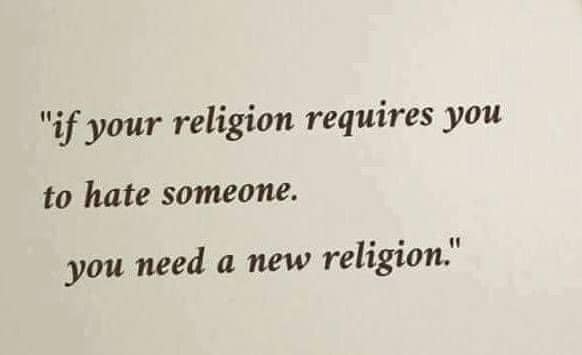
Now, which community can survive based on hate?
It doesn’t matter whether you are asked to hate somebody inside or outside your community.
Whether you hate individually or collectively.
Hating – or despising – somebody blinds you and exhausts you. Puts a huge burden on your back. Focuses your attention so tight that you are no longer able to notice the real dangers.
Those which actually make you less likely to survive.

And this is valid both for you as an individual and for you as a hating community.

‘A proposition needs more than ‘mere’ Logic
in order to be True.
It also needs to be epistemologically correct.’

Oscar Hoffman, 1930-2017

This morning (February 22, 2013, thanks FB) I had a very interesting discussion with my son.

Trying to ‘soften’ him up to my arguments I said: “I don’t understand how a person with such a command of logic as yourself is unwilling to accept that…”

I should have seen this coming:
“If you have such an admiration for MY logic why don’t YOU accept that…”
That very moment I recalled a lecture by Professor Oscar Hoffman: ‘A proposition needs more than ‘mere’ Logic…’

How do you translate that to a 13 years old?

“Look here. Being Logical is only the beginning. You cannot do anything without it but it isn’t enough just by itself. It’s only the formal side of Things”.
And that was the very moment when inspiration hit me:
“Let me give you an example. You have a lot of wooden pieces: spheres, cubes, pyramids, cylinders, cones..etc. and two boards with holes in them: circles, squares, triangles. Your task is to put each wooden piece through the corresponding hole but you must also follow a second rule: half the wooden pieces are made of red oak and they belong to the red board while the other half are made of birch and they belong to the blue board”.

“Let’s presume you have no idea about either geometry or kinds of wood. Using logic you might separate red oak from fir using the grain and then learn to thread various shapes each through the corresponding hole. But no amount of logic will ever enable you to associate the correct pile of wooden pieces to which colored board unless somebody tells you which pile is made of red oak and which pile is made of fir.
Savvy?”

I’m proud to report that he got the point!

Present day edit.
He remembers the discussion but neither of us can recall where it started!

Language is the tool we use to convey information.
To speak our minds…

The consequences of tool use – messages, in this case – depend on the yielder.
The consequences of shooting a gun depend mainly on the person aiming the gun.
The consequences of using language … depend on those who are at the both ends of the ‘barrel’.

Messages – consequences of language being used to put together batches of information with the intent of transmitting them to an audience – are interpreted as soon as they reach their ‘target’.
Meaning – what the receptor makes of a message, using the same languaging tools as those put to work by the emitter – depends mainly on the receptor. In fact, most of the times, there’s more information to be gleaned from a message than that intended to be conveyed by the person initiating the exchange.

The text attributed to Orwell is too simplistic and too misleading to had been penned by Orwell.
Hence Google…
There is no substantive evidence that George Orwell who died in 1950 made this remark. The earliest known matching statement appeared in a column in the Washington Times newspaper written by the film critic and essayist Richard Grenier in 1993

If interested in who said what and what Orwell thought about the subject… just click on the link above.
I’ll only add the reasons for which I know it to be a misleading affirmation.

The factual truth is that only dictators need to be guarded by rough men during their sleep. And during the rest of their lives…
We, the rest of ‘the people’, go to sleep at night knowing there’s only a very slim chance to be targeted by thieves. Yes, we know that the police will likely come to investigate after the fact. After the fact…
But we also know that we are less likely to fall prey to violence than those living in other countries because our societies work better than those which are more violent than ours.

Because our society works better, not because we employ more ‘rough men’ to guard us…
On the contrary!
The more violent a country, the more ‘popular’ the ‘rough men’ are. On both ‘sides of the isle’!

And the more violent a country, the less peacefully people sleep in that country…

We, the people

Imagine yourself living some 4000 years ago.

Yes, you who have enough spare time to read things like these and are open minded enough to continue.
Who don’t worry too much about what you’re going to eat tomorrow and who would like to figure out what life’s about. What’s the meaning of all this which is going on around you.

You who have just figured out you’re different from the rest of the animals.
That you’re able to think.
And that you’ll never make it alone.

That no matter how smart you are, you’ll never be able to pull it on your own.
That no matter how strong you are, now, you’ll always need to be helped by your brethren.

History doesn’t go anywhere.
It pesters us with lessons.
Until we figure out their meanings.
Or until there’s no one left.
No one left to be pestered!

Darwin 2.0

One of the recurrent lessons history is peppered with:
‘Imperia always fail. Sooner or later, eventually all imperial social arrangements end up in abject failure.
Empires as well as monopolies.’

And no, the Pharaonic empire didn’t last for 3000 years.
What happened there was 30 something successive empires. Read dynasties.
Whenever a dynasty lost its grip, its empire folded. Whenever a new dynasty took over, it presided over a new empire.
Same thing happened in modern France. Same territory, same population, same culture, 5 republics and two empires since 1789. The fact that the last three republics have been consecutive doesn’t merge them into a single one.

Europe has been the scene of a whole host of wars. Some of them worldwide wars.
Since the French Revolution, all empires which had attempted to subjugate their neighbors have failed.

Napoleon’s attempt had initiated the German ‘coming together’ and turned Russia’s attention back to Europe.
Napoleon the 3rd had helped Bismark to finalize Prussia’s taking over the rest of what we currently call Germany.
WWI was started by people who had no clue and put on hold by people who had no vision. Started by imperialistically thinking people who didn’t see any need to evaluate the consequences of their countries going to war and put on hold by (other) imperialistically thinking people who continued the well established tradition. Again, without any attempt to evaluate the consequences. Hence the vanquished - the only vanquished that was still standing at the end of the war, Germany – was presented with a hefty bill. And made to pay crippling war reparations. Which clumsy actions had prepared the scene for Hitler’s advent to power.
WWII – or, more exactly, WWI 2.0 – was ended by far wiser decision makers. Who had chosen to integrate the vanquished rather than deepening the trenches.
Although fought with ‘softer’ weapons, WWIII – also known as the Cold War – fits perfectly. It was also lost by the aggressor. Not as much won by those resisting as lost by the empire attempting to widen its grasp.

What we currently have on our hands, WWIV, is a ‘pinnacle’.
Putin attempting to revive Russia’s ‘old glory’ and the reaction of the ‘free world’ are a case study. And a horrible remake. Mistakes already made since the French Revolution have been reenacted as if never happened.
The aggressor failed to realize that at some point his actions will beget a reaction. That even if that reaction will be late, it will surely come about.
The ‘good guys’ have forgotten – never really cared to understand? – the lessons of WWI and WWII. No real attempt to integrate post communist Russia into the democratic fold had been made. Not in an organized manner, anyway. Everybody was happy that ‘history had finally reached its end’ and Russia was left to its own devices. Even worse, it was treated as a no-man’s land. Mutatis mutandis, post-communist Russia had been treated just as South America and Africa had been treated after they had been discovered by the Europeans.
Even worse, the ‘good guys’ have forgotten – or had never understood – that a bully has to be stopped early. And that the easiest way to stop a bully is to encourage his ‘sycophants’ to free themselves from his influence. And to help, in earnest, those who are bullied to overcome their plight.

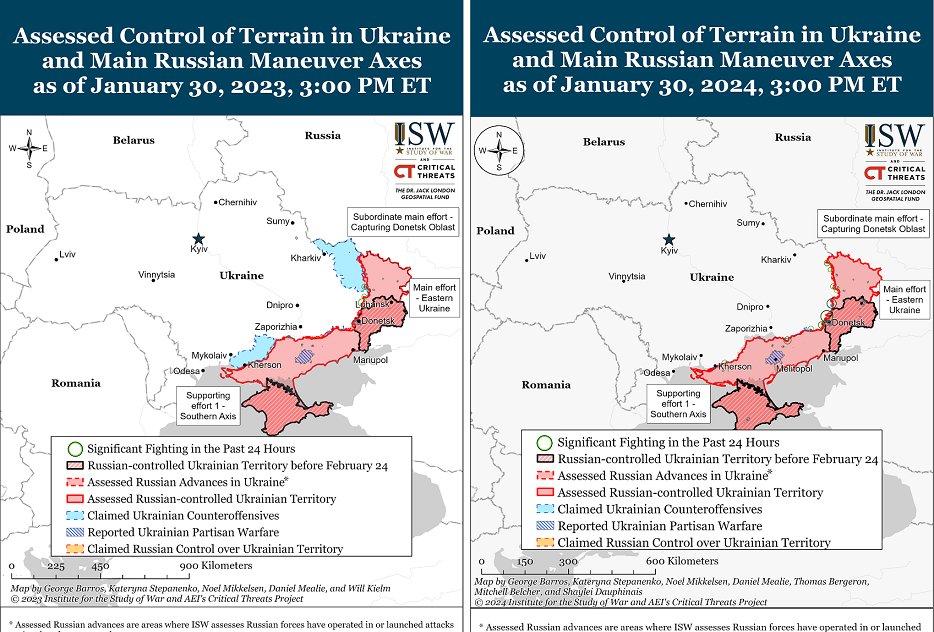
Now, almost two years after the aggression organized by Putin against Ukraine has become ‘hot’, there still are people who consider Ukraine should negotiate. Should accept the inevitable.
Other consider that helping Ukraine is ‘money down the drain’. That there’s no way for Ukraine to win.

The way I see this, we’re back in 1942.
Nazi troops were controlling most of Europe and most of North-Africa. But the signs were already there.
Russia, nor Britain, didn’t collapse under the onslaught. The nazis had been driven out from Moscow’s suburbs and Leningrad remained out of reach.
From there on… Hitler kept making stupid moves. Until the Third Reich crumbled under its own weight. Helped by the Allied bombardments.
And let’s not forget the huge amount of western weapons and munitions shipped by Russia’s then allies to Murmansk. Nor those hauled using the Iranian railway.

Now.
Will we relearn the lessons which are readily available to us?
The lessons we should have already learned?
What’s keeping us?
Does anybody still think Putin, or any other dictator, will ever stop?
Tired of waiting? Be glad Ukraine isn’t.
Be glad Ukraine isn’t tired of fighting!