Archives for category: The kind of world we are building for our children

We are constantly being told that we’re living in the best possible world.

I agree with that.
Of course it’s the best possible one… specially since there’s no other!

On this side of the Styx, anyway…

Let’s get real now.

This is the Century when we’ve managed to open up all corners of our round Planet. We’ve ‘conquered’ the most remote and inhospitable places – both poles, all mountain tops and most of the ocean floor, including that beneath the Arctic Ice Sheet, and, way more important, made most of the Earth solid surface accessible for almost everybody. By car, by train, by plane, by bike, by ferry …
We’ve managed to populate all the ‘cubicles’ designed by Mendeleev and we found uses for most of them.
We’ve managed to identify a vast array of natural resources. We’ve developed matching technologies to exploit each of them, to transform and combine them into what we thought it would fit our fancies and to distribute the results to whomever wished to receive them.
We’ve continued to develop already invented means of communication and we transformed them into something totally different. Practically, we’ve restored the world to it’s ‘Golden Age’. We now live in the Global Village.

Which is not that much different from the old one…

Now, with the world watching Aleppo burn, Daraya fall, and Idlib and other Syrian cities suffer so brutally, Pope Francis’s description of Syria as “abandoned and beloved” rings chillingly accurate. After Bosnia, I was sure the international community would never again stand by and watch in silence as hundreds of thousands of people were bombed relentlessly, starved, beaten, traumatized, and denied the most basic human rights, including education and medical facilities. During the height of the worst years in Sarajevo, from 1992 to 1994, you could chart the ebb and flow of the city’s hope, like the steady flow of the Mijacka River, whose shelled bridges we had to run across to avoid getting hit by snipers. Food supplies ran out; soldiers were getting slaughtered on the fronts; the hospitals’ generators went down.

Janine Di Giovanni, From Sarajevo to Aleppo, Lessons on Surviving a Siege,
The Atlantic, October 12, 2016

What happened with “only a fool learns from his own mistakes, the wise man learns from the mistakes of others“?

OK, back to square one…

1918 had seen the end of the First World War.
Which was the first ‘mixed’ war and the one which should have been the last…

‘The last’ part is obvious, let me elaborate on ‘the first mixed’ one.

Basically, people are both lazy and easily frightened. Their natural tendency is to ‘give in’, a.k.a. ‘trade in’ rather than ‘fight for it’ ‘to the ultimate consequence’.
Which actually makes a lot of sense. Just imagine what would have happened if we were just a tad more combative than we used to…

Need a clue? Click on the picture below.

sex bonobos chimps

Welcome back.

The proposition “Laziness and congeniality is our default mode (mood?)” is valid but from a ‘statistical point of view’.
On a ‘case by case approach’, the manner in which each of us reacts in specific circumstances depends both on those circumstances and on our own interpretation of what’s going on. In fact, it’s our individual consciousness which makes things even more complicated than the situation described in the video above.

During most of our history, human social arrangements have closely resembled those of the chimpanzees. Alpha males have somehow managed to climb to the top of the food chain while the ‘laziness’ of the rest kicked in and allowed the alpha males to do more or less what they pleased.
Which had included a lot of unwarranted aggression.

Up to WWI, most wars had been started by aggressive rulers who had somehow convinced their followers to attack one or more of the neighbors. Which neighbors were also organized more or less like a chimpanzee troupe – ‘lazy and congenial people’ ruled by which ever alpha male was aggressive/cunning enough to remain in power.
These social arrangements had a very interesting consequence.
All conflict was between rulers and all wars were ‘turf wars’.
The belligerents were not attempting to out-kill each-other but to establish hierarchies. More prosaically, war was nothing but ‘protection racket’. The loser had to pay a certain amount of money to the winner – ‘war reparations’, surrender a piece of the ‘turf’ or both at the same time.

In time – due to particular circumstances, some of what are currently known as ‘nations’ have learned that ‘chimpanzee social order’ leads to unnecessary suffering and have (re)invented an alternative. A.k.a. democracy.

WW1 was the first major war which pitted authoritarian regimes against democratic ones.
Yes, humankind had already witnessed some wars which had been started by more or less democratically run countries – the British Empire had attacked the Boer Republics in South Africa, for example, only this is but a blog post, not a 500 page dissertation…
Unfortunately, the democracies which had won the WWI had behaved totally inappropriately… with dire consequences. For them, as well as for the rest of the world.

The Treaty of Versailles imposed a huge amount of war reparations upon the main loser. Germany.
Two consequences have arisen from here.

The obvious one was WWII. And almost nobody disputes this.
The less obvious one was that those war reparations had transformed war itself.

A democratically run coalition imposing war reparations upon a defeated and leaderless/dispirited population had transformed war from a dispute between rulers into a dispute between nations.

This was the ‘accelerant’ used by Hitler to start the second funeral pyre which had engulfed Europe…

Democratically run nations behaving inconsiderately towards other nations also established an immensely dangerous precedent.

The first example of which had occurred less than 20 years later in Spain.
 

According to various theories, history is cyclical.
Meaning that we keep doing more or less the same things – or ‘errors’, until we figure them out for what they are.
And then we do them again, under a different guise…

“In China, people must use identity documents for train travel. This rule works to prevent people with excessive debt from using high-speed trains, and limit the movement of religious minorities who have had identity documents confiscated and can wait years to get a valid passport.

While this is the first time Chinese officials have used glasses to implement facial-recognition, the technology is widely used by police. China is also currently building a system that will recognize any of its 1.3 billion citizens in three seconds.”

We’ve spent most of our previously mentioned history living in closely knit and relatively small communities.
We made huge ‘progress’ during that time.
The period had started when we had climbed down from our ancestral tree – or had been made by God, take your pick, and had ended – for most of us, anyway, when we had moved to what we presently call ‘cities’.

Win some, loose some.

Apparently, ‘city-slickers’ are more ‘advanced’ than their rural cousins.
More people living together allows for a deeper division of labour, hence a higher specialization. Productivity increases faster and accumulated knowledge becomes simultaneously deeper and wider.
Unfortunately, all these come at a cost. At first for the individuals and, ultimately, for the society at large.

Living in smallish, and necessarily closer knit, groups provides a lot of ‘natural’ social solidarity. Individuals feel that they belong somewhere and, by sheer necessity, give relatively much to the community. Effort as well as attention.
Lost in the city‘, individuals are simultaneously freer to experiment/innovate and also more prone to growing alienated. So alienated as to become a danger to themselves and/or to those living around them.

On the other hand, small communities, where everybody knows everybody else, necessarily generate a lot of social conformity.
Individuals enjoy a lot of (relative) security and psychological comfort but don’t have very much lee-way.
Innovation, technological as well as social, is slower in this circumstances.
It took us some 130,000 years to ‘invent’ speech, another 65,000 to ‘invent’ writing and then, after no more than 6 short millennia we invented the printing press.
Less than another 6 centuries later we have the Internet.

Writing was invented by the Assyrians – an ‘imperial’ people who lived in cities and who needed a ‘technology’ to keep track of taxes due on the commercial trades which sustained the whole civilization.
Basically the same thing was repeated in many other places. Ancient Egypt, Ancient China, etc.
Written records and favorable geography had allowed the imperial administrations to control relatively vast tracts of land, relatively huge amounts of people and marshal considerable resources to whatever goals considered worthy by those who controlled the flow of information.
Writing down ones thoughts/discoveries also made it possible for humankind to better store its knowledge about everything. ‘Hard copies’ travel better through time than oral traditions.

Until something went wrong.
We all know that all those ancient ‘imperiums’ had crumbled, despite having been the most advanced civilizations of their times.
Other, more nimble, competitors were able to outmaneuver the older behemoths.
Maybe because the old behemoths had exercised too much social control?
‘Written’ central administration was able to marshal enough resources for the ruler to be able to impose stiffer rules towards his own personal safety. The most immediate consequence being that increased social conformity stifled innovation and, hence, created the conditions for the others to catch up, outmaneuver and eventually leave the behemoths behind…

The printing press had a relatively smaller impact than the mere pen.
OK, information was more readily available to those who wished to learn – hence the boost in science and technology, but was ‘useless’ as a ‘coercive tool’. It doesn’t make much difference to someone who wants to control a system whether the information used to do such thing is hand written or ‘pressed’. The small number of ‘insiders’ need to keep that information under tight control so…

The latest ‘gizmo’, the internet, is a totally different development than the printing press.
While the latter is unidirectional – from the author to the wide public, the former goes both ways with equal ease.

Each of us can, almost instantly, become a ‘shooting star’ and, simultaneously, all of us can be monitored by whom ever has the necessary means.

As if we’ve backtracked to a ‘Global Village‘.
In more ways than one.

In a traditional village, everybody knows more or less everything there is to be known about everybody else.
In the Global Village everybody can learn considerable amounts of information about almost anybody worth following while those with enough means can learn almost everything about everybody. Then analyze that information to whatever depth they are able to.  And store it for as long as they find any use for it.

What we call reality exists.
Regardless of us being able to faithfully express whatever we know about it.
Regardless of how much of what we know we are willing to share with others.
Regardless of some of us using their knowledge to impose themselves upon the less knowledgeable.

The irrefutable proof about reality being a fact is not that we have chosen to call it so. Or even to call it at all.

The irrefutable proof that reality is factual is, duh, another fact.
That nobody, no matter how knowledgeable, powerful or both at the same time, has ever been able to impose their will upon the said reality for any significant length of time.

No dictator has ever been able to consistently subdue a people. To kill it, yes. To consistently subdue it, NO. Lately, most of them have also lost an erstwhile relatively common ability… that of bequeathing their power to their intended successor.
No scientist has ever been able to pretend they really knew what they were talking about. No genuine scientist, that is… That they have a clue… yes. Of course!
A fair understanding of what’s going on… that is increasingly plausible.

That at least one of the above possesses the ultimate knowledge/power about even the minutest portion of reality…

According to Protagoras, we are here for but one reason. To determine whether anything which happens around us makes any sense.
Mind you, we are not supposed to knit fancy stories and to skillfully include in them everything we perceive! A.k.a ‘narratives’.
Just ‘measure’ things and call them out for what we think they are.

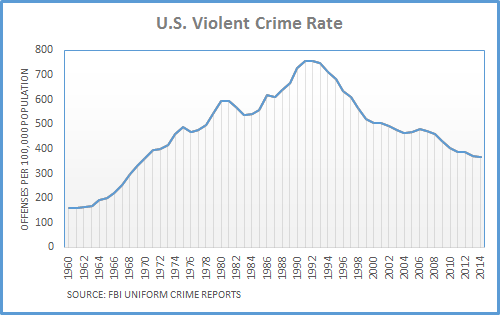
I’m going to enumerate a series of facts and let you figure them out.

“A well regulated Militia, being necessary to the security of a free State, the right of the people to keep and bear Arms, shall not be infringed.”

Violent-Crime-Rate-Chart1

Murder-Rate-Chart


guns in circulation per household

So, if people are less likely to be killed, in any manner, why a shrinking number of them buy an increasing number of guns?

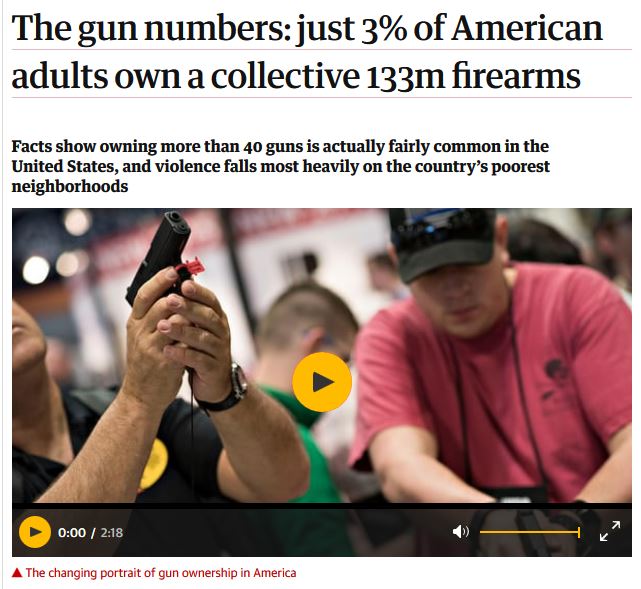
3% gun owners

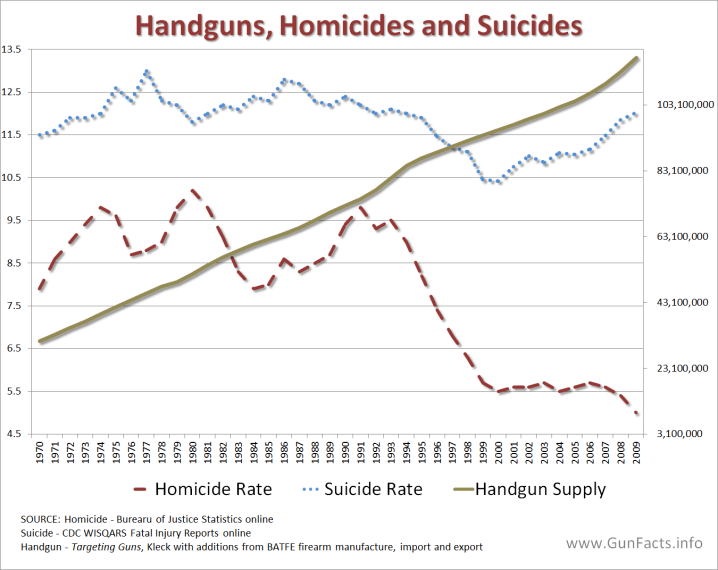
AVAILABILITY-OF-GUNS-Handgun-Supply-and-Homicies-Suicide-Rates

suicide versus mass shootings


murders by type of gun

Then why are people so focused on ‘assault rifles’? Only because they tend to be used in mass murders? Is this a good enough reason to try to remove them from the eco-system?
And why is there so little fuss about the huge number of suicides?
Bzw, can ‘mass murders’ be considered a form of suicide? After all, very few of the perpetrators ever managed to leave the scene… And even fewer have never been identified.

number_of_nfa_firearms_processed_by_fy

According to the ATF, people in the USA buy an ever increasing number of guns each year yet since 2012 (Sandy Hook) Cerberus Capital Management has not been able to find a buyer for Remington Outdoor – the weapons manufacturer who produces, among other ‘things’, “the most popular version of the “modern sporting rifle” sold in the US.
People in the US are interested to invest in weapons per se but not in weapons manufacturers?

Considering that, according to Bloomberg, Cerberus Capital had eventually handed over Remington Outdoor to “Wall Street Creditors”…

Blackstone Group, which offers asset management services, has been reducing its weapons exposure for years. This weekend, it verified that no gun investments remained in its portfolios, according to the Wall Street Journal. The investment giant BlackRock Inc. said it, too, was exploring ways to cull gun companies from the portfolios of clients who no longer wish to invest in them.

It was Hegel who first noticed that how much of ‘something’ was available at some point in place and/or time was determining the evolution of things.
Later, Marx and Engels ‘hijacked’ the idea and then corrupted evolution into revolution but I’ll set aside that subject for the time being.

“It is said that there are no sudden changes in nature, and the common view has it that when we speak of a growth or a destruction, we always imagine a gradual growth or disappearance. Yet we have seen cases in which the alteration of existence involves not only a transition from one proportion to another, but also a transition, by a sudden leap, into a … qualitatively different thing; an interruption of a gradual process, differing qualitatively from the preceding, the former state”

Georg Friedrich Hegel, Science of Logic

According to Ernst Mayr, evolution is a process which weeds out the misfits.
Which ascertains that at any given moment only those individuals/species who can survive the present conditions continue to enjoy life.
Regardless of who’s responsible for any changes in those conditions, of course…

And did I tell you that evolution is an impersonal process? Which has no goal, whatsoever?

We are currently witnessing an accumulation of heat on our Planet.
I’m not going to argue whether we are the main culprits or not. I don’t command any expertise in this domain, except that I know for a fact that increasing the relative content of CO2 in the atmosphere does increase the retention of heat by the aforementioned atmosphere.
I also know for a fact that we’ve burned in the last three centuries fossil fuels which had been accumulated during God only knows how many millennia. Releasing a huge amount of CO2 ‘in the aforementioned atmosphere’
Was it enough to raise the level of CO2 to the present figure? I don’t know… Volcanoes are another ‘prolific’ source for this fateful gas…

„Then why are you writing this post? Only to acknowledge your ignorance? Why should we bother?”

Dead saiga antelopes

Dead saiga antelopes in a field in Kazakhstan. About 20,000 of the species were found dead in one week. Photograph: Reuters

„The scientists on the ground pinpointed blood poisoning as the cause, but were puzzled as to why whole herds were dying so quickly. After 32 postmortems, they concluded the culprit was the bacterium Pasteurella multocida, which they believe normally lives harmlessly in the tonsils of some, if not all, of the antelopes. In a research paper published in January in Science Advances, Kock and colleagues contrasted the 2015 MME with the two from the 1980s. They concluded that a rise in temperature to 37C and an increase in humidity above 80% in the previous few days had stimulated the bacteria to pass into the bloodstream where it caused haemorrhagic septicaemia, or blood poisoning.”

You see, this post is indeed about ignorance.
We just don’t know what will happen if enough of something accumulates somewhere.
Until it does, of course.

And to find out we’ll need to survive the ‘happening’…

Some of us loose our patience when in close contact with age related ‘peculiar behaviors’.

There are a few ‘real’ facts about this phenomenon and I’m going to list them before letting you in on what I feel about this whole thing.

We live way longer than our parents and grand parents. Statistically, of course.
Which means that everybody gets a fair chance at reaching well into their 80-ies, something which was ‘available’ only to those smart enough to navigate around the perils of life, rich enough to hover over them or both at the same time.
Most of the run-of-the-mill-s and the outright dumb-asses used to die long before that.

Brain is both an organ and a muscle. Like any other organ, it deteriorates with age. Like any other muscle, if trained properly, it keeps for longer.

People are lazy. Most of them don’t like to compete on their own. And, even more importantly, most of them stop training after reaching the top. Even a relative one.

Simplistically, one could say age is an opportunity each of us has to demonstrate their true nature.
Both the quality of our ‘natural endowment’ and how well each of us has treated/trained theirs.

A more comprehensive approach suggests that age might be something a little more complicated than that.

The present is a combination between whatever resources were at the disposal of our ancestors and the accumulated ‘consequences’ of our ancestors living in those conditions. Basically, a combination between nature and human decision making.

We live today in the world we inherited from our parents and our children will live in the world we’ll bequest upon them.

Yep, only living longer also means having to retire at some point.
It means having to give up calling the shots.

And this is the real litmus test.
How one behaves after they realize they can no longer call the shots but are not yet ready to die and how one behaves after being called to call the shots yet still having to care for the former ‘bosses’.

This is when people have to face the consequences of how they trained their brains during their life times.
This is the moment when people meet the real results of how they had interacted. Among themselves and with their children.
This is the moment when people meet the consequences of their former choices.

And, also, this is the moment when the children have the opportunity to prove themselves.

In a nutshell, one may say that humankind is like wine.
Both depend very much on terroir, are the results of collective efforts and age demonstrates their true nature.

Or, one could say that age is more of a social disease than a mental illness.

My close friends know that I’m a strong supporter of the Second Amendment.

In a mature enough society, gun ownership promotes both individual responsibility and social cohesion. As intended by the Founding Fathers.

“A well regulated Militia, being necessary to the security of a free State, the right of the people to keep and bear Arms, shall not be infringed.”

At the time when the US Constitution was drafted, the American state didn’t have a proper army, nor any real need for one. The neighbors were few and very far away, in contrast to what was going on in Europe at that time.
It didn’t make sense, at that time, for a strong army to be mentioned in the Constitution but the Founding Fathers very aptly told their constituents to build up a strong self defense capability. You never know what might happen in the future.
Hence the “well regulated Militia” which was deemed “necessary to the security of a free State”. NB, for a “free State”, not for any random individual citizen who wishes to free himself from a democratically elected government…

In this sense, the Second Amendment should be primarily defended as a stringent need of the entire society, instead of being promoted mainly as an ‘individual right’.

And it should be enforced accordingly. Keeping in mind the needs of the entire society, not only those of particular individuals.

Periodically, we are reminded of what may happen when society forgets to actually ‘regulate’ itself. When rules which have been agreed upon are put in practice in a ‘creative’ manner.
One has to pass ‘back-ground checks’ if he wants to buy a gun from a store but he can also buy one anonymously from a gun show.
Assault guns have been forbidden yet until this very morning those who ‘needed’ one could legally  buy a ‘bump stock’. A “device” which “causes the gun to buck back and forth, repeatedly “bumping” the trigger against the shooter’s finger. Technically, that means the finger is pulling the trigger for each round fired, keeping the weapon a legal semi-automatic.

Not only that people kill themselves using their own guns. Not only that gangsters kill each others in turf wars. Not only that policemen get killed in the line of work.
Not only that from time to time individuals attempt a particularly murderous form of suicide – by indiscriminately shooting people and waiting for the police to shoot them back.
Time and time again students, some of them very young, are brought back from school in coffins.

And after each of such incidents, various ‘authors’ attempt to put things into ‘perspective’.

In 2017, with 300,000,000-plus guns in the hands of Americans, there were 15,549 gun deaths. This ranks less than half the number of automobile deaths even though there are fewer cars in existence than guns. In 2017, there were 253,000,000 cars in existence and 41,000 auto deaths.

It’s exactly this kind of warped perspective which makes it perfectly intelligible what’s going on. Some people would say anything which seems to prove their point. Only to make it obvious how wrong they are.

Cars are meant for transportation and are widely used by their owners. For the reason they were meant to. Therefore, death by car accident is just that, an accident.
Guns are meant to be deadly. Reasonable people use them for for practice and, only when they absolutely have to, to defend themselves. In theory, death by gun shot would exclusively be accidental or as a result of people rightfully defending themselves or their property.

So, should we compare those two numbers?

15,549 more or less intended gun related murders – this figure doesn’t include most suicides, with the 41,000 of more or less unintended car accidents?

Are these two figures really comparable?

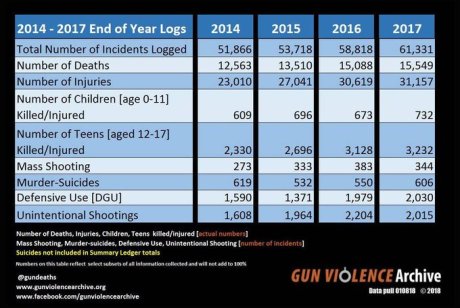
gun violence archive

If we compare apples to apples, then yes, guns are less accident prone than cars. 2,015 shootings – let’s assume all of them were fatal, versus 41,000 death by car accidents.
We can also say guns are a little less deadly than cars. According to the CDC preliminary published data, in 2016 the total number of gun related deaths – including suicides, was 38,000. Almost 10% smaller than the number of car related deaths.

But then again, how many cars have been used to intentionally kill someone? Or to commit suicide?

And since it’s true that guns don’t kill by themselves, it’s obvious that’s up to us to solve the situation. For no other reason than ‘we are the ones who might get killed otherwise’!

culture of violence


Remember Midas, the character who, after being granted a wish by a grateful Dionysus, “asked that everything he touched would turn into gold“?
And who was happy as a pig in mud after his wish was fulfilled … only to find out that he was going to die of hunger since everything he touched did turn into gold? Including his beloved daughter who had enthusiastically embraced her father upon his return from the fateful meeting with Dionysus?

Under the Violent Crime Control and Law Enforcement Act of 1994, the “Three Strikes” statute provides for mandatory life imprisonment if a convicted felon: (1) has been convicted in federal court of a “serious violent felony”; and (2) has two or more previous convictions in federal or state courts, at least one of which is a “serious violent felony” (the other offense may be a serious drug offense). The sentencing enhancements in this law can have a significant impact on a criminal defendant.

Now wait a minute! What has this got to do with anything?

Well, more than two and a half millennia after Midas had driven himself into a tight corner we continue to ignore his lesson. As a species…

And the key words here are ‘continue to’.

The axe.

Very soon after our flint knapping ancestors discovered that a shaped stone is very useful at chopping wood they tied it to a shaft and started bashing the heads of their neighbors with it.

stone axe

‘Corrupting’ tools into offensive weapons, strike one.


Articulated language.

Soon after learning to fight our fellow humans, we started to speak to each-other.
It might have started while hunters tried to coordinate their efforts or when strangers tried to barter things… Does it really matter?
For me, it’s enough that very soon after we learned to speak we were masters in the art of lying.

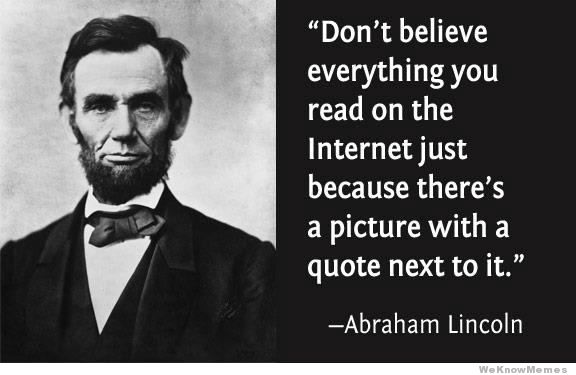
internet lies lincoln

Corrupting words into lies, strike two

Money.

At some point in our more recent history, we discovered that it was easier for each of us to learn a particular skill and to exchange goods among rather than each of us providing for all his (family’s) needs. Eventually we invented money and replaced barter with proper trading.
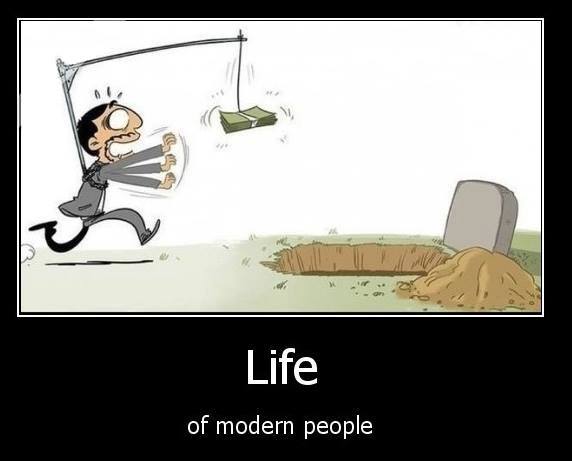
Soon after, some of us forgot that money was meant to facilitate trade and started to hoard it.

follow the money

Elevating money to stardom against all historical advice, strike three.


Are you wondering whether I’ve lost it entirely?
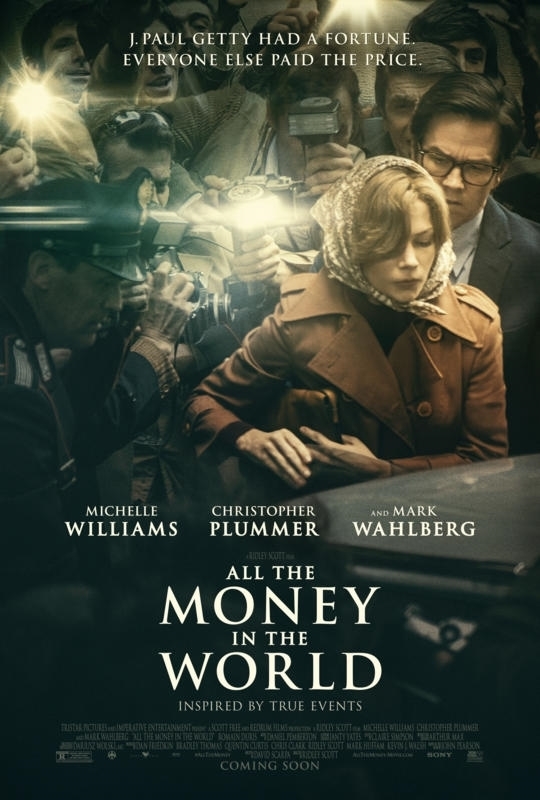
Neah… just came home from the movies…

All the money in the world

Since the movie ended on the bright(-ish) side, I’m going to remind you that Midas also found a way out of his predicament.
The ‘golden’ King begged Dionysus to lift the cursed blessing bestowed upon his head, was instructed to wash his hands and everything else he wanted turned back to its original state in the Pactolus River – in present day Turkey, and presto, everything was fine again.

There’s only one small problem left.
Where are we going to wash our hands…. or should we cleanse our minds first?

Hopefully, before experiencing the hunger pangs which had driven Midas to wisdom…


The early believers were convinced that God’s ‘real’ name could not be uttered by their ‘mortal’ lips.

Their logic was simple. Using a single word to ‘differentiate’ something from everything else is somewhat arrogant. It implies that the ‘god-father’ knows all that there is to be known about that something – or at least enough to give credence to that naming.

As faith became stronger, so did the self confidence of those involved in the process.
When writing about their beliefs, some of them circumvented the initial shyness by using multiple names to describe the object of their adoration – hoping that in this manner they’ll get close enough to the real thing.
“To begin with, God is referred to by a number of names in the Bible—not just a single name. By some counts there are more than 20 different names for God mentioned in the Bible. And each of these names has great significance. Each one tells us something important about God—His character and how He relates to us.”
Others still stick to the ‘no name’ policy, refer to their God using a title, Allah – the ‘One and Only Who Deserves to Be Worshiped’ – instead of a ‘proper’ (?!?) name, and use a number of attributes to describe him. Such a large number of attributes as to make it evidently clear that stringing attributes is in no way enough to ‘exhaust’ the inner nature of any god. Of anything, really.
“”If We had sent down this Quran upon a mountain, you would have seen it humble itself and shatter out of fear of God.  Such are the parables which We put forward to mankind that they may reflect. He is Allah, there is no deity but He.  He is the Knower of the unseen and the seen.  He is ar-Rahman (Most Compassionate), ar-Raheem (Most Merciful).  He is Allah besides Whom there is no deity.  He is al-Malik (Sovereign), al-Quddus (Most Pure), as-Salaam (Giver of peace), al-Mumin (Giver of security), al-Muhaiman (Vigilant), al-Aziz (Migthy), al-Jabbar (Overpowering), al-Mutakabbir (Glorious).  He is pure from whatever they ascribe to Him.  He is Allah, al-Khaliq (Creator), al-Bari (Perfect Maker), al-Musawwir (Fashioner); to Him belong the most beautiful names.  Whatever is in the heavens and the earth glorifies Him.  He is al-Aziz (Mighty), al-Hakeem (Wise).” (Quran 59:21-24)”

After writing for long enough about their beliefs, the worshipers had become emboldened enough to transform their convictions into precepts. To be not only followed by the believers themselves but also imposed upon others.

And this is how various groups of people have traveled from “The Truth Shall Make You Free” to defining heresy as being the most heinous crime… so heinous that the congregations felt the need to punish it in the most eloquent manner.
Does it seem logical that heretics were burned alive, with their mental faculties intact, to give them one last chance to repent before being sent into the “eternal fire”? Could it be that burning an individual at the stake was seen as a merciful death, as a means of giving that person one last chance to save his or her soul before final damnation??? I have read that “burning at the stake was believed by some medieval authorities and scholars to liberate the sinner from his or her formerly damned state and offer some hope of salvation to the now ‘cleansed’ soul”.

After some of us have somehow survived that era, a few parts of the world have become ‘the lands of the free’.
The countries where a majority of the inhabitants believe that “your right to swing your arm leaves off where my right not to have my nose struck begins.”

It’s here that things get really interesting.

The quote defining freedom as stemming from the relation between your fist and my nose logically leads us to observe that those who define liberty in this manner are a bunch of tired, and maybe wised up, fist-fighters.
Who have finally reached the understanding that it’s better to negotiate it rather than fight over it.

‘Negotiate? What is here to be negotiated?’
‘The distance between our noses? How close am I allowed to bring mine to yours before you becoming allowed to defend your intimacy?
After all, if my nose is so far away that you’ll never be able to touch it, this particular definition of liberty ceases to make any sense while if you’re never allowed to punch mine then I’ll be able to use it to crowd you out of your own life.
And vice-versa.
Capisci?’

Which points out the cruel reality that we cannot negotiate everything.

To start any negotiation we must first have something in common.
A common language would be fine indeed but I have something else in mind.
Both sides involved in any negotiation need to share the same attitude.

This is the hardest thing to convey.
To convince the other side that you’re going to keep your end of the bargain.
Only after both sides have reached this ‘belief’, they will feel free enough to discuss the real issues.
This is where ‘religion’ comes in handy. It teaches us that all people are to be treated equally – all of them have been molded in a single cast, and that they share a spark from the same divine fire.
God created mankind in his own image, in the image of God he created them“.

“I am astonished that you are so quickly deserting the one who called you to live in the grace of Christ and are turning to a different gospel, which is really no gospel at all. Evidently some people are throwing you into confusion and are trying to pervert the gospel of Christ. But even if we or an angel from heaven should preach a gospel other than the one we preached to you, let them be under God’s curse! As we have already said, so now I say again: If anybody is preaching to you a gospel other than what you accepted, let them be under God’s curse!

Am I now trying to win the approval of human beings, or of God? Or am I trying to please people? If I were still trying to please people, I would not be a servant of Christ.” (Galatians, 1:6-10)

 Which brings us back to the original question.

Is any liberty possible, outside the one we continuously build ourselves, through constant negotiation?
Is any bona-fide negotiation possible without a healthy dose of mutual respect among all those involved in it?
Why do we, grown-ups, still need our father to constantly remind us to stop bickering?

a-mans-ethical-behavior


(http://www.bibleinfo.com/en/questions/names-of-god)

https://www.islamreligion.com/articles/10827/chapter-59-verses-21-24/

http://biblelight.net/burn-heretics.htm

https://quoteinvestigator.com/2011/10/15/liberty-fist-nose/

http://biblehub.com/niv/galatians/1.htm


Are you done laughing?

It isn’t funny?

Well, it wasn’t meant to be funny… only illustrative for the way in which some people understand freedom… ‘they’ being free to impose their will upon others while all the rest are free to obey. Or else.

My point being that freedom is nothing more and nothing less than what we make of it.

In order to make myself understood I have to mention that there are two kinds of liberty and that, historically, there have been two only apparently conflicting visions on whether freedom is real or not.

Freedom, like most things human, is both a concept and a reality.
We think about it, hence it is relatively simple to accept ‘freedom as a human concept’.
If you find it hard to accept that liberty is also real… when was the last time you took a dog to a park where you can unleash it? To a meadow where it can run its heart out without you being afraid of the city warden? And no, I’m not thinking about the joy experienced by the dog…

We have ‘internal’ freedom – the manner in which each of us relates, in their heads, with the concept, and ‘social’ freedom – the vectorial sum of all that the members of a certain society put in practice about freedom.
It’s a matter of ‘obvious evidence’ that these two may swirl in two directions.
Form a virtuous circle – the natural evolution of humankind, from slavery to feudalism to democratic capitalism, sometimes interrupted by ‘vicious’ epicycles –  the last two being fascism and communism.

Before discussing whether liberty is real or just an illusion let me poke another wasp nest.
How big is this thing we call ‘freedom’?
How big can this ‘vectorial sum’ be?

Infinite? Nobody can live that long, anyway…

Then where does it stop? At the ‘tip of our collective nose’?
It’s up to us to decide? Through constant negotiation? Always keeping in mind that all ‘imperial’ endeavors have failed, sooner or later? That no human being has ever been able to survive alone for any considerable length of time, let alone to grow up by him/herself?

Communism and fascism being only the last two examples of what happens when too many of us forget the most important lesson history teaches us?

One more thing. I still owe you an explanation about why I consider the conflict between the ‘promoters’ and  ‘deniers’ of liberty to be a false one.
Currently, most people agree – even if most of them only implicitly, about ‘your liberty to swing your fist ending where my nose begins’.
From time to time various ‘hot headed’ individuals have contested this.
Either philosophically – Nietzsche, Marx, or practically – Lenin, Stalin, Hitler, Pol-Pot…
The most interesting aspect of all this being that there still are ‘philosophers’ (?!?) who continue to argue one side of the argument against the immense historical evidence which keeps growing. Not only ‘against’ the immense… but also producing fresh pretexts for the ‘willing practitioners’ to try for yet another time. And to continue to increase the mountain of evidence…

‘But what are the arguments marshaled by the ‘freedom deniers’?
What if they are right, after all, only the ‘practitioners’ have not yet been able to ‘do it right’? You, of all others’ – that would be me, ‘should remember that “Critics of early steam-spewing locomotives, for example, thought “that women’s bodies were not designed to go at 50 miles an hour,” and worried that “[female passengers’] uteruses would fly out of [their] bodies as they were accelerated to that speed”!
And, even more importantly, who are you to tell us that freedom is real?’

OK.
As I mentioned before, there are two categories of deniers.
‘Relative’ and ‘absolute’ deniers. The ‘Nietzsche-s’ and the ‘Marx-s’.
The ‘Nietzsche-s’ argue that freedom is up for grabs, that it can – no, actually that it should – be cornered by those having the strongest “will to power”. ‘Finders keepers, losers weepers’.
The ‘Marx-s’ argue that freedom is nothing but an illusion and that everybody must observe the implacable laws which derive from the world being made of nothing else but matter. Hence, according to Marx, the ‘communists’ – those who have understood the ‘scientific’ nature of the world/society, have the duty to take over the society and to take it, forcefully if needed, to its ‘scientifically’ determined destination.
‘Quite a Platonic vision of the world, don’t you think?’
‘Well… I’ve already covered this subject…’
Coming back to the apparent conflict between the promoters and the deniers of freedom, it is now rather simple to observe that ‘Marx’ is nothing but ‘Nietzsche’ dressed up in ‘scientific’ garb – don’t be fooled by the fact that Nietzsche was way younger than Marx, they had been kindred souls, while ‘Nietzsche’ had been a very focused ‘freedom fighter’ – focused exclusively on ‘his’ freedom, that is.

A petty conflict about ‘who has the bigger one’, hidden under pretentious make-up…

‘And were does all this leave us?’

At the conclusion that being free means, before and above anything else, being responsible?
For one’s own fate and for at least some of what’s going to happen in the (near) future?