Archives for category: Social justice

quote-a-nation-that-is-afraid-to-let-its-people-judge-the-truth-and-falsehood-in-an-open-market-is-a-john-f-kennedy-100676

There is undeniable truth in here but there is also a considerable amount of confusion.

Whenever truth is hidden behind the words instead of being openly discussed among those who deal information pertaining to a particular situation all those involved will eventually suffer the consequences of their deceptions.
This is something that has been common knowledge for sometime now yet there still are too many individuals who think they can ‘beat the market’ on this.

This is the true part.

What makes me wonder is how come a nation may become afraid of its own people? Isn’t this an oxymoron of sorts?
Or is it that only some members of that nation have become afraid that their deceptions will become apparent to the rest of the people?

I have used a small strike in an orchard valley as the symbol of man’s eternal, bitter warfare with himself.” (John Steinbeck, in a letter to George Albee)

Why on Earth had Kennedy chosen to beat around the bush instead of speaking out in plain English? It didn’t much good for him anyway, isn’t it?

Why are so many of us still following this policy?
Why are so many nations that allow this to happen?

050c31042a04e93467298c7458c219af4cbcc6-wm

For some time now I’ve been wondering how come so many people who define themselves as being Christians – “Again I tell you, it is easier for a camel to go through the eye of a needle than for a rich person to enter the kingdom of God.“, Matt 19:24 – are so passionately defending the very concept of (private)”property”.

Could it be that Marx was right after all: “Private property is the result of alienated labor.” ?!? And so many of us have been wrong for so long?

“The right to private property is the social-political principle that adult human beings may not be prohibited or prevented by anyone from acquiring, holding and trading (with willing parties) valued items not already owned by others. Such a right is, thus, unalienable and, if in fact justified, is supposed to enjoy respect and legal protection in a just human community.”

Trying to understand the source of this dichotomy I adopted a two pronged strategy. First I looked up the word itself and then I tried to deepen my understanding of the entire concept.

It’s absolutely obvious that ‘property’ comes from ‘proper’.
‘Proper’, in its turn, has two basic meanings: ‘fit for use‘ and ‘pertaining to one individual‘. The first one has evolved into ‘propriety’, “the state or quality of being correct and proper” while the second has become ‘property’, “thing owned“.

So, do all these etymological arguments make it any easier for us to accept that respecting each others’ right to private property is what introduced a certain degree of functionality in the human society?

‘But aren’t you contradicting yourself?
At the beginning of your post you suggested that ‘property’ might not be as good as advertised and now you say that the ‘right to private property’ is ‘good for you’?
Will you make up your mind, for Christ’s sake?’

Now, that I’ve reached the conceptual stage of my analyses, I must bring to your attention the fact that a right is nothing but an opportunity while each (piece of) property is a thing – even those  which are not of a ‘substantial’ nature. ‘Intellectual property’, for instance, is a ‘measurable thing’ even if you cannot put your finger on it while the ‘right to intellectual (or any other kind of) property’ is (an infinite) something which patiently waits for (a rightful) somebody to make (proper) use of it.

Maybe this is what Christ tried to tell us in the first place. That it’s not property itself that stands between us and our salvation but our (improper) attitude towards it. That it’s not the object of our property that is the problem but how we make use of our right to private property.
After all Christ told the “young rich man” “If you would be perfect, go, sell what you possess and give to the poor, and you will have treasure in heaven; and come, follow me.” (Matt 19:21). ‘Go sell, give and THEN follow me’, not ‘come help me ABOLISH the very right to private property’, as Marx used to preach to his followers.

To understand the difference between what Christ and Marx said about this subject let’s see how these two relate to the notion of ‘Man’.

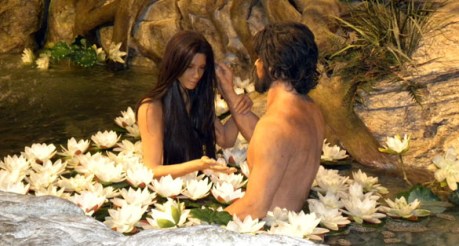
In Christ’s book God took a lump of dirt and ‘made Man in His own image’ while in Marx’s narrow materialistic vision “it is not the consciousness of men that determines their existence, but, on the contrary, their social existence that determines their consciousness.”

Basically both of them start with the same ‘materiel’ – the mundane ‘star dust’ that Mendeleev distributed throughout his table – but what a difference at the end of the ‘assembly line’!
adamevebefore

Being made ‘in His Own image’ not only means that all Men (and Women) are created equal but also that each of them shares in His Divine Nature. Hence the origin of our free will, of our ability (‘right’, opportunity) to be saved. Compare this to how Marx described the human society:

“The Communists, therefore, are on the one hand, practically, the most advanced and resolute section of the working-class parties of every country, that section which pushes forward all others; on the other hand, theoretically, they have over the great mass of the proletariat the advantage of clearly understanding the line of march, the conditions, and the ultimate general results of the proletarian movement.

The immediate aim of the Communists is the same as that of all other proletarian parties: formation of the proletariat into a class, overthrow of the bourgeois supremacy, conquest of political power by the proletariat.

The theoretical conclusions of the Communists are in no way based on ideas or principles that have been invented, or discovered, by this or that would-be universal reformer.

They merely express, in general terms, actual relations springing from an existing class struggle, from a historical movement going on under our very eyes. The abolition of existing property relations is not at all a distinctive feature of communism.”
articlefiles-mv003370610000-96750_bd

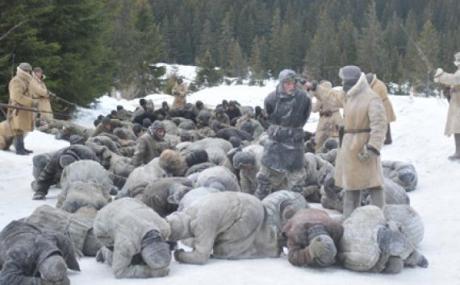
As somebody who has lived for 30 years under communist rule let me translate this from ‘Newspeak‘ into plain English:
‘History suggests that those who figure out the inner workings of this world  have, from time to time, the opportunity to take over the show. Now is one of those moments. The ‘fat cats’ have been so greedy lately that the regular people are growling under the very heavy yoke that has been placed on their shoulders.  That’s why we have the opportunity to unsettle the ‘old’ from their positions and to plant our fat asses in their comfortable chairs.
And the first thing we must do in order to achieve that goal is to abolish the right to private property. People are so fed up with what was going on lately that they’ll go along. They have grown to hate so much the ‘greedy plutocrats’ that most of them won’t notice that in the (revolutionary) process they’ll lose the very last shrouds of personal autonomy they still have. Without the right to dispose of the results of their own labor they’ll be at our mercy’.

Who was right between the two?

Well… Both, unfortunately.

The communists did run the show, at least for a while. And we all know to which results.
On the other hand it seems that in the longer run miss-using the right to private property is indeed a powerful drawback. The already too long sequence of economic crises caused, ultimately, by nothing else but our own greed has indeed given birth to a generalized state of psychological malaise.

I don’t know about what’s gonna happen in the next world – or if it exists at all – but I’m sure that if we don’t learn, fast, how to use, properly, the right to private property things will become too hot for our own good in this one.

The only one we are sure about.

Further reading.
During my research for this post I found this very interesting take on the same subject:

“Zwolinksi argues that libertarians are right to support private property, but also that private property is more complicated than we sometimes think.”

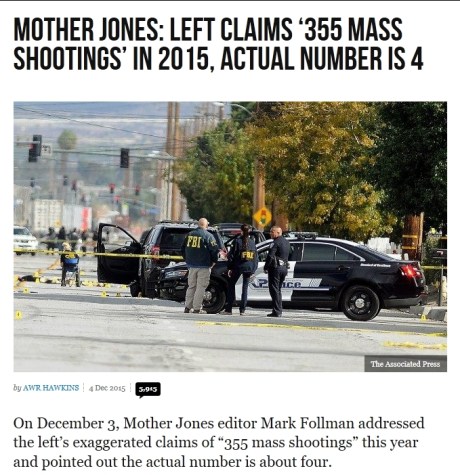
355

So FBI considers an incident where 4 people get killed to be a ‘mass shooting’ while Shooting Tracker considers a “mass shooting is when four or more people are shot in an event, or related series of events, likely without a cooling off period.”

Interesting.
The number is in fact real, only its significance is a little different.
Anyway, 355 incidents in which 4 or more people were intentionally wounded by somebody else is a lot.
And I really don’t care about how they got wounded. Regardless of being shot, stabbed or whatever, it was a fellow human (?) that did it.
What was it that drove these individuals to do such extreme acts?

jkegsfs

“As latest batch of innocent Americans are left in pools of blood” politicians continue to do what we have permitted them to do, for too long.

Some of the conservatives offer prayers, Trump offers to “take out their families”, Hillary Clinton tweets a very well worded but other-ways transparent message (“I refuse to accept this as normal. We must take action to stop gun violence now“)  and Martin O’ Malley squares up the ‘anti-gun’ position: “Enough is enough: it’s time to stand up to the @NRA and enact meaningful gun safety laws”.

One of the worst cases of heels being dug in I’ve ever witnessed…

bp39zn1ieaaudlw

Some of the conservatives cannot get  over the ‘if it doesn’t hurt me, it doesn’t need to be addressed’ attitude while some of the democrats cannot get over the Marxist attitude which posits that everything must have a ‘material’ cause – in this case ‘the guns’.

Am I exaggerating?
Then how come the conservatives act swiftly whenever ‘terrorism’ is involved while the democrats conveniently forget that no gun can kill without a man pulling its trigger?

And while too many of the conservatives let God fix the problems they don’t consider important and the ‘democratic’ ideologues focus on the wrong target too many voters from both sides of the aisle “are left lying in pools of blood”.

So yes, “God isn’t fixing this!”.
Anyway, not until ‘we, the people’ start doing something about it.

And the first thing that needs to be done is for us to stop digging in our heels and start talking across the ideological divide.


lashes1-copy-300x210
If we want to understand what’s going on there we have realize that we are dealing with a absolute dictatorship which uses Islam as a crutch, exactly as the soviet style dictators in the so called ‘popular democracies’ were using ‘scientific materialism’ – their term for the communist doctrine.
The job of the Saudi ‘justices’ is to maintain ‘the order’ as they see fit – the kingdom as it is and the Saudi family in power, not at all to dispense justice as we know it.
In order to do that they use, ‘creativelly’, the most powerfull tool they have at their disposal: the faith shared by the majority of the inhabitants of the kindom.
It even doesn’t matter for them that in the process they are ruining any chance of a decent life for the majority of their conationals.
At first their only goal was to retain the graces of the ruling family – just as minions everywhere behave in the presence of a powerfull figure.
In time things have evolved in a malignant manner. I’m afraid that nowadays the House of Saud itself has become the prisoner of the erstwhile minions, just as every dictator eventually becomes the prisoner of his guards.
armed citizens
Terrorism needs three things in order to produce victims.
Some disgruntled/deranged individuals to perpetrate the actual crimes.
Some callous individuals who for various reasons organize/support the disgruntled/deranged.
A large enough section of the community which is too tired/despondent/discouraged to care about what’s going on in its close vicinity – that’s where the terrorists (hit men and the support network) hide while preparing a hit and where the support network will try to sink itself afterwards.
Since it is practically impossible to corral all the deranged and to smoke out all the schemers beforehand the only really viable strategy  remains to make it so that the general public no longer assists catatonically to whatever is happening in its close vicinity. Until it’s so late that even drawing a gun is no longer very helpful.

I don’t even think that arms are such a must.
They might come handy in certain occasions but what we really need is a much more active attitude. A calm and considerate one but firm enough to impose respect.


I happened to stumble upon this image on somebody’s FB wall.
gore2bvidal

And then it hit me.

Waging war is simple.
Even winning one is relatively simple if one has enough resources.
Winning the peace afterwards is the real challenge.
America did very good jobs at winning the peace after WWII and the Korean War but very poor ones afterwards.
Here’s Gore Vidal elaborating on the subject:
gore vidal

I believe that you’ve already watched the video before starting to read so I’m not going to discuss about what’s going on there.

The point I’m trying to make is that all rights come with a huge responsibility attached to them.
No, not the one to take that right to it’s ultimate consequence:

Every right has to be exercised with the utmost discretion and consideration.
Or else:

And no, this would be funny only if it wasn’t already tragic:

“Publicly, law-enforcement officials have been reluctant to link the movement’s antipolice rhetoric to the spike in violent crime. Privately, they have been echoing South Carolina Gov. Nikki Haley, who said in a speech last week that the movement was harming the very people whose interests it claims to represent. “Most of the people who now live in terror because local police are too intimidated to do their jobs are black,” the governor said. “Black lives do matter, and they have been disgracefully jeopardized by the movement that has laid waste to Ferguson and Baltimore.””

ISIS Enshrines a Theology of Rape Claiming the Quran’s support, the Islamic State codifies sex slavery in conquered regions of Iraq and Syria and uses the practice as a recruiting tool. Written by RUKMINI CALLIMACHI; Photographs by MAURICIO LIMAAUG. 13, 2015

This is not as much about a particular religion as it is about the dominant religion of a certain place loosing its ability to fulfill its mission.
By ‘religion’ I understand the set of ties that transforms a certain population into a community, the rest is ritual.
When those ties no longer do what they are meant to do – make the individual feel that he belongs and therefore impart a certain sense of safety – many members of that erstwhile community start to loose their marbles.
Some kill themselves, pretending to be martyrs who die for a sacred cause, some others rape the innocents that happen to cross their paths.
The fact that some ‘religious leaders’ use the teachings of a particular religion to encourage these abominations only proves that the so called leaders are nothing but fraudsters that feed on other peoples’ misery.
More than a hundred years ago Emile Durkheim, one of the founding fathers of sociology, had wrote ‘Le Suicide’ and fully explained all this. Maybe what we need is to re-read it. All you have to do is follow the link.

I borrowed this title from the BBC because it frames nicely what I wanted to say.

First of all I’m at a loss to understand why so many people considers this to be a ‘Greek debacle’? Did the Greeks lend money to themselves and then refused to pay or this whole mess started years ago, when some private banks supplied huge amounts of money to a country notorious for her shoddy ways?
Then, when Greece was way outside the European norms about how much debt a country might have if it wished to join the Eurozone, the Greek Government lied blatantly and the European officials knowingly turned a blind eye in that direction.
Later, when Brussels started to make noises about this issue the Greek Government, instead of finding a way to pay some of the debt, used another ‘creative solution’ – a currency swap organized by Goldman Sachs. This time Euro-stat rubber-stamped the deal. Now the blame is put entirely on Goldman Sachs.

In 2010, after it became apparent that Greece was no longer able to service its foreign debt – at that time owned mostly by private banks, a first bailout plan was arranged. In 2011 a second one. This way ownership of most of Greece’s debt was transferred from private to public hands.

On the other hand giving Greece a ‘haircut’ now, before they had even started to mend their crooked ways, would be an insult towards the Irish, the Portuguese and the Spanish – who had all swallowed the bitter austerity pill.

And yet.
Moral hazard aside we have to consider two things. Greece is different from the rest of the Euro-zone and Greece’s accrued debt is so huge relative to it’s GDP that none in his right mind would ever expect it to be payed back. In this respect what is happening now is nothing but an exercise of ‘kicking the can down the alley’.

Now let me explain in which way Greece is different and why this is important for the future of the EU.
s

Samuel Huntington has put forward a very interesting theory in which he argues that “The fault lines between civilizations will be the battle lines of the future.” And as you can see in this map, borrowed from Huntington’s book, via Wikipedia, Greece does not belong to the same cultural space as the ‘Western Europe’.
Huntington has drawn that map using the dominant religion as a criterion, in Europe as well as in other parts of the world. Nevertheless he probably has ‘felt’ that his method has it’s shortcomings. America is divided into ‘Latin American’ and ‘Western’ but Europe is not divided into ‘Catholic’ and ‘Protestant’.
And rightly so because what happened in Catholic South America is currently happening in ex Soviet dominated Eastern Europe AND in Greece: rampant and casual corruption that tears apart the social fabric.
What if the nations that inhabit these two cultural spaces have something more in common than ‘top-down’ religious systems – both Orthodox and Catholics have a rather rigid ecclesiastical hierarchy?
Relatively little experience at being independent? At thinking with their own heads, as nations? At being proud of their constant success as teams instead of defining themselves relative to something that had happened in their distant past?

A modern independent nation is, or more precisely used to be, defined by the fact that the elite understands its mission and takes it seriously. Because of that – the positive results, that is, the masses are content with their current elite and follow it – consciously or not so consciously.
A country where the population hasn’t fully reached the ‘national’ stage of development experiences an almost schizophrenic situation. The individuals who should gather together, coalesce into an elite and run country are more preoccupied with their individual short term well being than with making sure that their own children will be able to live in a fully functional country when they grow up. For this reason the general public doesn’t trust the ‘leaders’. And this mutual distrust/disrespect has a very practical consequence: corruption becomes the modus vivendi of the entire society.

It is relatively simple to understand that a relationship of mutual respect between the elite and the general public needs a rather long time to develop and that the process has to take place unhindered by outside intervention. That’s why it cannot take place while the country is dominated by a colonial power, by an imperium or in any other way.
That’s why the peoples that live in South America have only recently started to make peace with their politicians – and not in all countries yet:  they might have conquered their independence from Spain and Portugal almost 200 years ago only their elites had everything in their minds but the general well being of the countries they were running. On top of that the former colonial powers and later the US have all intervened in the daily life of their former colonies/neighbors, further hindering their natural development.
Same thing happened in Eastern Europe. The Baltic States, Poland and Hungary have been, on and off, under foreign occupation but not for so long as to severely damage their development. In contrast Romania, Bulgaria and Greece had not enjoyed real freedom since the XIV-th century. And after they did became independent their elite went looking elsewhere for inspiration. Towards Western Europe at first and to the Soviet Union afterwards.  A somewhat natural thing, given the circumstances, but which did little to forge fully functional nations out of their populations.
Meanwhile the ‘man in the street’ has developed a particular strategy for surviving. He trusts nobody but his family  and close friends and doesn’t pay taxes unless he really has to. He has no qualms to take ‘bribes’ from the state – early retirement, subsidies, etc. – but that doesn’t mean he will trust the politicians that ‘distributed’ those ‘gifts’.

What is happening now, when the European elites are supposed to take their cue from Brussels, is not helping much. Ms Merkel is preoccupied primarily with her own constituency and the EU top brass are fully aware that Berlin has the last word about who gets what top notch European position. Any wonder smaller nations feel ‘neglected’? We should keep in mind that, as Great Britain is just one example, that Europeans do not feel towards the EU what the Americans feel towards the good old US of A.
Eastern Europeans have a particularly hard time. They want to get in the EU – they are both fed up with their local politicians and would like to be part of a working environment but at the same time they have a rather ambivalent attitude towards the EU institutions. This institutions enjoy a lot of respect from the Easterners, because they had worked properly – until not so long ago, at least, but at the same time they are watched with great apprehension. People who have had to take, in the past, their cue from ‘foreigners’ are somewhat weary of this whole thing.

So yes, I’m afraid that the euro-zone will be damaged by the current crises only I don’t think we should be speaking of a ‘Greek debacle’.  In fact the union itself – the European elite, to be more precise – has not entirely fulfilled its duty.

The sooner we understand that, the sooner we’ll know what to demand of it. And maybe we’ll be able to bridge the cultural divide mentioned by Huntington.

The alternative would be dire. The Russian elite – not the Russian people itself, only a fragment of its elite – will grab the opportunity to extend their influence. And by doing so to continue to hinder the natural development of the Eastern European nations. Including Modern Greece.