-Now that it doesn’t work anymore, why don’t you do something about it?
-Like what?
-Preventive action? As in ‘it’s easier to prevent it from happening than to fix it afterwards’?
-Sounds good. But the real problem here is not what’s going to happen – which is bad, but the fact that we’ve become blind. Blinded by ideology. By us convincing ourselves that we are right.
That we are right and the others are wrong! That ‘otherness’ is wrong…
Furthermore, the other is not only wrong but also pigheaded. They don’t want to listen! They are so stupid that their inability to let any fresh idea into their thick skulls will take us, all of us, into living hell!
You see, any successful preventive action needs at least one of the following:
A powerful enough ‘agent’ to take the matter into their hands. One who knows exactly what’s needed, can do it, and has no qualms about it.
A powerful enough coalition of people who learn what’s needed. And then convince the community to act.
Nowadays, the only agent powerful enough to implement, single-handedly, a solution is the US. But people there cannot see eye to eye with each-other. The only thing they agree about is that the others are idiots. Too many of the Republicans have followed Trump into the ‘all Democrats are idiots’ mantra while too many of the Democrats are convinced there’s no way anybody could convince the Republicans of anything which isn’t spelled in the Bible.
And, unfortunately, the rest of the world is equally divided along more or less the same line.
The ‘icing on the cake’ being the fact that many otherwise intelligent people have identified this situation as being ‘full of opportunities’. For each of them… Without realizing that the further they go down this lane, the deeper they dig themselves in quicksand. Taking all of us along with them!
What kind of preventive action might prevent something like this?!?
– But why?!? If you see it, if I can follow your argument about it… then surely they must see it too!
– They see it all right. The elephant has not only driven us into the corners of the room but has already cracked a fair amount of china… But they see only a side of it.
The problem is compounded by the fact that the elephant is only a puppy. It still has a lot to grow. As it is, there are many people who are convinced there’s a lot of time left for us to ‘wait and see’. And further compounded by the fact that so many of us want to find the culprit first. To find somebody to blame for letting the elephant in!
You see, nobody wants to accept that we’ve made this elephant. In here! In our midst. Nobody had brought the elephant in, we’ve all contributed to it’s birth. Some more than others but that doesn’t really matter anymore. Anyway, since its birth, most of us have contributed to it reaching its present size.
– Then all that’s left for you to do is to paint the elephant. To make it as visible as possible. So that when people will come to their senses, they’ll have something to look at…
Further more, it’s very likely that other people have also seen it. And don’t speak up because they’re convinced there’s nobody else who sees it as they do.
In the beginning was the word
– How did you manage to mess things up so thoroughly?
– By allowing too much coherence to slip away. After we – well, some of us, already had a fair understanding about how things worked. About how we got there in the first place.
– Would you care to elaborate?
– Things went on more or less linearly up to when we had learned to speak. That was when it had all started. When we had realized what a start was.
And that was it.
Speaking to each other allowed us to access the second level of consciousness. Self awareness.
Speaking to ourselves – a.k.a. ‘thinking’, gave us the illusion of ‘knowing’.
‘Knowing’ led to ‘knowing better’ and ‘knowing better’ gave birth to arrogance.
For a while, this process had been kept in check by the harsh reality. People, like all living organisms, have certain needs. Basic needs. Food, shelter… During most of our evolution, getting enough food and shelter consumed most of our resources. And time. Only a very small number of people had enough spare time. And energy left for thinking. And only a very small percentage of this already small number of people used their minds to think about anything else but how to preserve their privileged status. Which status was the source of their ‘spare time’ in the first time…
Slowly but surely, those having something else in their minds besides their selfish self interest have come up with a thing called ‘technology’. By carefully, and considerately, watching those who worked, the selfish thinkers have noticed that from time to time and from craftsperson to craftperson there could be noticed small differences in how things were done. Hence the concept of ‘how things are done’. With the natural sequel of ‘let’s do things in a better way’.
Technology made it possible for workers to be more productive. Communities as a whole became more productive. Hence increased the possibility for more people to have spare time for thinking.
Some communities made good use of this new possibility while others failed to do so. Usually for reasons depending on the ‘general conditions’ and not at all imputable to the communities themselves.
Unfortunately, technology also had two less fortunate consequences.
By freeing more and more people from want, it also freed them from ‘religion’.
Until that moment, people who were ‘excluded’ from society – who did not partake in ‘religion’, could not survive on their own for any significant length of time. After the advent of technology, reclusion no longer meant almost instant death.
Technology also produced ‘hard science’. A corpus of knowledge about how nature works. Which knowledge can be summarized as a collection of natural laws.
No longer depending as much on their contemporaries and cognizant of those natural laws, some of the thinkers – whose numbers had been constantly swelled by the continuously improved technology, have reached the conclusion that through thinking a human might, given enough time and resources, understand basically everything.
Some of those had become dictators. Others had become consultants.
Both categories extremely confident in their own knowledge. Arrogant, even.
This is how we messed things up. This bad.
Equality has become ‘the’ thing.
But things are not that simple. Not simple enough to be explained/solved in such a trivial manner.
Equality is a theoretical concept. It doesn’t exist, as such, in nature. Nor in practice.
Two ‘objects’/issues/items are declared, by us, to be equal if the differences between them are smaller than a threshold. Instated, again, by us. Mathematics – a theoretical field by excellence, being the only domain where the difference between two equal ‘objects’ is exactly zero.
On the other hand, societies where people consider themselves to be equal fare better than those where the differences between people are ‘manifest’.
Hence ‘equality’ must be important, right?
‘Societies where people consider themselves to be equal’…
The key word here is “consider”, not “equal “.
In this situation, equality is not only a concept but also a value.
The fact that a functional majority of the people living in those societies consider themselves to be equal creates a certain ‘environment’. A situation where those people actually complement each-other. A society which works as an organism. Not as a shoal of fish nor as a simple herd. A society which works a community.
A single parent can raise children. But two parents do it a lot easier. And, in most cases, better.
A single parent can adopt children. But no single parent, man or woman, is able to give birth to a child without being helped by a member of the ‘opposite sex’.
Societies where people consider men and women to be equal fare a lot better than those entertaining other beliefs. Which doesn’t negate the fact that men and women complement each-other. In a lot more situations than those in which they merely reproduce themselves.
Economies where the market is free fare a lot better than those where the economic decisions are made in a centralized manner. The communist camp – where the economies were run by the party, had crumbled under their own weight. Which strongly suggests that no matter how skilled it may be, a central planner will never be able to balance such a complicated process as a whole society/economy. Monopolistic situations, where decision making became too concentrated, invariably ended up in a pile of mess. Another proof that no decision maker, no matter how skilled/well intended, was ever capable of managing, by itself, a really complicated situation.
What is the real difference between a free market and one where decision making is concentrated in an unsustainably small number of hands? Or heads?
Economic agents are equal? Suppliers are equal among themselves, buyers are equal among themselves and suppliers are equal with buyers?
Or suppliers complement each-other in adequately supplying the market while buyers and suppliers complement each-other in maintaining the market afloat?
Which brings us back to where we have started.
Where people who complement each-other have reached the conclusion they’d better consider their complements as equals. And treat each-other as such.
Word of mouth has it that a dissatisfied customer will be more vocal than a happier one.
A search over the internet yields unconvincing results. The statistical jury seems to be still out on this one.
A misspell in the search window unveiled something a lot more interesting.
The brain is hard wired to recognize an angry voice. As well as an angry face.
Are we aware of all this?
Probably not. Statistically speaking…
And this is important why?
Being able to recognize anger makes it easier for us to deal with conflict.
Individuals who do it better have more chances to survive when involved in dangerous situations. Or even to turn them around. To find ways in which to use conflict in a profitable manner. Profitable for them… And only time will tell for how long!
Communities adept at taming conflict into something useful have greater chances to survive than those less able to deal with it.
Now, where are we in this moment?
Do we talk to each other? Are we aware of what’s going on around us? Cognizant enough to take the appropriate measures?
Or do we just vent out our bile? Creating such an environment that no coherent answer will be presented when needed?
Are we, each of us, part of the solution?
Or we just create more and more problem?
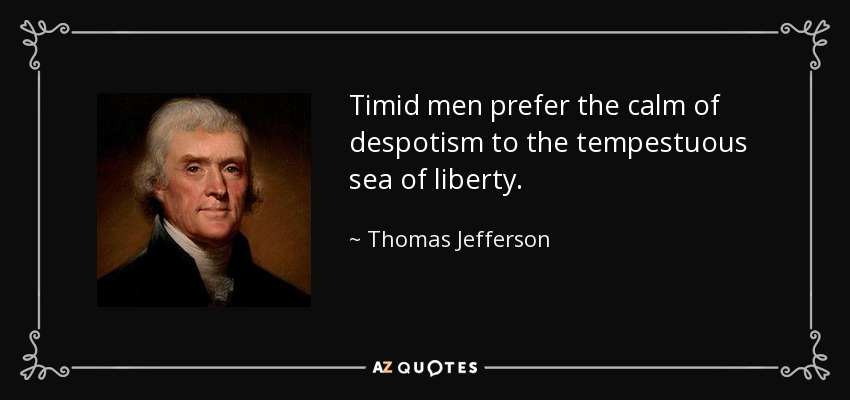
Trying to make sense of this this proverb, one might find handy a deeper understanding of ‘it’.
I’ll be arguing in a future post about the synthetic nature of equality. A concept we came up with, based on things found in the natural world. But the concept itself has no natural precursor. It was invented by us and exists exclusively in our minds.
On the other hand, liberty – the ‘it’ I’m writing about right now – is ‘artificial’. Another concept we’ve came up with, based on things found in the natural world.
But one which has evolved from a natural precursor. It still exists exclusively in our minds – like all other concepts, but we didn’t actually invent it. We only noticed its natural precursor and built on in.
Orangutans are freer than us. They live individualistic lives, depending on no one but themselves. They are strong enough to do this and they live in such a manner and place that they don’t have to face any natural enemies. We, humans – their cousins, are the only agents powerful enough to represent a real danger for them.
Gorillas are less free than us. They live in strict autarchies, where they need nothing but what already exists in their domains – the plants they feed on, and where they respect the strict discipline imposed by their strictly authoritarian male leaders. Which are the only free(ish) members of the groups.
Chimpanzees and bonobos, each in their own way, are the closest to us. Some freer than others but none as free as the orangutans.
None of our cousins have the concept of liberty. As far as we know, they long for it – for freedom, that is – when they lose it. Hence they feel (for) it. But they haven’t, as far as we know it, came up with the notion of it. This being the reason for which the concept of liberty might be synthetic – like all other concepts, but liberty itself is artificial.
Our experience of liberty has a lot in common with what our cousins feel when they lose theirs. When they lose theirs to us!
We being the only agents who, after synthesizing the concept of liberty, have taken the process a step further.
Have started to take prisoners. And to justify our actions!
I’ve been talking about complementarity, equality and freedom.
The implication being that unless people treat each other fairly – as in consider the others as being equal, and equal with themselves – none will be actually free. Free to fully complement each-other. Free to ‘boldly go where no one has yet been’. Together.
What’s keeping us from doing it?
To figure that out, we need first to understand how we got here.
‘I’ve been talking about…’
To talk about something means the talker is aware about the existence of that something. They may not fully understand what’s going on but they have already noticed that something’s afoot.
Furthermore, for a human to attempt to communicate about something means that that human considers there’s at least a small chance that others will understand the message. That others understand the language used and that those others already have a modicum of interest in that matter.
In other words, any attempt to communicate means that those involved are not only aware that something’s afoot but also have reached a certain degree of consciousness. That they are not only aware of something being there but also aware that they, together, can/should/must do something about it.
They key word here being “together”.
Why bother talking about it when/if you’re able to deal with it on your own?
Which brings us to ‘war’!
How many do we need to be in order to ‘deal’ with this ‘thing’?
How many of us will be able to ‘feed’ themselves after this ‘thing’ will be dealt with?
How much will each of us have contributed to the whole process?
How will the spoils be distributed among ourselves?
How will we deal with the ‘loose cannons’ among ourselves?
How will we know who will do what?
Who will lead? Who will be responsible for the whole thing?
This is the moment when I’ll remind you that this is a blog about the consequences of our limited consciousness. A blog where I gather my attempts to understand the limits of our ability to make decisions – as individuals, and the manner in which different societies have come up with different methods to mitigate the consequences of those limits.
Happy reading, every one.

What makes us think that the Thinker is thinking while the Woman is just sitting?!?
Is there any meaning in this?
Newton had only described gravity, he didn’t invent anything. Noticed it – like many others before him, thought about it – more (better?) than all those before him, and came up with a deeper meaning for the whole ‘falling thing’.
Nobody cared to contradict him. Because everything, once exposed, was so obvious!
I’ll make a break here and wonder… what does the Flat Earth Society think about gravity?

Had your laugh?
OK, let’s move on.
Darwin had also noticed things. Thought about them. Really hard. And put together a theory.
Which continues to be considered a theory because not everybody is yet convinced…
OK, things are a little harder to swallow. Specially the part with us being relatives, no matter how distanced, with Judy…

Furthermore, the evolution thing is not as obvious as the gravity thing… most of us would have to take Darwin’s word for it… something we don’t do that easily, specially if/when we dislike – for what ever reason, the outcome.
Then why do we ‘swallow’ – line, hook and sinker, however implicitly, the names affixed on those two prehistoric figurines?!?
Because they are obvious?
Just as obvious as gravity?
The guy must be thinking and it’s obvious that the woman is just sitting?!?
Or is it that we believe what we want to believe?
We attribute meaning according to our own standards. Then stick to our opinion. Almost no matter what…
How about He nursing a hangover and She guarding him against predators?