Archives for category: Respect Mutual.

Inainte de decembrie ’89 oamenii ‘votau cu picioarele’, intr-un singur sens.

In ’89, pentru ca se adunasera destul de multi, au votat cu ‘pumnul’.

In Duminica Orbului, 20 Mai 1990, si apoi in 1992, au fost primele doua dati cand am votat ‘rational’: ‘Ne-a dat Iliescu pamantul inapoi?’ ‘Ne-a dat!’ ‘Partile sociale?’ ‘Ni le-a dat si pe alea’. ‘Banane si portocale?’ ‘Da, nu mai vazusem de mult!’ ‘Ne-a lasat sa iesim mai devreme la pensie?’ ‘Da!’
Pai si atunci cum sa nu-l votam?
Oricat ne-am da acum cu pumnii in cap nu putem reprosa unei populatii neobisnuite cu exercitiul democratic si cu functionarea unei economii de piata ca a votat ‘primitv’, ca s-a lasat cumparata cu maruntis.
Ii putem intr-adevar reprosa lui Iliescu ca a irosit un bun prilej de a intrepta tara catre o cu totul si cu totul alta directie dar…’cine a stat cinci ani la rusi nu poate gandi ca Bush’ … asa ca …

In orice caz in ’96 ne cam lamurisem ca nu mergeam chiar in directia cea buna asa ca iar am votat ‘contra’.
Unii ar spune ca atunci am votat cu Emil Constantinescu si ca acesta ne-a dezamagit.
Eu unul nu sunt de acord cu asta. Noi suntem cei care am gresit fundamental. Am crezut ca Milica era tot un fel de Iliescu. Ca dupa ce va ajunge la putere se va ocupa el de tot.
Ar fi putut face asa ceva? In primul rand fotoliul de presedinte al Romaniei nu confera ocupantului suficienta putere pentru a face asa ceva daca nu se bucura si de colaborarea unei majoritati parlamentare functionale. In al doilea rand Constantinescu era exact opusul lui Iliescu. Un democrat convins ca rolul unui politician este acela de a asigura cetatenilor un spatiu in care acestia sa isi poata folosi cat mai bine calitatile si nu un ‘tatuc’ care se crede dator sa-si duca ‘con-cetatenii’ – momindu-i daca se poate, cu forta daca nu se lasa – acolo unde crede el ca trebuie sa ajunga.
Ori, dupa ce l-am ales, noi insine l-am lasat pe Constantinescu de unul singur. Cei 15000 de specialisti erau acolo, asa cum ni se promisese, numai ca au preferat sa intre in afaceri in loc sa intre in administratia publica. Si, de fapt, de ce ar fi facut-o? Erau tineri, capabili, de ce sa se ingroape singuri cand in fata lor se desfasura, virgina, economia de piata?!?

In 2000 am fost atat de scarbiti de ceea ce se intamplase incat iar ne-am sucit. Atat de scarbiti incat pe locul doi a iesit Vadim. Iar in turul doi scarba de scarba ne-a orbit atat de tare incat am fost in stare sa votam cu Iliescu incat sa nu iasa CVT-ul!

Si apoi iar, in 2004 am votat cu Basescu de frica lui Nastase, nu pentru ca am fi inteles ceva din proiectul lui Basescu. Noroc de Tariceanu ca nu si-a pierdut capul si a stiut sa-i faca fata.

In 2008 si 2009 parca ne-a luat cineva mintile. Dupa ce Tariceanu si PNL-ul – tocmai pentru ca nu s-au bagat unde nu le fierbea oala, in mațele economiei – permisesera Romaniei sa ia parte la cresterea economica mondiala – asa fortata cum fusese ea – i-am aruncat la alegeri tocmai pe locul 3. PDL-ul care nu facuse nimic 4 ani a luat de doua ori mai multe mandate decat PNL iar PSD-ul, care nu facuse nimic altceva decat sa sprijine din umbra PNL-ul, a iesit pe locul doi. Si ne mai miram acum de ce Tariceanu se comporta asa cum o face in zilele astea si de ce PNL-ul a stat pe bara in turul I de la prezidentialele de acum? Si dupa aceea sa-l reconfirmam pe Basescu pentru inca 5 ani?!? Doar pentru ca ni se paruse Geoana prea moale?!? Ne-a invatat Basescu minte ce inseamna un lider puternic…

2012, in schimb, promite sa fie inceputul schimbarii. Pentru prima oara am votat un ‘proiect’. S-au adunat unii, au facut un program cu cap si coada, au parut ca se inteleg si bine am facut ca i-am ales. Dupa aceea s-au certat intre ei…

Acum avem ocazia sa terminam schimbarea. N-am sa va spun cu cine am de gand sa votez, din posturile mele anterioare rezulta foarte clar ca sunt de parerea lui Lao-Tzi ca datoria conducatorului este sa stea deoparte si sa vegheze, nu sa se bage in toate cele. (Recitind imi dau seama ca s-ar putea intelege ca ma compar pe mine cu Lao-Tzi… ma refeream la conducatorul pe care urmeaza sa-l alegem! Nu vreau sa iau, acum, pe fata, partea nici unuia dintre ei pentru ca imi doresc ca mesajul meu sa ajunga la cat mai multi dintre voi, indiferent de simpatiile voastre politice.)
Am sa fac in schimb remarca ca situatia de extrema polarizare in care se afla Romania se datoreaza in foarte mare masura exact acestui ‘vot negativ’.
Polarizare politica, adica imparirea populatiei in TREI tabere care aproape ca nu vorbesc intre ele – o masa imensa de scarbiti pe care nu-i mai intereseaza nimic, iar alaturi de ei o ‘stanga’ si o ‘dreapta’ care au in comun doar autoritarismul, nu si vre-un proiect de tara – si polarizare economica – o mare masa de saraci, cativa indivizi extrem de bogati si o mana de oameni despre care ei cred ca fac parte din clasa mijlocie numai ca sunt atat de departe de cei saraci incat acestia din urma nu-si pot da seama pe unde or fi ajuns aia acolo.

Ce legatura are votul negativ cu polarizarea?

Simplu.
In situatia in care populatia este scarbita este nevoie de masini puternice de partid pentru a fi scoasa la vot. De unde si tendinta ca partidele bine organizate – PSD si PDL, in realitate amandoua urmase ale FSN-ului – sa se transforma in partide-stat. Iar aceste doua lucruri – o populatie scarbita si dezabuzata si niste masinarii puternice de partid, organizate aproape militareste – fara prea mare libertate interna, imping inexorabil inapoi catre campanii negative. Un cerc vicios. Este mult mai usor sa starnesti o populatie nemultumita provocandu-i emotii negative decat sa o aduni in jurul unui proiect si e mult mai usor sa raspandesti ‘zvonuri’ decat sa convingi atunci cand ai la dispozitie ‘soldati’ disciplinati dar pe care nu i-ai incurajat niciodata sa gandeasca de unii singuri – tocmai ca sa nu intre la idei.
Acest cerc vicios ii prinde pe unii si ii arunca pe alti afara. Afara de tot, adica afara din tara, sau la periferia jocului. De unde, in aparenta linistiti dar in realitate mereu la panda,  vaneaza oportunitatile. Unii ii acuza de venalitate, altii ii scuza – ‘pai ce sa faca si ei, saracii?’. O fi bine? O fi rau? Cert este ca la fiecare dintre schimbarile de macaz/guvern o parte dintre acestia cad victima schimbarii. Unii se prabusesc de tot, altii se inregimenteza in cate o masinarie de partid. In felul acesta polarizarea se adanceste si mai tare.
La varful piramidei, in zona rarefiata a atmosferei, ajung doar cativa, sa-i numeri pe degete. Tocmai din cauza acestui razboi continuu in care nimeni nu iarta pe nimeni. Iar problema nu este ca sunt extrem de bogati – nu ma intereseaza cum au ajuns sa fie asa – ci extrem de putini. Fiind putini fiecare dintre ei este foarte puternic – destinele a extrem de multi oameni depind, direct sau indirect, de deciziile pe care le ia fiecare dintre ei. Situatia este valabila atat in ceea priveste clasa politica cat si pe ‘oamenii de afaceri’. Iar in conditiile in care foarte multa putere este concentrata in foarte putine maini ori de cate ori oricare dintre aceste maini tremura efectele sunt dezastruase. Acest lucru este valabil chiar in conditiile in care detinatorii puterii sunt bine intentionati, cu cat acestia sunt mai putini cu atat creste probabilitatea ca greselile comise de unii ei, involuntar sau chiar cu buna credinta, sa treaca neobservate de ceilalti – tocmai datorita numarului lor insuficient. Reteta clasica pentru dezastru si explicatia pentru prabusirea inevitabila a tuturor imperiilor cunoscute in istorie si a tuturor companiilor care au ajuns vreodata sa domine autoritar o anumita piata.

Ce facem in situatia asta?
Cu cat stam mai multi acasa cu atat hotarasc ‘ceilalti’ pentru noi si se adanceste polarizarea dintre noi.
Macar sa iesim, masiv, la vot. Eu, unul, stiu cu cine voi vota. Cu toate ca sunt sigur de optiunea mea nu va pot cere si voua sa faceti aceiasi alegere. Cred ca intelegeti de ce.
Ce pot face insa este sa va rog sa ma ‘urmati’ catre sectiile de votare. Doar in felul acesta le putem transmite ‘lor’ ca ‘ne pasa’. Ca am inteles. Ca nu mai suntem dispusi sa ne lasam purtati de vant incolo si incoace.

confruntare electorala

Confruntarea, directa sau indirecta, este o forma de negociere.

Specialistii in PR si/sau marketing politic pot intra in amanante extrem de interesante pe aceasta tema.

Am sa incerc sa analizez ce se intampla din postura celui interesat mai degraba de modul de gandire al oamenilor – si de maniera in care gandirea este tradusa in practica – decat de orice altceva.

Situatia curenta:
– Ponta a primit in turul I mai multe voturi decat Iohannis. Ca atare este interesat in pastrarea status-quo-ului. Are nevoie ca in turul doi sa se prezinte toti cei care l-au votat in turul I, eventual mai multi, si sa faca in asa fel incat toti ceilalti sa devina descurajati, eventual chiar scarbiti.

– Iohannis a reusit sa iasa pe locul doi dar la distanta destul de mare. Are nevoie sa-i re-mobilizeze pe toti cei care l-au votat in turul I si sa atraga pe cat mai multi dintre nehotariti si dintre cei care au votat cu alti candidati de ‘dreapta’.

Deci in timp pe pe Ponta il intereseaza mai degraba sa-si conserve alegatorii (teoretic nu prea mai are de unde sa atraga foarte multi votanti noi) Iohannis are nevoie de a aduna foarte multe voturi ‘proaspete’ – atat de la unii dintre cei care au votat deja in turul I cat si de a aduce cat mai multi votanti noi care sa-l sprijine.

Privind situatia in felul acesta devine clar de ce Ponta isi doreste 4 confruntari iar Iohannis doar una si de ce Ponta vrea la televiziuni de stiri in timp ce Iohannis are nevoie de un teren neutru.

– Daca sunt mai multe intalniri, cu tematica bine stabilita si cu moderatori din televiziuni totul se transforma intr-un spectacol bine regizat. Dupa fiecare dintre ele ‘stafful de campanie’ poate analiza efectul obtinut si calibra raspunsurile de la urmatoarele intalniri. Acelasi lucru poate fi facut si cu intrebarile ce urmeaza a fi adresate. Daca este vorba despre o singura intalnire lucrurile pot scapa mult mai usor de sub control, mai ales ca tematica nu mai poate fi atat de stricta.

– Televiziuni de stiri versus teren neutru si emisiune preluata de toate televiziunile care isi doresc acest lucru.
Cele 4 televiziuni care au lansat invitatii sunt percepute de public ca fiind inregimentate politic. Doua intr-o tabara, doua in cealalta tabara.
Telespectatorii, la randul lor, sunt impartiti in trei. Unii, din pacate cei mai multi, nu se uita la ‘politica’. Unii de scarba, altii pentru ca pur si simplu, si-au pierdut interesul – daca l-au avut vreodata. Ceilalti, cei cu ‘opinii ferme’, tind sa fie de acord cu mesajele transmise de televiziunile care sunt in aceiasi tabara cu ei si extrem de critici cu mesajele venite din tabara cealalta.

Daca contruntarea ar avea loc la televiziuni lucrurile s-ar intampla cam asa:
– Cei mai multi, cei neinteresati, ar schimba canalul dupa primele 5 minute pentru ca incepe ‘Las Fierbinti’ sau alt serial foarte popular.
– Cei care au incredere in televiziunea care transmite emisiunea din seara respectiva isi vor intari convingerea in ‘valoarea’ candidatului ‘lor’.
– Cei care n-au incredere in televiziunea respectiva vor gasi nenumarate prilejuri de a se enerva – ‘uite cum i-au taiat vorba/nu l-au lasat’ – pe modul cum este tratat canditatul ‘celalalt’ si vor sfarsi prin a schimba si ei canalul, scarbiti.

Cu alte cuvinte exact ce are nevoie candidatul care isi doreste sa conserve cat mai mult din situatia actuala.

Celalalt, Iohannis, are nevoie sa-i scoata din amortire exact pe cei indeobste neinteresati de ce se intampla in studiourile televiziunilor de stiri – printre altele si pentru ca nu au o parere foarte buna despre aceste televiziuni. De unde insistenta sa ca intalnirea sa aiba loc pe teren neutru, moderata de cineva care nu are mare legatura cu peisajul media si transmisa simultan pe cat mai multe canale – astfel incat telespectatorii sa nu aiba unde ‘fugi’.

Cica nu e bine sa dai sfaturi, mai ales daca nu ti se cer.
De aceea voi margini in a ura ‘succes’.
Nu, nu candidatilor!
Alegatorilor.
Succes in a alege pe cel mai potrivit dintre candidati.

PS. Am inceput postul prin a face referire la ‘negociere’ si dupa aceea am vorbit despre orice numai despre ‘negociere’ nu.
De cele mai multe ori negocierile sunt ‘castigate’ inca inainte de a avea loc, de cel care reuseste sa impuna agenda si locul care ii convine lui – si care este ales astfel incat sa-l incomodeze la maxim pe adversarul sau.
Si abia acum am ajuns la partea care ma doare pe mine.
In principiu o negociere ‘adevarata’, care se incheie cu un succes durabil, este o negociere din care amandoua partile ies suficient de multumite incat sa continue relatia.
Nu asa ar trebui sa fie facuta ‘politica’?
Cu respect si nu cu aroganta?
Si cine ar trebui sa ceara, ba chiar sa impuna acest lucru, daca nu exact cei in capul carora se sparg oalele?
Adica noi, alegatorii? ….

Cred ca trebuie sa scriu ceva si in ‘corpul’ postarii, nu?

A, de exeplu ca la dreapta si la stanga lui Basescu se vor afla, bineinteles, Boc si Udrea.

Ce mi-a venit?
Pai e extrem de simplu.

Tariceanu a fost un excelent prim ministru. Atat ca premier cat si ca barbat politic. A fost suficient de priceput incat sa nu ‘strice’ nimic, din punct de vedere economic, cat a fost la Palatul Victoria si in acelasi timp suficient de barbat incat sa ii tina piept lui Basescu.
Si la ce i-a folosit? In 2008, dupa cei mai buni patru ani pe care i-a avut Romania, noi, poporul, i-am dat cele mai multe voturi lui Basescu. Probabil ca sa compenseze perioada de suspendare. De parca Basescu ar fi guvernat Romania si nu Tariceanu… Pentru cei care nu mai tin minte: in 2008 au votat cam 40% dintre cei care aveau dreptul iar PNL a iesit pe locul trei, cu jumatate de mandate fata de PDL. Pai cum sa te mai miri ca Tariceanu s-a acrit rau de tot?!?

In orice caz in situatia asta, dupa ce a acceptat postul de Presedinte al Senatului din partea PSD nu mai poate aspira la pozitia, chiar onorifica, de ‘comandant al dreptei’.
Iohannis, daca pierde alegerile, va fi obligat sa faca un pas inapoi.

Si atunci cu cine ramanem?
Mai vedeti pe altcineva in afara de Basescu care sa poata pretinde aceste galoane?
Pana revine Antonescu pe prima scena s-ar putea ca PSD-ul (sau o alianta PSD-PLR) sa castige si alegerile din 2016.

Daca va convine situatia asta…

PS.
In 2000 am votat pentru prima si ultima oara cu Iliescu ca sa nu iasa Vadim.
Acum 10 minute a anuntat ca il sprijina pe Ponta pentru turul doi.
Nationalism de stanga?!?

vadim turul 2


treziti-va ma!

A vous de jouer

I shared a video clip on FB a couple of days ago, I’ll post the link at the end of this entry.

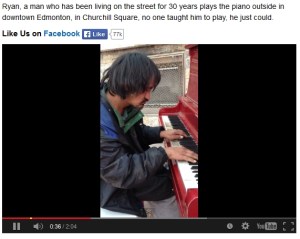
It was about a homeless artist in Edmonton, Canada, who taught himself to play the piano and I was wondering where did he find a piano on the streets to do that.

This is how I found out that: “There’s a public piano on the sidewalk in downtown Fargo (North Dakota . It’s in front of an art gallery and is free for anyone to play. (It’s covered during rain and taken indoors for winter, of course.) The plan is to acquire and “sprinkle” more of them around downtown. It’s very popular.”

I was very glad but my happiness was both short-lived and and quickly born again: “The first piano placed on the corner of First Ave. and Broadway in Fargo was vandalized within 10 days. When it comes to public art, our biggest challenge lies in defining the type of behavior our community will tolerate. We must hold each other accountable for our actions. I am working with the local police and with business owners to create ways to reduce the potential for future vandalism.”  
What’s going on there is way bigger than a lonely enthusiast sharing his piano with the passersby. It’s an entire project and the guys aren’t going to give up so easily.

Even more important is that the project is supported by the community: the pianos are donated by the general public and expenses are covered by private sponsors (Kickstarter “helped” a lot) while the big heart behind all this is Susanne Williams.

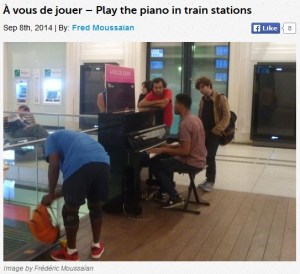
On this side of the Atlantic, or more specifically in Paris, pianos have found another way to get in touch with the general public. They have somehow convinced the managers of most rail-stations to have one installed near the platforms used by the commuters, as can be seen in the picture that opens my post. Click on it if you want to find out more.

While searching the internet to find out more about ‘street pianos’ I discovered Luke Jerram, the artist who in 2008 had the idea to launch “Play me, I’m yours” : ”

‘The idea for Play Me, I’m Yours came from visiting my local launderette. I saw the same people there each weekend and yet no one talked to one another. I suddenly realised that within a city, there must be hundreds of these invisible communities, regularly spending time with one another in silence. Placing a piano into the space was my solution to this problem, acting as a catalyst for conversation and changing the dynamics of a space.’
Luke Jerram, International artist and creator of ‘Play Me, I’m Yours’

Now I wonder if Luke Jerram and Ryan know about each other.
Ryan playing the piano

Thanks Maria Flieth and Paul Wehage for providing me the initial information for this post.

Me and my limited vision. I consider myself to be a person who is relatively well connected to the world at large yet I could never conceive of somebody not only dreaming about but actually bringing pianos out on the boardwalk for everyone to play.
Maybe it is high time for the rest of us to unleash their dreams.
And to start working on them!

Cine va castiga

N-am avut ce face si am clickuit o poza pe aplicatia Votează a site-ului Money.ro

Si cum tot romanul se pricepe la fotbal si la politica ce-ar fi sa comentez si eu rezultatele astea?

– Site-ul se adreseaza in principal oamenilor preocupati de bani. Nu neaparat unora care au asa ceva, si nici macar unora care stiu cum sa ii faca – aceste doua categorii sunt de obicei suficient de ocupati incat nu prea mai au timp de pierdut pe net, ci mai ales celor interesati de modul in care circula banii prin societate.
– Avand in vedere publicul tinta al acestui site nu trebuie sa ne miram ca ‘dreapta’ castiga detasat. Mai degraba trebuie sa ne bucure ca Ponta ia totusi 16 % din voturile acestei categorii de oameni. Inseamna ca acestia mai au totusi ‘un pic de inima’. Si chiar nu glumesc, cu toate ca eu unul am de gand sa votez cu Iohannis.
– Cel mai interesant lucru de aici mi se pare locul doi ocupat de Monica Macovei.
Pe de o parte e de bine. Inseamna ca mesajul ei axat aproape total pe ‘anticoruptie’ prinde si la aceasta categorie sociala, atasata in mentalul colectiv ideii de ‘coruptie functionala’ – de spaga data multimii de ‘inspectori’ veniti in control si care te amendeaza chiar daca nu ai facut nimic pentru ca ‘trebuie sa scrie si ei ceva in registrele alea de control’. Adica oamenii s-au cam ‘plictisit’ de sistemul asta. E de bine, pana aici.
Pe de alta parte Monica Macovei promite a se implica foarte activ in viata de zi cu zi a tarii: ‘Din prima zi voi….’
Pai asta nu e treaba primului ministru, care o fi el? Un nou un presedinte jucator?

Ar mai trebuie un sondaj pentru a vedea care dintre aceste doua motive a primat atunci cand votantii Monicai Macovei si-au manifestat preferinta pentru ea.

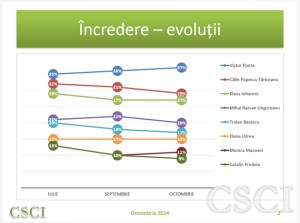
Pana la aparitia acestuia, daca va veni vreodata, putem verifica daca populatia, in general, mai este dispusa sa accepte o ‘figura paterna’ cu ajutorul unui sondaj cu privire la increderea in politicieni, facut in octombrie 2014 de catre CSCI:

incredere oct 2014

Concluzia mea?
Mare atentie. Orice va ocupa scaunul de la Cotroceni trebuie sa aiba grija. Oamenii nu mai sunt dispusi sa creada in figuri providentiale si s-au cam saturat de coruptie.

Extreme fragility, dead ahead.

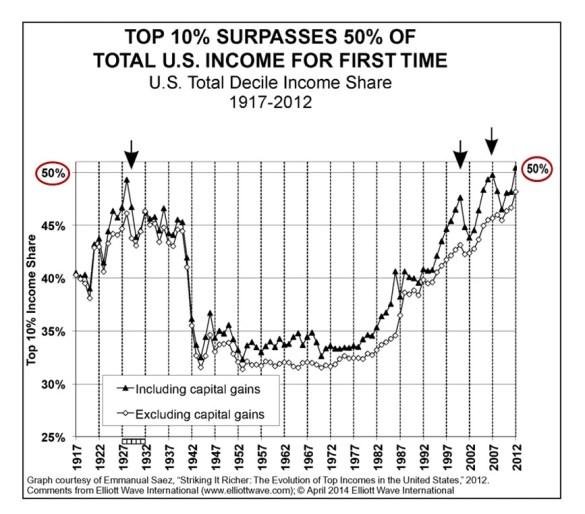
Just prior to the Great Depression an American accountant, Ralph Elliot, had taken Charles Dow’s insight about economic cycles a step forward and came up with the ‘Wave Theory’.
I won’t enter into details here but I have to give you some broad outlines.
Charles Dow: In any market, prices evolve in trends – sustained moves towards the main direction fragmented by ‘reactions’ that run contrary to the trend. According to Dow there are three categories/levels of trends: major, intermediary and minor. The major trends cannot be manipulated and comprises three phases: ‘accumulation/distribution’, ‘public participation’ and ‘panic’. The names are self explanatory but if you want to read some more please click here.
Ralph Elliot: (If a certain asset is traded by a large enough number of traders so that market could be considered ‘free’) Price action is fractal in nature and hence can be broken down and analyzed as such. While Dow identified 3 levels of trending Elliot uses 9 but both ‘agree’ that each action in the direction of the analyzed trend is followed by a reaction contrary to that direction.

Robert Prechter, the brain behind ‘Elliot Wave International’, ” the largest independent financial analysis and market forecasting firm in the world” – the guys from whom I borrowed the picture above – has been using successfully the ‘Elliot Wave theory’ for some 40 years now.
And here comes the really interesting part. Besides building Elliot Wave International as a market analysis company Prechter also founded The Socionomics Institute, a think tank that starts from the assumption that the markets are driven by the prevalent social mood (sentiment) that dominates at any given moment and not all the way around as it is usually believed. Prechter posits that markets go down when/because ‘people are afraid’ and not ‘people start to panic after the market has begun to go down’.
For some people this whole process is a tug of war between greed and fear. It makes a lot of sense but we still lack an explanation about why at some points the bulls are stronger than the bears and at some-other points the situation is completely turned over. Reason was supposed to take care of business at all times, wasn’t it?
Now some of you will tell me that Daniel Kahneman and others have provided ample proof that the market is far from being rational... OK, I agree with that but still, we continue to need an explanation for why the market behaves for so long as if it were reasonable only to break down exactly when everybody was so happy – as it constantly did, from the Tulip Mania in the the XVII-th century Holland to the last financial melt down.

Now please remember two things that I already mentioned.
– One of Charles Dow’s assumptions was that ‘major trends cannot be manipulated while the lesser ones might
– (If a certain asset is traded by a sufficient number of traders so that market could be considered ‘free’). Here I was presumptuous enough to introduce my own experience into the equation. After I was introduced to the Elliot Wave theory I found out that it worked (meaning that I could use it successfully – statistically, of course) for indices or other frequently traded symbols while it is completely useless for illiquid ones.

I started to understand what’s going on only after reading Nassim Taleb’s Antifragile.
The gist of this book is that for a system to remain viable, to conserve it’s chances to survive, it has to keep open as many options as it possibly can.
Does it make any sense to you?
To be alive means being able to make decisions, as freely as possible. If you are forced to make one thing or another then you are not free anymore, right? If you have at least the slightest opportunity to choose among two or more possibilities then it means that you still have a sparkle of life in you! Stephen Hawkins, tied in his wheelchair for so many years, is alive just because he choose not to be overwhelmed by his condition while so many of us are (brain) dead because we indiscriminately follow fads, fashions, habits, you name it. The moment we give up our individual autonomy and enroll into a crowd (read ‘herd’) we might have the impression of becoming safe, or at least safer, but in reality we are already headed for the slaughterhouse.

It is somewhat true though that ‘there is safety in numbers’. And no, I’m not contradicting myself. The bigger the crowd the harder it is for someone to control it (take it to the slaughterhouse, by will or by error) and the greater the chances for an individual to escape an unforeseen  predator. So you need a really big crowd if you want to have a survival situation, a reasonably viable system.

If we look back in history – no magical solution can be found there, only a long list of errors – we’ll see that empires never fail to crash, authoritarian regimes survive for considerable shorter periods than the more democratic ones and that the more powerful a fad was the least it survived. And all these situations fit perfectly Taleb’s theory: the less open options a system has the less able it is to survive. The emperor is but a single man, who inevitable ends up being ‘naked’, no matter how capable it is – and people notice it sooner or later. Also the more an authoritarian a regime the less are the ordinary people inclined to contribute to the welfare of the community.
And something else. When a fad becomes intense enough the people involved become blind to any other alternatives but those prescribed by those convinced that they have a lot to gain by keeping that fad alive. That’s why it is very hard for a social ‘vicious circle’ to be broken until enough people hit the rock bottom. No grown up will voluntarily shout ‘the emperor is naked’ because he thinks he has nothing to gain from this. As strange as it may seem it is rather hard for the regular Joe, who’s afraid of the emperor, to understand that the entire kingdom becomes a laughing stock for the rest of the world if the emperor is known to stroll naked through the public square.

Now please take a second glance at this picture.
Extreme fragility, dead ahead.

What does it suggest?
That there is a certain correlation between income being concentrated in fewer and fewer hands and the probability of a market crash?
But correlation is not causation!
No, it isn’t. Not unless we can find a reasonable story for what may ’cause’ that correlation! Explain it, that is!

By now I’m almost convinced that most of you have already ‘got’ it.
Concentration of revenue means concentration of decision power. As less and less people (proportionally) remain in ‘powerful’ positions they not only command a higher proportion of the aggregated revenue of the entire community but they also control in a greater measure the destiny of that community.

No, I don’t think that ‘they’ are ill intended. ‘They’ live here too. They are not idiots, otherwise they wouldn’t have reached/been able to retain those lofty positions. So no, I don’t think they are willingly leading us to disaster.

The problem is that they are too few! No individual human being is able to make a considerable number of decisions in a short period time. That’s the very reason why we have consultants and so on, right? The problem is that ‘consultants’ only give advice, they cannot/are not allowed to make actual decisions. And the fewer are the people wielding real power the more the rest of us become mere consultants…

And according to Taleb’s theory and to an immense number of historical occurrences the less people are involved in the decision making process the higher are the chances for a catastrophic error to ‘reset’ the entire system.

PS I. Funny for a conclusion like that to be drawn from a picture published by somebody who caters for those ‘working’ hard to get as rich as possible, isn’t it?
On the other side…if these people considered the issue to be important enough to write about it … maybe it’s worth a moment of our precious time.

PS II Never say never!
I don’t think we are necessarily facing another economic melt-down in the immediate future. It might happen, of course. It will happen – sooner or later, of course again, but there is no sure way of telling when.
What I’m trying to suggest here is that there is a very strong possibility that in the near future we’ll witness a considerable change in how we manage the economy and in the way we relate to the concept of ‘money’.

Democracy_People_Power
Democratia nu inseamna ‘dictatura majoritatii’, aia este ‘mob rule’ – dictatura gloatei pe romaneste. N-am sa intru acum in amanunte despre cum este aglutinata si manipulata aceasta gloata de catre diversi operatori politici.

Democratie este ceea ce se intampla inainte de vot, discutia pe fata cu privire la problemele cetatii si propunerea de solutii. Dupa aceasta discutie sunt alese solutiile, nu oamenii care sa le puna in practica. Acestia sunt secundari solutiilor, chiar daca ei sunt cei care au propus aceste solutii. Mai mult, democratia nu este nici macar despre alegerea celei mai bune solutii. S-ar putea ca in cadrul acelei discutii sa nu fie identificata solutia optima sau chiar ca cel care o sustine sa nu fie in stare sa o prezinte convingator sau ca marea masa sa nu fie inca pregatiti/suficient de maturi pentru a accepta acea solutie. Dar in mod sigur in timpul discutiilor – daca sunt cu adevarat libere – vor fi eliminate propunerile idioate.

Pentru aceasta este nevoie de libertatea de expresie si de simt civic – adica de niste alegatori suficient de treji incat sa isi dea seama ca este vorba despre soarta lor si nu a altora.

Si nu, nu este acceptabil sa nu te duci la vot. Nu sunt de parere ca votul ar trebui sa fie obligatoriu dar nici sa-i lasi sa faca ce vor fara ca macar sa-i intrebi de sanatate… N-ai inteles nimic? Asta inseamna ca ei nu s-au straduit destul, ca nu si-au facut cu adevarat treaba in campania electorala – discutia aia despre care vorbeam la inceput. Nici unul dintre ei nu iti inspira incredere? Si nu te duci?!?
Asta inseamna ca de fapt nu iti pasa! Daca iti pasa te duceai si anulai votul. Le transmiteai ca ar fi cazul sa se apuce serios de treaba. Asta este singurul fel in care poate fi sprijinita democratia.
Daca nu te duci inseamna doar ca ii sprijini pe cei care sunt la putere, adica esti multumit cu ce se intampla sau nu te intereseaza  ce ti se intampla. Cu alte cuvinte le dai o imputernicire in alb sa continue pe mai departe ce ti-au facut pana acum.

“Kaci Hickox, a nurse whose return to the U.S. after treating Ebola patients in Sierra Leone was sidetracked when she was placed in a mandatory 21-day quarantine Friday, is criticizing the way New Jersey officials have handled her case.

Hickox says she doesn’t have a fever; a preliminary blood test came back negative for Ebola. She reportedly hired a civil rights attorney Sunday to work for her release.

I can understand the notion of ‘quarantine’ even if I have serious doubts about it’s efficiency.
But in an unheated tent and wearing paper scrubs?
I’m afraid this is less about separating people that might be carrying the virus from the rest of the population and more about frightening others from coming in!
Now, I cannot stop wondering, how many otherwise reasonable people will do their ‘best’ (worse?!?) to hide any contact they might have had with this disease?

PS. “Gov. Andrew M. Cuomo Sunday night said people returning from West Africa who have come in contact with Ebola virus patients but are not showing symptoms will be quarantined for 21 days at home instead of in a hospital.

The announcement marked a change in the policy outlined by Cuomo and New Jersey Gov. Chris Christie on Friday that drew criticism from federal and local officials, and medical…”

Altruism is a behaviour that has been ‘naturally’ selected at the ‘social’ level,
Communities that encourage it fare better, as a whole, than communities which condone widespread indifference towards the others.
Please notice that the opposite of altruism is not ego-centrism and not even egoism but complete indifference. An egocentric or egoistic individual is one who is aware of his person and values his individuality. As such he will try to take good care of himself and never dare to behave in a completely callous manner because he fears social rejection, provided his egoism is tamed by reason.
If his egocentricity becomes unmanageable he turns into a socio-path that will be, sooner or later, expelled from the society.
If nothing out of the ordinary (extremely good or extremely bad) comes along, naturally (randomly) occurring ‘altruism’ is encouraged by some, faked by others and on the whole a ‘moderately altruistic’ behaviour becomes the modus vivendi of that particular community. Ties between the members of that group gather more and more force but don’t overwhelm the individual autonomy of the members, on one side because of the ‘fakers’ and on the other because the ‘real’ altruism involves a certain degree of respect towards the others.
If a particular social group, for whatever reasons, stops discouraging extreme egocentricity, like the one Caligula and his heirs ‘practised’ in Ancient Rome, that entire group is doomed. The largely disseminated egocentricity gives birth to indifference about the fate of the group, later to lawlessness and eventually to a state described as ‘anomie’ by a certain Durkheim – a French sociologist who discovered the link between the number of suicides taking place inside a community and the intensity of the forces that coalesce that community.
Durkheim had reached the conclusion that although the actual decision belongs to the individual, each of the members of a community is more or less ‘prone’ to consider ‘doing’ it according to the strength of the bonds that exist inside that community. (Suicide, A study in Sociology). He continued by introducing the concept of Anomie “a condition or state in which there is a breakdown of social norms and guidance for the citizens of a society. Anomie occurs when society has little influence on individuals’ propensity to follow rules and norms, and individuals are, therefore, left without moral guidance. Individuals do not feel attached to the collective society.”

Meaning that there is almost nothing to bind together a society whose members no longer value their own lives, let alone those of their neighbors.

Let’s go back in time to Caligula’s Ancient Rome or to the pre-Revolutionary France. The general atmosphere in both instances could have been very accurately described by ‘apres moi, le deluge‘ (‘a huge amount of water will be needed to cleanse after me’) – a phrase attributed either to Louis XV of France or to his mistress.
Well, we all know what followed. Ancient Rome collapsed under the attacks of the barbarians and the famous Bastille was occupied by the sans-cullotes.

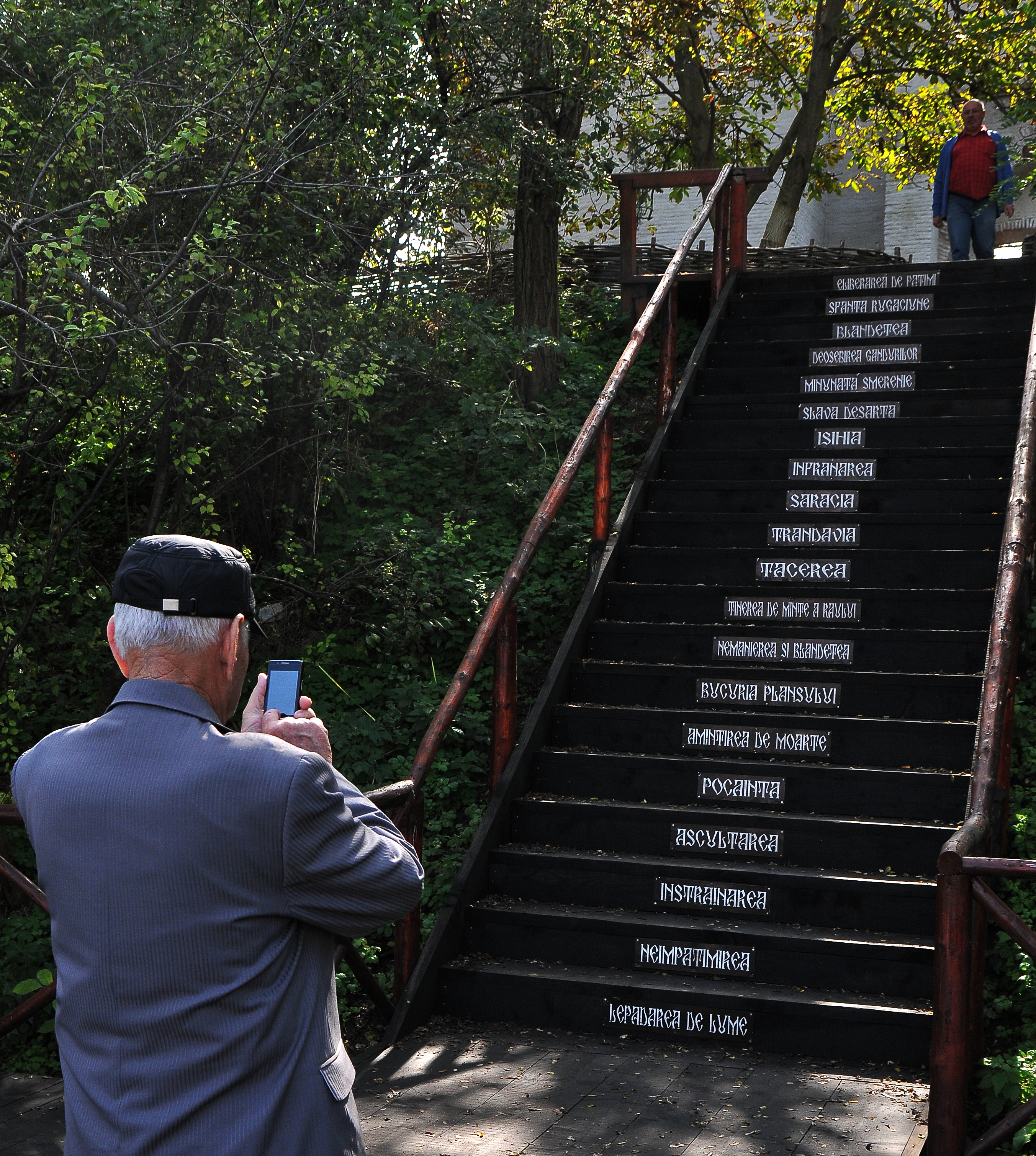
trandavia

Dati click pe poza.
Zoom in pana se vede bine scrisul.
Si acum spuneti-mi ce cauta trandavia pe lista asta?

Sau manastirea Comana o fi ajuns cumva salas de cersetori budhisti?