Archives for category: Psychology

the brexit hero

“Isn’t it funny?
You know, when I came here 17 years ago and I said that I want to lead the campaign to get Britain to leave the EU, you all laughed at me.
Well, I have to say, you are not laughing now, are you?”


Now let me get something straight.

This guy has been going to work, as an elected official, with one goal in mind. And one goal only.

To undermine the very institution he was working for.

Not to improve it in any way but to simply dismantle it.

I’m not going to discuss here whether he is right about the shortcomings of the EU or not. (He is)

But I am going to question his modus operandi.

OK, he did point out, very astutely, which are the weak points of the European Union.
And then, instead of proposing ways to mend those problems, he did his ‘best’ to make matters even worse.

That was all that he could do in those circumstances. That’s it. Nobody’s perfect.

But why elect a guy like this, time and time again, into a position where he gets to be paid, handsomely, for making trouble?

And no, he wasn’t a ‘whistle-blower’. He never came forth with anything new.
He just kept milling around a few otherwise well known ideas – most of which are absolutely correct – and then turned them on their head, effectively morphing them into ‘seeds of doom’.

And yes, he was the guy “who has repeatedly criticised wasteful EU spending” and then used 58 000 pounds of EU money to cover a security bill “for just five events held in modest venues such as a darts arena in Essex where there was not a single demonstrator.

Now go figure.
There are people out there who consider him to be “The Hero of Brexit”….

they keep telling us.

As if it would always be obvious where ‘up’ and ‘down’ are…

In his efforts to figure up how society works Max Weber has introduced the concept of “ideal type”:

Ideal type, a common mental construct in the social sciences derived from observable reality although not conforming to it in detail because of deliberate simplification and exaggeration. It is not ideal in the sense that it is excellent, nor is it an average; it is, rather, a constructed ideal used to approximate reality by selecting and accentuating certain elements.”

In other words, Weber proposed that in order to better understand social interactions we should first divest everything we consider unimportant from whatever we are studying and then concentrate our attention on what, in our opinion,  ‘makes the world go round’.

Key words here, in my opinion, being “our opinion”.

Common lore, somewhat older than organized ‘science’, used to speak about ‘put yourself in his shoes’.

To me this way of putting it shows two different things.
Commoners are more humble than scientists – none of them pretends to know which are the aspects that have to be taken into account and which are those that should be discarded –  and, maybe even more important, a lot more ‘democratically minded’ – ‘put yourself in his shoes’ plainly states that both opinions, ‘his’ and ‘yours’, have equal value.

In this sense ‘look from above’ seems a rather ‘scientific’ attitude, don’t you think?
By telling somebody that he should search a vantage point and then examine the situation from there actually suggests him to construct one of Weber’s ideal types.

Now, please, don’t get me wrong.
Of course this is exactly how human minds work.
Whenever we look at something – no matter how open minded we believe ourselves to be about it – we do it from a personal point of view. There’s no way that we can reasonably pretend otherwise.

The real problem is what we do next.

When ever we try to put ourselves in somebody else’s shoes we have to make a choice.

We can either try to understand/feel what we would have understood/felt if those things would have happened to us or we can try to imagine what the original owner of the shoes understood/felt then, when things were actually happening to him, in ‘real time’.

I’m sure you all see the difference.

This is why, whenever I’m asked ‘please look at this situation from above and tell me your conclusion’, I always start with ‘all I can do is offer my opinion on this, accompanied by a stern warning: My opinion is just that, an opinion. It can happen to be more accurate than yours but it can also be wrong. If you still want it I’ll gladly put it on the table and let us all discuss it.’

On the practical level Nicholas Nassim Taleb proposes that we should shift our focus from trying to determine which is the best option in a given situation to doing our best to avoid choosing the obviously wrong ones.

‘Obvious’ to those who do not allow themselves to become mesmerized by the illusion that ‘best’ can be identified, o course.

8d99cf9b636a698e5bb1d4c6644dcc84

The moment we try to appraise the value of human life, in monetary terms or in any other way, is the threshold to man made hell.
By simply accepting the notion of collateral damage – that the ‘ultimate goal’ might be considered important enough to justify damage suffered by innocents – we enter the realm of ‘fantasy world’.
The place where wishes trump reality and where desires are considered – by those who entertain them, of course – more important than anything else.
In this realm people cannot get along with each-other, simply because they cannot find any common ground. Whenever a group of people accepts the notion that one life can be considered more important than any another – that individual human lives can be ‘filed’ according to their individual values, sooner or later its members will start fighting each others for preeminence.
‘Top dog’ position becomes not only desirable but also the only thing a ‘rational’ individual will ever pursue. Simply because no other position comes even close and because, by agreeing that human life can be appraised, the members of that group have proclaimed that ‘social life’ is more about competition than about cooperation.
The problem with ‘no holds barred’ competitions being that some of the spectators think they are fun to watch while those in the pit discover very quickly that survival is almost impossible but for the briefest lengths of time.
donald-trump-short-fingered-vulgarian-fingers-bruce-handy-ss13
When trying to understand a rather complicated phenomenon one has two options.
Amass as much pertinent information as possible and then try to put it together or watch out for questions posed and opinions offered by others on the same subject. And, then again, put them together in your own way, of course.
A friend of mine posted this on FB:
“Trump’s trick is that he has never run on substance, yet his opponents and detractors attempt to attack the substance of how he is wrong. Because there is no substance, they cannot help but miss.”
See what I mean? Why strain your own head when there are people who already have the answer to your question?
All that is left for me to do is elaborate a little.
Well, as the man said, it is hard to be a ‘Trump detractor’ since there is nothing there to detract in the first place!
As for the ‘Trump’s opponents’… here again it’s a matter of understanding the mechanics of human interaction.
This whole thing started when Trump, the ‘perfect opportunist’, noticed that the ‘anti-Establishment’ sentiment was strong enough to present a ‘workable opportunity’.
Which he gleefully grabbed. And started to position himself as the ‘quintessential anti-Establishment candidate’.
As a matter of fact this is also the explanation for why he joined the Republican camp… after lavishing so much money on Clinton, for instance.

Among the Republicans the anti-Establishment feeling is stronger than among the Democrats – Sanders doesn’t seem able to uproot Clinton.
Now I have to remind you what most Trump supporters were saying a year ago:
‘I don’t like him, as a person, but by supporting him I’m sending a strong message to the Establishment’.
What happened during the last 10 months or so – that so many people have started to ‘like him as a person’ – is very simple to understand. Trump was skillful enough to position himself effectively while those who disliked him started to ‘oppose’ him. And, by doing so, gave him ‘substance’.
You see, engaging a conversation – no matter how ‘heated’ – with somebody means acknowledging his presence. Speaking to somebody means lending him some of your own legitimacy.
The second mistake made by Trump’s opponents was ‘calling names’ to those who spoke in his favor. And, just by doing so, transformed those who at first only wanted to vent their frustration into full-fledged supporters.
What we have now is a perfect example of a man made ‘perfect storm’.
A ‘loose cannon’ candidate whose supporters are experiencing a double layered frustration. A basic one fueled by the bleak economic perspectives faced by the entire middle class which is exacerbated by the disdain so oftenly felt by Trump’s supporters whenever they express their political opinion.
Hopefully Trump will eventually loose. But the ‘perfect storm’ will remain and it will have to be treated with utmost care.
The point being that we should not forget who brought us here.
The Establishment.
Reason tells us that in its own interest the Establishment – who has the most to loose – would be the first to look for a solution.
As we’ve just seen, the Republican half has failed miserably and the Democratic one is following in their footsteps. Judging by the quality of the candidates, of course.
Could this be the reason behind Kim’s endorsement for Trump?
trump, far sighted politician

North Korea supports Trump over “Dull” Hillary

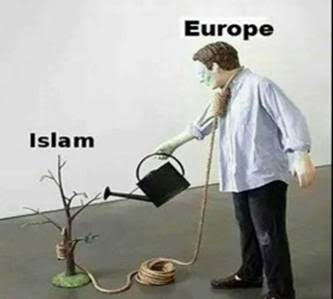
Islam Europe

I’ve just found this cartoon in my e-mail.
It was captioned: “The Winning cartoon in an organized competition.”

I instantly remembered some very wise words I’ve read long time ago:

Do not be deceived: God cannot be mocked. A man reaps what he sows.
Whoever sows to please their flesh, from the flesh will reap destruction; whoever sows to please the Spirit, from the Spirit will reap eternal life.
Let us not become weary in doing good, for at the proper time we will reap a harvest if we do not give up.
Therefore, as we have opportunity, let us do good to all people, especially to those who belong to the family of believers.”

“Beware! Whoever is cruel and hard on a non-Muslim minority, or curtails their rights, or burdens them with more than they can bear, or takes anything from them against their free will, I (Prophet Muhammad) will complain against that person on the Day of Judgment.”

All religious teachings, all of them, maintain that ‘a man reaps what he sows’. It doesn’t really matter if the ‘result’ will come as a sentence delivered by a divine judge or if it will be just another bead in the string representing the life story of an individual.
I, for one, don’t see much difference between ‘fate’ and ‘karma’.

Then how come we keep acting as if we’ve never been warned?

“In my two visits to Auschwitz, the Nazi concentration camp in Poland, I learned that holocausts and genocides do not occur in a vacuum. Rather, there is almost always a vicious campaign of incitement directed against the target group preceding them. What is troubling today, with the recent uptick in anti-Semitic and Islamophobic incidents worldwide, is that extremists and zealots are not the only ones inciting their followers. In a number of Arab countries, Muslim children are taught ideas that distort the true meaning of the Quran and hadith too.”

o-gay-prophet-570

Love, more powerful than hate.

Yesterday I read an article which stated that ‘when it comes to violin there are a lot of things that are more important than talent‘.

I must confess that I was taken aback.
Not as much by the call itself but by the very fact that someone would actually make a call like that.
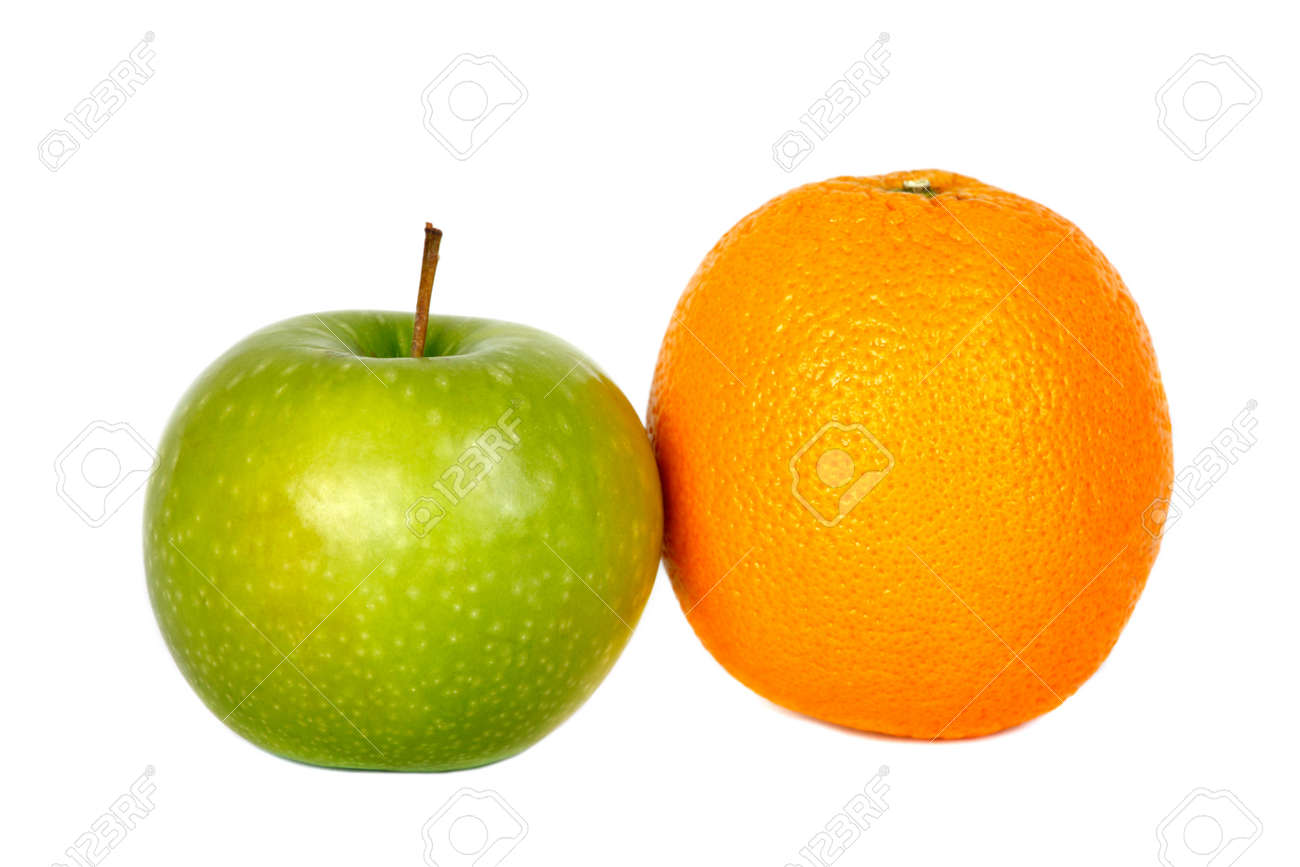
Compare apples and oranges, that is.

OK, both these two can be found in the same department of the grocery store and are somewhat similarly shaped so…

The whole thing made me wonder ‘how is it that we compare things’?

Simply. We choose a standard and then measure the things we want to compare against that standard.
According to our interest in the matter, of course.

That’s why a comparison is not only easier but also less contestable when that standard is actually measurable.
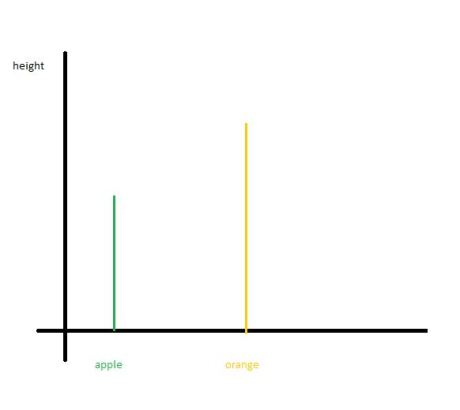
A dimension, for instance. Nobody in his right mind will ever contest a proposition like ‘this orange is larger than this apple’.
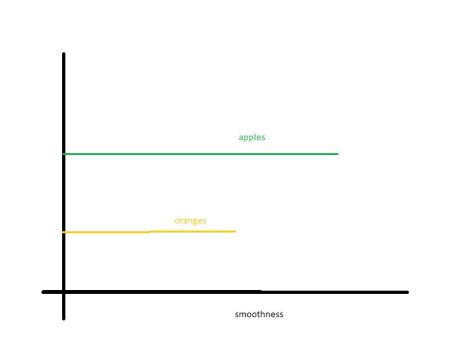
Or an evident feature shared by the items being compared. ‘Apples are usually smoother than oranges’.

5989177-comparing-apples-to-oranges-isolated-on-white-stock-photo

In these cases, when the items are easily comparable – sometimes even against the current mantra, we can say that the characteristics used to compare them are ‘parallel’ to each other.

parralel

Here we can, easily and undoubtedly, determine that one is ‘taller’ than the other.

parralel 2

Or we can make that call by measuring the intensity with which a characteristic shared by both categories manifests itself: “Apples are usually smoother than oranges”.

But what if the things we are trying to compare are defined by characteristics which are perpendicular to each other?

Like length and width, for instance.
In fact this particular case is relatively simple. Here we can determine whether one is longer than the other, wider than the other or if the area covered by one is bigger than that covered by the other.
And, for each case, it would be relatively simple to determine which of the two characteristics is more important. According to each individual situation and to our interest in the matter.
After all it doesn’t make much sense to buy a very long and narrow strip of fabric if you want to make a shirt nor to buy a square shaped cloth  if you need some ribbon.

Things are more delicate though if the characteristics are ‘perpendicular’ only in a figurative manner of speaking. For instance talent and dedication. Or opportunity and diligence. In both these situations it’s extremely hard  to make a call as to which member of the pair is the more important. Simply because without any of them the other is utterly useless. Despite our moral biases. Like ‘dedication is more important than talent’. Or ‘Lady Luck will never fail to smile to the really diligent’.

I’m not implying here that preparing yourself for life, like learning and training, is useless. Quite the contrary.
I’m simply saying that you need first to determine what you are really good at.
It doesn’t make much sense to put a lot of effort into something simply because someone tells you that you’ll become better at it if you work really hard.

Yes, the harder you work at something the better you’ll become at it. But what about spending the same amount of effort at something you are talented for?

So go find out what you are really good at.
If you are diligent enough in your search you’ll eventually find out something that you enjoy doing and others find useful.

And that, my friend, is the real happiness.

Or, in Csikszentmihalyi‘s terms, it would mean that you’d have reached the state of ‘Flow‘.


For how many times each of us has moaned, in true disbelief, ‘why is this happening to me?’. Or at all.

“I emerge from this conversation dumbfounded. I’ve seen this a million times before, but it still gets me every time.
I’m listening to a man tell a story. A woman he knows was in a devastating car accident; her life shattered in an instant. She now lives in a state of near-permanent pain; a paraplegic; many of her hopes stolen.
He tells of how she had been a mess before the accident, but that the tragedy had engendered positive changes in her life. That she was, as a result of this devastation, living a wonderful life.
And then he utters the words. The words that are responsible for nothing less than emotional, spiritual and psychological violence:
Everything happens for a reason
. That this was something that had to happen in order for her to grow.

That’s the kind of bullshit that destroys lives. And it is categorically untrue.”

In a sense the post that prodded me into writing this (Everything doesn’t happen for a reason by Tim J. Lawrence) is akin to a self supporting fallacy coupled with the kind of honest, well intended error all of us somehow feel is wrong at the very time we are doing it yet we cannot help ourselves to stop doing it.

So, why is all ‘this’ happening to us?

Basically there are three main stances on this.

The staunch believers are convinced that there is a grand scenario that ultimately decides our fates, down to every minute detail. You can find here, mingled together, religiously motivated people, convinced that ‘God’ has preordained their entire lives well before they were even born, rubbing elbows with the scientifically minded who are convinced that everything that  had ever happened went on according to an uninterrupted chain of causes and effects which can, only if we were able to find out how, be followed down to the root of all things. To even before the Big Bang?

The amoral ‘happenstancers’ believe that  ‘Lady Luck’ is blindly leading us down the path to exactly nowhere, hence ‘it’s up to each of us to make the best of it’. Sometimes up to callously disregarding everything else but their own whims.

The agnostics have figured out that while it is impossible to know/understand the ultimate cause for anything, from time to time it happens that each of us has a glimpse of understanding about something. And that however incomplete, that piece of understanding might  prove itself to be useful, even if temporarily.

Most of you have already noticed that the first two positions are at the very extreme ends of the spectrum and are held, in earnest, by relatively few people.
And that most of us – despite our professed affiliations, belong, in reality, to the third category.

Before proceeding any further I’m going to make a small detour here and note that ‘science’ itself was invented by Christian scholars trying to make sense of God’s ways. Hence no wonder that the ‘scientific minded’ cannot see eye to eye with the ‘believers’ – new converts are looking down in disdain to their old religion, and that both partake in the conviction that ‘there must be something behind what is readily visible’.

The link between all these three categories, between the first two who already have a strong conviction about things and us, the run of the mill people who are sometimes taken aghast by what is happening in our close vicinity, is that all humans need to make at least some sense of things before learning to live with them. And with their consequences.
And since no two normal people are alike there never was a one size fits all narrative able to cover, efficiently enough, all situations that ever occurred to us.

That’s why I simultaneously agree with Tim that the best thing to do when something happens to somebody I care about is to simply say I acknowledge your pain. I am here with you. and disagree with him when he says that all other things that get said in times like those are wrong.

The fact that my experiences/opinion on the matter happen to fit his doesn’t mean that we are both right, nor that our take on things that already happened to us might fit all other things that might happen to all other people. So I find it just a little presumptuous to discard all other opinions simply because they are different from ours.

Now, that I’m nearing the end of this post, let me discuss a little the pretext shared by both our posts: ‘Is there a reason for anything?’

Well, the answer for this depends heavily on what you mean by ‘reason’.

Is there a cause for anything? Most certainly ‘yes’, regardless of whether you believe that that cause to be divine, completely aleatory or any combination of these two.

Or is it that we’d better ask ourselves if there’s a ‘motive’ behind what’s happening to us?

Another thing that is common to most people is their tendency to blame others when thinks go bad and to claim more merit than it’s their due when things go well.
That’s why so many of us find it difficult to assume individual responsibility for our own mistakes and for putting ourselves in harms way – even when that responsibility is only partial.
Along the same psychological mechanism many of us cannot accept the very notion of ‘blind’ bad luck. While cashing a lucky lottery ticket is accompanied by nothing more than a self congratulatory slap on the back, and no soul searching questions get to be asked on the occasion, every time we as much as catch a cold in a very bad moment we wrench our hands in self deprecation: ‘what was it in my head that drove me to go in such a germ infested environment?’.

So, while I cannot rule out the existence of the famous Grand Design that I mentioned earlier, it seems obvious to me that only some things happen for a motive. Or that sometimes there are one or more motives which tilt the table in a direction or other. On the other hand what each of us does in each circumstance might have a huge importance. And sometimes both our efforts and the ‘motive’ responsible for the general set-up are rendered inconsequential by some haphazardous  occurrence.
For instance Romania endured the Soviet yoke simply because of its geographic position, because Stalin-ism was an aggressive creed and because the West was too tired shortly after the WWII to do something really meaningful about the Soviets extending their influence beyond where it was welcomed. At the same time the manner in which communism had influenced our destinies depended a lot on individual decisions – ‘theirs’ but also ours – and on pure luck.

That’s why I fully endorse Tim when he says that it’s extremely important for us to act appropriately whenever something nasty happens to those living inside our reach and that we should carefully select those whose presence we accept around us when something nasty happens to us, while I cannot accept his insistence that there is a single ‘appropriate’ behavior in all circumstances.


rape in the not so virtual reality

Two concepts are slowly merging into one and becoming more and more obvious for the most oblivious among us.

Virtual reality was mentioned for the first time way back in the XXth century.
In 1938, Antonin Artaud described the illusory nature of characters and objects in the theatre as “la réalité virtuelle” in a collection of essays, Le Théâtre et son double. The English translation of this book, published in 1958 as The Theater and its Double,[2] is the earliest published use of the term “virtual reality”.
Nowadays the concept has been widened to cover a lot more than what’s happening inside the theaters.
In fact, the technology used to create VR is able to transform everyplace in a stage, everybody in an actor and to broadcast everything almost everywhere.

The other concept I was mentioning at the beginning of my post is a lesser known one.
The Social Construction of Reality“, published in 1966 by Peter L Berger and Thomas Luckmann eloquently explains how various groups of people collectively adapt their historically accrued habits (cultures) to the ever-changing surrounding reality. One of the sources of change being human activity itself.

The latest, that I heard of, addition to the realm of the not so virtual anymore reality is Periscope. A mobile app that lets its user broadcast, live, whatever he/she deems interesting enough from what is taking place around him/her. What is broadcast has a ‘shelf live’ of 24 hours but can be deleted at wish or made permanent. Also the sharing ‘voyeur’ has control over the audience, it can be set as ‘public’ or ‘private’ – and broadcast only to a selected few.

Some days ago two female high-school students and friends, one 18 and the other 17, met a 29 male in a Columbus, Ohio, mall. He bought them a bottle of vodka and “encouraged them to meet him the following day“.
The girls ‘honored’ the invitation, the three  ‘socialized’ for a while – read “had all been drinking“, and then the male proceeded to raping the youngest of the girls.
The older one live-streamed the rape using Periscope.

The case came to light when authorities were contacted after an out-of-state friend of the woman saw the images, Franklin County Prosecutor Ron O’Brien said.

It is not unusual for a rape to remain unreported by the victim. It’s not OK, but it happens.
Also it is not that unusual for a rape to remain unreported even after friends or relatives of the victim learn of the event. Again, it is not OK but it is known to have happened before.

Yet this is the first time that I’ve heard of a rape that had taken place practically in public and which wasn’t reported ‘live’ to the police.

‘She does everything possible to contain the situation even to the point of asking while it’s being filmed to these Periscope followers, “What should I do now? What should I do now?”‘ Shamansky said.” Shamansky being a lawyer for the older girl, who is currently charged with rape, alongside the male perpetrator.
Separately, she is being charged with “illegal use of a minor in a nudity-oriented material or performanceforlivestreaming her friend nude the day before the assault“.

And how did the viewers react to the broadcast? Except for the “out-of-state friend of the woman” who reported the incident, of course?

Here’s the prosecutor’s side of the story:

O’Brien said Lonina is seen trying to help only briefly during the 10-minute video. O’Brien said the victim was clearly screaming ‘stop’ and ‘no’ during the assault.
Although Lonina told police she was trying to record the assault as evidence, her behavior as people watching via Periscope ‘liked’ the assault painted a different picture, O’Brien said.

‘She got, I guess, taken up with all the “likes” that her livestream was getting and therefore continued to do it, and did nothing to aid the victim,’ O’Brien said.

I don’t know what, or even if, she could have done anything in a really effective manner – remember that all three had been drinking – but I know for sure that at least some people were watching the live stream. The ones “liking” it.

I still cannot understand how come all of them failed to call 911.

Just finished reading, again, another excellent post written by John Faithful Hamer on Committingsociology.com

I remember now that something was nagging me after reading it for the first time. I also remember the pangs of helplessness felt almost a year ago, when I couldn’t identify what was nagging me.

Well, this time I nailed it.

“Getting angry isn’t really like releasing the built-up pressure in a steam engine; it’s far more like exercising a muscle group. Every time you give in to the desire to lose it, you strengthen your “anger muscles”; every time you resist the urge, you weaken them.”….
“So perhaps it’s time to stop preaching the gospel of expression, and revisit the much-maligned virtues of repression.”

“Anger” and “getting angry” are not the same thing.
Anger is just a feeling – and, hence, a source of ‘energy’ – while ‘getting angry’ is the manner in which we allow it, consciously or unconsciously, to take us over.
I fully agree that ‘getting angry’ only worsens the situation only I’m afraid that ‘resisting the urge’ isn’t any better. In fact that would be no different from tightening your arse because you don’t want to fart in public.
The problem is not solved, not at all, only postponed. You still need to relieve yourself.
By widening Freud’s concept of repression to encompass more feelings than the simple embarrassment we might find a reason to continue to look for a manner in which to ‘release that built up pressure’.
Only now we are faced with a new problem, since we’ve already agreed that ‘getting angry’ is not the best thing to do.
Freud, again, to the rescue.
How about widening another one of his concepts, sublimation?
How about learning to express, this time consciously, our intense negative feelings in a socially acceptable, and hence a lot more effective, manner?

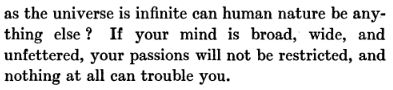
section 211-1

section 211-2

Yoshida Kenko, Tsure-Zure Gusa