Archives for category: Mutual Respect

Darwin had wrote “On the Origin of Species by Means of Natural Selection“.
Some of us had mistakenly understood ‘evolution’ as being a ‘fight for survival’.
‘Fight’ as in ‘kill/subdue all those around you’, not ‘strive to improve yourself’, unfortunately.

Ernst Mayr had put things right. ‘Evolution is not about the survival of the fittest but about the demise of the unfit.

Adam Smith, a philosopher, had explained to us that free market capitalism functions because ‘the butcher, the brewer and the baker‘ cooperate across their respective ‘professions’, fully understanding that by respecting each-others work each of them would better serve their individual interests than by struggling individually.
Unfortunately too many of his contemporaries, and some later exegetes, mistook Smith’s words as meaning that ‘Greed is Good’.
And proceeded accordingly. Which was just another ‘application’ of Gresham’s Law. The ‘greedier’ among the capitalists slowly climbed to a dominant position and created a situation later described as ‘savage capitalism.’
Since people have a tendency to over-react, and to make matters worse instead of solving the problem, Karl Marx came up with an even more stupid idea than ‘Greed is Good’. According to him, the world should be run, in an equally authoritative manner, by a different class of people. Not by the ‘greedy capitalists’ but by the ‘virtuous communists’.
As if there ever was any real difference between dictators…

Almost a century later than Smith, Emil Durkheim, a sociologist, revisited the concept of ‘cooperation’ – from another angle, and demonstrated that society had leaped forward when each of its members developed his/hers particular talents instead of toiling together indiscriminately.  And then traded, on the free market, the results of their efforts. Nothing really new, just told in a different manner.
A marked difference from the ‘rantings’ of Marx. Who, by the way, had assessed the situation perfectly. Which makes it all the more baffling the fact that he was able to propose such aberrant remedies.

Almost simultaneously with Durkheim, another guy had noticed two very interesting things.  After a successful career as an engineer Vilfredo Pareto had started to study economics. Then he turned his attention to sociology. As an economist he had noticed the Pareto Principle – 80% of the results (income) are produced by 20% of the causes (agents), while as a sociologist he discovered that whenever social mobility, upwards as well as downwards, is hampered, the society where this happens will, sooner rather than later, experience serious difficulties. In fact this observation is quite straightforward. Whenever young people from the ‘lower strata’ cannot accede, despite being better qualified and harder working, to more meaningful positions because those positions are ‘safeguarded’ for members belonging to the ruling minority, the people from the lower strata stop striving while those from the ruling minority become lazy and careless. The recipe for disaster, don’t you think?
If we put both Pareto’s observations together we discover something similar to Smith’s budding concept of a free market. Whenever an individual, or a group of individuals, become so powerful as to dwarf those around them, economically as well as politically, the free market, economically as well as socially, stops working.

That’s why all monopolies have never failed to collapse.
That’s why all authoritarian regimes, including those built according to Marx’s rantings, have eventually failed – causing great harm to those fool enough to believe in them.

That’s why dinosaurs had disappeared – they had grown too big for their own good.
They behaved as if they were ‘greedy’. They seemed more interested in dominating the world instead of minding their own business.
Fishes – which are older than dinosaurs – survived and thrived.
Crocodiles, alligators, turtles, tortoises, snakes and you name whatever other reptiles come to your mind have survived the same conditions that have cut the mighty dinosaurs down to size.

That’s why Mayr goes on warning us. ‘Evolution is not about the survival of the fittest but about the demise of the unfit.

Let’s not destroy ourselves, as a species, attempting to prove him wrong.

Update
Pareto’s elite theory is rather straightforward.
As soon as a society ‘grinds to a halt’ tension starts to build up. A ‘lion’ – or a coalition of lions, will sooner or later seize the opportunity and ‘make a grab for it’.
By tearing the calcified sinews which tied the society down the lions actions unleash – for the moment, at least, the creative forces that could not assert themselves. Things become markedly better than they used to be.
Because the lions are ‘lazy’ they soon hire ‘foxes’ to run the show. Unfortunately the foxes tend to be rather narrow minded and soon their narrow-mindedness coupled with the decrepitude of the lion ‘in charge’ bring back the society to the original – aka bogged down, situation.
A younger lion/fresh coalition of lions restarts the cycle.
Basically we have the definition of the boom-bust cycle.
A very compelling example would be the manner in which communist states had crumbled under their own weight. Or the manner in which all monopolies – or even companies in dominant positions, eventually screw up. The automobile industry – a mature economic field, would be a very good example for this.
Nothing dramatically different from Schumpeter’s ideas, albeit at a different scale.
Ideally, in a free (aka fully functional) ‘market’ there are a number of lions which keep each-other at bay and a big enough number of foxes to keep the show together. The lions, acting in concert, make sure that the foxes do not take over while the foxes prevent the lions from driving the whole thing over the cliff.
If the circulation of the elites is hampered, in any way, shape or form, the continuous/evolutionary social and economical fine tuning no longer works and the society reverts to the boom-bust cycle.
A really free market would closely resemble Darwin’s, or more exactly Mayr’s, evolution while the present situation is one where the circulation of the elites has been brought almost to a halt.
The whole process tends to be rather ‘circular’. As in a vicious circle.
Or a virtuous one. As it used to be, until very recently.

NB. This blog is more like a collection of notes than anything else.
I write them down because doing this streamlines my thinking process and I make them public because readers’ feed-back (mostly on FB) is very helpful.

We seem to be stuck between two apparently irreconcilable positions.

Both the ‘free-market totalitarians’ and the avid ‘state interventionists’ agree about the present situation being untenable but are unable to identify a mutually acceptable way out.

And the rest of us watch them fighting each-other, as if mesmerized by some irresponsible/immature  hypnotism stage-artist, instead of clearing a path of our own!

But since we’re already gathered around the ring, let’s see first what are they fighting about.

The laissez-faire people maintain that things will eventually get in shape by their their own – only if we’d let them, while the statists say that waiting for that to happen would take too long and provoke too many ‘collateral victims’.

Each of the two sides advocate a very specific solution.
The ‘anarho-marketeers’ are OK with what seems to be going on – relatively fewer and fewer individual people/corporations becoming richer and richer/more and more powerful while the rest are falling behind but not at all OK with the left behind becoming angrier and angrier.
Meanwhile the interventionists demand that the state should take more and more ‘things into its hands’ and ‘solve’ them. As if it knew how.

I must confess that I fail to see any real difference between them. Both imply that a small number of individuals – belonging to the same species and being subjected to the same cultural and social conditioning – becoming extremely powerful relatively to the rest of the people.

Historically, all societies which had allowed power to become concentrated in too few hands had crumbled. The more concentrated the power, the faster the fall.

When confronted with the argument that greed, for both money and power, is bad for you, both sides react in a very fatalistic manner.

‘Greed is natural, hence it must be good!’

The funny thing – if anything about any of this might be considered funny, is that greed has been castigated by all religions. And by mainstream science.

Let both religion and science rest for a while.
Actually this is one instance where common sense is more than enough.

Greed, like appetite, is indeed natural.
But that doesn’t make it necessarily good.

We need indeed to strive towards improving our lot, just as we need a healthy appetite.
Otherwise we’d end up worse than where we were at the start.
Dead by starvation.
Or both.

But hoarding a good thing doesn’t necessarily improve it.

There is a difference between appetite and gluttony.
That’s why we use different words for each of them.

glutonny-for-power

Just found this in my FB feed:

“Why is it that good people are always so far away?”

A few days ago I came across “On God: An Uncommon Conversation” between Norman Mailer and J. Michael Lennon.

Reading it made me wonder.
Most of us are aware that there is no way of knowing God, or his will, and, simultaneously, most of us are absolutely sure about the Devil and his intentions.

Isn’t this ‘inconsistent’, to say the least?

The musing about the ‘good people’ shed a new light upon the object of my wonder.

Bad is a lot easier to recognize that good.
There is nothing remarkable in putting on your old loafers and going for a stroll.
Now try to imagine how would it be if you had to walk, even for a short distance, with a pebble in one of those loafers. Or, God forbid, with a sharp pain in one of your knees.

Our ability to pinpoint the sources of discomfort and to identify (potential) danger did a tremendous job.
We survived.

We are so good at it that right now we are on top of the world.
Precisely because ever since we became aware of what was going on around us we have striven to keep danger, and discomfort, as far away  from us as possible at any given moment.

Unfortunately, by concentrating on identifying evil, we are slowly loosing our ability to see the good.

In a sense we have brought upon ourselves a certain ‘tolerance‘ to ‘good’. By successfully driving so much of the ‘bad’ away from our lives we have become unable to recognize the good moments in our lives.

Simultaneously we have developed a ‘reverse tolerance‘ for bad.
We have grown so adept at identifying it that we see it almost everywhere.

Because we are culturally conditioned to presume that ‘different’ is bad.

As I mentioned before, our ability to identify danger is what kept us alive. I won’t delve into how our brains are hard-wired to run/shoot first and ask questions later. You can read ‘all about it’ over the Internet.
Here is an as good place to start as many others.

“Officers need to build confidence with hand-on techniques

Taking what they admit is a controversial position, the authors argue that officers today may be too quick to use control tools like CEWs or OC, instead of applying hands-on tactics to subdue some unarmed subjects. The researchers say they were “struck by several incidents…that might have easily been addressed [successfully] by going hands-on” instead of resorting quickly to a less-lethal or deadly weapon.

 Sometimes unarmed “rowdy” people need to be “grabbed and secured,” even though they may fight in response, Selby writes. “Officers should be expected not to treat every assault as a life-and-death situation….

 “Over-reliance on TASER or pepper spray has its own set of dangers. Officers who do not practice fighting…risk being surprised by physicality, over-powered or out-maneuvered by those they confront… [T]hose who practice their physical skills are mentally and physically [better] prepared.”” (Force Science News, #314, II. 8 “key findings from new study on killing of unarmed suspects)

Can we do anything about this?

Of course.

Remember the old loafers at the top of my post?
(Almost) None of us trows away a good pair of shoes when they get dirty, right? It makes a hell of a lot more sense to grab a rag and ‘polish’ them, isn’t it?
Also, when judging a person, we’d better ‘examine’ him from top to bottom before passing a ‘sentence’ to the tune of ‘his shoes are dirty, hence I’ll discard him right away’.

And, above all, we need to remember that while ‘beauty is in the eye of the beholder’, goodness is, simply put, the absence of ‘bad’.

So, theoretically, none of them really exists.
Beauty doesn’t exist because we cannot fully agree upon it while nothing is absolutely free of ‘bad’. Hence nothing absolutely good has ever seen the light of day.

It seems that a better definition for a ‘good’ person would be somebody who behaves in such a manner as to be accepted by those around him.

Yeah, I know, I just opened a fresh can of worms… when in Rome…

What if one happens to live on an island run by pirates?

Well… soon enough the pirates will become so obnoxious to the rest of the world that the island will be conquered by the first powerful enough nation which happened to be pushed to the limit of its tolerance. Or, if that doesn’t happen, at some point, the ruling pirates will jump at each others throats.
That’s why all totalitarian regimes, including the communist ones, have failed.
The totalitarians tend to believe that only they are good and that all the rest are bad.

And totalitarian regimes usually start when an authoritarian leader convinces a critical mass of the people that:

  • their ideas right/good
  • all the rest are bad
  • so bad, in fact, that all means are acceptable while fighting ‘the evil.

Even if at first the authoritarian seems almost harmless the very logic of the system – more and more intolerance – leads all authoritarian regimes towards more and more intransigence. Meaning that the forces employed to maintain the regime become more and more adept at identifying ‘evil’, until the pressure eventually cranked up in the process blows open the entire social structure.

The sooner enough members of a given society discover that most of them are in fact ‘more good than evil’, the sooner the authoritarian would be dictators loose traction and things can return to normal.


“A couple drove down a country road for several miles, not saying a word. An earlier discussion had led to an argument and neither of them wanted to concede their position. As they passed a barnyard of mules, goats and pigs, the husband asked sarcastically, “Relatives of yours?” “Yep,” the wife replied, “in-laws.” “

Remember that these two are described as being a couple! Going somewhere together…

And not an out of the ordinary one, judging by what happens around us.

OK, I can understand differences of opinion between people – how ever close their relationship. What I cannot understand is this ‘need’ to aggravate things. To make the other one feel just as bad as ‘I’ do.

Why cannot we focus on the really important issues?

Like in this instance:

“A five-year-old boy was mowing his front lawn and drinking a beer. The preacher who lived across the street saw the beer and came over to harass the kid. “Aren’t you a little young to be drinking, son?” he asked. “That’s nothing,” the kid said after taking a swig of beer. “I got laid when I was three.” “What? How did that happen?” “I don’t remember. I was drunk.” “

Both are done ‘by hand’.

Apparently, any likeness between these two stops here.

But, if you pull back in earnest, the ugly thing becomes unraveled.
Not only that it is masturbatory, aka self-inflicted, (political) manipulation should also be classified as sado-masochistic.

Manipulation, as a process, can be examined from two perspectives.
A social one and an individual one.
Now, that everybody knows that ‘manipulation is bad for you‘, any individual who allows themselves to be manipulated into anything must suffer from a masochistic disorder while those who actively manipulate others must be cold blooded sadists.
On the social side, since time and time again manipulation has been proven to have had dangerous consequences, any community that sees any form of manipulation as an acceptable practice must have certain suicidal tendencies. Aka suffer from a ‘social form’ of masochistic disorder. While those who manipulate must be, themselves, cold blooded sadists.

As for being masturbatory, something which is brought upon one self by their own hand, that is almost as evident as Polichinelle’s secret:

Bona-fide politics, that made in earnest, involves open discussion between those who are going to be affected by the decisions and those who propose and support them. Discussions which take place before each major decision is made, during its implementation and after its consequences have started to be felt. The interaction between the politicians and the general public is direct, unmediated.
In Nassim Taleb’s terms, in this situation the politicians have their own ‘skin in the game‘.

Which results ‘risk management’ policy which is the complete opposite of the one adopted by those who believe themselves to be insulated from the consequences of their own actions.

The manipulators, on the other hand, window-dress themselves and the propositions they make. Their goal being not as much to contribute to the well being of their community as to ‘sell to the public’ whatever their minds have been focused on, at that moment. They consider manipulation to be a legitimate tool either because they are not fully aware of the great dangers involved or because they have convinced themselves that they will be forever exempt from contributing to the  the eventual price.
Meanwhile, those who allow themselves to be manipulated either do not realize they are being manipulated or have adopted ‘cynicism as a refuge’ in order to mitigate the cognitive dissonance that is eating away their self esteem.

In an ever-changing, incomprehensible world the masses had reached the point where they would, at the same time, believe everything and nothing, think that everything was possible and nothing was true… The totalitarian mass leaders based their propaganda on the correct psychological assumption that, under such conditions, one could make people believe the most fantastic statements one day, and trust that if the next day they were given irrefutable proof of their falsehood, they would take refuge in cynicism; instead of deserting the leaders who had lied to them, they would protest that they had known all along that the statement was a lie and would admire the leaders for their superior tactical cleverness.

Please note that in this situation the interaction is no longer direct. The manipulator and the manipulated do not ‘touch’ each-other. Therefore neither knows exactly what the other has in mind.
The interaction is mediated by symbols. Which are ‘photo-shopped’ by the manipulators and, sometimes ‘admiringly’, accepted by the manipulated.

It’s exactly this lack of direct contact between the manipulators and the manipulated which determines the whole thing.
The manipulators are, simultaneously, unaware of the true situation and growingly convinced of their ‘impunity’.
The manipulated have initial difficulties in determining that they are subjected to manipulation and, in a second stage, the impression that there is nothing left to be done about the whole thing.

When, eventually, the consequences catch up with both of them, it is usually too late for anything else but ‘damage control’.

People regret that they didn’t wise up earlier, promise themselves they’ll never let something like that happen to them… and forget. Until the next time.

Manipulation: useful tool, mortal sin or what?!?

Hannah Arendt Explains How Propaganda Uses Lies to Erode All Truth & Morality: Insights from The Origins of Totalitarianism

Masochistic Personality Disorder

Secret de Polichinelle

Cognitive dissonance

Karma

The Rorschach test consists of a trained specialist encouraging a subject to share his interpretations on 10 “ambiguous images“.
At the end of the discussion the trained specialist more or less ‘determines the fate’ of the subject, by filing his interpretation of the subject’s reactions.

The democratic process consists of everybody freely expressing their concerns about things.
Periodically some people are invested with enough power to solve the problems encountered by the community, in a manner consistent with the values agreed upon by that community. At the end of each such period the activity of these people is analyzed (interpreted ?!?) by those at the ‘receiving end’ of the political mechanism, with the intended goal of improving the ‘political process’.
The fate of the entire community being under a double determination. The diligence of the politicians invested to run the show and the diligence of the people when evaluating the results of the political process.

As you can see with a naked eye, there are a few striking similarities between  Democracy and the Rorschach test. Both depend heavily on the participants being honest and straightforward.

If the patient ‘doesn’t trust his doctor’ or ‘doesn’t feel like talking’ the ‘trained person’ will undoubtedly have problems in reaching a ‘fair conclusion’. Both will have to ‘suffer some consequences’.
If the ‘doctor’ has ‘ulterior motives’ and ‘unfairly labels’ his patient, it will be the patient to suffer the initial consequences but, eventually, those consequences will ‘bounce back’ to their source.

Same things happen in any society.
The difference between a democratic and an authoritarian one being that in a democratic environment ‘consequences’ become apparent, and are dealt with, a lot easier than in an authoritarian one.
This being the reason for which true, functional, democracies work better than any form of authoritarianism.

As long as both parties involved ‘interpret’ their roles appropriately, of course.

(D)evil is ‘the difference’ we cannot accept.

For some, the fact that anything so ‘distant’ from what they find acceptable can survive for any length of time is a slap in their faces.

Which prevents them from learning anything in that situation.

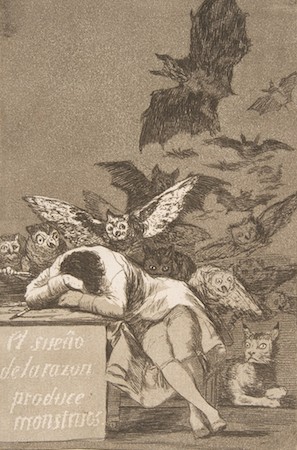
the-sleep-of-reason
People have started to freak out after realizing the full scale of what has just happened.
Some see him as a just retribution for our past sins – and they are probably right about this – while others look at the whole situation as if it was a sort of a Rorschach test.
How about Trump as an opportunity?
The inverse of a Rorschach test since that is about the shrink trying to learn something while an opportunity is about the subject bearing the responsibility for the consequences …
An opportunity, and a prod, for the silent majority to remember that ‘The sleep of reason produces monsters‘?
The way I see it Clinton would have done everything in her power to lull us back into our erstwhile stupor while Trump, willingly and/or unwittingly, is already making enough noise… Even the Sleeping Beauty must have already heard something…
So, test or opportunity, now it’s up to us to find a way out of the current mess. Which, I have to repeat this, is our exclusive responsibility.
The problem being that for those inside, the ‘light at the end of the tunnel’ can be the actual exit or the head-light of a train engine barreling down towards them.
‘Lady Luck’ is a tough bitch and that’s why one should be really careful with these things.
PS. The ‘shrink’ already has a huge ‘blot’ to muse about. Some people never learn.
Emily Linroth being a spokeswoman for the National Park Service, the organization which has cleaned up “the National Mall following the inauguration and the Women’s March on Washington Saturday.

I was planning a post and going to use this title, but without the quotation marks.

I wasn’t aware of the book that begins with the very same words.

Before starting to write – the original post was meant to be about the relationship between us, people, and the laws that govern our lives – I checked on Google whether somebody else had already used the same title and where they had went from there.

Since G‑d is the ultimate perfection and is free of all limitations and definitions, it is self-evident that, in the words of the Alter Rebbe, “The fact that He creates universes does not express what G‑d is.” At the same time He is, as Maimonides writes in his Laws of the Fundamentals of Torah, “the one who brings every existence into being; all existences exist only as derivatives of His ultimate existence” and the one upon whom “all existences are utterly dependent.” It is also obvious that just as no creature can comprehend the nature of G‑d’s creation of reality ex nihilo, so too no creature can comprehend the nature of G‑d, even the nature of G‑d as the creator of the world and the source of every existence.

In the words of the great Jewish philosophers: “If I knew Him, I would be Him.”

So, though a person realizes and understands that no thing can create itself, and that one must therefore conclude that the created reality has a source that generates its existence, this is proof only of the existence of the Creator, not an understanding of what He is, even as “Creator.”

Now, after reading Rabbi Schneerson’s (the Lubavitcher Rebbe) words, I cannot stop wondering what drives certain people to pretend that they have fully understood God’s will and therefore their actions/words are not only ‘correct’ but also above any doubt.

Not to mention their insistence that we, the rest of the (not divinely blessed with such a deep understanding) people, must follow their directions or suffer the consequences?
Here on Earth, at ‘their’ hands…

On the other hand, the same principle has been affirmed – time and time again – by various scientists.
For example, by Werner Heisenberg.
The depth of the uncertainty principle is realized when we ask the question; is our knowledge of reality unlimited? The answer is no, because the uncertainty principle states that there is a built-in uncertainty, indeterminacy, unpredictability to Nature.


For more than a year now I was struggling to understand the circumstances that have produced the current political mess in America.

I finally figured it out.

Confusion and dissatisfaction!

If you have enough people that are both confused and malcontent then all kind of ‘strange’ things will happen.

Only one of them won’t be enough to explain the whole gamut of what’s going on and that’s why I wasn’t satisfied by any of the many articles that pointed out one reason or another for the ‘popular discontent that brought the Donald to the White House’.
In fact no amount of ‘unhappiness’ can explain how two mature parties can nominate such lousy candidates. Neither Hillary Clinton nor Donald Trump fit, not even loosely, the profile of a decent President. That’s why the voter turn-out was the lowest in the last 80 years or so.

But if you add ‘confusion’… things begin to clear out.

And no, I’m not speaking here about the regular people being confused as a result of the ‘politicos’ having misbehaved horribly.
I’m afraid things are way deeper than this.
Even those who believe themselves to be educated in these matters seem to be swimming in a sea of thicker and thicker fog.

Take, for instance, the current debate about the differences between ‘republic’ and ‘democracy’.

A republic is a representative type of government, and its goal is to simultaneously control the majority while protecting the minority. For example, in the republic of the United States, the government is limited constitutionally, and power is divided between the three branches of government.

A democracy is a type of government that grants eligible citizens the right to equal participation. This right is provided directly through the creation and development of laws or through elected representatives. The interest of the majority is the most important aspect in a democracy.

A republic is a representative form of democracy. A republic has an elected head of state, such as a president, that serves for a specific period of time. In a republic, the interest of the majority rules through its elected representatives. However, a republic has a constitution that protects the minority from being entirely overruled or unrepresented.

See what I mean? Adding insult to injury this definitions were published by a site which calls itself ‘reference.com‘ …

I’m not going to pick truth from fiction in that quote, that would only add to the already too thick confusion.

Enough for me to say that ‘republic’ is indeed a manner in which societies are organized (a.k.a. ‘governed’) while ‘democracy’ is a manner in which societies decide for themselves. Yes, these two things have a lot in common but we should not confuse them.

There are republics which only pretend to be democratic – like the late Soviet Union or the current Democratic Republic of Korea, some which are democratic in a rather strange way – Iran for example, or which are slowly ‘loosing’ democracy behind – like Orban’s Hungary or Putin’s Russia. History has also a few examples of republics which had given up democracy all together. Hitler’s Germany, for instance.

On the other hand there are monarchies (OK, constitutional monarchies) which are perfectly democratic. The British Commonwealth, Sweden, Norway, Holland, Belgium…

What can explain the current confusion?
‘The interest of the majority is the most important aspect in a democracy’?!?
A major lack of understanding about what democracy really means?

A terrible confusion between the formal aspects of democracy – freedom to vote for what ever candidate accompanied by a fair account of the ballots – and the really important tenets of democratic behavior – honest, open and mutually respectful exchange of ideas about the current state of affairs between the interested members of the society?
My point being that true democracy is about the opportunity to rationally convince those around you/making yourself available to be convinced by rational arguments, not about the majority imposing its view on the minority. That is nothing but mob rule, a horrid perversion of what democracy was meant to be.

Basically, what happens – under all forms of social arrangements/forms of government: republic, constitutional or absolute monarchy – in a society is that people need to know where that society is headed to. Authoritarian societies are run by the ruler – and the people, willingly, unwillingly or with mixed spirits, agree for the time being – while the democratic societies entertain a certain ‘effervescence of ideas’ which bring forward the important problems that need to be resolved and what would be the socially acceptable manners for those problems to be fixed.

But in order for that ‘effervescence of ideas’ to be efficient, the ordinary people have to contribute in earnest to the exchange and the politicians need to pay close attention and to cooperate among themselves and with the rest of the society towards solving those problems.

That’s why I’d like you to remember when was the last time that people on the different sides of the political divide have actually talked together?
Why do we have a ‘political divide’ in the first place?

Aren’t we supposed to be ‘all together’ in our respective countries?

What’s gotten into us that made us fight each-other so bitterly?

Why do we succumb so easily to ‘divide and conquer’?

Why are there still so many politicos who keep using this method, despite the ample proof that has been provided to us, through out the history, that ‘divide and conquer‘ inevitably ends up in disaster?

http://politics.blog.ajc.com/2017/06/16/when-your-own-rhetoric-gives-you-license-to-commit-mayhem-and-worse/