Archives for category: Mutual Respect

Facts don’t care about your feelings.

It’s the act which does the trick.

It is the fact that it was you who had determined whether to keep them or not as they were given to you which actually affirms ‘it’.

Simple, actually, if you consider it with an open mind…

And here’s another question.

How wise is it for people to not care about other people’s feelings?

‘Cause I don’t expect facts to care about feelings. Mine or anybody else’s…

He was my friend. We trusted each-other.

He was huge. 150 pounds of muscle. Pitch black.
Some people feared him. Specially when seeing him for the first time.

He had earned the respect of many. Canine friends in the park. People who had come in contact with him.

Respect is a tricky thing.

Fear is simple. Not that different from love. Somewhat contrary…
Trust is simplish. After enough time spent together, you learn whether you can trust the other.
Respect, on the other hand….

You cannot respect something/somebody which/whom you find repulsive.

You can ‘trust’ a bully to make your life miserable but you cannot respect them.

Do you fear a bully?
Not necessarily. You don’t need fear to avoid a danger. You only need to understand what’s going on.

Then what is ‘respect’?
Something you learn about. While trust is something you learn to.
Trust is something to be rather felt while respect is something you experience with your mind. First and foremost.

Furthermore, nobody fakes trust. Unless presented as ‘respect’.

Why have I chosen an animal to illustrate this post?
Because ‘fear’ is what drives awareness. Fuels conscience. And, as far as evidence suggests, it is widely felt in the animal kingdom.
Our family. Our only home in this world!

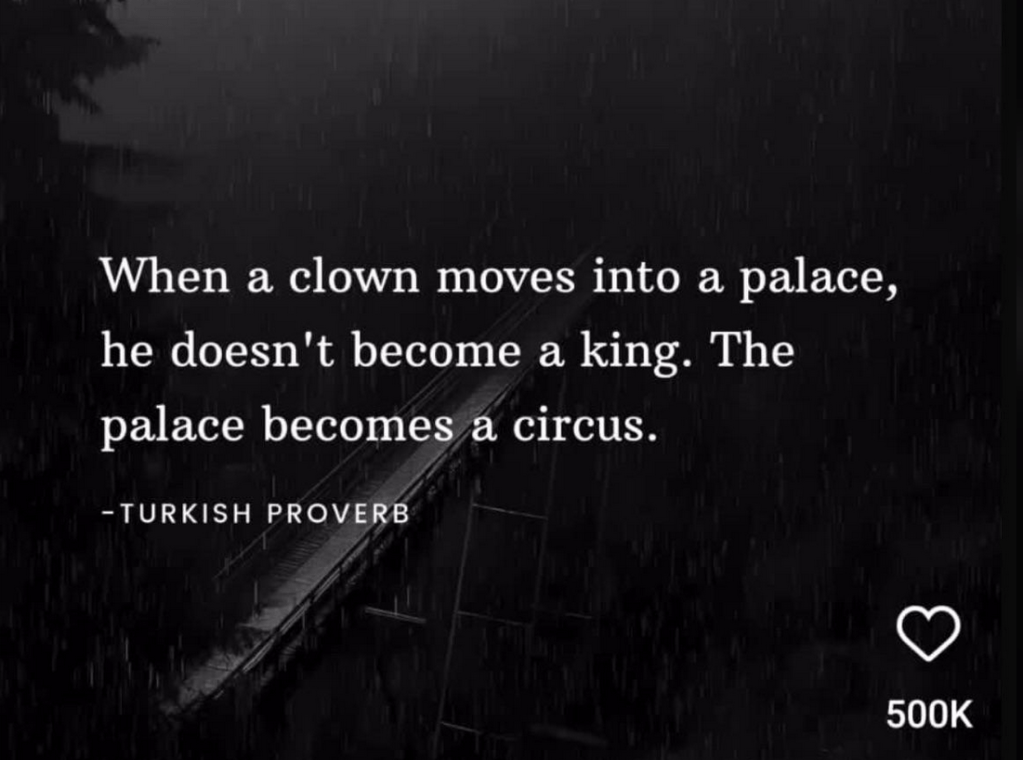
Indeed, but only a clown has enough gumption to tell the king that ‘he’s got no clothes on’!

Furthermore, every respectable palace has both a king and a jester.
The jester overpowering the king doesn’t change the palace into a circus. Only refocuses the attention of those paying attention…

1. Revelation
2. Widespread destruction or disaster

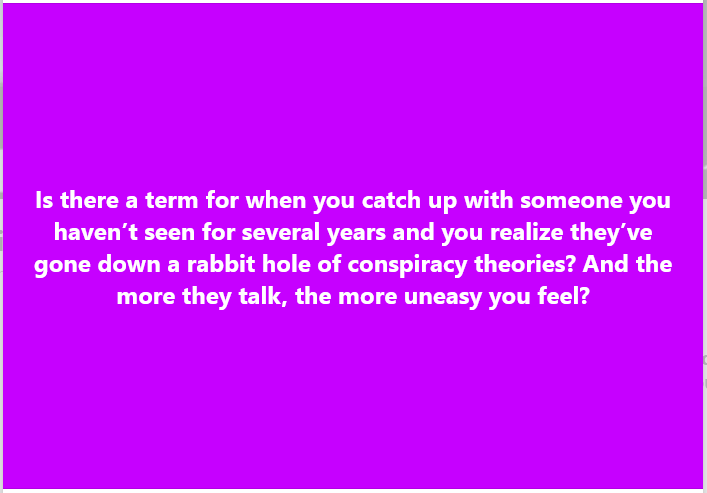
Unsettled.

Not in the sense that I feel unsettled in my ‘beliefs’.

In the sense that the world is coming apart. We allow ourselves to be led further and further away from our brethren and, together, from the ‘hard’ reality.

The key concept here is ‘rabbit holes’, not ‘conspiracy theories’.

Each of those theories are nothing but a highly redacted version of the truth, draped in psychological gimmicks. Dangerous but survivable.

It’s the fact that once hooked, those so disposed become unable to see/perceive/accept that no truth is complete or ‘everlasting’. That we need to adapt our beliefs to the ever-changing reality.

On the other hand, it was us who have built this world. The one we currently inhabit.
We have inherited the world and fine-tuned it according to our own wishes. To fit our own desires.

We are also the ones who have to sleep in the bed of our own making.
We are the ones to continue the project.
Or take it apart…

We have arrived at the moment of reckoning.
Like each and every other generation before us.

After all, one cannot build something new before taking apart the old.
This is the only constant truth.

It hurts me to accept that I have been wrong. That my understanding was incomplete or inaccurate.
Yet I have to acknowledge that before starting to build a new, hopefully better, version of the truth.
And I cannot do this alone.

Going forward, I can ‘circle the wagons’, along other like minded people, and attempt to defend the old truth.
Or I can, accompanied by a ‘motley crew’, attempt to see behind the curtains.

To leave behind the ‘safety’ of the rabbit holes and see with our own, very diverse, eyes what lies behind the make-belief shrouds woven by the conspiracy theorists.

“Complementarity is a principle that illuminates
an “honest anthropology”
based on “the nature of the subjects themselves who are performing the act””

John Paul II

The manner in which people chose to speak about the subjects they consider to be of great importance sheds a lot of light.
On the speakers!

The notion of “complementarity” was coined by John Paul II in 1979-1981. He was the reigning pope at that time.
I must remind you he was born Karol Wojtyla and his native language was Polish.

Well, nobody bothered to tell him that, in English, “complementary” has a rather limited ‘range’.
“Combining in such a way as to enhance or emphasize the qualities of each other or another. “they had different but complementary skills””

The notion was, and continues to be, used as the reason for which women cannot be made priests or deacons in the Catholic Church. And to deny marriage to the homosexual couples.

I find this whole thing rather baffling.

Man and Woman do not complement each-other. Not always, anyway.
Man and Woman survive together.

If you don’t understand the difference, don’t bother reading any further.

Now, if we need a certain ‘interaction’ between Man and Woman for the species to survive, then certainly we need to condemn homosexuality, right?

Wrong!

We have a series of facts here.

For the species to survive, Man and Woman are equally needed.
For the species to survive, it isn’t necessary for all men and women to bear children.
Homosexuality and gender dysphoria are realities. Regardless of what each of us thinks about each of them.

Humankind has survived. For now, at least.
The three facts I mentioned above have existed along the entire human evolution. We’re still here.

Back to square one.

I can ‘understand’, for the sake of the argument, the notion that homosexuality should not be ‘encouraged’. Homosexual couples are not naturally ‘productive’ so they shouldn’t be sanctioned by the church…
But if both Man and Woman are so indispensable, in their respective ‘natural roles’, for the survival of the humankind and “equal”, according to mainstream Catholic theology, then how can be explained the fact that Woman always comes second? And cannot be ordained?

Why do we allow a rather obscure thinker from the IV-th century B.C. to influence our decisions!?!

“The polarity position, first articulated by Aristotle
(384–322 b.c.), rejected fundamental equality while defending the
natural superiority of man over woman.”

Prudence Allen, RSM: Man-Woman Complementarity, The Catholic Inspiration

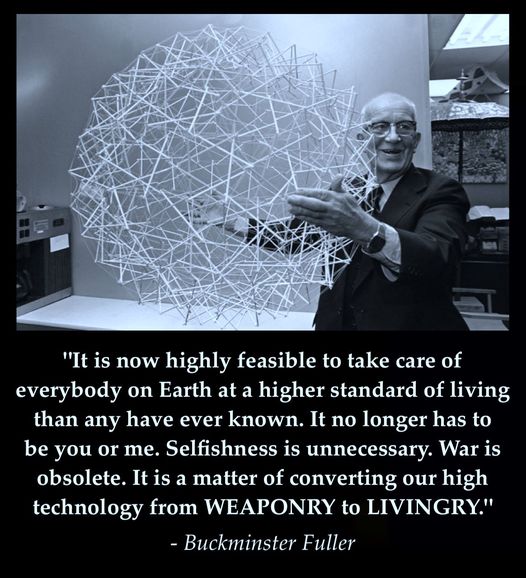
Buckminster Fuller prodded us to ‘convert our high technology’ into something really useful.

To do that, we need to perform a ‘self-actualization’ act.
Maslow considered self-actualization to be a need. An actual need, on par with the rest of them. Basic resources, safety, a place in society, esteem…
Maslow was right. Even if somewhat ‘incomplete’.

We need to crawl through the first four stages of Maslow’s pyramid in order to reach the fifth level. Where we have the opportunity to perform a self-actualization.
The result is up to us! There’s no rule nor any guaranteed outcome.

Eat and you’ll live another day. Feel safe and you’ll sleep well. Be loved and you’ll find your place. Feel good about yourself and you’ll be more ‘useful’. For yourself and for those around you.
To become a ‘better person’ you have first to find out what ‘better’ means.
And we really need self-actualization. In order to fulfill the first four needs, we’ve changed the ‘environment’. The place we call ‘home’.
We’ve built the technologies mentioned by Fuller! To make life easier…

To accept Woman as Man’s equal, as a full fledged equal, needs accepting that Man has been borne by Woman.
Some believe that Man has been made by God, ‘In His Image’. I can accept that but I must point out that God made only one Man. Adam.
All the rest have been given birth. By Woman. And raised by the extended family. By Men and Women, together.

After all, what’s keeping us from following Buckminster Fuller’s advice?!?
And is there any real difference between not allowing a woman to be ordained and not allowing her to speak ‘publicly’?

Our children have to make do
with the consequences of what we’ve cooked up.

The happier amongst us live in states run as liberal democracies.
Most countries on this planet define themselves, constitutionally speaking, as being democratic.
And except for a very few, all the others behave in an apparently capitalistic manner. Some under a free(ish) market and the rest under a ‘mixed’ regime.

Since we’re speaking about the ‘current’ socioeconomic arrangement, which is in flux, we still don’t have a name for it.
We do have a name, though, for the previous one. Feudalism.
And for the one before that. Slavery.
Or, to use a modern term, all the previous regimes might be bundled together as ‘authoritarian-isms’. Regimes where authority flows from top to bottom and where feed back comes only in the form of revolution. Coup d’etat. Dynastic change… and other euphemisms.

History suggests, and those wise enough to notice implement this lesson where ever possible, that all authoritarian regimes crumble under their own weight.
While liberal democracies tend to survive for as long as they maintain their liberal nature. Their freedom!

What’s the difference between liberal and ‘illiberal’ democracies?

“It’s not who votes that counts
but who counts the votes”

Josef Stalin

Now, speaking seriously – as Stalin style ‘popular democracies’ have crumbled more than 30 years ago, following all other ’empires’ which no longer exist, there is a difference between liberal, a.k.a. functional, and make-belief democracy.
People maintaining a liberally democratic regime take their job seriously.
They speak up their minds. Hence the problems become known.
They listen what the others have to say. Hence the people are not only aware of problems as they arise but people also have the opportunity to understand the nature of those problems.
They respect each-other. Hence they treat all problems, affecting all the people, in a fair manner. Thus maintaining the natural stability of the social arrangement.

It goes without saying that in a liberal democracy everybody can vote and each vote is counted…

An illiberal democracy, on the other hand, is where things are more complicated.
The most illiberal situation is that where it doesn’t matter whether people vote or not. The results have been counted beforehand. The latest example being Venezuela 2024.
A more ‘subtle’ picture is offered by, for example, Hungary. As a matter of fact, it was Viktor Orban, the Hungarian “dictator“, the one who had coined the very notion of “illiberal democracy“. A revamped Constitutional Court, some Constitutional Amends, “emaciated checks and balances“, tight controls imposed over the media

What about the ‘capitalist’ part of the current arrangement?
I’m afraid we waddle in confusion here.
We no longer make any distinction between ‘capitalism’ seen as ‘hoarding money as a sport’, and ‘using accumulated fiscal deposits as resources for building something new’. New and useful, of course…

‘Fiscal deposits’ – hoarded fiduciary money – have been around since coins have been minted. And IOU notes have been written. But capitalism, as Adam Smith understood it, wasn’t born yet at that time.

Under authoritarian regimes, having a lot of money does offer some leverage. But no immunity!
Consider what had happened to the Templar Monks when France’s Philip the IV-th coveted their money. Or the fate of the richest Chinese, after he had been perceived as being too cocky by the communist regime…
Whenever ‘capitalism’ takes place in liberally democratic settings, the market can be described as being ‘free’. Each economic agent – buyer or seller – decides in an autonomous manner. Takes their own advice and has to obey nobody’s orders. Has to obey the law but doesn’t have to abide to any whims.

Putting two and two together, for a society to remain functional in the longer run, the most importing thing is the ‘free market’.
The key word here being ‘free’. The meaning attached to the word and the understanding people have about the concept.
There is ‘free’ as in ‘free for all’ and free as in ‘freedom under the law’.
‘Free for all’, also known as ‘the law of the jungle’, inevitably ends up as a ‘dog eat dog’ situation while freedom under the law remains functional for as long as The People bring the law up to speed whenever needed.
The ‘market’ part is a lot simpler.
A ‘place’, an ‘open’ space, where both ideas and wares are exposed and exchanged. Amongst those who come to the market, to the agora, to solve their problems. To fulfill their needs.

As long as that ‘space’ remains free – as in ‘open’ for all – most people are able to make ends meet. The situation remains stable. For everybody to enjoy.
As soon as one ‘operator’ starts to ‘corner the market’ – using any of the already known ‘technologies’, the most popular being the old fashioned lie – the situation becomes potentially dangerous.

Whenever ‘The People’ have a sound understanding of what freedom really means, the bullies are ejected from the system. The ‘antitrust’ legislation is put to work and the budding ‘monopolies’ are dismantled before real harm was done.
If not… If von Papen hadn’t helped Hitler to rise into power and if Chamberlain hadn’t led the free world into submission…
Had we not threaded so lightly when Putin snatched Crimea back in 2014….

https://carnegieendowment.org/posts/2017/03/revisiting-the-2014-annexation-of-crimea?lang=en

“he said abortion bans early in pregnancy went too far,
suggesting Republican candidates needed to be moderate enough on the issue
to “win elections”.”

The point I’m trying to make here being that what candidates say matters.
That we really need to see through their words.
Whether they are interested in solving issues – and which of them – or they simply want to accede to power.

Doesn’t matter? As long as they keep their promises?

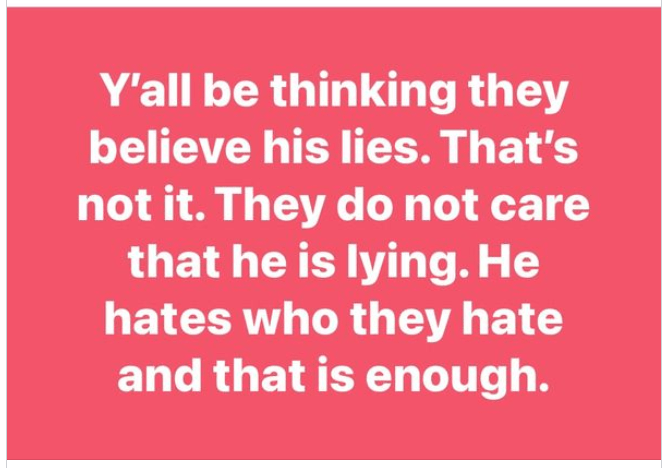
Do you really expect a lying bully to keep up with their words? To fulfill their promises?
Are you comfortable with ‘hiring’ a lying bully to mind the future of your children?

Classic sociologist Emile Durkheim theorizes that crime exists
in all societies because it reaffirms moral boundaries and at times
facilitates needed social changes,
while former U.S. Senator Daniel Patrick Moynihan believes that
Durkheim’s views omit the possibility of too much crime, especially violent crime,
so that deviance as a serious social problem is not addressed.

“Normlessness and deregulation are poor translations of dereglement for several reasons. They did not enter into common English usage until the 1960s and certainly didn’t exist in Durkheim’s time. Dereglement is difficult to render in English. It carries with it in French the connotations of immorality and suffering, but is perhaps best translated as derangement. Anomie as dereglement implies a condition of madness or something akin to sin. This concides with the observation that over 20 words denoting sin were translated as anomia when the Bible was translated by St. Jerome and others.”

Durkheim was right after all.
‘Crime’ does fulfill a social function.
Some deviance, when well ‘managed’, can be useful. The US have somehow managed to transform a rather high level of deviance into ‘speed’. 250 years ago, the 13 American colonies were almost insignificant.
Today, the US is the most powerful/wealthy nation on Earth. While the Union continues to be the most ‘deviant’ among the civilized nations. On all conceivable metrics.

The key words here being, of course, “well managed”!
Maybe the time has come for the likes of Senator Daniel Patrick Moynihan to go back to class. And to finish reading what Durkheim had to say about things.

The problem with the current political class, not only in America, being the fact that too many politicians ‘outsource’ responsibility!
It’s not history’s job to maintain accountability!

The politicians themselves need to provide enough reasonable alternatives for the ‘people’ to chose from!

Durkheim, read from both ends, told us that much.
We are the ones who need to maintain the balance.
For it’s us who will bear the consequences!

No matter who was the culprit, we’ll have to clear up the mess.
So we’d better stop the fan from spreading the mess around!

After all, shit happens. It’s a natural occurrence.
We have to eat so we need to relieve ourselves.
But how about doing this in a civilized manner?
And not rewarding those bragging about ‘inappropriate behavior‘….

The Polish state broadcaster on Saturday suspended
a television journalist who, during the Olympic Games opening ceremony,
reacted to a performance of John Lennon’s “Imagine” by saying it was a “vision of communism.”

Communism is perfect!
Communism is the perfect lie…

Communism was ‘invented’ by Marx and proposed as the only solution to a real problem.

The problem with communism as a practical solution is that it cannot be put into practice!

Humans, both at individual and social level, need freedom.
Without individual and social freedom, individuals regress to an animalic state and societies fail. Abysmally!

According to Marx, communism was the only solution for what he had perceived as a problem.
According to Marx, when a critical mass of people belonging to the middle class will become destitute, they will accept to be led out of their predicament by ‘the communists’. But since the rest of the society continues to enjoy their perks or to ignore the dangers ‘lurking in the future’, in order to achieve their goal – communism for everybody, including for the unwilling, the communists will have to institute the socialist dictatorship. As a transition phase to communism. A phase in which the unwilling will be convinced.
According to history, no dictatorship – including the socialist – has ever survived. Has ever achieved its goal.

Communism, at least for now, is unattainable. For the simple reason that humankind has not yet learned how to survive dictatorship. How to live without freedom.

On the other hand, communism is very alluring.
For the idealists amongst us…
Communism is a very suitable subject for dreaming. A very nice thing to have, albeit impossible to achieve…

Since the idealists are hard to convince, let me speak to the practical minded amongst you.
John Lennon invited us to dream. To dream a world with ‘no possessions’ and with ‘no need for greed or hunger’. What’s not to like in this dream, except for the fact that it can’t be put in practice?
Hunger is natural. Why eat if not hungry?!?
Greed is also natural.
Who doesn’t like/want more of what they consider to be pleasant?!? The wise amongst us?
How do we become wise? As wise as each of us is able to become…
By interacting with others? By learning from them? And from the consequences of those interactions?

Property – possessions – is a tool.
A tool society uses to make order. If each of us knows what they are able to use for what purpose things go smooth. There’s no need for outside intervention. Granted, this is valid for only as long as each – well, at least most – members of the society have enough to eat, where to sleep and what to protect their backs with.
Without the order construed by the society, collectively, using the tool known as ‘property’, how are the people going to cooperate?!? To interact? To learn, even…

How about we wake up?
Sleep is essential and dreaming a normal part of it.
But we also need some wake up time!
Pun intended…

Each of us expects the others to behave rationally.
While each of us rationalizes their own biases.
And considers this to be normal!

Not so long ago – evolutionary speaking, things were free. As in ‘up for grabs’.
Our not so distant forefathers fed and clothed themselves by picking ‘things’ from nature.

By talking to each other they had become conscious human beings.
Then came up with the notion of property.

‘If I/we have this thing, you cannot have it too’.

Using this notion, they introduced some order unto the social stage.
Some things, albeit fewer and fewer, remained free/up for grabs while the rest – specially ‘the things of interest’ had become private.

Entertaining the notion of property means that individuals are able to link an object to its owner.
This link is a piece of information.
Discussing and remembering who owns what, our forefathers realized that information is important. Not only the information regarding the link between owners and their property but also information in general. Whatever ‘useful’ things had been learned, remembered and passed around.
Thus information became ‘a thing’.

The order created by the communities using the concept of property and by actively circulating information among the members had become the premise for those communities to thrive.

Somewhat naturally, the members of those communities had reached the conviction that:
Property is good. And that more property is better.
Old people are precious. For the simple reason that they deposit what had happened. By sharing their memories, old people make it so that the younger ones don’t need to learn again and again.

Since property and remembered information were good for the community, the communities using them developed faster and had a way better survival rate than those who didn’t. For whatever reasons.

Since in reality people rationalize rather than think rationally, they have reached the conclusion that the rich and old people were the ultimate cause for the well being of the community.
The individuals, not the modus operandi of the community.

What is going now in China – and in Russia, for that matter –
has nothing to do with the ‘left’.
With what is understood as “left” in Europe…
Instead, it has many similarities with fascism.
‘Corporatist’ states imbued with revindicative nationalism.

Nassim Nicholas Taleb has introduced the concept of “Skin in the Game“.
In short, it is about the fact that the decisions made by people who do not directly and immediately ‘enjoy’ the consequences of their choices have a high probability of being bad. A phenomenon that is accentuated as bad decisions are not immediately sanctioned by those who suffer.

Taleb’s observation only confirms the fact that all dictatorships/authoritarian regimes have collapsed.
Without exception!
Alternatively, it is very easy to see that democracies ONLY last as for long as they manage to maintain their ‘functionality’. That is, for as long as people can – and undertake – to voice their grievances. And for as long as people listen to each other. Respectfully! In vain, some shout about being ‘hungry’ if nobody listens/cares ..

Returning to the idea of ​​’leadership’, yes, countries are led. By some who consider themselves/are considered to be ‘elite’. ‘Led’ only from the operational point of view, however…
Countries are living things, ‘natural selection’ still has the last word!
Ernst Mayr, a biologist, said that ‘evolution is not about the survival of the fittest, but about the disappearance of those who cannot find their ‘right’ place. The misfits. ‘. That’s right, countries have big problems if/when they don’t manage to take down the ‘misfits’ who happen to have clambered into power.
Why countries don’t succeed to do this in a timely manner? How did they clambered there in the first place…
Everything starts when the popular dissatisfaction reaches a critical level. Which dissatisfaction is engendered when the members of that country no longer care for each-other. When mutual respect has disappeared.

I will conclude by returning to the major difference between communism and fascism.
Both of them appeared in situations when enough dissatisfied people were ‘wandering aimlessly’ while looked down by the rest of the society.
Some low-life profiteers seized the occasion and ‘grabbed the helm’. Profiteers who have been able to operationalize the dissatisfaction festering in the society. And the lack of vision of those who hated the others. I repeat myself, both communism and fascism had appeared when various sections of the society despised, and sometimes hated, the ‘others’.
The minor difference consists in the fact that the proto-communist dissatisfied looked up without having any chance to get there, while the proto-fascist ones wanted to return to where they had once been. The Russian muzhiks dying during WWI versus the unemployed German workers who had just lost WWI.

This being where the difference appears.
The difference which makes it hard to recognize what’s going on now in Russia/China as being a form of fascism.
Both the Russians and the Chinese have a lot better lives now than they had under communist rule. Statistically and from the material point of view! Psychologically speaking…
Those who live in well-established democracies – people who respect each other – have a greater tolerance for ‘insecurity’. Each of them knows they can rely on the others. In that environment, failure is temporary. People try as many times as they need to succeed. Or that’s how it used to be…
In communism, we had learned – the hard way, that one was not allowed to make mistakes.
When Russia and China switched to ‘capitalism’ and people saw what could happen to them – to make mistakes while trying – they had become frightened!
And, at least some of them, chose to return – especially psychologically, in the past. Where they felt safe…