Archives for category: Mutual Respect

Can we do without it?
And if not, how much of it?

– If ‘no government’, then who would pay for the army we need to defend ourselves?

Ooops… you’ve just answered the ‘why does Russia ‘encourage’ the trolls who push ludicrous libertarian ideas’ question. Which trolls attempt to achieve two things at once. Weaken the concept of free government and give libertarian-ism a bad rep. Transforming libertarian-ism into yet another form of extremism.

Let’s get serious and try to find an answer to ‘why, and how much of it, do we need government?’

The boring one would be: ‘Whenever one government falls, another one takes over. The interregnum is always bad so… let’s get used to it’.

‘Getting used to it’ works only for very short expanses of time. Left on its own, all ‘government’ becomes sloppy. So sloppy that it soon becomes such a burden that even the most ‘used to it’ lose their patience.
Government, all of them, need to be kept on a tight leash. Otherwise it will soon cease to perform as intended.

– But if you have to keep it on a tight leash, why bother with any in the first place?
Can’t we do without such a bothersome pet?
What’s the point of the whole thing, anyway?

Instinctively, we’re against ‘government’ for two reasons.
It costs us a lot and it used to represent the interests of the ruler.

Until 10 000 or so years ago, we didn’t need ‘government’.
People were living more or less like the modern day Sun People still do. In the Kalahari desert… small bands roam the place, living of the land. The bands are small – so that they might find sustenance, they don’t have any ‘private’ property to protect, hence they don’t need government. Neither did our ancestors.

As soon as people ‘invented’ agriculture – raising ‘tame’ animals at first and working the land soon after, things had changed dramatically.
The advent of agriculture brought two things. An increased productivity and private property.
Soil has not been born equal. Both pastures and arable land can be good, passable or bad. People wish to have the best. Those who already have it are willing to defend it and those who don’t are willing to steal it.
Increased productivity means that those who produce are able to hire people to protect their ‘means of production’. Their property. As a consequence of fighting for it, some people accumulate more and more of it.
More and more ‘means of productions’ – property, means an ever increasing need for ‘management’ and an ever increasing need for ‘protection’. Soon you have a very ‘wealthy’ owner – the lord of the place, call it what you like or use the name given to him by his subjects, the people who perform the day to day management of the ‘whole-sale property’ and those who protect it from ‘marauders’. Both the ‘managers’ – read ‘government’, and the ‘protectors’ – read ‘army’, used to be under the direct supervision of the local lord.
For a while – for as long as the lord kept everything in balance, everybody was happy. The ‘peasants’ were happy because thy were safe, the ‘managers’ were happy because the wise lord used to appreciate their work and ‘compensated’ them accordingly, the ‘protectors’ were happy because they were well fed and taken care of. According to this article, the great Egyptian had been built by willing people, not by slaves.
https://www.harvardmagazine.com/2003/07/who-built-the-pyramids-html
But soon enough, the lord had become estranged from his people. Government had become an instrument used to extract more and more wealth from the peasants while the army was used to protect the government against the people and, whenever possible, to increase the property of the ruling lord by stealing some from the neighboring ‘lords’. The ’empire’ was born.

But this development could take place only in certain circumstances. Where those below the ruling lord had nothing more to do than to obey. Where the best subject was the disciplined one. Where autonomous thinking and imagination were frown upon by the ruler. Where one mind was enough.
Whenever the ‘environment’ mandated the individuals to remain relatively autonomous, proto-democratic forms of self government had been experimented. From the nomadic pastoralists of the Central Asia to the sailing communities in Ancient Greece and Medieval Scandinavia. Those driving herds or sailing ships need to be a lot more independent-minded that those who just tile the earth. No offense intended here! Simple observation will notice that where the geography of the place had allowed it, somebody had ‘built’ an empire. The Nile Valley, the Middle East, the Russian plain, China, Mexico…
Where ever the geography of the place was fragmented enough by sail-able sea, proto-democratic forms of self-management had been developed. The sailing Ancient Athens versus the land-locked Sparta, Medieval Scandinavia versus Medieval France…

Fast forward to present day.
When we have two forms of government.
The more or less democratic ones. Those under whose ‘guidance’ discussions like the present one can happen.
And the more or less authoritarian ones. Which actively discourage autonomous thinking.

Mind you, there are no ‘perfect’ governments.
There’s no perfectly democratic arrangement anywhere on Earth. Because we are imperfect human beings.
And there’s no ‘perfect’ authoritarian government. Because no government can survive for long if it attempts to centralize the decision power. The closer a government gets to being perfectly authoritarian, the smaller is the crisis needed to topple it. Unless it is supported from the out-side but that’s another topic.

So. It is fairly simple to understand how authoritarian governments fail. Too much ‘stiffness’ makes it impossible for authoritarian governments to evolve. To find solutions for whatever challenges pop up constantly.

But what can go wrong with the collective forms of self-rule? With the participative forms of social self management? Otherwise known as democracies?
Lack of enough popular involvement. Due to a sense of apparent safety, initially. And to a feeling of apparent impotence, soon after.
Lack of enough fore-sight. Those who should know better become distracted, for whatever reasons.
Too much opportunism. More and more of the ‘insiders’ use ‘the power of the government’ to fulfill their own, private, goals instead of making sure that ‘government’ works properly.

And what does that mean?

A government works properly when the community which self manages itself using that particular (form of democratic) government survives in the long run.
When those momentarily working inside the government make things happen for the community at large.
When people, both inside and outside the government, follow, in spirit, Kennedy’s words.

Am I being naive?
Maybe… But wouldn’t it be a nice thing to have?
A nice thing to chase, anyway?

And what better way to chase ‘it’ than voting for people who at least pretend to be honest? Who at least make the ‘right’ noises? Whom we can hold accountable whenever they break their promises?
Instead of voting for those who promise barrels and barrels of ‘pork‘?
https://grammarist.com/idiom/pork-barrel/

Ideological pork or hands-on pork, I don’t know which is worse…
– In which direction?

– I thought we were talking about a glass ceiling, not a glass bottom…

You see, we have to deal here with the difference between depth and thickness.

A ‘coat of paint’ has a certain thickness – we know where it starts and where it ends, while a sea has a certain depth. We know it’s there, we know where it starts – at the surface of the water, but we’re never exactly sure where it ends. How deep it actually is!

Another way to put this would be to compare the depth of human consciousness with the thickness of the cerebral cortex.
The depth of the reality we perceive using our brain and the thickness of the cerebral tissue where this perception takes place.
The depth of the reality we, humans, have built during our history inside the relatively shallow portion of the Earth where we feel at home.

We use a small number of phonemes to communicate among ourselves.
A relatively small number of words to convey hugely complicated concepts.
Two digits, 0 and 1, to build artificial intelligence… inside a wafer thin ‘slab’ of doped silicon.

– OK, enough introduction. How about making in clear what you really meant?
A glass ceiling or a glass bottom?

Whether it is a glass ceiling or a glass bottom is a matter of perspective.
A matter of where you are when looking at it. Above or below.
The only thing which really matters being the fact that you see it despite of it being made of glass.
Despite it being transparent.

Transparent to our eyes but not to our conscious mind.

– But if it’s already transparent, why is it such a big thing to break through it?
We already know what’s behind/above it…

Seeing is not the same thing as knowing… just as 0 and 1 scribbled on a computer chip is not enough to make an intelligent computer…

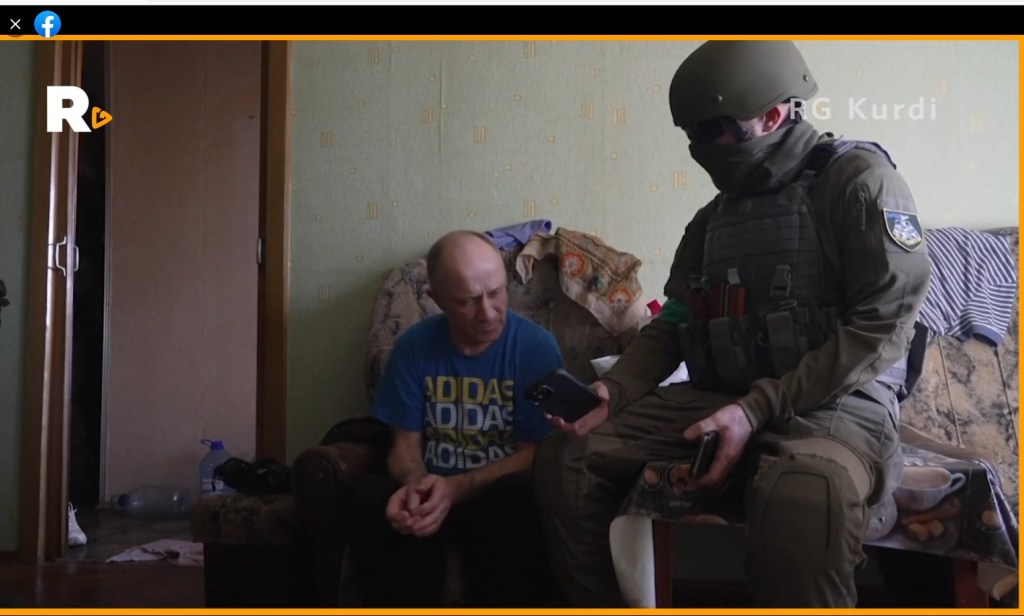
The guy in the blue T shirt is being questioned by the Ukrainian police about his activity on ‘social media’.
You probably guessed already what kind of ‘activity’ we’re talking about…

Which brings back painful memories.

During my childhood, in communist Romania, you could get arrested for listening to Radio Free Europe. Or for speaking against the communist rule.

In present day Russia, you’ll soon enough be arrested if you use the word war in relation to what is going on in Ukraine.

In Ukraine itself, you can be arrested for publicly supporting Putin’s actions.

The worst thing being the fact that there still are people out there who consider Putin is right and the Ukrainians – those who do nothing but defend their country, should be ‘left alone’.

To be ‘left alone’ to what?!?
To be bombed away by Putin?
So that we may continue our ‘peaceful lives’?

Peaceful only until Putin – or someone equivalent, will ‘change his mind’?

The guy above hasn’t figured out yet, in spite of the bombs falling over his head, that there’s no such thing as ‘peaceful life’ under dictatorship! Any kind of dictatorship…
Nor have any of those who continue to defend Putin’s actions!

Or use their ‘freedom of speech’ in an attempt to sow doubt about the matter.

Isn’t the other party always the guilty one?

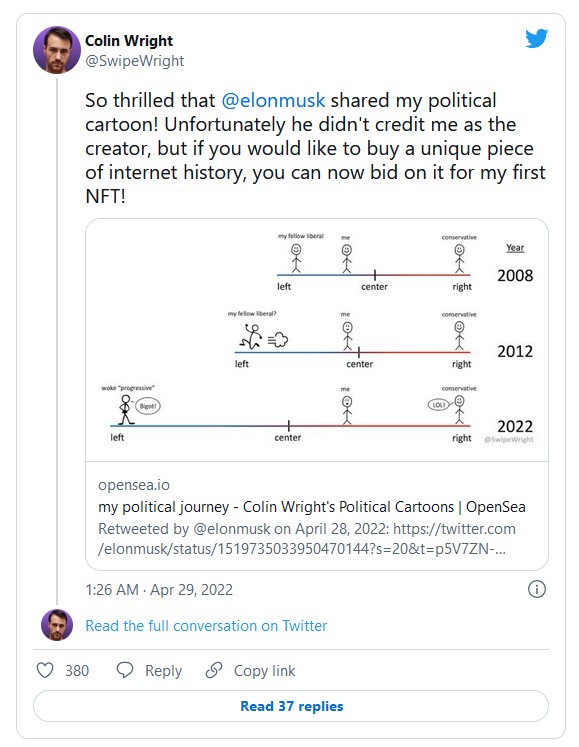
Or, otherwise put, Musk – who in 2008 was left of center, currently finds himself in a moderate conservative position because the woke progressives have displaced the center. To the left of where Musk was in 2008. And where he still is…

This might have not been uttered by Churchill but nevertheless rises some questions…

‘If you’re not a liberal when you’re 25, you have no heart.
If you’re not a conservative by the time you’re 35, you have no brain.’

What? The cartoon wasn’t Musk’s to share in the first place? He had just ‘borrowed’ it from somebody else?!?

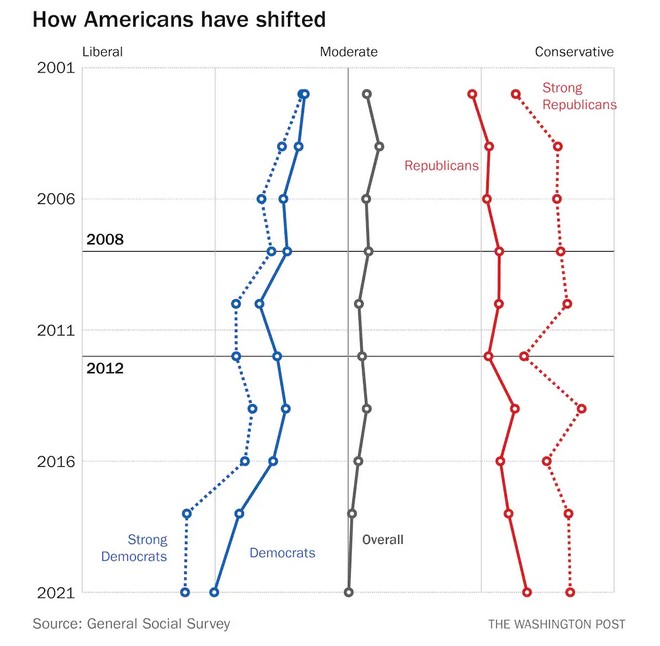
And here’s what ‘Big Data’ has to say about the whole thing.

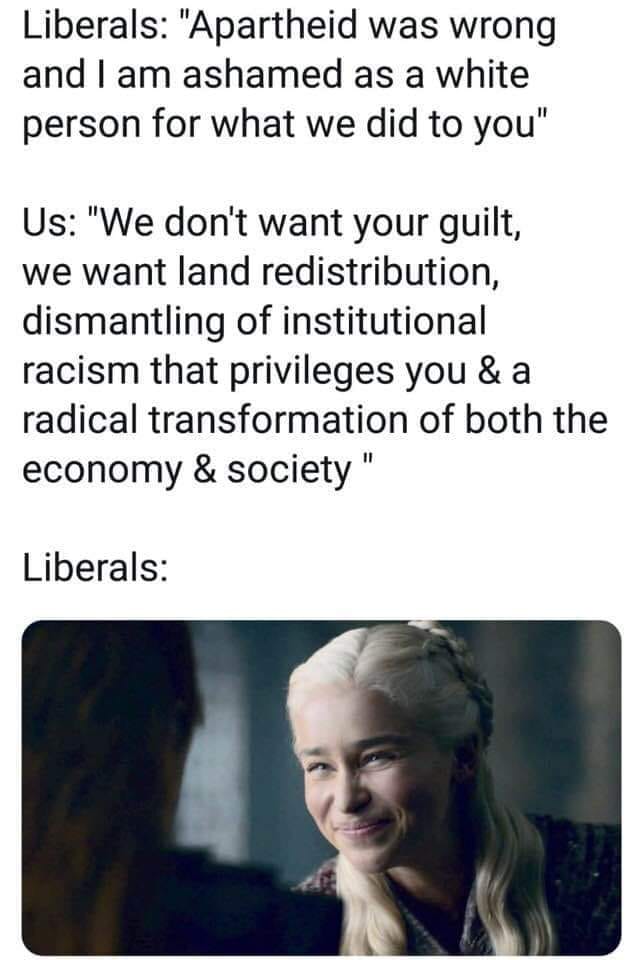
The fact that too many self styled liberals hold on to their ill begotten wealth while distributing a lot of quilt doesn’t obliterate the fact that very few of the ‘self believed’ conservatives share much of their wealth… while seldom admitting any responsibility for what had happened in the past. And continues to this day, in very insidious ways.

As for any attempt at a radical transformation of both economy and society – as in making them actually free for all us – white, black and all the other hues… forget it.

NB. All of us will eventually lose. Everything. Things are becoming too lopsided.

To make sense of that we have already passed through?

What does ‘worst’ mean in this circumstances?
Until now, I was under the impression that ‘critics’ were good.
That in a democratic setting, the critics are those who pull at our sleeves when we go astray.
That the critics are those who bring us back to the straight and narrow.
How can ‘critics’ become ‘bad’? Let alone “worst”…

“”Free speech is the bedrock of a functioning democracy, and Twitter is the digital town square where matters vital to the future of mankind are debated” said Mr. Musk. “I also want to make Twitter better than ever by…””

As many of you already know, I grew up under a communist regime. In Ceausescu’s Romania.
That was were I learned to decipher messages transmitted using the ‘wooden language’.
Or, in Orwell’s parlance, “newspeak”…

Here’s what I make of Elon Musk’s words:

‘From now on, the “digital town square where matters vital to the future of mankind are debated” is mine. Mine to make what I see fit of it. To “make better” under my own terms. And if you don’t like it, keep ‘barking’. There’s nothing you can do to me. I’m going to make Twitter ‘private’. A.k.a. free from any ‘market interference’. Furthermore, your ‘barking’ will only increase the traffic. Hence the money I’ll be making on the back of your ‘free speech’.’

Twenty four years ago, in 1998, I spent a fortnight visiting Tunisia. I still remember the discussions I had with my wife. In our native Romania, we – the country, not the two of us – already had a couple of malls – which were quite new for us.
Each time that we entered a Tunisian suk – also known as a bazaar, we felt like strolling through a mall.

In the Middle Ages, a suk was the property of the local sheik. Even if each ‘stall’ was operated as an individual business, the whole thing was run at the whim of the local ruler.
According to the laws of the land, but still at the mercy of the landlord.

Each mall, the building, is owned by a company. And, the business, operated by another. Usually by a chain. Hence the ‘freedom’ of the individual businesses ‘housed’ by each mall is ‘defined’ by the rules put in place by the owners and the operators. Under the laws and by laws valid for the physical location of the building but still at the ‘mercy’ of those who own/operate the mall.

From now on, the “digital town square where matters vital to the future of the mankind” are ‘freely debated’ by us will be owned and operated by yet another one of Elon Musk’s enterprises.
Who, for now at least, promises to welcome his “worst” critics, whatever that might mean.

And an after thought.
A way shorter translation of Musk’s words might be: ‘Freedom of speech means being able to say ‘those who criticize me are bad people”. With the corollary that some are worse than others…

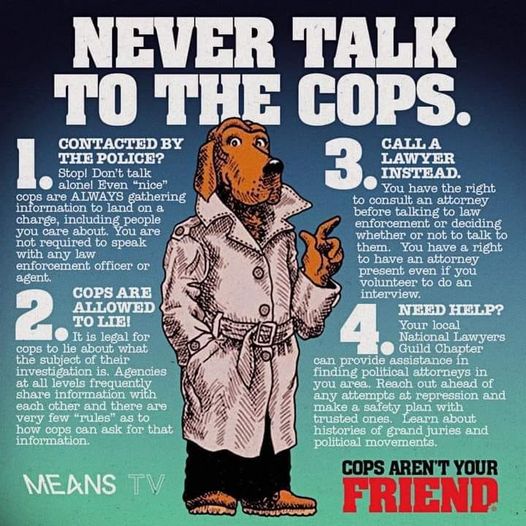
Just came across this meme.

It was shared on a FB-wall and somebody had commented that “Institutionally they are not your friends.”

My ‘jerked’ comment was:

“Institutionally, cops should be your ‘last resort’ friends.

The fact that too many of them are not, and the fact that too many of us consider them, as a category, to be unfriendly, is proof of how dysfunctional our society has become.

Cops used to be ‘unfriendly’ when I grew up. In communist Romania. When the cops were used, by the communist state, to preserve their power. The communist power over the entire society.

In the free countries of today, the cops are the sole barrier separating our persona and private property from the hands of the criminals.

Without their presence…

Or, putting it the other way around, we have but the cops we deserve. Train and motivate them properly and you’ll have good cops!”

At a second glance, I had an inkling.
Is it possible for the whole thing to be nothing more than a ‘marketing campaign’? Organized by the only people interested in increasing litigation?

Interested in altering the relative stability of our political establishment?

The police, by properly performing their duties – the world over, not only in the communist countries, contribute to the political stability of those respective countries.
For the police to properly perform their duties, there must to exist a proper trust between the general population and the police itself. The population must see the police as their friends of last resort while the police must see the general public as both their employer and their responsibility.
The population must be open in their relationship with the police while the police must treat respectfully every individual, including the suspects and the convicts.

In the communist regime I grew up, the police couldn’t fulfill its duties. Exactly between there was a ‘trust’ barrier between the general public and the police. Between the oppressed and the armed hand of the oppressor.
The communist regime I grew up under, in Romania, had eventually collapsed.
Exactly because of the malignant mistrust between the general public – The People, and the government. The police being nothing but a portion of the government itself.

Who is interested in the collapse of the democratic regimes?
Who is mostly interested in wedging apart the government from The People?

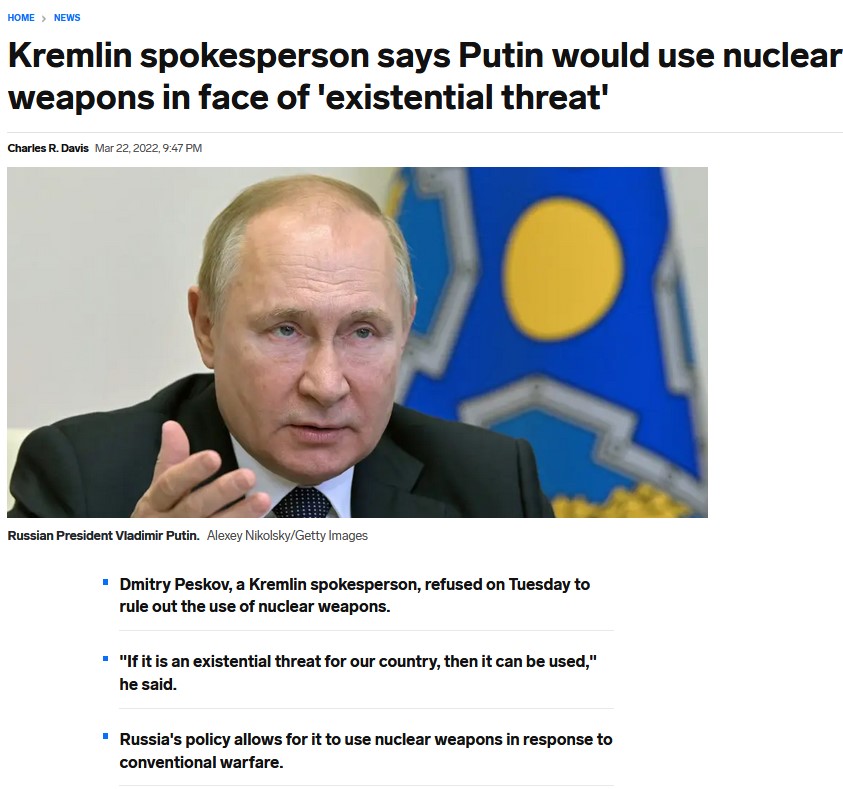
No, Putin’s henchmen executing a nuclear attack isn’t the worst case scenario.

This is.

People around the world asking themselves ‘how is it possible for an army belonging to a civilized country – one currently holding the right to veto any UN Security Council decision, might behave in such a horrible manner’?!?
How is it possible for a civilized people, the Russian people, to allow something like this to happen?

After the Cold War had been lost by the Soviet Union, the world over was under the impression that the liberal-democratic and capitalist model had ‘won’. That nobody could any longer advocate for an alternative.
Nine years later, Russia was on the verge of collapse. After following – ineptly, the capitalist mantra – greed is good, the Russian people was almost dying of hunger. That’s how the Russians had fallen under Putin’s spell. He had turned around the Russian economy and earned the gratitude of the ordinary Russian people.

  • But he had done nothing but reigning in Yeltsin’s oligarchs… and got filthy rich in the process!

Yes, but the ordinary Russians had enjoyed, for some 15 years, a life they had never thought possible. A life of relative abundance.
At a relatively low cost. At a cost they were already accustomed with.

The Russian people has been been accustomed, since always, to keep its mouth shut.
That’s so deeply ingrained into their minds that most of them never even dream of speaking up….

  • OK, OK… but what is the link between your ‘worst case scenario’ and the Russian people being unable to ‘speak up’?!?

Putin is able to do what he is currently doing because nobody is challenging his decisions.
Nobody inside Russia…

Because nobody inside Russia is challenging his decisions – and a ‘handful’ of ‘dimwits’ actually executes those decisions, the rest of the world is under the impression that the Russian people is OK with what’s going on in Ukraine.

  • And who are you to tell us that ‘regular Ivan’ would challenge Putin’s decisions if he had any opportunity?!?

I didn’t say that!
If you are under that impression, I’m afraid I haven’t made my point yet.

You see, what we really need to do is to ‘fold’ the Russian people into our ‘Weltanschauung’.
To welcome them into our social and cultural space.

The current war will end. One way or another.
Putin will die. Sooner or later.
But until the Russian people will learn that with us is far better that against us… we – all of us, will live on a ‘tight-rope’.

My impression, watching the horrors committed by the Russian army, is that those horrors have been ordered by Putin for one reason. And one reason only.

To convince us, the rest of the world, that the Russian people is nothing but a bunch of savages.
That they deserve no compassion.

That their leader – Putin, must be offered an easy way out – at the expense of the Ukrainians, and that the Russian people must be left to rot at his disposal.
That the Russian people deserves nothing. Nothing but to be left at the mercy of their ruthless and mind-twisting sheep-master.

That is the worst case scenario.
Us accepting that another people, any people, is worthless.

Putin’s followers – Le Pen and Orban being but the most obvious examples, are eagerly waiting for that to happen.

Putin advisers ‘too afraid to tell him the truth’ on Ukraine: US official
“Putin didn’t even know his military was using and losing conscripts in Ukraine, showing a clear breakdown in the flow of accurate information to the Russian president,” the official said.

There are two ‘things’ which collide here.

Dictators tend to drive away really competent people and those remaining tend to put the entire blame on the ‘guy on top’.

As many of you already know, I grew up in the communist Romania. Ruled by Nicolae Ceausescu, the dictator who ended up being shot on Christmas Day, 1989.

At 28, I was already familiar with the notion of ‘yes-people’. Decision makers who ruled our daily lives were surrounded by people who provided the ‘right’ answers, effectively isolating the decision makers from the reality.
This ‘development’ being the fundamental explanation for how all dictatorial regimes, including the communist ones, ended up in abject failure. For ‘how’, not for ‘why’ – but this is another issue.

After Ceausescu was toppled, I was absolutely flabbergasted when I first heard

‘He didn’t know what was going on. Had his close advisers kept him in touch with the real situation, he would have taken the proper decisions to rectify things’

Really?!?

Who had selected his ‘close advisers’?!?

Who prevented him from asking ‘a second opinion’? From stepping out of his office and ….

Who, step by step, had ‘created’ the ‘atmosphere’ which had driven all those unwilling to lick where ‘he’ had spat to flee, living ‘him’ surrounded by sycophants?

Sycophants attempting, after Ceausescu had been toppled, to pile all the blame on his shoulders…

I’m afraid we are witnessing a replay, with Putin as the lead character.

When I was six, my father took me to a German kinder-garden.

He was learning German, at 35, and thought I should start earlier.
In the end, I didn’t exactly learn the language but during the process I met a lot of nice German speaking people.

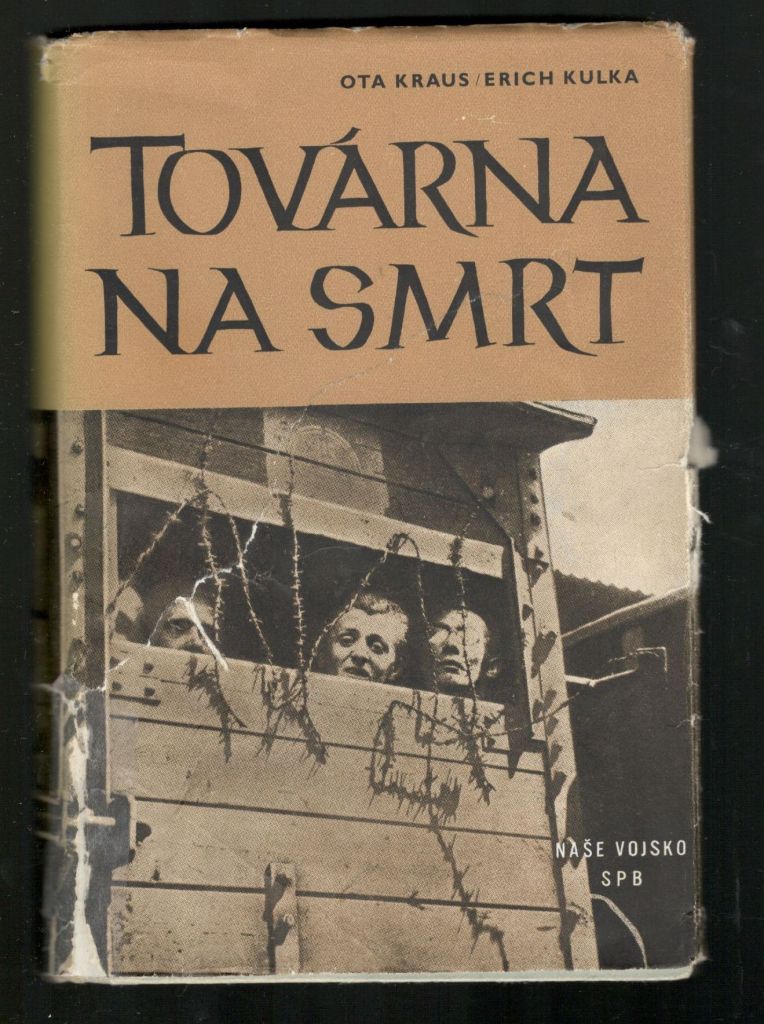
At 16 I read

The Death Factory, a book about the Auschwitz concentration camp

Well, actually it was translated in Romanian but the original cover is far more suggestive for non-Romanians.

That was when I learned to distinguish between a people as a whole and the atrocities committed by a minority.

As I grew up, under communist rule, I noticed the ‘little compromises’ my parents had to make in order to provide a better life for me. The small bribes offered whenever ‘necessary’, not speaking up their minds in ‘official settings’, allowing stupid, but powerful, individuals to boss them around…
As a young adult, I understood how those small compromises, made by almost all of us, added up and eventually caused the entire regime to collapse. Eaten up, from inside, by institutionalized corruption.

As a no longer young adult, after the regime change, I noticed that ‘compromise’ was so entrenched in our habit that it had been carried over into the new regime. As if the new found liberty had been interpreted as the freedom to accept ‘un-earned benefits’ from whoever offered them. In exchange for things which were not ours to give…
The same was happening in other ex-communist countries. The closer to Moscow, the more intense the phenomenon.

That was when I learned to dissociate corruption from any particular political regimen.

Soon after that I learned the international dimension of the whole thing.

“BONN, Germany (AP) _ Germany is set to outlaw tax deductions for bribes paid to foreign officials, falling in line with a U.S.-led drive to fight corruption and promote fair competition.
The change is part of proposed tax reforms presented Monday by the new center-left government of Chancellor Gerhard Schroeder. Parliament is expected to approve the measure before the end of the year.
Currently, kickbacks paid by German companies abroad or at home to win contracts are tax deductible as legitimate business expenses unless the person who made the payout is found out and convicted of bribery. In practice, that rarely happens
.”

AP NEWS, November 10, 1998

Gerhard Schroeder, who had called „the Russian president a “flawless democrat””, „has been tapped to join the Gazprom supervisory board”.

That was when I realized how many of those living inside a country have no effing idea about what some of their compatriots do when ‘working’ abroad.

A few short years later, a Romanian president had the audacity to shout ‘the emperor is naked’.

“Corruption belongs to both the public and private sectors, and the president has said he does not shift responsibility to anyone, but that it must be “shared and assumed.”
An official cannot be corrupted if there is no one to pay a bribe, just as a ministry cannot pay 50% more for a contract if there is no consultant to do an expertise in this regard, Basescu explained.
“Let’s get out of the hypocrisy. If there is corruption, the state alone cannot be corrupted, it has a partner. The state cannot be alone. It has a partner and this is the private economy.”
Basescu was present yesterday at the launch of the Romanian Competitiveness Report prepared by AmCham.
“

Claudiu Medrega, Ziarul Financiar, 15/12/2011

That was when I learned that democracy alone is not enough to cure corruption. That democracy can also be eaten from the inside by this worm. If ‘the people’ do not pay enough attention!

This morning, on top of the already ‘normal’ news from the Ukrainian front, I learned that

“Last week, Boris Romanchenko, a 96-year-old Holocaust survivor, was killed when shelling hit his ordinary flat in the war-ravaged Ukrainian city of Kharkiv”
“The multi-storey apartment building where Romanchenko lived was shelled and caught on fire,” said the statement.
Kharkiv, Ukraine’s second largest city, has been under heavy fire from Russian artillery throughout the invasion, which Russian President Vladimir Putin calls a “special military operation” necessary to disarm and “denazify” its neighbour.”

Reuters, March 22, 2022

That was when I understood that ‘what goes around, comes around’ is driven by our bad choices.
By our unwillingness to make good what we have already learned from past mistakes.

Should have learned from past mistakes…

Really guys?
The Red Army had spilled its blood to free the people herded to be killed at Auschwitz and a survivor from Auschwitz is killed by a Russian bomb attempting to ‘denazify’ Ukraine?!?
Which Ukraine wanted nothing but to join the EU and NATO?
But couldn’t! Crimea was occupied while Donetsk and Luhansk have rebelled against the central government… and NATO – like all other clear headed alliances do not admit new members which are already involved in ‘border disputes’.

“Putin says Russia’s concerns expressed over three decades about NATO’s expansion were dismissed by the West, and post-Soviet Russia was humiliated after the 1991 fall of the Soviet Union.”
He says NATO, as an instrument of the United States, was building up its military on Ukraine’s territory in a way that threatened Russia.
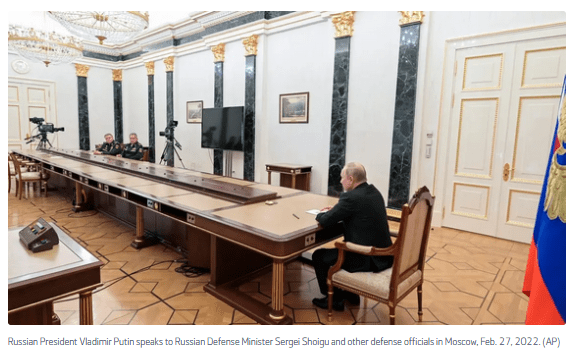
On March 11, Russia’s Defence Minister Sergei Shoigu told Putin the West was beefing up military forces close to Russia’s Western borders. Putin asked Shoigu to prepare a report on how to respond
.”

“For almost 25 years, the West believed Russia could be tamed by diplomacy and trade to maintain stability and security in Europe. In 1997, NATO and Russia signed a “founding act” that was designed to build trust and limit both sides’ force presence in eastern Europe.
The alliance also sought to build a partnership with Russia, which took part in NATO exercises in the Baltic as recently as 2012, according to retired U.S. Admiral James Foggo, who commanded U.S. and NATO fleets in Europe for almost a decade until 2020.

After Russia annexed Crimea in 2014… NATO created small, multinational combat units in Poland and the three Baltic states, which serve as a forward presence to deter Moscow. But the force numbers are designed not to violate the “founding act,” which has hindered NATO’s ability to move troops into the Baltics and Poland on a permanent basis.“

So. Putin, spooked by a NATO who doesn’t dare to violate the ‘founding act’ – not even after Russia had occupied Crimea, orders the Russian Army to demilitarize and denazify a country whose independence and integrity was guaranteed by the Budapest Memorandum.

And, caught in the middle, a man whose life had been saved – some 75 years ago, by the Red Army ends up being killed by the Russian one…

Simply because we didn’t pay attention.
And allowed what went around to come back!

Boris Romantschenko of Ukraine, along with five other former prisoners, renews the oath of Buchenwald, from April 19, 1945, at the Buchenwald Concentration Camp Memorial, in Weimar, Germany, April 12, 2015. Picture taken April 12, 2015. Michael Reichel – Buchenwald and Mittelbau-Dora Memorials Foundation/Handout via REUTERS/File Photo