Archives for category: Mindset

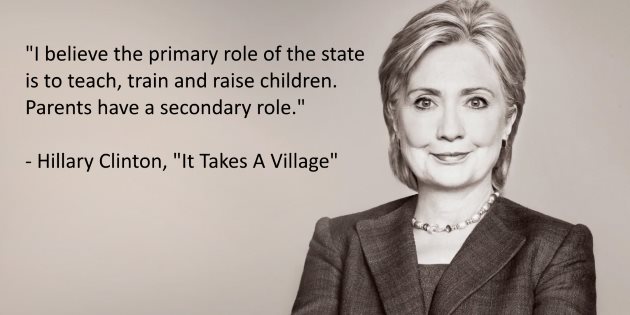
takes-a-village-quote

I’ve spent the first 30 years of my life under communist rule.

One of their many ‘mantras’ was: ‘Children are the future of mankind’.

Communist rule had brought about so much happiness in Romania that people had stopped making children.
Concerned about the future the communists had decreed that from then on abortion was to be considered a crime – after it was freely available until that time,  October 1, 1966.
As a consequence more than 10 000 women died after botched abortion attempts – all other methods for birth control had been banned also.
Add to those deaths the individuals, mostly youngsters, killed while attempting to flee communism by sneaking across the borders.

But there was one good thing that communist rule had brought to the people. Not that much because the communists really cared about the fate of the individuals but because they needed skilled laborers in order to put their plans into practice.

Schooling was free.
You could learn as much as you wanted without having to pay a dime.
One had to pass some exams, positions were limited for higher education, but if you were smart enough and diligent enough you could go really high. Specially in the area that is currently known as ‘STEM’. ‘Humanities’ were somewhat off limits, because one could get ‘funny’ ideas when delving too deep in that area but STEM was OK.

Fast forward to our days.

Half of my University mates – I have a MSc in Mechanical Engineering – have emigrated right after Ceausescu was toppled while political power in Romania has fallen under the constant grip of a small coterie which doesn’t really care about what’s going on and/or has not enough intellectual flexibility to understand that we are currently running towards a dead end.

In the end the ‘good’ thing has proved to be a poisoned apple. By tuning the schooling system towards their own goals the communists had created many generations of  superb engineers – who were welcomed by the ‘greedy capitalists’ – but also had completely discouraged independent thinking – the kind needed to breed honest politicians and effective public figures, if you can accept those concepts as anything more than empty words.

Gazing over the borders I became even more despondent.

Forget, for a minute, about child pornography, sweat-shops and so on. These are absolutely horrible but we might console ourselves with the thought that those who are involved in them are either mentally disturbed or blinded by greed.

But something like this?
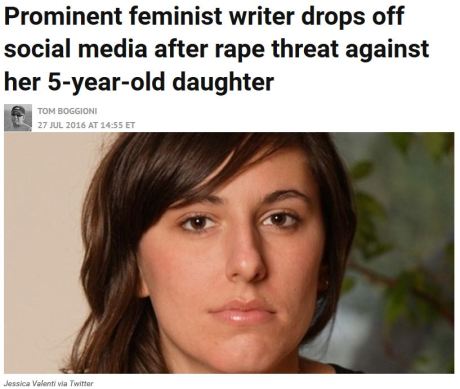
rape threats

Supposedly a feminist writer is followed by either like-minded people or opponents of her ideas only both categories belong to the wider category of ‘intellectuals’ – people concerned with ideas, human rights, philosophical thinking, etc., etc….
In this context to threat a mother that you are planning to rape her child is way above anything that was imaginable until this moment.
It’s as if being able of sophisticated thinking is no longer one of the venues towards becoming a better person – by simply being able to understand how much pain is produced by evil or careless behaviour.

Then I came across the meme at the top of my post.

I must confess that I don’t like her. For various reasons that do not fit here. Enough to say that while watching the DNC 2016 I had the distinct impression of being transported back in time to one of the congresses organized by the Romanian Communist Party.
Because of my dislike of her I had the tendency to believe that she had actually wrote that.

trust-but-verify-quote-2

So I did that.

false

“While it’s true that Hillary Clinton published a book in 1996 called It Takes a Village: And Other Lessons Children Teach Us, it does not include the above-displayed quote, and Clinton (a parent herself) has not said at any point that she believes that children should be raised by the state with parents taking a secondary role.


OK, some of you will tell me that Snopes is leaning towards the left and that you cannot always trust its findings.

I can agree with that. Sometimes you should not believe your own eyes, let alone what you read over the Internet.

But my argument still stands.
What has happened to us?
Why are we so willing to involve even our children in our political lies? It doesn’t matter here who lied – Snopes or those who ‘cooked’ this meme…

What are politics for if not for securing a future for our children?

What kind of future can be build on lies?
On this kind of lies and on this kind of threats…

When are we going to understand that the state which side-lines the parents is a fascist one – fascism and communism are close authoritarian cousins, that no one can survive for long outside a community and that the community, as a whole and each of its members, fare better if all its members have a real chance to develop their potential?

Education and health care should not be treated as ‘individual rights’.
It is obvious to the naked eye that societies who take good care of their members while simultaneously respect their freedom fare better than those who let their members fend for themselves without helping them train for today’s job market and without extending them any safety net.
We keep saying that we need better skilled individuals and do nothing about it. We keep saying that in a free market there are risks that have to be taken yet we step back when a risk taker who happened to have failed, honestly, asks for our help.

OK, I understand. The communists dissuaded their children from studying ‘humanities’. Simply because they might have started to ask the very same questions that I’m asking today.

But what happened to the rest of the world?

Who is thinking about the future, beyond planning for future cash-flows (extremely unreliable in the first place), anyway?

truck-nice

When facing an uncertain future, people are hard wired to search their past.
Some look for things that have gone well and hope that reenacting them will bring back a measure of order in their lives.
Some others look for clues pointing to things that went bad, hoping that making them right will change their prospects.

In this respect I remember how fascinated I was when I first heard about Malraux’s “The XXI-st Century will be religious or will not be at all“.
When trying to understand what Malraux wanted to convey we must remember that he started as a left wing intellectual who, at some point, felt an admiration for Stalin. Later, after he found out what Stalin was really up to, Malraux had given up on Stalinism but never on his atheism. So?

Looking even further back in time we arrive at Emile Durkheim’s Suicide.

Written at the end of the XIX-ht century the book teaches us that while suicide remains a profoundly individual decision those who consider it are deeply influenced, when making the call – one way or another, by the strength and nature of the social ties that connect him to the community to which each of them belongs.
Further into the book Durkheim also discusses the fate of the communities themselves, arguing that a society needs to keep a dynamic balance between social control – that keeps a community together – and a healthy dose of deviance – which might pull at the seams of a society but simultaneously allows it to change when it has to do that in order to survive.

OK, all these are very nice but will you come back to our present? You promised us something about the future and you are leading us further and further into the past. Into a ‘mythological’ past, no less…

One of the most pressing issues that we must face today is the advent of ‘lone wolf’ terrorism. The kind that not only scares us the most but also the one that is hardest to prevent.
Some even try to make us accept the idea that we’ll have to learn to live with it.
“No revelations come from the massacre in Nice. There is nothing to be learned. This is what we live with, what we are getting used to living with. None of it is surprising—that’s the most frightening thing of all.” (George Packer, The Tragic and Unsurprising News from Nice, the New Yorker, July 15 2016)

Well, I strongly disagree with this line of thinking.

What happened in Nice, where a lunatic drove a truck through people gathered to watch fire-works celebrating Bastille Day and killed 86 of them, is proving that both Malraux and Durkheim were spot on. Each in his own right.

In the last twenty or so years, terrorist acts have doubled as suicides. Some perpetrated by ‘simple minded’ youngsters driven to desperation by perceived socio-economic inequities and primed by callous so called religious leaders while others were carefully planned and cold-bloodedly executed by apparently sophisticated members of the middle class.

If we interpret these acts according to Durkheim’s theories we might reach the conclusion that the communities that harbor the terrorists do not function properly. Either the individuals feel so constraint by the existing rules that they cannot find enough breathing space – and snap – or that they cannot find enough social support – and go out ‘with a bang’.

Or both, at the same time.

Let’s remember that those who comited most recent terrorist acts, in Europe and in the Middle East – if we count those who joined ISIS coming from the Western Europe, are second generation Muslim immigrants or new Islamic converts.
I’ll deal with these two categories separately.
The second generation immigrants had a very frustrating experience.
Their parents came from abject poverty, worked hard and, most of the time, fared a lot better in their new countries than any of them even dreamed of on arrival – specially when comparing to the situation in their countries of origin. The youngsters went to school alongside the natives, watched the same television programs and read the same books and magazines. And grew to have the same expectations. But had a lot more difficulties when tried to fulfill them. Because of their skin color, religion, etc., etc. Add to that the nefarious propaganda coming from the Wahhabi preachers and you have an already primed keg of gun-powder waiting for a spark.
But let’s not forget that these people live in otherwise closely knit communities.
And that preparations for terrorist acts do take some time and effort.
How come these preparations go unnoticed and, even more important, unreported?

Can we conclude that whole communities have went past the ‘I don’t care anymore’ point?

A situation for which Durkheim used the term ‘Anomie‘?

Could we consider that not only the immigrant Islamic communities are in an anomic state but also the larger, host ones? For letting the whole situation degrade to such an extent? Not only at home but also at the door steps of Europe?
And please remember the new converts to Islam. What happened to those youngsters – most of them are young people –  that they became so estranged to their native society that emigrated to a totally different realm, not to a different country? A few of them might be explained away by individual ‘deviance’ but such a large number becomes a social phenomenon that begs a different explanation.

Should we accept the situation – and the degradation that would inevitably follow if nothing is done – or should we heed to Malraux’s advice and do our best to find new, and more efficient, communication channels so that we’ll be able to built some much needed trust amongst us? Based on mutual respect, not on MAD force?

5eg5cq4_llox-4hqq6q6r-cwzhlmn9igl6ermaorfgy

For the last 3500 years humankind has been busy writing Laws.

Which can be grouped in two main categories.
Natural laws and man made (normative) laws.
According to this classification while all laws have been written by Man those belonging to the first category are active regardless of Man being aware of their existence and those who belong to the latter come to life only as long as Man chooses to enforce them.

Another classification could be ‘phusical’ laws – ‘phusis’ being an ancient Greek term for ‘grown naturally’, all things that came to be in a ‘natural’ manner – ‘statistical’ laws and, again, ‘normative’ laws.

Both these classifications depend on how much influence Man has over how the laws work, besides the obvious fact that the wording, in all cases, belong to Him. To Man, of course.

The difference between them being that while the first sees Man as an individual making decisions by himself the second takes into consideration the fact that Man cannot function properly outside of a community.

Before going back to discuss some more about both classifications I have to note that laws are important mainly because they define areas of opportunity.
People are, from a functionalist point of view, self aware decision makers. But since none of them has an infinite amount of knowledge at his disposal nor an infinite capacity to process what ever information he has on a subject, people find it very useful to have the reality around them partitioned into ‘safe’ and ‘enter at your own risk’ areas.
In this respect it doesn’t matter whether the law itself belongs to either of the 5 categories. The consequences of the law are the same. Those who are aware of its existence have a lot easier job at discerning the safe from the potentially dangerous places than the ignorant ones. What each of them does after finding that out is another matter.

Coming back to the first classification, ‘natural’ versus ‘normative’ laws, let me elaborate a little about what ‘natural’ means in this situation.
It is obvious that the law of gravity, the one formulated by Isaac Newton, belongs here.
It started to produce consequences as soon as ‘mass’ came into existence – regardless of who, if anyone, made the necessary ‘arrangements’ and regardless of anyone being aware of its very existence or not.
But how about the law against killing another human being?
Animals belonging to the same species occasionally do kill each-other so this doesn’t seem to be an all encompassing natural law.

On the other hand history has compellingly taught us that communities where individuals are treated fairly by their peers fare a lot better than communities where some of the members kill (some of) the others. In a Darwinian sense the communities who do protect the lives of their members have an evolutionary advantage over those who don’t.
In this sense the ‘do not kill’ law becomes ‘phusical’. It is both ‘man made’, hence ‘normative’, and acts regardless of people being aware of its existence.

And no, this is not the same thing as ‘ignorance of the law offers no excuse‘.
As I said before, the first classification, ‘natural’ versus ‘normative’ considers Man mainly as an individual – who cannot hide himself under the cloak of ignorance and who has to bear the consequences of his acts, if apprehended – while the second classification, ‘phusical’, ‘statistical’ and ‘normative’, considers Man as an individual member who both depends heavily on his community and contributes decisively to the well being of the place where he lives.

In this respect ‘do not kill’ becomes a ‘statistical’ law. If enough individuals refrain from killing other people and if the community successfully puts in place and operates a protection mechanism  to guard the lives of its members, without otherwise stifling the ingenuity of its people, that community will fare better than those who either fail to protect their members or protect them so jealously that transform them into hapless puppets unable to fend for themselves. Those who are interested to find out more about the equilibrium between protection and freedom of expression might want to check Crime and Deviance, Functionalist Perspective.

By now you must have noticed that ‘statistical’ laws are both ‘objective’ – in the sense that they will produce consequences even if people are not aware of/do not care about their existence, and ‘normative’ – in the sense that those consequences do depend, heavily, on how people act.

So. Does this make me a staunch defender of ‘normative’ laws?

Not at all. Just as Durkheim noticed long ago telling people what to do will only stifle their ability to adapt. To cope with change.

That’s why I strongly feel that ‘normative’ laws, the few that are really necessary, must be written in a ‘negative’ way. Do not kill, do not rape, do not discriminate, do not steal are quite different from ‘all of us have to be maintained alive’, ‘we must assign an armed guard to every nubile woman’, ‘we must write millions of pages of rules to cover every possible act of discrimination’, ‘we must arm ourselves to the teeth in order be able to defend our property against all odds’.


tainted vote

“It was a fair vote. They may not like the outcome but nobody’s saying that the vote was tainted. Maybe by the misinformation ahead of it … but the actual voting process…”

If there is something to be learned from the current debacle is that democracy is about way more than honestly counting the votes.

In fact, if we resume ourselves to that, we’ll end up tied down in a cage known as ‘mob rule’. Who ever succeeds to stir up more efficiently the public sentiment will rule the day and ‘apres nous, le deluge‘.

In order for the democratic process to be efficient – actually democratic, that is – the electorate must have at its disposal all the pertinent information that is available at that moment. If the electorate doesn’t really care and doesn’t mind that information… that’s it. But the information has to be readily available.

And there’s the catch.

If those ‘in charge’ use the media to spur up public sentiment instead of honestly informing the people about the  situation at hand then we’ll have a beauty pageant instead of a democratic election. Or referendum.

What we really need to remember, fast, is that for a democracy to maintain its function – weed up the really bad leaders/ideas proposed in the public square – we need to add two things to ‘honestly counting the votes’.

‘Mutual respect’ among all members of a given society and a keen enough interest of a majority of the members of that society in the well being of their community.

‘Democracy’ won’t work properly unless the voters respect each-others, and the government they had, themselves, elected. Simultaneously  the government has to treat ‘the people’ with utmost respect, not as if they were hapless children in dire need of close guidance.

At the same time no democracy ever successfully maintained its character unless the ‘leaders’ were constantly remembered of their ‘mortal’ status.

And the Lord God said, “The man has now become like one of us, knowing good and evil. He must not be allowed to reach out his hand and take also from the tree of life and eat, and live forever.”” Genesis, 3:22

The point being that those who think they can make the difference between good and evil need their feet constantly brought back to the Earth.

In Heaven it was God who did that. Here on Earth God works through the hands of Man. Hence we have to take good care of our own fate.
We won’t be able to do that efficiently unless we start respecting each-others, and each-others’ opinions – because none of us will ever be able to know the entire truth so we’ll be better off collectively if we share our knowledge.
For the very same reason – no one can master all the information that floats around us – all those who try to grab too much power must be treated with ‘extreme caution’. Again, this can be done more efficiently in a collaborative, and respectful, manner.

That’s why I’m convinced that the EU needs to be remodeled, not bulldozed.

Yesterday I read an article which stated that ‘when it comes to violin there are a lot of things that are more important than talent‘.

I must confess that I was taken aback.
Not as much by the call itself but by the very fact that someone would actually make a call like that.
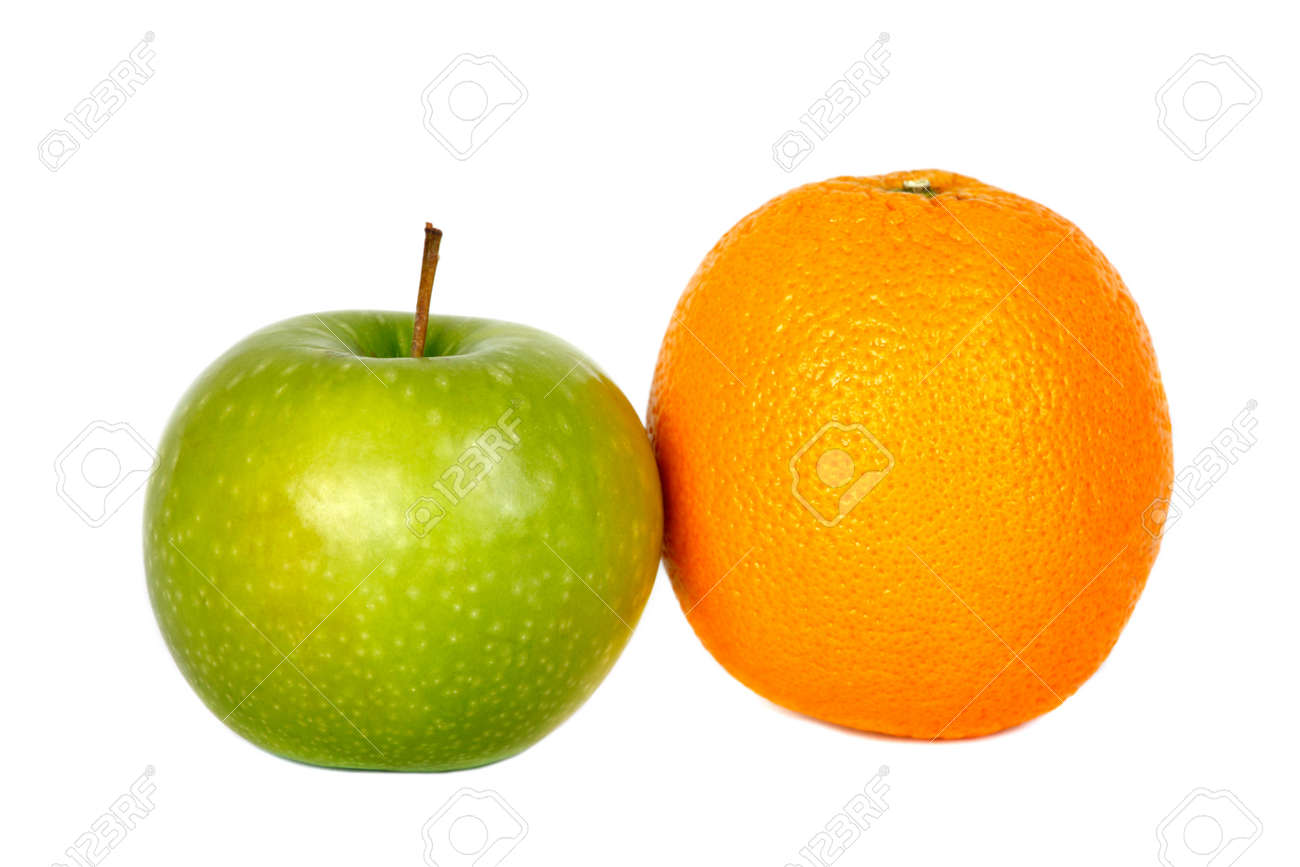
Compare apples and oranges, that is.

OK, both these two can be found in the same department of the grocery store and are somewhat similarly shaped so…

The whole thing made me wonder ‘how is it that we compare things’?

Simply. We choose a standard and then measure the things we want to compare against that standard.
According to our interest in the matter, of course.

That’s why a comparison is not only easier but also less contestable when that standard is actually measurable.
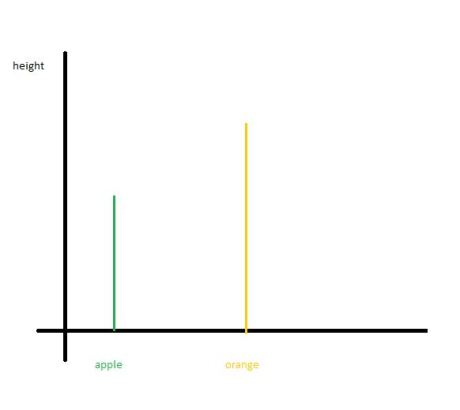
A dimension, for instance. Nobody in his right mind will ever contest a proposition like ‘this orange is larger than this apple’.
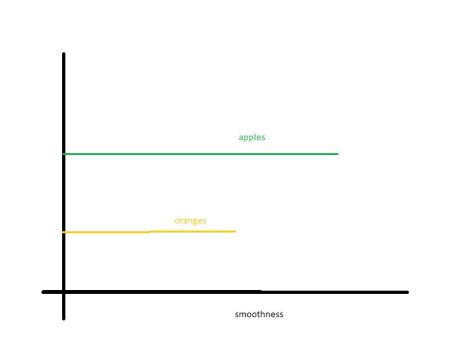
Or an evident feature shared by the items being compared. ‘Apples are usually smoother than oranges’.

5989177-comparing-apples-to-oranges-isolated-on-white-stock-photo

In these cases, when the items are easily comparable – sometimes even against the current mantra, we can say that the characteristics used to compare them are ‘parallel’ to each other.

parralel

Here we can, easily and undoubtedly, determine that one is ‘taller’ than the other.

parralel 2

Or we can make that call by measuring the intensity with which a characteristic shared by both categories manifests itself: “Apples are usually smoother than oranges”.

But what if the things we are trying to compare are defined by characteristics which are perpendicular to each other?

Like length and width, for instance.
In fact this particular case is relatively simple. Here we can determine whether one is longer than the other, wider than the other or if the area covered by one is bigger than that covered by the other.
And, for each case, it would be relatively simple to determine which of the two characteristics is more important. According to each individual situation and to our interest in the matter.
After all it doesn’t make much sense to buy a very long and narrow strip of fabric if you want to make a shirt nor to buy a square shaped cloth  if you need some ribbon.

Things are more delicate though if the characteristics are ‘perpendicular’ only in a figurative manner of speaking. For instance talent and dedication. Or opportunity and diligence. In both these situations it’s extremely hard  to make a call as to which member of the pair is the more important. Simply because without any of them the other is utterly useless. Despite our moral biases. Like ‘dedication is more important than talent’. Or ‘Lady Luck will never fail to smile to the really diligent’.

I’m not implying here that preparing yourself for life, like learning and training, is useless. Quite the contrary.
I’m simply saying that you need first to determine what you are really good at.
It doesn’t make much sense to put a lot of effort into something simply because someone tells you that you’ll become better at it if you work really hard.

Yes, the harder you work at something the better you’ll become at it. But what about spending the same amount of effort at something you are talented for?

So go find out what you are really good at.
If you are diligent enough in your search you’ll eventually find out something that you enjoy doing and others find useful.

And that, my friend, is the real happiness.

Or, in Csikszentmihalyi‘s terms, it would mean that you’d have reached the state of ‘Flow‘.


rape in the not so virtual reality

Two concepts are slowly merging into one and becoming more and more obvious for the most oblivious among us.

Virtual reality was mentioned for the first time way back in the XXth century.
In 1938, Antonin Artaud described the illusory nature of characters and objects in the theatre as “la réalité virtuelle” in a collection of essays, Le Théâtre et son double. The English translation of this book, published in 1958 as The Theater and its Double,[2] is the earliest published use of the term “virtual reality”.
Nowadays the concept has been widened to cover a lot more than what’s happening inside the theaters.
In fact, the technology used to create VR is able to transform everyplace in a stage, everybody in an actor and to broadcast everything almost everywhere.

The other concept I was mentioning at the beginning of my post is a lesser known one.
The Social Construction of Reality“, published in 1966 by Peter L Berger and Thomas Luckmann eloquently explains how various groups of people collectively adapt their historically accrued habits (cultures) to the ever-changing surrounding reality. One of the sources of change being human activity itself.

The latest, that I heard of, addition to the realm of the not so virtual anymore reality is Periscope. A mobile app that lets its user broadcast, live, whatever he/she deems interesting enough from what is taking place around him/her. What is broadcast has a ‘shelf live’ of 24 hours but can be deleted at wish or made permanent. Also the sharing ‘voyeur’ has control over the audience, it can be set as ‘public’ or ‘private’ – and broadcast only to a selected few.

Some days ago two female high-school students and friends, one 18 and the other 17, met a 29 male in a Columbus, Ohio, mall. He bought them a bottle of vodka and “encouraged them to meet him the following day“.
The girls ‘honored’ the invitation, the three  ‘socialized’ for a while – read “had all been drinking“, and then the male proceeded to raping the youngest of the girls.
The older one live-streamed the rape using Periscope.

The case came to light when authorities were contacted after an out-of-state friend of the woman saw the images, Franklin County Prosecutor Ron O’Brien said.

It is not unusual for a rape to remain unreported by the victim. It’s not OK, but it happens.
Also it is not that unusual for a rape to remain unreported even after friends or relatives of the victim learn of the event. Again, it is not OK but it is known to have happened before.

Yet this is the first time that I’ve heard of a rape that had taken place practically in public and which wasn’t reported ‘live’ to the police.

‘She does everything possible to contain the situation even to the point of asking while it’s being filmed to these Periscope followers, “What should I do now? What should I do now?”‘ Shamansky said.” Shamansky being a lawyer for the older girl, who is currently charged with rape, alongside the male perpetrator.
Separately, she is being charged with “illegal use of a minor in a nudity-oriented material or performanceforlivestreaming her friend nude the day before the assault“.

And how did the viewers react to the broadcast? Except for the “out-of-state friend of the woman” who reported the incident, of course?

Here’s the prosecutor’s side of the story:

O’Brien said Lonina is seen trying to help only briefly during the 10-minute video. O’Brien said the victim was clearly screaming ‘stop’ and ‘no’ during the assault.
Although Lonina told police she was trying to record the assault as evidence, her behavior as people watching via Periscope ‘liked’ the assault painted a different picture, O’Brien said.

‘She got, I guess, taken up with all the “likes” that her livestream was getting and therefore continued to do it, and did nothing to aid the victim,’ O’Brien said.

I don’t know what, or even if, she could have done anything in a really effective manner – remember that all three had been drinking – but I know for sure that at least some people were watching the live stream. The ones “liking” it.

I still cannot understand how come all of them failed to call 911.

Just finished reading, again, another excellent post written by John Faithful Hamer on Committingsociology.com

I remember now that something was nagging me after reading it for the first time. I also remember the pangs of helplessness felt almost a year ago, when I couldn’t identify what was nagging me.

Well, this time I nailed it.

“Getting angry isn’t really like releasing the built-up pressure in a steam engine; it’s far more like exercising a muscle group. Every time you give in to the desire to lose it, you strengthen your “anger muscles”; every time you resist the urge, you weaken them.”….
“So perhaps it’s time to stop preaching the gospel of expression, and revisit the much-maligned virtues of repression.”

“Anger” and “getting angry” are not the same thing.
Anger is just a feeling – and, hence, a source of ‘energy’ – while ‘getting angry’ is the manner in which we allow it, consciously or unconsciously, to take us over.
I fully agree that ‘getting angry’ only worsens the situation only I’m afraid that ‘resisting the urge’ isn’t any better. In fact that would be no different from tightening your arse because you don’t want to fart in public.
The problem is not solved, not at all, only postponed. You still need to relieve yourself.
By widening Freud’s concept of repression to encompass more feelings than the simple embarrassment we might find a reason to continue to look for a manner in which to ‘release that built up pressure’.
Only now we are faced with a new problem, since we’ve already agreed that ‘getting angry’ is not the best thing to do.
Freud, again, to the rescue.
How about widening another one of his concepts, sublimation?
How about learning to express, this time consciously, our intense negative feelings in a socially acceptable, and hence a lot more effective, manner?

As you can very easily infer from the title, I define myself as being an agnostic.
I’m reasonably satisfied with the scientific explanation about how the world came to be but I cannot rule out any intervention from an out-side agent during the process.

Hence my unwillingness to commit myself to any of the extreme positions.

And hence my conundrum.

A significant portion of the theist believers are convinced that God, their God, is behind everything that takes place on the surface of the Earth. And beyond.

All scientific materialists are convinced that everything takes place according to some immutable and implacable ‘natural laws’.

Then how come any of them has enough gumption to contradict any of the others?

How come a religious believer can say to another ‘your God is false’ if he is convinced that nothing in this World can happen without the knowledge and approval of his own one? Isn’t this a form of censorship towards his own God?
How come a religious believer can say to an atheist ‘you are going to rot in Hell’?
Last time I checked all Gods were very jealous, all religious teachings I know are clear about this: ‘You do your job and let Me do the judging.’ Then how come so many zealots feel free to usurp the place of their Gods and pass judgement on their peers?

How come so many of the atheists feel free to poke fun at the believers?
According to their own creed, religion is a natural thing. It does exist, isn’t it?
And by its mere existence it necessarily observes the very natural laws the atheists so staunchly defend. As if any of them needs any defense, let alone to be imposed upon the others…

When are we going to accept that religion, any of them, is nothing but an environment, not a yoke?
Just a place with some rules, not some kind of a prison?
That the final responsibility for our acts belongs to us, regardless of any God watching or not over our fates?

Here on Earth, anyway.

grandson of sweetie pie

Grandson of TV’s Miss Sweetie Pie gunned down in St. Louis. (AP)

“St. Louis police say they found Andre Montgomery dead at a home Monday night. A second man was taken to a hospital in critical condition with gunshot wounds.
Police say that after someone shot Montgomery, the second man ran upstairs to help him. A third man who was in the home saw the second man carrying a gun and shot that man because he feared for his safety.”

So.
A guy invites some people in his home.
Judging by the way in which they interact they don’t know, or at least don’t trust, each-other.

Somebody – not necessarily from among the invited guests, shots the host.
Somebody else – presumably alerted by the noise, draws a gun and hurries to assist the victim.
A third person, fearing “for his safety”, draws his gun and shots the good Samaritan, simply because he was carrying a weapon.

Is there anything to be learned from here?

OK, by somehow removing all privately owned firearms in America, personal safety, on average, would be somewhat improved. But since something like that would be very unlikely to happen let’s concentrate on something more plausible.

How about taking grater care about who enters your home?

And something else.
Ever since reading about this I cannot stop thinking about the similarity between cars and guns.

Both are tools and both are dangerous. Yet almost everybody has the right to buy one.

But no-one is entitled to use a car without a license while so many people advocate that everybody should be allowed to carry guns, everywhere.

37 000 people dead and 2.35 million people injured or disabled as a consequence of road accidents. Per year.

32 000 people dead by fire arms. Per same year. 60% of them being suicides while roughly 34% are classified as homicides.
On top of this another 67 000 people are injured, per year, by fire arms.

Some could say that there is not any significant difference between the two situations and, as a consequence, a carry permit would not change much.
Are you sure about that?

Currently most guns do not follow their owners when they leave their houses – for various reasons. This is why I’m afraid that if more and more people would chose to carry their weapons, things would become a lot more complicated.

Not because people are bad or ill intended.

Simply because most ‘civilians’ are not trained to asses dangerous situations in an effective manner nor the necessary skills to use their weapons safely.

You see, defending your home – everybody else but you and your family becomes an enemy in this scenario, is very different from trying to help in a complex setting. When people might freak out at the sight of yet another gun.

That’s why not all those who own a gun should ‘drive’ them around without a license.

After all, how safe would you feel when driving in a country where no driver’s license is necessary and where DUI is not forbidden?

cz0qnrnwaaibsy2

First, some very condensed history.

Humankind evolved in Africa and then migrated around the word.

During its African childhood Man had never encountered Winter. OK, he did have to face barren desserts, dry seasons, inundations,  wild-fires, earthquakes, you name it…but none of these even comes close to watching the light of the day becoming shorter and shorter, the weather becoming colder and colder and the food becoming scarcer and scarcer.

Remember, at that time Man was a hunter-gatherer who had no notion of stashing food or any interest in astronomy. Simply because there is no real scope for hoarding large reserves of food in Equatorial Africa and no real scope for astronomy since at the Equator there are no seasons to speak of.

Now, try to imagine the horror experienced by the migrants who had climbed the Anatolian plateau for the first time and, after a while, felt the snow melting on their faces and the frost biting at their bare feet. All this while the sun kept sinking lower and lower towards the horizon.

Was it possible that those migrants did start thinking about the end of the world?

Were they pondering on whether they had entered the realm of a strange god who was trying to get rid of them by cooling the entire (or at least the ‘visible’) Earth and by making the food extremely scarce?

Did they try to placate that god? Through prayers and offerings?
Was that the very reason for which Abraham came back to Canaan after having “tarried for seven years at Harran“?

Were they extremely elated when noticing that the light of the day was becoming longer and longer? Did they throw a party to thank that God for listening to their prayers, soon after noticing that the winter solstice had passed – even before knowing what a solstice was?

And this is why in most cultures that have developed in the temperate regions of the Earth people celebrate, under various guises, the rebirth of the world that takes place right after the winter solstice.

That is why, after a while, Christians have started to celebrate Christmas on the 25th of December.

But, if you remember, those migrants didn’t take the whole thing as a gift but as a trade.
They prayed, made offerings and the God kept his side of the bargain.
Same thing here. Christ had to offer himself so that the world could be redeemed.

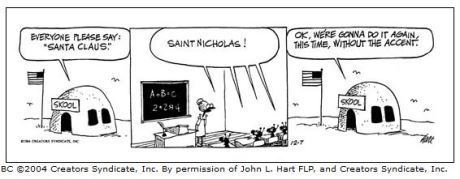
In time another habit had evolved. When I was a small child, even in communist Romania, Saint Nicholas was serious business. People used to eschew any formal links between Saint Nicholas – presented as an opportunity to educate the children – and Christmas. That’s why Saint Nicholas was tolerated by the authorities – and we, the kids, could discuss openly at school the presents that had miraculously appeared during the night in our socks, carefully prepared the evening before, while Santa Claus had disappeared altogether – having been replaced by a Santa-Freeze who came on the New Year’s Eve instead of during the Christmas Night.
And now I’m wondering how many of you remember that Saint Nicholas brought presents only to the good children and that those who misbehaved during the year got either a rod or a few lumps of coal instead of the candy so keenly expected by everybody.

In fact Saint Nicholas is way closer to reality than Santa Claus. He doesn’t give anything for free.
Not that he doesn’t love us.
He really does and that’s why he doesn’t indulge us with undeserved gifts.
So that we don’t become frustrated later in life when we’ll have to work, hard, for any whim we might have. Not to mention the effort to feed our belies, clothe our backs and make sure our children make it safely to adulthood.

That’s why I think it’s time for us to cut the crap. Santa Claus might be a nice gimmick for the big retailers who came up with the whole concept.
But look at what he brought to the rest of us.

saint nicholas

Yeah, I know.
“If I couldn’t have the nice childhood I dreamed about at least my children should have it.”
Only ‘nice childhood’ is one thing while ‘spoiled rotten’ is quite another one.

And ‘spoiled rotten’ can be achieved along many routes.

One of them being the one described above. Hard working parents, who consciously spoil their children, trying to compensate, through their kids, the hardships  experienced during their childhood.
Another one being followed by the parents who are so busy that they basically don’t get to know their children. And who try to compensate the time not spent with their kids by showering them with gifts. The end result being the same.

After the children have become young adults, with no marketable skills, no exercise at self control and after never trying hard at anything, the shit hits the fan:
‘We have done our best yet we’ve raised a couple of ‘good for nothing’ bummers!’

Well, your ‘best’ wasn’t good enough and, mostly, it’s your fault. Not theirs!

Just as most of our ancestors didn’t need to till the soil before migrating to the Middle East – simply because they had enough to eat even without having to work/plan hard for it, our children won’t develop the necessary skills nor the necessary mindset if we insulate them from the right stimuli. In fact, if we insulate them from the real world.

After all, our ancestors might have been ‘the children of the Humankind’ while ours are simply ‘children’ but, in the end, ‘children are children’.