Archives for category: man induced fragility

The current President of the United States describes himself as a man always making good use – as a manner of speaking, anyway, of all opportunities he ever identifies.

grab them by the pussy

Erotically as well as financially.

trump eminent domain

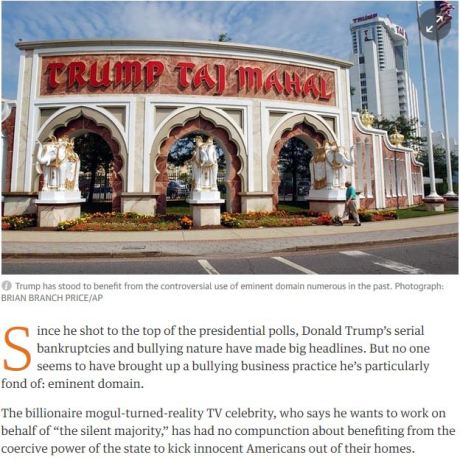
“Trump turned to a government agency – the Casino Reinvestment Development Authority (CRDA) – to take Coking’s property. CRDA offered her $250,000 for the property – one-fourth of what another hotel builder had offered her a decade earlier. When she turned that down, the agency went into court to claim her property under eminent domain so that Trump could pave it and put up a parking lot.

Peter Banin and his brother owned another building on the block. A few months after they paid $500,000 to purchase the building for a pawn shop, CRDA offered them $174,000 and told them to leave the property. A Russian immigrant, Banin said: “I knew they could do this in Russia, but not here. I would understand if they needed it for an airport runway, but for a casino?” “

Now, after climbing a new pinnacle of popularity, he has become, himself, a very lucrative opportunity.

donations for coming out

“The Hill reported Friday that Bloom worked with campaign donors and tabloid media outlets to arrange compensation for the alleged victims and a commission for herself, offering to sell their stories. In one case, Bloom reportedly arranged for a donor to pay off one Trump accuser’s mortgage and attempted to score a six-figure payment for another woman. The former ultimately declined to come forward after being offered $750,000, the clients told The Hill.”

The first question which crossed my mind after reading this was:
‘OK, so why would any one bring all this up? What difference does it make if those women get some money for telling their stories? It’s the facts themselves which are really important here, right?

‘But what if?’ was the second one…
What if, after seeding enough ‘oblique doubt’ into people’s minds, facts start to look rather different than at ‘face value’?

I told you so

Remember that XX-th century aphorism, “The best defense is a good offense”?
And the smoke screen tactics pioneered by the military but also very important to those who study the Bible?

“When studying the Bible with teens, the term “smoke screen” refers to a commonly deployed tactic designed to avoid exposure of the heart. Smoke screens, though not unique to teens, are important to understand and overcome.

Each of us have areas in our lives and places in our hearts we do not want exposed. Sometimes we are afraid of what others may feel about us; sometimes we realize these areas in our lives and places in our hearts need to change, but we don’t want to change them or even believe that we can.

Practically, smoke screens are often the emotion we express, the issue we lead with, or the confusion we claim, in order to deflect what is really going on in the heart. When emotions are present, the words that are flowing out of a teenager’s mouth are rarely communicating what is actually driving them.

Getting past a smoke screen takes understanding and the willingness to go deep. It takes understanding and depth to remain calm when our teen is using emotions to derail a conversation that might be getting to the heart of the matter at hand. We learn depth when we are willing to look into our own hearts and be honest about the smoke screens we use.”

ignoramus

Imagine now that Reagan, or his speech writer, would have used a single different word …

It isn’t that people are ignorant, it’s just that they know so much that isn’t so.

From a friend’s FB wall:

“African proverb:
Every morning in Africa, a gazelle wakes up.
It knows it must run faster than the fastest lion or it will be killed.
Every morning a lion wakes up.
It knows it must outrun the slowest gazelle or it will starve to death.

It doesn’t matter weather you are a lion or a gazelle.
When the sun comes up, you better start running.”

(from The World Is Flat, by Thomas L. Friedman)

It seems that the modern world is gradually becoming more and more ‘African’.
We’re so busy running ourselves out that we’re failing to remember the essential.

That we’re people.
Neither gazelle nor lion!
And that most of us have long ago left the jungle and now live in cities!

How about ‘taking five‘ from our incessant quest for trinkets and use the time to remember “togetherness”?
As in “communion”?

In the civilized world, ‘Dog eat dog’ was supposed to be an exception, not an everyday occurrence…

Ruthless acquisition or competition, as in With shrinking markets, it’s dog eat dog for every company in this field. This contradicts a Latin proverb which maintains that dog does not eat dog, first recorded in English in 1543. Nevertheless, by 1732 it was put as “Dogs are hard drove when they eat dogs” (Thomas Fuller, Gnomologia).”

PS.
After reading this, my son pointed out that lions are the only cats which hunt cooperatively on a constant basis.
Could this be the reason for which they are seen as the royals of the animal world?

Fake news

“Federal lawmakers on Wednesday released samples of 3,000 Facebook ads purchased by Russian operatives during the 2016 presidential campaign. The ads conveyed the wide range of influence Russian-linked groups tried to enact on Americans…”

Let’s zoom out in order to gain some perspective over all this.

Fake news are defined by Oxford Learner’s Dictionaries as “false reports of events, written and read on websites“.

The way I see it, “fake news” have a lot in common with counterfeit currency.
In more ways than one!

First of all, most money in current use is ‘fiat money’.
We are dealing with either printed pieces of paper or otherwise useless pieces of metal.
We ‘trust’ them for trading purposes simply because we are convinced that the institution which stand behind them – Central Banks, free(ish) markets and law enforcement, will do what they are meant to do. We trust that the Central Banks will not print too many of those pieces of paper, that the free(ish) markets will set a reasonable price to everything and that the police will manage to weed out (most of) those who try to circulate fake money.
Not even a return to ‘real’ money – a.k.a. gold,  wouldn’t insulate us from crooks. Gold coins can be, and had been, tampered with in so many ways. Human greed is a very powerful motivator but not necessarily a good mentor.

Which brings us to the reason for why fake money came to be.
Simply because some ‘industrious’ people ‘make’ them and some other, equally greedy, people knowingly distribute them.

In conclusion, we wouldn’t have to deal with fake money if money wasn’t essential for an efficient free market and we would have a lot less of it if greed were not such a widespread attitude. And no, a cash-less economy would not solve the problem. A printing press is no longer essential for faking money. Hacking skills have become  a good enough substitute.

Let’s translate this rationale to (fake) news.

We need to know what’s going on around us so we’ve developed an equivalent to the financial system. The mass media.
Which has a more or less equivalent set of ‘guardians’.
The ‘printers’ are responsible for the equivalence between their ‘product’ and the reality it represents while the market (readers, that is) is responsible for ‘setting the price’.

Of course, there are also differences.
‘Law enforcement’ has indeed a role to play in the news industry but its scope is a lot narrower than in the first case. And rightfully so. The ‘information’ market needs to be a lot more ‘flexible’ than the one dealing in ‘economic goods’. There’s a lot to discuss on this subject, I’ll leave it here.
There’s also no Central Bank to ‘tug at the sleeves’ of those who ‘jump the shark’.

As a consequence of these two differences, the ‘counterfeiters’ have an easier life and the consumers/victims a far greater responsibility for what’s going on. Simply because the consumers/potential victims cannot rely on any third party to do their job. To sniff out the ‘bad thing’.

But what if ‘it’s the thief who plays the victim’?
That very much depends on who the ‘thief’ is!

Let’s go back in time for a short while.
First to the American Revolutionary War. During which the British attempted to crash the American economy by injecting in it enough counterfeit money to cause hyperinflation. “No economy, no more war.” The British did manage to produce and distribute a huge amount of fake money yet the outcome was not the intended one. “Even when at one point the amount of counterfeit currency in circulation may have exceed the amount of legitimate currency, the economy hung on by its eye teeth and never fully collapsed.”
One and a half centuries later, the British had found themselves at the receiving end of the same game. “…during World War II the Nazis almost destroyed the credibility of the British pound sterling by producing near-perfect forgeries, The Telegraph reports. By the end of the war the forgeries were so rife that Bank of England notes would not be accepted by any neutral country on the Continent “except at a very large discount…”.
Hitler was even less successful than the British had been but the inflicted injuries were huge nonetheless.
Now, would Hitler have attempted this on his own, without the British establishing a precedent?
We’ll never know… Sufficient to say that the US has also used fake money, obviously fake this time. For propaganda reasons and not as an attempt to ‘crash the economies’ of the countries they were fighting.

To close the circle, we must ask ourselves how successful would Putin’s trolls have been if Trump wouldn’t have beaten so hard the ‘birther’ drum…

Seriously now, propaganda is a very efficient weapon. Maybe more efficient than guns.
But, and in total contrast with a gun, propaganda is useless against really determined people.
“Sticks and stones may break my bones but names can never hurt me” is true. But only as long as those being called names are in the right state of mind. As soon as they start feeling hurt, all hell comes loose.

If you think of it, Trump’s birther campaign, fake as it was – he had admitted that much, eventually, was a very successful ‘fake news campaign’. It had established Donald Trump as  shrewd  media manipulator.
Unfortunately, it had an even worse outcome. It had very much helped those who wanted the American public split into warring parties.

And who are now pushing these parties further and further apart.

PS. While researching for this post, I found out that “fake news” has been declared ‘word of the year’ for 2017. A fitting development… last year’s ‘champion’ was “post truth”…
What next? Doublethink?

Plato, without actually saying so, was planning to ‘kill’ it.
A society run by his king-priests would have been ‘perfect’. Hence in no need of improvement. Not exactly dead but how would you describe something that doesn’t change in time? Anything but alive, right? And since ‘no change’ means ‘no history’…

Four centuries later, Jesus Christ had warned us about the ‘Final Countdown‘. Last Judgement, sorry. But what difference does it make? Final… Last…

Fast forward to the XIXth century, when Karl Marx was breathing new life into Plato’s ideas.
The Communists, therefore, are on the one hand, practically, the most advanced and resolute section of the working-class parties of every country, that section which pushes forward all others; on the other hand, theoretically, they have over the great mass of the proletariat the advantage of clearly understanding the line of march, the conditions, and the ultimate general results of the proletarian movement.” (Karl Marx et al, Manifesto of the Communist Party),
Which very able and extremely wise communists were supposed to solve all past, present and future problems through a very simple measure. Abolition of private property and of the state needed to protect such property.
And since not everybody was yet ready to receive ‘the good news’, the communists were given a free hand to use revolutionary force in order to accomplish what they had to do.

To finally bring order to the World. To end history, that is.

Am I thick headed or the difference between Marx’s and Plato’s words is small enough to be insignificant?

You have again forgotten, my friend, said I, that the law is not concerned with the special happines of any class in the state, but is trying to produce this condition in the city as a whole, harmonizing and adapting the citizens to one another by persuasion and compulsion, and requiring them to impart to one another any benefit which they are severally able to bestow upon the community, and that it itself creates such men in the state, not that it may allow each to take what course pleases him, but with a view to using them to the binding together of the commonwealth.” (Plato, Collected Dialogues, The Cave)

A short century later, another optimist announced that ‘now, after the communist gulag had finally imploded, liberal democracy – a system flexible enough to absorb/solve any input/problem – will take over the entire planet. And, of course, bring over “The End of History” “.

Three decades later things are going on, as if nothing had happened.

There are still plenty rulers who behave as if “L’etat c’est moi” was coined yesterday and, even more sadly, too many people who look up to them.

The end of history has been postponed. Indefinitely.


We were discussing ‘worst possible scenarios’ on Facebook and somebody mentioned ‘climate change’.
I must add here that the exchange was ‘framed’ by ‘skin in the game‘, a concept used by Nassim Nicholas Taleb in his rather don-quixotic quest for more responsible decision makers.

OK, the whole domain of climate change is riddled with epistemological holes.
Linear models are used to approximate processes we barely know anything about.
‘Starting points’ have been, again and again, been proven wrong.
I could go on for hours.

I’ll make a small parenthesis here and inform you that according to a fresh study things might be far worse than we’ve reckoned. This paper, published by Nature.com, suggests that Earth’s oceans used to be far cooler than we’ve previously thought they were.

In this context, one of the participants made the following remark:
the burden (of proof) should fall on those calling for changes, for the rather obvious reason that we could suggest changes all day long. Only a few can be implemented.

Hard to argue with that, right?

But which changes are we talking about here?

A change in our manner of interacting with Mother Nature?
Costly, indeed, financial wise, but nowadays technologically possible.

Or about the changes we’ve already – unwittingly, most of them, imposed upon our ‘spaceship’?

We’ve dramatically changed the ‘use of land’. Agriculture and transport – yes, roads and railways have a huge impact – have changed the very nature of what’s going on on a considerable portion of the Earth’s surface.
We’ve dramatically changed the composition of the atmosphere. And I’m not talking about CO2 yet. CFCs, pesticides, NOx and SOx gases, etc., etc….
And, last but not least, we’ve reversed a trend which had been going on for hundreds of millions of years. Photosynthesis used to transform atmospheric CO2 into organic matter, some of which has been steadily accumulated as coal and crude oil.

So, about which changes should we worry first?

Or, in SITG terms, whose skin should bear the brunt of change?

Ours or our children’s?

“Between 1970 and 2010, the number of administrators in health care grew more than 3000%, while the number of physicians grew about 200%, according to the Bureau of Labor Statistics. During that same 40 years, U.S. health-care spending rose 2300%. Doctors’ fees account for only 8 cents of the health care dollar. Where do you think the other 92 cents are going?”  (Marni Jameson Carey, Focus on Health Coverage Misses the Point, Forbes.com, Oct 24, 2017)

A few years ago I was arguing that profit was overrated.
It seems that Forbes, a magazine which cannot be accused of any socialist tendencies, has reached a somewhat similar conclusion.

Even more interesting is the solution proposed by Forbes to the health care problem.

A return to the free market!

Free from what? Who says the American health care market is not free?
Well, click on the quote above and see what Forbes has to say about this…

But what happened? How did we get here?

Well, the free market described by Adam Smith was an environment where people used to fulfill their needs by selling their wares.
The butcher sold meat and bought everything else he needed, the brewer sold beer and bought everything else he needed, the baker… and so on!
OK, there  was a certain kind of competition which kept the things in check. The butchers competed against other butchers, the brewers…
And because of this competition, all traders – those who wanted to survive, anyway – streamlined their operations and became more and more efficient. Hence profitable.

I mentioned the link between the survival of a commercial enterprise and its ability to generate profit.
Apparently, it doesn’t make much sense to elaborate on this. Bear with me, please.

The whole point of the free market is the division of labor. Besides its freedom, of course.
Each of us does what he knows better and then we trade our respective wares. This way all of us fare better than if each of us would have had to produce everything each of us needs to survive.
In this scenario, competition – between ‘bakers’, for example – is actually a tool which makes it so that the market, as a whole, doesn’t waste resources. When the less efficient bakers are ‘encouraged’ to find something else to do, the entire market is better off. And so on.
In this sense, profit is only one indicator – and a very good one – of how able to survive is a certain commercial venture. But not the only goal of the entrepreneur who started/runs the enterprise. What he wants is to make an as good as possible living by doing what he knows best, in close collaboration with the other participants to the free market.

Adam Smith had written his books some two and a half centuries ago.
And the free market had served us well, for a while.
Just look at what we’ve accomplished in these two and a half centuries.

But, just as Forbes points out, things are no longer going in the right direction.

Why?

Simply because the market is no longer free!

Not only because some of the participants have become ‘heavy’ enough to crush all competition. This is only the lesser part of the problem.
The really big one, and so well hidden that it’s almost invisible, is that too many of us have become obsessed with the same thing. Money!

Life-of-modern-people

Profit has become THE absolute goal of everything we do. Too many of those who participate in the free market no longer want to collaborate with the others but simply want to get rich. By any (legal) means.

Some say this is a good thing.
They invoke Adam Smith’s words as a justification for their beliefs.

I beg to differ.

The simple existence of our current obsession has profoundly altered the very nature of the market. Which is no longer free.

Because WE are no longer free. When too many of us are obsessively concentrated on the same thing, they will necessarily disregard all other options. And the rest have no other option but to follow.

This is not freedom!

Mesmerized people can not be described, by outside observers, as being free.
Regardless of how they consider themselves.


do as the Romans do.

According to UrbanDictionary.com, “it has become shortened so often, some people don’t get it anymore. It’s an analogy making use of the strict rule of the ancient Roman empire”

Wikipedia mentions that it’s “a proverb attributed to Saint Ambrose”, meaning “that it is advisable to follow the conventions of the area in which you are residing or visiting.”

OK, seems sensible to follow the rules, specially when their are enforced vigorously. Furthermore, why rock the boat – specially when visiting a place? Or shortly after you’ve just moved in?

How about after becoming familiar with the local mores?


fall of Rome


Could there be anything more behind these words?

The proverb dates from an era when Rome was the center of the world. Of the Mediterranean world, anyway…
Could it also mean ‘do as the Romans do and you’ll share into the benefits enjoyed by the rest of them’? In line with ‘don’t rock the boat, lest the others will throw you out’?

In other words, the proverb suggests that ‘herding is good for you’.

Which is true. Most of the time, anyway.

Specially when you know when to bail out…

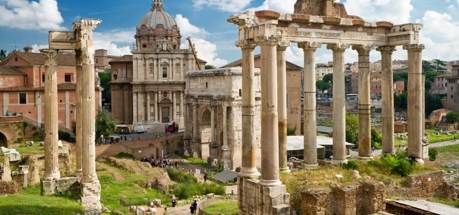
In this context I must remind you that mighty Rome ended up being sacked by a succession of rogue thieves… some of them hired by the emperors to guard the borders because the Roman citizens had became too ‘adept’ at ‘panem et circenses’ to bother anymore with bearing arms…

It seems that not all things done by the Romans were actually worth doing.

How about exercising our brains instead of sheepishly following the herd?
No need to insult the others, ‘rock the boat’ or anything else dramatic.
Just honestly give them the reasons for your dissent.
If they are wise – and you are right, of course, they’ll come your way.

If not… you should either follow the rules… or change the herd.


Humankind is a work in progress.

We’ve changed the planet we’re living on and we’ve changed ourselves.

We’ve invented the automobile and we’ve become more autonomous.
By driving we’re now able  to cover more space in less time, carrying a lot more with us.
To achieve that we’ve straddled the globe with seemingly endless ribbons of tarmac.
The changes which had appeared as a consequence of ‘automobile’ are enormous. Some conspicuously visible – the roads and our increased individual autonomy, a few less so – we’re not only more autonomous but also more ‘socially dependent’, building cars and maintaining roads depend on a lot of us ‘working together’, while ‘the jury is still out’ on yet others – global warming, for instance.

We’ve invented vaccines and we live longer and better. Small pox has disappeared, polio is likely to follow suit, being bitten by a rabid animal is no longer a death sentence and so on.
I don’t need to explain how this has changed us, right?

All these have come with some costs attached.
Thousands, if not millions, die each year in traffic accidents and many more are injured.
Children suffer side-effects after immunization.

What intrigues me is that we treat these two phenomena in two completely different manners.

We’ve introduced tough regulations when we’ve discovered that some car companies were cutting corners in their attempt to increase margins. We insist for wide-spread ‘call-backs’ whenever we hear about a batch of cars having systemic troubles. Some of us try to produce self driving cars – even if these would be somewhat ‘counter-productive’ – in our very orderly life, where many of us are reduced to following procedures, driving is one of the few areas where we still retain full responsibility.

Yet I don’t know of people dissuading their children from learning to drive or from buying a car. Even if some of them will, helas, die as a consequence of traffic accidents.

Then why so many parents refuse to vaccinate their children? Not only putting them into harm’s way but also extending a warm invitation for many diseases to make a dramatic come-back. Measles have killed tens of children in both Italy and my native Romania in the wake of recent anti-vaxxer militancy…

OK, there might be a back-lash against ‘big-pharma’. I can understand more indignation being felt against huge corporations profiteering from people being sick than against big corporations making a faster buck by selling ‘lemony’ cars… but why throw away the baby along with the bath water?

Why give away the shared safety of herd immunity instead of introducing better safety measures? Instead of cutting down to Earth the virtual monopolies which produce most of our vaccines, making it easier for the ‘safety inspectors’ to do their jobs?

One of the possible explanations being that vaccination is ‘prevention’ while learning to drive is a matter of improving one’s skills.

And prevention means paying the price up-front while having only an expectation for a possible pay-back while skills improvement is seen as something having a certain outcome.
Corroborate this with the ‘fundamental attribution error‘ and things become a lot clearer.

For those unfamiliar with this term, the whole thing boils down to how we tend to ‘apportion’ blame and praise. When something good happens to us we tend to attribute it to our skills while when something bad falls on our heads we blame the bad luck we had in that moment.
And this is only half the picture. When things happen to other people we tend to turn the tables. When something good happens to a guy we attribute it to his luck while when somebody is subjected to a misfortune we are inclined to believe that ‘he had somehow brought it upon himself’.

Hence we get sick only as a consequence of misfortune – but we consider ourselves lucky, don’t we? – while safety on the road depends exclusively on our driving skills.

In this situation blunt reason tells us to ‘let all the other children be vaccinated’, ‘constantly improve our driving skills’ and ‘check our cars often’.

Well, the same blunt reason tells the others the very same thing. That’s why they insist that all children must be vaccinated – individual ‘specifics’ must, of course, be taken into account, all drivers must be vetted and all cars checked periodically.


Road Rage
So, a man of the cloth, driving a Corvette, pointed a gun at a guy who was trying to overtake him in a truck.
Reading this had somehow set my mind into overdrive.
If the other car would have been a Mercedes, or a BMW, would the priest had reacted differently? Better or worse?
In America, the priests are hired directly by the community. Why would a community of church goers entertain the wishes of a priest who covets a Corvette?
What kind of advice would such a person give to a grieving widow? Or to a grieving widower – or parent, whose spouse/child had been killed in a road accident?
This is not a blame apportioning contest but who was/is in a position to do more? The individual subjected to various craves/emotions or the individual(s) having the opportunity to evaluate/keep in check the first?
Where do we draw the line between ‘desirable behavior’ and ‘no go zone’? Can we reasonably expect the ‘significant others’ (priests, doctors, teachers, politicians) to behave differently (better?!?) than the rest of us?
When is the proper time to act? How much deviation from the norm should we accept before ‘pushing back”?
What is ‘proper behavior’, anyway?