Archives for posts with tag: Sun Tzu

Sun Tzu is traditionally credited as the author of The Art of War,
a Classical Chinese text on military strategy from the Warring States period,
though the earliest parts of the work probably date to at least a century after him.
Sun Tzu is revered in Chinese and East Asian culture as a legendary historical and military figure;
however, his historical existence is uncertain.
The Han dynasty historian Sima Qian and other traditional Chinese historians
placed him as a minister to King Helü of Wu and dated his lifetime to 544–496 BC.

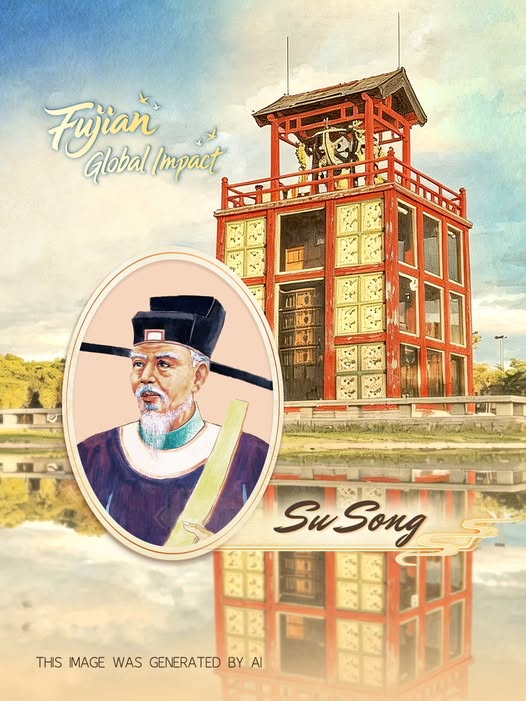
The hydro-mechanical astronomical clock tower (Shuiyun Yixiangtai) that he (Su Song, 1020-1101) supervised pioneered key technologies later seen in modern observatories, including the escapement mechanism, mechanical clocks, and automated rotating domes.

Su Song has build a mechanical ‘watch’ some two hundred years before his European equivalent.
Sun Tzu is credited for writing a, some say ‘the’, military ‘vademecum’ two millenia before von Clausewitz.

These two examples, along many others, demonstrate that China is both different and similar to Europe. Culture wise.

China was the first to discover things. Magnetic needle, printing press, paper, gun powder, mechanical watches, treaties of war…
Yet the Europeans were the first to put all these to work.
They’ve used chronographs and compasses to sail around the world, improved the printing press and used it for commercial purposes, ‘up-graded’ gun-powder from propelling fire-works to firing cannons…

As if the Chinese were trying to learn/discover for the sake of knowing while the Europeans did it to solve problems.

Yet both cultures are now more or less in the same ‘place’.
Each had ‘generated’ a very much appreciated war treaty. Then stopped ‘winning’ wars. Their influence in the world continue to grow but their military prowess is no longer the spear point of that expansion.
Each had entered the demographic ‘death-trap’. Stopped giving birth to enough kids to replace the deceased.

The differences can be explained. We’ll propose one, redacted from what we learned from you, sometime soon.
The similarities are simpler. Both Europe and China are inhabited by people. No difference between them, biologically speaking.

Culture is something else. Socially accrued knowledge which heavily depends on the specifics of the space where the accruement has taken place.
As if time flows differently in various spaces. But, somehow, the resting places are the same.

Sometimes reading about history is not enough.
You might need to live at least some aspects of it…

I’m sure most of you are familiar with this notion.
With the notion that war is an art and that Sun Tzu was at least a notable teacher. In this domain.
And the second place goes to

Now, that we have established whom we consider to be the THE greatest experts on war, would you be so kind as to tell me when was the last time that China – or Germany, for that matter – had vanquished their opponents? After their respective treaties on war had been compiled…

My point being that a really ‘successful’ war ends with both parties understanding that there’s no point in fighting one.
That whenever the winner starts boasting about their exploits, that war has been fought for nothing. The winner might have won the war but they certainly had lost the peace.
My secondary point – and, maybe, the more important one – being that we tend to treat the current war using the knowledge gathered during the previous one, Which seems rational, right?!?

Yeah… well… The only successful war in our recent history – and only partially at that – was WWII.
WWI was fought for nothing. At the end, the victors had copied the actions of those who had won the previous wars. Imposed hefty reparations upon the vanquished. Hence the advent of Hitler.
WWII was not only terrible but also widespread. France, Germany, Italy, the Central Europe and, to a central extent, the Great Britain have been so thoroughly destroyed that people there did learn their lesson. No more war. Hence a completely different approach to peace than after WWI.
Inclusion of the former aggressor instead of punishment.

The next global war was the Cold one.
Fought mainly between the two WWII victors who had not directly experienced war. The US and the USSR.

What?!?

Well, just think about it.
France, Germany, Italy and so on had been occupied. Experienced hot war on a first hand manner for years on end. Great Britain had not only fought but had also been bombarded.
The US had fought in the war but only Hawai’i had directly experienced it.
And when it comes to the USSR the situation is… complicated. The eastern part of the WWII had been fought mainly in Ukraine and in the western part of Russia proper. The only main city directly affected by war was Sankt Petersburg/Leningrad. The rest of the Russian Federation had experienced less disturbance than western Ukraine in the present conflict.
And what did the free world do after the Cold war had been concluded? Specially the Americans?
Boasted? About their exploits?

How was the loser treated?
The westerners tried to do what the allies had done after WWII? Integrate the loser into the ‘brave new world’? Without understanding that the loser had not accepted its status?