Archives for category: freedom

My close friends know that I’m a strong supporter of the Second Amendment.

In a mature enough society, gun ownership promotes both individual responsibility and social cohesion. As intended by the Founding Fathers.

“A well regulated Militia, being necessary to the security of a free State, the right of the people to keep and bear Arms, shall not be infringed.”

At the time when the US Constitution was drafted, the American state didn’t have a proper army, nor any real need for one. The neighbors were few and very far away, in contrast to what was going on in Europe at that time.
It didn’t make sense, at that time, for a strong army to be mentioned in the Constitution but the Founding Fathers very aptly told their constituents to build up a strong self defense capability. You never know what might happen in the future.
Hence the “well regulated Militia” which was deemed “necessary to the security of a free State”. NB, for a “free State”, not for any random individual citizen who wishes to free himself from a democratically elected government…

In this sense, the Second Amendment should be primarily defended as a stringent need of the entire society, instead of being promoted mainly as an ‘individual right’.

And it should be enforced accordingly. Keeping in mind the needs of the entire society, not only those of particular individuals.

Periodically, we are reminded of what may happen when society forgets to actually ‘regulate’ itself. When rules which have been agreed upon are put in practice in a ‘creative’ manner.
One has to pass ‘back-ground checks’ if he wants to buy a gun from a store but he can also buy one anonymously from a gun show.
Assault guns have been forbidden yet until this very morning those who ‘needed’ one could legally  buy a ‘bump stock’. A “device” which “causes the gun to buck back and forth, repeatedly “bumping” the trigger against the shooter’s finger. Technically, that means the finger is pulling the trigger for each round fired, keeping the weapon a legal semi-automatic.

Not only that people kill themselves using their own guns. Not only that gangsters kill each others in turf wars. Not only that policemen get killed in the line of work.
Not only that from time to time individuals attempt a particularly murderous form of suicide – by indiscriminately shooting people and waiting for the police to shoot them back.
Time and time again students, some of them very young, are brought back from school in coffins.

And after each of such incidents, various ‘authors’ attempt to put things into ‘perspective’.

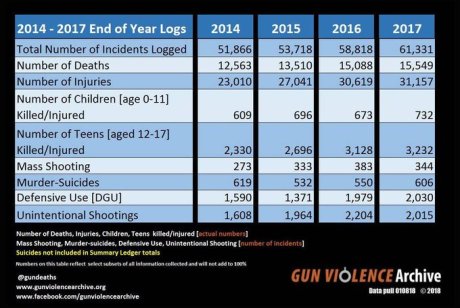
In 2017, with 300,000,000-plus guns in the hands of Americans, there were 15,549 gun deaths. This ranks less than half the number of automobile deaths even though there are fewer cars in existence than guns. In 2017, there were 253,000,000 cars in existence and 41,000 auto deaths.

It’s exactly this kind of warped perspective which makes it perfectly intelligible what’s going on. Some people would say anything which seems to prove their point. Only to make it obvious how wrong they are.

Cars are meant for transportation and are widely used by their owners. For the reason they were meant to. Therefore, death by car accident is just that, an accident.
Guns are meant to be deadly. Reasonable people use them for for practice and, only when they absolutely have to, to defend themselves. In theory, death by gun shot would exclusively be accidental or as a result of people rightfully defending themselves or their property.

So, should we compare those two numbers?

15,549 more or less intended gun related murders – this figure doesn’t include most suicides, with the 41,000 of more or less unintended car accidents?

Are these two figures really comparable?

gun violence archive

If we compare apples to apples, then yes, guns are less accident prone than cars. 2,015 shootings – let’s assume all of them were fatal, versus 41,000 death by car accidents.
We can also say guns are a little less deadly than cars. According to the CDC preliminary published data, in 2016 the total number of gun related deaths – including suicides, was 38,000. Almost 10% smaller than the number of car related deaths.

But then again, how many cars have been used to intentionally kill someone? Or to commit suicide?

And since it’s true that guns don’t kill by themselves, it’s obvious that’s up to us to solve the situation. For no other reason than ‘we are the ones who might get killed otherwise’!

culture of violence


The early believers were convinced that God’s ‘real’ name could not be uttered by their ‘mortal’ lips.

Their logic was simple. Using a single word to ‘differentiate’ something from everything else is somewhat arrogant. It implies that the ‘god-father’ knows all that there is to be known about that something – or at least enough to give credence to that naming.

As faith became stronger, so did the self confidence of those involved in the process.
When writing about their beliefs, some of them circumvented the initial shyness by using multiple names to describe the object of their adoration – hoping that in this manner they’ll get close enough to the real thing.
“To begin with, God is referred to by a number of names in the Bible—not just a single name. By some counts there are more than 20 different names for God mentioned in the Bible. And each of these names has great significance. Each one tells us something important about God—His character and how He relates to us.”
Others still stick to the ‘no name’ policy, refer to their God using a title, Allah – the ‘One and Only Who Deserves to Be Worshiped’ – instead of a ‘proper’ (?!?) name, and use a number of attributes to describe him. Such a large number of attributes as to make it evidently clear that stringing attributes is in no way enough to ‘exhaust’ the inner nature of any god. Of anything, really.
“”If We had sent down this Quran upon a mountain, you would have seen it humble itself and shatter out of fear of God.  Such are the parables which We put forward to mankind that they may reflect. He is Allah, there is no deity but He.  He is the Knower of the unseen and the seen.  He is ar-Rahman (Most Compassionate), ar-Raheem (Most Merciful).  He is Allah besides Whom there is no deity.  He is al-Malik (Sovereign), al-Quddus (Most Pure), as-Salaam (Giver of peace), al-Mumin (Giver of security), al-Muhaiman (Vigilant), al-Aziz (Migthy), al-Jabbar (Overpowering), al-Mutakabbir (Glorious).  He is pure from whatever they ascribe to Him.  He is Allah, al-Khaliq (Creator), al-Bari (Perfect Maker), al-Musawwir (Fashioner); to Him belong the most beautiful names.  Whatever is in the heavens and the earth glorifies Him.  He is al-Aziz (Mighty), al-Hakeem (Wise).” (Quran 59:21-24)”

After writing for long enough about their beliefs, the worshipers had become emboldened enough to transform their convictions into precepts. To be not only followed by the believers themselves but also imposed upon others.

And this is how various groups of people have traveled from “The Truth Shall Make You Free” to defining heresy as being the most heinous crime… so heinous that the congregations felt the need to punish it in the most eloquent manner.
Does it seem logical that heretics were burned alive, with their mental faculties intact, to give them one last chance to repent before being sent into the “eternal fire”? Could it be that burning an individual at the stake was seen as a merciful death, as a means of giving that person one last chance to save his or her soul before final damnation??? I have read that “burning at the stake was believed by some medieval authorities and scholars to liberate the sinner from his or her formerly damned state and offer some hope of salvation to the now ‘cleansed’ soul”.

After some of us have somehow survived that era, a few parts of the world have become ‘the lands of the free’.
The countries where a majority of the inhabitants believe that “your right to swing your arm leaves off where my right not to have my nose struck begins.”

It’s here that things get really interesting.

The quote defining freedom as stemming from the relation between your fist and my nose logically leads us to observe that those who define liberty in this manner are a bunch of tired, and maybe wised up, fist-fighters.
Who have finally reached the understanding that it’s better to negotiate it rather than fight over it.

‘Negotiate? What is here to be negotiated?’
‘The distance between our noses? How close am I allowed to bring mine to yours before you becoming allowed to defend your intimacy?
After all, if my nose is so far away that you’ll never be able to touch it, this particular definition of liberty ceases to make any sense while if you’re never allowed to punch mine then I’ll be able to use it to crowd you out of your own life.
And vice-versa.
Capisci?’

Which points out the cruel reality that we cannot negotiate everything.

To start any negotiation we must first have something in common.
A common language would be fine indeed but I have something else in mind.
Both sides involved in any negotiation need to share the same attitude.

This is the hardest thing to convey.
To convince the other side that you’re going to keep your end of the bargain.
Only after both sides have reached this ‘belief’, they will feel free enough to discuss the real issues.
This is where ‘religion’ comes in handy. It teaches us that all people are to be treated equally – all of them have been molded in a single cast, and that they share a spark from the same divine fire.
God created mankind in his own image, in the image of God he created them“.

“I am astonished that you are so quickly deserting the one who called you to live in the grace of Christ and are turning to a different gospel, which is really no gospel at all. Evidently some people are throwing you into confusion and are trying to pervert the gospel of Christ. But even if we or an angel from heaven should preach a gospel other than the one we preached to you, let them be under God’s curse! As we have already said, so now I say again: If anybody is preaching to you a gospel other than what you accepted, let them be under God’s curse!

Am I now trying to win the approval of human beings, or of God? Or am I trying to please people? If I were still trying to please people, I would not be a servant of Christ.” (Galatians, 1:6-10)

 Which brings us back to the original question.

Is any liberty possible, outside the one we continuously build ourselves, through constant negotiation?
Is any bona-fide negotiation possible without a healthy dose of mutual respect among all those involved in it?
Why do we, grown-ups, still need our father to constantly remind us to stop bickering?

a-mans-ethical-behavior


(http://www.bibleinfo.com/en/questions/names-of-god)

https://www.islamreligion.com/articles/10827/chapter-59-verses-21-24/

http://biblelight.net/burn-heretics.htm

https://quoteinvestigator.com/2011/10/15/liberty-fist-nose/

http://biblehub.com/niv/galatians/1.htm


Are you done laughing?

It isn’t funny?

Well, it wasn’t meant to be funny… only illustrative for the way in which some people understand freedom… ‘they’ being free to impose their will upon others while all the rest are free to obey. Or else.

My point being that freedom is nothing more and nothing less than what we make of it.

In order to make myself understood I have to mention that there are two kinds of liberty and that, historically, there have been two only apparently conflicting visions on whether freedom is real or not.

Freedom, like most things human, is both a concept and a reality.
We think about it, hence it is relatively simple to accept ‘freedom as a human concept’.
If you find it hard to accept that liberty is also real… when was the last time you took a dog to a park where you can unleash it? To a meadow where it can run its heart out without you being afraid of the city warden? And no, I’m not thinking about the joy experienced by the dog…

We have ‘internal’ freedom – the manner in which each of us relates, in their heads, with the concept, and ‘social’ freedom – the vectorial sum of all that the members of a certain society put in practice about freedom.
It’s a matter of ‘obvious evidence’ that these two may swirl in two directions.
Form a virtuous circle – the natural evolution of humankind, from slavery to feudalism to democratic capitalism, sometimes interrupted by ‘vicious’ epicycles –  the last two being fascism and communism.

Before discussing whether liberty is real or just an illusion let me poke another wasp nest.
How big is this thing we call ‘freedom’?
How big can this ‘vectorial sum’ be?

Infinite? Nobody can live that long, anyway…

Then where does it stop? At the ‘tip of our collective nose’?
It’s up to us to decide? Through constant negotiation? Always keeping in mind that all ‘imperial’ endeavors have failed, sooner or later? That no human being has ever been able to survive alone for any considerable length of time, let alone to grow up by him/herself?

Communism and fascism being only the last two examples of what happens when too many of us forget the most important lesson history teaches us?

One more thing. I still owe you an explanation about why I consider the conflict between the ‘promoters’ and  ‘deniers’ of liberty to be a false one.
Currently, most people agree – even if most of them only implicitly, about ‘your liberty to swing your fist ending where my nose begins’.
From time to time various ‘hot headed’ individuals have contested this.
Either philosophically – Nietzsche, Marx, or practically – Lenin, Stalin, Hitler, Pol-Pot…
The most interesting aspect of all this being that there still are ‘philosophers’ (?!?) who continue to argue one side of the argument against the immense historical evidence which keeps growing. Not only ‘against’ the immense… but also producing fresh pretexts for the ‘willing practitioners’ to try for yet another time. And to continue to increase the mountain of evidence…

‘But what are the arguments marshaled by the ‘freedom deniers’?
What if they are right, after all, only the ‘practitioners’ have not yet been able to ‘do it right’? You, of all others’ – that would be me, ‘should remember that “Critics of early steam-spewing locomotives, for example, thought “that women’s bodies were not designed to go at 50 miles an hour,” and worried that “[female passengers’] uteruses would fly out of [their] bodies as they were accelerated to that speed”!
And, even more importantly, who are you to tell us that freedom is real?’

OK.
As I mentioned before, there are two categories of deniers.
‘Relative’ and ‘absolute’ deniers. The ‘Nietzsche-s’ and the ‘Marx-s’.
The ‘Nietzsche-s’ argue that freedom is up for grabs, that it can – no, actually that it should – be cornered by those having the strongest “will to power”. ‘Finders keepers, losers weepers’.
The ‘Marx-s’ argue that freedom is nothing but an illusion and that everybody must observe the implacable laws which derive from the world being made of nothing else but matter. Hence, according to Marx, the ‘communists’ – those who have understood the ‘scientific’ nature of the world/society, have the duty to take over the society and to take it, forcefully if needed, to its ‘scientifically’ determined destination.
‘Quite a Platonic vision of the world, don’t you think?’
‘Well… I’ve already covered this subject…’
Coming back to the apparent conflict between the promoters and the deniers of freedom, it is now rather simple to observe that ‘Marx’ is nothing but ‘Nietzsche’ dressed up in ‘scientific’ garb – don’t be fooled by the fact that Nietzsche was way younger than Marx, they had been kindred souls, while ‘Nietzsche’ had been a very focused ‘freedom fighter’ – focused exclusively on ‘his’ freedom, that is.

A petty conflict about ‘who has the bigger one’, hidden under pretentious make-up…

‘And were does all this leave us?’

At the conclusion that being free means, before and above anything else, being responsible?
For one’s own fate and for at least some of what’s going to happen in the (near) future?


“If you say that an idea or action goes against the grain, you mean that it is very difficult for you to accept it or do it, because it conflicts with your previous ideas, beliefs, or principles.”

In other words, going ‘against the grain’ – if you do it sensibly, of course, is a better survival strategy than ‘going with the flow’.

Simply because going against the grain will prod you to discover a solution for the next challenge while going with the flow will hone your expertise in solving the last problem you have encountered.

Autumn of 2008.
The Bucharest Stock Exchange assembled a conference for the investors where some relatively junior guys working for the ‘Global Banking Establishment’ tried to uplift our mood by outlining their bosses’ envisioned reaction to the crises. Something which would later be known as  ‘quantitative easing’.
I asked one of them:
‘The current crises is the straight consequence of money having been used improperly. Are you sure that throwing a fresh amount of it on the market would make things any better?’.
‘Well, nobody has come yet with a better idea…’

Almost ten years later, it seems that ‘throwing fresh money at it’ did revive the market.
Dow Jones has climbed through the clouds, unemployment is low, inflation is low, interest rates are also low…

Some 120 economies, accounting for three quarters of world GDP, have seen a pickup in growth in year-on-year terms in 2017, the broadest synchronized global growth upsurge since 2010.“, according to the IMF.

Only the very same words could have been used to describe the 1990’s…

But there is something that at least some of us have noticed.

income-inequality-08

©Elliot Wave International (www.elliotwave.com)

Both major economic crises which have scarred us in less than a century have been closely predated by spikes in ‘income inequality’.

To make things worse, we are confronted by yet another fast moving development which pushes us towards uncharted waters.
Large scale replacement of ‘human capital’ by industrial robots, some of them driven by ‘artificial intelligence’.

Reaction has been mixed.

Some of the very rich have pledged to make available to charity important chunks of their estates while other ‘concerned parties’ promote  heavier involvement of the government – ‘guaranteed universal income’, etc., etc…
All these in the name of an illusive ‘equality’.

‘On the other side of the isle’, where inequality is seen as being not only natural but also harmless, people are happy with what’s going on and see no problem in everything continuing to march to the same beat.

I argued earlier that ‘heavy involvement of the government’ has already been experimented. And failed. Check the fate of every communist dictatorship.
Actually, check the fate of all dictatorships.
You’ll find that whenever a society becomes too centralized, that thing alone considerably diminishes its survival chances.
Same outcome whenever people in a group/community evaluate things using a single yardstick/from a single perspective.
To make things worse, the speed of the degenerative process becomes catastrophic when decision making becomes centralized while the reduced number of decision makers are partially blinded by too many of them using a single yardstick to do their job.

We are fast approaching that situation.

Extreme wealth polarization means that economic resources become concentrated in very few hands. Hence economic decision making.
And since policies cannot be put in place without resources…

The funny thing is that this concentration of power/decision making take place regardless of property remaining private or communism taking over.
As long as those who control the whole system are too few, ‘who owns it’ makes no difference.
Absolute monarchies faltered in the very same way as their communist successors.

It doesn’t matter whether an universal basic income would be supported by a tax exacting government or by a small coterie of ‘concerned investors’, sooner or later any such arrangement would become sour.

One other thing.
Claims for equality might become so deafening as to impede clear thinking.

Just as money is a very good tool/servant but a lousy goal/master, equality is a commendable goal but a lousy tool.
Human beings ‘work best’ as autonomous individuals who cooperate freely inside what has been described as ‘free market’.
Whenever that market was cornered, either from outside – by the government, or from inside – too many of the players acting in ‘concert’/sync because they had been ‘mesmerized’, remember the ‘Tulip mania” of yore? – it had faltered. Sometimes abysmally.
Attempting to fit everybody in a ‘one size fits all’ mould would be catastrophic.
Just as catastrophic as when less and less people can develop and express their true potential. Remember that we haven’t changed, biologically, during the last 50 000 years or so. But, generation after generation, we’ve been able to do more and more things simply because each generation made it easier for the next one. Most of the times, anyway.
Let’s not change this.


From the airlift which kept the flame of liberty alight in West Berlin to “Trump’s decision (to stop supplying arms to Kurdish fighters in Syria) appeared to catch both the Pentagon and the U.S. State Department off guard. Officials at both agencies, who would normally be informed of changes in U.S. policy toward arming the Syrian Kurds, said they were unaware of any changes. The officials spoke on condition of anonymity. It was unclear whether the Trump administration notified the Kurds of the move before telling the Turks. Nor was it how much significance the change would have on the ground, considering the fight against Islamic State is almost over.

Ich bin ein Berliner

What happened to “Ich bin ein Berliner”?!?

I’m afraid that  too many people continue to not understand what’s ‘the big issue between the free world’ and the authoritarianism which still encroaches it. They should indeed ‘go to Berlin’!

“Between 1970 and 2010, the number of administrators in health care grew more than 3000%, while the number of physicians grew about 200%, according to the Bureau of Labor Statistics. During that same 40 years, U.S. health-care spending rose 2300%. Doctors’ fees account for only 8 cents of the health care dollar. Where do you think the other 92 cents are going?”  (Marni Jameson Carey, Focus on Health Coverage Misses the Point, Forbes.com, Oct 24, 2017)

A few years ago I was arguing that profit was overrated.
It seems that Forbes, a magazine which cannot be accused of any socialist tendencies, has reached a somewhat similar conclusion.

Even more interesting is the solution proposed by Forbes to the health care problem.

A return to the free market!

Free from what? Who says the American health care market is not free?
Well, click on the quote above and see what Forbes has to say about this…

But what happened? How did we get here?

Well, the free market described by Adam Smith was an environment where people used to fulfill their needs by selling their wares.
The butcher sold meat and bought everything else he needed, the brewer sold beer and bought everything else he needed, the baker… and so on!
OK, there  was a certain kind of competition which kept the things in check. The butchers competed against other butchers, the brewers…
And because of this competition, all traders – those who wanted to survive, anyway – streamlined their operations and became more and more efficient. Hence profitable.

I mentioned the link between the survival of a commercial enterprise and its ability to generate profit.
Apparently, it doesn’t make much sense to elaborate on this. Bear with me, please.

The whole point of the free market is the division of labor. Besides its freedom, of course.
Each of us does what he knows better and then we trade our respective wares. This way all of us fare better than if each of us would have had to produce everything each of us needs to survive.
In this scenario, competition – between ‘bakers’, for example – is actually a tool which makes it so that the market, as a whole, doesn’t waste resources. When the less efficient bakers are ‘encouraged’ to find something else to do, the entire market is better off. And so on.
In this sense, profit is only one indicator – and a very good one – of how able to survive is a certain commercial venture. But not the only goal of the entrepreneur who started/runs the enterprise. What he wants is to make an as good as possible living by doing what he knows best, in close collaboration with the other participants to the free market.

Adam Smith had written his books some two and a half centuries ago.
And the free market had served us well, for a while.
Just look at what we’ve accomplished in these two and a half centuries.

But, just as Forbes points out, things are no longer going in the right direction.

Why?

Simply because the market is no longer free!

Not only because some of the participants have become ‘heavy’ enough to crush all competition. This is only the lesser part of the problem.
The really big one, and so well hidden that it’s almost invisible, is that too many of us have become obsessed with the same thing. Money!

Life-of-modern-people

Profit has become THE absolute goal of everything we do. Too many of those who participate in the free market no longer want to collaborate with the others but simply want to get rich. By any (legal) means.

Some say this is a good thing.
They invoke Adam Smith’s words as a justification for their beliefs.

I beg to differ.

The simple existence of our current obsession has profoundly altered the very nature of the market. Which is no longer free.

Because WE are no longer free. When too many of us are obsessively concentrated on the same thing, they will necessarily disregard all other options. And the rest have no other option but to follow.

This is not freedom!

Mesmerized people can not be described, by outside observers, as being free.
Regardless of how they consider themselves.


Farfetched?

Somebody was asking the other day on Facebook “how can you prove that a table doesn’t exist?”
The answer, ‘walk through the place where that table is supposed to stand’ is so obvious that it hurts.

So, was that table real or not?

You see, a table may exist in two kind of places. In a store/room/backyard and in the imagination/memory of the guys who designed/made/owned it. It can remain ‘in storage’ long after it was forgotten by everybody and/or can be remembered long after it was destroyed.
A tree, on the other hand, can exist – and die, without anybody ever noticing it. Or could have been lovingly planted and taken care of by somebody. Who might die even before the tree ever reaching maturity…

But how can any of us determine whether a table, or a tree, is real or not?

By attempting to walk through it, and hurting ourselves, we only determine that there’s something there. Not at all that we’d hurt ourselves by hitting a tree or a table…

OK, there’s yet another possibility.

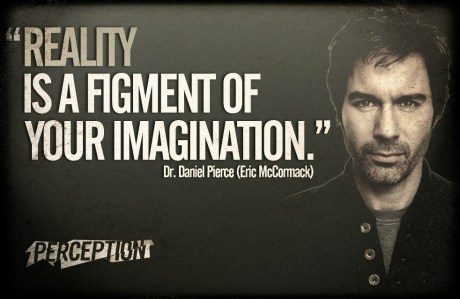
reality figment

Dr. Pierce – who, by the way, was produced by the imagination of a screen-writer, reminds us that neurologically there’s no way of telling apart a dream/nightmare/vision from a ‘legitimate’ perception.

So.
Then it would be possible for whatever each of us perceives on a daily bases to be nothing but some-kind of an elaborate multidimensional movie. Or prank. Played on each of us by some extremely bored ‘arcade operator’. Or by a lab-technician performing some kind of an experiment… In this scenario all other people each of us has ever met would be nothing but characters imagined by the guy who had written the script/devised the experiment…
A slightly different scenario would be that our planet (the whole world?) is a theater, we are the spectators and most of what we perceive is the movie which is played on (for?) us. In this variation we are free to speak amongst us (discuss the movie?) and this would be the explanation for why our perceptions are coordinated so well. After all, all English speakers use the same word for table/tree and most of us are able to differentiate between a table and a chair. Or between a tree and a weed…

Or we could take a completely different road!
There’s a guy, Humberto Maturana, who has reached the conclusion that most humans are not simply aware but also aware of their own awareness. And that this is what really makes us human.
In fact, his ideas make a lot of sense. A dog is aware. If house trained, it will not pee inside and most of them are able to differentiate between their owners and some strangers. But it takes a fully functional human being to step outside of themselves and examine their actions/status.

Without this very self awareness, none of us would be considering ‘reality’. We’d simply walk around the table/tree or directly through the clear space and never waste a second considering whether the table/tree is real.

Or what reality really is.

In this scenario, reality is more like a table than like a tree.
It resembles a tree in the sense that it existed long before any of us ever thought about it and it is like a table in the sense that in order to consider it we need to imagine it first.

Reality exists.
In both scenarios and along both roads. It doesn’t matter whether in the first one we are fed fake sensations and led to believe whatever the screen writer wants us to believe. In order to do that, the screen writer has to exist in the first place. We also have to exist, otherwise there wouldn’t be anyone to watch the movie!
OK, maybe what we perceive has nothing to do (very little?) to the real reality. But that doesn’t mean that a certain reality doesn’t exist at all. Even in the first scenario.

Coming back to the second road, we cannot pretend that OUR reality exists outside us.
Yes, there is a reality – THE reality, which lurks somewhere outside our reach.
What we’re able learn from it, and all we’ll ever be able to learn, is what we’ll be able to imagine first.

Think of it. What do we do when we come across something new?
First we try to classify it among our memories. In fact we try to remember whether we already have a word for it. One imagined by one of our ancestors.
If not, we imagine one ourselves.
And only then we can proclaim that the new thing has been discovered. That it has become ‘real’.


Before proceeding any further, let me introduce you to two other, more distanced, cousins of ours. Gorilla and Orangutan.

Orangutan leads a semi-solitary life in the Bornean and Sumatran Jungle. They are fairly large animals, males tip the scales at 200 pounds or so, and need a lot of food. They eat mostly fruit and, in times of scarcity, bark, flowers, insects and eggs.
It was their ‘eating habits’ which had shaped their social lives:
Food is often scarce in the rain forest and that is why the orangutan is a semi-solitary creature. In times of great abundance of food, orangutans may use the opportunity to socialize and gather in small groups.
Because they live solitarily, the young siblings must on one hand learn ‘everything’ before starting their adult lives and they don’t have anybody to learn from but their mothers. Hence they stick around for longest. A baby orangutan will nurse until about six and continue to live with their mothers for a few more years. Two or three for the males, five or six for the females – on top of everything else the females have to learn “mothering skills” and for them the only way to do it is to watch their own mother taking care of the next sibling.
As a consequence of all this, the females give birth only once every 8 years, “the longest time between births of any mammal on earth. (This results in only 4 to 5 babies in her lifetime.)” Not a very efficient survival strategy, for the species I mean…

Gorilla has adopted a different feeding strategy.
This is actually a joke. It wasn’t ‘the gorilla’ which has ever adopted anything, least of all ‘a survival strategy’. The ‘adoption process’ had been fueled by chance, had been ‘censured’ by  the realities of their living places and was later labeled as “evolution” by Charles Darwin.
Coming back to our distant cousins, gorillas are even larger animals than orangutans.
300-400 pounds, for the males, versus 200. Hence they need even more food.
An adult Grauer’s gorilla male is estimated to eat 30 kg of plants every day, an adult female about 18 kg.” The difference being that gorillas eat a lot of leaves.
When they have the opportunity to choose, they will surely pick up fruit but they are much more adapted to eating leaves than orangutans are. As a consequence they do not need to ‘spread around’ as thinly as orangutans do, the young can also learn from the rest of the pack so females can give birth every 4 years instead of every 8.

Is there any link between all this babbling and the stated subject of your post?

Actually yes.

As gorillas and orangutans are teaching us, together is easier than each by its own.
Being able to give birth every 4 years is a huge evolutionary advantage over having to wait 8 years before becoming pregnant again.

But this is not all we can learn from our cousins.
Male gorillas, at 300 to 400 pounds, are formidable defenders. Their only enemies, except for humans, are the leopards.
Compare 350 pounds with less than 100 for a chimpanzee/bonobo male.
That would be a good starting point to figure out why silver-backs – mature male gorillas who despotically reign over their 1 to 5 females – can afford to drive out their sons after they become sexually mature while the chimpanzee alpha males, who lead troops of up to 50 members, will allow other mature males to live by – and to have intercourse with some of the females living in the same group.
The second reason being that gorillas eat, almost exclusively, plant matter, supplemented with some insects, while chimpanzees form hunting parties in order to catch, kill and eat other animals, including monkeys. And one can ‘graze’ by himself while hunting is way easier in cooperation with others.

Feeding habits can explain quite a lot, isn’t it?

Let’s make a step further and turn back, as I promised in my previous post, to the differences between chimps and bonobos.
Well, bonobos hunt, just as efficiently as the chimps do, only they are less inclined to murder their neighbors.
Just one suspected killing observed during “92 combined years of observation at four different sites“, for the bonobos. In the other camp, 152 killings, 58 directly observed and the rest “counted based on detective work“, gathered over “426 combined years of observation, across 18 different chimp communities“.
The second difference, that I find interesting in the context of ‘capitalism’, is the size of the ‘colonies’. Bonobos live in way bigger groups than the chimpanzees. 100 versus 40 to 60, I’m not sure whether this had any impact over the relative fate of chimps or bonobos but it is surely relevant for how capitalism works. Stick around.

One more ‘animal story’ and I’ll wrap everything up.

“We previously reported that chimpanzees were unable to optimally select the smaller of two candy arrays in order to receive a larger reward. When Arabic numerals were substituted for the candy arrays, animals who had had prior training with numerical symbols showed an immediate and significant improvement in performance and were able to select reliably the smaller numeric representation in order to obtain a larger reward. Poor performance with candy arrays was interpreted as reflecting a response bias toward the intrinsic incentive and/or perceptual features of the larger array. In contrast, the Arabic numerals represent numerosity symbolically and appear to promote response choice on the basis of abstract processing of numerosity, with minimal interference from the inherent properties of the choice stimuli. The present study tested the hypothesis that, for mixed symbol-candy choice pairs, the requisite processing of the abstract numeral may foster a mode of numerical judgment that diminishes the interfering incentive/perceptual effects of the candy stimuli. The results were consistent with this hypothesis. Whereas performance on candy-candy arrays was significantly below chance levels, performance on numeral-candy choice pairs was significantly above chance and comparable with performance on numeral-numeral pairs.”

OK, OK, don’t shoot the messenger… those guys were writing a scientific paper, not a blog post… let me ‘translate’ it in simpler words.

There is a relatively simple psychological test involving two bowls full of candy.
One of them containing more pieces than the other.
The test consists of a child being asked to choose between those two bowls, after being told that the candy from the chosen bowl will be given to somebody else and the candy from the second bowl, the unchosen one, will be given to the child. The test is repeated a number of times and most of the children, 4 year olds and above, learn quite quickly to point to the bowl containing the smaller number of candy.
If, instead of children, chimpanzees are asked to choose between the two bowls, they continue to point to the bigger number of candy, even after the umpteenth repetition.
Now here comes the really interesting part.
Dr. Boysen and other scientists from Ohio State University, had previously taught a chimp, Sheba, not only to count but also to read numbers. One digit numbers…
When Sheba was subjected to the test, using real candy, she had responded exactly as the other chimps had done before her. She was unable to wrap her head around the notion that she will get the candy from the OTHER bowl. But as soon as the researchers had replaced the actual candy with digits written on small cartons… bingo! Sheba had become a lot wiser and had very quickly figured out that choosing the bowl with the smaller number (of candy) was a far better option.

Let me put two and two together.

Our cousins, the great apes, have given us a valuable lesson about cooperation.
Orangutans have to raise their offspring as single mothers. A very time consuming process which limits the number of siblings to 4.
Silver-backs don’t need much help to defend their families. So they can afford to drive off any potential competition… but they cannot hunt. Or do anything else ‘in concert’ with their peers.
Chimpanzees have learned to tolerate each-other, to a degree. They can form larger communities and engage in cooperative endeavors. Hunting and warfare.
Bonobos have developed a very efficient method to quell tension which may appear among themselves and to subdue rogue members of the community, without actually killing them. With no apparent benefit… except for us…

History is telling us, shouting at us even, that authoritarian regimes are short lived. Shorter and shorter lived, as we come closer to the present day.
Ancient Rome had lasted for almost a 1000 years. 2000 if we take Byzantium into account.
The British Empire was de facto dissolved, more or less peacefully, after less than 500 years, along with the rest of the European colonial empires.
The Russian Czarist Empire had buckled under its own weight after some four centuries, reinvented itself as the Soviet Union and faltered again after less than a century.
The rest of the ‘modern’ dictatorships have crumbled even faster, with only two notable exceptions: North Korea and Cuba.

Mighty commercial ventures, which had seemed impregnable in their heydays, are now almost forgotten memories. From the British East India Company to the now infamous ENRON…

Yet humankind, as a whole, had fared better and better.
OK, we did bring a lot of ‘man made’ misfortune over our own, collective head.
Only every little piece of that misfortune had been produced and inflicted in an authoritarian setting.

From Alexander the Great (?!?) to Hitler, history is full of ‘leaders’ who had somehow convinced their subjects to foolishly follow orders. Eventually, everybody got killed in the process. The leaders as well as the hapless subjects…
From John Law – ‘the son of a Scottish banker, a gambler and playboy who had killed a man in a duel‘ before insinuating himself at the top of France’s financial establishment during the first part of the XVIII-th century, where he had orchestrated a “system” closely resembling a Ponzi scheme – to Bernard Madoff, the economic and financial history is full of ‘tycoons’ who have led their their subordinates, and a considerable portion of the financial markets, to utter disaster.

And some of us still consider that ‘greed is good’… Maybe they should read again about Sheba and the candy bowls…

I can hear some of them protesting: “In the real world, there is nobody to switch the bowls! ‘Finders keepers, losers weepers'”
Yeah, right… tell that to some of those who had won the lottery… “About 70 percent of people who suddenly receive a windfall of cash will lose it within a few years, according to the National Endowment for Financial Education.

Then why are we still so obsessed with money?
Like Sheba was with those candy?
Why do we collectively continue to behave like a bunch of three years olds?

Maybe because money have proved, over the centuries, to be very reliable tools?
Because profit has been a very good measure for a company’s ability to survive? If corroborated with other indicators, but that’s another story…

At some point I mentioned that capitalism only works if the market where its wares are traded is really free. Meaning that that market has to work under the rule of law and that nobody in that market should allowed to become so powerful as to dominate the others.

Well, that was a lie.
Actually, capitalism works anywhere.
Those running the late Soviet Union have tried to convince the rest of the world that monopolies might work.  Various ‘business men’, including some very successful ones, try to convince us of the same thing. “Competition is for losers” they say… OK, I can understand why they keep trying… That’s what the entrepreneurs are for! “To boldly go where no man has gone before.”
My point being that markets which are not presently free will become free with the passage of time. No matter what!
No political arrangement has ever been strong enough to contain a dysfunctional economy. That’s why the Soviet Union, and the rest of the communist camp, had crumbled. That’s why we have a crises every time the government, with the best intentions, abruptly intervenes in the economy. Or fails to do so and allows monopolies to exist for too long…

Capitalism actually works.
Look around us.
I could give you a myriad examples. I’ll settle for two.
Romania, which less than 30 years ago was struggling under the communist yoke, now has one of the fastest internet in the world.
Some 40 years ago, when my uncle had emigrated to America, long-distance  phone calls were so expensive that he barely afforded to call his mother more than twice a year… nowadays two people can chat for hours across the planet, for free, over the internet. With video…

How about we letting it do its magic without some of us trying to drain ‘undeserved advantages’ from the process?
And no, those trying to ‘drain undeserved advantages’ are not the real culprits for what is going on!
A really free market is not one where a big bully with a huge stick makes sure that nobody steals from its neighbor.
That would be the definition for a police state!
A free market is one where people organize themselves, hire a normal guy with a smallish stick to take care of thieves and then call him every-time when they see a robbery taking place.

Nowadays too many of us actually admire the thieves and try to bribe the guardian.
While the rest idly walk by, as if what’s going on under their own noses is not going to affect them in a very short while …

Road Rage
So, a man of the cloth, driving a Corvette, pointed a gun at a guy who was trying to overtake him in a truck.
Reading this had somehow set my mind into overdrive.
If the other car would have been a Mercedes, or a BMW, would the priest had reacted differently? Better or worse?
In America, the priests are hired directly by the community. Why would a community of church goers entertain the wishes of a priest who covets a Corvette?
What kind of advice would such a person give to a grieving widow? Or to a grieving widower – or parent, whose spouse/child had been killed in a road accident?
This is not a blame apportioning contest but who was/is in a position to do more? The individual subjected to various craves/emotions or the individual(s) having the opportunity to evaluate/keep in check the first?
Where do we draw the line between ‘desirable behavior’ and ‘no go zone’? Can we reasonably expect the ‘significant others’ (priests, doctors, teachers, politicians) to behave differently (better?!?) than the rest of us?
When is the proper time to act? How much deviation from the norm should we accept before ‘pushing back”?
What is ‘proper behavior’, anyway?