Archives for category: Frames of mind

shark2-625x352

Over reliance on ‘tradition’ and over reliance on ‘science’ (a.k.a. rational thinking).

The individual prone to falling victim to the first method is convinced that:

They has adequately framed the problem.
– The answer, to that particular problem or to one close enough so that the old answer is still usable,  has already been found and recorded in the collective archive currently known as ‘tradition’.
– They is smart enough to identify the correct answer inside that huge wealth of  rather haphazardly accumulated knowledge.

The individual prone to falling victim to the second method is convinced that:

– They has adequately framed the problem.
– The answer to that particular problem can be reached scientifically.
– They is smart enough to identify the correct answer using the scientific tools currently at their disposal or to develop new ones, if necessary.

If, on top of all this, that individual, in no matter which of the two situations described above, is so convinced of the adequacy of “their” answer as to be prepared to impose it on others, even against their will – or without telling them before starting the implementation of “the answer”, then all hell will break loose – sooner or later.

By now you have probably figured out why these two methods are ‘only apparently different’.

In fact both of them are nothing but variations of the ‘inflated ego syndrome’.
This theory has been proven by the fact that all the dictators that have ever ‘ruled the Earth’ have always been convinced they were ‘rational people’, regardless of all of them either pretending to had been ‘blessed by God’ or explaining their ‘arrival’ as a ‘natural consequence’ of Marx’s scientific/dialectic materialism and/or Nietzsche’s Will to Power.

The people suffering from this syndrome can be identified by the manner in which they react to every input they receive. If their response is either ‘No, you’re wrong about this’ or ‘Yes, I was thinking along the same lines’ but never ‘Thank you for this fresh and very interesting perspective’ then you are dealing with someone harboring a very ‘inflated’ – and usually also very jealous – ego.

This kind of people are usually very good at spearheading change but allowing any of them  to acquire any considerable amount of power is, to say the least, suicidal.

An otherwise excellent article published by Robby Soave in reason.com claims that “Trump Won Because Leftist Political Correctness Inspired a Terrifying Backlash

While I think that yes, there is something here, I’m also afraid that the author is ‘guilty’ of the same crime… he’s too afraid of ‘crossing the red line’ that to go all the way and spill it out.

“Trump won because of a cultural issue that flies under the radar and remains stubbornly difficult to define, but is nevertheless hugely important to a great number of Americans: political correctness.”

“What is political correctness? It’s notoriously hard to define. I recently appeared on a panel with CNN’s Sally Kohn, who described political correctness as being polite and having good manners.That’s fine—it can mean different things to different people. I like manners. I like being polite. That’s not what I’m talking about.

The segment of the electorate who flocked to Trump because he positioned himself as “an icon of irreverent resistance to political correctness” think it means this: smug, entitled, elitist, privileged leftists jumping down the throats of ordinary folks who aren’t up-to-date on the latest requirements of progressive society.

Example: A lot of people think there are only two genders—boy and girl. Maybe they’re wrong. Maybe they should change that view. Maybe it’s insensitive to the trans community. Maybe it even flies in the face of modern social psychology. But people think it. Political correctness is the social force that holds them in contempt for that, or punishes them outright.”

There are two problems with this approach.

It is both counterfactual and too imprecise.

First things first.
A sizable portion of Trumps supporters do not care much for such subtleties like ‘political correctness’. They might indeed feel ‘the social force that holds them in contempt’ but they are the kind of people who do not beat around the bush. They blame a person directly, not their manner of thinking.

Secondly, using the same name for two very distinct behaviors, ‘polite and having good manners‘ versus ‘jumping down the throats of ordinary folks who aren’t up-to-date on the latest requirements of progressive society.‘ is so imprecise that it becomes counterproductive.

By using the same label for both we end up discouraging both.

Do we really want to discourage people from being polite? From having good manners?
Do we really think that actually destroying all ‘political correctness’, the first kind included, is a good thing to do?

The way I see it we have to use a different moniker for the second behaviour.

How about ‘political bigotry’?

This way it would be clear what we stand for and what we strongly oppose.
‘Good manners’ would be in and ‘grab them by the pussy/jumping down the throat… simply because we can’ would be out.
‘Polite and considerate’ would be in while ‘smug, entitled and privileged‘ would be out.

Most of my right wing friends – and some from the left, are fretting about taxes and angry about the fact that they, the taxes, are ‘forcefully’ collected by the democratically elected government.

In their interpretation, the majority dictates, by the power of their numbers, the amount of taxes that the ‘fretters’ have to pay. The rationale being that ‘the poor’ help themselves, ‘democratically’, to the hard-worked, or other-wise rightfully owned, private property of the wealthy.
This rationale is a little fallacious – I see taxes as a form of ‘protection fee’, received by the state/government for maintaining a functional environment where everybody, including the wealthy, can take care of their lives and businesses – but this is a different subject.

Others warn us that “The Most Intolerant Wins” and that we must not, in the name of tolerance, tolerate any form of intolerance.

Isn’t it funny that under the current law a minority of Americans, composed significantly of ‘less educated, lower middle class people’, have imposed, upon themselves but also to the entire planet, a right wing President who has wowed, among others, to lower the taxes?

popular-vote

education-and-income

Any complaints?

PS.
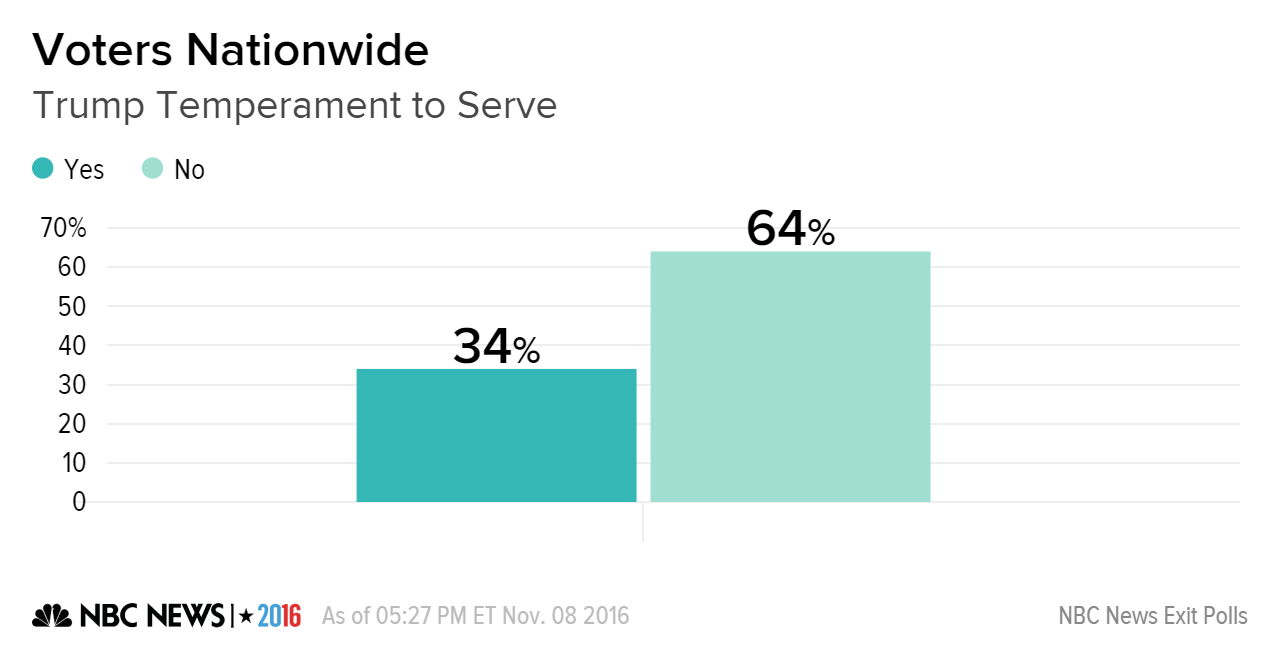
Even stranger is the fact that 18% of Trump’s supporters said they didn’t thought he was qualified for the job but that they had ‘nonetheless voted for him, as did 20% of those who felt he did not have the necessary temperament.‘.

Further more “Of people who gave their opinion of the candidate they voted for, 41% strongly favoured them, 32% had reservations and 25% said they disliked the opponents.”


What can we make of it?

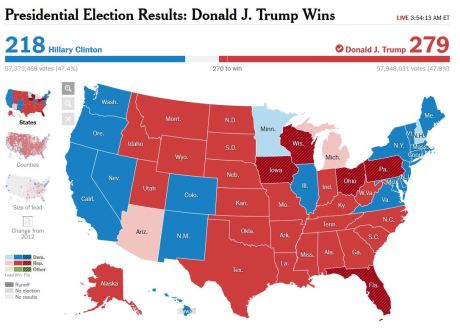
Momentous as it was the result was no landslide.
Only a little less than 120 million people bothered to vote – out of the 250 million or so who are old enough to do it – and most of them, 47.7% vs 47.5, have chosen the ‘looser’.

Actually I don’t like the notion of anybody winning – or loosing, for that matter, a democratic election but that’s a different subject. Stay tuned, I’ll probably cover it soon.

Then Trump is no Hitler, as some have feared.
Even if he is riding a similar wave of popular discontent like the one used by Hitler to rise to power, and uses the same political tricks, Trump is nothing more than the ultimate opportunist.
Check his body language.Turn off the sound and just watch him.

the-most-corrupt
While Hitler was a mad ideologue absolutely convinced of his own righteousness Trump’s only conviction is that he ‘deserves’ as much as he can ‘grab’.
Now, that I’ve mentioned ‘ideology’, in this respect it is Clinton who belongs to this category – people who conscientiously use an elaborated ideology as a compass to find their bearings and as a ‘looking glass’ to read the fine print on the maps they try to navigate. But this is a subject I’ll have to come back to at a little later.

No landslide but still momentous.

A lot of people who had not bothered to vote before have come out in droves.

Trump, the business man, and the Republican Party – which now controls both Houses of the Congress, cannot afford to forget this.
Also, they must not forget about the other half, the one which had chosen to remain silent, on Tuesday, of the electorate.
The fact that they didn’t vote, then, doesn’t mean that they didn’t have any opinion.
And they are simply too many to be discarded.

“How come we haven’t seen this coming?”

I keep hearing these laments from my fellow sociologists.

Well, the raw data was all there. Compiled in the opinion polls result sheets, only that we could not interpret them right.
Trump had felt it in his gut – and acted on this hunch, but we had not been able to see it coming despite our ‘scientific’ methods and hugely accurate number crunching machines.

Which brings me to the main topic of this post.

What happened these days is yet another proof that the math used by the number-crunchers is nothing but a (very accurate) language and that ‘science’ is nothing but a (meta) tool that can be used to make sense of various aspects of the surrounding reality.
The results obtained, by us, through the use of this tool and expressed with the help of that language depend primarily on our skills and intelligence and only secondarily on the quality of the tools used in the process and on the precision of the language used to present them.
Not to mention the fact that it was us who developed the tool and formulated the language…

I ‘warned’ you I’ll come back to ‘ideology’.
This is yet another tool. As I mentioned before, we, all of us, use it as a compass with which we try to find our way through the world and as a magnifying glass with which we try to make sense of what’s happening to us.

‘But you just said we’re using science ‘to make sense of various aspects of the surrounding reality’?!?’

Well… we’re using both.
Whenever confronted with anything new we have to make a snap decision. Try to assimilate it with something we already know or investigate it.
It is our personal ideology which kicks in first and tells us what to do. And each time that we choose to look in our mental drawers for something that might fit in the new situation we remain in the ideological realm and continue to use ideology as a light beacon – what happens to be inside that beacon is brought to our attention while everything else doesn’t exist for us.
Only if we choose to investigate, science kicks in. But not even then we are not entirely free from ideology. Each time that the investigative process leads us to anything which contradicts something that had been already ‘filed’ in our ideological cupboards we find ourselves in a huge dilemma. How to proceed from there on. Continue to trust the scientific method or revert to the safety of the already settled?

This is why individual responsibility is hugely important.
And why no one should ever consider that he is the sole repository of the entire truth.

This is why we need to be constantly reminded about the limited nature of our understanding.
And the democratic process has been proven, time and time again, invaluable in this respect.
As long as it was allowed to proceed freely and it was conducted with respect towards all members of the community involved.


trump-nbc-favorability-trump

trump-temperament-nbc

1478656414_trump_treatment_of_women

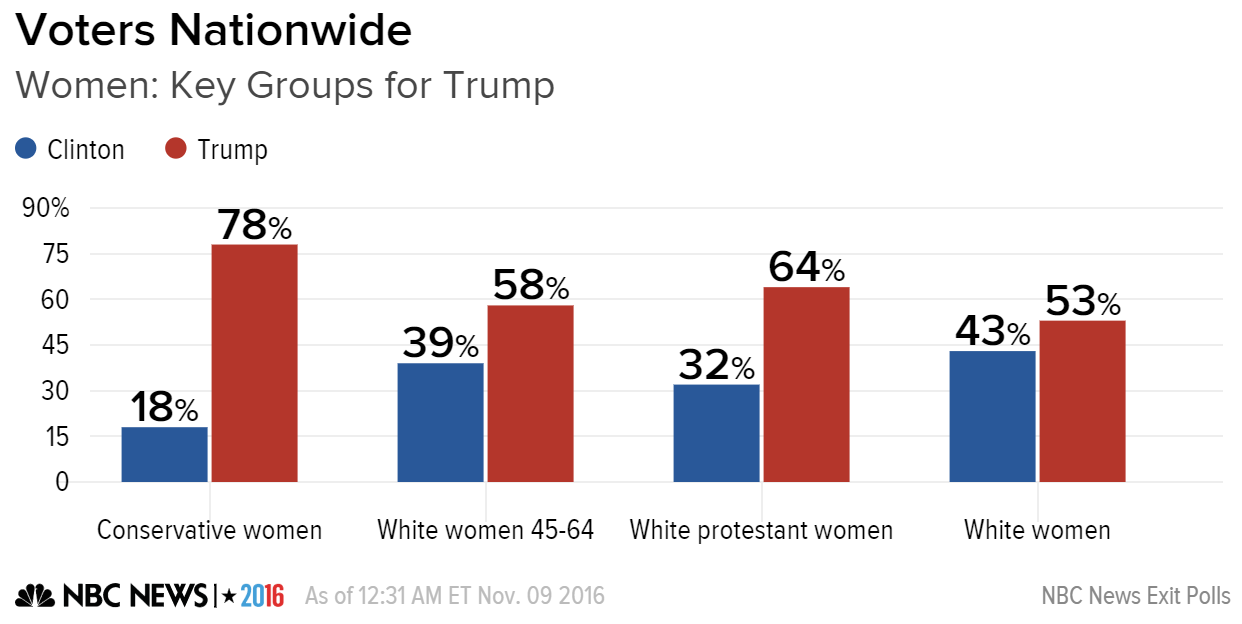
womens-votes

evangelicals-votes

white_catholics-votes

clinton-honesty-nbc

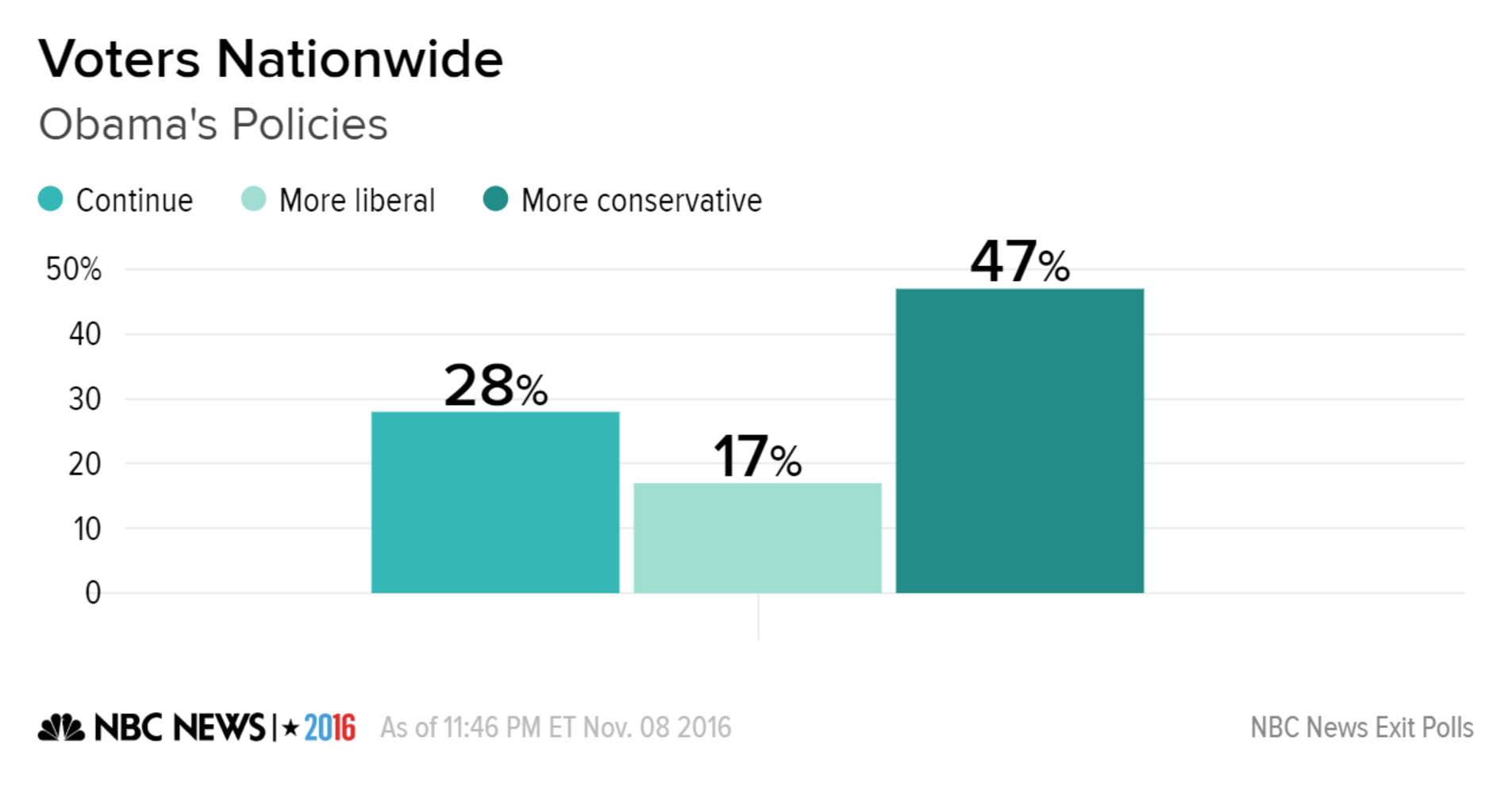
whether-to-continue

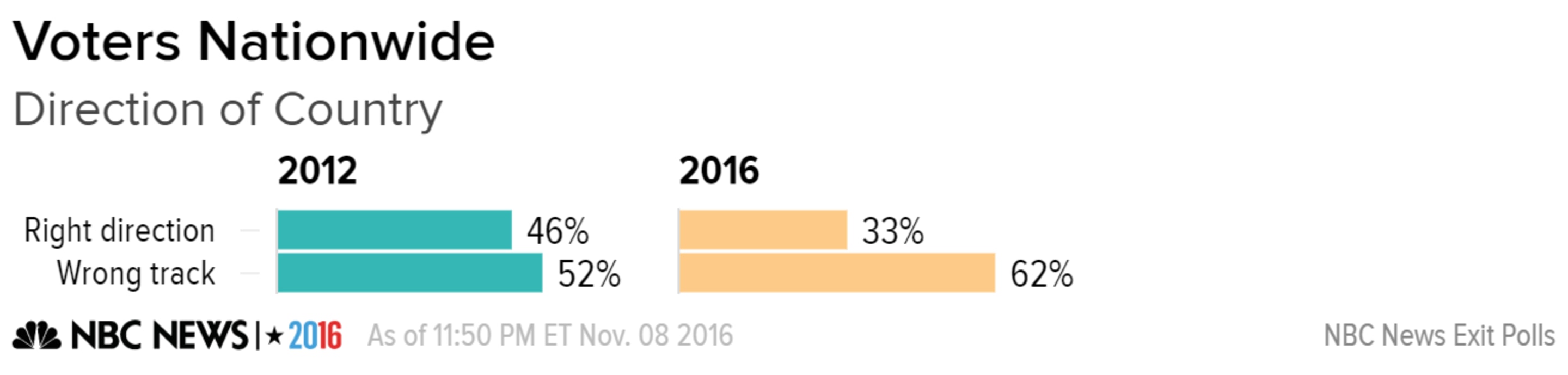
direction-of-the-country

trump-wins

New York Times, Elections 2016

Like always, the dispirited enough to stay at home have given a carte blanche to the  desperate enough to ‘jump into the unknown’!

And no, this is not exclusively about the ordinary voters!
They’ve already sent plenty messages stating clearly that they’ve had enough.
But those whose job was to make things work had chosen not to hear.
Then, when it had become plenty obvious that the boil had been festering for long enough, most of them had stepped aside – leaving at the forefront of the ‘operating table’ a ‘surgeon’ whose long resume was anything but capable of generating trust and a ‘willing’ and ‘enthusiastic’ ‘wannabe’ with no experience.

And now they are trying desperately to find an ‘honorable way out’…


the-final-countdown


“We’re leaving together,
But still it’s farewell.
And maybe we’ll come back
To earth, who can tell?
I guess there is no one to blame
We’re leaving ground (leaving ground)
Will things ever be the same again?

It’s the final countdown.
The final countdown.”

the-final-countdown-2


quote-the-philosophers-have-only-interpreted-the-world-in-various-ways-the-point-however-is-to-change-karl-marx-250986

Change it into what? And on what grounds?

I had spent the first 30 years of my life under communist rule and I’ve witnessed, first hand, the debacle produced by a bunch of people trying to transform the world according to their own liking. And it’s not only that they had brought a lot of misery to an awful lot of people but they also brought it upon their own heads. They, and their families, have been indeed living a lot better than the rest of the people but a lot worse than the ordinary people living in the free world. Not to mention the fact that many of them ended up really bad, some of them at the hands of their own insatiable, Minotaur-like, leaders and some others during and immediately after the regime change.

I’m writing this post after watching Jon Haidt’s excellent lecture “Two incompatible sacred values in American universities“, delivered at Duke’s Departement of Political Science on October 6, 2016.

The point of Haidt’s conference being that each university should clearly declare its ‘telos’ as belonging to one of these two clear cut options:

the-point-of-a-university_dxo

Don’t bother to search the quote attributed to John Stuart Mill.

It is only an interpretation belonging to Haidt himself, who had inferred it from one of Mill’s famous quotes excerpted from  “On Liberty”:
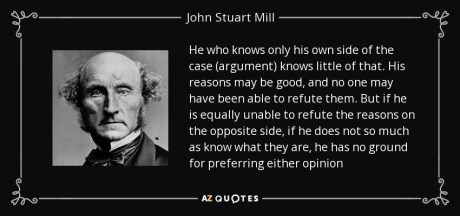
quote-he-who-knows-only-his-own-side-of-the-case-argument-knows-little-of-that-his-reasons-john-stuart-mill-125-0-0981

So, what should it be?

Change or Truth?

Before proceeding any further I strongly suggest that you take some time and listen to Haidt’s excellent arguments.

Now I’d like to discuss a little about ‘Change’ and ‘Truth’.

What both Marx and Haidt have in mind when they speak about ‘change’ is both ‘purposeful’ and ‘centralized’.
When they say ‘change’ they mean an ‘effort towards increased social justice’, effort whose parameters would be determined by the wise men (and women) delving in the depths of the University’s libraries and which would be implemented without fail, preferably with a sanction from the higher authority.

I had already mentioned, at the beginning of my post, where such ‘change’ would lead anyone  attempting to put it into practice.
And Haidt gives us an excellent explanation for why anybody who will ever attempt such a thing would eventually fail. (I told you to watch his conference…It may be long but every minute of it is packed with very interesting things!)

So why is Haidt challenging us to make this choice instead of giving us a clearer piece of advice?

Well… maybe you should ask him that… I’d hate to believe that he, in his own words, ‘has become afraid of that too many of his students might feel that he is so distanced from what is generally accepted that too few of them would follow him’.

So what should we do?
Some of us should embark on a ‘sterile’ search for the (absolute) truth and then, after eventually finding it, nurse it quietly in our lap but refrain from an even minutely more drastic action while others should attempt to implement change based on already ‘over the hill’ principles?

I’m afraid that would be a dangerous road to follow.

There is no such thing as an ‘absolute’ truth that might be nursed in our lap and even if there was such a thing we are not able to find it – individually or even as a group. There’s plenty evidence about that in Haidt’s discourse.
And then what would be the use of the whole enterprise if we are not planning to use the results of our quest, whatever those might be?

And here lies the crux of the matter.

I’m sure Haidt knows what I’m going to tell you now and I’m very sorry that most of your teachers have never mentioned at class this very interesting story.

Marx was not the first revolutionary thinker of his time.
OK, you already know that. There were a certain number of French intellectuals whose writings have set the stage for the 1789 Revolution.
What is less known is that John Stuart Mill himself had been groomed by his father “as the future leader of this radical movement”, whose aim was supposed to be “social reform based on utilitarianism” with the goal of attaining “the greatest happiness of the greatest number“.

The only difference between James Mill (the father) and Karl Marx being that Mill didn’t advocate the the forceful confiscation of the ‘means of production’.
Otherwise both were faithfully following Plato’s dictum:
Until philosophers are kings, or the kings and princes of this world have the spirit and power of philosophy, and political greatness and wisdom meet in one, and those commoner natures who pursue either to the exclusion of the other are compelled to stand aside, cities will never have rest from their evils, –nor the human race, as I believe, –and then only will this our State have a possibility of life and behold the light of day. Such was the thought, my dear Glaucon, which I would fain have uttered if it had not seemed too extravagant; for to be convinced that in no other State can there be happiness private or public is indeed a hard thing“.

Well, the problem with this line of thought is that it doesn’t work.
Again, Haidt has already presented a solid case about this and I’m not going to re-count his arguments.

So, since there is no such thing as an absolute truth to be discovered, one way or another, and no priest-kings on any white stallions that might come to our rescue, what shall we do?

Simple.
Follow Haidt’s, and John Stuart Mill’s, advice and take it one small step further.

The point of a university is to understand the world because only if you commit to truth, I believe, can you actually achieve justice.

We need to understand, and accept, two things:
Change has to be allowed to come naturally, not pushed forward simply because we are momentarily convinced that ‘The Truth’ had downed on us,
And that (social)justice is a process which has to be implemented on an ‘as needed’ basis, not an independent goal?

In fact Mill’s personal destiny is eloquent enough for what happens when somebody tries to breed a ‘perfect’ Priest-King.
“But in 1826, Mill began to suffer from a severe depression, which he attributed to his excessive analytical training and the resulting impairment of his emotional capacities. Reading the romantic poetry of Wordsworth and Coleridge helped Mill to overcome this mental crisis. It also inspired him to form a more complex view on human flourishing than the Benthamite utilitarianism of his father’s generation, with its dogmatic rationalism and unidimensional concept of pleasure.”

And this is why Haidt is absolutely right when he tells us that we need to expose ourselves to a lot more than what we are already familiar, and comfortable, with.
And this is why Heidegger kept warning us that truth as conformity between our words, or even our understanding, and the reality of the fact that we try to understand, and describe to others, is a Fata Morgana which consistently eludes us and that the only way to get any closer to her is ‘unhidennes’.

In this sense there is nothing better than an open mind, both towards our innermost thoughts and to the people living, and thinking, around us.

A mind open enough as to be able to simultaneously attempt to implement whatever changes become necessary in the light of the newly discovered truths AND accept the possibility that those ‘newly discovered truths’ might be incomplete or even altogether false.

Does all this seem rather schizophrenic?

Then let me rephrase the question I started with.

What’s the use of ever trying to understand anything if we’re not going, ever, to change our behavior as a consequence of anything we might come to figure out and on what basis is anyone to attempt any change if he never tried to understand anything above what he already knew long before he even started to think about any change?

As I was ready to close this post I stumbled upon the thought that maybe Haidt meant to apply in the academic world a principle that has been proved invaluable in the political life.

‘Separation of powers’.

Some universities would busy themselves with finding ‘the truth’ while others would attempt to find ways to put ‘it’ into practice.

Leaving aside the fact that this would smack too much of Marxism for my taste I’ll have to remind you that the separation of powers has become necessary in the political realm only because the government has an effective monopoly on power and we need to make it so that it cannot abuse this situation.

No university has any monopoly on truth and/or change.
Furthermore, not even the Academia, as a system, has been able to implement such a monopoly. Not for lack of trying, but that’s another subject.

So, instead of acquiescing to such efforts – by accepting certain universities as official ‘truth seekers’ and others as ‘path finders’/’change implementers’, we’d better ask each and all of them to clean up their acts.

And open up their collective minds.


OK, then please someone explain to me what the heck is going on here.

“Other researchers have pointed out the correlation between education rates and declining female health outcomes. The most shocking study, published in August 2012 by the journal Health Affairs, found that life expectancy for white female high-school dropouts has fallen dramatically over the past 18 years. These women are now expected to die five years earlier than the generation before them—a radical decline that is virtually unheard of in the world of modern medicine.”

femalemortalityratesmaplg

(Health Affairs/The Population Institute, University of Wisconsin)

“…women in parts of the country have been left behind, and in some cases, they are dying younger than they were a generation before.”

swing-states-20161


This map shows the probable number of votes each parties candidate would win in the Electoral College if the meeting of the College were held today.  If you live in a red state on the map above you probably do not have to vote for anyone for the office of POTUS but you should vote for a candidate for all  the other offices on the ballot.  – Abyssum

If you are not aware of at least some of the many ‘forces’ which attempt to control your mind, at least in part, you are just as ‘out of your mind’ as those who believe their minds are successfully and consistently controlled by outside agents.

And those who are convinced they are in control of other people’s minds.

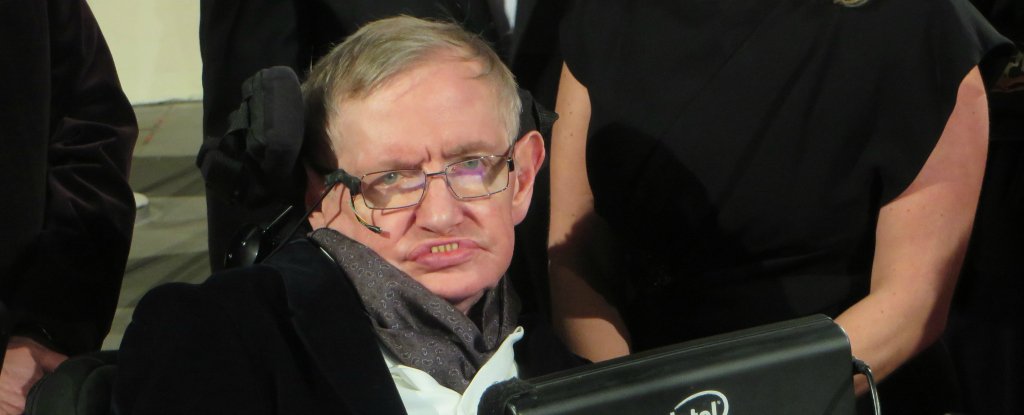
stephenhawkinghistory_web_1024

“We spend a great deal of time studying history, which, let’s face it, is mostly the history of stupidity.” (Stephen Hawking speaking at the Cambridge University)

Really?

First of all what we call ‘history’ is not what had happened but a story comprising the subjects some of us had chosen to write about, in the manner they saw fit to do it.

Secondly, until very recently most people had a very vague – and heavily biased – idea about what had happened in their past.
Only in the last two hundred years or so a very small number of people have started to study what had happened in their past in a value neutral manner and, unfortunately, their efforts are still being disparaged by many and ignored by a vast majority.

Coming back to Hawking’s words, I must admit that we, as a species, have done indeed a lot of stupid things.
But, as a whole, the sum of our deeds is far from being negative.

After all… we’re still here, aren’t we?

And, despite the huge amount of misery that is still being experienced by a lot of us, we are doing better than our great parents used to do.

So it is hard for me to agree with Hawking on this subject.

He is right about one thing though.
We are currently doing a very stupid thing indeed.
Our ancestors had the excuse that historical information was very scarce.
This is no longer the case.
While they could have claimed ‘innocence’ when re-enacting an error that had already been committed we no longer have that luxury. We should have known better since it is a lot easier for us to learn than it was for our great-parents.
We really need to stop ignoring the lessons we have at our disposal.

And there’s something else which further complicates the situation.
We have become so powerful that our mistakes can have far worse repercussions than any of our ancestors ever had.

So while I don’t think our history is that full of ‘stupidy’ as Hawking believes it to be I share his concerns about the stupid things we may be making in the future if we don’t wake up and start learning from the stupid enough mistakes we have  already done.

As I said before, we make our own history.
We do the things that will constitute tomorrow’s history and we write the story of things that constitute our past.
Let’s not do, nor write, a ‘stupid’ one.

Just stumbled upon this joke:

One day, all the human body parts started arguing about who was on top… The mouth said, ”I should be on top because, without me, you wouldn’t be able to eat.” Then the stomach said, ”Ya but if it weren’t for me, you wouldn’t be able to digest and transfer all the minerals and vitamins throughout the body, I should be on top.” Then the heart said, ”I should be on top because I’m the one who takes the blood from point A to point B. Without me, the body would die.” Then the brain said, ” Well, without me, you wouldn’t be able to move, eat, digest or allow circulation of blood, so I should be on top.” Now, the asshole was beginning to get annoyed, ”You know, I should be on top because I can just shut my hole and then shit will accumulate and block the digestive track and screw all of you up.” It was chaos, everyone was yelling and fighting. Finally, the asshole got fed up, ”That’s it, I’m fed up, I’m shutting up my hole.”

So for a few days, the body couldn’t shit and the brain had trouble moving, the stomach digesting, the mouth eating and the blood flow going, everyone was begging the asshole to open up, The brain said, ”Please open up, you made your point, your on top, just open up.” The asshole smiled, ”So everyone agrees that I’m on top?” ”YES” everyone shouted. ”OK!” so the asshole opened up and the body could shit again. The moral of this story is, you have to be an asshole to be on top…“

Isn’t this interesting?

A bunch of guys are too thick to understand that they cannot live one without the others and to learn what mutual respect really means, one of them decides to teach the group a well deserved lesson and it is he who ends up being considered an ass-hole…

On the other hand… there are so many examples of ass-holes who end up ‘on top’ simply because they are the ones willing to do anything in order to get there – not caring at all if their actions hurt everybody else who happens to be around… AND because those who end up being hurt don’t see it coming or are too lazy, too thick or both at the same time, to do anything about it…