Archives for category: Culture

Wilhelm von Humboldt had initiated a current of thinking, linguistic relativity, which posits that the language used in a cultural space is a reflection of the ideas populating that space. And that there is a strong link between the workings of that language and the manner of reasoning favored by those who use it.

‘Dull as fuck’ is a perfect example.

Nowadays ‘conventional’ fuck is considered to be boring.

We’ve arrived to need all kinds of ‘gadgets’ and a cornucopia of titillation.

We’ve become addicts. Depending on porn.

Isn’t it interesting?

There is a then and there is a now.
We’re OK with ‘then’ and we’re not so comfortable with ‘now’.
Yet the only link between ‘then’ and ‘now’ is us.

Our generation took ‘then’ and brought it ‘now’.

Everything that happened between then and now had happened to us, by us.

Universal Grammar (UG) is intended to specify the most general principles of human language. It must provide an explanation for the extraordinary fact that a Japanese child raised in Paris will acquire French, but not Japanese, and a French child raised in Tokyo, Japanese, but not French. Either child may acquire both French and Japanese, of course, but neither will fail to acquire French or Japanese. Linguists and philosophers may have known this in antiquity; they did not say so with any great conviction, and they may not have said so at all. It was left to Chomsky to remark with the full force of his genius that every human language can be acquired by any human being. Universal Grammar, Chomsky concluded, must be a species-specific characteristic of the human race, biologically encoded, genetically transmitted.

The quote comes right out of an article written by David Berlinski and Juan Uriagereka. Never heard of any of them.

Reading that article, I remembered the reason for which I tend to avoid modern philosophers. Or linguists. Hard to discern which is which, anyway…

Let me return to the quote itself.
“An explanation for the extraordinary fact that a Japanese child raised in Paris will acquire French, but not Japanese, and a French child raised in Tokyo, Japanese”.
Read this to anybody who isn’t familiar with the notion of ‘Chomsky’. You’ll get a laugh and a troubled look. ‘What’s so extraordinary here?!? People will always learn whatever language is spoken around them… but only if they come in contact with the ‘exterior’ world!’

Home-school those Japanese/French children in Paris/Tokyo while preventing them from getting in touch with anybody else but their immediate family/trainers and they’ll learn only whatever language(s) their trainers/family will have chosen for them.

As an aside, what does Chomsky mean by ‘French’ and or ‘Japanese’?
‘Genetically’ French/Japanese? What if one parent is French/Japanese and the other German/Korean? What will the child be? Like the father or like the mother?
‘Culturally’ Japanese/French? According to their ‘mother’ tongue?!?
Forget it…

“Universal Grammar, Chomsky concluded, must be a species-specific characteristic of the human race, biologically encoded, genetically transmitted”.

‘Species specific characteristic of the human race’… told you these guys have a lot of humor… or, maybe, they cannot make up their minds…
What are we, humans?!? A species or a race?

OK, let me move forward.
Hidden underneath all this ado, there is a piece/gem of ‘harsh’ reality.
The simple fact that if/when we want to, we are able to understand each-other. To communicate with each-other. To exchange ideas. To trade meaning.
And there is indeed something species-specific about this ability of ours. Nobody else has it… according to our present knowledge about the world, anyway.

‘Nobody else has it’… yeah, right… as if you hadn’t watched, time and time again, two dogs ‘greeting’ each-other in the park.
OK, those dogs were interacting in highly unnatural circumstances. Walked by people, in a people infested environment …
Fact is that all animals have ‘procedures’ for interacting with other animals. Belonging to the same species or belonging to other species. Some of the procedures being inbred while others had been acquired trough learning or training.
Cats, for instance, have an inbred ‘procedure’ for chasing anything which might become a prey but need to be taught by their mothers how to finish the chase. How to kill that prey.
And yes, cats do have a species-specific, biologically encoded and genetically transmitted characteristic which allows them to kill and eat their prey. Or to play with the people who take care of them. They kill and eat using their claws and teeth while they play using their brain. OK, the brain also contributes during the chase… don’t be a nit-pick.

Let me summarize.
So cats have a specific set of tools, teeth and claws, which are ‘coordinated’ by a brain which needs to be taught in order to become fully functional.
And the overall ‘functioning’ of any given cat depends simultaneously on how well their organism works AND the quality of the learning they have been able to amass.

Then where’s the difference between humans and cats?
What is so species-specific in our ability to interact with the world?

I’m exaggerating, of course. We are able to understand each-other far deeper than the other great-apes, our cousins. There is something species-specific in all this.
But only in ‘depth’, not in ‘nature’.
We’ve been able to teach chimps to write. And cats to play with strings instead of catching mice. All three of us ‘share’ the more or less same kind of brain and surprisingly similar anatomies.

What really sets us apart is our learned ability to watch ourselves while doing something. To observe ourselves observing, as Maturana puts it.
And our ability, learned again, to formulate information in a transmittable form. To ‘build’ highly specific messages using rather ‘fungible’ building blocks and in such a manner that those messages might be transmitted from one individual to another. From one generation to another, even.
To make good use of the Universal Grammar noticed by Chomsky.

Can any of this be construed as species-specific? Of course. Without the huge brain we’ve got – or without the ability to articulate sounds, we most likely wouldn’t have been able to reach this stage of our evolution.
But to reduce everything to mere biology … I’m afraid that would be too simplistic.

Consciousness – or self-awareness, opens up huge evolutionary venues. Powered by our very ability to communicate so intensely. To use ‘Universal Grammar’, even without being aware of its existence.
But since both self-awareness and talking depends upon learning them from/with the others… biology is not enough. Necessary, indeed, but not enough.

Not by a long shot.

According to Humberto Maturana, what we call consciousness – our ability to ‘observe ourselves observing‘, is the result of what sociologists would call a ‘cultural process’.
Meaning that consciousness has been developed in time – as is millennia, and is constantly shaped through daily interactions between us.

I don’t intend to discuss its genesis now, I’m just gonna point to one of its many consequences. Our need to explain everything.

We’ve developed our consciousness by talking to each-other. If we are to accept Maturana’s theory – of course, which I do.
At some point in time, during this process, there must have been an ‘aha’ moment.
Or, more precisely, a ‘what if’ moment.

Until then, everything was ‘natural’. Sun up, sun down, birth, death… and everything in between.
While learning to ‘observe ourselves observing’ one of our ancestors must have noticed that we make a lot of decisions. Unconsciously – until that moment, of course, but, nevertheless, still momentous. To ‘flee or fight’, which fig tree to climb, which cave to use tonight, which pelt to skin, which flint to flake…

The very next moment our ancestor must have asked their-self:

What if the Sun doesn’t get up next morning? Will I wake up from sleep tomorrow?
Who decides these things?
Are there only rules – like ‘every time you touch a flame you get burned’ and ‘ice is always cold’ or on top of the rules there is somebody who calls the shots? As in ‘decides whether this time the lion will attack on sight or it will let this one go’?

And we’ve tried to explain away our fears ever since…
By determining which are the pertinent ‘natural rules’, by placing the responsibility on somebody else’s shoulder – read ‘God’, or both at the same time. Again, I’m not going to develop this subject either, I’ll just remember you that Buddhism – for example, doesn’t reject older creeds. The Japanese, for instance, follow both Buddhist precepts and Shintoist traditions. Also, many Christians entertain a lot of local and not so local superstitions. Like never start walking with the left foot or having a very strong ‘respect’ for the third number after 10.

Let me make a short recap.
We taught ourselves to speak, we talked to each other until we developed something called consciousness to such a level that we’ve started to ask ourselves existential questions and then we came up with more or less credible scenarios meant to allay our fears.

‘OK, … and your point is?’

Don’t be so ‘surprised’ when somebody ‘irrationally’ defends their own ‘story’. ‘Their story’ encompasses their world. That’s where they had been living, together with everybody they used to know/consider their kin.
Don’t attempt to force your story upon them. Let aside that you might be wrong yourself… any attempt to forcefully impose a narrative upon somebody else is nothing but “rape”. Don’t do it unless you are prepared to get raped yourself.
And keep in mind that it’s not ‘their story’ that harms you but ‘their actions’.

No story has ever harmed anyone. For any story to have consequences, people must act upon it. According to how they have chosen to relate to the it.  That’s where we can see eye to eye, regardless of the stories each of us keep dear.
Are we ready to accept that we might be wrong? That our story might be incomplete? That our explanation of the world might need some adjustments?

Are we ready to understand that enlarging our explanation to encompass others will actually increase our own ability to survive?
Or are we going to defend ‘our’ version, no matter what?

Are we going to keep looking for explanations or to become the subject of yet another one?

DSC_0007

The way I see it, this lady is freer, in body and mind, than most of us will ever be.

Human Nature as a social construct

Now, that some doctors are not only able but also willing to perform sex/life changing surgery, the subject has spawned a rather hot debate.

The ‘inputs’ being ‘sex’, ‘gender’ and ‘how each of us feels about it’.

Feels about what?

Well… this is the tricky part.
The what of the matter isn’t so simple…

There are so many things that might be felt here…

How each of us feels about the sex they have been born with.
How each of us feels about the gender role assigned to their particular sex by the particular culture into which they have been born.
How each of us feels about those who have enough courage/money to assume another gender/change their sex.

Please note that while neither the society nor the individuals have anything to do with the birth sex, both the society and the individuals are instrumental in shaping all those feelings.

Since sex/gender is too ‘hot’ right now, let me take a parallel road.

Many of my friends are glad when I invite them to dinner. To a home cooked dinner.
Their appreciation has driven me to improve my cooking skills, over time.
Yet in my culture, men are not supposed to cook – if they are not professionals, of course.
Which I’m not.
Yet very few people, if any at all, see anything strange here.
That being the social construct part.
On the other hand, cooking implies certain individual characteristics. For instance, I find it harder when my nose is running. I have to do it ‘mechanically’. It also demands a lot of patience and the ability to plan in advance. Not to mention the fact that one needs both hands.
My point being that cooking, and gender, is based on a certain physical configuration – both hands, a working nose – a certain state of mind AND a lot of study/social conditioning.

My real point being that every ‘social construct’ is based on ‘nature’.
Just as no builder will ever be able to build anything without ‘bricks’, no society will ever be able to build anything out of nothing.
And just as all builders have to adapt their plans to what they have at their disposal, all social constructs will be limited by ‘human nature’ – how ever adaptable and ingenuous it might be.

Now it’s the moment to remind you that other cultures have dealt differently with this matters. Driven by different kinds of necessity.

“It began hundreds of years ago, deep in the Albanian Alps—an unusual tradition where women, with limited options in life, took the oath of the burrnesha. A pledge to live as a man. To dress like a man, to work like a man, to assume the burdens and the liberties of a man. But these freedoms came with a price: The burrneshas also made a pledge of lifelong celibacy. Today these sworn virgins live on, but their numbers have dwindled. Many Albanians don’t even know they exist. What happens when the society that created you no longer needs you? And how do you live in the meantime?”


“In Samoa, gender identity is largely based on a person’s role in the family and if one family has numerous sons and no daughters, it’s not uncommon to raise one of the boys as a girl.

In fact, being a Fa’afaine or the practice of males adopting female gender roles and the attributes traditionally associated with women is deeply embedded in much of Polynesia.”

Confused?

You’re not alone…

“Some Polynesian elders believe there are boys born with the “Fa’afafine spirit,” while others say it can be nurtured.”


SPOKEN

According to Britannica.com, language is “a system of conventional spoken, manual, or written symbols by means of which human beings, as members of a social group and participants in its culture, express themselves. The functions of language include communication, the expression of identity, play, imaginative expression, and emotional release.

Since we’re already dealing in conventions, I’m going to ask you to consider this:
How about we redefine language as ‘any manner in which information is transported across space and or time between two entities which have the possibility to interpret, act and or otherwise intervene on/influence the message, the situation described by the message or both at the same time’?

You’ll surely notice that the second definition is more inclusive that the first, of course. And you’ll also notice the differences. Which aren’t that dramatic, after-all…

– ‘Conventional’…
‘Classic’ languages – English, Chinese, French, Urdu, German,  etc., are more the result of ‘natural evolution’ than of any ‘straightforward’ convention… while Esperanto, the most conventional of the spoken languages, didn’t make it too far.
In this sense, the ‘natural’ languages – those which have evolved ‘on their own’, without any intentional intervention from those who use it, are not that far away from the ‘classic’ languages. Birds have ‘vocal’ manners of sending distress and ‘sexual’ signals; monkeys and apes also; even social insects, ants and bees, dispose of an entire array of chemicals, sounds and gestures used to convey freshly gathered information from one individual to another.

– ‘by means of which human beings, as members of a social group and participants in its culture, express themselves’.
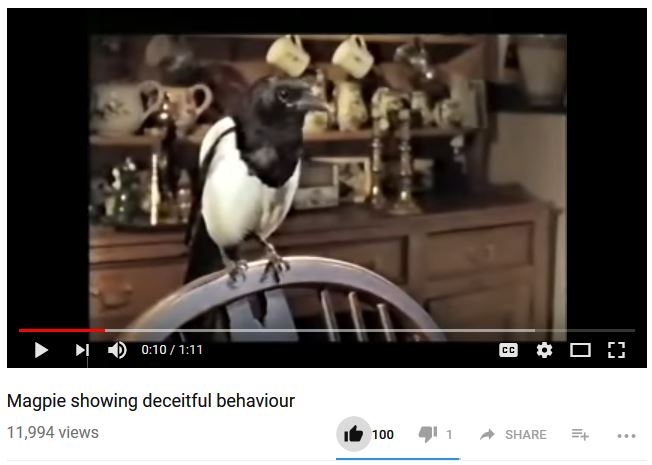
Really? What’s all this brouhaha about ‘expressing one’s self’? A call for help, ‘expressed’ in any way, shape or form, remains a call for help… regardless of the manner in which it has been expressed. Articulated language, Morse code, sign language or a simple sob. Same thing is valid for a warning call. Most of the times, the caller does it ‘instinctively’ and not to gain any ‘social points’ by ‘expressing’ their care for the rest of the ‘cultural community’ ‘conversant’ in the language used to make the call. The magpie in the video above is one of the exceptions, not the rule. Otherwise, the whole signaling ‘industry’ would have been abandoned long ago… due to the very evolutionary forces which have made language what it is today.
Don't cry wolf

– ‘The functions of language include…”
Isn’t this funny?!? ‘The functions of language include…’ How about ‘some of functions we, users of language, have been able to identify are… “.
Or even ‘some of the uses we’ve been able to put language to are …’?

Quite a lot of confusion… isn’t it?

But language was supposed to make things clearer, not muddier… right?

Tell that to those dogs… the ones sent chasing ghosts by the fake distress calls ‘jokingly’ (?!?) emitted by the magpie in the video at the top of my post…

So…

– ‘Spoken’ language.
Or should I call it ‘extemporaneous’? The way I see it, most ‘spoken’ language is uttered on the spur of the moment… or used to be, anyway.
Nowadays, spoken words can be carefully prepared long time in advance… even made to ‘faithfully’ mimic an impromptu message…

– ‘Written’ language.
While ‘spoken’ messages’ have been used, extemporaneously, for a huge amount of time – and not only by humans, as I mentioned earlier, ‘writing’ has been a late invention. Ours.
Or, at least, this is how we like to believe…
The most important characteristic of ‘written’ – as opposed to ‘spoken’, being ‘verba volant, scripta manent’. ‘Spoken words fly away, written words remain’!
The earliest scripts, both cuneiform and hieroglyphic, were used to ‘transport’ information through time. At first, to conserve data rather than what we currently call ‘complex information’. Inventory and ‘identity’ rather than information which may – or even has to, be interpreted in order to make sense. The early cuneiform clay tablets contained ‘cargo manifests’ and only later some of them had been used to ‘conserve’ the Story of Gilgamesh.

– ‘Operational’ language.
Aren’t you tired of that magpie yet?
Have you even watched the video?
Did you notice how the dogs reacted to the fake distress calls? For the umpteenth time, probably…
For the purposes of the present post, it doesn’t matter whether the magpie actively/conscientiously makes fun of the dogs or just acts out of some sort of an instinctive boredom… something akin to the bright spots we sometimes see when ‘confronted’ by a pitch-black environment. It also doesn’t matter whether the dogs are actually fooled every-time they go out to chase the invented fox or they do it because they experience the same kind of boredom like the one which ‘fuels’ the magpie.
For me, all that counts is the consistent manner in which the target reacts to the message transported through the use of this particular kind of language. It is this kind of consistency which determines the ‘operational’ nature of certain languages.

And now, let’s get to the ‘fun’ part.

The calls emitted by the magpie can be construed as being ‘spoken’, right?
They are of a ‘vocal’ nature, are fleeing by definition – unless someone records them using some artificial devices… yet they are also ‘operational’… since the dogs faithfully execute what they are ‘told’ to do…
Now, if we think of it, most natural languages are ‘operational’ indeed.
Ants and bees use them to direct ‘practical’ action, not to ‘express themselves’…
Calls used by most animals relate to avoiding danger, signaling food or ‘expressing’ sexual ‘desire’… and have little or no connection with anything else.
In this respect, the magpie is an exception, not the rule. And even here, the message is ‘formulated’ ‘operationally’. Simply because magpies don’t ‘know’ any other kinds (uses) of language.

We, humans, have bucked the trend only in the sense that we’ve developed kinds of languages lax enough to allow ‘thinking’.

I’m sure that all of you have noticed that when considering the pros and the cons to something you think using a language, right?
A language ‘lax’ enough to accommodate ‘what if’!

Something which doesn’t ‘fit’ in the ‘language’ used by most nursing babies to ask for more milk…

Huh?!?

thinking

We’re not the only ones able to use tools to solve problems.
We’re not the only ones capable of self-awareness. Otherwise said, to recognize ourselves in a mirror.
We’re not even the only ones able to use language to dampen our feelings for long enough so that the frontal cortex might take over from the amygdala.

So?

But what does it mean to be human?

What if being human means being able to do all those three things, simultaneously?

Well, I’m not so sure I’d be comfortable with that…

‘Dampen our feelings for long enough so that the frontal cortex might take over from the amygdala’.

A key difference between a psychopath and a sociopath is whether he has a conscience, the little voice inside that lets us know when we’re doing something wrong, says L. Michael Tompkins, EdD. He’s a psychologist at the Sacramento County Mental Health Treatment Center.

A psychopath doesn’t have a conscience. If he lies to you so he can steal your money, he won’t feel any moral qualms, though he may pretend to. He may observe others and then act the way they do so he’s not “found out,” Tompkins says.

A sociopath typically has a conscience, but it’s weak. He may know that taking your money is wrong, and he might feel some guilt or remorse, but that won’t stop his behavior.

Both lack empathy, the ability to stand in someone else’s shoes and understand how they feel. But a psychopath has less regard for others, says Aaron Kipnis, PhD, author of The Midas Complex. Someone with this personality type sees others as objects he can use for his own benefit.

Oops!

So one of the very things which make us human might also explain why some of us become psycho/sociopaths?

No, not only one. All three of them.

For a psycho/sociopath to become manifest, one has to behave like one. To act like one. To make the difference between their own persona and the rest – self-awareness, and then to use tools to defend/enhance what makes their own persona so special. Regardless of whatever consequences those actions might impose upon any second or third party.

Then how come we have survived for so long?
As a species?

According to Ernst Mayr – ‘evolution is not about ‘survival of the best’ but about the demise of the unfit’, whatever psycho/sociopathy has plagued us wasn’t enough to kill us.
What kept it in check?
We might have a natural propensity for doing the right thing but… bad things still happen… the mechanism which ‘tames’ us has to be a dynamic one… Does the job in an at least satisfactory manner – we’re still here, it has successfully adapted to whatever historical changes had fallen upon our head – again, we’re still here, but is not fail proof. From time to time, evil explodes into the world.

We’ve somehow coped with these ‘explosions’. For now, at least.

Basically, any future strategy for survival might imply one of the next two scenarios.

Put our faith in God. Who had created us. And who’ll lead us out of whatever predicament we might get in. Even if/when we do it to ourselves. Simply because he is our loving father.

Remember that when we had really pissed him off, he had preferred to cleanse the entire (known) world with water. And learn to reign in our own ability to do the wrong thing.

And, maybe, our distance nephews will consider that being human means being able to innovate AND to knowingly keep that ability in check.

Let’s face it, all of us have asked ourselves, ‘why do we have to go through all this’?

Why are we thrown into this world, without any of us ever been asked about it, only to end up dead?

Well, I haven’t got an answer to this particular question. Sorry for getting your hopes too high.

But, thanks to a friend of mine, I’ve just found the answer to the next best one.

‘Now, if we’re already here, is there anything that we can do about it?’

The gamut of a potential answer to this question runs from ‘end it this very minute’ to ‘let’s do our best, which ever that might be’.

‘End it this very minute’ has the obvious plus of avoiding any additional suffering to that already experienced – and we pretty much know what we can expect as we’ll be getting older, and the equally obvious minus that no one knows what tomorrow will bring.

Literally.

Who amongst us knew, thirty five years ago, that communism will fall? With a bang!
Who amongst us knew, thirty years ago, that the internet will allow us to exchange ideas so fast, across so much of the world?
Who amongst us knew, five minutes ‘before’, who was the soul-mate each of us have been so happy to share everything with since ‘that happy moment’?

OK, let’s do our best then.
But what is this ‘best’?
How can we define it?!?

To each, their own…

It was exactly here that my friend’s input was invaluable.

“Curiosity is an important source of wisdom, but nowhere near as important as pain.”

The very moment that I was reading this, my fingers started to itch:

“I’m afraid both are ‘equally’ important.
The way I see it, curiosity and pain are, intellectually speaking, very similar to man and woman. You cannot have wisdom without a ‘healthy’ dose of both curiosity and pain, just as you cannot possibly conceive a child without enough of both man and woman.
Furthermore, the kind of wisdom/child you end up with depends heavily on how well both factors manage to cooperate in their ‘discourse’. Not to mention how important is the ‘environment’ where wisdom is ‘attempted’ and ‘child’ is raised.
In this sense, curiosity and pain are just as equal as man and woman are equal.
Or should I say ‘so complementary that neither of them can fulfill their meaning if the other is absent’?”
At first glimpse, this whole thing seems extremely reductionist.
What about those who cannot/want not to have children? Am I implying they’re wasting their lives?
And what about the few who cannot even comprehend the concept of wisdom? Are they to be ‘set aside’?!?
Take a deep breath!
What I’ve just understood is simple.
Basically, these are the only two things over which we have the slightest degree of control.
To give birth – to the next generation of humans, and to learn. To add something to the accrued understanding which is known as ‘culture’.
‘End it, this very minute!’ versus ‘Do our best!’
In order to add something to the future of mankind, not all of us actually need to ‘give birth’. Not all of us actually need to become the next Steven Hawking – I have chosen him as an example because he had just passed away this morning.
But how better this world will become as more and more of us will learn to balance ‘curiosity’ and ‘pain’?
As more and more of us will learn to encourage ‘curiosity’ – their own as well as that of others?
As more and more of us will train themselves to apply only the least amount of ‘curative pain’ whenever they are in control?
As more and more of us will understand that in so many instances both curiosity and pain are more a matter of chance than of ‘due diligence’, and, as a consequence of their newly found understanding, will be more willing to extend a helping hand to both curious and painful?
Flash back from earlier this morning.
Another friend of mine had mentioned a Russian proverb – his translation, I don’t speak the language.

“Do not try “raising/shaping” your kids.

Whatever you do, they’ll still grow to resemble you.
Educate/shape yourself.”
There’s nothing else left to be done but to shape ourselves.
This way we’ll contribute both to the future of mankind and to our own.
It’s a lot nicer, and safer too, to live among people who entertain an atmosphere of mutual respect amongst all of them than to attempt to survive in a ‘top dog takes all’ ‘urban jungle’.
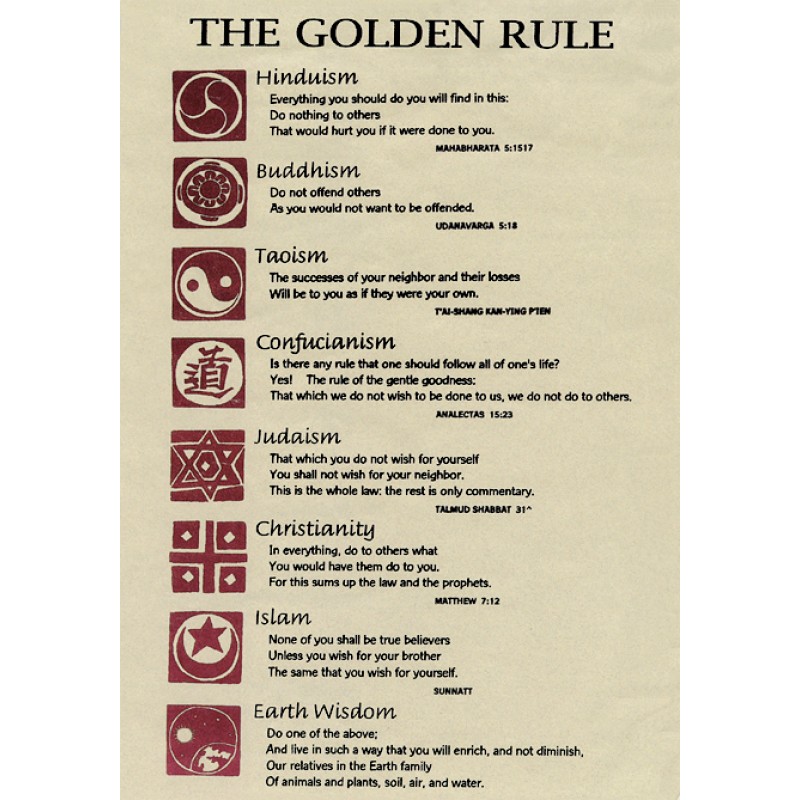
the golden rule

history-written-by-the-victors

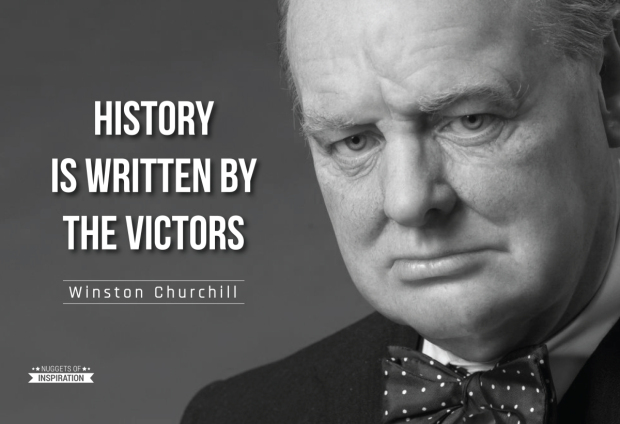
Quite a lot of people, most of them after misreading Machiavelli, have convinced themselves that ‘history is written by the victors’.

Even Winston Churchill, once a victor himself, had fallen into this trap.

Lately, more and more have started to doubt this assertion.

History is written by the writers.
Steve Theodore, professional game developer, amateur know-it-all

Ouch!

OK, let me dig deeper.

In reality, being able to write is not enough.

In order to be able to write about something, you have to survive it first.

And something else. Merely writing it would not necessarily preserve that information for further referral. For us to be able to read it. And be influenced by it.

So, the history that we are aware of today has been written by those who have survived the events, were smart enough to write and to understand the real importance of what they have just done. And to preserve the results of their effort.

But there’s more to it.
Basically there are at least two manners in which someone can describe something.
As close to what they honestly remember or in such a way as to bring as many benefits to the writer as possible.

I’m sure that you’ve already figured out what I’m hinting at.
Yes, the first manner of writing produces ‘true’ history while the second yields mere ‘propaganda’.

Which can be, indeed, useful.

On the shortest of times and only as long as the writer itself does not start to believe in his own writings!

Otherwise they’ll join the fate of the likes of Goebbels and …

goebbels-children

You know, Hitler’s very efficient ‘spin doctor‘ (“Think of the press as a great keyboard
on which the government can play.”) who, at the end of WWII and with the help of his wife Magda, had “murdered their six children and killed themselves as Soviet forces closed in on the bunker.” Would you call that a ‘victory’?
But we have to give him what was really his. He was a ‘man of his word’.
If the day should ever come when we must go, if some day we are compelled to leave the scene of history, we will slam the door so hard that the universe will shake and mankind will stand back in stupefaction..

So.
For some people to write history and for that history to remain as they have written it, the writers had to survive ‘it’, learn from what had happened to them that they were the in possession of very important information and decide to pass on that information, as truthfully as possible, to the next generations.
To help them survive if/when confronted with a similar ordeal.
And this very fact, that the history they had written taught someone how to survive, transforms the writer into the real winner.

In fact ‘history’ will be passed from one generation to another only as long as the next generation replaces peacefully the older one. Only as long as the older one helps the new generation to ascend into the future.

Otherwise, if the ‘children’ have to fight their ‘parents’ – as in ‘contradict what they had been taught by their teachers’ – in order to remain alive, they will also re-write the ‘history’ they had to fight against while struggling to survive.