Archives for category: corruption

Trump's shirts


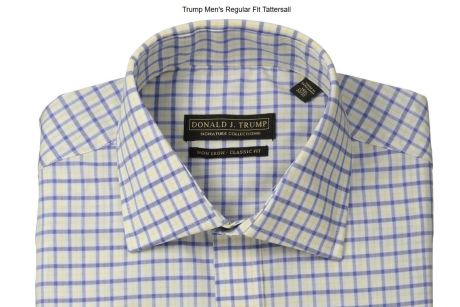
Did you know that Trump was selling shirts over the Internet?

Yes, Trump, the guy that so many Americans are going to vote for simply because they are convinced he will completely change the way America works.

Why?
Because he says so.
He presented himself as the quintessential anti-establishment candidate and they bought it.

OK, something has to be changed so I fully understand their exasperation with the current state of the Union.
But is he “the” guy?

And since deeds are, or should be, more convincing than words, lets see if he is as anti-system as he pretends to be.

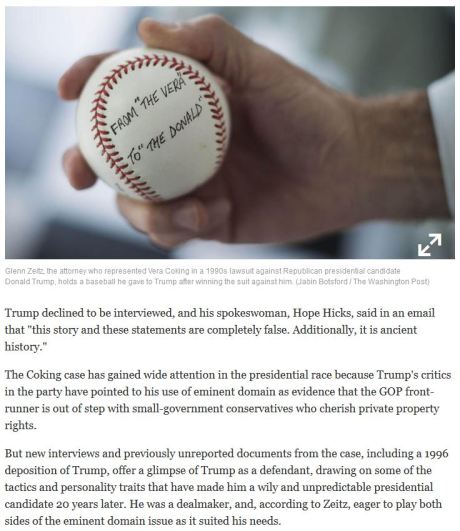
Well… at some point he did try to use the power of the government in order to con an old lady out of her house, didn’t he?
from the vera to the Donald

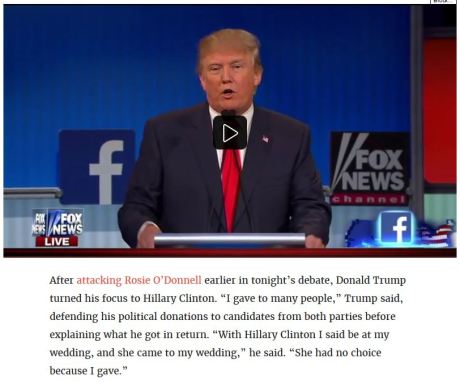
And he did ‘bribe’ Senator Clinton to come to his wedding. Simply because he had the money…

clinton came because I gave


And now this.
The way I see it the real problem is not the fact that he makes his shirts in Bangladesh in spite of being vocal about the need to preserve American manufacturing jobs. After all it’s his job to conduct his business as he sees fit. And if he is comfortable with doing one thing while saying the complete opposite…. that’s his job too.

But how come so many people take his words for real, without at least perfunctorily checking the facts?
How come so many are they so convinced he is ‘the right guy’ when he sells himself so cheap?

Oh, you didn’t know you could buy a “Donald J Trump Signature Collection” shirt for as little as $12.56!
Why is he doing this? Because he is so anti-Establishment that he doesn’t care about money?
You’re already laughing, right?

Or he simply does it because he can get away with it!
Because we don’t really care. Not anymore…

As one of my friends said about Hillary Clinton, Trump’s ‘Democratic’ counterpart:
” Hard to fathom how someone so openly, unapologetically corrupt can be the front runner. I think that says a lot about what we really expect from our politicians.”

I’m afraid she’s absolutely right.
We are the real culprits here.
‘They’ are simply doing what they are good at, grabbing gleefully whatever opportunities are within their reach, but we are the ones providing those opportunities.

Not only in America.

The New York Times, from the other side of the Atlantic Ocean, has found out that Calin Popescu Tariceanu, currently the second most important political persona in Romania, as the Speaker of the Senate, is being investigated “for giving false testimony to aid suspects in a wider real estate graft case.

Prosecutors said Tariceanu made untrue statements under oath in April when he was called to testify in an investigation in which …

OK.
So he isn’t investigated for anything he might have done then but for something he had (not?!?) recently said about the whole thing, now.

“Tariceanu denied wrongdoing and fired back at magistrates, saying “we live in a republic of prosecutors based on the politics of dossiers and handcuffs”.”

At this point it is very important to remember that Mr. Tariceanu has been at the fore front of the Romanian political stage for the last 25 years – for instance he was the Prime Minister from 2004 to 2008, and to mention that he is only one amongst  the many Romanian politicians being criminally investigated who deplore the growing importance of the role recently assumed by the Romanian prosecutors.

I’m not going to discuss here the individual merits of each of the corruption cases that have been investigated recently. It is very possible that some of them were started, or closed, because ‘somebody’ had made specific ‘recommendations’. The prosecutors are human beings themselves.

But isn’t it rather strange that so many of the people who have actually honed the finest inner wheels of the contemporary Romanian state are now complaining about the way it works?

During the last 26 years this rather small group of people had countless opportunities to put things on the right track.
It seems that they didn’t succeed. For various reasons.
But it also seems that some of them, at least, had ‘ulterior motives’ for not succeeding.

Some of which are now being unearthed by the prosecutors.

The point being that we shouldn’t become mesmerized by the process.

Let the prosecutors do their job. Under close supervision, of course.
Learn the appropriate lessons.
“Do not steal” is important not so much because it is one of the Ten Commandments but because no society that has condoned theft on a large scale has ever thrived for long long enough to really enjoy the spoils.

Coming back to the Romanian political class – and to the people itself, everybody eventually gets to sleep in the bed each of us has prepared for itself.

If corruption wasn’t so widespread as it is today the prosecutors wouldn’t have been able to launch so many investigations.
If corruption wasn’t so widespread as it is today the ordinary people would have undoubtedly enjoyed a way better life. Maybe one close enough to the point where they wouldn’t have minded so much ‘a little’ corruption.

I have to end this by quoting Traian Basescu, the former President, also a very controversial figure:

“Corruption rests with two sides. I do not want to change responsibility, but it must be shared and assumed. A corrupt civil servant cannot be corrupt if they do not have a partner to put money into their hands, a ministry cannot pay by 50 percent more if there is not a consultant to sustain what the constructor says: ?Yes, we’ll raise the bill’. The ministry finds it impossible to act, because anyone wins in court if one also has the consultant’s advice that they should increase the public works price by 50 percent’, Basescu said at the launch of the Report on the Competitiveness of Romania, an event organised by the Romanian-based American Chamber of Commerce.

The President went on: ‘I believe we must, first and foremost, leave hypocrisy behind. The state alone cannot be corrupt, it has a partner, if there is corruption. The state alone cannot be non-performing, it has a partner. Let us together assume what we have to do. The easiest thing for the private sector to do is to criticise the state and the easiest thing for the state to do is to show indifference to the problems facing the business environment. I believe we are not in such a situation. We all want to have performance, to be competitive.”

Those of you who are interested in learning more about how we got here might start by reading this report by Oxford Business Group.

Clinton, trump, unpopular

Not so long ago I was asking myself “What’s going on there?“.

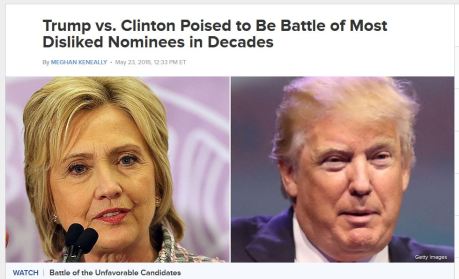
Now, that my nightmare is very close to becoming reality – both major American parties are about to nominate unpopular candidates for the 2016 presidential elections, I’m wondering about the current meaning attached to the very concept of ‘politics’.

For an impersonal and very theoretically minded observer ‘politics’ would seem to describe the job of those who make it possible for the rest of us to lead our lives in an orderly fashion.

I believe you are familiar with what a ‘super’ does. ‘Super’ as in ‘superintendent’ for a residential building.
“The super must be conversant with every mechanical and technical system in the building, work diplomatically to solve problems in the building, be responsive to residents and be able to work as a team member with the board and the managing agent.”
Not exactly ‘rocket science’ but a very important role. So important that when poorly played the whole thing might very quickly deteriorate beyond repair.

After all, ‘the government’ should do nothing more, and nothing else, but act as a nationwide ‘superintended’ while ‘politics’ should be nothing more, and nothing less, than what we, all the inhabitants of a country, do in order to make sure that the government, our government, does its job. Properly.
Especially when living in one of the so called ‘democratic countries’.

Then how come I’ve got a growing feeling that ‘politics’ have become just another set of means towards specific goals? Goals that are more often than not detrimental to the society, as a whole?

PS.
This is for those of you who are not familiar with how this site works.
By clicking on the pictures, or the highlighted text, you are automatically linked to the sources of the quoted material. Sometimes they might be interesting, to some of you.

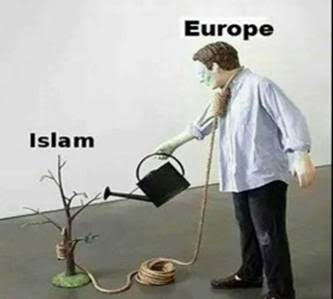
Islam Europe

I’ve just found this cartoon in my e-mail.
It was captioned: “The Winning cartoon in an organized competition.”

I instantly remembered some very wise words I’ve read long time ago:

Do not be deceived: God cannot be mocked. A man reaps what he sows.
Whoever sows to please their flesh, from the flesh will reap destruction; whoever sows to please the Spirit, from the Spirit will reap eternal life.
Let us not become weary in doing good, for at the proper time we will reap a harvest if we do not give up.
Therefore, as we have opportunity, let us do good to all people, especially to those who belong to the family of believers.”

“Beware! Whoever is cruel and hard on a non-Muslim minority, or curtails their rights, or burdens them with more than they can bear, or takes anything from them against their free will, I (Prophet Muhammad) will complain against that person on the Day of Judgment.”

All religious teachings, all of them, maintain that ‘a man reaps what he sows’. It doesn’t really matter if the ‘result’ will come as a sentence delivered by a divine judge or if it will be just another bead in the string representing the life story of an individual.
I, for one, don’t see much difference between ‘fate’ and ‘karma’.

Then how come we keep acting as if we’ve never been warned?

“In my two visits to Auschwitz, the Nazi concentration camp in Poland, I learned that holocausts and genocides do not occur in a vacuum. Rather, there is almost always a vicious campaign of incitement directed against the target group preceding them. What is troubling today, with the recent uptick in anti-Semitic and Islamophobic incidents worldwide, is that extremists and zealots are not the only ones inciting their followers. In a number of Arab countries, Muslim children are taught ideas that distort the true meaning of the Quran and hadith too.”

o-gay-prophet-570

Love, more powerful than hate.

This is probably the biggest bone of contention between the conventional sides of the political spectrum.

The conventional right claims that we’d be a lot happier with a considerably smaller government while the conventional left would, if left to its own devices, transform the government into a huge, and ‘smothering’, nanny.

Is there any reasonable way of determining the right size of the government or we should just try to reach a compromise between the warring factions?

I don’t think I’m smart enough to determine how big a government should be.
I also dislike the very concept of compromise – if I have to settle something I prefer to negotiate instead of compromising.
And that’s is why I’d rather approach this problem from another angle.

What KIND of government!

Let me take you on a short, and very condensed, historical ride.

Basically humankind has used, somewhat alternatively, two systems of running things.

Authoritarianism and democracy.

Specifics do not matter much. If decision making was centralized it was authoritarianism, if decisions were made by those directly affected by the results of those decisions being put in practice it was democracy.

What’s really important here is the fact that those two different manners of decision making generated different forms of government.

Authoritarian regimes employed ‘administrative’ (meaning ‘directorial’) forms of government while democracies were served by ‘referential’ forms of government.
And it was only natural that things happened this way.
Authoritarian regimes need nothing more than a ‘transmission belt’ to convey orders from the very top to the base of the social pyramid while democracies need a team of referees to keep the playing field level and nothing more than that.

Of course that I’m presenting a very simple sketch here. Things are more complicated than that.

And there are at least two main complications. ‘Human greed’ and ‘international relations’.

It doesn’t really matter if that greed is for money of for power. Whenever greedy individuals are allowed to enter the government and to cater for their ‘special needs’ things are headed south. And the only difference between this situation occurring in a democracy or under an authoritarian regime is that the latter has no natural defense against this kind of ‘mishaps’.

‘International relations’ play a less obvious role. The main job a government has to fulfill is to keep the state together. If a hypothetical state would exist in a vacuum – and have no neighbors, things would be a lot simpler. Since in the real world states do have neighbors the governments have to organize armies, secret services, engage in arms races…
Also in the real world states are very different. In size, for instance.

For all these reasons it’s very hard to ‘calculate’ the ‘proper’ size of a government.

Specially so without defining clearly what’s expected from that government.
An authoritarian regime would ask the government to preserve the privileges of those at the helm of the regime while a truly democratic minded people would expect their government to safeguard, using legitimate means, the independence of their country on the international level while simultaneously making sure that the individual members of that people enjoy enough personal autonomy so that their political regime remains democratic.

After those expectations are clearly formulated, the size of the government will simply be a consequence…


rape in the not so virtual reality

Two concepts are slowly merging into one and becoming more and more obvious for the most oblivious among us.

Virtual reality was mentioned for the first time way back in the XXth century.
In 1938, Antonin Artaud described the illusory nature of characters and objects in the theatre as “la réalité virtuelle” in a collection of essays, Le Théâtre et son double. The English translation of this book, published in 1958 as The Theater and its Double,[2] is the earliest published use of the term “virtual reality”.
Nowadays the concept has been widened to cover a lot more than what’s happening inside the theaters.
In fact, the technology used to create VR is able to transform everyplace in a stage, everybody in an actor and to broadcast everything almost everywhere.

The other concept I was mentioning at the beginning of my post is a lesser known one.
The Social Construction of Reality“, published in 1966 by Peter L Berger and Thomas Luckmann eloquently explains how various groups of people collectively adapt their historically accrued habits (cultures) to the ever-changing surrounding reality. One of the sources of change being human activity itself.

The latest, that I heard of, addition to the realm of the not so virtual anymore reality is Periscope. A mobile app that lets its user broadcast, live, whatever he/she deems interesting enough from what is taking place around him/her. What is broadcast has a ‘shelf live’ of 24 hours but can be deleted at wish or made permanent. Also the sharing ‘voyeur’ has control over the audience, it can be set as ‘public’ or ‘private’ – and broadcast only to a selected few.

Some days ago two female high-school students and friends, one 18 and the other 17, met a 29 male in a Columbus, Ohio, mall. He bought them a bottle of vodka and “encouraged them to meet him the following day“.
The girls ‘honored’ the invitation, the three  ‘socialized’ for a while – read “had all been drinking“, and then the male proceeded to raping the youngest of the girls.
The older one live-streamed the rape using Periscope.

The case came to light when authorities were contacted after an out-of-state friend of the woman saw the images, Franklin County Prosecutor Ron O’Brien said.

It is not unusual for a rape to remain unreported by the victim. It’s not OK, but it happens.
Also it is not that unusual for a rape to remain unreported even after friends or relatives of the victim learn of the event. Again, it is not OK but it is known to have happened before.

Yet this is the first time that I’ve heard of a rape that had taken place practically in public and which wasn’t reported ‘live’ to the police.

‘She does everything possible to contain the situation even to the point of asking while it’s being filmed to these Periscope followers, “What should I do now? What should I do now?”‘ Shamansky said.” Shamansky being a lawyer for the older girl, who is currently charged with rape, alongside the male perpetrator.
Separately, she is being charged with “illegal use of a minor in a nudity-oriented material or performanceforlivestreaming her friend nude the day before the assault“.

And how did the viewers react to the broadcast? Except for the “out-of-state friend of the woman” who reported the incident, of course?

Here’s the prosecutor’s side of the story:

O’Brien said Lonina is seen trying to help only briefly during the 10-minute video. O’Brien said the victim was clearly screaming ‘stop’ and ‘no’ during the assault.
Although Lonina told police she was trying to record the assault as evidence, her behavior as people watching via Periscope ‘liked’ the assault painted a different picture, O’Brien said.

‘She got, I guess, taken up with all the “likes” that her livestream was getting and therefore continued to do it, and did nothing to aid the victim,’ O’Brien said.

I don’t know what, or even if, she could have done anything in a really effective manner – remember that all three had been drinking – but I know for sure that at least some people were watching the live stream. The ones “liking” it.

I still cannot understand how come all of them failed to call 911.

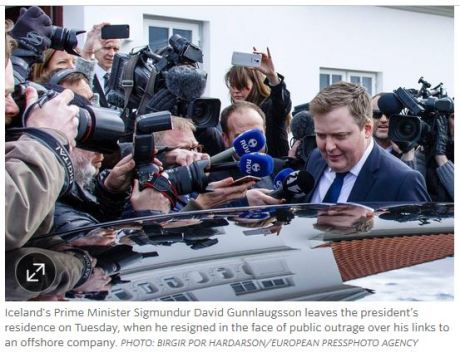
The ‘Panama Papers’ rekindled the public interest in the subject of ‘what legitimate goal could anyone have in setting up a company in a fiscal paradise?’.

Taxes, stupid!

Actually it’s quite simple.

Let’s pretend you are an alien from the outer space who has a business idea backed up by enough capital and you want to put it in practice somewhere on Earth. Aren’t you going to shop around for the best environment you might find? So that your business would have optimal conditions to grow? And when the business ripens wouldn’t you want to be able to cash on it – and end up with as much money as possible?

Rather conflicting demands, isn’t it?

First you want an ‘operational base’ with relatively low costs but secure and full of whatever amenities your business might need in order to thrive. Next you’ll need fast access to a market where to sell your wares. Last but not least it would be important for you to incorporate your business in such a way/place that you’ll end up pay the least amount of tax, both while operating the business and after the cash out moment.

While all these are legitimate demands there are a right and a wrong way to meet them.

I’ll refrain myself to discussing exclusively about the tax part, the rest being relatively easy to balance.

In this respect you can choose to incorporate the business in the same place you have selected for your operational base and pay whatever taxes are due in that place, under the rationale that those taxes cover the cost of doing business there and are nothing but a compensation for benefiting from the conditions present there at the time. After all, when you have chosen a particular place as the home of your business you have entered into an informal arrangement with that place. It lets you make good use of whatever is there to be used – exactly the things that convinced you to select that particular place, and expects you to fulfill your side of the bargain. Provide enough compensation so that that place can continue to be a good place to conduct business and, if possible, improve itself. Pay the local taxes.

Or, equally legitimate, use two different places for each thing. Organize your operational base where it would work best and incorporate your business in a place where you’ll be able to pay as little tax as possible.

And here’s the catch. No matter where you incorporate your business you’ll still have to pay some taxes in the place you have chosen as your operational base.

Then why bother?!? you might legitimately ask.
Since this is not an accounting dissertation I’ll just tell you that there might be serious financial advantages in making this choice, not the least of them having to do with the cash out moment.

And this is the very point where some people get greedy. They try to avoid altogether the taxes tied to the ‘operational base’ – by employing various semi, or even completely i-legal stratagems, and by doing so completely transform the very nature of the entire operation.

From one of fiscal optimization to one of money laundering.

There are a lot of rationalizations for this course of action. From ‘the state is a thief that uses force in order to part me from the fruit of my efforts!’ to ‘why give it to the state since the money will be squandered by the inefficient government?’.

Now let’s please remember where we started from.
OK, you are not an ‘alien from the outer space’ but what’s stopping you from conducting your business where ever you want on the face of this Earth? (My bad, this question is not valid for exactly everybody, there still are countries that don’t allow for people, or capital, to exit freely, but I’m sure you get my drift)
Oh, you like it where you are but you hate paying taxes and/or you’re disgusted by the way the government handles its finances!

Then let me remind you of two things.

First, you probably live in a democracy. Speak up. Make your concerns known. Loudly. Make sure you are listened to. Vote wisely.

Secondly, you are probably fed up not only by the fact that in your country taxes are really high but also by how little you get back in return.
Well… that’s because there are so many people who do not pay their fair share and that your government has to take more from those who do pay in order to make the ends meet.

Savvy?

iceland prime minister resigns over Panama papers

As you can very easily infer from the title, I define myself as being an agnostic.
I’m reasonably satisfied with the scientific explanation about how the world came to be but I cannot rule out any intervention from an out-side agent during the process.

Hence my unwillingness to commit myself to any of the extreme positions.

And hence my conundrum.

A significant portion of the theist believers are convinced that God, their God, is behind everything that takes place on the surface of the Earth. And beyond.

All scientific materialists are convinced that everything takes place according to some immutable and implacable ‘natural laws’.

Then how come any of them has enough gumption to contradict any of the others?

How come a religious believer can say to another ‘your God is false’ if he is convinced that nothing in this World can happen without the knowledge and approval of his own one? Isn’t this a form of censorship towards his own God?
How come a religious believer can say to an atheist ‘you are going to rot in Hell’?
Last time I checked all Gods were very jealous, all religious teachings I know are clear about this: ‘You do your job and let Me do the judging.’ Then how come so many zealots feel free to usurp the place of their Gods and pass judgement on their peers?

How come so many of the atheists feel free to poke fun at the believers?
According to their own creed, religion is a natural thing. It does exist, isn’t it?
And by its mere existence it necessarily observes the very natural laws the atheists so staunchly defend. As if any of them needs any defense, let alone to be imposed upon the others…

When are we going to accept that religion, any of them, is nothing but an environment, not a yoke?
Just a place with some rules, not some kind of a prison?
That the final responsibility for our acts belongs to us, regardless of any God watching or not over our fates?

Here on Earth, anyway.

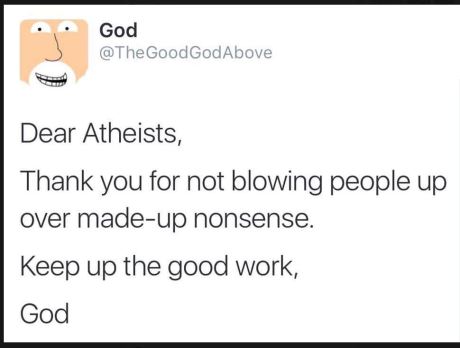
God thanks

I recently shared this meme, originally posted on FB by Black Atheists.

The broad spectrum of the commentaries made on this subject enticed me to elaborate on it.

There are people who blow people up under religious pretenses and people who blow people up under their own ‘rationale’.

This meme can be interpreted as God praising those who do not use his name when committing heinous crimes.

Who do not misinterpret religious teachings to fit their callously narrow goals.
Who do not make up self-serving nonsense simply because they have enough sleigh of mind and an audience who, for various reasons, is willing to believe anything that might provide some psychological comfort.
Who do not use religious pretexts when horribly mistreating others.

And don’t get me wrong. God doesn’t praise them for what they’re doing – there is nothing to be praised there.

He praises them for what they are not doing.

Using false pretenses, that is.

Read the comments to any article that deals with the European Community and you’ll certainly find something to this tune:
“This is the end of the EU”

That might happen anytime, of course, but I’d still like very much to know why so many contemplate this possibility with so much glee? And I’m not talking here about those who think they have something to gain from a weaker Europe. Putin, for instance. Or Erdogan.

Why so many ordinary Europeans are so angry towards the very idea of a closely knit European Union?

How about reading the entire history of this continent as a long story of individuals striving hard to become more and more autonomous?

Some would say that Europe was about individuals becoming free, and I can agree with that. Only that freedom had strings attached.

“My freedom stops where your freedom begins”.

Meaning that none of us is really free unless each of us respects the liberty of all the others. That our individual liberties depend on each-other. Well, that’s the definition of autonomy, not that of ‘absolute freedom’ but let’s not be bogged down by words.

In fact what helped Europe become what it is today is an unique combination of ever growing individual freedom made possible by an ever stricter respect for the rule of law.

This was not at all a smooth process.

From time to time some individuals garnered a lot of liberty for themselves precisely by depriving all other of theirs and sometime even succeeded in writing this into law. For instance, until 1848 it was still lawful to own slaves in France.

Another type of ‘garnered’ freedom is what happens in a dictatorship. The dictator and his henchmen are freer than the rest of the people, but none of them as free as the people living in a truly free country. And Europe had witnessed a considerable number of dictatorships.

Which all eventually failed.

But something lingered in the collective memory of the Europeans. Their disdain for being told what to do. Their mistrust for rules imposed from above, for regulations that did not have the opportunity to become evident, through the passage of enough time, for those called to follow them.

This is why the ‘enthusiasm’ with which “l’aquis communautaire” was peddled by the Brussels bureaucrats to the new entrants has been met with such reticence.
This is why the measures being practically imposed by the more powerful members of the Union to the rest of the gathering are met with such scorn.

Very little real consideration is being given to the manner in which these measures are adopted and then communicated ‘from above’  and, simultaneously, very little attention is paid, by those called to put them in practice, to what their real effect would be – if they’d be applied in earnest.

And, unfortunately, there is no real shortage of callous political mavericks who eagerly try, and sometimes succeed, to capitalize on these misgivings.

As if we didn’t know any better.