Archives for category: collective identity

1x59cvjb_mojtouxmkbihsq

“When we’re trying to recreate an intellectual milieu, even one that’s relatively recent, we invariably discover that the vast majority of the sources we need to do such a thing have been swallowed up by oblivion and lost forever. Sometimes those that remain—e.g., Plato’s dialogues—remain because they were the best of the best, works of great importance. But this isn’t always (or even usually) the case. Sources often survive for largely accidental reasons. Regardless, the temptation to exaggerate the significance of what we have has proven irresistible for generations of intellectual historians. As the philosopher Aaron Haspel puts it in Everything (2015): “The parable of the drunk looking for his keys under the street lamp, where the light is better, explains vast swaths of intellectual history.” (John Faithful Hamer, Touch They’re Real in his blog Committing Sociology)

As always things are not as simple as they seem at the first glance – otherwise we wouldn’t have had a parable to start with, would we?

Basically the drunkard is doing the only reasonable thing available to him. Searching in the lightless park would be completely pointless but what if somebody else had lost a wallet in the lighted area?

Aaron Haspel is also right. Our intellectual history consists indeed of whatever cultural artifacts have been lucky enough to survive. Considered important enough by a sufficient number of people so they helped preserve it to the present day.
Or, evidently, both!

I’d like to direct your attention to ‘Considered important enough by a sufficient number of people’.
You see, the drunkard was looking under the street lamp because ‘This is where the light is’. He was reacting rather sensibly to a real situation.

But what if the reality of something is not so easily ascertainable? What if it’s a ‘second degree’ reality, one that is constantly (re)created by human intercourse? Like people choosing which book to keep and which one to throw into a bonfire?

fahrenheit451

Or even a ‘third degree’ reality? One that is imagined by someone who tries to assess the wishes of somebody else?

“Politicians are fooled into thinking corporate welfare is important to voters because politicians spend an inordinate amount of time with the powerful people to whom corporate welfare is vitally important. That’s why every candidate who has tried to win Iowa has prostrated him or herself before ethanol.”

You certainly guessed it. This paragraph will be about the ‘fourth degree’ reality. The one we, the voters, bring upon ourselves at the ballot box. After having carefully considered each candidate and his or her programme. Or having voted with ‘that particular one’ just because  …

The point I’m trying to make here being that this ‘fourth degree reality’ is not at all ‘virtual’, in the manner the second and the third ones are. In fact this ‘fourth degree’ reality is exactly the one where we have to live. Where we are faced with the consequences of the choices we, ourselves, have made while bringing it about.

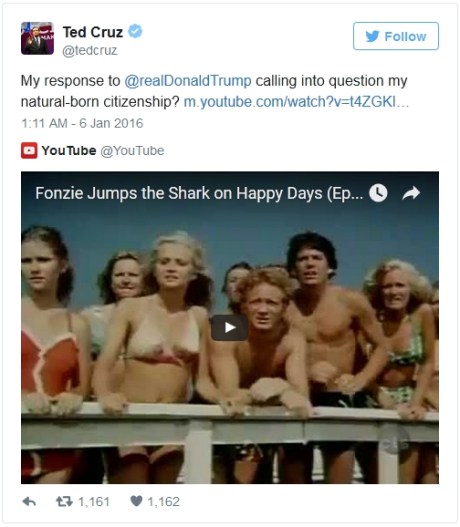
cruzmeme

“That was done by somebody named John Fugelsang, who somehow thinks he’s funny. At least he has the courage or naivete (you decide) to own up to such stupid overgeneralizing, of a company-line liberal sort that panders to a sycophantic gaggle of Cruz-hating left-wing foamers. [I’ve hosted the image locally in case the creator sees this essay and tries to delete it from his social media out of shame and embarrassment…sorry, man, too late–it’s on the record now!”

“The Candidate is a natural born citizen by virtue of being born in Canada/(Hawaii) to his mother who was a U.S. citizen at the time of his birth,” the board said, explaining Cruz/(Obama) met the criteria because he “did not have to take any steps or go through a naturalization process at some point after birth.”

Wow… That settles it… Both are indeed ‘natural born citizens’ so the only relevant thing here is the manner in which people relate to a ‘delicate’ subject.
Some tend to let themselves be driven by sentiment rather than reason while others change their minds according to their most immediate interest.

September 9, 2015, at a rally in Washington against the deal with Iran:

“Despite being rivals for the Republican presidential nomination, Cruz and Trump enjoy an unusually cozy relationship. Cruz, who invited Trump to the rally because he would bring the spotlight, praised the real estate mogul as “my friend” and the two men embraced on stage.”

“I hear it was checked out by every attorney and every which way and I understand Ted is in fine shape,” Trump told ABC News just before speaking at a Capitol Hill rally blasting the Iran nuclear deal.

Fast forward to January, 2015.

“Donald Trump doubled down on rival Ted Cruz’s citizenship Monday night, again questioning whether the Canadian-born Texas senator is eligible for the presidency.
“My new battle is with a gentleman named Ted Cruz,” the billionaire real-estate mogul said at a rally in Farmington, N.H. “The Canadian, the man from Canada.””

“But Trump has begun to raise an issue that could have deeper resonance. He criticized his principal GOP rival as trying to portray himself as “Mr. Robin Hood — he’s gonna protect you from the horrible Wall Street bankers,” when he took a loan from Goldman Sachs, his wife’s employer, for his Senate campaign, which he didn’t fully disclose.”

“Cruz noted that Trump in September said Cruz’s Canadian birth did not disqualify him for the White House since his mother was an American citizen. Now, he has changed his mind.
“Now since September, the Constitution hasn’t changed,” Cruz said, “but the poll numbers have.”
Trump acknowledged as much, saying that Cruz didn’t seem like a threat before, but now is neck-and-neck with him in the Iowa polls.”

perspective09

During this exchange Cruz brought back into the limelight an almost forgotten movie:
cruz jumping the shark

“That’s the scene that brought into our parlance the use of the term “jumping the shark” to signify that someone’s relevancy had reached it’s zenith and was in decline.”

Prophetic words?
For which one of them?

Anyway, my ‘democratic conundrum‘ is still unsolved.

Gov. John Kasich, maybe?

kasich, the underdog

I published yesterday a post on this subject. In Romanian.

Today I stumbled upon another article which uses almost the very same manipulative tools. In English this time.

legal public urination

“Of all the things one could think of that New York City needs more of, public urination doesn’t immediately come to mind. But New York’s City Council, which is so far left it almost collides with the right, is about to make it happen thanks to it’s Speaker, a Puerto Rican nationalist who supports terrorists and rejects the Pledge of Allegiance.”

 Now can someone explain to me how can decriminalizing something be interpreted as an encouragement towards that something?
And what’s the use of making it a crime to urinate or to drink in public? A crime? Something that will be written into your rap sheet and follow you all your life?
Let’s imagine for a moment that you are a 19 year old who had one too many beers. And had to take a leak. A cop happens to be in the area. Now tell me what are the chances that he’ll look the other way if you’re white? And if you’re black?
Do you understand, at least now, what the ‘liberal official who sponsored this change’ meant by ‘helping the minorities reach their full potential’?
Who’s going to give a real chance to a ‘minority’ with a criminal record? Who has the time to check that his only crime was ‘public urination’? Or that he had a beer in front of his porch? Not exactly in front of his porch, because he used to live in a ‘public housing facility’ but you get the general idea…
Reality check no 1.
How about providing some places where people can relieve themselves? Porta-johns for instance? Or functional public rest-rooms in all New York subway stations?
Now I’m wondering what the author meant by “But New York’s City Council, which is so far left it almost collides with the right, is about to make it happen thanks to it’s Speaker, a Puerto Rican nationalist who supports terrorists and rejects the Pledge of Allegiance.“?
What has the Pledge of Allegiance have to do with anything? What’s the relevance of the Speaker’s ethnicity, beyond the fact that belonging to a minority increased her awareness of the way the minorities are treated by some of the law enforcement officers?
And how come a ‘supporter of terrorism’ has been elected Speaker in the first place?
What’s going on here?

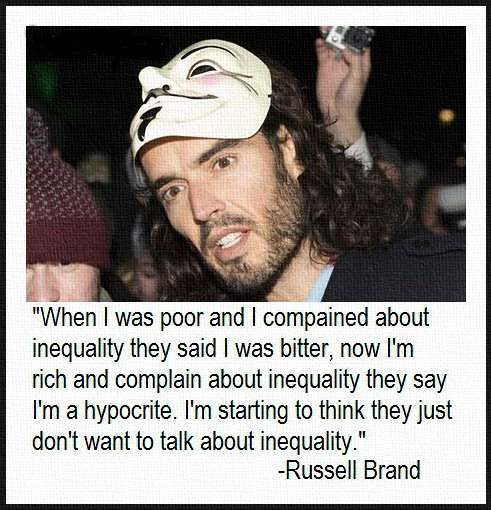
I recently shared this meme on my FB wall:

when_i_was_poor_and_i_complained_about_inequality_they_said_i_was_bitter_2014-07-23

This is what happened next:
No two people are the same.“”That’s why I prefer equal opportunities instead of equality.
No two opportunities are the same. What you might consider an opportunity I might pass up. It’s a very diverse world we live in, a wide one in which hopefully everyone can be accommodated.

‘Can be’ or ‘will be’?

And who is the real looser here?

Let’s see what the broad picture looks like:

The world’s super-rich have taken advantage of lax tax rules to siphon off at least $21 trillion, and possibly as much as $32tn, from their home countries and hide it abroad – a sum larger than the entire American economy.”

Meanwhile

education debt

And what’s wrong with that?!?
Everyone has the right to do what ever he wants with his money and why should anyone expect to be educated for free?!?

OK, let me put it differently.

Every society is like a big community, even if its members do not share an intimate knowledge of each-other.
At least theoretically an overwhelming majority of any nation share the same set of values and the same goal – the long term survival of both the population and the afore mentioned set of values.

Now please consider which society would be better at the game of survival:

One which would make it easier for as many of its members to develop as much of their individual potential as possible or one that would make it easier for a small number of its members to spirit away so much wealth that the rest would remain crippled?

One which would use the very concept of a ‘free market’ as broadly as possible – make sure that as many as possible of its members enjoy the widest possible autonomy – or one that would allow the ‘never as free as advertised’ market to degenerate into the ‘winner takes it all‘ situation we are bound to reach if we continue on our present course?

How could enough people afford to ‘wander around’ for long enough to find the opportunities that would fit them if they are saddled at birth with a huge burden – the ever burgeoning national debt?
Would enough people risk to take on any additional debt (in order to prepare themselves to make better use of the opportunities they might find) if too many of those opportunities, even if met diligently, do not pay enough to ‘eat’ AND pay back the debt?

How is a society going to survive, let alone thrive, if a lot of ‘opportunities’ (social needs) end up being ‘plugged’ by unfitting/under-skilled/’less than enthusiastic’ individuals? Or not at all?

On the ‘supply side’, what do you think of those who choose to dodge paying taxes?
On the ‘demand side’, what do you think of those who squander public money as if there is no tomorrow?

So what should we be talking about? Equality or Equal Breadth of Opportunity?
About the Bed of Procrustes or about a ‘Free Market’ where all participants are simultaneously autonomous and fully aware of their responsibility for their children’s future?

lp
“A day after Leela moved in, she came home visibly upset. I asked what happened. Apparently, the doorman had blocked her from entering the building, refusing to believe that the keys she was carrying were legitimately hers. She had to convince him to check the approved tenants list before he allowed her to go to her own home.The incidents piled up. Things that may seem small to someone who doesn’t endure these experiences, but that in aggregate soured her daily life. The cabs that wouldn’t stop when she tried to hail them but hit the brakes and backed up when they saw she was with me. The clerks asking her to verify her ID every time she presented a credit card. The smiles at me from neighbors and barely concealed scowls at her when I turned away. The usual catcalls and crude comments when she walked alone. It quickly became clear that although we shared the same day to day life, her existence was profoundly different from mine.

The event that brought it to a head was when she pressed ‘PH’ in the elevator and the other occupant, a white male, asked which penthouse apartment she was going to clean. The idea that she lived there didn’t occur to him. When I heard about it, my indignation was palpable. It was the indignation and disrespect she lived with every day and that was alien to me.”
….
“What I didn’t realize was that we are stuck in our own heads far more than we can appreciate and that empathy has limitations. As a white male, I can convince myself that I understand racism and sexism, but it’s far more intellectual than visceral. My point of view is distorted by the culture I exist in.”
Peter Daou, “My Rude Awakening on White Males, Brown Females and #BlackLivesMatter

Now consider this:
Mothers usually have a ‘disproportionate’ influence over their (small) children.
This translates into the psychological well being of the mothers having a huge influence on the general behavior of the next generation.
In a so called ‘normal’ family – composed of a father and a mother – whatever ‘bad moments’ that happen to the mother can, and sometimes even are, mitigated by the father.
But the sad reality is that there are a lot more Afro-American single mothers than white single mothers – relative to the demographic composition of the population.
And we still wonder about how come the Afro-American teenagers and young adults are the cause of so many unpleasant incidents – relative to the demographic composition of the population, of course…

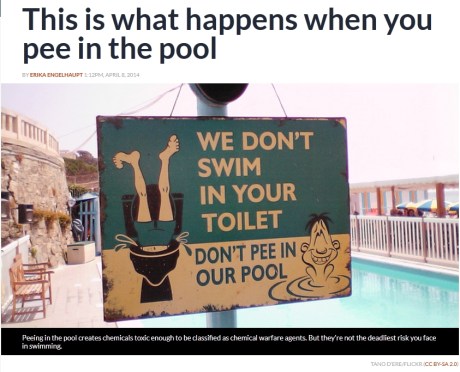
don't pee in our pool

First things first. Click on the picture and read the article.
It is interesting enough, even if it doesn’t say anything you didn’t already know – or at least presumed. That if enough people pee in the pool, the mixture of uric acid and chlorine, which produces some nasty chemicals, could become ‘powerful’ enough to affect a susceptible person.
The really interesting part being the fact that the scientists who have studied the matter do not seem to agree on how dangerous it is and what exactly, if anything, should be done about it.

But do we really need a scientist to tell us that we simply shouldn’t pee in the pool?
Regardless of whether the issuing chemicals would be powerful enough to harm us or not?

Then why do we hide behind slogans like ‘Global Warming is the New Religion’ when we discuss the subject of carbon dioxide being spewed into the atmosphere by the tens of billions of tonnes each year?

OK, I can understand that some of us are not convinced by the data put forward by the ‘alarmists’, specially after some of the scientists studying the matter have changed tack and have become ‘skeptical’ about the whole thing.
“I would say that the global warming is basically a non-problem. Just leave it alone and it will take care of itself. It is almost very hard for me to understand why almost every government in Europe — except for Polish government — is worried about global warming. It must be politics.”

“So far we have left the world in better shape than when we arrived, and this will continue with one exception — we have to stop wasting huge, I mean huge amounts of money on global warming. We have to do that or that may take us backwards. People think that is sustainable but it is not sustainable.” Ivar Giaever, 1973 Nobel Prize for Physics, speaking in July 2015.

So. Cutting down the tropical jungle to make room for palm trees grown for their oil and burning during the last two centuries fossil fuels that have been accumulated during God only knows how many millennia is ‘sustainable’! Yeah, right.

Do you remember the smog that used to hang over Los Angeles until some of us wised up to the matter?

Is it a matter of politics?!?
And money?!?
And what’s new about that? Or is it that some of those who have to gain from us continuing to burn fossil fuels, indiscriminately, have not understood, yet, that we are all together in this? That the atmosphere is nothing but the huge ‘pool’ where we all live?
And breathe…

To me it doesn’t really matter what ‘science’ has to say about this. In fact ‘science’ cannot speak, it’s the scientists who speak on its behalf.
Now, since they don’t seem to agree on this subject we’d better realize that ‘This is too important a matter to be left to the scientists’ and remember the Hippocratic principle which teaches us ‘primum non nocere’: ‘Above all, do no harm!’

If ‘it’s a matter of politics’ how about us telling the politicians how we wanted it solved instead of letting them scheme on it?
And then let the business people take care of the money part?

One other thing and I’ll wrap it up.
I can already see my libertarian friends frowning:
‘He had jumped on the big government bandwagon’.
Not so fast.
In fact this is not a decision that should be made by the government, be it big or small.

We are the ones who should make up our minds about this matter.
We are the ones who should close the faucets, use more efficient cars, collect the trash selectively, etc, etc, etc… and maybe even walk a little.
We are the ones who should instruct the governments we have elected to use some of our tax money to finance some honest research into renewable power sources instead of allowing them to transform the whole issue into another ‘pork barrel bonanza’…

wumo567852b7e8fa87-46431296

tripoteur de fesses en allemagne

‘J’ai etait Charlie’ when the barbarians tried to silence it.
Not because I agreed with everything that was published there but because I believe that it’s unacceptable to try to kill somebody – unless that somebody tries to murder you, of course.

Having said that I must confess that I find it harder and harder to understand what’s going on in Charlie’s mind.

“Charlie doit être là où les autres n’osent pas aller. Pour cette couverture, je voulais dépasser telle ou telle religion et toucher à des choses plus fondamentales. (…) En affirmant les choses clairement, ça fait réfléchir. Il faut bousculer un peu les gens, sinon ils restent sur leurs rails”

(Charlie must go where others do not dare to. For that I’m willing to leave behind specific religious ideas and reach deeper levels. … By speaking frankly (about a subject) one can convince the others to take the matter into consideration. Sometime you need to jolt people (outside their comfort zone) otherwise they’ll stay put on their tracks).

OK, I can agree with that. Even if I think that some of the ‘jolts’ are distasteful, to say the least,  the principle is correct.
But there is a small problem here. If the jolt is too powerful the target will not get just outside its comfort zone – and into the ‘thinking mode’ – but directly into a full-fledged rage. A state of mind which rejects reason and sends the brain into a frenzy, looking for arguments with which to annihilate the original message.

2233252_136_charlie

This, for instance, might be considered rude but it’s impersonal enough to prod some individuals into considering whether following blindly into someone’s steps  – just because that someone pretends to have God’s blessing – might be a wise thing to do.
In fact this message works precisely because it offers food for thought. Each of the viewers might interpret it according to their own ‘Weltanschauung’ but the ultimate responsibility for the interpretation lies with the viewer, not with the cartoonist.

This is why I can’t agree with the cartoon about Aylan.
There is no option there. The message is clear. Aylan would have grown up to be a sex-molester, no doubt about that – at least in the eyes of the cartoonist.

And this just isn’t fair.
Because killing hope is a lot worse than actual murder.

Yes, we need to take great care about how we help the migrants to find a place among us. No doubt about that.
The point being that corralling them into a ghetto won’t solve anything. On the contrary.

“When it comes to assimilating new arrivals, Europe could learn a thing or two from America, which has a better record in this regard. It is not “culturally imperialist” to teach migrants that they must respect both the law and local norms such as tolerance and sexual equality. And it is essential to make it as easy as possible for them to work. This serves an economic purpose: young foreign workers more than pay their way and can help solve the problem of an ageing Europe. It also serves a cultural one: immigrants who work assimilate far more quickly than those who are forced to sit around in ghettos. In the long run most children of migrants will adopt core European values, but the short run matters too.” (The Economist, Migrant Men and European Women, Jan 16th, 2016)


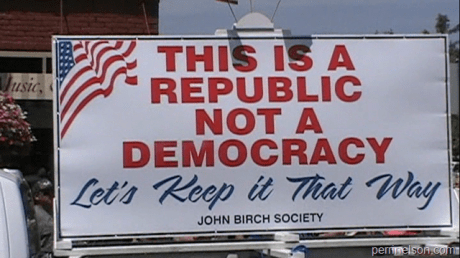
not2bdemocracy

Enter a caption

Our nation did not become great because our form of government was created as a socialist, communist, or any form of democracy; it was specifically created as a constitutional republic.

I’ve been trying for some time now to figure out the origin of this huge confusion.

Yesterday, during an exchange on this subject, a FB friend of mine used this link to prove her argument:

An Important Distinction: Democracy versus Republic


And there it was, laying in plain sight, THE explanation I was too blind to find it by myself.

It is important to keep in mind the difference between a Democracy and a Republic, as dissimilar forms of government.

Come again?!?

Since when democracy has become a “form” of government?
If you want to discuss about forms of government you have basically two: republican and monarchic. In a republic the head of state is changed from time to time, sometimes in a more or less democratic manner, while in a monarchy it is customary for that head of state to be replaced only after his death and by a person which has already been known for quite a while.

That was not what you had in mind? You meant what kind of interaction exists between the governed and the government?
‘Cause only in this realm we may speak about the difference between democracy – where the population has a say about its fate – and dictatorship – where the rulers don’t give a damn about the wishes of those who allow themselves to be ruled from above.

Don’t believe me?
Then please consider the British Empire. It is headed – nominally – by a monarch who has had no power for the last two hundred years or so and has NO – absolutely NO – constitution. Yet its democratic traditions can be traced down to the Magna Carta – a ‘compact’ signed in 1215 between the King (John of England) and his ‘free subjects’.

I used ‘ ‘ around ‘free subjects’ to highlight the fact that this is an oxymoron AND that the basic function of Magna Carta was to solve that oxymoron.
It actually doesn’t matter much what was written in that compact. The very fact that the King – erstwhile considered an almost divine person who until then had absolute power over his subjects and the land under his control – sat down at the same table with some of his erstwhile subjects and by his own signature conceded that they were “free” (‘all free men have a right to justice and a fair trial‘) signifies the dawn of a new kind of interaction between those at the no longer opposed ends of the society.

OK, things didn’t evolve smoothly. The Magna Carta wasn’t enforced in earnest until a lot later but still, the bird was out of the cage.

My point being that until we understand that the difference between ‘republic’ and ‘democracy’ is the same as the one between apples and oranges – and that we should stop comparing them – we are stuck.

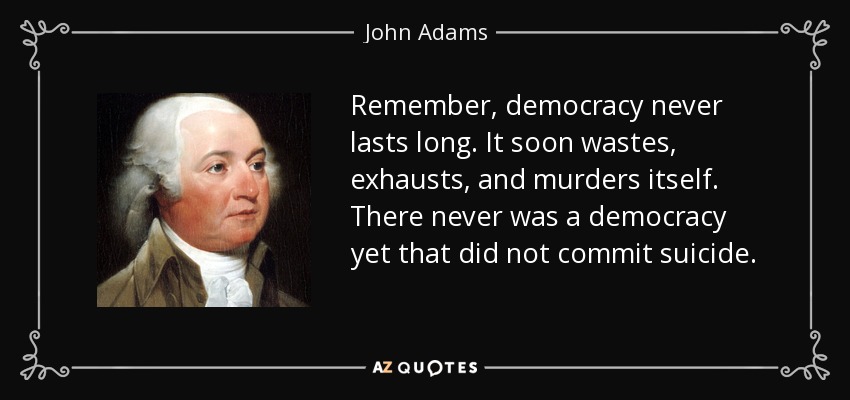
So, am I somewhat implying that John Adams was wrong?

quote-remember-democracy-never-lasts-long-it-soon-wastes-exhausts-and-murders-itself-there-john-adams-0-19-42

Not at all. All I’m saying is that he used a poetic license and that the quote is not only incomplete but also used in a misleading way.

“I do not say that democracy has been more pernicious on the whole, and in the long run, than monarchy or aristocracy. Democracy has never been and never can be so durable as aristocracy or monarchy; but while it lasts, it is more bloody than either. … Remember, democracy never lasts long. It soon wastes, exhausts, and murders itself. There never was a democracy yet that did not commit suicide. It is in vain to say that democracy is less vain, less proud, less selfish, less ambitious, or less avaricious than aristocracy or monarchy. It is not true, in fact, and nowhere appears in history. Those passions are the same in all men, under all forms of simple government, and when unchecked, produce the same effects of fraud, violence, and cruelty. When clear prospects are opened before vanity, pride, avarice, or ambition, for their easy gratification, it is hard for the most considerate philosophers and the most conscientious moralists to resist the temptation. Individuals have conquered themselves. Nations and large bodies of men, never.”

OK, he made the same confusion between ‘forms’ of government and social relationships between the people and those in power, only this is an understandable mistake. But, to his merit, he made it amply clear that it is the very “passions” of the people that “when unchecked, produce the same effects of fraud, violence, and cruelty”!

This is precisely the job that every constitution – not only the republican ones – is called to fulfill. Or a powerful enough tradition – please remember that the British ‘Empire’ has no constitution to this day.

Coming back to the notion of democracy I must add that it might not work properly, no matter how well written the constitution that presides over the process, unless the people who uses this form of collective decision making entertains the proper mental and moral attitude.
If the entire society isn’t permeated by enough mutual respect among its members then what Adams had warned us against is about to happen – regardless of any constitution. Or even under the cloak of the existing one.

You see, proper democracy works because it creates a frame where all those interested in the matter – all stake-holders – have the opportunity to express their grievances. This way the society is able to find out what doesn’t work properly and to take the appropriate measures.
But if there is not enough mutual respect going on around, things may become ugly, eventually. Just as Adams told us. When mutual respect weans out we stop caring about anything else but our own personae and ‘passions’ are no longer ‘checked’.
Society no longer acts like an organism and people become divided into smaller ‘mobs’ whose leaders fight each-other – sometimes under a democratic disguise – for followers.

That’s when democracy ceases to be a venue for a civilized debate about ideas and become an arena for the bloodiest sport of them all. Politician-ism.

That’s when some people start thinking like this.
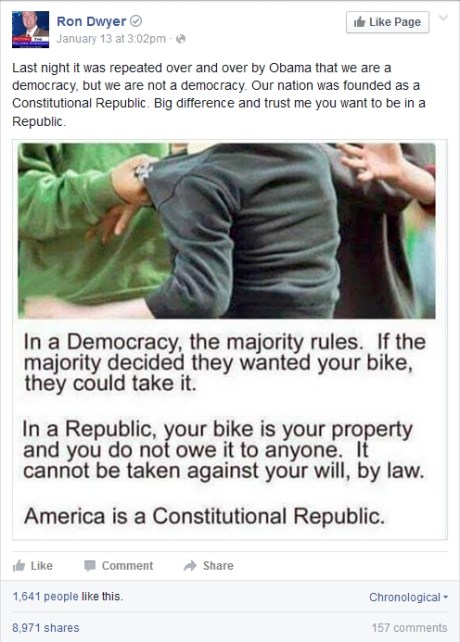
democracy, bikes

Or even like this:
jbs_3

Let me tell you something.
I’ve been living under a republican regime for all my life. Only for the first 30 years that republic was a communist one. It even had a constitution – and at the first glance it wasn’t such a bad one. But believe me, you don’t want to experience that kind of republic.

What you really want is true democracy, the one where people respect each-other. It doesn’t matter if that happens in a republic or in a kingdom. It is enough that it works, and for that to happen it is enough for the people to ‘check their passions’.

And mind you!  Whenever 51% of the voters band together to confiscate the bikes that the others have acquired through honest means, that’s no longer democracy but mob rule. Something that could very easily degenerate into communism. That’s what you want to avoid, not bona fide democracy.

future shock

Some 30 years ago Herbie Hancock published an album which proved to be uncanningly prescient. The future we have been building since is indeed shocking.

Breastfeeding in public is considered unbecoming by too many of us:

breastfeeding

“Weren’t you breastfed when you were little? – We had formula in those times!”

while almost none of us freaks out, for the right reasons, when seeing something like this:

devil prank

I’m afraid that if we don’t get our act together the future we are currently building for our kids will be even more gruesome than some of our pranks.

S

Somebody shared a video – where two senior citizens swing their golf clubs at some rather idiotic pranksters – on FB

golf prank

and captioned it “Don’t mess with old dudes and their balls…”

This made me wonder ‘what on Earth are we doing to ourselves?’ As a species, I mean.
OK, those kids did a rather stupid thing, indeed.
But let’s not forget that they have been raised by people not so very different from those golf players – statistically speaking, of course.
And where is the difference between what those two kids have done and the ‘practical jokes’ that are aired ad nauseam by most TV stations? Owned and run by individuals very much like those two annoyed ‘senior citizens. Who were enraged enough to swing their ‘irons’ at the pranksters, risking serious injuries…

How much lower can we get?

devil prank

PS.
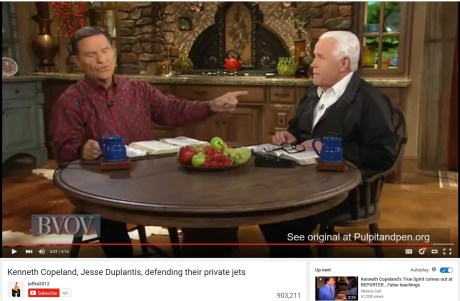
Somebody pointed me to this. You might say there is no connection between these two private-jet loving ministers and the pranksters but don’t think they all display the same level of callousness towards the rest of the people?

private jet loving ministers