
Everything any (most?!?) of us cares about is:
‘What each of us gets, and when.’
Emphasis on ‘each of us’.
All of us?
Everything any (most?!?) of us cares about is:
‘What each of us gets, and when.’
Emphasis on ‘each of us’.
All of us?

OK, I’m willing to admit that the past gives us a strong indication about what may happen in the future. Hence it might be a very good prophet!
The best?… that would depend on how each of us interprets the notion.
The notion of prophecy, of course.
And since the best( ?!?, 😉 ) way to understand an action is to figure out the motivation behind it…
Let me start with the beginning.
What is a prophecy?
In fact there are two kinds of prophecies. Of promises, actually.
‘Don’t do that or you’ll have to face the consequences’ and ‘if you’ll do such and such, your reward will be this’.
Only very few of the prophets have been using such a clear language. Most of them have preferred to use a much more convoluted manner of expression.
Quite understandably.
First of all, because these were ‘second hand’ promises.
They were not uttered directly by the promising agent but by a more or less ‘self appointed press secretary’. Who had no sure way of knowing whether he had at least a working understanding of the message he was supposed to deliver to his peers, whether they were going/able to understand/accept the message in it’s entirety nor whether they were going/able/willing to abide to all its intricacies.
Secondly, and this is applicable specially to the ‘don’t do it’ kind of prophecy, let’s examine what may happen if/when people do heed to a professed prophecy.
I’ll consider the ‘positive’ case first.
If people do ‘the right thing’, and the reward promptly arrives, they think/feel ‘it is rightfully theirs’, no question asked. The prophet is seldom remembered. And in the rare cases when people do remember they’ve been foretold, the extended thanks rise very rarely above ‘lip service’ level.
If people think they have done ‘the right thing’ but are unaware they have ‘trespassed’, one way or another, they expect ‘their’ reward. Which, usually in this situation, never comes.
Who’s more likely to shoulder the blame? Remember that the people are not aware of not having fulfilled their bidding!
The prophet?
You nailed it!
And there’s a strong possibility that he might get nailed himself!
Let’s examine the ‘negative’ case now.
The one where the prophecy is ‘don’t do that, or else!’
People might choose to heed to the warning. Hence no punishment. Again, the prophet is usually forgotten along the way. Mainly because the bad things he kept speaking about never came through/true. Or even worse, he may be laughed at. But he’s happy. He has helped his people avoid experiencing a bad thing.
Or people might choose to ignore the warning. Hence experience the punishment.
Or, even worse, the people might try to ‘do the right thing’ and fail. For what ever reason. Who would be the most likely to be held responsible by the masses, or blamed by the politicians? For making an incomplete, or mistaken, prophecy…
An even stranger situation develops when the ‘judge’ decides to give ‘his’ people another chance. And postpones the (well deserved?!?) punishment. Is it possible that the people might decide to ignore altogether the prophecy, completely misinterpreting both the prophecy and the misericordia displayed by the judge?
Quite annoying for the prophet, right?
Boring?
You might consider that I didn’t consider all possibilities… for instance that when the reward comes without (in spite?) all demands having (not) been fulfilled. The prophet becomes a laughing stock, right?
Anyway, the whole thing was intentionally meant to be somewhat boring.
This way your attention wasn’t mesmerized and you had a fighting chance to figure out my real point.
Go back up and glance at Byron. He looks back but his body faces the future.
We are the ones called to presently transform the past into the future.
Glancing back tells us where we come from and what we have at our disposal.
Yet we have only one option. To go forward.
To survive and, maybe, to prosper.
Yes, we have a lot of carry-on luggage.
But it’s up to us to use that luggage as a resource or to trundle it along as a burden.
Another prophecy…
do as the Romans do.
According to UrbanDictionary.com, “it has become shortened so often, some people don’t get it anymore. It’s an analogy making use of the strict rule of the ancient Roman empire”
Wikipedia mentions that it’s “a proverb attributed to Saint Ambrose”, meaning “that it is advisable to follow the conventions of the area in which you are residing or visiting.”
OK, seems sensible to follow the rules, specially when their are enforced vigorously. Furthermore, why rock the boat – specially when visiting a place? Or shortly after you’ve just moved in?
How about after becoming familiar with the local mores?
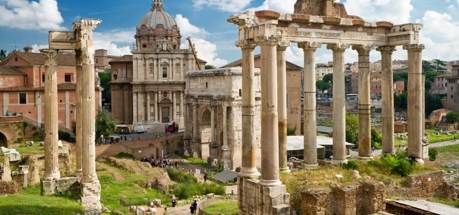
Could there be anything more behind these words?
The proverb dates from an era when Rome was the center of the world. Of the Mediterranean world, anyway…
Could it also mean ‘do as the Romans do and you’ll share into the benefits enjoyed by the rest of them’? In line with ‘don’t rock the boat, lest the others will throw you out’?
In other words, the proverb suggests that ‘herding is good for you’.
Which is true. Most of the time, anyway.
Specially when you know when to bail out…
In this context I must remind you that mighty Rome ended up being sacked by a succession of rogue thieves… some of them hired by the emperors to guard the borders because the Roman citizens had became too ‘adept’ at ‘panem et circenses’ to bother anymore with bearing arms…
It seems that not all things done by the Romans were actually worth doing.
How about exercising our brains instead of sheepishly following the herd?
No need to insult the others, ‘rock the boat’ or anything else dramatic.
Just honestly give them the reasons for your dissent.
If they are wise – and you are right, of course, they’ll come your way.
If not… you should either follow the rules… or change the herd.
Recent developments have resurrected a Soviet era concept.
“Whataboutism refers to the practice of deflecting criticism by pointing to the misdeeds of others. Oxford Dictionaries defines it as “the technique or practice of responding to an accusation or difficult question by making a counter-accusation or raising a different issue.”
Essentially, it’s an appeal to hypocrisy ― a logical fallacy also known as “tu quoque.” Instead of proving that your opponent’s claim is wrong on its face, whataboutism argues that it’s hypocritical of the opponent to make that claim at all.”
The current bout of whataboutism came about when Trump and his supporters tried to deflect the public condemnation of neo-nazi activism after a young woman had been killed by a white supremacist.
So, which is worse?
Communism or nazism?
I’ll make a small detour here and ask myself ‘what’s wrong with the spell checker? Why insist that nazism should be written with a capital N? Is it a nation? It’s OK for communism to start with a lower case letter, same thing for all other political denominations… what’s so special about nazism?!?’
Back to business.
One way to answer the question would be to asses the damages incurred as a consequence of each of them being put in practice.
Easier said than done. There are a lot of similarities between these two but also a huge difference. Precisely that which makes it very hard to compare the consequences of each of them having been experimented.
Nazism and communism have evolved in totally different social environments and have been fueled by closely related yet different public feelings.
This is why I’m going to change tack.
Why attempt to establish a relative hierarchy on the axis of evil when they can be studied together?
As the left and right wings of the same carrion eating bird which feeds itself on the countless societies ruined by authoritarianism?
After all, any attempt to determine which is worse does nothing but normalizes ‘whataboutism’ itself, doesn’t it?
Regardless of which wing flaps first….

Seven years ago somebody was elected to the Senate of the United States.
Despite
Six years later, another guy became POTUS despite the newspaper who published the article above having mounted quite a vigorous campaign against him.
The really interesting thing is that the second guy uses the information published in the newspaper seven years ago to smear the first guy while constantly accusing the same newspaper of being a relentless purveyor of fake news…

Now, which is stranger?
That two guys had managed to muster enough public support to get elected into public office, despite their shoddy relationships with the truth?
Or that newspapers continue to bother themselves?
Chris Ladd,
Why Republicans Cannot Replace the ACA, Or Accomplish Anything Else,
forbes.com, Jul 20, 2017
ACA means “Affordable Care Act”.
‘Affordable’ for whom?
For those left out, of course…
And who was going to pay the difference?
Those already in, obviously…
See what I mean?
Health care can be seen in many ways.
As yet another opportunity for profit to be made – one of the best actually, since health is such a valuable commodity.
As a ‘social benefit’ extended by the society at large to (all?) its constituents. America already takes care of its elders, children and veterans, doesn’t it?
A combination of the first two. A free market where many independent health care providers cater for the needs of their customers – free to choose among the various providers – while the bills are picked up by a third party, financed through public contributions.
The only problem with the third option being our current obsession with money.
For as long as we’ll let ourselves be governed by the current mantra, “greed is good”, we’ll continue to perceive health care as nothing but yet another opportunity for some to get rich at the expense of everybody else.
How about an Efficient (Health) Care Act?
Opening the market – by allowing the patients to freely choose their doctors and by preventing monopolies – would drive down the costs.
Cutting the middle-men – the insurance companies would no longer be needed since the public contributions would be collected by a public authority – would also help.
Would such a scheme work?
As I mentioned earlier, not before we give up ‘greed‘.
In order to trust yet another public authority with even more money we’d need at least some hope about that authority being populated by really honest people.
We’d also need many more ‘health care providers’ who actually love to help their patients – and make a decent living out of it – instead of so many people becoming involved with this ‘industry’ simply because it is among the very ‘rewarding’ ones.
And when I say ‘health care providers’, I mean all of them. Not only the doctors and the nurses – most of them do love their jobs and perform them almost heroically. (Some of/too many of) the Big and Small Pharma, (some of) the hospital ‘owners’, etc., etc….
Should we extend this scheme to other areas? Education, for instance? You bet!
Should we apply the same ‘weltanschauung’ to the rest of the economy?
Minus the ‘single payer principle’, of course?
Well, last time I read his work, Adam Smith was talking about “the Nature and Causes of the Wealth of Nations” and about “Moral Sentiments“, not about greedy individuals becoming filthy rich at the expense of their fellow human beings.
Humankind is a work in progress.
We’ve changed the planet we’re living on and we’ve changed ourselves.
We’ve invented the automobile and we’ve become more autonomous.
By driving we’re now able to cover more space in less time, carrying a lot more with us.
To achieve that we’ve straddled the globe with seemingly endless ribbons of tarmac.
The changes which had appeared as a consequence of ‘automobile’ are enormous. Some conspicuously visible – the roads and our increased individual autonomy, a few less so – we’re not only more autonomous but also more ‘socially dependent’, building cars and maintaining roads depend on a lot of us ‘working together’, while ‘the jury is still out’ on yet others – global warming, for instance.
We’ve invented vaccines and we live longer and better. Small pox has disappeared, polio is likely to follow suit, being bitten by a rabid animal is no longer a death sentence and so on.
I don’t need to explain how this has changed us, right?
All these have come with some costs attached.
Thousands, if not millions, die each year in traffic accidents and many more are injured.
Children suffer side-effects after immunization.
What intrigues me is that we treat these two phenomena in two completely different manners.
We’ve introduced tough regulations when we’ve discovered that some car companies were cutting corners in their attempt to increase margins. We insist for wide-spread ‘call-backs’ whenever we hear about a batch of cars having systemic troubles. Some of us try to produce self driving cars – even if these would be somewhat ‘counter-productive’ – in our very orderly life, where many of us are reduced to following procedures, driving is one of the few areas where we still retain full responsibility.
Yet I don’t know of people dissuading their children from learning to drive or from buying a car. Even if some of them will, helas, die as a consequence of traffic accidents.
Then why so many parents refuse to vaccinate their children? Not only putting them into harm’s way but also extending a warm invitation for many diseases to make a dramatic come-back. Measles have killed tens of children in both Italy and my native Romania in the wake of recent anti-vaxxer militancy…
OK, there might be a back-lash against ‘big-pharma’. I can understand more indignation being felt against huge corporations profiteering from people being sick than against big corporations making a faster buck by selling ‘lemony’ cars… but why throw away the baby along with the bath water?
Why give away the shared safety of herd immunity instead of introducing better safety measures? Instead of cutting down to Earth the virtual monopolies which produce most of our vaccines, making it easier for the ‘safety inspectors’ to do their jobs?
One of the possible explanations being that vaccination is ‘prevention’ while learning to drive is a matter of improving one’s skills.
And prevention means paying the price up-front while having only an expectation for a possible pay-back while skills improvement is seen as something having a certain outcome.
Corroborate this with the ‘fundamental attribution error‘ and things become a lot clearer.
For those unfamiliar with this term, the whole thing boils down to how we tend to ‘apportion’ blame and praise. When something good happens to us we tend to attribute it to our skills while when something bad falls on our heads we blame the bad luck we had in that moment.
And this is only half the picture. When things happen to other people we tend to turn the tables. When something good happens to a guy we attribute it to his luck while when somebody is subjected to a misfortune we are inclined to believe that ‘he had somehow brought it upon himself’.
Hence we get sick only as a consequence of misfortune – but we consider ourselves lucky, don’t we? – while safety on the road depends exclusively on our driving skills.
In this situation blunt reason tells us to ‘let all the other children be vaccinated’, ‘constantly improve our driving skills’ and ‘check our cars often’.
Well, the same blunt reason tells the others the very same thing. That’s why they insist that all children must be vaccinated – individual ‘specifics’ must, of course, be taken into account, all drivers must be vetted and all cars checked periodically.

Ayn Rand
OK, she borrowed this idea from Adam Smith, without mentioning him… let bygones be bygones…
A more interesting endeavor would be to learn something from all this.
‘Abundance was not created by public sacrifices’.
Makes a lot of sense. In a free market everybody gets what they are offered, ideally in close accord to what each of them had brought to the market.
‘Abundance was created by the productive genius of free people who pursued their own personal interest and the making of their own private fortunes’.
Now, whose ‘productive genius’ are we speaking about here?
About Ford’s, for instance, or about that of his workers?
Tim Worstall, Forbes Magazine
Anyway you look at it, both Ford and his workers were acting as ‘rational economic agents’. Ford was paying them the going rates in the industry and they were putting in as little effort as they could afford to.
Again, a very reasonable attitude displayed by both parties.
An attitude made possible by the fact that both the car and workforce markets were free.
Ford could hire anybody/sell his cars to whomever had enough money to buy them while his workers were free to leave their previous workplaces and accept Ford’s offer. Or leave him if they found a better one.
And let’s not forget the fact that Ford was not alone, at that time. At the turn of the XX-th century there were hundreds of automobile producers in the US alone and this was one of the reasons for which the workers could afford to be so ‘picky’ – specially those who had some experience.
In this situation – where the market was really free, each party taking good care of their own interest yielded excellent results.
Ford had became one of the leading car manufacturing corporations.
The diligent workers continuously improved their living standards.
The society, as a whole, prospered. And learned, or should have had, the long term benefits of commitment and mutual respect.
What happened after the market was no longer free?
Meaning that instead of hundreds of car manufacturers competing for the best available workers we had for a considerable number of years only three corporations more interested in short term profiteering rather than improving their products?
And instead of diligent workers striving to improve their skills we had union members more interested in their week-end barbecues?
Kimberly Amadeo, thebalance.com
Some of you might tell me that the Japanese car manufacturers operate along more or less the same guide-lines. ‘Cradle to grave’ employment for the workers, a rather opaque management never held accountable until too late…
A very correct observation.
Only there is a huge difference between the Japanese work-ethos and ‘the American Dream’. The Japanese have a long history of being told to ‘fit in’ while most Americans have gradually convinced themselves that ‘getting rich’ is the only possible solution for all their problems…
Considering that both Japan and America seem to have reached two different cul-de-sacs it wouldn’t be farfetched to suggest that both are doing something wrong.
For almost 30 years now Japan has been running in circles. She hasn’t completely lost her edge but hasn’t performed as it used to.
The most worrying indicator – for me, at least, being the fact that they have given up ‘making’ children. As if the present generation doesn’t have much hope for/expectations from the future.
For almost 30 years now the American people has allowed a huge trench to grow larger and larger in their mist. The haves on one side, the have-nots on the other and the rift so wide that they are no longer able hear each-other. A present day Henry Ford would have no idea about how much to pay his workers in order to obtain similar results to those achieved at the start of the XX-th century…
Is there a ‘common cause’ that might explain what’s going on on both sides of the Pacific?
How about both cultural and economic spaces experiencing a somewhat similar decrease in individual liberty, the phenomenon having rather different causes in each of the two cases?
First of all, ‘dedication to duty’ can take you only that far. It is very useful for those wishing to ‘close a gap’ but acts similarly to an ankle weight for those who are in the position to attempt to ‘take the lead’. ‘Dedication to duty’ focuses the attention of the team to ‘obeying the rules’ while ‘taking the lead’ means leaving the ‘straight and narrow’ and venturing into the unknown.
These two situations imply completely different mind frames.
Secondly, those who venture outside the ‘safety of the perimeter’ need to follow a simple rule.
“Leave no man behind”.
You see, time and time again history has hinted to us that freer societies fared better, ceteris paribus, compared to ‘tighter knit’ ones.
For example, subjected to the same communist knut, Poland came out differently than my native Romania.
And while most people agree about Poland being in a better shape than Romania, there is very little agreement about a possible explanation.
Just as most people agree about ‘liberty is good’ while each of those people derive different meanings from the very concept of freedom.
Since it is so hard to coordinate ourselves about the meaning of a ‘simple’ word, how about taking the liberty to ‘agree to disagree’ and turn our attention to another concept?
Mutual respect.
Just think about what liberty would mean without mutual respect.
Can you imagine the liberty of someone driving a M1 Abrams tank on a highway?
Can you imagine what would happen if the driver of the tank wouldn’t treat the others with utmost respect? What would happen if the outraged others would band together and wait for the ‘mad’ driver to burn through his last drop of fuel?
You see, people who have more respect for the rules than they have for each-other end up belonging to a society so tightly knit that it has immense troubles whenever it has to cope with unforeseen situations. Adapt to change. Confront a catastrophe…
For example, the Soviet Union, Japan and the US have a considerable number of nuclear power plants and have experienced a number of failures. The tightly knit Soviet Union and Japan have displayed commendable individual acts of heroism in the aftermath of such incidents but it was the more individualistic US who has somehow ‘ducked’ any serious experience of this kind.
On the other hand, I see potential trouble when I hear people stating that “My right to swing my fist ends where your nose begins”.
On the face of it, this sounds perfectly reasonable.
Only the whole thing absolutely depends on both individuals involved in it having comparable reach. Do you really think that a guy with twice the ‘wing-span’ of his opponent would continue to stick to this rule if the by-standers would not band together to stuff it down his throat?
My point being that no ‘market’ is really free if its freedom relies primarily on a set of rules instead of depending on a healthy dose of sincerely upheld mutual respect among the participants to that market.
In this instance ‘free’ and ‘freedom’ are perfectly interchangeable with functional/sustainable.
The communist centrally planned economies had failed abysmally simply because the powerfuls of the day had nothing but contempt for those under their rule.
Japan’s strict set of rules about what constitutes proper behavior in each situation seems to act as a brake whenever decisive action is needed.
America’s new mantra, ‘greed is good’, has time and time again produced speculative bubbles which have inevitably ended up badly. Under its spell, the market actually looses every shred of liberty. Exactly as a hypnotized group of people think of themselves as being free while sheepishly obeying the orders of their herder.
I gather you all know what ‘herd behavior’ means…
Compare Ayn Rand’s words to Adam’s Smith original idea.
See what I mean?
Smith sees all ‘market goers’ as equals who freely address each other while Rand applauds “the productive genius of free men” who, in pursuit of “their own private fortunes” had the magnanimity to bestow upon “the people better jobs, higher wages, and cheaper goods with every new machine they invented, with every scientific discovery or technological advance”.
I, for one, fail to detect any shred of actual respect towards “the people” in the behavior so laudatory described by Rand.
And I’ll let you be the judge whether her description fits the current ‘state of the nation’.
Anywhere on the planet, not only in the US.
“and thus the whole country was moving forward and profiting, not suffering, every step of the way.”

 nicichiarasa