Archives for category: Choices we make

The current President of the United States describes himself as a man always making good use – as a manner of speaking, anyway, of all opportunities he ever identifies.

grab them by the pussy

Erotically as well as financially.

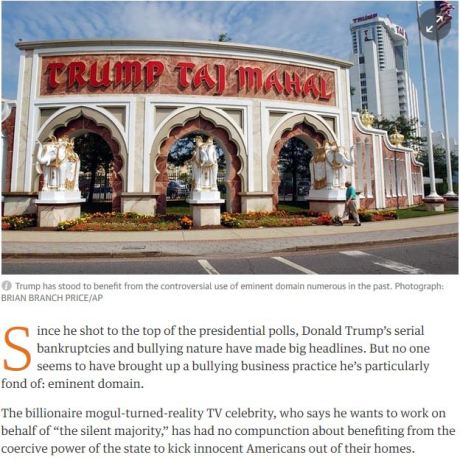
trump eminent domain

“Trump turned to a government agency – the Casino Reinvestment Development Authority (CRDA) – to take Coking’s property. CRDA offered her $250,000 for the property – one-fourth of what another hotel builder had offered her a decade earlier. When she turned that down, the agency went into court to claim her property under eminent domain so that Trump could pave it and put up a parking lot.

Peter Banin and his brother owned another building on the block. A few months after they paid $500,000 to purchase the building for a pawn shop, CRDA offered them $174,000 and told them to leave the property. A Russian immigrant, Banin said: “I knew they could do this in Russia, but not here. I would understand if they needed it for an airport runway, but for a casino?” “

Now, after climbing a new pinnacle of popularity, he has become, himself, a very lucrative opportunity.

donations for coming out

“The Hill reported Friday that Bloom worked with campaign donors and tabloid media outlets to arrange compensation for the alleged victims and a commission for herself, offering to sell their stories. In one case, Bloom reportedly arranged for a donor to pay off one Trump accuser’s mortgage and attempted to score a six-figure payment for another woman. The former ultimately declined to come forward after being offered $750,000, the clients told The Hill.”

The first question which crossed my mind after reading this was:
‘OK, so why would any one bring all this up? What difference does it make if those women get some money for telling their stories? It’s the facts themselves which are really important here, right?

‘But what if?’ was the second one…
What if, after seeding enough ‘oblique doubt’ into people’s minds, facts start to look rather different than at ‘face value’?

I told you so

Remember that XX-th century aphorism, “The best defense is a good offense”?
And the smoke screen tactics pioneered by the military but also very important to those who study the Bible?

“When studying the Bible with teens, the term “smoke screen” refers to a commonly deployed tactic designed to avoid exposure of the heart. Smoke screens, though not unique to teens, are important to understand and overcome.

Each of us have areas in our lives and places in our hearts we do not want exposed. Sometimes we are afraid of what others may feel about us; sometimes we realize these areas in our lives and places in our hearts need to change, but we don’t want to change them or even believe that we can.

Practically, smoke screens are often the emotion we express, the issue we lead with, or the confusion we claim, in order to deflect what is really going on in the heart. When emotions are present, the words that are flowing out of a teenager’s mouth are rarely communicating what is actually driving them.

Getting past a smoke screen takes understanding and the willingness to go deep. It takes understanding and depth to remain calm when our teen is using emotions to derail a conversation that might be getting to the heart of the matter at hand. We learn depth when we are willing to look into our own hearts and be honest about the smoke screens we use.”

ignoramus

Imagine now that Reagan, or his speech writer, would have used a single different word …

It isn’t that people are ignorant, it’s just that they know so much that isn’t so.

Cambridge Dictionary lists ‘riddle’ as being “a type of question that describes something in a difficult and confusing way and has a clever or funny answer, often asked as a game

What if there’s way lot more than this, hidden ‘in plain sight’ under the ‘difficult and confusing’ cloak draped over each of them?

“Black sheep on a white field;
He who knows them, leads them.”

“My father, the son of a subsistence farmer and his barely literate wife, used riddles to try to foster critical thinking in his daughters.”

This particular one is a classic in Eastern Europe and I stumbled on this version while Googling for an English translation. The quote belongs to Daiva Markelis, a Lithuanian American Professor with a PhD in linguistics… go figure… I included the part about the father because it illustrates perfectly the point I’m trying to make with this post.

That words, and letters, mean nothing by themselves.
We are the ones who attach meaning to each of them.
We are the ones who ‘lead’ them… even if sometimes unknowingly…

And precisely this is what riddles are for!
To tell us that languages, and letters, can and have to be mastered.
That unless we get to really know them, we’ll never be able to lead them where we want them.

But there’s an even deeper reason for riddles enjoying so much popularity.
Knowingly or unknowingly we somehow ‘feel’ that being familiar with letters and able to speak is not enough. That no matter how well we ‘know’ a language we’ll never grasp the full intended meaning of what is being spoken around/to us.

Yes, when speaking we should be forthcoming… to the tune of not becoming self detrimental, of course… and when listening we must remember to look for the intended meaning, not jump to conclusions according to our own opinion on the matter…

From the airlift which kept the flame of liberty alight in West Berlin to “Trump’s decision (to stop supplying arms to Kurdish fighters in Syria) appeared to catch both the Pentagon and the U.S. State Department off guard. Officials at both agencies, who would normally be informed of changes in U.S. policy toward arming the Syrian Kurds, said they were unaware of any changes. The officials spoke on condition of anonymity. It was unclear whether the Trump administration notified the Kurds of the move before telling the Turks. Nor was it how much significance the change would have on the ground, considering the fight against Islamic State is almost over.

Ich bin ein Berliner

What happened to “Ich bin ein Berliner”?!?

I’m afraid that  too many people continue to not understand what’s ‘the big issue between the free world’ and the authoritarianism which still encroaches it. They should indeed ‘go to Berlin’!

What would you prefer?

Long and thin or short and thick?

How about long AND thick?
How about REASONABLY long and thick?
Who cares about how long or thick it is IF it stays stiff for long enough?

From a friend’s FB wall:

“African proverb:
Every morning in Africa, a gazelle wakes up.
It knows it must run faster than the fastest lion or it will be killed.
Every morning a lion wakes up.
It knows it must outrun the slowest gazelle or it will starve to death.

It doesn’t matter weather you are a lion or a gazelle.
When the sun comes up, you better start running.”

(from The World Is Flat, by Thomas L. Friedman)

It seems that the modern world is gradually becoming more and more ‘African’.
We’re so busy running ourselves out that we’re failing to remember the essential.

That we’re people.
Neither gazelle nor lion!
And that most of us have long ago left the jungle and now live in cities!

How about ‘taking five‘ from our incessant quest for trinkets and use the time to remember “togetherness”?
As in “communion”?

In the civilized world, ‘Dog eat dog’ was supposed to be an exception, not an everyday occurrence…

Ruthless acquisition or competition, as in With shrinking markets, it’s dog eat dog for every company in this field. This contradicts a Latin proverb which maintains that dog does not eat dog, first recorded in English in 1543. Nevertheless, by 1732 it was put as “Dogs are hard drove when they eat dogs” (Thomas Fuller, Gnomologia).”

PS.
After reading this, my son pointed out that lions are the only cats which hunt cooperatively on a constant basis.
Could this be the reason for which they are seen as the royals of the animal world?

Plato, without actually saying so, was planning to ‘kill’ it.
A society run by his king-priests would have been ‘perfect’. Hence in no need of improvement. Not exactly dead but how would you describe something that doesn’t change in time? Anything but alive, right? And since ‘no change’ means ‘no history’…

Four centuries later, Jesus Christ had warned us about the ‘Final Countdown‘. Last Judgement, sorry. But what difference does it make? Final… Last…

Fast forward to the XIXth century, when Karl Marx was breathing new life into Plato’s ideas.
The Communists, therefore, are on the one hand, practically, the most advanced and resolute section of the working-class parties of every country, that section which pushes forward all others; on the other hand, theoretically, they have over the great mass of the proletariat the advantage of clearly understanding the line of march, the conditions, and the ultimate general results of the proletarian movement.” (Karl Marx et al, Manifesto of the Communist Party),
Which very able and extremely wise communists were supposed to solve all past, present and future problems through a very simple measure. Abolition of private property and of the state needed to protect such property.
And since not everybody was yet ready to receive ‘the good news’, the communists were given a free hand to use revolutionary force in order to accomplish what they had to do.

To finally bring order to the World. To end history, that is.

Am I thick headed or the difference between Marx’s and Plato’s words is small enough to be insignificant?

You have again forgotten, my friend, said I, that the law is not concerned with the special happines of any class in the state, but is trying to produce this condition in the city as a whole, harmonizing and adapting the citizens to one another by persuasion and compulsion, and requiring them to impart to one another any benefit which they are severally able to bestow upon the community, and that it itself creates such men in the state, not that it may allow each to take what course pleases him, but with a view to using them to the binding together of the commonwealth.” (Plato, Collected Dialogues, The Cave)

A short century later, another optimist announced that ‘now, after the communist gulag had finally imploded, liberal democracy – a system flexible enough to absorb/solve any input/problem – will take over the entire planet. And, of course, bring over “The End of History” “.

Three decades later things are going on, as if nothing had happened.

There are still plenty rulers who behave as if “L’etat c’est moi” was coined yesterday and, even more sadly, too many people who look up to them.

The end of history has been postponed. Indefinitely.


We were discussing ‘worst possible scenarios’ on Facebook and somebody mentioned ‘climate change’.
I must add here that the exchange was ‘framed’ by ‘skin in the game‘, a concept used by Nassim Nicholas Taleb in his rather don-quixotic quest for more responsible decision makers.

OK, the whole domain of climate change is riddled with epistemological holes.
Linear models are used to approximate processes we barely know anything about.
‘Starting points’ have been, again and again, been proven wrong.
I could go on for hours.

I’ll make a small parenthesis here and inform you that according to a fresh study things might be far worse than we’ve reckoned. This paper, published by Nature.com, suggests that Earth’s oceans used to be far cooler than we’ve previously thought they were.

In this context, one of the participants made the following remark:
the burden (of proof) should fall on those calling for changes, for the rather obvious reason that we could suggest changes all day long. Only a few can be implemented.

Hard to argue with that, right?

But which changes are we talking about here?

A change in our manner of interacting with Mother Nature?
Costly, indeed, financial wise, but nowadays technologically possible.

Or about the changes we’ve already – unwittingly, most of them, imposed upon our ‘spaceship’?

We’ve dramatically changed the ‘use of land’. Agriculture and transport – yes, roads and railways have a huge impact – have changed the very nature of what’s going on on a considerable portion of the Earth’s surface.
We’ve dramatically changed the composition of the atmosphere. And I’m not talking about CO2 yet. CFCs, pesticides, NOx and SOx gases, etc., etc….
And, last but not least, we’ve reversed a trend which had been going on for hundreds of millions of years. Photosynthesis used to transform atmospheric CO2 into organic matter, some of which has been steadily accumulated as coal and crude oil.

So, about which changes should we worry first?

Or, in SITG terms, whose skin should bear the brunt of change?

Ours or our children’s?

“Between 1970 and 2010, the number of administrators in health care grew more than 3000%, while the number of physicians grew about 200%, according to the Bureau of Labor Statistics. During that same 40 years, U.S. health-care spending rose 2300%. Doctors’ fees account for only 8 cents of the health care dollar. Where do you think the other 92 cents are going?”  (Marni Jameson Carey, Focus on Health Coverage Misses the Point, Forbes.com, Oct 24, 2017)

A few years ago I was arguing that profit was overrated.
It seems that Forbes, a magazine which cannot be accused of any socialist tendencies, has reached a somewhat similar conclusion.

Even more interesting is the solution proposed by Forbes to the health care problem.

A return to the free market!

Free from what? Who says the American health care market is not free?
Well, click on the quote above and see what Forbes has to say about this…

But what happened? How did we get here?

Well, the free market described by Adam Smith was an environment where people used to fulfill their needs by selling their wares.
The butcher sold meat and bought everything else he needed, the brewer sold beer and bought everything else he needed, the baker… and so on!
OK, there  was a certain kind of competition which kept the things in check. The butchers competed against other butchers, the brewers…
And because of this competition, all traders – those who wanted to survive, anyway – streamlined their operations and became more and more efficient. Hence profitable.

I mentioned the link between the survival of a commercial enterprise and its ability to generate profit.
Apparently, it doesn’t make much sense to elaborate on this. Bear with me, please.

The whole point of the free market is the division of labor. Besides its freedom, of course.
Each of us does what he knows better and then we trade our respective wares. This way all of us fare better than if each of us would have had to produce everything each of us needs to survive.
In this scenario, competition – between ‘bakers’, for example – is actually a tool which makes it so that the market, as a whole, doesn’t waste resources. When the less efficient bakers are ‘encouraged’ to find something else to do, the entire market is better off. And so on.
In this sense, profit is only one indicator – and a very good one – of how able to survive is a certain commercial venture. But not the only goal of the entrepreneur who started/runs the enterprise. What he wants is to make an as good as possible living by doing what he knows best, in close collaboration with the other participants to the free market.

Adam Smith had written his books some two and a half centuries ago.
And the free market had served us well, for a while.
Just look at what we’ve accomplished in these two and a half centuries.

But, just as Forbes points out, things are no longer going in the right direction.

Why?

Simply because the market is no longer free!

Not only because some of the participants have become ‘heavy’ enough to crush all competition. This is only the lesser part of the problem.
The really big one, and so well hidden that it’s almost invisible, is that too many of us have become obsessed with the same thing. Money!

Life-of-modern-people

Profit has become THE absolute goal of everything we do. Too many of those who participate in the free market no longer want to collaborate with the others but simply want to get rich. By any (legal) means.

Some say this is a good thing.
They invoke Adam Smith’s words as a justification for their beliefs.

I beg to differ.

The simple existence of our current obsession has profoundly altered the very nature of the market. Which is no longer free.

Because WE are no longer free. When too many of us are obsessively concentrated on the same thing, they will necessarily disregard all other options. And the rest have no other option but to follow.

This is not freedom!

Mesmerized people can not be described, by outside observers, as being free.
Regardless of how they consider themselves.


Language is the tool we use when we consciously transmit, receive or glean information.

While the ‘transmitting&receiving’ part is rather simple, ‘consciously and ‘glean’ might need some explaining.

You’ve all heard about ‘body language’.

Actors use it consciously to convey emotion and sometimes even meaning while profilers use it to glean information unconsciously distributed by their marks.

Artists use specific ‘modes of expression’ – language, actually – to convey emotion/subliminal meaning to sometimes unsuspecting audiences.

Skillful ‘communicators’ have learned how to chisel a message – using most common words, printed or spoken – to obtain ‘maximum impact’.

By now I’m sure you’ve already gleaned what I meant by “‘consciously’ and ‘glean'”.
Contrary to popular belief, only one half of those ‘immersed’ in communication need to be conscious of what is going on in order for language to be in use.

Actors can influence their audience without the audience being privy to acting tools.
All of us freely distribute a lot of information about ourselves – through walking, eating, manner of speaking, etc., etc. – which can be ‘deciphered’ with ease by those knowledgeable in this trade.
All of us are inundated by all kinds of advertisement – commercial, political, religious, you name it – but very few of us are aware of the full picture which is being played for us.

In a sense, those of us who can sense anything are like any device connected to the internet.

If it’s connected, it can be hacked‘.

But nothing’s as bad as it seems.
Devices can be plugged off or fire-walled while we can stop watching crap.
And, of course, we can put our brains to work, in earnest, before buying into anything which is hurled towards us.