”Remember the old adage, ‘Sticks and stones will break my bones, but words will never harm me’. True courage consists in doing what is right, despite the jeers and sneers of our companions.” The Christian Recorder, 1862
However fleetingly, words do scare! Otherwise, why bother?!?
And since I really doubt that enough of you will follow the link and read the entire article, here’s another interesting thing.
Which means that back in 1862 there were enough black people interested in reading. Enough to constitute an audience for a periodical! A periodical which dealt in words…
Some people are convinced that all they have to do is to follow the rules. Other people are convinced that freedom – their freedom, in particular – is the most important thing.
Apparently, these two convictions are incompatible.
Which is not true.
Those convinced that following the rules is the only way to ‘get there’ – wherever that might be – forget one thing. Two things, actually… That no journey starts until the traveler makes the first step. And decides where they want to go… Those convinced that freedom is the only important thing forget one thing. One thing only. That whenever the traveler breaks a rule… there will be consequences!
The fact of the matter being that freedom is a human achievement. Achieved during the long journey towards the future. Achieved as a consequence of the process through which we have learned about rules.
‘Rules’ is our definition of ‘possible’. Defines a space where things can happen. As long as the pertinent rules are being observed, of course.
At first glance, flying is possible. For birds… After learning the pertinent rules – and mastering certain skills – we have learned to fly. But we can continue to fly for only as long as we keep observing the pertinent rules!
At first glance, walking a rope strung between Manhattan’s Twin Towers was impossible. Not for Philippe Petit. He had the skills and he was crazy enough. He even didn’t ask for permission… Click on the picture and read ‘all about it’. My point being that he remained alive because he had observed the laws of physics. All of them! And because the human laws he had trespassed didn’t involve the capital punishment…
I believe you already understand what I want to convey. Have a nice week-end.
China, on the other hand…. Am I wrong or Trump’s tariffs have been used by the Chinese leaders as an opportunity to position themselves as ‘champions of the free world’? Free from Trump’s version of America…
In nature, change happens. It is produced by chance. According to rules but only when chance starts it. No one plans it, if you leave God out of the picture. And, evolutionary wise, change ‘remains’ if it doesn’t bother too much. If the individual things/organisms affected by change are able to survive. Please note that if ‘dramatic’ enough, change may ‘alter’ everything. A star changes constantly but at some point it will become a nova. Or even a supernova. Which event will change everything around it…
In a social setting, things are a tad more complicated. Change, social change, is initiated. By individuals. Not necessarily according to a plan and almost always ignoring the end results. But it is always initiated by somebody. And is allowed to stay. Or not… By those experiencing the consequences. According to what they make of it. Again, even in the social setting there are rules. Just as in nature. But while the natural rules are enforced by nature itself, the social rules need to be enforced. By people. By those who end up experiencing the consequences of the afore mentioned rules being enforced properly. Or not…
What am I babbling about?
You’re not comfortable with a bragging pussy-grabber signing presidential orders in the Oval Office? How comfortable were you when Clinton got away with “I did not have sexual relations with that woman!“ You’re not comfortable when ‘US national-security leaders’ establish a private group on a social network to share sensitive data? How comfortable were you when a Secretary of State had established a private e-mail server to handle official messages? And got away with it…
I was arguing in the previous post that we think using images stored in our memory. While we are convinced that we deal with real ‘objects’… ‘Hammers’ versus ‘nails’…
As you should have already noticed, Abraham Maslow had said more or less the same thing sometimes in the first half of the previous century… Well, he was a ‘clinical’ psychologist while I’m nothing more than an engineer. He was interested in how our mind works, I’m interested in the consequences of how our minds work. If you understand what I mean…
‘And what about the pretext you used for today’s post?’
Free market capitalism is nothing but an environment. Man made, for sure, but also ‘natural’. As in ‘evolved’ to the present state as opposed to ‘designed’ in the present state. Free market capitalism doesn’t do/cause anything. People toiling in this environment do whatever happens here.
Gravity doesn’t cause any falls.
Gravity pulls us, all of us, towards the center of the Earth. Regardless. Of us walking sober in the middle of the town versus skating ‘under the influence’ on a thin iced lake in the middle of nowhere.
Recent developments have helped me to understand something. And no, not the fact that there are more worlds out there. One happy about what’s going on, one horrified and a few rather indifferent.
Trump being elected for a second term as President of the United States hasn’t changed much in the real world. Not yet, anyway. What it had changed, dramatically, was our image of the world. Of the US, in particular, but also of the world as a whole.
This development has helped me to understand that we don’t deal in realities. We don’t consider things, make decisions, by examining the things themselves. No!
We consider things by examining the images we have in our minds.
We look at things and we get a ‘set of data’. A virtual image. We recollect from our memory whatever other information we have on the subject. Another image. We put two and two together. And we reach a conclusion. Most of the time ignoring the fact that we’ve been dealing with images instead of the real thing.
Until we are forced to acknowledge that our image was incomplete. Inaccurate… Or that, simply, we’ve chosen to see what was more comfortable for us!
By 1917 it seemed to Lenin that the war would never end and that the prospect of revolution was rapidly receding. But in the week of March 8–15, the starving, freezing, war-weary workers and soldiers of Petrograd (until 1914, St. Petersburg) succeeded in deposing the Tsar. Lenin and his closest lieutenants hastened home after the German authorities agreed to permit their passage through Germany to neutral Sweden. Berlin hoped that the return of anti-war Socialists to Russia would undermine the Russian war effort.
Do you remember the story about the early American Colonists “gifting of blankets and linens contaminated with smallpox” to the native inhabitants of the place? It worked, to a degree, because the natives had no prior experience with the disease. Their immune systems had no prior experience with this pathogen. Which had been construed as an opportunity by those who had cooked up the plan, even though – in those times – nobody had any idea about ‘immunity’.
Lenin was also effective towards pulling the Czarist Empire out of WWI. Do we really care whether he was aware of the fact that he had been used as a 5-th column by Kaiser Wilhelm II’s strategists?
Life, in general, is about species evolving in a given set of circumstances. If the circumstances allow it, live will appear. And survive for as long as the circumstances remain livable. We must keep in mind that life changes the environment in which it evolves. Social life, the human kind in particular, is about cultural species evolving in given sets of circumstances. For as long as the circumstances remain livable, cultural species will continue to evolve. To put their culture to work and to build civilizations. Each set of circumstances influencing both the culture which inhabits the circumstances and the civilization being built there.
Currently, there are three main categories of cultures. Imperial, democratic and incomplete.
I will start by noting that those cultures which are ‘incomplete’ have remained so because they didn’t have enough time to make ‘full use’ of the limited resources they had at their disposal. The difference between the imperial and the democratic cultures being the fact that the imperial ones stagnate as soon as they reach a certain level of development while the democratic ones continue to evolve for as long as they manage to remain democratic. To retain their ability to change as soon and as far as they need in order to survive. To maintain their democratic character.
Need proof? Are you familiar with any empire which had lasted for long? The Egyptian? 33 dynasties covering 3 millennia? Is that long enough for you? Well, not so fast. ’33 dynasties’ actually means 33 different empires. It was very seldom that a dynasty ended when/because there was no available successor… Most dynasties were removed from power rather than petered out. And, nevertheless, who cares about why a certain dynasty was replaced by the next one?!? The simple fact that it was replaced is enough for me. The replaced dynasty was no longer able to cope! Hence it had to make place for the next one. Another set of decision makers, naturally following a (however slightly) different mantra.
Don’t believe me? Consider any other empire. Evaluate the duration for which each dynasty had managed to hold the helm. And compare it with the fact that the Roman Republic had survived, as a functional democracy, for almost 5 centuries.
And no, Europe isn’t the only place where democratic forms of self-rule had happened during human history. Kurultai, Loya-Jirga… The mere existence of the concepts is proof enough for the budding democracies which might have developed in those places, given enough time and resources.
Then, if democracy is so much ‘better’ – as in more helpful towards the survival of a certain set of mores/culture – then why is it so ‘scarce’?
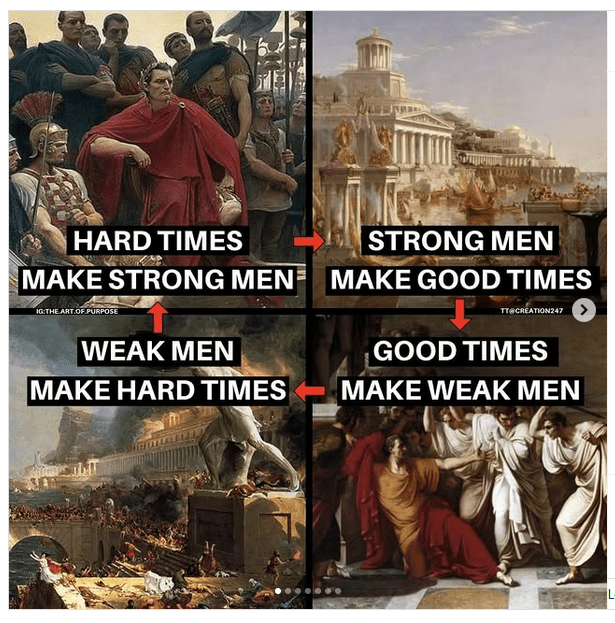
Well, for democracy to remain functional, at least some wise men need to remain both strong and focused on the job at hand. Otherwise, the helm will be confiscated by the would be strong but not so wise….
And why is it that good times tend to make weak people? First of all, good times tend to weaken ‘the people’. Not as much to weaken the individuals living a good life as to make them careless. To take the good times for granted. To convince them that ‘times’ will continue to remain good regardless…..
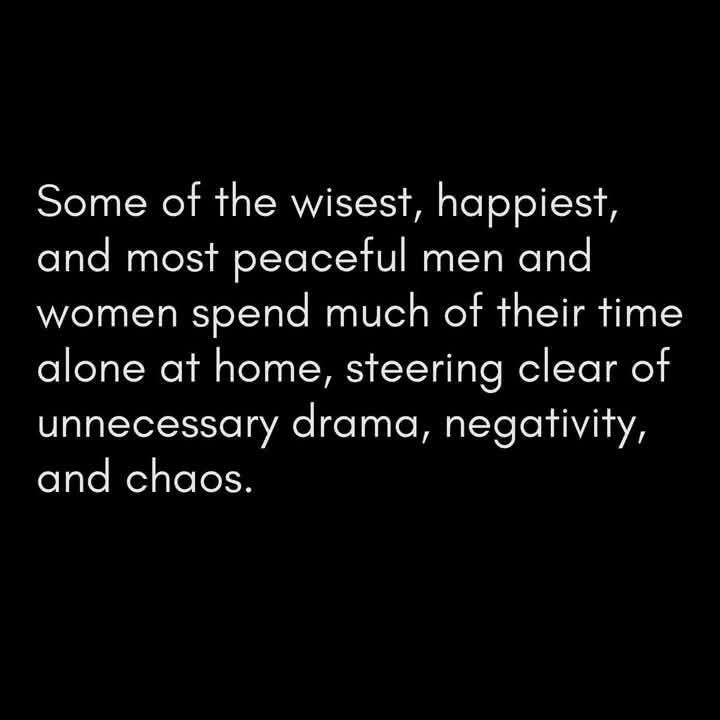
Not having to struggle for their day to day existence tends to make ‘some of the wisest, happiest, and most peaceful men and women to spend much of their time alone at home, steering clear of UNNECESSARY drama, negativity and chaos’.
This being how successful democracies sometimes succumb to tyranny and how empires eventually crumble under their own weight.
And the LORD God said, Behold, the man is become as one of us, to know good and evil:
We live in a world of our own making. We build it by talking ourselves into shaping it one way or another. If not careful, we end up building a lie!
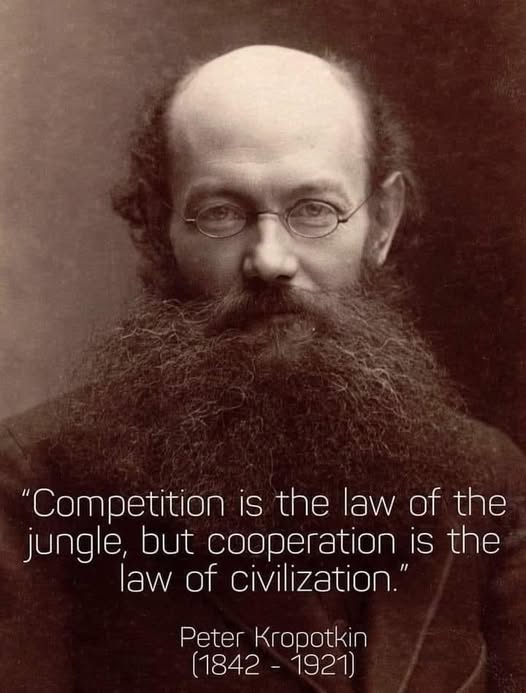
Competition has nothing to do with what’s going on in the jungle!
The jungle is about eat or be eaten! Competition is about rules. Follow the rule or you’re kicked out before you get to the end! The competition stops being true the moment you break the rule and your co-competitors do not throw you out. By not throwing you out, those in attendance have just transformed that particular pitch into a jungle!
“Cooperation is the law of the civilization!“ This part is true. But incomplete! As I explained before, to compete implies to cooperate. Those involved in a competition want to know who amongst them is better in a particular field. And COOPERATE in order to find that answer. By doing that they also build what we currently call ‘civilization’.
Kropotkin might be forgiven for what he had said. He didn’t get to witness the Chinese Cultural Revolution. That was the true pinnacle of ‘cooperation’! Not civilized by any measure…
We really need to be more careful with words. With what we say and with what we end up holding to be true!
Etiquette is a matter of social interaction. A mannerism used to convey ‘we are in sync’. ‘We see eye to eye’ on most matters that count.
In this picture, one of the two men are dressed ‘inappropriately’. According to the ‘normal’ etiquette.
This is ‘posturing’. That choice of attire – in flagrant breach of ‘comme il faut’ – is a constant reminder to the rest of the world that he, and his country, are not ‘normal’. Like the rest of us still are. For now…
We can accept his ‘look’. Demonstrating that we feel with him. And with his country!



 nicichiarasa