Archives for category: awareness

Kiss an ass for long enough, its owner will become god.
And start behaving accordingly…

We all know that no communist regime has ever worked. For long…
Some of us have noticed that all empires, all imperial regimes, eventually collapsed. Under their own weight. Under the weight of accumulated errors…

The mechanism is simple.
Lord Acton was convinced that “Power corrupts and absolute power corrupts absolutely”.
Frank Herbert, looking from the other direction, argued: “It is not that power corrupts but that it is magnetic to the corruptible”.
My experience suggests that both were right. Power is magnetic to the corruptible and when enjoying it those in power are subjected to innumerable ‘temptations’. Already corruptible, most of them indulge themselves…

Democracy is nothing but a weeding mechanism. “The People”, realizing that (some of) those in power have become too corrupted, have the necessary tools to weed them out. To replace those corrupted politicians peacefully.
With other politicians, not – as yet, anyway – as corrupted as those sent away.

Imperial regimes, the communist ones included, do not have such mechanisms.
The already corruptible, once in power, sink deeper and deeper into corruption. Become more and more impervious to any advice. More and more confident in their own infallibility. More and more prone to making bigger and bigger errors.
The consequences of which errors keep pilling one on top of the other.
Until nothing works anymore…

Which is why all reasonable political regimes have limits.
Elections are organized on a timely manner.
And no more than two presidential mandates, for example.

Given all of the above, I’m afraid. Petrified, actually.
Two people are going to meet, in a short time, pretending to solve…
The entire planet seems mesmerized!
Two people are going to determine the fate of billions!?!

Are we nuts?


Mind what you wish for,
for it might happen…

Putin wants to survive while Trump wants the same thing.
Xi also wants Putin to survive…

Without Putin(ism), Europe wouldn’t spend a dime on weapons. On American weapons!
America would have to develop and maintain alone the hardware needed to keep Xi at bay.

Once Putin gone, the Russian people will completely turn their attention towards Europe.
Leaving the ‘Chinese model’ stranded. In limbo…

What do we want?!?
Who cares?!? But now, that you’ve asked…

We want America back!
The already great America…
The one wise enough to save Europe from itself. Twice!
The one wise enough to help Japan back on its feet after WWII.
The one wise, and brave, enough to defend South Korea.
The one wise enough to understand that behaving like a bull in a China shop might be fun. For a while… but inexorably produces a fine mess… Specially when the bull owns much of the china being traded in that shop!

America does have a huge responsibility in maintaining the world in a working state. For the simple reason that America’s wealth depends, directly and indirectly, on the smooth functioning of the increasingly integrated world market.
Forgetting this, and concentrating your attention on ‘particular interests’, vested or not, is nothing short of blinding yourself. Of shutting reality out!

And we want Europe back!
Europe has already done the same mistake America is about to commit.
Behaved like the bull in the China shop. Literally. Then, overwhelmed by the consequences, left out without clearing up the mess.

Finally, but equally important, we need China – along with all other ‘wishful thinkers’ – to learn.
To understand that behaving like a bull in the China shop, even if you do it at home, doesn’t help anybody. Not in the long run.
Everybody, including the bull, ends up in tatters…

And God saw every thing that he had made,
and,
behold, it was very good.

Our fore-fore fathers believed that the birth of gods was what had transformed the primordial chaos into a more orderly cosmos. A place where man could live, as long as he didn’t fall on the bad side of the local gods.

Our fore fathers, those who had invented monotheism, had condensed the previous generation of gods into a single one. Thus unifying the space and the time. Transforming Cosmos into the Universe.

We’ve given up god altogether.
We no longer believe in a unifying God. Some of us have given up religious belief while others continue to have faith in a personal god. Often times shared with the other members of their particular religious community.

But even though we no longer believe in a unifying god, we still consider that we all share the same world. The same Universe. Even if some of us consider the Earth to be flat…

So.
Our fore-fore fathers used common sense and hired human-like gods to make sense of and to bring order in their particular portions of the world. In those times, each region – or each piece of the world – was a cosmos in itself. Governed by a specific set of arrangements between those who lived there and the gods they believed in. And the people who had to move to another cosmos, or were conquered by people coming from another cosmos, usually changed their belief accordingly. Simply because faith came with the territory.
Our fore – fathers used philosophy to understand there was, and continues to be, only one world. Only one Nature. And changed their belief accordingly. After all, and after learning enough, one world and one god makes more sense than a plethora of gods running wild and doing as they please… One world… one God… obvious enough… but which God to believe in? Particularly when ‘I’m a jealous God’.

Since then, God no longer comes with the territory… but comes with those who believe in him.

It’s no longer god who makes sense of the world.
It’s the believers who choose their belief. Choose what to make of their world.

Of the one, otherwise known as ‘single’, world we have at our disposal.
“Be fruitful and increase in number; fill the earth and subdue it. Rule over the fish in the sea and the birds in the sky and over every living creature that moves on the ground.”

Logos continuously chiseling
new Reality
out of whatever Opportunity is at hand….

At the beginning there was nothing but Chaos.
Then Gods were born. One way or another.

The birth of Gods sowed order into Chaos.
Thus Cosmos was born.

For a proposition to be ‘true’
it is not enough for it to be logically valid.
It also has to make sense. Epistemologically speaking.

Oscar Hoffman

“This house belongs to me”.
“I own this house”.

Logically, these two propositions are equivalent. Both state the same thing.
But which one makes real sense?

Where do you belong?
Where do you feel at home?

What can your house do for you?
What have you done to your house?

Terror management theory is the idea that we create culture
and aspects of our lives that will “outlive” us
because of our knowledge of our own mortality
which is innately terrifying to us.

Self awareness doesn’t come cheap…

Collectively, species-wise, we’ve done OK. We’ve become the dominant species on Earth.
For good and/or for worse…

Individually, on the other hand…

Doubts!
Self-awareness comes with plenty of them:
Will I be able to find enough food tomorrow? For me and for my family?
When will it start to rain?
Will the sun rise again?

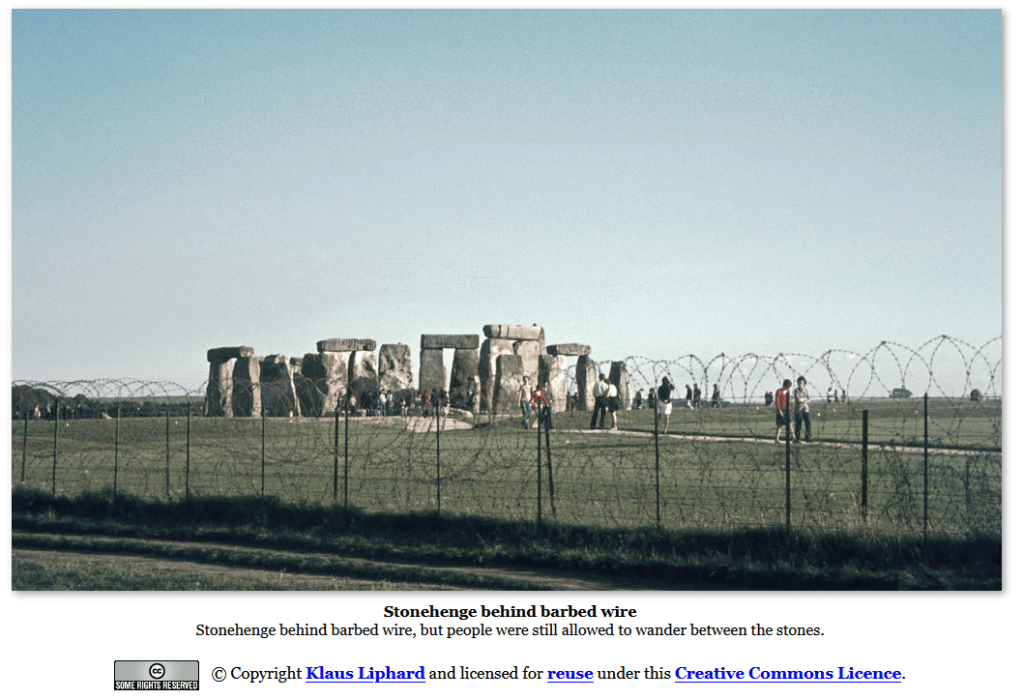
The way I see it, ‘The Stonehenge’ has been built for one thing only.
To assuage fear.

According to scientists researching the phenomenon, ‘The Stonehenge’ had been built by the immigrants who brought agriculture into Britain.
Solving the food problem wasn’t enough. Enough to bring peace of mind…
Now, that full bellied people had enough time on their hands, they started to think about ‘the future’:

‘OK, tomorrow will come. The sun will rise. We’ll be able to sow our crops for the next year. But is there an order in all this? How can we be sure?’
‘Let’s build something which will prove “order”. If we could demonstrate that year after year the summer solstice ‘falls’ under the same ‘parameters’ then there’s indeed an ‘order’. Things don’t just happen, they follow a ‘script’ ‘.

And they did exactly that. Built the first scientific instrument. Proved that the sun not only rises each day but also follows a precise path.

Quite a management feat.
And no, I don’t mean the stone stacking part. However remarkable that was…
Their real success was to convince themselves to keep toiling into the future!

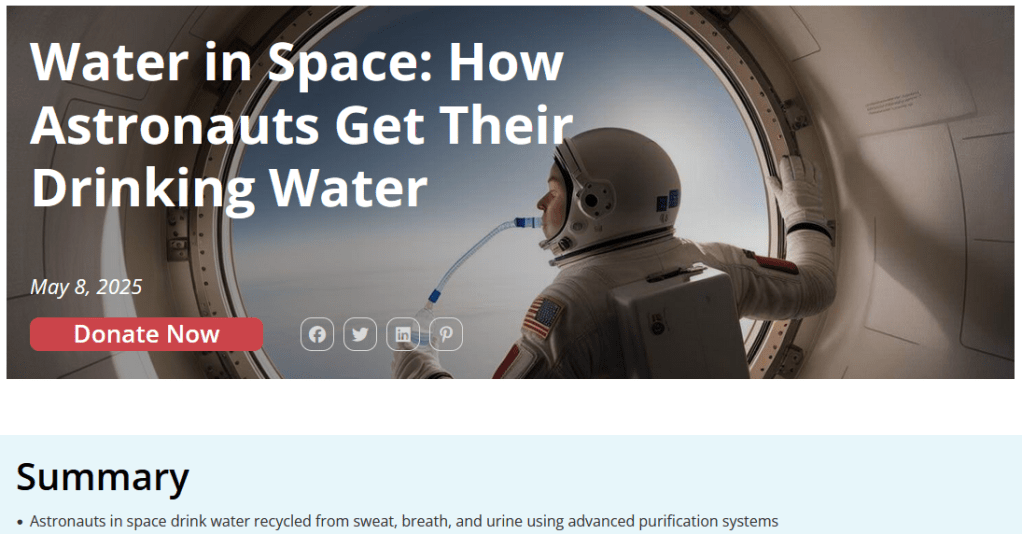
Astronauts don’t bring all their drinking water from Earth.
Instead, they rely on closed-loop water recycling systems
that recover and purify nearly every drop of moisture produced onboard.
That includes urine, sweat, breath vapor, shower water, and humidity from the air.

In space, nothing is wasted.

NASA 1132 77.0F

A space station circling the watery pebble we call home…

Cooperation brought us so far.
A majority of us have enough to eat and some of us – albeit very few – get to see the world from above.

Some of us might wonder:
What’s the point of ISS?!?
Wouldn’t that money be better spent feeding the hungry?

The short answer is:
‘We don’t need the ISS money. Feeding the hungry is well within our current possibilities. We just haven’t yet figured out how important this is!’

And here’s the explanation.
We’re no longer able to feed ourselves. Individually…
In order to enjoy our current standard of life, we need to cooperate.
In order to cooperate, we need to trust each-other.

Nobody has asked to be born.
Yet here we are.
La Legion Etrangere goes by “Marche ou Creve”. Keep walking or ‘make way’.
Now that we’ve been born, how about we make the best of it?

Those who get to see the world from above did have a say about the whole thing.
Nobody gets there against their wishes.
And they know what they’re signing for. Not everything – some of them don’t get to get there – but they have a fair image of what’s gonna happen to them. Including the facts about the water they’ll be drinking while enjoying the view.

Maybe it’s time for the rest of us to understand the limited nature of the Earth itself.
Not as limited as the ISS but I’m sure you understand my drift.

The astronauts trust each-other.

And they trust the rest of us.
Those who have made it possible for them to go there.


We, the rest, need to learn the trick.
How to actively, agentically, build trust 2.0.

“Give us today our daily bread”

We’ve been around for a while.
300 millennia, according to some. 70 millennia, according to others. Who use a more stringent set of criteria.
Anyway. Homo Sapiens is considered to be 300 000 years old while his nephew, Homo Sapiens Sapiens, is a little younger. Only 70 000 years…

Regardless of age, for most of this time we have been foragers.
OK, even our ancestors had tools. We’ve been around for 300ky while tools have predated us by more than 1my. Yes, our hominin predecessors were the ones to invent tools…

Then what is our contribution? Why are we the ones who are still around?

According to Ernst Mayr – if I interpret correctly – we’ve simply been lucky!
Nothing happened.
No catastrophic event bad enough to extinguish us. And no freshly minted ‘superman’ to take our place.
That question, regarding our contribution, speaks volumes about our infatuation with ourselves.

Hence the paradox.

Very recently, we’ve done something. Used agriculture on a large enough scale to change our way of life.

As foragers, we used to live in a certain way.
As homo economicus, who actively, agentically, produces food – and everything else we need, we’ve crossed yet another barrier. Benchmark? Anyway, we live completely different lives from those experienced by our foraging (fore)fathers. Despite the fact that there’s no biological or psychological difference between us.
Don’t believe me? Take a small child from the African or South American bush, lovingly raise them in a functional family and tell me if you find any difference. Between any of those children and their ‘already civilized’ school-mates. The key concepts here being ‘lovingly raise them in a functional family’ and ‘school mates’. If you understand what I mean…

‘Completely different lives’.
‘OK, I get it. They, the lives, are different. But are they better? Or worse?!?’

Your question, your very pertinent question, is extremely eloquent.
It fully expresses the paradox haunting us.

As foragers, we’ve learned to speak. To carve. To make beautiful tools. To paint…
As foragers, we’ve become human.

As agriculturalists, we live way longer lives. And accomplish way many more things.
Yes, ‘things’.
We speak the same. We paint the same. We carve the same. We even eat more or less the same things. Less of them but there’s nothing really new in our diet. Less diverse, heavily processed in too many instances, but no really new ingredients…
The only two differences between us and our fore-fathers is the length of our lives and the amount of things we end up owning.

So. Are our lives better?

Longer, for certain!
Less painful? Probably. Considering the physical pain…
Happier?

Then what? Give up agriculture? Go back to bare-back foraging?

How about learning from agriculture?
Digesting the concept, not only the produce…

As foragers, we were ‘expandable’. Each of us could do everything. Statistically, speaking… Gathering, hunting, fetching water and wood, you name it. We depended on each other, of course, but none of us was irreplaceable.
As homo economicus we also depend on each other. But differently!
Just remember what happened last week. When nobody knows how/why, yet, the fuel lines of an airplane taking off somewhere in India were switched off.
Or think about what happens when one of your colleagues calls in sick.

Smith, Adam ‘Free Market’ Smith, taught us about ‘the baker, the butcher and the brewer’.
We still have to digest his teachings.

Our daily bread demands a lot of cooperation.
We’re no longer capable to accomplish much individually.
Our longer and way more bountiful lives depend on our ability, and willingness, to cooperate.
Respectfully….

Where there’s a way
There will be a will!

An open wound will be ‘colonized’ by various organisms.
A mixture of water and flour will develop a ‘froth’.
A naive person will be swindled.

A healthy immune system will, eventually, take care of the infection. Successfully or not…
If in the hands of an experienced baker, the mixture of water and flour will – eventually – become the starting point for a delicious sour-bread loaf.
The previously naive person, once swindled, might learn something from the experience.

Life is nothing but an added layer of opportunity.
The pre-animated world is about strict rules. No variation, except for that brought about by happenstance.

Life is also about rules. But way laxer than those governing the pre-animated world.
While the pre-animated world is about nothing more than mere existence, life is about surviving in the given conditions. About evolution. About change.

And here’s the catch.
Pre-conscious change is also mainly about happenstance.
Darwin’s evolution is driven by minute changes at the DNA level. Those which are helpful are perpetuated while those which are harmful either kill out-rightly the organism where they have appeared or restrict its ability to ‘give birth’.
Nota bene. Darwin’s evolution was about “On the Origin of Species by Means of Natural Selection
In his understanding, and in the real world, evolving – biology wise – is done by the species. Not by individual organisms!

Conscious change, on the other hand… is driven by individuals!
Happenstance continues to be involved, heavily, but the main drive comes from ‘want’. From individuals willing/wishing to ‘make a difference’.

Is this a good or a bad thing?!?
It is a fact. Neither necessarily good or bad. Just a fact.
The outcome, evolution wise, depends on how the social organism – the cultural species – digests the experience.

For a while, I was convinced we were living in a virtual reality.
In a reality of our own making. As I mentioned earlier, ‘vir‘ is a Latin word. “Man”. “Hero”.
Hence ‘virtual’ literally means ‘man-made’. ‘Manufactured’.

Now I’ve realized we live inside an experiment.
We are both the objects and the agents of the intersecting experiments currently active.

We call them ‘lives’. Our lives…

Deeds?
Or individuals?
What do you see first?

Most of you are more likely than not to be familiar with the ‘straw that broke the camel’s back’ metaphor.
My straw borrowed the shape of a book. Erich Fromm’s The Anatomy of Human Aggression.
At some point, when discussing the differences between Skinner and Freud, Fromm asks more or less the same question. His point of interest being different from mine… his thoughts follow a different path from mine…

So? What do you you reckon?

I feel the need to remind you a few things.
Fromm, a famous psychologist, had a PhD in sociology.
I, an engineer, have a BSc, in sociology.
Skinner, the entire behaviorist school of thinking, was contemporary with the dissolution of ‘God’.

Once the camel’s back had given way, things have started to fall into place.
Those who see ‘individuals’ first are psychologists, at heart, and those who see ‘deeds’ are sociologists.

‘So Skinner should have been a sociologist?!?’

I would never go as far as telling people what any of them should be doing!
I leave that to Marx’s followers. To all those, in general, who are confident enough to do it. I’m sure this is a wrong thing to do but I’m not here to judge. Only to express a few considerations.

‘You don’t tell people what to do, only what to NOT do! Semantics…’

There is an old story which sheds some light on this problem.

A teacher gave an after school assignment:
‘Do a good deed. Come back tomorrow and share the experience.’
John:
‘At a traffic light, sounding the right kind of beep, a blind person was already halfway across. A runaway truck was fast approaching without a sound. I pulled the person out of the danger. They was very grateful.’
Kevin:
‘An elderly lady was approaching a traffic light which was about to change. There was no chance in hell that she could have made it. I hoisted her over my shoulder and carried her across. She screamed and kicked like hell. She had no business on that side of the road. I felt ashamed and I left her there.’

Skinner, the behaviorists in general, do not care about ‘intent’. ‘I have no clue about what’s going on inside people’s heads. All I know, and can ‘measure’, is what they do. How they behave. In any given circumstances after whatever conditioning had been exerted upon them’.

Which makes a lot of sense, right? Specially for an engineer…

Freud, on the other hand, puts the onus on the manner in which each individual ‘digests’ – ‘internalizes’, according to the lingo – the whole history of interactions (conditioning?!?) they have experienced on the road towards their present state.

For Freud, behavior is something to be studied in order to understand the individual while for Skinner behavior is something to be fine-tuned.

Not so different, from my perspective.
Both Freud and Skinner somehow forget about the elephant in the room.
Who studies the individual? Who makes the (psycho)analysis? Who attempts to fine-tune ‘the behavior’?
I’m not going to go any further. And ask ‘why?’. What’s the end goal of any of those individual ‘experimenters’. ‘Motives’…
I’m no psychologist.

Being an engineer, I’m more interested in consequences. In what comes out…

In what we, ordinary people, have to survive in!