Archives for category: authoritarianism

050c31042a04e93467298c7458c219af4cbcc6-wm

For some time now I’ve been wondering how come so many people who define themselves as being Christians – “Again I tell you, it is easier for a camel to go through the eye of a needle than for a rich person to enter the kingdom of God.“, Matt 19:24 – are so passionately defending the very concept of (private)”property”.

Could it be that Marx was right after all: “Private property is the result of alienated labor.” ?!? And so many of us have been wrong for so long?

“The right to private property is the social-political principle that adult human beings may not be prohibited or prevented by anyone from acquiring, holding and trading (with willing parties) valued items not already owned by others. Such a right is, thus, unalienable and, if in fact justified, is supposed to enjoy respect and legal protection in a just human community.”

Trying to understand the source of this dichotomy I adopted a two pronged strategy. First I looked up the word itself and then I tried to deepen my understanding of the entire concept.

It’s absolutely obvious that ‘property’ comes from ‘proper’.
‘Proper’, in its turn, has two basic meanings: ‘fit for use‘ and ‘pertaining to one individual‘. The first one has evolved into ‘propriety’, “the state or quality of being correct and proper” while the second has become ‘property’, “thing owned“.

So, do all these etymological arguments make it any easier for us to accept that respecting each others’ right to private property is what introduced a certain degree of functionality in the human society?

‘But aren’t you contradicting yourself?
At the beginning of your post you suggested that ‘property’ might not be as good as advertised and now you say that the ‘right to private property’ is ‘good for you’?
Will you make up your mind, for Christ’s sake?’

Now, that I’ve reached the conceptual stage of my analyses, I must bring to your attention the fact that a right is nothing but an opportunity while each (piece of) property is a thing – even those  which are not of a ‘substantial’ nature. ‘Intellectual property’, for instance, is a ‘measurable thing’ even if you cannot put your finger on it while the ‘right to intellectual (or any other kind of) property’ is (an infinite) something which patiently waits for (a rightful) somebody to make (proper) use of it.

Maybe this is what Christ tried to tell us in the first place. That it’s not property itself that stands between us and our salvation but our (improper) attitude towards it. That it’s not the object of our property that is the problem but how we make use of our right to private property.
After all Christ told the “young rich man” “If you would be perfect, go, sell what you possess and give to the poor, and you will have treasure in heaven; and come, follow me.” (Matt 19:21). ‘Go sell, give and THEN follow me’, not ‘come help me ABOLISH the very right to private property’, as Marx used to preach to his followers.

To understand the difference between what Christ and Marx said about this subject let’s see how these two relate to the notion of ‘Man’.

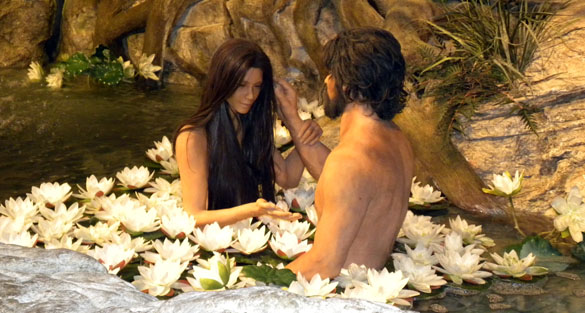
In Christ’s book God took a lump of dirt and ‘made Man in His own image’ while in Marx’s narrow materialistic vision “it is not the consciousness of men that determines their existence, but, on the contrary, their social existence that determines their consciousness.”

Basically both of them start with the same ‘materiel’ – the mundane ‘star dust’ that Mendeleev distributed throughout his table – but what a difference at the end of the ‘assembly line’!
adamevebefore

Being made ‘in His Own image’ not only means that all Men (and Women) are created equal but also that each of them shares in His Divine Nature. Hence the origin of our free will, of our ability (‘right’, opportunity) to be saved. Compare this to how Marx described the human society:
“The Communists, therefore, are on the one hand, practically, the most advanced and resolute section of the working-class parties of every country, that section which pushes forward all others; on the other hand, theoretically, they have over the great mass of the proletariat the advantage of clearly understanding the line of march, the conditions, and the ultimate general results of the proletarian movement.

The immediate aim of the Communists is the same as that of all other proletarian parties: formation of the proletariat into a class, overthrow of the bourgeois supremacy, conquest of political power by the proletariat.

The theoretical conclusions of the Communists are in no way based on ideas or principles that have been invented, or discovered, by this or that would-be universal reformer.

They merely express, in general terms, actual relations springing from an existing class struggle, from a historical movement going on under our very eyes. The abolition of existing property relations is not at all a distinctive feature of communism.”

articlefiles-mv003370610000-96750_bd

As somebody who has lived for 30 years under communist rule let me translate this from ‘Newspeak‘ into plain English:
‘History suggests that those who figure out the inner workings of this world  have, from time to time, the opportunity to take over the show. Now is one of those moments. The ‘fat cats’ have been so greedy lately that the regular people are growling under the very heavy yoke that has been placed on their shoulders.  That’s why we have the opportunity to unsettle the ‘old’ from their positions and to plant our fat asses in their comfortable chairs.
And the first thing we must do in order to achieve that goal is to abolish the right to private property. People are so fed up with what was going on lately that they’ll go along. They have grown to hate so much the ‘greedy plutocrats’ that most of them won’t notice that in the (revolutionary) process they’ll lose the very last shrouds of personal autonomy they still have. Without the right to dispose of the results of their own labor they’ll be at our mercy’.

Who was right between the two?

Well… Both, unfortunately.

The communists did run the show, at least for a while. And we all know to which results.
On the other hand it seems that in the longer run miss-using the right to private property is indeed a powerful drawback. The already too long sequence of economic crises caused, ultimately, by nothing else but our own greed has indeed given birth to a generalized state of psychological malaise.

I don’t know about what’s gonna happen in the next world – or if it exists at all – but I’m sure that if we don’t learn, fast, how to use, properly, the right to private property things will become too hot for our own good in this one.

The only one we are sure about.

Further reading.
During my research for this post I found this very interesting take on the same subject:

“Zwolinksi argues that libertarians are right to support private property, but also that private property is more complicated than we sometimes think.”

lashes1-copy-300x210
If we want to understand what’s going on there we have realize that we are dealing with a absolute dictatorship which uses Islam as a crutch, exactly as the soviet style dictators in the so called ‘popular democracies’ were using ‘scientific materialism’ – their term for the communist doctrine.
The job of the Saudi ‘justices’ is to maintain ‘the order’ as they see fit – the kingdom as it is and the Saudi family in power, not at all to dispense justice as we know it.
In order to do that they use, ‘creativelly’, the most powerfull tool they have at their disposal: the faith shared by the majority of the inhabitants of the kindom.
It even doesn’t matter for them that in the process they are ruining any chance of a decent life for the majority of their conationals.
At first their only goal was to retain the graces of the ruling family – just as minions everywhere behave in the presence of a powerfull figure.
In time things have evolved in a malignant manner. I’m afraid that nowadays the House of Saud itself has become the prisoner of the erstwhile minions, just as every dictator eventually becomes the prisoner of his guards.

forgiveness

Some say that God created the world, a long time ago, and that’s why he is the only one who can forgive.
Some others remember how the elders taught them that keeping a grudge is far worse than having an ulcer. It will eat you alive, like a cancer.

I, personally, don’t know anything about God creating the world. I wasn’t there at that time so…
What I do know is that playing God is extremely dangerous. Not only for the impersonator but mostly for those around him. Exactly those who were amused at first by his performance – enough so that they encouraged him to continue, only to find out later how annoying the show will soon become AND that the exit door had been paddled shut behind their back, while they were happily clapping after the first gigs.
At the very end, after the impersonator had left the scene – by his own will or simply carried out, he will end up shouldering the whole blame – as he should, of course.
But I can’t stop wondering how much suffering could have been avoided if the crowd were just a tad more circumspect?

Not making very much sense, do I?

OK, first take a look at this:

No mercy

Then watch this:

go hard

Do you really think this is funny? Well… more than 38 000 of the almost two and a half million who watched this say they enjoyed it and only two and a half thousand became worried enough to express their feelings.

Most of you have not experienced how it is to live under dictatorship so I’ll use another metaphor.

You are probably quite familiar with this guy:

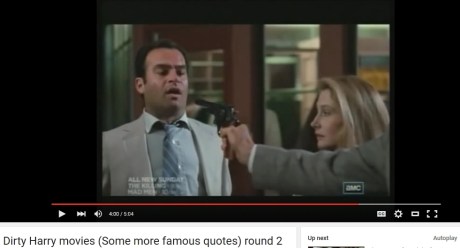
dirty harry

He was lionized during the ’70’s and the ’80’s for impersonating a no-nonsense cop who cut through the red tape and got things done.

Mostly by shooting the bad guys.

Don’t get me wrong.

They didn’t get anything else than they actually deserved.

What I find really troublesome about Dirty Harry is the casualness with which he killed people. And his over-reliance on guns. On brute force, that is. “Go ahead, make my day.”

It is true that at that time people were exasperated with the daily occurrence of violent crime and were desperate for a way out of that situation. I’m not going to offer you statistics or stuff, you can look them up yourself. I’ll just tell you that the Romanian television was having an almost daily news bulletin presenting the latest violent acts committed Stateside. It was all part of the propaganda, of course, but the facts were real. And plenty enough to make me wonder, I was a teenager at that time, what on Earth is going on there?

That wave of violence has subsided, as we all know. Some say it happened because of ‘broken windows policing’, some ‘freakin’ others ‘blame’ ‘Roe vs Wade’ for it while I suspect that all of the above had something to do with it but that the main ‘culprit’ was the economic upsurge that followed the ‘stagflation’ period.

Nowadays we find ourselves in another economic and psychological down-turn. With a twist though.
The recent economic troubles were brewed at home while then it started with the Oil Crisis. Much of the violence no longer starts as a robbery but has a psychological motivation – disgruntled and socially disconnected young people commit multiple acts of homicide, either by indiscriminately shooting their victims or by blowing themselves up, along with a huge amount of explosives, in densely populated areas.

And how do we respond to this fresh wave of violence?
By turning a blind eye to heavy policing? By digging fresh trenches that further divide our already highly polarized society? By another wave of over reliance on guns?

“I said it was only me and, hands still raised, slowly descended the stairs, focused on one officer’s eyes and on his pistol. I had never looked down the barrel of a gun or at the face of a man with a loaded weapon pointed at me. In his eyes, I saw fear and anger. I had no idea what was happening, but I saw how it would end: I would be dead in the stairwell outside my apartment, because something about me — a 5-foot-7, 125-pound black woman — frightened this man with a gun. I sat down, trying to look even less threatening, trying to de-escalate. I again asked what was going on.”

Go ahead, click on that quote and read the entire article. My post won’t go anywhere.

What’s the connection between what happened to Kyle Monk, the Dirty Harry movies and Putin?

For starters all those involved were …human individuals.
Kyle’s neighbor who called the police and who, when asked by Kyle ‘why did you do it’, chose to end up the conversation with “I’m an attorney, so you can go f— yourself.”
All of the nineteen policemen who played a role in this drama – and who treated a 125 pound, scantily clad, woman as if she were an armed and dangerous criminal were also human individuals.
The heads of the public administration, those who adopt and enforce policing policies are also human individuals.
The financial wizards who engineered the recent crisis belong to the same species as we do.

We, the guys who admired Dirty Harry for his toughness, are the parents of the hapless generation who blows itself up or mindlessly shoot their colleagues in campuses.

We are also the guys who are amused when bored magazine writers attribute to Putin such silly quotes as ‘it’s my job to send them to Him’.

And it’s us who applaud the Putins of this world. Only to find out, on our own skin but too late to be able to do anything about it, that the ‘hug of the bear’ is not that comfortable as it seemed from a distance.

you're Callahan


Basically, “anarchy” is about everybody for himself. And damn everybody else – even though most forget about this part.

While “secession” is mostly about someone trying to carve a ‘piece of the action’ for himself – and some people (naively?) following him. Maybe hoping that the new ruler would prove to be better than the old one?

Hardly a day passes by without Putin, Russia’s current ruler, being present at the top of every major news channel.

While sometime ago he was lionized on the cover of many glossy magazines nowadays he is the star of a lot gloomier articles.

Happier days (last month). Photographer: Vasily Maximov/AFP/Getty Image

What’s going on there?

About a week ago a prominent Russian journalist addressed an open letter “to President Vladimir Putin and Prime Minister Dmitry Medvedev, where he discusses his case and the significance its abandonment has for Russia as a nation“,

Oleg Kashin, the author of the open letter, which can be read here in English, had been beaten to a pulp some 5 years ago and “Last month, on September 7, 2015, after a surprisingly exhaustive investigation by Russian police, Kashin revealed the names of his alleged attackers. The men appear to be linked to Andrey Turchak, the powerful governor of Pskov, and ex-employees of the security department of “Zaslon,” a company owned by Turchak’s family that designs and produces aircraft electronics and weapons-targeting systems. Though the evidence against Turchak and his entourage has mounted in the press, he remains free and in office. He hasn’t even been questioned.”

Well, Kashin’s case is the perfect illustration for what Adam Michnik has mentioned last August: “Russia non è uno Stato totalitario, ma è un sistema autoritario”  (Russia is not a totalitarian state but an authoritarian system).

This observation solves perfectly an apparent paradox. How come the Russian police discovers, after five years, who had beaten – following orders given by one’s of Putin’s own protegees – a political dissenter?!?
Simply because there is an important difference between an ‘authoritarian system’ and a totalitarian state.

The authoritarian leader cannot act, not yet at least, like a totalitarian one. He is not in full control of everything under the sun in his country.

This apparently small thing is of paramount importance. Sooner or later more and more Russians will figure out for themselves that Putin is bad for them. Bad for Russia’s long term future.
Meanwhile the rest of the world has to thread this situation very carefully. Every time one of us wants to say anything about what’s going on in Ukraine or in Syria we must use “Putin” instead of “Russia”. It wasn’t Russia – but Putin – that annexed Crimea, encourages the Ukrainian separatists and supports the Syrian dictator by bombarding the Syrian moderate opposition.

By mentioning them separately – Putin distinct from Russia – we send a very powerful signal to the Russian people. That we understand they are not personally responsible for Putin’s acts and that we know they are not yet able to change anything.

If we fail to do so we’ll fall into Putin’s trap.

Our failure to understand, and insist upon, the simple fact that Putin is not Russia is the only thing that enables him to portray the rest of the world as nothing but a bunch of callous people who are devilishly conniving against Mother Russia – and himself as the only possible savior of the Russian People.

Adam Michnik, La sfida di Mosca al mondo e sempre piu imprevediblie, La Reppublica, http://www.repubblica.it/esteri/2015/08/18/news/p-121206360/
Adam Michnik, While we Praise Ukrainian Restraint, Putin Builds His Neo-Soviet Empire, New Republic, http://www.newrepublic.com/article/117462/adam-michnik-putins-post-soviet-empire-threatens-ukraine
Oleg Kashin, A letter to the Rulers of Russia, Global Voices, https://globalvoices.org/2015/10/04/a-letter-to-the-rulers-of-russia-from-oleg-kashin/Marc Champion, Why Russian Jets are Buzzing Turkey, Bloomberg View, http://www.bloombergview.com/articles/2015-10-08/why-putin-s-russian-jets-in-syria-are-buzzing-turkey,
Better Failling, BBC dropped Clarkson. How much longer till Russia drops Putin?, Nicichiarasa, https://nicichiarasa.wordpress.com/2015/03/26/bbc-dropped-clarkson-how-much-longer-till-russia-drops-putin/
Michael Shaw, Reading the Pictures: Putin &Sochi: Let the FU’s Begin, Huffington Post, http://www.huffingtonpost.com/michael-shaw/reading-the-pictures-puti_b_4699356.html

OK, VW couldn’t figure out how to balance the ever stricter polution norms with the public demand for simultaneously more powerfull  and cheaper to run/cleaner diesel engines so they decided to fake it. And it seems they were not the only ones to do that.

This development poses some questions.

– What were they hoping for? Did they really think that something like this could have gone unnoticed for ever?
– What were the regulators thinking? That it’s possible to solve pollution by simply changing some norms?
“Moore’s Law” (“overall processing power for computers will double every two years” has been valid, for a while, in a very young technological field.
Internal combustion engines have been around for more than a century, they are rather old. Everybody knows that it is hard to teach new tricks to an old horse yet we tried to clean exhaust gases well beyond the reasonable instead of radically changing the technology. Computers seemed to be able to help, but only for a while…

Could this be just another ‘application’ of the Peter Principle? “Managers rise to the level of their incompetence?” GM was, sometime ago, the No. 1 Automobile Company. It recently went through a painful bailout. Toyota, the next champion – its methods were studied at the most prestigious management schools – was hugely embarrassed lately by a technological failure.
OK, you might argue that what went on at VW was an ‘upfront’ fraud, not at all an ‘honest’ mistake. Indeed but still a mistake, even if a potentially catastrophic one. Mainly for the shareholders, of course, but also for the rest of us.
A certain dose of distrust towards established authority is healthy for the society, as a whole, while too many proofs of the established figureheads behaving callously generate a diffused disrespect for the law which is really bad for everybody.

In fact what happened at VW is exactly what people tend to do when they do not see any way out of a certain situation.
When they don’t really think that anything bad can happen to them, regardless of whatever they do.
Or both.

So. Is there anything to be learned from here? Except for the oldest lesson history keeps teaching us: ‘reaching the top is easy, staying there is the really tough job’?
Maybe.
Toyota says that transparency, “both inside and outside the company“, is a good way towards avoiding this kind of mistakes. “You have to be able to listen to your customers, not just hear them.“

Photo credit: Akram Abahre. While European countries are being lectured about their failure to take in enough refugees, Saudi Arabia – which has taken in precisely zero migrants – has 100,000 air conditioned tents that can house over 3 million people sitting empty.

Those tents have been erected there precisely for the pilgrims who go there for the Hajj. They are empty now because at this time of the year there are no pilgrims, yet.
If the Saudis were to invite refugees to stay, temporarily, in those tents, they would have to provide for those refugees more stable lodging by the time of the next Hajj.
Integrate them, that is.
And this is the reason for which the Syrians are not at all welcome there, just as the Palestinians were not welcome either. They would upset the balance of power.
Basically the rulers of the Gulf states bribe their citizens with money coming in from the rest of the world while shamelessly exploiting imported workforce, allowed to stay only on temporary visas. The Syrians (and the Palestinians) would have to be accepted on a more permanent basis and offered the option for a full citizenship. That would both dilute the per capita revenue of the citizens and introduce a more liberal line of thought in a very conservative society.
Yes, a more liberal line of thought. The Syrians do not insist that their women cover their faces and have tried, repeatedly, to out-throw the ruling family.
So yes, the wealthy Gulf States are indeed very hypocritical “when it comes to helping with the crisis.” (they have helped create) but that’s no excuse for us to follow their example.
After all it is us who came up with the notions of ‘human rights’ and ‘pursuit of happiness’, didn’t we?

“Dame Athene Donald, who is Professor of Experimental Physics at Cambridge University, believes more “creative” toys such as Lego and Meccano, which are more likely to be given to boys than girls, should replace traditional “girls’ toys,” reported The Telegraph.”

Isn’t this nice? A scientist that shares her beliefs with us… how about some facts, for a change?

Don’t get me wrong, I basically agree with her only she’s got her horses behind the cart.

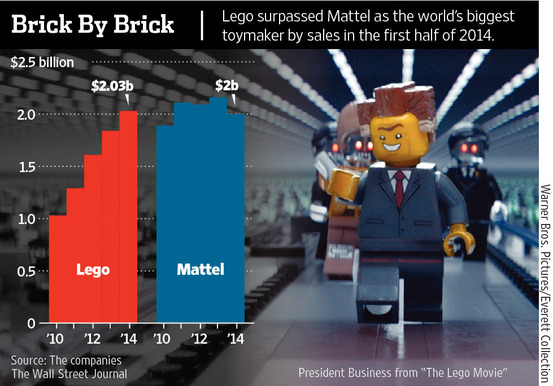
First of all Dame Athene Donald shared this, otherwise sensible, piece of advice – “ditch Barbie for Lego” – a full year after “The Lego brick has toppled the Barbie doll—at least for now—in children’s affections.”
Secondly the parents influence their children’s future in a lot more ways than by the choice of toys that are presented to their offspring. That choice is indeed a very good indicator about the attitude of the parents but only that, an indicator – not at all a ‘sentence’.

Here is Professor Donald’s main argument: ““We introduce social constructs by stereotyping what toys boys and girls receive from the earliest age,” she went on. “Girls’ toys are typically liable to lead to passivity — combing the hair of Barbie, for instance — not building, imagining or being creative with Lego or Meccano.””
So combing hair, or dressing a doll, leads to passivity while playing with Lego necessarily leads to becoming a creative adult… Yeah… sure… That’s why fashion and cooking, two domains otherwise closely connected to the womenfolk, involve a huge amount of creativity while most manufacturing jobs – still performed predominantly by men – are mostly about following procedures…

So yes, I fully agree with her conclusion – ““We need to change the way we think about boys and girls and what’s appropriate for them from a very young age.”” – but I’m afraid that she arrived there led by her activism rather than by ‘scientific’ reasoning.

And since I’m very afraid of all forms of activism I’d rather follow the advice offered by Claire Gillespie, the author of the article that prodded me into writing this post:“Don’t pigeonhole little girls into typically “female” interests and subjects. Don’t pigeonhole little boys into typically “male” interests and subjects. And give all children the time and freedom to explore all their options, without forcing them to go down the arts or sciences route from a young age.”