Archives for category: authoritarianism

Both are done ‘by hand’.

Apparently, any likeness between these two stops here.

But, if you pull back in earnest, the ugly thing becomes unraveled.
Not only that it is masturbatory, aka self-inflicted, (political) manipulation should also be classified as sado-masochistic.

Manipulation, as a process, can be examined from two perspectives.
A social one and an individual one.
Now, that everybody knows that ‘manipulation is bad for you‘, any individual who allows themselves to be manipulated into anything must suffer from a masochistic disorder while those who actively manipulate others must be cold blooded sadists.
On the social side, since time and time again manipulation has been proven to have had dangerous consequences, any community that sees any form of manipulation as an acceptable practice must have certain suicidal tendencies. Aka suffer from a ‘social form’ of masochistic disorder. While those who manipulate must be, themselves, cold blooded sadists.

As for being masturbatory, something which is brought upon one self by their own hand, that is almost as evident as Polichinelle’s secret:

Bona-fide politics, that made in earnest, involves open discussion between those who are going to be affected by the decisions and those who propose and support them. Discussions which take place before each major decision is made, during its implementation and after its consequences have started to be felt. The interaction between the politicians and the general public is direct, unmediated.
In Nassim Taleb’s terms, in this situation the politicians have their own ‘skin in the game‘.

Which results ‘risk management’ policy which is the complete opposite of the one adopted by those who believe themselves to be insulated from the consequences of their own actions.

The manipulators, on the other hand, window-dress themselves and the propositions they make. Their goal being not as much to contribute to the well being of their community as to ‘sell to the public’ whatever their minds have been focused on, at that moment. They consider manipulation to be a legitimate tool either because they are not fully aware of the great dangers involved or because they have convinced themselves that they will be forever exempt from contributing to the  the eventual price.
Meanwhile, those who allow themselves to be manipulated either do not realize they are being manipulated or have adopted ‘cynicism as a refuge’ in order to mitigate the cognitive dissonance that is eating away their self esteem.

In an ever-changing, incomprehensible world the masses had reached the point where they would, at the same time, believe everything and nothing, think that everything was possible and nothing was true… The totalitarian mass leaders based their propaganda on the correct psychological assumption that, under such conditions, one could make people believe the most fantastic statements one day, and trust that if the next day they were given irrefutable proof of their falsehood, they would take refuge in cynicism; instead of deserting the leaders who had lied to them, they would protest that they had known all along that the statement was a lie and would admire the leaders for their superior tactical cleverness.

Please note that in this situation the interaction is no longer direct. The manipulator and the manipulated do not ‘touch’ each-other. Therefore neither knows exactly what the other has in mind.
The interaction is mediated by symbols. Which are ‘photo-shopped’ by the manipulators and, sometimes ‘admiringly’, accepted by the manipulated.

It’s exactly this lack of direct contact between the manipulators and the manipulated which determines the whole thing.
The manipulators are, simultaneously, unaware of the true situation and growingly convinced of their ‘impunity’.
The manipulated have initial difficulties in determining that they are subjected to manipulation and, in a second stage, the impression that there is nothing left to be done about the whole thing.

When, eventually, the consequences catch up with both of them, it is usually too late for anything else but ‘damage control’.

People regret that they didn’t wise up earlier, promise themselves they’ll never let something like that happen to them… and forget. Until the next time.

Manipulation: useful tool, mortal sin or what?!?

Hannah Arendt Explains How Propaganda Uses Lies to Erode All Truth & Morality: Insights from The Origins of Totalitarianism

Masochistic Personality Disorder

Secret de Polichinelle

Cognitive dissonance

Karma

“If democracy and open societies depend on constantly providing their citizens with more wealth tomorrow than today, then the Western world — and soon enough the whole world — is in for tough times.” (Zachary Karabell, Forget Dow 20,000 — the Boom Times Are Over. Is Democracy Next?, Foreign Policy, 2017/01/26)

Shouldn’t we ‘back track’ and try to identify what and when, if any, we’ve done wrong before attempting to go any further?

The author identifies, with surgical precision, the stepping stones that have led us to where we are now.

We, in the West, have grown to associate material affluence with capitalism, democracy and liberalism.
In the process, we got “addicted” to a special kind of ‘economic growth’,  the one measured in monetary terms.Lately, after people no longer had as many children as they used to – which, supposedly, is going to hinder and eventually halt ‘economic’ growth, things are no longer seen in the same light.
The economic boom in China and recent developments in Philippines, Turkey and a few other places which “have seen a surge in nationalism of late, a questioning of democracy and skepticism about liberalism even as economic growth has been strong and deep”  are adding to the confusion.
Even “more surprising is the erosion of support for democracy and the norms of liberalism — even of capitalism — in the United States, France, Spain, Greece, and elsewhere”.

He also identifies, with equal precision, some of the barriers that prevent us from seeing the wider picture.

That we haven’t yet developed a clearer understanding of what liberalism and democracy might be. In his own words they still are “adolescent concepts relative to the tenure of recorded history”.
Then there is the matter of how we understand ‘economic’ growth.
“Politicians and governments rise and fall based on how successfully they have been seen to address the problem of wealth and jobs — not the problem of food, shelter, health, and quality of life.”
“we know no other way to assess economic strength and societal success except by the metric of growth. Three hundred ago, the metric was armies and territory. Today, it is GDP, jobs, and wages. You could craft a lovely society with zero growth, but nobody would believe it if GDP, jobs, and wages were shrinking and the rewards remained unevenly dispersed.”
And it’s not only a matter of understanding but also one of perception. “How people react to inequality is hardly straightforward; the populist wave that elected Trump doesn’t yet mind a billionaire cabinet. But the perception that some are reaping rewards at the expense of the many is deep and strong; that, too, was a line almost verbatim in Trump’s inaugural address.”
Which perception leads to a certain way of seeing things. “We clearly are able to provide basic material needs to everyone. But in the developed world, we are failing to provide a sense of security even while most people’s lives are de facto more secure.
On top of this, there is “anger”. Produced by the “evidence that we have the ability to meet our collective needs and wants” corroborated with the “ample evidence that many countries lack the political will or social consensus to make that happen”.

So, what next?

In Mr. Karrabell’s terms, we need to brush off skepticism, fear and anger – since they “are not themselves barometers of the future” – and …

“The greatest questions for the coming years is whether material stability is enough to mitigate against political chaos and societal decay.”

I’m sorry but I really don’t like this kind of ‘wait and see’ attitude.
It doesn’t make much sense to bother about something that will happen outside your sphere of influence, does it?
Place a bet, if you are a betting guy, and go back to whatever you might be able to actually do!

How about rephrasing that question?

What is it that might bring about the “political chaos and societal decay” we are so afraid of?

Now is the moment for me to make a confession.
I’ve altered, just a little bit, the narrative.
While Mr. Karrabell did mention “anger”, he only said about it that it was “evident” – without providing any cause for it. It was I who associated that anger with the “ample evidence that many countries lack the political will or social consensus” to “meet our collective needs and wants”.
The way I see it there is no way that any country might ‘meet our collective needs and wants’, no matter what amount of ‘political will or social consensus’ might be involved in the process. Not in the longer run, anyway.
All communist regimes – which were, declaratively, trying to accomplish exactly that – have failed. Abysmally.  Not because, in reality, all of them did nothing but cater for their ruling elite but because all of them used to be run according to a ‘central plan’.

And stop calling China a ‘communist’ regime. Or Vietnam, for that manner. As long as the ‘means of production’ are more or less private, and their owners free(ish) to use them as they see fit, those countries are not ‘communist’. They might not be entirely free but they are not at all ‘communist’. Venezuela, for instance, is a lot more ‘communist’ than China.

But let’s return to the countries that might attempt to make it so that ‘our collective needs are met’.
How are they going to do that?
First of all, those in charge – the government, right? – would have to determine what those ‘needs and wants’ are and only then make the necessary arrangements for them to be met. But not more than that, because that would be wasteful.

Do I hear any chuckles? You figured out that those ‘willing’ countries would have to use the same ‘central planning’ system that has already led to the failure of the communist regimes?

How about re-framing the whole situation?
How about the “ample evidence” mentioned by Mr. Karrabell suggesting that too many countries – including the one that has recently inaugurated Mr. Trump as President – no longer have “the political will or social consensus” to allow their citizens enough real freedom and enough real opportunities to pursue their own “needs and wants”? As they see fit?

Then shouldn’t we next try to understand the process through which the erstwhile ample opportunities have been curtailed?

As I mentioned before, I’m going to use the ‘back-walking’ method.

First step, anger. We really need to loose that. Nothing good ever came out of it.

Specially when considering the next steps, perception and understanding. If we allow anger to cloud our thinking both perception and understanding will yield errors instead of knowledge.

Which brings us to our obsession with (monetary measured) growth. Could this obsession be explained by the fact that money is the easiest thing to distribute but also the easiest thing to hoard? Panem and circenses eventually failed… Why do we still see hoarding money as a legitimate goal (after amassing more than one could ever spend, with the entire family, in a hundred years)… beats me.
But explains what’s going on.
As long as enough of us see hoarding money as a legitimate past-time, more and more people will engage in it. More exactly ‘try to engage’ in it. And this is the very behavior which produces ‘bubbles’. As in ‘market bubbles’. And, eventually, crashes.

But not only crashes. Misconceptions also.

“There is little evidence that democracy and liberalism (and capitalism) in their current form are the best or only conduit for providing for economic needs and wants for all. If they were, there would be less roiling discontent.”
My point being that none of those, in any form, are ‘conduits’ for anybody to provide, through them, anything for anybody else.
Democracy, liberalism and capitalism, together, determine the three dimensional ‘space of opportunity’ where we, human individuals, try to provide for our own needs. If allowed to, of course.
It fact it is not the “politicians and governments” mission to “address the problem of wealth and jobs”. In a full-fledged liberal democracy the government does nothing but guards the freedom of the economic market  and the safety of the citizens – including their ‘human’ rights and private property.

As for capitalism… it doesn’t provide anything. Lest of all “incentives”. People provide incentives. Capitalists provide their employees with incentives to work and politicians provide the capitalists with incentives to engage in such or such enterprises or to refrain form others. And while the first kind of incentives, those provided by the capitalists themselves, work as intended – increase productivity, that is, if employed wisely, the latter end up curtailing the freedom of the market. Which can no longer work smoothly enough. This being the moment when opportunities disappear for the ‘man in the street’ and when those ‘connected’ to the government start to ‘flourish’.

You see, real capitalism is not as much about money as it is about trust.
Trust that your business partner – well, most of them – is going to fulfill his end of the bargain, not try to rip you off. Trust that if things go wrong – in the rare event that he does try to rip you off – the government will move swiftly on your behalf.

That’s all.
That’s what Deng Xiaoping meant by ‘I don’t care about the color of the cat, all I care is for it to catch the mouse’. That’s why the Chinese imported capitalism works. Because the Chinese government has learned that the market cannot do its job, in the longer time frame, without a certain dose of ‘liberty’.
The problem being that China is but an exception. Along with a few other examples, mostly in South Asia, they are the very few countries whose authoritarian governments have learned to refrain from interfering too much in their economies.

Looking back in time, ‘back-tracking’ that is, we’ll notice that capitalism has emerged in places where the entrepreneurs had both considerable individual liberty and enough wisdom to refrain themselves from trying to con their business partners. Otherwise the whole (budding) economic effervescence of the time would have very quickly been smothered by greed.
Think of the Medieval Venetians trading with the Arab merchants of the time. This being the reason for why the oldest surviving bank in the world, Monte dei Paschi di Siena, is based in Italy – the least centralized country in the Medieval Europe.
Or think about how a hand shake used to be enough to seal a deal between two Americans. Some time ago… nowadays you need an army of lawyers to buy a car… not to mention the flurry of official permits needed in most cases…

So, what we need to do, if we want to continue to be a source of inspiration for the rest of the world, is to restore democracy, liberalism and capitalism to what they used to be. Dimensions which described the space of opportunity that used to be open for all of us.

OK, hindsight is always 20-20… or so they say…
I’m afraid that what I just described was an idealized mental construction but I’m sure that you got my drift.
After-all, if the Chinese were able to learn it from us … we’ll surely be able to restore it to its old glory.
Or else…

http://foreignpolicy.com/2017/01/26/forget-dow-20k-the-boom-times-are-over-is-democracy-next/

The Rorschach test consists of a trained specialist encouraging a subject to share his interpretations on 10 “ambiguous images“.
At the end of the discussion the trained specialist more or less ‘determines the fate’ of the subject, by filing his interpretation of the subject’s reactions.

The democratic process consists of everybody freely expressing their concerns about things.
Periodically some people are invested with enough power to solve the problems encountered by the community, in a manner consistent with the values agreed upon by that community. At the end of each such period the activity of these people is analyzed (interpreted ?!?) by those at the ‘receiving end’ of the political mechanism, with the intended goal of improving the ‘political process’.
The fate of the entire community being under a double determination. The diligence of the politicians invested to run the show and the diligence of the people when evaluating the results of the political process.

As you can see with a naked eye, there are a few striking similarities between  Democracy and the Rorschach test. Both depend heavily on the participants being honest and straightforward.

If the patient ‘doesn’t trust his doctor’ or ‘doesn’t feel like talking’ the ‘trained person’ will undoubtedly have problems in reaching a ‘fair conclusion’. Both will have to ‘suffer some consequences’.
If the ‘doctor’ has ‘ulterior motives’ and ‘unfairly labels’ his patient, it will be the patient to suffer the initial consequences but, eventually, those consequences will ‘bounce back’ to their source.

Same things happen in any society.
The difference between a democratic and an authoritarian one being that in a democratic environment ‘consequences’ become apparent, and are dealt with, a lot easier than in an authoritarian one.
This being the reason for which true, functional, democracies work better than any form of authoritarianism.

As long as both parties involved ‘interpret’ their roles appropriately, of course.

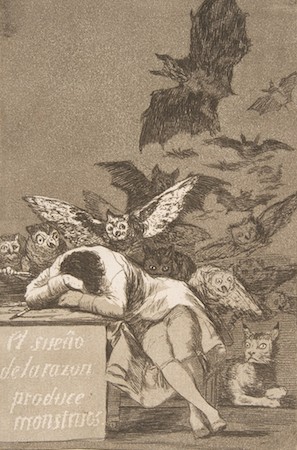
the-sleep-of-reason
People have started to freak out after realizing the full scale of what has just happened.
Some see him as a just retribution for our past sins – and they are probably right about this – while others look at the whole situation as if it was a sort of a Rorschach test.
How about Trump as an opportunity?
The inverse of a Rorschach test since that is about the shrink trying to learn something while an opportunity is about the subject bearing the responsibility for the consequences …
An opportunity, and a prod, for the silent majority to remember that ‘The sleep of reason produces monsters‘?
The way I see it Clinton would have done everything in her power to lull us back into our erstwhile stupor while Trump, willingly and/or unwittingly, is already making enough noise… Even the Sleeping Beauty must have already heard something…
So, test or opportunity, now it’s up to us to find a way out of the current mess. Which, I have to repeat this, is our exclusive responsibility.
The problem being that for those inside, the ‘light at the end of the tunnel’ can be the actual exit or the head-light of a train engine barreling down towards them.
‘Lady Luck’ is a tough bitch and that’s why one should be really careful with these things.
PS. The ‘shrink’ already has a huge ‘blot’ to muse about. Some people never learn.
Emily Linroth being a spokeswoman for the National Park Service, the organization which has cleaned up “the National Mall following the inauguration and the Women’s March on Washington Saturday.

I was planning a post and going to use this title, but without the quotation marks.

I wasn’t aware of the book that begins with the very same words.

Before starting to write – the original post was meant to be about the relationship between us, people, and the laws that govern our lives – I checked on Google whether somebody else had already used the same title and where they had went from there.

Since G‑d is the ultimate perfection and is free of all limitations and definitions, it is self-evident that, in the words of the Alter Rebbe, “The fact that He creates universes does not express what G‑d is.” At the same time He is, as Maimonides writes in his Laws of the Fundamentals of Torah, “the one who brings every existence into being; all existences exist only as derivatives of His ultimate existence” and the one upon whom “all existences are utterly dependent.” It is also obvious that just as no creature can comprehend the nature of G‑d’s creation of reality ex nihilo, so too no creature can comprehend the nature of G‑d, even the nature of G‑d as the creator of the world and the source of every existence.

In the words of the great Jewish philosophers: “If I knew Him, I would be Him.”

So, though a person realizes and understands that no thing can create itself, and that one must therefore conclude that the created reality has a source that generates its existence, this is proof only of the existence of the Creator, not an understanding of what He is, even as “Creator.”

Now, after reading Rabbi Schneerson’s (the Lubavitcher Rebbe) words, I cannot stop wondering what drives certain people to pretend that they have fully understood God’s will and therefore their actions/words are not only ‘correct’ but also above any doubt.

Not to mention their insistence that we, the rest of the (not divinely blessed with such a deep understanding) people, must follow their directions or suffer the consequences?
Here on Earth, at ‘their’ hands…

On the other hand, the same principle has been affirmed – time and time again – by various scientists.
For example, by Werner Heisenberg.
The depth of the uncertainty principle is realized when we ask the question; is our knowledge of reality unlimited? The answer is no, because the uncertainty principle states that there is a built-in uncertainty, indeterminacy, unpredictability to Nature.


For more than a year now I was struggling to understand the circumstances that have produced the current political mess in America.

I finally figured it out.

Confusion and dissatisfaction!

If you have enough people that are both confused and malcontent then all kind of ‘strange’ things will happen.

Only one of them won’t be enough to explain the whole gamut of what’s going on and that’s why I wasn’t satisfied by any of the many articles that pointed out one reason or another for the ‘popular discontent that brought the Donald to the White House’.
In fact no amount of ‘unhappiness’ can explain how two mature parties can nominate such lousy candidates. Neither Hillary Clinton nor Donald Trump fit, not even loosely, the profile of a decent President. That’s why the voter turn-out was the lowest in the last 80 years or so.

But if you add ‘confusion’… things begin to clear out.

And no, I’m not speaking here about the regular people being confused as a result of the ‘politicos’ having misbehaved horribly.
I’m afraid things are way deeper than this.
Even those who believe themselves to be educated in these matters seem to be swimming in a sea of thicker and thicker fog.

Take, for instance, the current debate about the differences between ‘republic’ and ‘democracy’.

A republic is a representative type of government, and its goal is to simultaneously control the majority while protecting the minority. For example, in the republic of the United States, the government is limited constitutionally, and power is divided between the three branches of government.

A democracy is a type of government that grants eligible citizens the right to equal participation. This right is provided directly through the creation and development of laws or through elected representatives. The interest of the majority is the most important aspect in a democracy.

A republic is a representative form of democracy. A republic has an elected head of state, such as a president, that serves for a specific period of time. In a republic, the interest of the majority rules through its elected representatives. However, a republic has a constitution that protects the minority from being entirely overruled or unrepresented.

See what I mean? Adding insult to injury this definitions were published by a site which calls itself ‘reference.com‘ …

I’m not going to pick truth from fiction in that quote, that would only add to the already too thick confusion.

Enough for me to say that ‘republic’ is indeed a manner in which societies are organized (a.k.a. ‘governed’) while ‘democracy’ is a manner in which societies decide for themselves. Yes, these two things have a lot in common but we should not confuse them.

There are republics which only pretend to be democratic – like the late Soviet Union or the current Democratic Republic of Korea, some which are democratic in a rather strange way – Iran for example, or which are slowly ‘loosing’ democracy behind – like Orban’s Hungary or Putin’s Russia. History has also a few examples of republics which had given up democracy all together. Hitler’s Germany, for instance.

On the other hand there are monarchies (OK, constitutional monarchies) which are perfectly democratic. The British Commonwealth, Sweden, Norway, Holland, Belgium…

What can explain the current confusion?
‘The interest of the majority is the most important aspect in a democracy’?!?
A major lack of understanding about what democracy really means?

A terrible confusion between the formal aspects of democracy – freedom to vote for what ever candidate accompanied by a fair account of the ballots – and the really important tenets of democratic behavior – honest, open and mutually respectful exchange of ideas about the current state of affairs between the interested members of the society?
My point being that true democracy is about the opportunity to rationally convince those around you/making yourself available to be convinced by rational arguments, not about the majority imposing its view on the minority. That is nothing but mob rule, a horrid perversion of what democracy was meant to be.

Basically, what happens – under all forms of social arrangements/forms of government: republic, constitutional or absolute monarchy – in a society is that people need to know where that society is headed to. Authoritarian societies are run by the ruler – and the people, willingly, unwillingly or with mixed spirits, agree for the time being – while the democratic societies entertain a certain ‘effervescence of ideas’ which bring forward the important problems that need to be resolved and what would be the socially acceptable manners for those problems to be fixed.

But in order for that ‘effervescence of ideas’ to be efficient, the ordinary people have to contribute in earnest to the exchange and the politicians need to pay close attention and to cooperate among themselves and with the rest of the society towards solving those problems.

That’s why I’d like you to remember when was the last time that people on the different sides of the political divide have actually talked together?
Why do we have a ‘political divide’ in the first place?

Aren’t we supposed to be ‘all together’ in our respective countries?

What’s gotten into us that made us fight each-other so bitterly?

Why do we succumb so easily to ‘divide and conquer’?

Why are there still so many politicos who keep using this method, despite the ample proof that has been provided to us, through out the history, that ‘divide and conquer‘ inevitably ends up in disaster?

http://politics.blog.ajc.com/2017/06/16/when-your-own-rhetoric-gives-you-license-to-commit-mayhem-and-worse/

Growing in a communist country, Romania, I was ‘exposed’, naturally, to all sorts of communist propaganda. ‘Embedded’ in almost everything.
One ‘sugar coating’ that was very popular among the apparatchiks of the day was ‘crime novels’. ‘James Bond’-like  ‘literature’ which was supposed to educate us, ordinary citizens  who could almost never get an exit visa to go to a ‘capitalist’ country,  about the perils ‘our’ trading agents/diplomatic personnel had to ‘negotiate’ when sent abroad to ‘serve the country’.
The most publicized ‘peril’ being the ‘prostitute trap’. Supposedly the ‘pure’ communist was trapped by a skillful prostitute into believing she was heavily enamoured  of him and then lured to an apartment were the couple would be filmed while ‘consummating’  their new found passion. Later, of course, the recording would have been used to exert pressure in order to influence the hapless fool into betraying his country.

The recent articles regarding ‘the art of kompromat’ tend to suggest that those ‘novels’ were nothing but yet another example of a wolf crying wolf… but who knows…

Fast forward to our times.

Is there anything clear in all this?

And no, I’m not wondering whether there is an actual tape of Trump ‘frolicking in bed’ with anybody. Even if it exists, it is well guarded. After all, such a tape is way more valuable as long as it is hidden away than when out in the open. The threat to reveal it works only as long as nobody else but the black-mailer and the victim know about its existence.

Then why all this brouhaha?

A preemptive strike meant to dull the effect of Putin actually publishing such a tape?
Putin trying to ‘soften up’ his intended target?
But what is Putin’s goal? He cannot dream of ‘controlling’ the President of the United States. Even when that position is fulfilled by someone like Trump… The actions of any POTUS are so public that any influence would very soon become apparent, on one side, and Trump, himself, is a very ‘unreliable’ person to start with.

But what if Putin has another, and way more insidious, goal?

What if he wants to compromise the very concept of democratic elections?
To ‘demonstrate’ to us that ‘the public’ is (has become?) incapable of electing a good man to lead it to the future?

Well… the problem with ‘kompromat’ is that it has to be tailored to its intended victim.
Just imagine what effect would have had a tape depicting Obama in bed with someone else but Michelle. Who would have believed such a thing?
But Obama was, to a degree at least – as Trump had very astutely estimated, vulnerable to a campaign focused on his birth certificate. We all know what kind of ‘passion’ the birthers have managed to instill into some of the die-hard conservatives.
And we should not forget that Trump had started his political life as a friend of the Clintons. His words, “that Hillary Clinton ‘had no choice’ but come to his third wedding“, are now world famous…

Now, bearing all these in mind, shouldn’t we ask ourselves how farfetched is Putin’s project of destroying our faith in democracy? Using ourselves as minions?

After all, Trump was elected democratically!

And do you remember those discussions about the US being intended as a Republic by the forefathers, and not as a Democracy? Or Orban’s – Hungary’s authoritarian prime minister, one of Putin’s close political friends, concept of ‘illiberal democracy‘?

“I voted for Trump because I think his illiberal tendencies are actually a feature rather than a bug. When he undermines rule of law, I see not a danger, but someone who is undermining a system that has become a game for elites with access to armies of lawyers. When he browbeats Congress, I don’t worry about “checks and balances” which have become a recipe for dysfunction, but rather see him as a man taking on useless political prostitutes servicing everyone who can write a sufficiently large campaign check. When he strong-arms multinational companies like Carrier, I see someone standing up to the worst aspects of globalization.”

Who built the world as it is right now? The one where the young adult who wrote the words quoted above, had grown up into and was modeled by?

We did it? With both its good-s and its bad-s?

It is us who kompromised it?
Then it is us who’ll have to fix it!
Or we’ll have to endure the yoke the likes of Putin and/or Trump will undoubtedly try to put on our shoulders.


Theoretically it means “from each according to their abilities, to each according to their needs”.

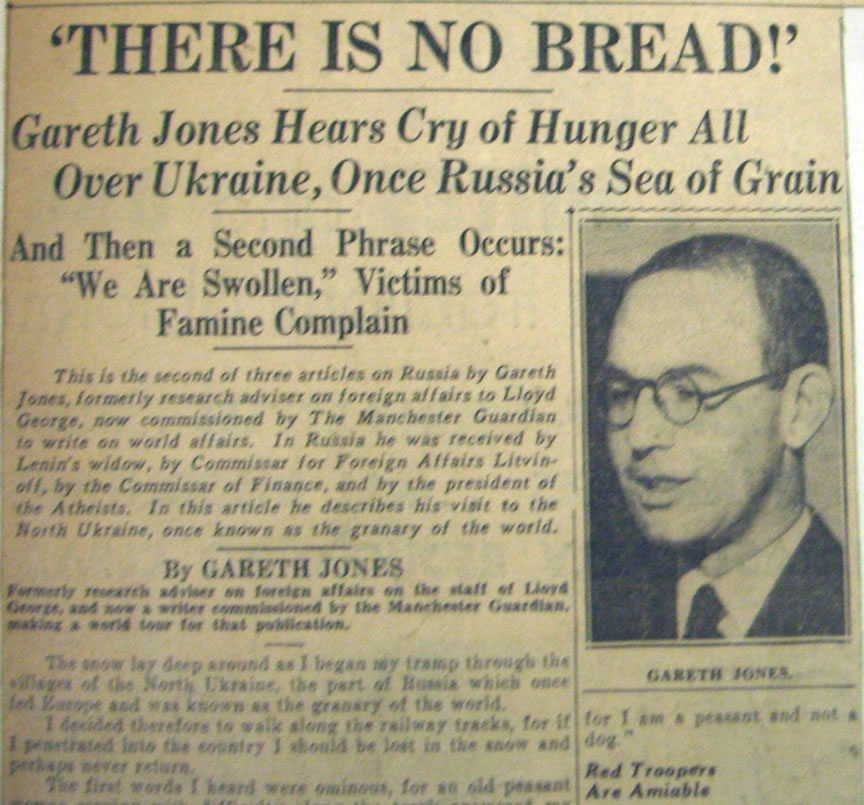
Practically it looks like this.

famine-in-ucraine

In fact real life communism still is, and always was, about a whole country kow-towing to a dictator who pretends to care for nothing else but for the welfare of the people. His people!

The point being that each resource allocation game needs a referee. Otherwise all rational people would take as much as they could carry from the communal reserve – because it is free – and bring back as little as possible, hence nothing if not coerced to – because it implies some effort.

OK, any reasonable five years old would tell you that the communal reserve would very soon become empty if things would go like this – hence that presumably ‘rational’ behavior would be anything but – only it would be very rational to at least try, wouldn’t it? For how long it would work, no matter how short that interval…

And something else.
You are most likely familiar with ‘bad money drives out good’. There have been a lot of examples to prove this, one of them being Christ driving the money changers out of the Temple.
Some of you might not be familiar with how money worked in those days so here is it.
A coin was a simple ‘slab’ of precious metal, of somewhat constant weight, approximately round, which had been ‘stamped’ with the face of the local ruler. At first, in the minting shop, all coins belonging to the same edition were more or less of the same weight. But, since the edges of the coins were not ridged, ‘smart’ people started to ‘shave’ the coins.
And, after the first guy had started to shave them, each individual who got a coin would have been foolish not to shave it, just a little bit. Maybe the next guy would be foolish enough to accept it, after being shaved. To contest it the recipient would have had to go to the money changers and pay for their expertise. And this is how the coins became smaller and smaller…
Only the priests at the temple didn’t want to be fooled. So they hired some money-changers to vet the coins the believers brought to the Temple. The very money-changers that Christ had driven away. “God doesn’t need this kind of guardians. If we keep them here it would mean that we expect people to cheat. Even here, at the Temple. And if we expect them to cheat, they will surely do so!”

Only some people do cheat. And since some cheat, the rest will have to do something about it. Either make cheating the rule, which would lead nowhere, or make it so hard to cheat as to become impractical. Hence the ridges at the edges of the modern coins. Which can no longer be shaved because the ridges would make it obvious.

Coming back to our ‘communal reserve’ you would have to employ a guardian to make it sure that no one would take any more than they really need and that everyone periodically brings back stuff according to their abilities.
But how would that guardian determine what are the real needs and the real abilities of each of those individual members of the community?
And, even more importantly, what would stop the guardian from taking the whole ‘communal’ reserve into his private possession? As in acting like a communist dictator? Simply because ‘he needs it’?

The only alternative that worked was the free market. That where you sold your abilities and where you could buy things to fulfill your needs. Where prices were set at the meeting point between ask and demand.
But the same principle, bad money drive out the good, acts even here.
‘Smart’ people try to organize ‘monopolies’. Which, basically, is the same thing as they attempting to become the owners of the ‘communal reserve’.

This whole thing looks like an intractable vicious circle?
Take heart, that’s what ‘reeds’ are for.
We invented those, when we realized that we needed them, didn’t we?

reeded-coins

You still wondering what to use in order to transform that vicious circle into a virtuous one?
How about individual freedom coupled with a healthy dose of mutual respect?

gambit noun [C] (CLEVER ACTION)

– a clever action in a game or other situation that is intended to achieve an advantage and usually involves taking a risk:

 – specialized games a way of beginning a game of chess, in which you intentionally lose a pawn (= game piece) in order to win some other form of advantage later

I borrowed this definition from Cambridge Dictionary, the on-line version.
You have already noticed, I’m sure, the accent on cleverness, the ‘intent to achieve an advantage’ and the relative downplay of the risk that is only ‘usually’ involved.

A more nuanced definition of the concept would mention that the person who uses this tactical maneuver has to get out of their psychological  comfort zone in order to perform it properly.
The whole thing involves offering a valuable bait which, once taken, might produce consequences favorable to the party that is ‘spending’ it.
Since the favorable consequences are not sure – otherwise it would have been a bribe, not a gambit – but the expenditure is certain the guy who initiates this has to thread very carefully. Hence the need for the bait to be really valuable. Valuable enough for the taker to take it and valuable enough so the giver would be really careful when performing the maneuver.

We have witnessed three gambits in close succession.

Britain’s David Cameron promised a Brexit referendum in an attempt to win the 2015 general election. He won the election but lost the referendum.

Quite a large number of Americans, fed up with what has been going on in their country, have pinched their noses and elected Trump into the Oval Office. The deal is not going exactly as they have planned it – Clinton is not going to be charged, the ‘swamp’ is more likely being repopulated rather than drained in earnest – but the jury is still out on this one.

Italy’s Matteo Renzi tried to cash in on his popularity and stream-line the constitution – a move which would have given more powers to the central administration. He has just lost the referendum, is about to resign – as promised and his losing the gambit has opened a wide venue for the opposition 5 Stars Movement led by a comedian – Beppe Grillo.

Need a moral to this?
Gambit works fine when playing chess. That’s a special kind of game where all the pertinent information is out there on the table and the sole variable is the opponent’s mind/will.

Real life, a.k.a. politics, is a completely different game. There are lots of stakeholders, instead of the two chess players, while most of the pertinent information is jealously guarded by each of the stake-holders – along with most of their real intentions.

If we add here the ‘detachment’ of the players – Trump and Cameron are both independently wealthy while Renzi is rather inexperienced – we’ll soon arrive at the conclusion that we’d be better off with some unadventurous, bland even, politicians.

The essence of spin doctoring is to present a sequence of true facts in such a manner that will compel the audience to reach the conclusion desired by the ‘good-doctor’. The really skilled ones don’t even need to lie in order to achieve their goals. At most they ‘shave’ some of the rough edges so that the truths they choose to mention fit smoother into their narrative
In fact it doesn’t matter much whether the conclusion they mesmerize their audience into is ‘true’ or not – truth is relative, anyway. The only thing that’s important here is that ‘the’ conclusion fits the intentions of the spin doctor.
Also, it even doesn’t matter what those intentions are. Good, bad… the end is always the same.

Because of the manner in which all this works.

The principle involved here is the same as that used by the magicians who entertain the crowds of circus goers.
They first concentrate the attention of their audience to a single point and then direct it in such a way that the people are no longer able to see anything but what they are allowed to by the magician.
Or by the spin-doctor.

Unfortunately the similarities between magicians and spin-doctors end here.
While most of the circus goers have a nice experience, albeit a relatively short one, most victims of the spin-doctors have to endure long lasting trauma and/or substantial material loss.

Again, irrespective of the spin doctors’ intentions. It doesn’t matter whether the method is used by a (well wishing socialist) utopian or by a callous Nazi.  In my previous post I mentioned how ‘political hyenas’ spring up and monopolize all the situations in which their ‘dark talents’ cannot be kept in check by the rest of the society.
Here we have the explanation for why the otherwise reasonable members of the society are unable to perceive the mortal danger they find themselves in.

Because the spin doctor had skilfully overloaded their attention.
Because after living for so long ‘under the spell’, too many people have become accustomed to let others think for them and in their name.

Was that clear enough?
The spin doctor doesn’t have to be malefic in order for the tragedy to take place. It is enough that they have occupied the attention of the people and have exhausted the ability of too many of the individuals involved to think with their own heads.
In these conditions the ‘political hyenas’ will undoubtedly make their appearance and attempt to gain control over the society.

And, undoubtedly again, those attempts will be extremely detrimental for the entire society.