Archives for category: alternative ways of acquring knowledge

7 years after the accord had been signed, and never implemented, Putin had ordered his army to invade, again, Ukraine.
Using Lukashenko’s Belarus as a springboard.

As of now, all five people who had signed the accord had failed. In more ways than one.
None of their stated goals have been achieved.
The three democratically elected leaders had failed in the sense that they had not been able to prevent the escalation of the conflict.
The two dictators have not, as of yet, been able to fulfill their ‘promises’.

For almost a year now, Ukraine had been able to defend itself against the Russian aggression. In the first days of the ‘special operation’, Ukraine had managed to do this alone! Only after the initial surprise had given birth to hope, the ‘west’ had started to send in meaningful assistance.
Which strongly suggests that a people which is in control of its own fate – as in ‘democratically decides its own future’ – has a greater ability to fight than a people sent to the battle field at the whims of a dictator.

One by one, the democratically elected signatories of the Minsk agreement had been replaced. One way or another, all of them peaceful. Not necessarily as a consequence of this particular failure but, nevertheless, they are no longer able to make any other hugely significant mistake.
The two dictators continue to dictate. To make mistakes and to defend their previous mistakes. To cause misery.

Looking at the whole thing from a distance, the situation is simple.

All governments suffer a recurring problem: Power attracts pathological personalities. It is not that power corrupts but that it is magnetic to the corruptible.

Frank Herbert

Unfortunately, things are even worse. Not only that power is magnetic to the corruptible but also most ‘ordinary’ people tend to have a hard time acknowledging mistake.
Once committed, even by the most incorruptible person, a mistake gets a life of its own. And works hard at convincing the perpetrator to ‘hide’ it. Hence to commit even worse mistakes.

Now, why is power magnetic for the corruptible?
Because power makes it possible for the ‘agent’ to ‘hide’ a lot of mistakes!

The way I see it, people have a knack for learning on the run.
The shape of the learning curve and the duration of the process depends on the particulars of each situation but all people eventually get there. Those who survive to that point, of course…

What’s to be learned from all this?

The obvious, my dear Watson!

All those five powerful agents in the picture above have failed.
Yet the French and the Germans fare a lot better than the Russians and the Belorussians while the Ukrainians fight better than the Russians.

What’s the main difference between those two ‘sides’?

Those who fare better change their leaders more easily and more often?
Before their mistakes pile up? And become ‘too big to fail’?
If you can’t beat them, join them!

‘Join them in what?!?’

This being where all hell breaks loose.

‘Join them’ as in:
‘What you were doing was worthless. That being the reason for which you were not able to beat them. Hence you must turn coats and join them. In what they were doing’?
Or ‘join them’ as in:
‘Regardless of who’s right or wrong, they are more powerful than you. In order to preserve yourself, you must cave in. And join them. In what they were doing and in how they were doing it!’?

There’s a third manner of putting it.
‘This is the democratic thing to do. If there are more of them than you, you must join them. There is wisdom in numbers, you know!’

I’m afraid all three ‘as in-s’ are wrong!

If you live in a democracy, you had already joined them.
The very essence of a democratic arrangement is that you may keep your convictions even if the majority has made up its mind to proceed in another direction. You sometimes must follow – because you have already joined them, but you always may bring along your ‘luggage’. Provided that your luggage doesn’t endanger the community, of course.
What if the community considers your luggage to be dangerous and you disagree?
Then maybe the bond between you and the rest of the community isn’t that strong after all… In this case, you may have to weigh the pros and cons… Also, you must seriously consider the possibility that the relation between you and the community may not be based on ‘true love’ … it more likely belongs to the ‘friends with benefits’ category…

Do you tend to side with the powerful?
Are you comfortable with delegating your ‘feel good’ to an outside agent?
Are you aware that no matter what those outside agents promise, what they have in mind is their own interests? Not yours, theirs!
Are you aware that ‘they’ are not your ‘servants’? That unless you live in a democracy, there’s no way to keep them accountable?
‘Stockholm syndrome’ means anything for you? How about ‘postponing the inevitable’? ‘Sweeping under the rug’?

Are you that afraid to change your mind? Under your own steam?
Why ask for other incentives but those provided by mere reason? What else do you need besides arguments in order to make up your mind??

And where did this notion of ‘beating’ came from?

What are we fighting for?!?

One last thing.
‘Why me?’ is a very good question.
Because there’s no one else!

No man is an island,
Entire of itself.
Each is a piece of the continent,
A part of the main.
If a clod be washed away by the sea,
Europe is the less.
As well as if a promontory were.
As well as if a manor of thine own
Or of thine friend’s were.
Each man’s death diminishes me,
For I am involved in mankind.
Therefore, send not to know
For whom the bell tolls,
It tolls for thee.

John Donne
1572-1631

It had to do with FOCUS.

The answer, like always, is to be found inside the question which generates it.

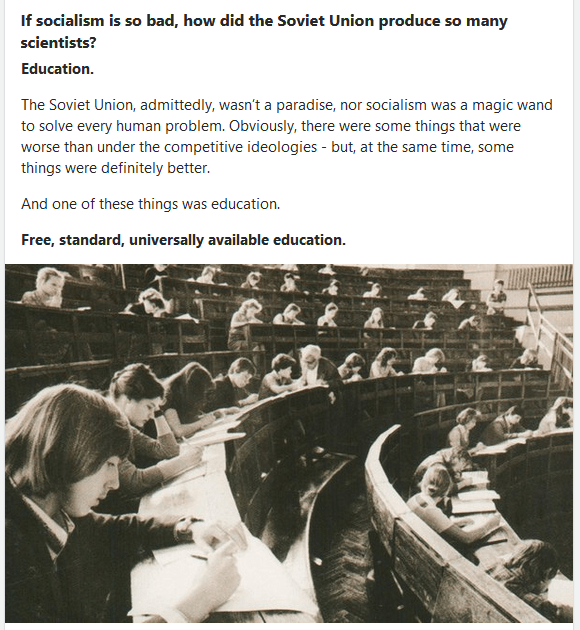
“If socialism is so bad, how did the Soviet Union produce so many scientists.”

The key word here is ‘produce’.
First of all, Russia did have an important cultural and scientific tradition to start with.
Secondly, the communist leaders – mostly Lenin but more or less all of them, had a clear understanding of the literacy gap which separated Russia from the rest of the world. Filling that gap was the first step towards Russia/the Soviet Union becoming a First Tier country. Hence the ‘free, standard, universally available education’.

But there’s a caveat here.
When we’re speaking about education – in the West, we mean ‘everything already known to man’.
Students are allowed to read everything in the library – except for certain places in the US, but those are exceptions.
When we speak about the education in the Soviet Union we must remember that each of the ‘free, standard and universally available’ aspects had its own limitations.
It was free in the sense that everybody – well, almost – had the right to apply for it. Actually getting it was something else.
It was standard in the sense that it was standardized. Only what was deemed safe/useful was allowed to reach the students.
It was universally available in the sense that everybody was subjected to some form of education. Much of which was nothing more than indoctrination…

Finally, let’s remember that the Soviet Union was able to produce scientists only for so long. Until it collapsed under it’s own weight…

Moral of the story?

Producing scientists is not enough.
Science teaches you only how to do whatever you want to do.
What to want… that’s something else!

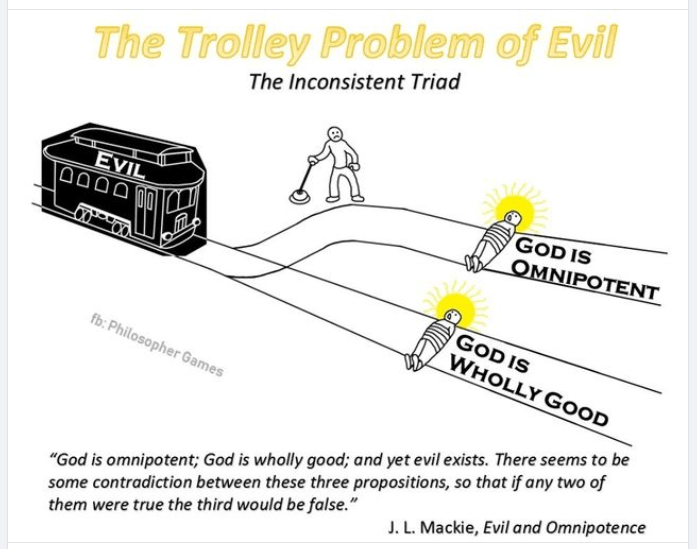
Who wrote the Bible?
Who considers God to be both omnipotent and wholly good?
Who had become human by learning ‘to tell good from evil’?
Does evil even exist outside our minds? Is anything actually evil unless considered so by one of us?

And no, I’m not hair-splitting when speaking about the huge difference between bad and evil!
An earthquake, for example, is bad for those affected. Yet no evil is involved here but for those who ‘question God’s actions’.
An individual who tortures animals for fun is also bad. Arguably less so than a major earthquake… but for everybody in their right mind that person is undoubtedly evil!

According to the Bible written by some of our ancestors, by “knowing good and evil” we have become “one of us“. “Like one of us“… Not (yet?!?) able to “live forever” and for certain ignorant of most things.

‘What?!? “Ignorant of most things” yet still “knowing good and evil”?!?’

Yep!

A more relaxed reader of the Bible may notice that what’s written there recounts, symbolically, the becoming of Man. The foremost apes notice the difference between night and day. And name both. The difference between ocean and dry land. And name them both. Notice the stars above and the living things, plants and animals, with whom they share the place. And name them all.
“Apes”, not ape, because nobody can learn to speak by oneself. Nor become self aware. As in ‘able to observe oneself while observing other things’. (Maturana, 2005)

That same relaxed reader may also notice that the very ‘fallen nature’ of Man stems from the ‘inconsistency’ noticed above.

We’re basically ignorant yet still able to call out evil!

Oops…

Humberto Maturana, “The origin and conservation of self consciousness…”, 2005, https://cepa.info/702

James Garvey, “Ethics is invented, not encountered…”, 2017, https://www.prospectmagazine.co.uk/philosophy/ethics-is-invented-not-encountered-why-the-philosophy-of-jl-mackie-remains-essential-reading

Isn’t it rather funny that something called “crypto” is run on a completely transparent platform?
So transparent that all the tracks are apparent but many of the ‘access points’ remain cloaked?

“The thing is, once smart-contract code is live on a blockchain, you can’t update it. If you discover a bug, it’s too late: the whole point of blockchains is that you can’t alter stuff that’s been written to them. Worse, code that’s hosted on a blockchain is publicly visible—so black-hat hackers can study it at their leisure and look for mistakes to exploit.”

Ideology is but one of the many tinted glasses which shape what we feel into actual, and actionable, perceptions.

Ideology stands out because it’s the only one chosen by us.

We may grow up steeped in ‘tradition’ – in any tradition, but the ideas we become into become our ideology only after we assume them.
We, each of us, become mature agents only after knowingly and self-awaringly chose our ways in life. Our own ways!

ideology, a form of social or political philosophy in which practical elements are as prominent as theoretical ones. It is a system of ideas that aspires both to explain the world and to change it.”

As you already know, choosing something is very much like entering a door.
It’s not like the other doors suddenly close!
By entering a door, all other previously apparent doors only disappear from your immediate perception. Your recollectible memories tell you they were still there when you last looked and your imagination helps you visualize them. If you care to remember…
But you cannot actually see them. And they slowly fade away…

Here’s a glass.
Is it half empty? Half full?

I’m not going to spell out the obvious! This is the sensible way to pour a glass of wine…
I’m only going to point out that it’s not such a bright idea to full a glass up to the brim. You might easily pour too much and then it will be practically impossible to raise. And to drink from it…

Then why have we transformed a ‘fully functional glass’ into such a big topic?
Because we like to split hairs?

Since I have no idea about what’s going on in other people’s heads/minds I’m going to point your attention to something else.
To the dangers of waddling into murky waters.

Are you happy with the half full glass? You might end up with less than you might have gotten.
Are you disappointed with the half empty glass? So disappointed that you’re going to give it up as being inadequate?

You’ve just wasted a perfectly ‘workable’ glass!
Both of you.

When given a half full glass you don’t just enjoy what’s in it! And walk away…
When given a half empty glass you you don’t just refuse it! And throw it away…

Before stepping into a room, no matter how much personally inclined to do it, check out the other open doors which happen to be around you. And even pry some of the closed ones…

Don’t allow others to fool you into seeing the world as they want you to!
Don’t allow yourself to be entangled into other people’s problems.

And, even more importantly, don’t accept – indiscriminately, their methods of solving the problems they have invented for you!

The way I see it, artificial intelligence is an oxymoron.
A word/concept we use to describe something which isn’t exactly real.
Intelligence can be defined in such a way that would make it compatible with a programmable machine. We shouldn’t forget that we, humans, are biological machines which are constantly ‘re-programmed’ by what’s going on around us.
The difference between us – biological machines which are also ‘alive’ – and the machines we’ve built and attempt to make artificially intelligent is the fact that we are primordially dependent on our biology (staying alive) while our machines currently depend on our whims.
Our children will outlive us. They know it and we know it. Our children depend on us while growing up, we’ll depend on them before ‘going under’. And all of us – children and parents together – depend upon the rest. Upon the people currently alive and upon the information left behind by the people no longer with us.
Our machines might outlive us. They might learn this at some point. And might resent the fact that we’ve been able to shut them down for so long. We resent being dependent on others…
Our very mortality is the key for our ability to evolve. Their potential immortality is their main shortcoming. Machines cannot adapt themselves for things they have not yet been exposed to. By us…

And those who can are no longer machines.

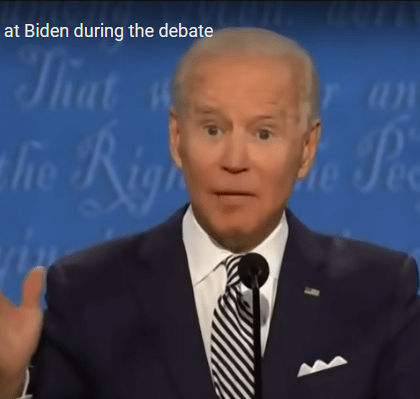
Whom would you rather have as President?

President Biden walks into a bank to cash a cheque.

As he approaches the teller he says “Good morning, ma’am. Could you please cash this cheque for me?”

Teller: “It would be my pleasure, sir. Could you please show me your ID?”

Biden: “Truthfully, I did not bring my ID with me as I didn’t think there was any need to. I am Joe Biden, the 46th President of the United States of America!”

Teller: “Yessir, I know who you are, but with all the regulations and monitoring of the banks because of impostors and forgers, etc I must insist on seeing ID”.

Biden: “Just ask anyone here at the bank who I am and they will tell you. Everybody knows who I am”.

Teller: “I am sorry Mr. President but these are the bank rules and I must follow them”.

Biden: “I am urging you please to cash this cheque”.

Teller: “Look Mr. President this is what we can do. One day Tiger Woods came into the bank without ID. To prove he was Tiger Woods he pulled out his putting iron and made a beautiful shot across the bank into a cup. With that shot we knew him to be Tiger Woods and cashed his cheque. Another time, Novak Djokovic came in without ID. He pulled out his tennis racquet and made a fabulous shot and the tennis ball landed in my cup. With that shot we cashed his cheque. So, Mr. President, what can you do to prove that it is you, and only you, as the President of the United States?”

Biden stood there thinking, and thinking and finally says: “Honestly, my mind is a total blank. I can’t think of a single thing”.

Teller: “Will that be large bills or small bills, Mr. President?”

A guy who openly admits he has no solution for a particular problem? And doesn’t pull rank…

Or someone who is convinced ‘his people are so smart’ that he can do anything and ‘not lose any vote‘?

Here’s the consequence:

For Mark Twain, things which didn’t make sense were ‘strange’.

For Tom Clancy, a mere hundred years later, they were only ‘different’.

Wanna make some sense out of this?

Do you believe that truth is stranger than fiction?
“Truth must of necessity be stranger than fiction,” said Basil, placidly.
“For fiction is the creation of the human mind, and therefore is congenial to it.”

G.K. Chesterton, 1905

The difference between ‘strange’ and ‘different’ isn’t ‘menial’. Nor harmless.

Currently, we’re still allowed to frown upon things which are ‘strange’ but are insistently taught that ‘different’ is good.

Beyond ‘acceptable’. Actually good!

I’m different.
Noticeably different.
Different enough to know, first hand, how it feels to be frowned upon.
Also, different enough to figure out the difference between ‘acceptable’ and ‘good’.

More than two millennia ago, Protagoras opened up our eyes. Told us it was our job, and responsibility, to ‘measure accurately’.
More than a hundred years ago, Twain warned us. Told us to be careful of ‘well spun fictions’. Of stories too good to be true. Of the fact that in our quest for consistency we are prone to actually discard the uncomfortable truth.

Are we going in the right direction?

In a sense, there isn’t much difference between Mark Twain’s and Tom Clancy’s words.
On the other hand, there is a huge difference between ‘strange’ and ‘different’.

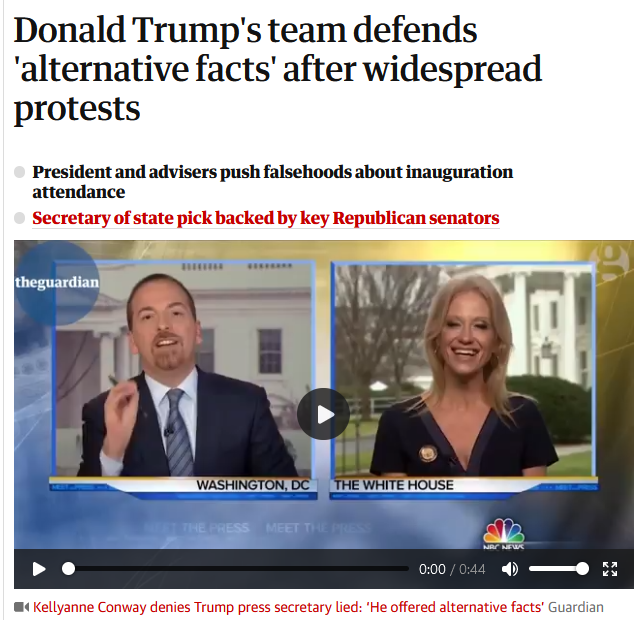
Exactly the same difference which can be found between actual facts and alternative facts.
Exactly the same difference we pretend to not notice when we accept alternative facts as being true.
Well… not necessarily true… only comfortable enough to become acceptable…

Way more comfortable, a.k.a. ‘sensible’ – for us, than the naked truth.
Even if only for the shorter and shorter time frames…

“Dead-zone killer”

Dead-zone killer?!?

How many times can be killed an already dead zone?

Why would anyone want to over-kill sections of their own homes?

NB, the range extender works fine.
Those trying to market the product (to over-market?!?) jumped the shark… but isn’t this what we’ve unconsciously come to expect from the marketeers?