We don’t get what we deserve, we get what we put up with.
How did we get here?
Then
What is Truth? Pilate
Well, there are two kinds of truth. The one you feel with your shin when you hit a coffee table. And the one you feel in your heart when those present laugh at you hopping on one leg while caressing the hurt one.
Which two kinds of truth divide us, people, into two categories. Those trying to patch ‘an ever-changing truth’ out of many individual pictures – each of them the consequence of a ‘shin’ happening to connect with a portion of the ‘outside world’. Which people are currently known as ‘scientists’. And those trying to reach ‘the truth’. By thinking, by divination, by… God only knows what any other means… Philosophers, theologians, quacks…
I was trained as an engineer. To notice needs and to design solutions while evaluating the possible consequences of those needs being met by the proposed solutions. Which places me squarely into the first category.
‘Truth’, ‘freedom-fighter’ and ‘terrorist’ are words. On the side where we get in touch with them. We see/hear them first before they penetrate our minds. If at all… We think of them and only afterwards they get pronounced by our mouths or typed by our fingers.
On the other hand, ‘propaganda’ – another ‘word’ – is a ‘technology’. A particular manner in which some of us choose to spread out their ideas. Same thing goes for ‘conspiracy’. A particular manner of doing things. ‘Cloaked’. Hidden from sight and involving a number of vetted participants. Nota Bene! Those involved in ‘conspiracy theory’ are also vetted. The ‘theorists’ vet their targeted audience by choosing the subjects of their discourse and by wording it in a certain manner. The members of the ‘public’ ‘vet’ the ‘influencers’ by following them. And themselves – they set themselves apart from the rest – by allowing themselves to be ‘entertained’ by the message they keep returning to. ‘Terror’ itself is also a ‘technology’. A sort of ‘propaganda’ 2.0.
While ‘propaganda’ is a manner of spreading ‘the word’ around – presenting the ‘message’ in an easier to ‘accept’/’digest’ form for the targeted audience – ‘terror’ is a ‘technology’ used to convince an entire population that there’s no alternative. No alternative other than that ‘proposed’ by the terrorist. A technology used to break the will of those whom the terrorist wants to submit.
And what ‘happened to THE truth’?!?
The truth of the matter is that there is no ‘truth’. No ‘one size fits all’ kind of truth!
A truth is something we agree upon. In this moment! Something we agree to consider as being true for as long as nothing meaningful contradicts the generally accepted ‘true thing’.
But what if there’s no longer a ‘we’? What if those who – for whatever reasons – want to separate us manage to do exactly that? What if ‘we’ no longer see each other eye to eye regarding not so long ago widely accepted ‘subjects’? What if ‘we’ – a sizeable portion of us – accept ‘alternative facts’ as being at least as valid as the ones previously accepted as being true? What if we, too many of us for our own good, start to doubt as a matter of creed?
“Too many of us for our own good”?!? What happened to ‘doubting as a matter of creed’ being the ‘stepping stone’ for science?!?
Words… so many words, no matter how beautiful…
‘Science’ is, first and foremost, a state of mind. The ‘open’ state of mind which conserves the willingness to change ‘the truth’ according to the newly acquired information, if this new information is convincing enough. If it comes from more than one sources AND if ‘the conclusion’ can be reached again and again. Independently! Being in a scientific state of mind means keeping the door open for new information. Questioning everything with the transparent intent to impose a single version of ‘the truth’ is more than propaganda. It’s a form of terrorism!
‘A proposition needs more than ‘mere’ Logic in order to be True. It also needs to be epistemologically correct.’ Oscar Hoffman, 1930-2017
This morning (February 22, 2013, thanks FB) I had a very interesting discussion with my son.
Trying to ‘soften’ him up to my arguments I said: “I don’t understand how a person with such a command of logic as yourself is unwilling to accept that…”
I should have seen this coming: “If you have such an admiration for MY logic why don’t YOU accept that…” That very moment I recalled a lecture by Professor Oscar Hoffman: ‘A proposition needs more than ‘mere’ Logic…’
How do you translate that to a 13 years old?
“Look here. Being Logical is only the beginning. You cannot do anything without it but it isn’t enough just by itself. It’s only the formal side of Things”. And that was the very moment when inspiration hit me: “Let me give you an example. You have a lot of wooden pieces: spheres, cubes, pyramids, cylinders, cones..etc. and two boards with holes in them: circles, squares, triangles. Your task is to put each wooden piece through the corresponding hole but you must also follow a second rule: half the wooden pieces are made of red oak and they belong to the red board while the other half are made of birch and they belong to the blue board”.
“Let’s presume you have no idea about either geometry or kinds of wood. Using logic you might separate red oak from fir using the grain and then learn to thread various shapes each through the corresponding hole. But no amount of logic will ever enable you to associate the correct pile of wooden pieces to which colored board unless somebody tells you which pile is made of red oak and which pile is made of fir. Savvy?”
I’m proud to report that he got the point!
Present day edit. He remembers the discussion but neither of us can recall where it started!
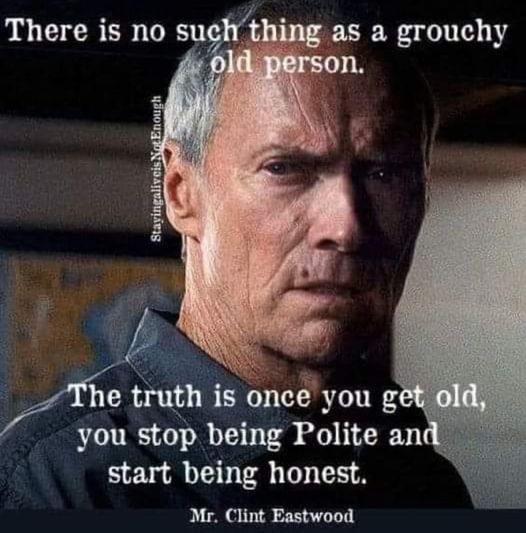
Well, from where I stand – 62 years and counting – ‘grouchy’ starts when people forget that truth – even the naked one – can be ‘exposed’ in a polite manner.
Becoming old doesn’t come with a license to stop caring about how the others feel about things. On the contrary. At some moment in time, each of us will reach ‘the point of no return’. After which we’ll depend on others. Totally! For food, for water, for somebody to change our diapers…
After all, we’ve been lucky enough to reach the ‘golden age’. How about becoming wise instead of devolving into rude punks?
‘Cause the opposite of polite is being rude. Not truthful!
Some people argue that ‘truth lies somewhere in between’ while others maintain that ‘truth is where it is, not somewhere in the middle’.
Well, both sides are right.
Truth is, indeed, “where it is”. The problem being that ‘that place’ is ‘out there’. Not necessarily ‘out of reach’ but definitely out of anybody’s realm. Hence finding ‘that place’ needs a collective effort. In this sense, the truth is, indeed, somewhere ‘in the middle’. In the middle of our converging efforts, if our efforts are honestly targeted.
On the other hand, truth is not ‘somewhere in the middle’. In the sense that truth is not something we can negotiate. We can indeed pursue truth individually but we cannot negotiate the results.
We can settle for a less than perfect truth, if we’re not able to reach ‘the absolute’, but it must be a workable version, not a lukewarm mean. The result of our quest, even if ‘only for a while’, must serve the goal we’ve been trying to reach! If we settle for something only because that something titillates the ego of the majority amongst us… then our efforts have been wasted!
Allow me to conclude that the truth is not somewhere between us but above us. It makes a lot of sense to thread carefully when trying to reach it – lest we stumble during our quest – but we nevertheless need to broaden our perspective. Lest the truth remains hanging just outside of where we’re looking for it.
Learning from who’s experience? A wise man is supposed to learn from other people’s experiences, right? No need to make your own mistakes, as long as they have already been committed… and the consequences made public!
‘Admitting that I may be wrong’ … easier said than done, for obvious reasons! Very few people enjoy being proven wrong. Specially when ‘others’ get the upper hand. And even more so when those ‘others’ have nothing special. When those ‘others’ are nothing more but our “potential equals.”
We’re doing it for a noble cause. In pursuit of the truth!
How about us being led into a wild goose chase? Not by Karl Popper, mind you!
Modern propaganda, and particularly the kind currently permeating the social-media, is shaped and propagated by very skilled operators. Who are familiar with all the tricks in the psychology book and conversant in most ideological tenets currently whirling in the public space. And each of these propagandists has their agenda… Each of them tries to pull as many of us into their orbit… One of their favorite tools being Popper’s “I may be wrong and you may be right and, by an effort, we may get nearer the truth”. In fact, these operators use Popper as a lever to break open our skepticism. To soften our disposition and to prepare the soil for the seed they want us to accept. And nurture… How to resist? Given the fact that we are mere novices while they are masters of their chosen profession? Masters at ‘brain fogging’…
They try to mis-use Popper, we’ll use Popper as an antidote. Do you feel treated as an equal? Being invited as an equal member into a truth searching party? Are you involved in a real debate? Do you get to say anything?
Or you, along with the rest, are simply told what to believe?
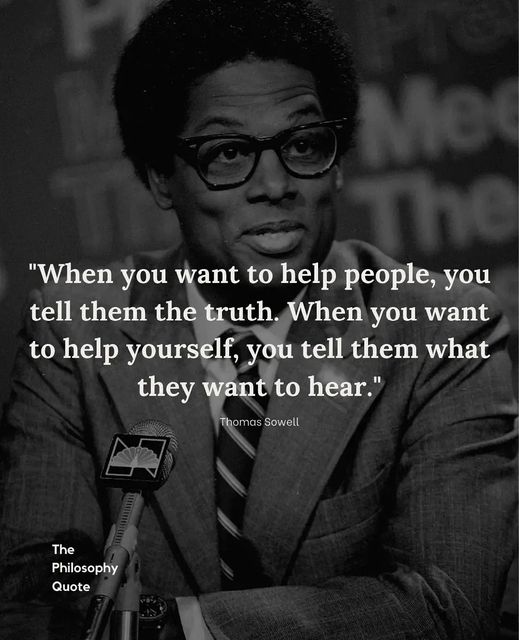
Can’t argue with Sowell… he’s right, right? As usual!
But there’s problem! For me, at least…
According to Orwell, there are people who refuse to acknowledge the truth. Which doesn’t bother the truth, of course. But it bothers us…
If there are people who refuse to acknowledge the truth, then truth isn’t self evident. There isn’t an immediate and direct ‘relation’ between not acknowledging the truth and ‘retribution’.
And for good reason! Truth is extremely elusive. And complex. Impossible to find, actually.
All we can lay our hands on is ‘relative’ truth. A truth we have all labored to find and which continues to remain ‘incomplete’. Against our best efforts! And which, from time to time, is found to be completely false.
Remember how so many of our ancestors were convinced that the Sun was circling around the Earth? Which Earth used to be flat?
Which Flat Earth brings us back to Sowell. I basically agree with him.
“If you want to help somebody, tell them the truth. If you want to help yourself, tell them what they want to hear…”
But do I know what the truth of the matter really is? Do I actually know what they really want to hear? And what if/when they find out? My strategy?
That I was telling them what they wanted to hear in order to help myself?
Sowell didn’t mean this as an ‘advice’? Only as a warning?
Well, I don’t dispute his intentions. Only the underlining assumption. That truth is accessible.
That we can reach it! And manipulate it according to our wishes….
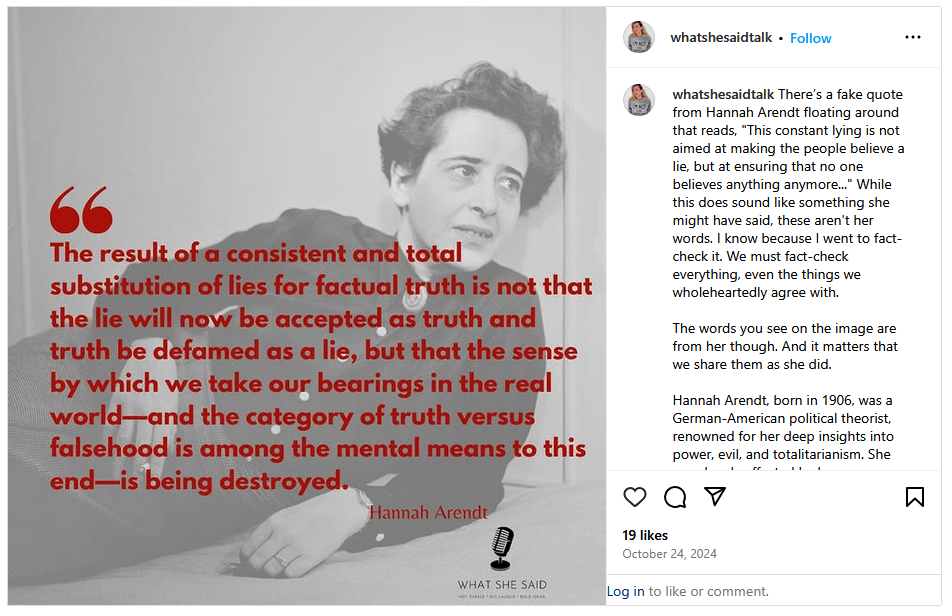
The first reaction, for the ‘average person’, is to ‘love’ this post.
The ‘normal’ reaction, for the ‘fact-checkers’ among us, is to ask ourselves:
Is this actually true?
Heidegger has something really interesting to say about the subject. I’m gonna put it succinctly and bluntly.
None of us knows everything about anything. Not even about the most trivial thing. Because the very nature of our knowledge and of our manner of expressing it – language, none of us is able to ‘put together’ even the simplest ‘absolute’ truth.
Hence, according to Heidegger, we have as many truths as there are people interested on the subject.
‘Then the African Proverb is a ‘lie’?’
Nope.
The African Proverb pictured above is a meta-truth. Heidegger’s truths, as well as those discussed by Popper, all converge towards the ‘absolute’ one. As each of the ‘people interested on the subject’ dig deeper, each of them gets closer to the kernel. Probably none of them will ever get exactly ‘there’ but their respective positions will become ever closer.
Meanwhile, there’s nothing like a ‘meta-lie’. As we had ‘truth’ and ‘meta-truth’. A lie, any lie, is also a meta-truth.
We know – we are under the impression, more exactly, that we’ll never reach ‘the absolute truth’. About any subject, let alone the ‘absolute-absolute’ one. But we can conceive that there is one. Somewhere. At least about individual points of interest.
Do we even have the concept of an absolute lie? What would that be? How could that even be expressed?
This being the reason for some of us being able to come up with so ‘plausible’ lies. They put so much truth into their words that it becomes harder and harder for us to notice that the ‘proposed conclusion’ is misleading.
That, in fact, they are lying through their teeth.
A. A proposition is ‘true’ if what’s being said there is in perfect correspondence with reality. B. A proposition is ‘true’ if the proposition encompasses everything the ‘communicator’ knows about the subject at hand.
‘OK, you promised us a discourse about science and here you are babbling about truth…’
Impatient as always! How do you determine whether something being said, a proposition, is in (perfect) correspondence with the reality of the fact described there?
To be able to do that, you need first to determine the reality itself. You know what’s being said – more about that later, and, if you are to determine whether what’s being said is true, you now need to know the truth itself. How are you going to do that? You either know it already or you proceed to determine that particular truth.
I’ll leave aside the ‘already known truth’ and proceed towards the ‘future truth’.
A particular individual has two possible approaches towards finding out a ‘new’ truth. A piece of ‘true’ information which is new for that particular person. Consult a reliable source or investigate the reality.
‘Consulting a reliable source’ brings us back to square one. How do you determine whether a source is reliable or not…. ‘Investigate the reality’… Easier said than done!
How do you do that? How do you investigate the reality in a reliable manner? How do you determine the truth of the matter when ‘things’ are a tad more complicated than touching a stove to determine whether it’s hot or not?
You use the scientific approach? Start from the scientific data base which already exists on the subject(s) closer to your object of interest then proceed using the proven scientific method of trial and error? Emit a hypothesis, try to prove it, formulate a theory and then challenge your peers to tear apart the results of your investigation?
Results you have chased being convinced from the beginning that you’ll never reach the ‘pinnacle’? Convinced from the beginning that the ‘absolute truth’ – even about the merest subject, is out of reach? For us, mere mortals, anyway?
‘But if ‘absolute truth’ is out of reach, then how can we determine whether the simplest proposition is actually true? And why continue to bother about the whole subject, anyway?!?’
Before attempting to find an answer to your question, let me formulate another one.
Let’s consider that you have reached a conclusion about something. That you are in possession of ‘a truth’. How are you going to share it? With your brethren/peers? I must remember you at this stage of our discussion that language is beautiful but rather inexact. Are you sure that you’ll be able to communicate everything you want to say? To cover every minute aspect of the truth you have just found? So that the proposition you are about to put together will be in absolute correspondence with the piece of reality you have just discovered?
You are not going to use language at all? You’re just going to point to your discovery? And let everybody else to discover the truth for themselves? And how many are going to take you seriously? To pay attention? To what you have pointed? And how many are going to suspect that you just want to take their focus off what’s really important? To lead their attention away of what you want to keep under wraps?
I’ve got your head spinning? Then you must understand my confusion. I’m so deep in this that I have to go back and read again what I’ve been writing…
So. ‘Science’ tells us that the ultimate truth is out of our grasp, linguistics/theory of communication tells us no messenger will ever be able to be absolutely precise nor convey the entire intended meaning … what are we going to do? Settle down and wait for the end to happen to us?
OK, let me introduce you to an absolute truth.
WE ARE HERE!
Who is here? ‘Us’. We are here.
What are we doing here? ‘Are’. We are here.
Where are we? ‘Here’. We are here!
I’ve been recently reminded that mathematics, the most exact language we have at our disposal, is based on a number of postulates. On a small number of axioms – pieces of truth we consider to be self evident, which have constituted a wide enough foundation for mathematics to become what it is today. But mathematics is far more than a simple language. It is also a ‘virtual space’. A space where special rules apply. A space where our thoughts move according to certain and specific ‘instructions’. A space where we enter holding our arms around a problem we need to solve and which we exit, if successful, with a solution inside our head.
A little bit of history. Our ancestors had a problem. A class of problems, actually. How to build something – a house, a temple, a boat, and how to ‘manage’ property – arable land, in particular, but also crops and other ‘stocks’. Problems easier to formulate, and solve, using numbers. To solve this class of problems, some of our ancestors have invented ‘mathematics’. Had ‘discovered’ the self evident truths – axioms, and then ‘carved’ an entire (virtual) space using the axioms as the foundation upon which they, and those who have followed in their steps, have built – and continue to build, the scaffolding of rules which keep that space ‘open’.
Through thinking, our ancestors have carved a space in which to solve some problems they have encountered in the ‘real’ world…
‘Please stop! I don’t understand something. Do you want to say that mathematics is not real?’
To answer this question, this very good question, we need to settle what ‘real’ means. To us, at least…
Let’s examine this rock. Is it real? Why? Because you can feel it? If you close your eyes, I can make it so that you experience the same feeling by touching something else to your stretched out fingers than the original rock. In a few years, I’ll be able to produce the same sensation in your brain by inserting some electrodes in your skull and applying the ‘proper’ amount of electric current. What will ‘reality’ become then?
Forget about that rock, for a moment, and consider this table.
Is it real? Even if it’s not as natural as the rock we were analyzing before? ‘Artificial’ – as in man made, starting from natural ‘resources’, might be a good description of the difference between a table and a ‘simple’ rock. Both ‘real’ in the sense that both imply consequences. Your foot will hurt if you stumble in the dark on either of them. Regardless of the rock being natural and the table happening to be artificial…
‘But what about things which are not of a material nature? Are they real?’
Are you asking me whether ‘metaphysical’ objects – God, for instance, are real? Then how about ‘law’. Is it real? As an aside, does law belong also to the metaphysical realm? Alongside God? Who determines which thing belongs there?
Or have you glimpsed the fact that ‘truth’, the concept of truth, is a metaphysical ‘object’? Something which, like God, has a ‘real’ side but makes no sense (to us) unless we think about it? Something which we have extracted – someway, somehow, from the surrounding reality – where else from? – then ‘carved’ a virtual space around it? So that we may examine it without the distractions of the rest of the ‘real’ world?
Or have you glimpsed also that even the concept of ‘reality’ is a figment of our self-reflecting conscience?
I argued earlier that truth is a convention. And that the Truth exists but will never be known. Not in its entirety, anyway.
Then what are we left with? How can any of us decide what is true and what is not?
First of all, any convention needs three things. The two convening parts and the object of their convention.
‘So, you want us to believe that truth is a make-believe?!?’
That it can be, yes!
And the further from the real truth – from reality itself, that convened about truth is, the worse the fate the believers will eventually have to face.
The first example which jumps to my mind is the fate of Bernie Madoff and ‘his’ investors. Bernie and each of the investors had convened a truth. That his investment fund was sound. Consider what happened to each of them. To each of the investors and to Bernie Madoff himself.






 nicichiarasa