Archives for posts with tag: Thinking

Kill time.
Solve problems.
Learn, understand, discover.

Gather information.
Grind it into a modicum of knowledge.
Make the call.
Implement it.
Wait for feed-back.
Evaluate and reach a ‘final conclusion’.

Formal decision making in a nut-shell…

Philosophy bothers itself with what to think. What conclusions we should be reaching…
Science bothers itself with the hows of the matter. How should we think in order to reach the right conclusions! ‘Right’ as in as close to reality as (humanly) possible.

But why?!?
Why do we think at all?

I haven’t read everything Ernst Mayr had ever written but I’m sure he would have answered ‘because we can’!
I’m no student of philosophy so I really don’t know whether a better answer has ever been offered. Or even if the question has been asked before…

So. What’s driving us to think?

Whoa! This is a different question, you know!
‘Why do we think’ is not at all similar to ‘What drives us to think’. But the second version is an easier one to answer…

As you’ve already noticed, I hope, this blog is about the ‘limited nature of our consciousness’.
Which consciousness is defined/generated by our ability to think.
Which has to be trained in order to be effective but I’ll save that for another post.

So, what drives us to think?
Sheer necessity, survival instinct… I’ll come back.
As the rest of us, I’m thinking as I go along. New paths open, left and right, but there is a place I want to reach today.
The dimensional dimension of the whole process of thinking.
I introduced the ‘driver’ to ‘open the space’. A driver needs a space to drive in…

According to the formal theory, thinking is a linear process. A narrative…
According to the day to day practice, a thought is, indeed, a linear thing. A narrative.
But the fact that a trail is linear doesn’t make driving into a linear something.

So, a thought is, indeed, a ‘linear narrative’ while thinking, like driving, is more like an exploratory process.

OK. Now that you’ve got my full attention, how about you get to the point?
Cut the crap, already…

I’d really love to oblige but I need to make a small detour…
I’m an engineer. As such, I do understand physics. Up to a point… Modern physics demand a lot of mathematics and that’s where I falter. As such, I’m aware that some specialists maintain that there are some 11 dimensions which measure the physical world… most of them being so tightly compacted that we don’t notice them in day to day life.
Same thing when it comes to thinking… There are many dimensions which may come in handy but I’ll mention only three of them.

Goal.
Individual prowess.
Environment.

Polichinelle is my witness. Each and everyone of the above dimensions can, and will, be divided in sub-dimensions.
Soon.
Here.

“I suppose it is tempting,
if the only tool you have is a hammer,
to treat everything as if it were a nail”

Abraham Maslow

I write this blog in the hope that ’embodying’ my thoughts will somehow help me.
Help me solve some of the quirky questions which have been haunting me for sometime now.

Why so many people have been convinced that thinking may help them make sense of things?
Why so many otherwise smart people have convinced themselves that thinking ‘in solitude’ would take them to the ‘right’ place?
Why so many seemingly reasonable people have somehow become certain that their version of things was the only one valid? To the tune of trying to impose it to those happening to be around them?

The first answer was easy to find.
Because that’s how we make sense of things.
And because that’s what people do when they have no other alternative.
They start thinking about how to get out of the mess into which they have entered by not thinking! Enough…

The second one was also easy. Ish… specially after I did come up with the question formulated like this.
Apparently, to shield their minds from ‘distraction’. From the mundane ‘minor’ problems which might have wasted their ‘brain power’.
In reality, simply because they could do it. They had a great time doing it – thinking, that was – so they indulged on every occasion they had. And smart as they were, they made it possible for them to have more and more time available for thinking.
And they cut themselves off from the rest of the world because the few people able to partake in the process not always shared the same opinion. Thus otherwise smart thinkers ended up in the company of sycophants…

Having found the answer for the second question opened, wide, the door for the third answer.
No, it wasn’t the presence of the sycophants which convinced the otherwise reasonable thinker that their was the only valid solution for whatever problem they had in mind at anyone time.
Sycophants showering praise were only a ‘favorable circumstance’. A mere opportunity for it to happen.

Unhindered by any outside intervention, the tinkering thinker turned his tool to his own head.
And hammered out all the remaining doubts his mind was still harboring.

Interesting enough.

And yes, what you think about me is more about you than about the real me.

Nevertheless, the point of this post is:

For me,

You are what I think you are!

I’ve reached the conclusion that thinking and digesting have very much in common.

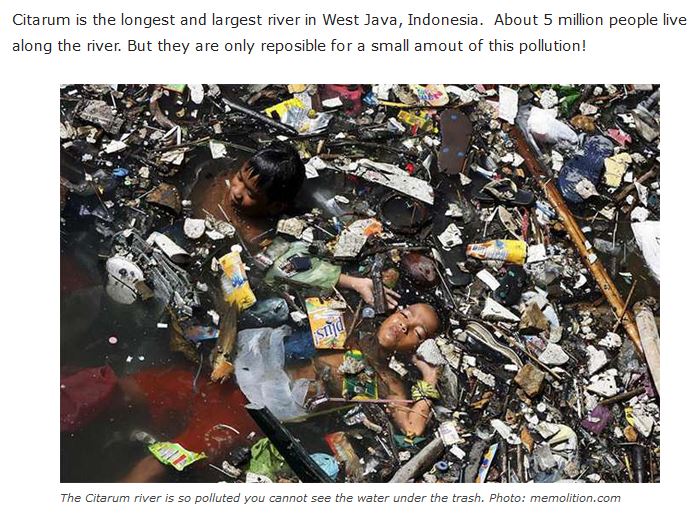
Citarum 2

We can’t do it by our own. Those of us who don’t cooperate/speak with those around them, don’t have what to eat or what to think about.

Both processes imply three stages. Identification, absorption, use.
We use cultural models to identify both our food and the important issues.
Absorption – through our gut/conscience, is both highly specific to each individual and governed by our common DNA/shared cultural traditions.
The ‘products’ of the digesting/thinking process are, again, used both in public as well as in private. Part of the energy we get from our food is consumed ‘cooperatively’ with our ‘coworkers’ while most of our thoughts end up either verbally expressed or put in practice.

Both processes, digesting as well as thinking, increasingly change the environment where we, and others, live.

Citarum 1