Archives for posts with tag: survival

Give me Liberty or give me Death.
Patrick Henry

I argued in the previous two posts that we, humans, live in a three layered reality.
At the intersection of three spaces.

One driven by a ‘primeval’ set of rules and inhabited by Democritus’ atoms.
The living one. Inhabited by individual living organisms, ‘suffering’ the consequences of evolution and subject to laws pertaining to the biological realm.
And what we call ‘reality’. A space opened up by our self-awareness. Inhabited by our individual consciences and furnished with culture. I prefer to call that space ‘consciousness’.

These three spaces have a few things in common.
The actual, physical, place where they exist.
The primeval set of rules. Which is valid for all those inhabiting these/this mingled space(s). The chemistry going on inside a living organism is no different from that happening in the inanimate world and the body of a fully conscious human continues to be pulled by gravity. Despite the fact that conscious human beings have have been building, and flying, airplanes for quite a while now.
And a few ‘principles’ which ‘transgress’ from one space to another.

‘Inertia’.
A ‘body’ tends to continue as it was. To move, on a ‘straight’ trajectory, or to stay put. Until subjected to a ‘burst of energy’.
‘Survival instinct’.
A living organism tends to go on living. Until subjected to a ‘burst of energy’ or until it wears down.
‘Cognitive ‘Consonance”.
Conscious subjects need to maintain a certain congruence. To close/rationalize whatever cognitive dissonances which happen to challenge their ‘Weltanschauung’. The story which imparts sense to their existence.

‘Inertia’ keeps the physical world together, ‘survival instinct’ drives individual living organisms to keep struggling against all odds and ‘cognitive consonance’ pulls us back from the precipice Nietzsche warned us about. “If you stare into the abyss, the abyss stares back at you”.

I’ve been speaking about three spaces. The older being the home and growing place for the newer one.
Each of them being different from the previous one. But still having a lot in common.

Here’s another thing shared by all three spaces.
‘Evolution’.
The concept – everything we speak about is a ‘concept’, first and foremost – has evolved out of our need to make sense of things. To make sense of what we noticed as going on in the world. Species disappearing and fresh ones springing up to make good use of new opportunities. All of these species having a lot in common and ‘evolving’ in order to survive changes in their environment.
Well, if we look closer, ‘evolution’ takes place in all of those three spaces I mentioned.

Hydrogen, the first ‘species’ of atoms, gets together with other of their own kind and engender Helium. The process which keeps our Sun both hot and from gravitationally collapsing into a white dwarf.
A gas, hydrogen, ‘coalesces’ gravitationally and evolves into a star. Hydrogen, the ‘basic’ chemical element, gets together with other members of their own species and evolves into the next chemical element. Through a nuclear reaction, but that’s another subject… And so on, until all the fuel is spent and the star either contracts into a white dwarf or explodes into a supernova. And then contracts into a black hole…

The main difference between the evolution of the living things and the evolution taking place in the inanimate realm residing in how ‘individual destinies’ end up in each realm.
‘Radioactive’ elements are unstable by definition. Bound to become simpler but not to ‘dissolve’ into their initial components, as individual living organisms do.
‘Stable’ elements are… well… stable. Expected to remain as such, unless they are sucked up into a star and transformed into something else. But to ‘die’, not even then …
Stars ‘become’, ‘live’ and then become something else. Never ‘die’ ‘properly’!

Living things, on the other hand, are ‘actually born’, live and then actually die. The former organism ‘releases’ the chemical components back into the nature. To be – sometimes, if ever – part of another organism.

Until consciousness – the space – has been opened, to harbor individual consciences, ‘death’ didn’t ‘exist’.
The process of dying happened unnoticed. Unnoticed and unnamed, of course. Not yet conceptualized, to use a fancy word.

Imagine now the complete bafflement which had engulfed the first conscious individuals who stared into the abyss. Who noticed and then attempted to understand death…
What kind of cognitive dissonance must have been experienced at that point? At that stage in the evolution of what we currently call ‘consciousness’?
Hence the various ‘cosmogonies’. Stories about how the world came to be.
‘Fairy tales’ meant to assuage fear rather than to explain anything. To ease the way out in order to make survival probable for as long as possible.

https://www.goodreads.com/book/show/22322778-a-history-of-religious-ideas-3-vols

https://www.psychologytoday.com/us/basics/terror-management-theory

The World Health Organization explains QoL
as a subjective evaluation of one’s perception of their reality
relative to their goals as observed through the lens of their culture and value system.

Until not so long ago, all people were busy surviving.
‘Waking alive to see another day’ wasn’t taken for granted.
Food was scarce, illness was plenty and war was a constant presence. And these were shared by all. From kings to their last subject. “Although (Queen) Anne (of Great Britain and Ireland, 1702-1714) was pregnant 18 times between 1683 and 1700, only five children were born alive, and, of these, only one, a son, survived infancy.”

And this need to survive didn’t stop at death.
Since most people were convinced that, one way or another, there was life after death, they were also concerned about redemption. It doesn’t matter what you believe in, if your belief includes any kind of an after life … you need to prepare yourself for it. Either to avoid reincarnation or to ascend to heaven/escape going to hell.

This commonality insured that all people had something to share. A common ground.
Which made it possible for them to see eye to eye regarding at least something.
Which common understanding of one thing made it possible for them to live in a (sort of) community. Together!

Nowadays…
Too many of us continue to have a hard time foraging for the essentials. Continue to survive.
While others have it differently.

Haven’t experienced hunger. Nor need. And their most dangerous experience is speeding on the highway. Dangerous in the sense that they may pay a fine if caught ….
Surviving has been replaced by searching for a better quality of life!

Which is fine!
One should make the most of the opportunities present, right?

But do we really know what we’re doing?
The consequences of our actions?
Specially since surviving was a team effort while ‘quality of life’ is a solitary quest… With nobody in attendance – except for the occasional life coach – to warn us when we ‘jump the shark’.

Survival of the fittest?!?
No, only the demise of the unfit!

Ernst Mayr, What Evolution Is?

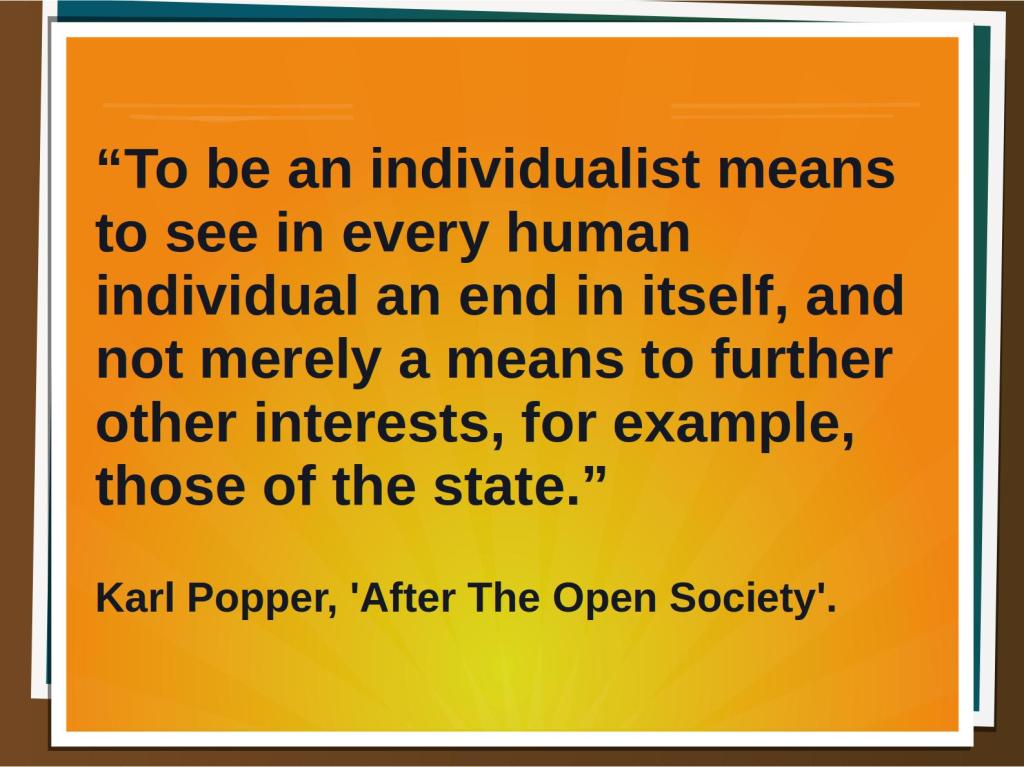
An end in itself…

For whom? For the concerned individual?
For the philosopher pondering the concept?
For the ideologue promoting the idea?

And who determines ‘the interests of the state’?!?

“Plato suggests, and all later collectivists followed him in this point, that if you cannot sacrifice your self-interest for the sake of the whole, then you are a selfish person, and morally depraved.”

Since there’s no better judge for ‘sustainability’ than mere history, let’s ‘look back’.

Whenever the powerful of the day considered that everything belonged to them, and that the collective wasn’t worth any consideration, that ‘arrangement’ soon ended in chaos. From Alexander the Great to Saddam Hussein. Hitler, Stalin, Ceausescu…
Whenever the meek had accepted everything which came from ‘above’, very soon the ‘arrangement’ also ended in chaos. The Khmer Rouge experiment, the Chinese Cultural Revolution, communism being instated in the Eastern Europe by the Soviets…

As a rule of thumb, individuals can exist only as members of a collective.
None of us can birth itself (?!?)
None of us can educate itself ON ITS OWN. OK, one might teach itself to read. And then devour a whole library. But for that to happen, somebody else must have invented the letters first!
None of us can develop into a conscious human being without living with other human beings.

Furthermore, the same rule of thumb states that collectives which value their individuals, all of them, fare a lot better than the highly ‘hierarchical’ ones.
In this sense, Popper was right. ‘Individualistic’ societies – the collectives which ‘see individuals as ends to themselves’ – fare better than the collectives which allow, for a while, their temporal leaders to lure them into obedience.

On the other hand… letting go, emotionally speaking, may not be as beneficial as advertised.
We might lose some bitterness but we might become more liable to ‘repeat the experience’

As in …

Forgive but don’t forget is a lot easier to be said than done, you know…

Which brings us to:

Do we really need ‘a purpose’?
As in ‘an ideologically determined goal’?
Remember Marx’s “The philosophers have hitherto only interpreted the world in various ways. The point, however, is to change it.”. Then the consequences produced by those who had followed Marx’s teachings…
But not only Marx’s!

All set goals which go ‘against the grain’ incur costly consequences.
Which are detrimental to survival! Of the leading trespasser, of those in the following or of those hapless enough to be too close to that particular goal being pursued.
Remember Marx? Nothing unpleasant had happened to him. Not as a consequence of his attempts to change the world! But to others…
Which is equally valid for all other ‘world changers’. Along with all ‘world preservers’ who run along ideologically drawn paths.

Then what should we strive for?
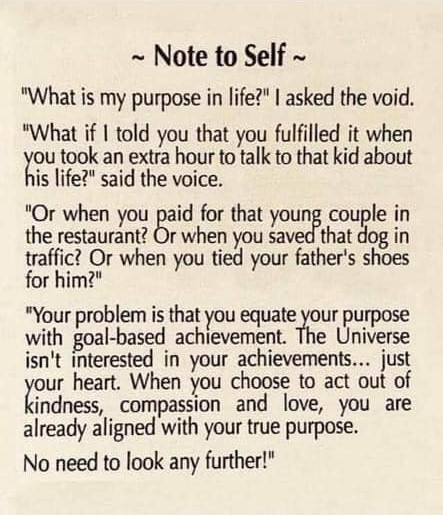
Simply ‘follow the heart’ to achieve ‘peace of mind’?!?
Would that be enough?

Enough for what?!?

https://www.goodreads.com/book/show/56083.In_Dubious_Battle

It is a truism that almost any sect, cult, or religion will legislate its creed into law
if it acquires the political power to do so,
and will follow it by suppressing opposition,
subverting all education to seize early the minds of the young,
and by killing, locking up, or driving underground all heretics.
Robert A. Heinlein, Postscript to Revolt in 2100.

Religion is the metaphusical ‘thing’ inside which people who hold a set of tenets to be true are able to build a community.

Religion is sociological phenomenon. Something belonging to the realm studied by those who try to understand how large number of people work together.

Religions – on the other hand – are ‘sets of tenets’ put in practice by various groups of people.
Sets of tenets which survive for as long as they continue to help the people who uphold them in their quest to survive as a group. As a community.

Religion cannot be ‘changed’.
Religion can be studied. May be better understood.
Like physics. You can’t ‘change’ physics! With what? With chemistry? Things don’t work like this. The only thing you may do about physics is to ‘deepen’ your knowledge about it.

Religions can, and sometimes have to, be changed.
By the very people who ‘use’ them to survive.

Since nobody can survive on their own, each and everyone of us needs to belong.
To a community.
To a religion, actually!

And what do people do when they realize survival is impossible in certain conditions?
Die or do something about it, right?

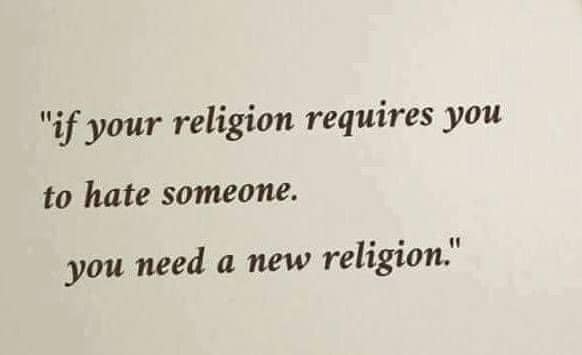
Now, which community can survive based on hate?
It doesn’t matter whether you are asked to hate somebody inside or outside your community.
Whether you hate individually or collectively.
Hating – or despising – somebody blinds you and exhausts you. Puts a huge burden on your back. Focuses your attention so tight that you are no longer able to notice the real dangers.
Those which actually make you less likely to survive.

And this is valid both for you as an individual and for you as a hating community.

What’s wrong with them?
They know plenty and they have everything…
Yet they’re not even content, let alone happy!

‘Now, that you’ve reached your personal pinnacle, which do you think is more important?
Setting the right goal for yourself or reaching it by keeping on the ‘straight and narrow’?’

Well, staying on the straight and narrow is a goal in itself…
The way you put it, you’re asking me to determine which came first, the chicken or the egg?

Neither.
Evolution came first. At some point reached the ‘chicken and egg’ stage then went forward to giving birth to living offspring.

Same thing here.
Life is opportunistic. Setting goals and following rules is OK, as long as you keep an open mind about things. Keep your eyes wide open yet fully aware that nothing is exactly as it looks like.

The only legitimate long term goal is ‘sustainable survival’. The rest are nothing but ‘staging posts’.
In order to be able to do something – anything – you need to be alive. And kicking!
In order to stay alive, you need to make as little damage as you go along. To yourself – as a living organism – and to the environment in which you live. To the natural environment each living organism depends on and to the social environment which allows us, human beings, to maintain and develop our human-ness. Our capacity to generate meaning by making successive decisions.

How to achieve this meta-goal?
By following the common sense rules which become apparent as we go forward in time. Which become evident as long as we keep our eyes open….

The vaunted human capacity for reason may have more to do with winning arguments
than with thinking straight
“.
Elizabeth Kolbert, Why Facts Don’t Change Our Minds

I love that. Just love it.
“The … human capacity to reason”!

Other thinkers hail reason as the thing which sets us apart from the rest of the animals…

The way I see it, reason is nothing but just another tool.

The thing which sets us apart from the rest of the animals being our ability to observe ourselves while interacting with the rest of the universe. Otherwise known as consciousness.

Basically, reasoning is nothing more than a ‘dialogue with myself’.
When I ‘consider a thing’ in my mind, consciously, I practically put my brain to work.
I order my memory to summon up all the data it has on the subject and I ask my frontal lobe to process that data and to reach a conclusion. In theory…
In the real world, my amygdala – the piece of the brain where emotions are processed – already has an opinion about everything which crosses my mind. The more familiar the thing, the stronger the opinion. The more often my mind – meaning I, had expressed itself regarding a subject, and the more recently, the stronger the opinion my amygdala already has about the matter.
If the matter is considered for the first time, and has no connection with anything else I had already ‘conclusioned’ about, only then my amygdala might keep its opinion for itself. The key word here being ‘might’…

Since this is nothing more than a blog post, I’m not going to prove my opinion. To discuss the importance of the fight-flight mechanism and to mention that this mechanism had done more – evolutionary wise, than reason for our survival. For us having the opportunity to develop this vaunted capacity for reason…

I’ll just end it abruptly.
Mentioning that our individual consciousnesses use reason as a tool. To arrange facts in such a manner as to confirm the already reached conclusionary opinions put forward by our amydalae. “To win arguments”, if you will, including when debating with ourselves.
Only when the facts – the harsh reality, contradict in a flagrant manner the already held convictions we might change our minds.
The more immediate the danger we put ourselves into by sticking to our convictions, the more likely we are to cave in to the facts.

To the facts as we perceive them… Which is yet another story!

War is over when the goals have been achieved, not when the enemy had been destroyed.
While sometimes you have to utterly obliterate the enemy in order to achieve your goals, this is not always necessarily true.


Hari Bucur-Marcu

This makes a lot of sense, right?

Yeah, sort of…

The problem with this approach being that this understanding degrades war to a simple instrument.

Something used by a decision maker towards the achievement of certain ‘goals’.

The problem with this approach being that it obliterates the decision power of all other people involved in it. Of everybody else but of those calling the shots. Pun intended!

All analysts commenting Putin’s ‘special military operation’ babble on about Putin’s goals.
‘Ukraine will never be able to crush Russia, militarily, so we need to understand what’s going on in Putin’s mind.
In order to be able to ‘bribe’ him into ending the war. Or to black mail him. Only we need to understand first what will constitute a too big of a price for him to pay.’

On the other hand, Putin seems to be thinking along the same lines.
‘I need to preserve my position. MY power. Ukraine is a bad example for the Russian people. They have shifted their ‘allegiance’ and want to build a real democracy. I cannot allow this to happen, otherwise I’ll be next.
Now, how much pain do I have to inflict in order to achieve my goal? Directly, upon the Ukrainians and indirectly, upon the rest of the world?’

Meanwhile, the rest of those involved in this situation bear the brunt of the war. Directly and indirectly.

Some of them understand what’s going on and some don’t.

My point being that not all instruments are born equal.
While all are nothing but mere ‘sticks’ in the hands of the agents wielding them, choosing to use a certain instrument among the available alternatives speaks volumes about the agent making the choice.

What are we, reasonable creatures, to understand when an agent chooses an instrument which debases all other creatures to the role of ‘kill or be killed’?
For whatever reason and under whatever pretext?
Is that agent ever going to stop? To stop setting ‘goals’, further and further away?

Specially after having the ‘first installment’ safely tucked under the belt…

Let me put this another way.

Nobody can survive alone.
Not for a considerable amount of time, anyway.

“It takes nothing to join the crowd”.
To join, maybe… but if you choose to remain, you must ‘follow the rules’.

So yes, it takes everything to stand alone… Your very life!
And the ‘membership price’ is your ‘absolute’ freedom…

Hard to make up your mind, eh?
Then let me raise up a few points.

I started this argument by mentioning that nobody can live alone. Not for long and not very comfortably. No matter how hard you may prepare yourself.
Don’t kid yourself. All those hermits and preppers you hear about – on ‘social media’!, are able to do that because of modern technology. Which technology has been developed by somebody else…
On the other hand, most individuals are able to survive, alone or in small groups, while jumping from ‘one boat to another’. Think emigration, for instance. Or ‘acculturation’.

But no crowd will ever survive its members leaving in droves!

One-Time
Monthly
Yearly

Make a one-time donation

Make a monthly donation

Make a yearly donation

Choose an amount

$5.00
$15.00
$100.00
$5.00
$15.00
$100.00
$5.00
$15.00
$100.00

Or enter a custom amount

$

As much as I love writing, I do have to eat.
And to provide for my family.
Earning money takes time.
If you’d like me to write more, and on a more regular basis, hit the button.
Your contribution will be appreciated!
Another very efficient way to help would be to share my posts.

As much as I love writing, I do have to eat.
And to provide for my family.
Earning money takes time.
If you’d like me to write more, and on a more regular basis, hit the button.
Your contribution will be appreciated!

As much as I love writing, I do have to eat.
And to provide for my family.
Earning money takes time.
If you’d like me to write more, and on a more regular basis, hit the button.
Your contribution will be appreciated!

DonateDonate monthlyDonate yearly