Archives for posts with tag: Mark Twain

For Mark Twain, things which didn’t make sense were ‘strange’.

For Tom Clancy, a mere hundred years later, they were only ‘different’.

Wanna make some sense out of this?

Do you believe that truth is stranger than fiction?
“Truth must of necessity be stranger than fiction,” said Basil, placidly.
“For fiction is the creation of the human mind, and therefore is congenial to it.”

G.K. Chesterton, 1905

The difference between ‘strange’ and ‘different’ isn’t ‘menial’. Nor harmless.

Currently, we’re still allowed to frown upon things which are ‘strange’ but are insistently taught that ‘different’ is good.

Beyond ‘acceptable’. Actually good!

I’m different.
Noticeably different.
Different enough to know, first hand, how it feels to be frowned upon.
Also, different enough to figure out the difference between ‘acceptable’ and ‘good’.

More than two millennia ago, Protagoras opened up our eyes. Told us it was our job, and responsibility, to ‘measure accurately’.
More than a hundred years ago, Twain warned us. Told us to be careful of ‘well spun fictions’. Of stories too good to be true. Of the fact that in our quest for consistency we are prone to actually discard the uncomfortable truth.

Are we going in the right direction?

In a sense, there isn’t much difference between Mark Twain’s and Tom Clancy’s words.
On the other hand, there is a huge difference between ‘strange’ and ‘different’.

Exactly the same difference which can be found between actual facts and alternative facts.
Exactly the same difference we pretend to not notice when we accept alternative facts as being true.
Well… not necessarily true… only comfortable enough to become acceptable…

Way more comfortable, a.k.a. ‘sensible’ – for us, than the naked truth.
Even if only for the shorter and shorter time frames…

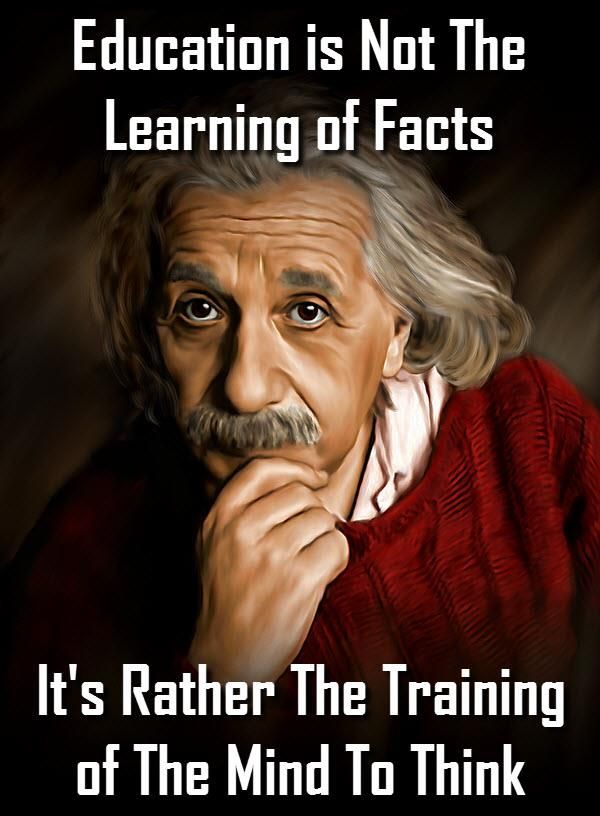
quotes-about-education-16

but also

So?

The way I see it ‘education’ is a blanket term that covers many things:

– Mental conditioning into obeying the prevailing rules of the moment/place
– Accumulation of information that is deemed useful by the educators.
– ‘Training of the mind to think’ – only this cannot be done without first supplying the student with some information on which to hone his mind.
– “Training of the mind to think” according to the rules of the moment/place – the term currently used for this kind of attitude towards thinking is ‘science’. If those rules are not obeyed then not only that the results of the thinking process won’t be recognized as valid by the community but the thinker won’t even be able to share them with those around him because those results won’t resemble anything known/familiar/acceptable to most of the members belonging to that community.

– Training of the mind to think outside of the box. To be able to do that a student needs first to learn what a box is so he must graduate through the first four stages AND to overcome some of the conditioning he was subjected to during the first stage.

Only after he “awakens” a student might start to discover for himself the rest of the world. And only if he uses his newly found awareness in a sensible way he will be able to share the results of his thinking with those around him and thus contribute to the long time survival of the society (family, community) that has nurtured him through his ‘coming of age’.

And only if that society (family, community) takes good care of its young it will have any chances to survive.
‘Taking good care of its young’ meaning encouraging them to open their wings in search of their full potential, not shackling them down to the nest in search for absolute safety.