Archives for posts with tag: Freud

Deeds?
Or individuals?
What do you see first?

Most of you are more likely than not to be familiar with the ‘straw that broke the camel’s back’ metaphor.
My straw borrowed the shape of a book. Erich Fromm’s The Anatomy of Human Aggression.
At some point, when discussing the differences between Skinner and Freud, Fromm asks more or less the same question. His point of interest being different from mine… his thoughts follow a different path from mine…

So? What do you you reckon?

I feel the need to remind you a few things.
Fromm, a famous psychologist, had a PhD in sociology.
I, an engineer, have a BSc, in sociology.
Skinner, the entire behaviorist school of thinking, was contemporary with the dissolution of ‘God’.

Once the camel’s back had given way, things have started to fall into place.
Those who see ‘individuals’ first are psychologists, at heart, and those who see ‘deeds’ are sociologists.

‘So Skinner should have been a sociologist?!?’

I would never go as far as telling people what any of them should be doing!
I leave that to Marx’s followers. To all those, in general, who are confident enough to do it. I’m sure this is a wrong thing to do but I’m not here to judge. Only to express a few considerations.

‘You don’t tell people what to do, only what to NOT do! Semantics…’

There is an old story which sheds some light on this problem.

A teacher gave an after school assignment:
‘Do a good deed. Come back tomorrow and share the experience.’
John:
‘At a traffic light, sounding the right kind of beep, a blind person was already halfway across. A runaway truck was fast approaching without a sound. I pulled the person out of the danger. They was very grateful.’
Kevin:
‘An elderly lady was approaching a traffic light which was about to change. There was no chance in hell that she could have made it. I hoisted her over my shoulder and carried her across. She screamed and kicked like hell. She had no business on that side of the road. I felt ashamed and I left her there.’

Skinner, the behaviorists in general, do not care about ‘intent’. ‘I have no clue about what’s going on inside people’s heads. All I know, and can ‘measure’, is what they do. How they behave. In any given circumstances after whatever conditioning had been exerted upon them’.

Which makes a lot of sense, right? Specially for an engineer…

Freud, on the other hand, puts the onus on the manner in which each individual ‘digests’ – ‘internalizes’, according to the lingo – the whole history of interactions (conditioning?!?) they have experienced on the road towards their present state.

For Freud, behavior is something to be studied in order to understand the individual while for Skinner behavior is something to be fine-tuned.

Not so different, from my perspective.
Both Freud and Skinner somehow forget about the elephant in the room.
Who studies the individual? Who makes the (psycho)analysis? Who attempts to fine-tune ‘the behavior’?
I’m not going to go any further. And ask ‘why?’. What’s the end goal of any of those individual ‘experimenters’. ‘Motives’…
I’m no psychologist.

Being an engineer, I’m more interested in consequences. In what comes out…

In what we, ordinary people, have to survive in!
“If the only tool you have is a hammer,
you tend to see every problem as a nail.”
Abraham Maslow

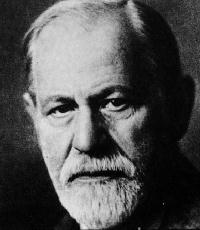
Did you recognize him?
Yes, Sigmund Freud. Dr. Sigmund Freud, as depicted on http://www.marxists.org.

“While the different religions wrangle with one another as to which of them is in possession of the truth, in our view the truth of religion may be altogether disregarded.
Religion is an attempt to get control over the sensory world, in which we are placed, by means of the wish-world, which we have developed inside us as a result of biological and psychological necessities.
But it cannot achieve its end.
Its doctrines carry with them the stamp of the times in which they originated, the ignorant childhood days of the human race. Its consolations deserve no trust. Experience teaches us that the world is not a nursery.
The ethical commands, to which religion seeks to lend its weight, require some other foundations instead, for human society cannot do without them, and it is dangerous to link up obedience to them with religious belief.
If one attempts to assign to religion its place in man’s evolution, it seems not so much to be a lasting acquisition, as a parallel to the neurosis which the civilized individual must pass through on his way from childhood to maturity.”
[Sigmund Freud, “Moses and Monotheism”, 1932]

No, I’m not going to argue with Freud.
I’m not going to compare his opinion on religion with that of Durkheim. Which makes more sense to me. You may find them here, at #e., and compare them yourself. If you wish, of course.

What I’m trying to point out in this post is that reason is over-rated.
That reason is an extremely powerful tool but, like all other tools, the consequences of yielding it depend on the yielder.
On the person using reason in order to get somewhere.
To find the intended meaning…

Which is?

On the other hand, Newton was also ‘discredited’ by Einstein…

Not to mention how discredited had been Aristotle, the scientist, by those who came after him!

Yet nobody speaks badly about either Aristotle or Newton.
Because they are considered ‘stepping stones’…

https://www.britannica.com/…/Aristotle/The-unmoved-mover

Just finished reading, again, another excellent post written by John Faithful Hamer on Committingsociology.com

I remember now that something was nagging me after reading it for the first time. I also remember the pangs of helplessness felt almost a year ago, when I couldn’t identify what was nagging me.

Well, this time I nailed it.

“Getting angry isn’t really like releasing the built-up pressure in a steam engine; it’s far more like exercising a muscle group. Every time you give in to the desire to lose it, you strengthen your “anger muscles”; every time you resist the urge, you weaken them.”….
“So perhaps it’s time to stop preaching the gospel of expression, and revisit the much-maligned virtues of repression.”

“Anger” and “getting angry” are not the same thing.
Anger is just a feeling – and, hence, a source of ‘energy’ – while ‘getting angry’ is the manner in which we allow it, consciously or unconsciously, to take us over.
I fully agree that ‘getting angry’ only worsens the situation only I’m afraid that ‘resisting the urge’ isn’t any better. In fact that would be no different from tightening your arse because you don’t want to fart in public.
The problem is not solved, not at all, only postponed. You still need to relieve yourself.
By widening Freud’s concept of repression to encompass more feelings than the simple embarrassment we might find a reason to continue to look for a manner in which to ‘release that built up pressure’.
Only now we are faced with a new problem, since we’ve already agreed that ‘getting angry’ is not the best thing to do.
Freud, again, to the rescue.
How about widening another one of his concepts, sublimation?
How about learning to express, this time consciously, our intense negative feelings in a socially acceptable, and hence a lot more effective, manner?