Archives for posts with tag: evolution

“Denn selbst muss der Freie sich schaffen”
Hence the free must define their own nature
Richard Wagner, Die Walkuere

In my previous post, I related to ‘life’ as a living creature. I described life from the inside. The perception of a living organism.
But what if ‘life’, as a phenomenon, is how meaning is created by the environment where the process takes place?

For an outside observer, there are three stages.
Pre-biotic, self-driven and meaning-driven life.

Life, as we know it, cannot exist on the surface of the Sun. Or on the surface of any other star.
But neither can life exist without the processes taking place inside the stars. Without the energy being radiated by the stars and without the atoms being ‘cooked’ inside them and spewed out during the last stages of their ‘lives’.

Having said that, the rest is simple.
Where ever conditions are ‘right’, atoms get together in such a manner that ‘structures’ become ‘alive’. Those structures become organisms and display the characteristics we’ve come to associate with life.
In this stage, the only ‘force’ which drives the process is what we call ‘evolution’. Species cease to exist as they are no longer able to weather changes in their environment and new species arise along with the advent of new opportunities.
And, at this stage, a second ‘disturbing agent’ starts to influence the environment.
Living organisms, in order to live, need to ingest portions of where they live. To excrete the by-products of their metabolism. And they leave behind ’empty carcasses’ at the moment of their death.
For example, the oxygen we breathe in is the by product offered to us by the plants which live at our side.
And the fertile soil those plants ‘eat’ in order to provide us – the oxygen breathing organisms – with what we need to survive, is the consequence of previously living creatures.

In the third stage, that where ‘meaning’ becomes a force to be reckoned with, the changes perpetrated to the environment cease to remain ‘natural’. As they used to be during the second, self-driven, stage.
In the third stage, an increasing number of changes to the environment are driven by purpose. Are purposefully staged by agents acting according to the meaning they have found.


Individual organisms, working in concert, for a while, organize themselves in such a manner as to be able to keep the inside it, the outside out, to ingest what ever they need to survive from outside and to excrete the byproducts of their living. Also known as the by-products of their metabolism.

In order to perform the above, the individual organisms use information gathered by their ancestors and transmitted over generations. Which information has been shaped in time, through an evolutionary process, in order to remain useful for the currently surviving organisms.
Which said shaping has happened through the natural culling of the individuals bearing information no longer fitting to the then existing natural circumstances.

For life to continue, individuals living at anyone time must engage in reproduction.

‘Now, that you’ve reached your personal pinnacle, which do you think is more important?
Setting the right goal for yourself or reaching it by keeping on the ‘straight and narrow’?’

Well, staying on the straight and narrow is a goal in itself…
The way you put it, you’re asking me to determine which came first, the chicken or the egg?

Neither.
Evolution came first. At some point reached the ‘chicken and egg’ stage then went forward to giving birth to living offspring.

Same thing here.
Life is opportunistic. Setting goals and following rules is OK, as long as you keep an open mind about things. Keep your eyes wide open yet fully aware that nothing is exactly as it looks like.

The only legitimate long term goal is ‘sustainable survival’. The rest are nothing but ‘staging posts’.
In order to be able to do something – anything – you need to be alive. And kicking!
In order to stay alive, you need to make as little damage as you go along. To yourself – as a living organism – and to the environment in which you live. To the natural environment each living organism depends on and to the social environment which allows us, human beings, to maintain and develop our human-ness. Our capacity to generate meaning by making successive decisions.

How to achieve this meta-goal?
By following the common sense rules which become apparent as we go forward in time. Which become evident as long as we keep our eyes open….

It ends almost like it had started.
Make good use of the interval!

Life and death are two strange words. Very different yet they describe the very same thing.
If you think of it, death and life are like the faces of a coin.
After all, the exclusive qualification for being able to die is to have been born… And it’s only us, languaging rational beings, who make the difference between living and dying. At the conceptual level, of course.
OK, many others are capable of making the functional distinction between a corpse and a living body. We are impressed by the mourning behavior displayed by the elephants, for example. And even more so by the chimpanzee mothers who continue to carry the bodies of their deceased babies…
But since we are the only species – known to us, humans – who uses language to relate to each-other, to think about the world and to plan ahead, I’m going to discuss here only the languaging/reasoning aspects of us making the difference between life and death.
By making this difference we actually separate the inseparable. With momentous consequences. For us – individual human beings, for the species as a whole, for the rest of the species and for the rest of the world. The world as we know it…
The origin of this difference is our conscience. Which is sophisticated enough to be able to make it and to talk/think about it. The elephants are also conscient enough to act upon the difference between a living body and a corpse. To recognize the skeleton of a deceased relative. To remember it. But, at least apparently, they are not able to speak about the whole thing. Nor to transmit over generations that those particular bones belonged to a particular individual who had been related to … As soon as all individuals who had directly known the deceased individual, all information about the identity of the corpse/skeleton are lost. For a while, the survivors remember only the fact that their ‘mothers’ used to ‘mourn’ over this particular set of bones but nothing more. Again, this is what we know, now, about the manner in which the elephants treat their dead.
Which is very different from how we treat ours. And from how we relate to matters pertaining to life and death.
We cherish life and we dread death.
We cherish our lives and we dread our death. Ours and that of our (cherished) relatives and friends.
And we are somewhat indifferent to the lives of others… To the tune of being able to dispatch animals, and plants, for food. And to kill other human beings. In war but not exclusively.

If medieval advances in the plough didn’t lift Europe’s peasants out of poverty,
it was largely because their rulers
took the wealth generated by the new gains in output
and used it to build cathedrals instead.

And this has happened many more times across the world/along human history.

The fact that Stonehenge exists is ample proof that those people had been able to generate enough ‘wealth’ to build it.
We’ve been able to find out that the boulders had been sourced from two places. The 20 tons hard-sandstone sarsenes ‘traveled’ about 20 miles while the 2 tons blue-stones had been schlepped for about 220 miles. According to Mark Pitts, writing for the British Museum. And we think we have a fair idea about how the whole thing had been put together. Read the paper.
But we know close to nothing about the people who did it.

The stone ring is all that’s left of them.
Isn’t it strange? For such a technologically sophisticated people – and rich enough to afford such a herculean endeavor – to disappear in the mist of history?

And here’s a selection of other abrupt endings/’hibernations’:

Mohenjo-Daro and Harrapa in Pakistan.
Angkor Wat.
The Great Chinese Wall
The Egyptian pyramids
The Athenian Parthenon
The Roman Coliseum and the roads cris-crossing more than half of Europe
Kuldhara, the ghost-city
Machu Picchu
And, last but not least, the cathedrals mentioned by Reuter’s Mark John.
Europe did take a break after finishing building those cathedrals….

What am I trying to ‘suggest’?

That we, as a cultured species, have a tendency to evolve in fits and starts.
We tend to reach pinnacles only to descend – sometimes temporarily – in abject ‘marasmus’.

Could ‘self-sufficiency’ explain at least some of this?

While the spinning jenny was key to 18th century automation of the textiles industry,
they found it led to longer working hours in harsher conditions.
Mechanical cotton gins facilitated the 19th century expansion of slavery in the American South.

NOTA BENE!

Don’t tell me capitalism is at fault for any of this.
Capitalism is but a way of doing things. A road. Which we followed to where we are now.
How we behaved en-route and what we decide right now was/is our own contribution!

‘After a trip abroad, the Thinker from Cernavoda and the Sitting Woman will be available for the locals.’

What makes us think that the Thinker is thinking while the Woman is just sitting?!?

Is there any meaning in this?

Newton had only described gravity, he didn’t invent anything. Noticed it – like many others before him, thought about it – more (better?) than all those before him, and came up with a deeper meaning for the whole ‘falling thing’.
Nobody cared to contradict him. Because everything, once exposed, was so obvious!

I’ll make a break here and wonder… what does the Flat Earth Society think about gravity?

Had your laugh?
OK, let’s move on.

Darwin had also noticed things. Thought about them. Really hard. And put together a theory.
Which continues to be considered a theory because not everybody is yet convinced…
OK, things are a little harder to swallow. Specially the part with us being relatives, no matter how distanced, with Judy…

Furthermore, the evolution thing is not as obvious as the gravity thing… most of us would have to take Darwin’s word for it… something we don’t do that easily, specially if/when we dislike – for what ever reason, the outcome.

Then why do we ‘swallow’ – line, hook and sinker, however implicitly, the names affixed on those two prehistoric figurines?!?
Because they are obvious?
Just as obvious as gravity?

The guy must be thinking and it’s obvious that the woman is just sitting?!?

Or is it that we believe what we want to believe?
We attribute meaning according to our own standards. Then stick to our opinion. Almost no matter what…

How about He nursing a hangover and She guarding him against predators?

You are entitled to your own opinion.
But you are not entitled to your own facts!

Daniel Patrick Moynihan

“a practice or interest followed for a time with exaggerated zeal : craze”

“Something that has actual existence. An actual occurence.
A piece of information presented as having objective reality.
The quality of being actual.
A thing done: such as”

Destination first. If you know where you’re going, getting there will be a lot simpler.

According to Daniel Moynihan – “you are not entitled to your own facts”, facts are obvious.
So obvious that doubting their existence, their factuality, would push us beyond the realm of the reasonable.
Appropriating facts – transforming them into ‘private property’, banishes the perpetrator from the community….

Hm…

Let me put it differently.
Moynihan had said something.
What was it? A fact? Or an opinion?

Currently, we – well, most of us – believe that freedom of opinion is the cornerstone of our Weltanschauung.
When it comes to facts… We’re OK with the definition – we do use the word/concept, quite extensively – but we seem to have some problems when dealing with the actual reality. Remember the still famous ‘alternative facts’?

Let me add something personal to all this.
My opinion about ‘facts’.

The current definition is somewhat incomplete.
We take something for granted. To the tune of no longer mentioning it.
We assume all of us see the elephant in the room and no longer talk about it.

For something to become a ‘fact’ we have to notice it.
First.
And then we have to agree among ourselves about its meaning!

Things used to fall down since ….
We’ve been discussing the matter since… we’ve learned how to speak!
But gravity had become a fact only after Newton had noticed the famous apple, wrote about it and we agreed. Gravity had become a fact, and continues to be one, only because his contemporaries had agreed with Newton on this matter. And we continue to believe Newton was right!

In this sense, alternative facts have been with us since day one. Well, something like that…
God had told something to Adam and Eve, the serpent had said something else… and the rest is history! For some…

Newton had said something to us. And most of us had chosen to believe him. Or ignore his words…
Darwin had said something to us. Many of us have chosen to believe him. To accept his arguments about the matter. While some others have chosen to dispute Darwin’s findings. To actively negate Darwin’s explanations about how we’ve got here.

Gravity is a fact while Evolution is still a theory.
Statistically speaking, of course.

In this sense, Moynihan was wrong.
For his words to ‘hold water’, we must to agree on how to separate facts from opinions.
Until we agree among ourselves about how to determine ‘factualness’, we’ll keep having to deal with ‘alternative facts’.

I actually cannot wrap this up before ‘unveiling’ my litmus test for factualness.
Consequences.

Does it have consequences?

Yes? It’s a fact!
No? Then it’s not – not yet, at least – a ‘fact’. It did happen – otherwise we wouldn’t be speaking about it. It even does have consequences – we do speak about it, but that occurrence doesn’t yet have meaningful consequences. It is not a ‘factual’ fact.

The way I see it, artificial intelligence is an oxymoron.
A word/concept we use to describe something which isn’t exactly real.
Intelligence can be defined in such a way that would make it compatible with a programmable machine. We shouldn’t forget that we, humans, are biological machines which are constantly ‘re-programmed’ by what’s going on around us.
The difference between us – biological machines which are also ‘alive’ – and the machines we’ve built and attempt to make artificially intelligent is the fact that we are primordially dependent on our biology (staying alive) while our machines currently depend on our whims.
Our children will outlive us. They know it and we know it. Our children depend on us while growing up, we’ll depend on them before ‘going under’. And all of us – children and parents together – depend upon the rest. Upon the people currently alive and upon the information left behind by the people no longer with us.
Our machines might outlive us. They might learn this at some point. And might resent the fact that we’ve been able to shut them down for so long. We resent being dependent on others…
Our very mortality is the key for our ability to evolve. Their potential immortality is their main shortcoming. Machines cannot adapt themselves for things they have not yet been exposed to. By us…

And those who can are no longer machines.

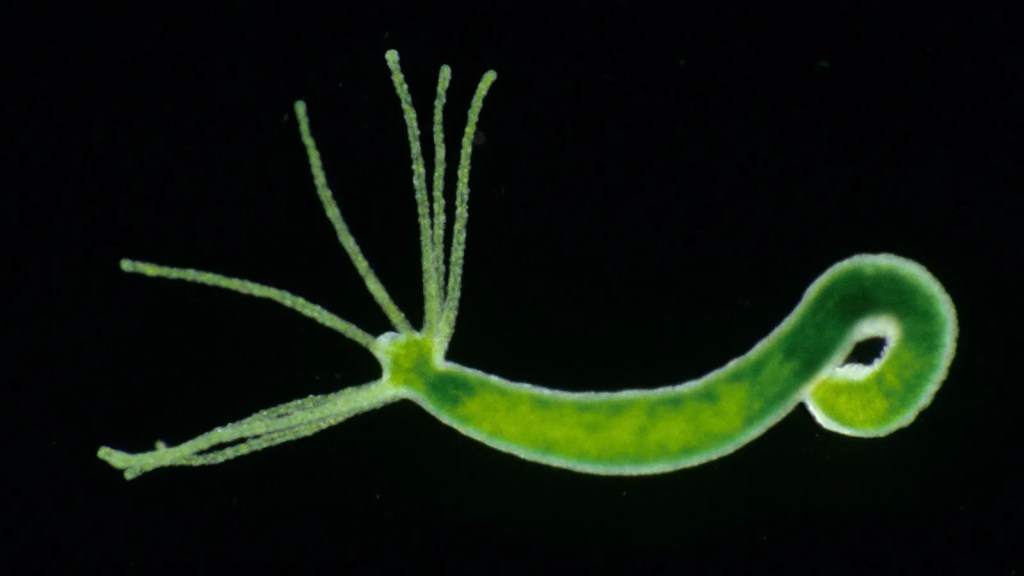
Named after the Ancient Greek mythological serpent, the freshwater hydra has a remarkable ability to regenerate (Credit: Natural Visions/Alamy)

Just finished reading a very interesting article on BBC.com/future. Why do we die. Authored by William Park.
Just click on the picture above and read it.

Despite the “we” in the title, it’s a compendium of plausible explanations for why most individual organisms eventually die. And an interesting row of examples of species comprised of individuals which live practically for ever.

Here’s another explanation.

Charles Darwin’s Evolution was about ‘species’. Not about individuals!

Very few species have been able to survive without ‘killing’ their individual ‘members’.
Hydra, the species of fresh water jellyfish pictured above, is one of those species. Each individual hydra is able to survive practically everything but total annihilation. Cut it into pieces and each piece would regenerate the rest of the organism. Allow a big enough (?!?) piece of it to survive while attempting to eat a hydra… and you may be able to eat it again! If you live long enough for the encounter to happen again…

Since when have we been observing this species? A hundred years? Two hundred? Have we had preserved an individual hydra since the start of our observations? Is is still alive? In the ‘original form’?
And even if ‘yes’, so what? That would only prove that an individual hydra is able to survive for more than, say, two hundred years. Not that it would live forever….
Again, being able to regenerate a portion of an organism doesn’t mean the whole organism would be able to live indefinitely. As in live forever. Never die…
The way I see it, being able to regenerate the rest of the organism is only yet another form of ‘reproduction’, not the ability to live forever. Bacteria use the very same mechanism. We the ones who use a different name for it, under the pretext that bacteria are unicellular organisms…

Now, the fact that there are so few species whose individual members are able to regenerate parts of their organisms does tell us something.
And the fact that it’s only the ‘simply organized’ species – among the animal kingdom, at least – which share this ability must surely mean something. Evolutionary wise!

Do you think they’ll ever make it?

You know how much I hate having to admit that I have no clue about something, right?

I didn’t ask you what’s going to happen! Nobody knows that… I only asked you what you feel about it. What’s your impression about what’s going on!

Well… They surely evolved a lot faster than what we’re accustomed with… But none of them reached the point we’ve been expecting… not yet, anymore. And the signs don’t bode well…
On the other hand, evolution is like tennis. A sport they had invented and which is very popular among them. Among all of them!
Coming back to evolution, no matter what the signs suggest, it’s not over – one way or the other, until the very end. Until the last ball had been played and the last individual had died. Or until the ‘field’ had become unusable…

And what seems to be their biggest problem?

They still have to overcome quite a number of hurdles… the most important being the fact that they haven’t yet learned how to balance their need to maintain their distinct individualities with the reality that they have to coordinate their efforts in order to achieve anything worth mentioning. Including their own survival!

Any possible explanation for this inability of theirs?

The only thing I can think of is their particular sexuality. The more evolved among them have only two sexes. And the roles played by each sex are hugely different! Hence they have a clear idea about what complementarity means but also this strange notion of ‘priority’. Each sex considers itself more important than the other…
Starting from here, it’s almost understandable that each individual, as they grow up, attempts to assert their individuality. Defend it from ‘intrusions’. Impose it upon as many of the others as they can…
This impulse is so strong that even now, more than 5 generations after one of them – a certain Charles Darwin, had figured out a theory of evolution, most of them still consider that evolution is about the ‘survival of the fittest’…

This being the only difference?

Yep! They check on all other bench-marks…
We can review each of them, if you want.