‘Intelligent design’ didn’t make much sense. For me. Until now!
Trying to make sense of what’s going on, I’ve suddenly understood how useful it is. The concept! How many things can be explained using the ‘intelligent design’ paradigm…
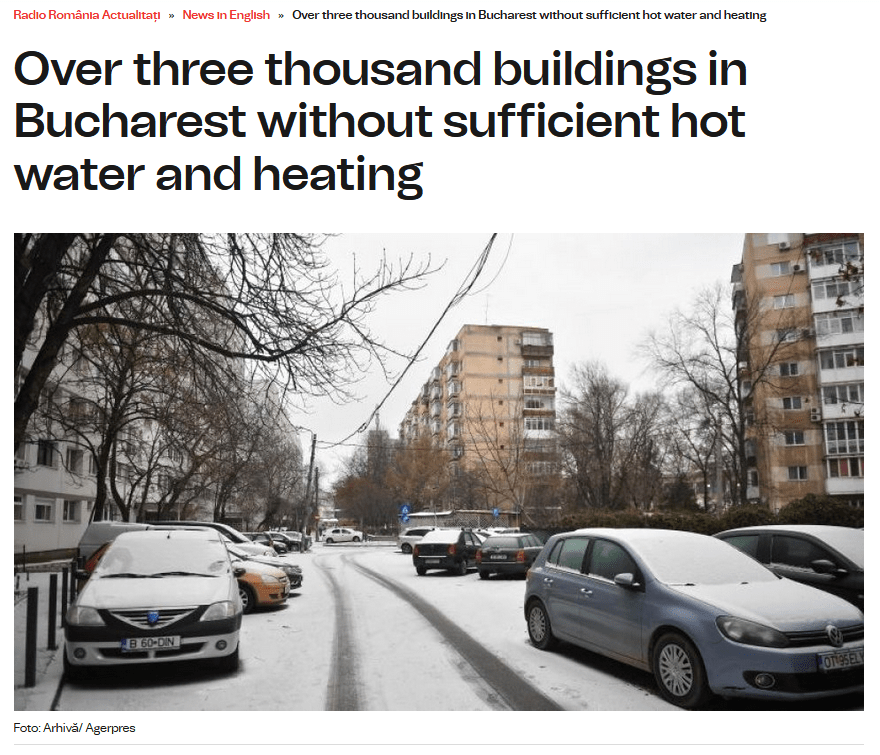
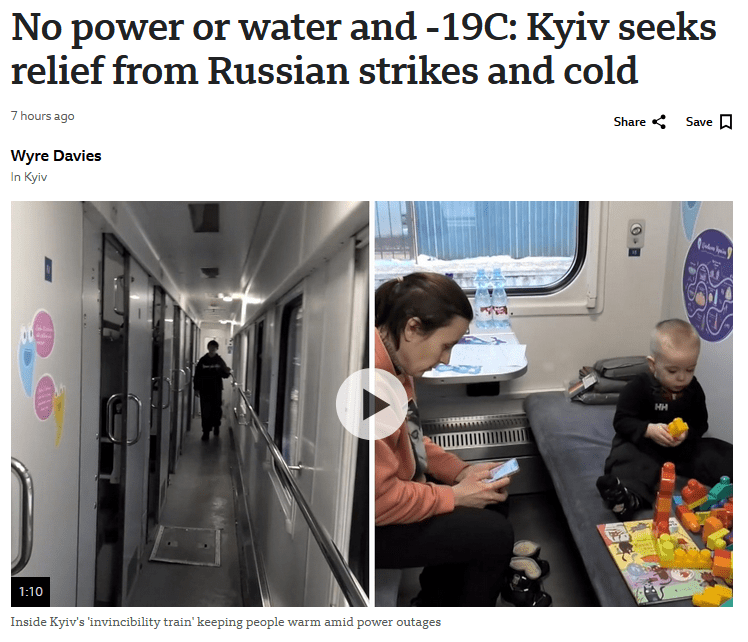
January 14, 2026. NASA is cutting short, for medical reasons, a scientific mission. And brings back 4 astronauts from the International Space Station. Meaning that NASA, a human ‘agency’, is able to fly people up and down into the sky. At will. And that it cares, for whatever reason, about the well being of those involved. Meanwhile, in both Bucharest and Kyiv people have to make do without enough heat. In the middle of winter. Why?
Can any of this be explained without making use of ‘intelligent design’?
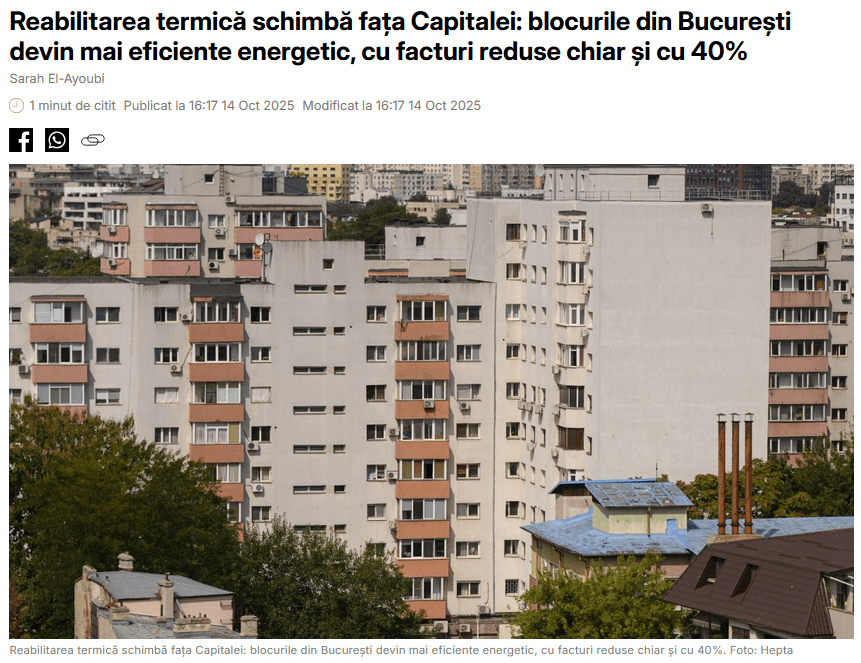
But wait! It gets even better… OK, NASA was well designed in the first place. Operates in a civilized country and is manned by some of the most capable inhabitants of that country. People in Kyiv are suffering the consequences of a ‘well designed’ conflict. People in Bucharest experiment the consequences of their own short-sightedness. For 35 years the centralized heating system has been neglected. Underfunded and ineptly maintained. A patent lack of ‘intelligent design’, right?
All these three examples, as well as many others, fit perfectly. Things too complicated to happen without outside intervention. Things so different from what is considered to be ‘normal’ that a ‘deus in machina’ is needed as the only possible explanation.
‘Nothing which is impossible may ever happen.’ Until it does…
Life happens. Because it is, after all, possible. In certain conditions, true.
Life, individually speaking, is limited. Individual organisms live for a while. Then go away. Species adapt themselves. Or disappear… Evolution! That’s how we, conscious observers, call this process. Life itself, the entire phenomenon, may happen – as I’ve already mentioned, I know – only ‘inside’ a certain ‘environmental bracket’. The kind of life we’re familiar with, anyway.
The ‘impossible’ I’ve started with is a very interesting thing. First of all, it’s – again – us who have come up with the notion. Until we’ve started to observe, things happened. Or not… But there was nobody to tell whether something was possible. Or impossible… Things which could happen, did – if the conditions were right for long enough, while things which could not – at least not in the then present circumstances – simply didn’t happen. Without anybody noticing any of those things. Now, that we’ve started to observe – in a conscious, as in ‘what’s in it for us’, manner – we’ve become very much interested in whether something may happen or not. Whether something good might be ‘enticed’ to happen and whether something bad might be prevented from happening.
I need to go back to ‘life’ for a moment. I’ve already mentioned that individual life is temporary. Finite. I’ve also mentioned that species have to adapt to changes in order to survive. And that life itself, as we know it, can happen only inside a certain environmental bracket. The point being that individual organisms which happen to be less than perfect – less than perfectly attuned to their environment – may still survive. At least for a while. Life, as a phenomenon and strictly inside that environmental bracket, has somehow stretched the very notion of possible/impossible. The limits of ‘impossible’ are no longer clear cut. Somehow hazy. As in ‘possible’ but not for very long… ‘In constant balance’.
And we’ve arrived to the next level. Society. Conscious people in congress. Just as life has stretched the limits of ‘possible/impossible’, society – us, individual people working in concert – has stretched those limits even further.
The most blatant example which crosses my mind being the academic who had decreed that ‘heavier than air flying machines are impossible’. Lord Kelvin, 1895. So. What had happened in the short 8 years passed between Kelvin uttering his now infamous words and the Wright brothers taking off? Had physics changed? Had our understanding of physics changed? None of the above. We, as in ‘we humans’, made it possible. Found ways. Just as life found a way to transform inanimate matter into living organisms – on a temporary basis – people working in concert have found ways to accomplish feats which seemed impossible. To their contemporaries. And, sometimes, even to those who live in the distant future of those achievements. We still have not figured out, in detail, how the Egyptian pyramids had been built…
I’ve been speaking of ‘individual’ achievements. Flying machines as well as pyramids are, in a sense, ‘individual’. Somebody had an idea and, based on previous human achievements and with the help of others, have put their ideas into practice. ‘Individual’ not strictly in the sense that they have been achieved by an individual but in the sense that they have been the result of a deliberately targeted effort.
Other achievements had been ‘natural’. Or social? In the sense that they had come around without anybody coordinating the effort. As in the case of the individual ones. Learning to speak. To write. Yes, we do know that Cyril and Methodius were the guys responsible for the Russian alphabet. And that Mesrop Mashtots had created the Armenian Script. Only these efforts had been based on previous knowledge. Humankind had already been writing for at least 3000 years. Using different manners of notation but the principle was already there. And the achievement was ‘folkloric’ in nature. No identifiable author. The feat belonged to the entire community.
Another social/natural achievement is morals. Our habit of doing ‘the right thing’. Which is different from what is being known as ‘justice’. Formal law being upheld by the government. Which is, basically, a collection of individual achievements. So, why do we – statistically speaking – behave in a moral manner?
Evolutionary speaking, simply because moral communities fare better than amoral ones. And even better than immoral ones. Don’t believe me? You’re not convinced that immoral communities will, sooner rather than later, either change their ways or crumble under the weight of their undoings? You are still under the impression that immorality is here to stay? Based on what you witness on a daily basis? Do you remember that “individual organisms which happen to be less than perfect – less than perfectly attuned to their environment – may still survive. At least for a while”? Same thing goes for communities/societies. Communism, amoral by definition and profoundly immoral in practice, did survive for quite a while.
Then why do we stray from the ‘straight and narrow’? Why do so many of us succumb to temptation? I’m going to save that for the next post. But I’ll add this here. Each digression is individual in nature. The consequence of ‘a deliberately targeted effort’. An individual human being comes up with a new idea. Good or bad. Is followed, if at all, by a group. Which group will survive – and add the ‘new’ idea to what is called ‘tradition’ if, and only if, that ‘new’ idea is beneficial for its survival. If that new idea works in the particular set of circumstances where that group of people live. Only after that had happened, after the group had survived for long enough and the new idea had become traditional, that particular, individual, achievement becomes a social one. The original author of the idea is forgotten and the engendered habit becomes natural.
Space is where ‘evolution’ happens. Where interaction shapes whatever is.
For space to exist, something must be there. Space needs ‘limits’. Which define it. ‘There’s a gap between these two bricks’. ‘This pile of bricks blocks the way’
‘Space’ is, simultaneously, a place, a concept and a word. We, writing and reading about it, exist. Somewhere. Somewhere in ‘space’… We’ve realized that. That we exist. Hence we came up with the concept. We needed to share that knowledge. To discuss it. We needed the word!
A wise man, using tools crafted by his predecessors, has calculated that whatever exists in space shapes its form. The heavier the object, the deeper the dent. Which depth of the dent influences the flow of time…
Time… the metric we use to measure ‘evolution’. The order and speed of happening… Time… Another ‘thing’ which exists, simultaneously, as a ‘reality’, a concept and a word.
Einstein, the wise man with the calculus, did his thing trying to understand. To put together an explanation for everything. Reading his findings, the results of his calculating, we can push our imagination. How about switching time for space?
How about considering ‘time’ as being the place where events exist? Interact, producing the ‘space’ needed for that process? Where the ‘weight’ of events, their ‘importance’, shapes the form of time. Which form of time influences the space ‘becoming’ as a consequence of those events existing/interacting in the place called time…
My point being … You see, Einstein’s predecessors had developed what we call ‘mathematics’. Our predecessors, also called ‘ancestors’, had developed a thing called language. Used it to communicate. Among themselves, as individuals, and among themselves – as a cultural species – and the surrounding reality. Language as the tool we use to digest and reshape the reality… Before we ‘do’ anything, we think about it. Using language to parse pertinent information stored in memory. Using language to consult with others. Using language to coordinate with others…
One of the languages we’ve developed is mathematics. Einstein, using this language, reached a ‘conclusion’. Wrote a story. Others call it a theory. Convincing enough for interested people to try. To try to prove it, to try to disprove it. To attempt to implement it into practice…
We exist. In space, using whatever resources we can identify and building time as a consequence of our actions. We do this using language. To explore, think and coordinate. That’s how we’re calling things. Space is where things happen and time is the ‘conclusion’ of whatever we do. Mathematics suggest that time and space are interchangeable.
So what?!?
Have we already solved all our immediate problems?
After all, we’re the only adults in the room. In the limited space called planet Earth. Or, at least and for all that it might matter, we’re the only adults in the room who care. Who should care about our own fate… Time’s running out, faster on the route we’re currently using!
You’re handed a pot. So heavy, you need to hold it with both hands. So hot, you want to let go of it. On your feet?!?
I’ve argued sometime ago that all living organisms act as if they were ‘aware’. All of them are adept at keeping their insides in, most of the outside out and, most importantly, they are the ones deciding what from the outside goes in and what from their inside goes out. And when! I call this awareness 1.0. Or life…
We congratulate ourselves over being the only creature wielding ‘self-awareness’. The ‘full fledged’ variety… according to our way of understanding it, of course. “Consciousness”, we call it. How about ‘awareness 2.0’?
Some of us are involved, heavily, into ‘faking’ things. From building something called ‘artificial intelligence’ to using ‘technology’ to mess up other people’s minds. They are ‘delving’ in the ‘next’ level. Knowingly but unwittingly playing god.
Life is driven by ‘natural selection’. Or ‘evolution’… as Darwin called them. ‘Happenstance’, if you look at it from another angle. The process of life/natural selection/evolution depends on it taking place ‘individually’. While evolution is a matter regarding ‘species’ – as Darwin itself had put it – the whole process depends on the fact that each individual organism which belongs to each species is distinct/different from all other members of the same species.
‘Self-awareness’ depends on the existence of other self-aware individuals. Willing to cooperate with the ones developing it. Just as no living organism has been observed, yet, while putting itself together starting from innanimate matter, no individual has ever been observed developing self-awareness with no outside help. Mind you, while the process involves ‘mature’ individuals helping ‘fledglings’ to ‘fly’, the process isn’t entirely ‘voluntary’. The outcome, the emerging individual consciousness, depends on the actions performed by those helping it but only inasmuch as the result of the natural evolution depends on the actions performed by the previous generation. Achieving ‘self-awareness’ is a ‘natural’ process, not a ‘deus ex machina’ machination!
Awareness 3.0, on the other hand… the ‘artificial’ kind… In this context, I wish to remind you of what happened when we, willingly but unwittingly, have reduced the natural bio-diversity in certain areas. According to our needs and understandings…
“The Green Revolution’s success also brought serious costs: intensive farming drained groundwater, degraded soil and contaminated fields with pesticides, while wheat and rice monocultures eroded biodiversity and heightened climate vulnerability, especially in Punjab and Haryana. Swaminathan acknowledged these risks and, in the 1990s, called for an “Evergreen Revolution” – high productivity without ecological harm. He warned that future progress would rely not on fertiliser, but on conserving water, soil, and seeds. A rare public figure, he paired data with empathy – donating much of his 1971 Ramon Magsaysay Award amount to rural scholarships and later promoting gender equality and digital literacy for farmers long before “agri-tech” was a buzzword. Reflecting on his impact, Naveen Patnaik, former chief minister of Odisha, says: “His legacy reminds us that freedom from hunger is the greatest freedom of all.” In Swaminathan’s life, science and compassion combined to give millions that very freedom. He died in 2023, aged 98, leaving a lasting legacy in sustainable, farmer-focused agriculture.“
Evolution is not about ‘survival of the fittest’. Evolution is about the demise of the unfit. Ernst Mayr, What Evolution Is, 2001
Well, it actually makes a lot of sense.
Being healthy is relative. On having a diagnostic hanging over your head.
Here’s another way of looking at things.
Functional versus dysfunctional. For as long as one is functional, that person is not a burden for anybody. Regardless of any diagnostic. Even a dysfunctional person can be useful for those around them. Even if that person is completely dependent on those taking care of them. A good word spoken at the right moment makes wonders.
So yes, I would also love to die ‘healthy’. As in trying to do my best to be useful. At least, to be as light a burden as possible.
On the other hand, health is yet another virtual thing. ‘Virtual’ as in man made… Until not so long ago, ’cause of death’ for people over a certain age was always ‘old age’. No longer. No matter how old the deceased, the body is transported to a medical facility and the particular cause of death is forensically determined. It makes perfect sense. Scientifically speaking. There is no such thing as too much data, specially when it comes to something as precious to us as human life. And it raises a ‘somewhat’ unreasonable kind of hope. That sometime, somehow, all causes of death will be mitigated. Diagnosed and treated. That life will become ‘longer’. That we, humans, will live if not forever… then until an accident will happen to shorten our destiny.
Can you imagine something like that? People living for 3 or 4 hundreds of years?
An open wound will be ‘colonized’ by various organisms. A mixture of water and flour will develop a ‘froth’. A naive person will be swindled.
A healthy immune system will, eventually, take care of the infection. Successfully or not… If in the hands of an experienced baker, the mixture of water and flour will – eventually – become the starting point for a delicious sour-bread loaf. The previously naive person, once swindled, might learn something from the experience.
Life is nothing but an added layer of opportunity. The pre-animated world is about strict rules. No variation, except for that brought about by happenstance.
Life is also about rules. But way laxer than those governing the pre-animated world. While the pre-animated world is about nothing more than mere existence, life is about surviving in the given conditions. About evolution. About change.
And here’s the catch. Pre-conscious change is also mainly about happenstance. Darwin’s evolution is driven by minute changes at the DNA level. Those which are helpful are perpetuated while those which are harmful either kill out-rightly the organism where they have appeared or restrict its ability to ‘give birth’. Nota bene. Darwin’s evolution was about “On the Origin of Species by Means of Natural Selection“ In his understanding, and in the real world, evolving – biology wise – is done by the species. Not by individual organisms!
Conscious change, on the other hand… is driven by individuals! Happenstance continues to be involved, heavily, but the main drive comes from ‘want’. From individuals willing/wishing to ‘make a difference’.
Is this a good or a bad thing?!? It is a fact. Neither necessarily good or bad. Just a fact. The outcome, evolution wise, depends on how the social organism – the cultural species – digests the experience.
For a while, I was convinced we were living in a virtual reality. In a reality of our own making. As I mentioned earlier, ‘vir‘ is a Latin word. “Man”. “Hero”. Hence ‘virtual’ literally means ‘man-made’. ‘Manufactured’.
Now I’ve realized we live inside an experiment. We are both the objects and the agents of the intersecting experiments currently active.
In nature, change happens. It is produced by chance. According to rules but only when chance starts it. No one plans it, if you leave God out of the picture. And, evolutionary wise, change ‘remains’ if it doesn’t bother too much. If the individual things/organisms affected by change are able to survive. Please note that if ‘dramatic’ enough, change may ‘alter’ everything. A star changes constantly but at some point it will become a nova. Or even a supernova. Which event will change everything around it…
In a social setting, things are a tad more complicated. Change, social change, is initiated. By individuals. Not necessarily according to a plan and almost always ignoring the end results. But it is always initiated by somebody. And is allowed to stay. Or not… By those experiencing the consequences. According to what they make of it. Again, even in the social setting there are rules. Just as in nature. But while the natural rules are enforced by nature itself, the social rules need to be enforced. By people. By those who end up experiencing the consequences of the afore mentioned rules being enforced properly. Or not…
What am I babbling about?
You’re not comfortable with a bragging pussy-grabber signing presidential orders in the Oval Office? How comfortable were you when Clinton got away with “I did not have sexual relations with that woman!“ You’re not comfortable when ‘US national-security leaders’ establish a private group on a social network to share sensitive data? How comfortable were you when a Secretary of State had established a private e-mail server to handle official messages? And got away with it…
And the LORD God said, Behold, the man is become as one of Us, to know good and evil. Genesis, 3:22
The point of this post is simple. The difference between ‘bad’ and ‘evil’.
‘Good’ is straightforward. It doesn’t matter – evolution wise – whether the ‘good’ has happened ‘naturally’ or ‘intentionally’. But it makes all the difference in the world whether the ‘bad’ only happened or it was the consequence of somebody planning it to happen.
Even if that difference is visible only to us. Conscious humans beings who use language to communicate and to consider.
Visible as well as ‘accessible’. How many among you consider that anybody else but us, human people, is capable of ‘evil’?
And what about the perpetrators? How many of them consider themselves to be ‘evil’? To have become evil, as they had intentionally hurt somebody?
And how come this simple ability was enough to elevate us to “one of Us” status?
Time, like everything else human, has two sides. Like a coin.
A ‘base’ and an interpretation.
There’s no interpretation without a base – even hallucinations are based on ‘something’ – and there’s nothing which has penetrated human conscience and ever managed to evade interpretation. In fact, human conscience needs to interpret, to assign meaning to, everything it ‘sees’. Everything it perceives. Anything which is uninterpretable, which has no meaning, cannot be controlled.It is, hence, dangerous. If you don’t know what’s going to happen next, you can assume anything. And since assuming the worst – and preparing for it – is far more useful towards survival than sleeping over it, we are biased towards erring on the side of caution. And towards relentlessly searching for meaning.
Time, like everything else human, is both a phenomenon – it happens – and a concept. The difference between the ‘time’ of a star and the human time being that ours has a name – given by us – and that the star cannot do anything about it. While we do!
We can do things to and about time!
We named it, we measure it, we attempt to interpret it…. and we try to do the best of it! We try to do, while alive, what we consider to be ‘the best’.
The best (?!?) for whom?
Tao.
The ‘road’. If everything flows, it has to flow ‘somewhere’. Not only from the start/spring to the ‘end’ (?!?)/never tranquil sea. Everything flowing needs a ‘riverbed’ to flow ‘through’. A plant needs soil to sprout, grow, bear fruit and ‘return to nature’. Even a star needs an Universe in order to shine… besides enough ‘fuel’, of course! I have started this post by saying that there’s no interpretation without a ‘base’ and that we, conscious human beings, need to attach meaning (a.k.a. interpretations) to everything of which we become aware. Same thing here. For anything to happen, a venue is needed. Some wise people in our past have used ‘Tao’ as a name for THE venue. For the venue where everything takes place.
Karma.
At first, when conscience had dawned on us, we were alone in the ‘dark’. And afraid about what was going to happen to us. To assuage that fear, we have identified God. As the ‘the meaning’ of the world. At first, when both the world and time seemed to be endless – to us, consequences came from God. We had to behave. Or else… God was there to punish each and every transgression. Sometimes using one of us as his proxy. After a while, some of our ancestors have learned to write. To reliably transfer information over generations. Very soon, those ancestors of ours have learned the link between cause and effect. Between behavior and consequence. Very soon God had become an outside observer. Or was out-rightly forgotten. But Karma survived.
Future.
I keep hearing that ‘evolution has no purpose’. Like many other human utterances, this one conveys far more information about the utterer than about the phenomenon described by the utterer.
‘This wooden table has 4 legs’. We learn about the table that it is in front of us, that it is made of wood and ‘has’ 4 legs. We learn about the utterer that: It was conscious when uttering those words. Only conscious agents are capable of ‘speaking like a human’. It has, at some point, learned to speak. English, and possibly other languages. It has, at some point, learned to count. At least up to four. And it had conserved that ability up the moment when it uttered those words. It was capable of identifying ‘wood’ as a material. When uttering that phrase, it was in a ‘casual’ state of mind. A ‘scientifically minded person’, a ‘grammar nazy’, for example – when in that mood, would not attribute human ‘abilities’ to a table. Which table is a mere object and objects cannot posses other objects. Tables cannot ‘have’, hence that person was speaking colloquially. Or, given the current ‘technological’ developments, those words might have very well been uttered by a statistically ‘minded’ AI application…. A man made ‘parrot’!
See what I mean?
Let’s go back to the presumably purposeless evolution.
Evolution is a phenomenon. Like a thunder. It takes a lot more time to unfold than a thunder, it’s about as hard as a thunder to predict the exact point where it will ‘strike’ but we know enough about both to be able to point out, quite reliably, a few ‘rules’ about how both phenomena take place. About where, when and how they will unfold. What’s the purpose of thunder? To ‘close the circuit’? To discharge the energy pent up in the cloud? I’m afraid that attributing purpose to thunder is akin to allowing tables to ‘have’ legs. What we have here is a ‘figure of speech’. An ‘implicit’ figure of speech… so implicit that it’s not even considered as such… Same thing when it comes to evolution.
Which evolution is paramount to survival. Just as no cloud can accumulate ad infinitum electric energy – hence thunder – no living thing ever – no species, more exactly – has yet been able to survive ‘everything’. Everything mother nature has thrown at it. Hence ‘evolution’! Which is a mere process which makes life possible. In certain conditions – in a certain Tao – after it had sprung up. And, again, attributing purpose to evolution is akin to allowing a table to own legs.
Then what about ‘future’? If God no longer decides for us – the God we have identified – and if evolution is ‘pointless’… then ‘future is blind’?!?
Not so fast!
Question: Where was God at Auschwitz? Answer: Where was man at Auschwitz?
Could any of those present at Auschwitz have done anything to fundamentally change the outcome? Probably not. Could we, as a species, have done – have behaved, actually – in such a manner as to avoid Auschwitz altogether? Specially after the Armenian Genocide had already taken place? Should we, as a species, have done differently when so many Tutsi had been killed in Rwanda? When 8000 Muslim Bosniak men and boys had been murdered in Srebrenica?
See what I mean? About the future? About our future?
What do we have here? “Eternity and endless return?” Or past mistakes haunting us through time? Until we figure out the way forward? Or else…





 nicichiarasa