A knife can be used for buttering toast, slicing steak and, occasionally, for slitting  throats.
A gun can be used to hunt dinner, defend a homestead or shoot a rival.
Bare hands can knot laces, caress a woman or choke the life out of an innocent.

What makes us, humans, sometimes transform tools into weapons?

We are astonished when we learn about other animals being able to make and use tools.
Which is good. ‘Astonished’ is the opposite of ‘insensitive’. A.k.a. ‘brain dead’.

How about we, humans, learning from the rest of the animals how to solve whatever issues we have amongst us without  killing each-other?
You are aware that humans and chimpanzees are the only animals who systematically murder adult members of their own species, right?

But what instance is powerful enough to transform tool into weapon?

Human consciousness?

Is this a ‘fatality’?
The simple fact that each of us is consciously aware of the differences between ‘I’ and ‘all the rest’ means that whenever ‘survival instincts’ kick in our humanity necessarily vanishes? Entirely?
And ‘love thy neighbour as thyself’ becomes ‘dog eats dog’?

We would have already been dead by now… all of us…
Our ancestors must have discovered a way to balance our propensity to ‘stick with your own kind’ with with our need to learn new things and meet new people!
Or is it that some of us continually come up with fresh reasons for ‘war’ while we, the rest, are too lazy to do anything about it? Despite everything history has ever taught us…

The Baby Boomer experience hasn’t been the same across the world but, due to globalization, you, the next generations, share much more, experience wise, than what we did. Frustration, that is.
Having said that, I don’t think that blaming us, your ‘parents’, for everything you have to put up with, will solve much.

First of all, let me explain what I mean by Baby Boomers having experienced different things across different parts of the world.
Actually, it is fairly obvious that the American Baby Boomers had it differently than the Western European ones and that the Eastern Europeans had the almost opposite experience from the first two.
The American Baby Boomers had been raised by the absolute victors of the WWII, the Western European ones by those who had been saved – from both war and the subsequent misery, by the Americans while the third category had been ‘eased into the world’ by people freshly fitted with the communist yoke.

Yet the X-ers and the Milennials have a very common Weltanschauung, on both sides of the Atlantic.

The Internet explains only half of what’s going on. Yes, the ‘coordination’ that bind all the X-ers and the Millennials has happened through the Internet but is due to the entire Euro-Atlantic region being under the same ‘spell’.

And You, X-ers and Milennials, blame us, Baby Boomers, for the present situation.

Which, in a way, makes a lot of sense.

As a matter of fact, I, and many around me, used to put a lot of blame on our parents for the damages inflicted on all of us by the onset of communism in Romania.

Then I realized three things.

That it could have been far worse.
That each generation has to face the mistakes committed by previous one but tends to brush aside the accomplishments  inherited from their parents.

The biggest of which, Baby Boomer accomplishments, being the fact that we have somehow managed to keep ‘cool’ the WW we have inherited from our parents.

OK, unlike our parents, we’ve somehow ‘lost the peace’… that’s on us, indeed.
Those who had won the WWII  had been wise enough to help the nations which had happened to be on the losing side.  Which process didn’t take place – not on the same scale, anyway, after the fall of the Iron Curtain.
Those who had lost the WWII had been wise enough to learn something from being fooled into following the fake prophets that had brought them so much misery. And to assume their part of the blame. Again, this has yet to happen in the former communist countries.

And the third thing that I’ve learned is that no generation, however enlightened, will ever be able to stray very much from the previous one. It can, sometimes, understand and avoid a few of the mistakes committed in the past but will always be ‘tugged back’ by the ‘ways of the past’.

Is there any way out of this historical ‘vicious circle’? Preferably one that will conserve the benefits brought about by the virtuous circle spinning in parallel with the vicious one?

I’m afraid there’s no ‘one size fits all’ remedy.
Each generation has to open their collective mind and select what to take over and what to fix from what they have inherited from their parents.
Specially now, when so much of the whole world is almost in ‘sync’.

The oldest surviving civilized nation, China, calls itself Zhongguo.
The Middle Kingdom. ‘In the middle’ of the barbaric people that surrounded her but also at middle distance between Heaven and the rest of the Earth. The aforementioned barbarians.

And, according to Confucius, it was the emperor’s job to ‘keep things as they should remain’.

Which makes sense. After all, the whole kingdom was the exclusive property of the emperor. And whose job is to watch over one’s property?

Well, things went on long enough for those involved to believe this was the natural order of things.
Until the whole arrangement was upset by a small number of people which had come, more or less ‘under their own steam’, from the other side of the world. And who were, at that time, a lot less civilized than the Chinese.

How can be explained something like this?
OK, the Aztec and the Inca empires might have been primitive relative to the Spanish invaders. They might have prevailed over the small number of invaders by brute force but they had been overcome by the sheer novelty and the apparent sophistication of the assailants.
But China had been in contact for centuries with the rest of the ‘civilized’ world! And way advanced than the rest. Both culturally and economically.

So, what had happened?
How can something like this be explained?

We might try to take the ‘historical route’. And observe that, exactly as Confucius and Laozi had told us, China’s destiny had been tightly linked to the ability of those in charge – the emperors, to manage the empire. From the paleolithic migrations until the Mongol invasion in 1271, nothing from outside had any significant impact over the Chinese hinterland. But the fortunes of those living in that hinterland had oscillated from the misery induced by almost constant ‘live conflict’ during the Warring States period to the various prosperous eras. The Han, Tang and Song dynasties, to mention just a few of them.
The same principle had been valid also for what went on while foreign dynasties had been in power. As long as the ‘managers’ were doing their jobs, things continued to improve. As soon as the helm was grabbed by an incompetent leader… all hell broke loose.

But is the emperors’ incompetence enough to explain what had happened during the XIX-th century? The most advanced, and numerous, nation on Earth had been subjugated – for all practical purposes, by a bunch of drug pushers pretending to act in the name of the far away, and far weaker, British King?

Or we can take the sociological route.
Along which we’ll notice that the ‘drug pushers’ were only nominally subjects of the British Empire. Which empire was behaving imperially only towards the exterior while inside it was already a democracy!

Sounds familiar?

Ancient Athens, the first known democracy, had dominated the Eastern Mediterranean for as long as it had retained its democratic character and had failed, abysmally, each time it had reverted to tyranny?
Ancient Rome had established a huge empire as a democratic republic and collapsed four short centuries after becoming a totalitarian empire?
And so on…?

And what might be the difference between a totalitarian empire and a democratic one?
On the face of it, a democratic empire sounds like an oxymoron… yet there’s plenty of such examples in our history…

As you might guess from the title of this post, the ‘famous’ middle class was both the engine and the explanation for the ease with which the ‘democratic’ empires had been established. And yes, the Spanish and Portuguese ones can be explained in the same manner. At that time none of the Iberian monarchies was yet behaving in the absolutist manner they had pursued as soon as the looted precious metals had started to pour in…

But what makes the middle class so special?

Nassim Nicholas Taleb would tell you that the middle class has enough skin left in the game to really care about the outcome and I’m going to add that the middle class is simultaneously distanced enough from the fray to act in a reasonable enough manner.

Let me put back, for a short while, my historian’s cap.

Most of us consider that the middle class is a late appearance. That most of the time, humankind had been divided in two. The haves and the have-nots. The powerful and the meek.
Well, I’m not so sure about that…
For the first 60 000 years after we had learned to speak – which had made us really human, we had been living in small packs. Led by the more powerful male member of the group – if we consider that our ancestors used to behave like our Chimpanzee cousins, or ‘self managed’ in a more or less democratic manner if our ancestors had used the model followed by our other cousins, the Bonobos.
Or we could look at how the surviving ‘primitives’ lead their lives. None of the Hadzabe, Yanomami or Inuit, who have survived in the most difficult conditions on Earth, have a hierarchical social structure.
Primitives?!? Maybe… but not because of their social arrangements. After all, they are freer than most of us.
And what is it that we, proudly modern people, value more than our individual freedom?

Money? I’m going to let this rest… for a while.

Let’s go back to our ancestors.
Who, by all indications, had been living as ‘extended middle class societies’. Without any 0.1% and without people who went to bed hungry while the rest of the gang had been gorging themselves.
Let’s remember now that during those times we had actually transformed ourselves from apes to humans. And if you consider this to be a small feat, just try to teach a bonobo to speak. Then remember how many people who had been born in poor and backward countries are now successful business people or scientists. After passing through a thorough educational process, true! Only that educational process is in no way accessible to any bonobo…
Don’t disparage the long evolution we had graduated from, as a species, while living in ‘extended middle class societies’.

‘But you haven’t explained what you mean by middle class! Most of us see the middle class as those people who make a certain amount of money each year and you keep speaking about primitive people… who have absolutely no use for any money…!’

OK.
For good or for bad, our present society consist of three categories of people.
The haves, the in-between and the dirt poor.

I’m not going to assign numerical values to any of these.
Taleb’s Skin in the Game criterion is far more useful in this situation.

The haves qualify only after they have no skin left in the game. In the sense that they have so much ‘money’ that come hell and/or high water they feel safe. What they make of this world is heavily influenced by the thick ‘insulation’ which separates them from the rest of the world.
The dirt poor – or the lumpen proletariat, in Marx’s terms, have all their skin in the game. In fact, they are the famous ‘Boiling Frog’. They have no way of leaving the kettle so…

In a sense, both haves and the dirt poor are  prisoners. Neither can leave their respective cell blocks. Simply because the dirt poor have no way to go anywhere while almost none of the haves would be able to survive ‘outside’.
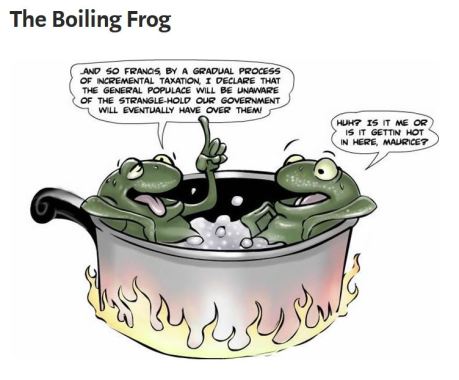
the boiling frog

Wesley Chang, The Boiling Frog, Medium.com

Which leaves us with the middle class.
Who have some resources stashed away – or enough credit available, to weather some crises. But not enough to last them for their entire remaining lives.
Which makes the middle class the only really interested people in the long term well being of the entire society. The only ones really interested in maintaining the freedom of the market as the main economic engine. The only ones really interested in maintaining democracy as the main manner of avoiding catastrophic mistakes perpetrated by the too powerful autocrats.

Or, from a psychological point of view, we can look at the haves/dirt poor as being stuck in an immobile state of mind while the middle class are the only open minded members of the society.
In fact, I prefer this last approach.
You see, until recently the American Dream was relatively accessible. With some luck, a ton of determination and a fair amount of brain power, the sky was the only limit. Belonging to any of those three categories, haves, middle class and dirt-poor was as much about the state of mind of those involved as it was about actual economic conditions.
The haves were free to consider the big picture, the dirt poor could contemplate brighter perspectives while the middle class were doing their thing. Keeping the whole show afloat.

I’m afraid we have reached an inflexion point. A watershed mark, if you prefer.
For whatever reason – I’m not ready to tackle this subject right now, we’ve become so preoccupied with something in particular that we’ve lost sight of everything else.

Including the middle class.

Exactly those which were supposed to maintain their cool heads and open minds.
part of the problem

Matthew Stewart,
The 9.9 Percent is the New American Aristocracy,
The Atlantic

I’ve ended my previous post by saying that we, humans, are tempted to see almost everything as a potential tool.

And the present one by asking myself ‘to what avail?’.

What are we trying to accomplish?

I kept telling you that we, humans, haven’t invented much. That everything we do has already been experimented by our predecessors. Plants and animals…

Well, one of the things that we did invent was ‘intent’. As in ‘premeditation’.

We don’t know whether plants are driven by anything else except their ‘vital spirit’.
Same thing is valid for ‘inferior animals’ (those which don’t have brains) while the superior (a.k.a. brained) ones seem to be driven by what we call emotion.

Including us!

No matter how much we pride ourselves about our ability to reason, we’re still driven by emotion.
Actually, we’re not even close to being rational!
At best, we rationalize our emotional impulses. Before or even after we put them into practice.
Dan Ariely and Daniel Kahneman, among others, have already settled this point.

Then why am I talking about ‘premeditation’?!?

And who said ‘premeditation’ is necessarily rational?

It is planned, OK, but …

You see, the real difference between us and the rest of most other animals is our ability to ‘watch ourselves watching the world‘. As if something inside each of ourselves is able to send a probe somewhere ‘outside’ and then examine its own individuality as an outside observer. I didn’t say an impartial observer, just an outsider. However biased.

I won’t elaborate on how we got here, Maturana had already done that. Brilliantly. I’m far more interested in the consequences of each of us being able to observe their own selves ‘from outside’, keeping in mind that our rationality is heavily bounded – Simon Herbert and others, and that we’re mainly driven by emotions.

The very first thing that each of us observes about their-selves is the overwhelming fragility which defines us.

And this is why we search solace in religion. In no matter which one of them, atheism included. There is ‘safety in numbers’, you know…

Our goal, professed or not, is to find inner peace.
No matter whether you call it salvation, redemption, nirvana, self acceptance or whatever else, what you crave is peace.

The sentiment (illusion?) that you are safe.

At least for a moment.

How long is that moment going to last?

Well, that depends on how you got there!
And who accompanies you…


Remember Sheba?

The Chimp I mentioned earlier? Who was able to tame her greed by making good use of symbolic reckoning?

I wouldn’t go as far as considering that she used numerical symbols as tools. Mainly because she didn’t initiate the process… had she been able of proper/complete symbolic thinking she would have been able to solve the task even when dealing with real candy…

Nevertheless, the whole encounter does speak volumes. If in a hurry, jump to 28:01.

Ape genius


Let me start from a little farther away.
I’ve already mentioned the that we, humans, haven’t really invented anything. All living organisms are already involved in elaborate trading, use tools and have at least a rudiment of self-awareness.
Let me elaborate on the tool making and using part.

The whole thing has suddenly become rather eerie? All living organisms making and using tools?

OK, what is a tool?
Something used by somebody to accomplish a task?

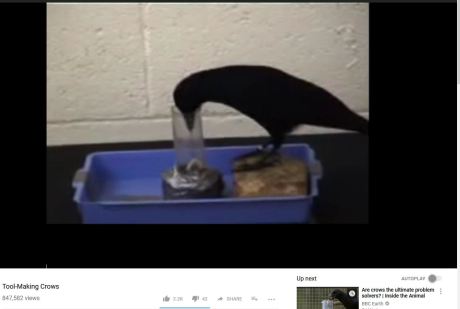
Crow making tools

Watch this crow fashioning a hook and using it to retrieve something and tell me whether that hook was a tool or not.

Says who? Us?

As smart as crows are, I seriously doubt that any of them really understands the concept of ‘tool’. Or any other concept, for that matter…
OK, some of them are able to use tools. Just as some of us are able to drive cars! That doesn’t mean that all drivers understand how cars work or all those capable to use tools are able to understand the concept of tool. Or what a concept is….

And what has any of this to do with Sheba and her bowls of candy?

I haven’t yet finished with tools, hold your horses.

A tool actually becomes a tool when at least one of us think of it as a tool. When some of us consciously try to determine alternative uses for that object.

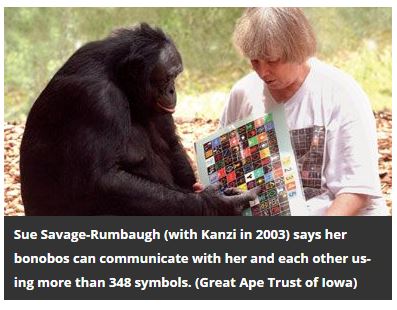
When we see a monkey picking up a rock to ‘pry open’ a nut, it is us who congratulate it. ‘Wow, such a smart monkey!’. For her, it was a natural thing to do. Something she had either found out by ‘mistake’ – when a rock had fallen on her toe, for instance, or by observing a more experienced member of her gang. But no monkey has yet tried to fashion a ‘proper’ tool… Just as no monkey has yet communicated more than in a ‘mechanical’ manner… In the wild they use various calls for more or less precise events and that’s it. After being taught some symbols  a few apes are now able to transmit their wishes/commands to other apes – including humans, or even to operate  various machines. But that doesn’t mean they are able to communicate impressions or to ‘talk about about something’ with a ‘friend’.

Kanzi

My point being that our very ability to use symbols to communicate among us has developed our ability to think. Because it is through thinking that we identify an object as a tool. And then expand the manner in which we use it.
You see, speaking has taught us that ‘what you hear’ almost never corresponds exactly with the ‘real thing’ … nor with what the speaker actually meant/tried to say … After millennia of conversations with our peers, we’ve learned that words/symbols are relative. That they can stand in for a piece of reality but that they’ll never be able to replace it. And that the same symbol might stand in for a lot of things….

The same phenomenon had happened with tools. After learning that one symbol might be used to represent two or more objects it was simple to put the same object to multiple uses. Even the most primitive stone axes were simultaneously used for ‘chopping’ fire wood, cracking bones for their marrow and for bashing in the skull of ‘thy neighbor’.

According to the various needs and wishes of the human agent who ‘called the shots’ in each instance.

Be it word or tool.

Hey, you said earlier that all living things use tools, not only an odd monkey and some crows…
Indeed… Have you ever watched a dog munching on a bone? Cracking it open and enjoying the marrow? Is it possible for us to consider that the dog has used its jaws as a tool?

No? Because the jaws are an integral part of its organism?
So what?

As a foolish teenager, I used to open beer bottles with my teeth.
Was I not using them, my teeth, as if they were tools?

Have a look-see at this short video.

seed developing tools

Had I not been conditioned to see it as a germination process, I might have interpreted it as the seed simultaneously developing a tool for retrieving nutrients from the soil and a solar panel to cook them with….


As I promised you some time ago, let’s have a look at ‘property’.

As you recall, I was arguing that we, humans, are only ‘qualitatively’ different from the rest of the animals. In the sense that we do everything that they do – and nothing really new or different, only that we do it ‘better’. And more ‘evenly’.

In my previous post, I was dealing with ‘trade’. So I’ll use ‘trade’ to explain what I mean by ‘more evenly’.

All living things are made of three things.

An inside, a membrane and a set of instructions which deal with two things.
How the whole thing should be structured in order to able to live and how the inside should interact with the outside – through the membrane, in order for the organism to remain alive and replicate itself.

My previous post dealt with individual organism trading food (a.k.a. matter) and information with their outside. It also dealt with manners in which trade can be performed.
Directly – as in barter, or indirectly – using symbols.
The most simple barter is breathing. Exchanging gases with the environment. Or foraging – individual organisms ingest food and water and excrete poop and urine.
‘Trading’ information is a little more complicated. An individual organism can be endowed with genetic information by it’s parents, presented with information by some of its peers – bacteria or playmates, taught by its voluntary or involuntary teachers or it can glean information by itself through mindful observation. Also, trading information is more complicated than trading food because information can be either ‘hardware’ or ‘software’. DNA inherited from the parents (received from peers/’invaders’) being ‘hardware’ while information gleaned through observation or during training being ‘software’.

Everything described in the previous paragraph is common for all living organisms, including humans.

My point being that we’ve been trading, from the ‘beginning’, far more items than any of  the other living things – plants and/or animals.
OK, an individual whale will eat far more than an individual human being. But whales eat, basically, one or two things. While we, humans, will throw down our throats almost anything that we fancy. Including some stuff which will actually hurt us.

But the real interesting thing is the manner in which we ‘trade’ information. We not only observe keenly what happens outside our consciousness (not just outside our-bodies, simply outside the shell that harbors our ‘mind’) but also translate that information into symbols and then communicate that symbolic information with our fellow human beings.

And here’s the catch.

I mentioned earlier that every individual organism consists of an inside, a membrane which keeps it together and a package of information.
For survival purposes, each organism must consider all its three components as being its own and to defend them ‘to the bitter end’. Or else…
Which is congruent to what happens in the real world… Membranes are relatively hard to penetrate, there are some defense mechanisms which at least attempt to take of any intruders – the immune system, for example….
More over, the more ‘sophisticated’ organisms also defend ‘their’ territories and the local resources they have identified and claimed as being theirs. If you don’t believe me, just try to take a bone from any normal dog which isn’t yours.

You see, not even ‘property’ is exclusively  specific to humans…. We have created the concept, we actually define ourselves using our possessions… yet we share this trait with all other living organisms… even if they don’t know anything about it…

Remember what I just said about us being able to trade ‘symbolic’ information? To ‘formulate’ the information before trading/sharing it?
Same thing happens with ‘property’.

For a dog, a bone is its property as long as it happens to be in his snout. And most dogs have no problem in attempting to ‘steal’ a bone from another dog – as long as the other is not way bigger, a pup or some-other special cases.

Meanwhile, most humans would painstakingly respect other people’s property.
Simply because, for us, property has also meaning. Besides ‘survival value’

NB. In English, ‘property’ is not exclusively about possession. Its root, ‘proper’, means from ‘clean’ to ‘as it should be’.

BetterFailling's avatarOK, But What If?

einstein energy

According to Einstein’s theories – and verified by rather numerous nuclear experiments, matter can be transformed – some of it, anyway, into energy.

According to some mathematical rule, E=mc2 introduces the notion that m=E/c2.

Otherwise said, energy might somehow/someway transform itself/be transformed by some very skilled alchemists or even through a natural process into matter.
Never yet observed by us but that doesn’t mean it cannot/could not happen.

Some modern alchemists actually plan to put this idea in practice. Read all about this here and here.

Now let me point your attention towards the ‘missing’ energy/matter. A.k.a. dark energy/matter problem.
According to the mainstream cosmologists, in order to make sense of what we already ‘know’ about what’s going on around us we must consider that “that roughly 68% of the universe is dark energy. Dark matter makes up about 27%. The rest – everything on Earth, everything ever observed…

View original post 316 more words

There is an almost unanimous consensus about laws having to be considered either natural or man made.

As in the law of gravity is implacable – hence ‘natural’, while the Penal Code is a lot more ‘amenable’.

Yeah, right…

Then how come Hammurabi had been able to write his Code some three and a half Millennia before Newton famously noticed that apples do fall to the ground? Besides being such irresistible objects of temptation, of course.
One way out would be to assume that Hammurabi was a lot smarter than Newton but that would be too easy, don’t you think?

Now that I’ve mentioned the noticing game, let me point out some of my own observations.
People have tried to fly way before Newton had told them this is impossible – for us, at least.
Individuals might occasionally get away with murder but murderous societies are far less stable than the more peaceful ones.
Gravity has been already ‘defeated’ while no totalitarian government has yet managed to ‘stay afloat’ in a consistent manner – no matter how many dissidents it had murdered.

Another approach to this conundrum would be to consider that natural laws deal with the non responsive kind of chaos while man made ones are meant to approximate what happens when the chaos is able to respond to what’s being thrown in it.

For instance weather and financial market. No one can change the weather – hence it is considered a non-responsive kind of chaos, while the market is constantly pushed one way or another by the various pieces of information that reaches the participants. Which participants respond to those inputs – according to their own abilities and preferences, hence the ‘responsive’ character of the market.

So, could we consider that nature is non-responsively chaotic while humans behave equally chaotic but in a responsive manner?

The key word here being ‘we’, of course.
After all, we have coined the very concept of law, we are the ones speaking about the difference between ‘natural’ and ‘man made’ and we have discovered, formulated and eventually bent all laws… both natural and man made.

It seems that the whole situation is a lot foggier than at the begging.
That I’ve messed things up instead of making some sense of them…

Let me use another tack.

First of all, let me notice that we’re surrounded by ‘things’. And that these things relate to each other. And to us, of course.
From this point of view, the world is made of things AND of the relationships that appear amongst these things.

And here’s the catch. Laws are not things. They are a small part of the relationships that appear between the things that exist in this world. And since we’ve already discovered that there are a lot more things around us than we will ever be able to ‘see’/notice, it would be unreasonably to expect us to be able to notice all the relationships that ‘tie together’ the world.

That doesn’t mean we shouldn’t try!

Returning to what we call ‘laws’, let me add yet another classification.

‘Noticed’ laws versus ‘pro-active’ laws.

In this sense ‘thou shalt not kill’, the Law of Gravity and ‘drive on one side only’ are, all three of them, ‘noticed’ laws. In the sense that things remain in order as long as we observe these laws.

On the other hand, pro-active laws are a lot more trickier.

‘Do this, do that’! …

‘Why?!?’

‘Because I know better AND/OR because I can make you obey my orders!’

While observing the noticed laws is essential in letting things flow naturally, imposing/accepting ‘pro-active’ laws is the recipe for disaster. Man made disaster.

Let’s take it one step at a time.

A guy hires a woman. A ‘working girl’, to be precise.

After a while, an attorney pays a hefty sum to the working girl and has her sign a confidentiality contract.

When asked about the whole thing, the guy first said that he didn’t know much about anything and then that he had reimbursed the hush money to the attorney.

The attorney apparently gets a lot of money from somebody else. Which somebody else might be, now or become in in the future, in a conflict of interests with the organization presently run by the guy who had once hired a working girl.

It becomes apparent that the attorney is a confidante of this guy. Or, in plain English, that this attorney takes care of the dirty laundry that ‘happens’ around this guy.

It also becomes apparent that this attorney is not satisfied with the amount of money he gets from this guy. That this guy is not his only client. And that this attorney is not very particular when accepting other clients.

What am I to understand from all this?

This guy is cheap?
This attorney is very greedy?
This guy is not very particular when choosing who takes care of his dirty laundry?

two sided coin

So, Japan and Germany have huge trade surpluses. Despite their workers being the best paid in the whole world. In both absolute and relative terms. Among the major economies, anyway.
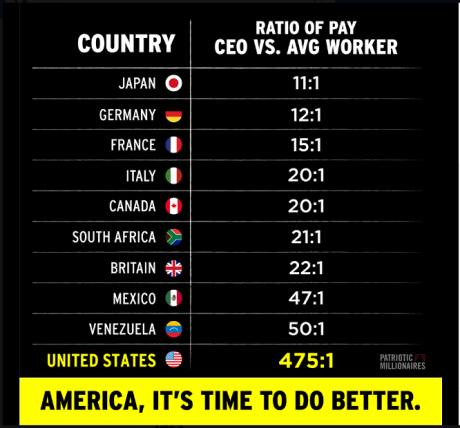
Meanwhile, the US has a humongous trade deficit. Yet the American CEO-s are ‘compensated’ as if they were the best in the world…

Interesting, right?

More ideas about the same subject here:

Why is Japan Economy (surplus of over $100 Billion) a considered Weak Economy? & Why is USA Economy (deficit of over $400 Billion) Strong Economy?