Archives for category: Trust

“Our measures do not tell us whether philosophy majors
go on to apply their newfound abilities in the service of truth and justice
or, conversely, for personal gain and glory.
Settling that question would require gathering a different kind of evidence.”

Reading it, https://theconversation.com/studying-philosophy-does-make-people-better-thinkers-according-to-new-research-on-more-than-600-000-college-grads-262681, brought back to memory another research subject. Linking a ‘reasonable consumption of alcohol’ to various health benefits.
A quick google search produced this:

The paper I found now, https://www.phcc.org.nz/briefing/glass-half-full-alcohols-health-benefits-cardiovascular-disease-still-controversial-and, is quite thorough.
More importantly, for me, it raises the points which bothered me when I first found out about the claim. On FB, more than five years ago.
I’ll put it in my own words.

Being able to drink for a relatively long time means one had a fairly strong health at the start of the whole process. And at least some degree of self-control.
Otherwise the drinker would have very soon become ill, an alcoholic, suffered some accidents… or any combination thereof.

Same thing regarding the findings of the first study.
Take a number of smart people. One has to be smart in order to be interested in philosophy! And able to graduate…
Train those people’s abilities. Help them develop whatever they’re good at. And like doing…
Then wonder about the good results you’ve achieved!

Writing this post made me realize that it goes far deeper than this.
No, this is not a self-congratulatory study. Far from it.
It’s stark warning!

“Public trust in higher education has hit record lows in recent years, according to polling by the Lumina Foundation and Gallup. Meanwhile, the rapid advance of generative AI has threatened the perceived value of a traditional college degree, as many previously vaunted white-collar skills are at risk of being automated.
Yet now more than ever, students must learn to think clearly and critically. AI promises efficiency, but its algorithms are only as good as the people who steer them and scrutinize their output.
The stakes are more than personal. Without citizens who can reason through complex issues and discern good information from bad, democracy and civic life are at risk.”

This paper is not about the virtues of learning!
It’s about us.
So many of us still have so much more to learn about the virtues of learning…

One possible explanation for what’s going on is that not enough of the learned people “go on to apply their newfound abilities in the service of truth and justice“.
Me starting this post with the distinct feeling that this was a self-congratulatory study is yet another confirmation of the generalized distrust which permeates the whole society.
We’ve reached that stage where we primarily look for reasons to refute.
Some say a little paranoia is good for you. That it keeps you safe.
I’m afraid we’ve reached exactly where ‘they’ want us to be.
Distrusting, paranoiac people cannot do anything together.

Constantly looking over your shoulder will never lead you forward.
Will only make you, us, susceptible to manipulation.
Remember, in this context, how many reasonable posts we get from people supporting various horrendous ideas.
How many ‘think with your own head’ messages we get from those ‘also’ promoting MAGA. How many times Putin says he only makes ‘reasonable’ demands.

How can we build trust?
I don’t know how but I do know we don’t have any alternative.

We either learn to respect each-other, and build trust together, or become subjects.
And I’ve already been a subject. To a communist regime. Don’t want to repeat the experience.

Terror management theory is the idea that we create culture
and aspects of our lives that will “outlive” us
because of our knowledge of our own mortality
which is innately terrifying to us.

Self awareness doesn’t come cheap…

Collectively, species-wise, we’ve done OK. We’ve become the dominant species on Earth.
For good and/or for worse…

Individually, on the other hand…

Doubts!
Self-awareness comes with plenty of them:
Will I be able to find enough food tomorrow? For me and for my family?
When will it start to rain?
Will the sun rise again?

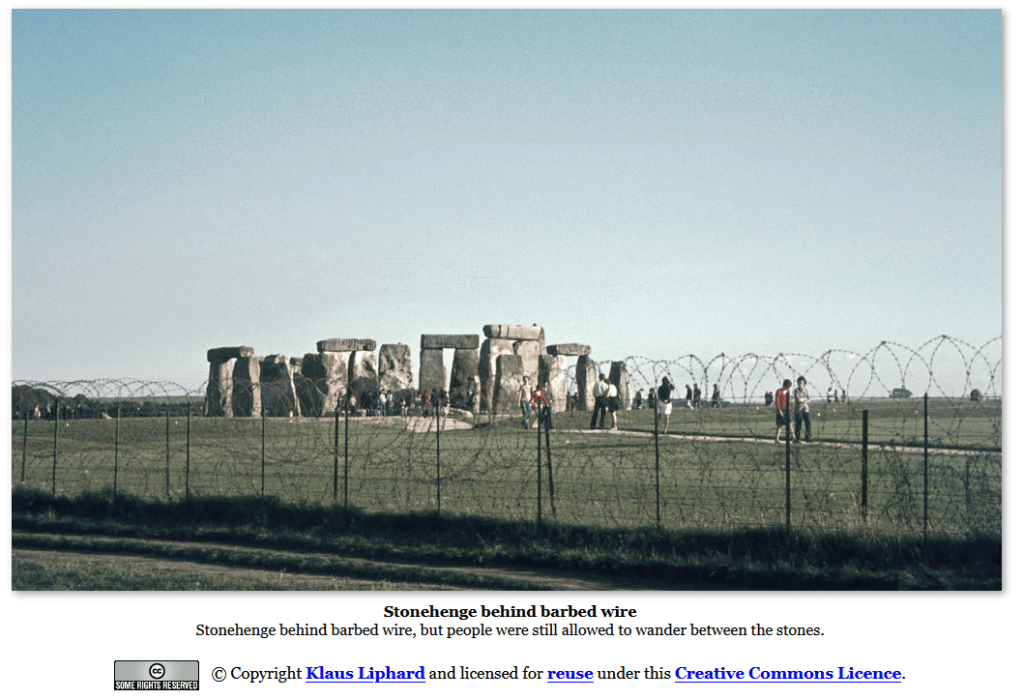
The way I see it, ‘The Stonehenge’ has been built for one thing only.
To assuage fear.

According to scientists researching the phenomenon, ‘The Stonehenge’ had been built by the immigrants who brought agriculture into Britain.
Solving the food problem wasn’t enough. Enough to bring peace of mind…
Now, that full bellied people had enough time on their hands, they started to think about ‘the future’:

‘OK, tomorrow will come. The sun will rise. We’ll be able to sow our crops for the next year. But is there an order in all this? How can we be sure?’
‘Let’s build something which will prove “order”. If we could demonstrate that year after year the summer solstice ‘falls’ under the same ‘parameters’ then there’s indeed an ‘order’. Things don’t just happen, they follow a ‘script’ ‘.

And they did exactly that. Built the first scientific instrument. Proved that the sun not only rises each day but also follows a precise path.

Quite a management feat.
And no, I don’t mean the stone stacking part. However remarkable that was…
Their real success was to convince themselves to keep toiling into the future!

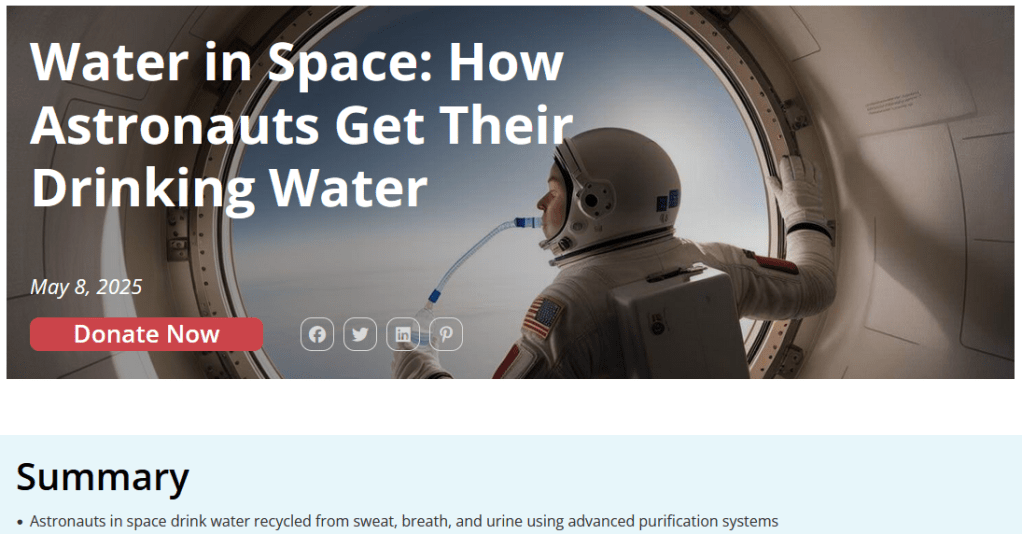
Astronauts don’t bring all their drinking water from Earth.
Instead, they rely on closed-loop water recycling systems
that recover and purify nearly every drop of moisture produced onboard.
That includes urine, sweat, breath vapor, shower water, and humidity from the air.

In space, nothing is wasted.

NASA 1132 77.0F

A space station circling the watery pebble we call home…

Cooperation brought us so far.
A majority of us have enough to eat and some of us – albeit very few – get to see the world from above.

Some of us might wonder:
What’s the point of ISS?!?
Wouldn’t that money be better spent feeding the hungry?

The short answer is:
‘We don’t need the ISS money. Feeding the hungry is well within our current possibilities. We just haven’t yet figured out how important this is!’

And here’s the explanation.
We’re no longer able to feed ourselves. Individually…
In order to enjoy our current standard of life, we need to cooperate.
In order to cooperate, we need to trust each-other.

Nobody has asked to be born.
Yet here we are.
La Legion Etrangere goes by “Marche ou Creve”. Keep walking or ‘make way’.
Now that we’ve been born, how about we make the best of it?

Those who get to see the world from above did have a say about the whole thing.
Nobody gets there against their wishes.
And they know what they’re signing for. Not everything – some of them don’t get to get there – but they have a fair image of what’s gonna happen to them. Including the facts about the water they’ll be drinking while enjoying the view.

Maybe it’s time for the rest of us to understand the limited nature of the Earth itself.
Not as limited as the ISS but I’m sure you understand my drift.

The astronauts trust each-other.

And they trust the rest of us.
Those who have made it possible for them to go there.


We, the rest, need to learn the trick.
How to actively, agentically, build trust 2.0.

He has the opportunity.
He feels good doing it.
And he doesn’t care. About the consequences experienced by those affected.
As long as those affected are not able to affect him back, of course!
And if you analyze the whole thing in a dispassionate manner,
this is a perfectly rational behaviour!

There is a difference. Between differences.
There is a quantitative difference and a qualitative difference.

There is a quantitative difference between moral and immoral behaviours/persons. An immoral person is someone who cannot restrain themselves in certain instances. Who knows the difference between good and bad and yet cannot resist. Cannot resist doing the bad thing.
And there is a qualitative difference between a moral/immoral person and an amoral one. The amoral one’s actions are not affected by morals. That person does anything they want to do as long as they is not affected by the consequences of their doings. Regardless of whatever consequences may have to be endured by others.

Which brings us to the difference between bad and evil. Also a qualitative one.
Which difference has nothing to do with the amount of damage caused to the bystanders. And everything to do with the attitude of the perpetrator regarding their actions!

As an aside, I have to remark that we are all ‘bad’.
In the sense that all of us commit bad things. That none of us is able to completely restrain ourselves from doing immoral things. From knowingly performing ‘bad’ things. Bad for ourselves or even bad for other people.

The difference between us, normal immoral people, and the evil amoral ones being simple.

The immoral perform things which are potentially bad. For themselves and for others.
For example we smoke. Which is bad. Both for us and for all those who breathe our smoke. But the damage isn’t obvious. We might die before developing a cancer, right?
And most of us have driven a car after having enjoyed one drink too many. With no intent to commit an accident, obviously.
Meanwhile, the amoral may commit things which will certainly cause harm to other people. Regardless of whatever rationales the perpetrators invent to justify their actions. From Ponzi schemes to terrorism.

I’ve saved the juiciest bite for the end of my post.
While immoral is necessarily bad, amoral is morally neutral. Anything in between necessarily bad and necessarily good.
For instance, using weapons of mass destruction and compulsory vaccination/quarantine are amoral. Both are used with a blatant disregard towards the feelings of all those who have to endure.
The first is ‘a certain killer’ while the latter has saved entire populations… go figure!

“All governments suffer a recurring problem:
Power attracts pathological personalities.
It is not that power corrupts but that it is magnetic to the corruptible.”

Frank Herbert, Chapterhouse: Dune

Some people are convinced that all they have to do is to follow the rules.
Other people are convinced that freedom – their freedom, in particular – is the most important thing.

Apparently, these two convictions are incompatible.

Which is not true.

Those convinced that following the rules is the only way to ‘get there’ – wherever that might be – forget one thing. Two things, actually…
That no journey starts until the traveler makes the first step. And decides where they want to go…
Those convinced that freedom is the only important thing forget one thing. One thing only.
That whenever the traveler breaks a rule… there will be consequences!

The fact of the matter being that freedom is a human achievement.
Achieved during the long journey towards the future.
Achieved as a consequence of the process through which we have learned about rules.

‘Rules’ is our definition of ‘possible’. Defines a space where things can happen. As long as the pertinent rules are being observed, of course.

At first glance, flying is possible. For birds…
After learning the pertinent rules – and mastering certain skills – we have learned to fly. But we can continue to fly for only as long as we keep observing the pertinent rules!

At first glance, walking a rope strung between Manhattan’s Twin Towers was impossible.
Not for Philippe Petit. He had the skills and he was crazy enough. He even didn’t ask for permission… Click on the picture and read ‘all about it’. My point being that he remained alive because he had observed the laws of physics. All of them! And because the human laws he had trespassed didn’t involve the capital punishment…

I believe you already understand what I want to convey.
Have a nice week-end.

Trump did what he had promised.
The EU still debates among themselves how to respond.
Britain has already said it will wait for a while.
“Nearly 50 countries want tariff deals”.
Canada is ‘leading the charge’ against Trump’s trade war with $60 billion worth of counter tariffs on American goods, and is urging Europe to retaliate too, Canadian Foreign Minister Mélanie Joly told Euronews in an exclusive interview.” But…

China, on the other hand….
Am I wrong or Trump’s tariffs have been used by the Chinese leaders as an opportunity to position themselves as ‘champions of the free world’? Free from Trump’s version of America…

https://www.sas.upenn.edu/~haroldfs/540/handouts/french/unintconseq.html

“If the only tool you have is a hammer,
you tend to see every problem as a nail”

Abraham Maslow

“The answer: Free market capitalism”?!?

I was arguing in the previous post that we think using images stored in our memory. While we are convinced that we deal with real ‘objects’… ‘Hammers’ versus ‘nails’…

As you should have already noticed, Abraham Maslow had said more or less the same thing sometimes in the first half of the previous century… Well, he was a ‘clinical’ psychologist while I’m nothing more than an engineer. He was interested in how our mind works, I’m interested in the consequences of how our minds work. If you understand what I mean…

‘And what about the pretext you used for today’s post?’

Free market capitalism is nothing but an environment. Man made, for sure, but also ‘natural’. As in ‘evolved’ to the present state as opposed to ‘designed’ in the present state.
Free market capitalism doesn’t do/cause anything. People toiling in this environment do whatever happens here.

Gravity doesn’t cause any falls.

Gravity pulls us, all of us, towards the center of the Earth.
Regardless.
Of us walking sober in the middle of the town versus skating ‘under the influence’ on a thin iced lake in the middle of nowhere.

What would the world do if…?

Which of the worlds are we talking about here?

Recent developments have helped me to understand something.
And no, not the fact that there are more worlds out there. One happy about what’s going on, one horrified and a few rather indifferent.

Trump being elected for a second term as President of the United States hasn’t changed much in the real world. Not yet, anyway.
What it had changed, dramatically, was our image of the world. Of the US, in particular, but also of the world as a whole.

This development has helped me to understand that we don’t deal in realities.
We don’t consider things, make decisions, by examining the things themselves. No!

We consider things by examining the images we have in our minds.

We look at things and we get a ‘set of data’. A virtual image.
We recollect from our memory whatever other information we have on the subject. Another image.
We put two and two together. And we reach a conclusion.
Most of the time ignoring the fact that we’ve been dealing with images instead of the real thing.

Until we are forced to acknowledge that our image was incomplete. Inaccurate…
Or that, simply, we’ve chosen to see what was more comfortable for us!

It’s one thing to be able to see white from black.
And a lot more complicated to see black and white…

Being reasonable means listening to what the world has to say about things.
Being reasonable means being open minded.

Being rational means balancing your means with your wishes.
Being rational means actively identifying resources which might help you attain your goals and the pitfalls you need to avoid.

Being reasonable means choosing goals which ‘do not disturb’.
Being rational means transforming things into what they should be. Into what you think they should be…

Being reasonable means getting along.
Being rational means going alone.

Being reasonable means trying to get all in.
Being rational means being able to get to the bottom of it.

The point being that evolution is about the species, not about the individual.
And this point can be made out but individually…


Total BS. ISS distance from Earth is 408 km.
So, the Moon should be…
I don’t know. You do the math.
In this picture, it looks like ISS is orbiting the Moon, not the Earth.”
Somebody on the Internet

“I don’t know. You do the math!”
But you do have the right to express your opinion, right?

Me

„I disapprove of what you say,
but I will defend to the death your right to say it

Voltaire

Oui maître, mais…
‘I will defend to the death your right to make a fool of yourself. To demonstrate your ignorance…’
OK, I get it. Only your attitude stems from your conviction that everybody who is able to read is also able to understand the meaning of what they read…
Which is no longer valid!

What do we need to do?
Educate? The readers…
Censor? The aberrant? And who will ‘put the stamp’?!? Who will be the trusted arbiter playing God?
Wait till the consequences of our laisez-faire will rattle their skulls against our crossed bones?

Or simply wake up?
Remember that mutual respect is paramount for our collective survival.
And that asking before sentencing is the smart thing to do….