Archives for category: teleology

Or should I say “straight”?!?
After all, not everything that comes from the right is ‘right’.
Not everything that comes from the left is ‘wrong’. Or good…
And even ‘straight’ has always been complicated but nobody seemed to care
!

Neither ignorance or education can do anything.
On their own. Education is a process and ignorance a mere situation.

It’s what the educated choose to do with their knowledge that makes the difference!

The key words in the statements above are “I always believed” and “It seems”.

It’s not ignorance that’s going to willingly destroy anything and it was the educated which had always ‘produced’. Moved things towards carefully chosen goals. ‘Rationally’ chosen goals, according to the latest fad.
Everything there is is the consequence of something initiated by educated people. The good, the bad and even the very ugly!

‘Another biased and inconsiderate post.
You completely dis-consider the ignorant. Assuming they are impotent and inconsequential.’

I’m afraid somebody else is assuming things.
First of all, there are no ignorant. Only the actual idiots are ignorant and they cannot do much. We, all the rest, start learning from the first minute of our life. Each according to how lucky we are.
Secondly, even the highest educated ignore most of the existing knowledge. But that doesn’t make them ignorant. The most important thing a person must learn before calling itself ‘educated’ is that nobody, that person included, will ever know enough.
Thirdly, all action is initiated from a piece of information. One starts to look for food after realizing they are hungry. After transforming a feeling into a resolution and making a plan to fulfill that resolution. A reaction – like pulling back your hand from a hot stove – doesn’t need much thinking indeed. But that’s only a reaction. Not at all a carefully, supposedly rationally, chosen goal.

He was my friend. We trusted each-other.

He was huge. 150 pounds of muscle. Pitch black.
Some people feared him. Specially when seeing him for the first time.

He had earned the respect of many. Canine friends in the park. People who had come in contact with him.

Respect is a tricky thing.

Fear is simple. Not that different from love. Somewhat contrary…
Trust is simplish. After enough time spent together, you learn whether you can trust the other.
Respect, on the other hand….

You cannot respect something/somebody which/whom you find repulsive.

You can ‘trust’ a bully to make your life miserable but you cannot respect them.

Do you fear a bully?
Not necessarily. You don’t need fear to avoid a danger. You only need to understand what’s going on.

Then what is ‘respect’?
Something you learn about. While trust is something you learn to.
Trust is something to be rather felt while respect is something you experience with your mind. First and foremost.

Furthermore, nobody fakes trust. Unless presented as ‘respect’.

Why have I chosen an animal to illustrate this post?
Because ‘fear’ is what drives awareness. Fuels conscience. And, as far as evidence suggests, it is widely felt in the animal kingdom.
Our family. Our only home in this world!

And what’s in it for us, ordinary people?”
My 90 years old father, commenting the news just running on TV

Nothing but what we can make of it.

The Earth was circling the Sun since the very beginning. Way before Bruno ‘discovered’ the phenomenon. Again…
The egg was sending ‘chemical signals’ since … who knows when. We, all of us, have been born without any knowledge on this matter.

Giordano Bruno was burnt at the stake.
He wasn’t the only one to face the consequences of his discovery. The lives of everybody else have been changed by his discovery. And the way we understand the world!
Sooner or later, somebody will find a way to use the information about ‘how the egg works’. To make some money out of it, to help people… or even to make an ‘ideological point’. “Yet another male dominated fantasy about the creation of life…”

So, Giordano Bruno was burnt at the stake as a consequence of his discovery?!?

Nope!
Bruno was burnt at the stake as a consequence of what we, the people, have made of his work.
Well, not exactly us but our ancestors. And not exactly we, the ordinary people, as the ‘bright minds of the day’. They had to be bright since ‘they’ were the ones running the show, right?!?

OK, so ‘those who know how to weave a story are those who order around those who know the facts’.
According to Yuval Noah Harari.
And, again, what’s in it for us?

Nothing but what we can make of it.

For as long as we’ll continue to chase power, ‘political power’, things will continue as they were.
As we’ve conditioned ourselves to expect them to be.

But, hopefully, when the next Giordano Bruno will tell us things can be spun the other way around, we’ll know better than to burn him at the stake. Alive. Again!

Power can be exercised in many ways!
The more sustainable of which being in favor of the general public.
‘For the long term benefit of the self aware social organism’ instead of ‘for how the public has been led to believe by the spin doctors’.

When will we be able to figure this out?
When those who know how things work will spill the beans out-front instead of choosing whose arse to lick.
After all, the egg encourages the most suitable sperm, not the most enchanting one…

1. Revelation
2. Widespread destruction or disaster

Unsettled.

Not in the sense that I feel unsettled in my ‘beliefs’.

In the sense that the world is coming apart. We allow ourselves to be led further and further away from our brethren and, together, from the ‘hard’ reality.

The key concept here is ‘rabbit holes’, not ‘conspiracy theories’.

Each of those theories are nothing but a highly redacted version of the truth, draped in psychological gimmicks. Dangerous but survivable.

It’s the fact that once hooked, those so disposed become unable to see/perceive/accept that no truth is complete or ‘everlasting’. That we need to adapt our beliefs to the ever-changing reality.

On the other hand, it was us who have built this world. The one we currently inhabit.
We have inherited the world and fine-tuned it according to our own wishes. To fit our own desires.

We are also the ones who have to sleep in the bed of our own making.
We are the ones to continue the project.
Or take it apart…

We have arrived at the moment of reckoning.
Like each and every other generation before us.

After all, one cannot build something new before taking apart the old.
This is the only constant truth.

It hurts me to accept that I have been wrong. That my understanding was incomplete or inaccurate.
Yet I have to acknowledge that before starting to build a new, hopefully better, version of the truth.
And I cannot do this alone.

Going forward, I can ‘circle the wagons’, along other like minded people, and attempt to defend the old truth.
Or I can, accompanied by a ‘motley crew’, attempt to see behind the curtains.

To leave behind the ‘safety’ of the rabbit holes and see with our own, very diverse, eyes what lies behind the make-belief shrouds woven by the conspiracy theorists.

“The act of redistribution requires confiscation of the fruits of labor.
Marxism is a fantasy…..
a classless society with no private ownership of the means of production.
The mere suggestion invites revolution.
Instead, today’s neo Marxist will allow for private ownership
with a high tax rate and a strangling bureaucracy.”

Life, a natural phenomenon, fine-tunes the environment where it happens to take place.
Living organisms, according to our current understanding of how life works, need to eat. Also to drink and to breathe. And they need to excrete the ‘consequences’ of their ‘imperfect’ metabolism.
By ingesting, digesting and excreting portions of their environment, living organisms slowly transform the space where they ‘do their thing’.

Humans do all of the above. Some of it ‘on purpose’!
Human societies ingest huge amounts of raw materials and ‘excrete’ merchandise and waste.
Human societies ingest huge amounts of information and ‘excrete’ knowledge. As in ‘meaning’ and ‘ideology’.

Living organisms, humans included, evolve in the environment they have inherited from their ancestors. Regardless of the species each of them belongs to.
Human societies have to make do in the environment they have inherited. To do that, to ‘survive’, they need to make sense of the situation they find themselves in. In order to go ‘forward’, they need to identify a ‘meaning’. Which meaning is actually built according to the prevalent ideologies, at each given moment in time.

Living organisms do their thing according to species specific information they have inherited from the previous generation. Individual organisms do have some ‘lee-way’/autonomy but only a very small number of animals are able to actually learn something from their parents. And none, but humans, have the ability to teach.
Humans are under a double determination. As animals, they are still functioning according to their DNA. As cultural beings, they are also heavily influenced by the culture in which each of them had happened to be raised. By the culture to which each of them has the opportunity to contribute.

The practical manifestation of culture, civilization, makes it possible for individual humans to enjoy a far deeper autonomy than the rest of the animals. Not only that humans have a lot more to learn from their ancestors/brethren but they are also capable to ad, in real time, new information/meaning to the very culture to which they belong. And to ‘rebuild’/refine the civilization itself.

Darwinian evolution is a multidimensional thing. The individuals/species endowed with genetic information which no longer fits with the prevalent environmental conditions disappear. Only those capable to survive, those endowed with useful enough genetic information, manage to transmit their genetic information to the next generation.

Human evolution, a process which takes place on top of the Darwinian level, is a three dimensional thing.
We build culture and civilization. While searching for ‘meaning’.
We gather information and use it to build the world we live in. The freshly built civilization, our new ‘environment’, constitutes a new ‘playing ground’ where we gather some more information. Which we quickly use to ‘improve’ our ‘homes’.

Humans, like all other living organisms, are limited. By their material nature. By our making.
We live in a three dimensional space but we only perceive two and a half dimensions. Up/down and left/right are very clear. Depth, on the other hand… is a little bit trickier…

Same thing with the evolutionary dimensions.
At first, when transitioning from animals to conscious human beings, we were mainly concerned about ‘meaning’. Gathering food was ‘natural’ – we did it like our ape-like ancestors used to – and we didn’t need much protection against the elements. But our budding conscience was screaming for meaning.

What’s gonna happen to me? What is this whole thing? Who’s responsible for all this?

That was why our ancestors had invented totems, territorial gods and, eventually, religions.
As an answer to the three questions I’ve just formulated.

What we currently call culture and civilization have been built, by us, to ‘beef up’ ‘meaning’. As a manner of confirming, to us, that our already formulated conclusion was right.
Stonehenge was erected to prove that, year after year, the Sun was rising when it was supposed to.
And so on…

After reaching a certain level of material and psychological comfort – Abraham Maslow’s fourth level, self-esteem – we no longer need ‘confirmation’. We’re comfortable enough with what we have so we no longer need fresh meaning.
As a matter of fact, when Maslow was speaking about ‘self-actualization’ he was absolutely clear.
In this stage, the individual is free to chose.
Nota Bene, self actualization is only an opportunity. Not a ‘sentence’.
An open door to a vast space. Where each of us can do almost anything. Anything of what is possible…

Until the bubble bursts!

I grew up under communist rule.
None of us had any hope that our society could ‘revert’ to being ‘normal’.
The fall of the regime was a surprise for everybody.

I understand now, after 35 years of freedom, that the communist rule was doomed to failure.
Because of the ‘strangling bureaucracy’ which was preoccupied with their own survival.
And which blissfully ignored the hard reality.
Living in the bubble they have built for themselves, the strangling bureaucrats were unaware of the mistakes built one on top of the other as a consequence of the bureaucrats deciding according to their own ideology and without proper feed back from the real reality.
Looking farther down in human history, it is easy to see that this has been the fate of all ‘imperial arrangements’. From ‘political’ empires to ‘economic’ monopolies.

Alexander the Great, Genghis-Han, Napoleon Bonaparte, Hitler, Lenin-Stalin-Brezhnev…
East India Company, AT&T and now Boeing & Intel.

Meanwhile, as we reported in a post earlier this week, Lip-Bu Tan, a high-profile board member of Intel, has now resigned, citing the board’s unwillingness to listen to his ideas to make Intel’s contract manufacturing business more customer-centric and to remove the inertia-inducing layers of bureaucracy, including an army of middle managers who thwart innovation at the company’s desktop and server divisions.

And what about gambling?
Using datasets showing deposits and withdrawals into and out of online sports betting platforms like FanDuel and DraftKings, as well as to and from equity brokerage accounts like Charles Schwab, E-Trade, Vanguard and Fidelity, Baker and his co-authors found that legalization has led to higher credit card balances, lower access to credit, a reduction in longer-term and higher-yield investments, as well as an increase in lottery play — with the effects particularly pronounced among financially constrained households.
“Financially constrained” people have a tendency to see their future through a glass ceiling. They know it’s there but they have no idea how to reach it.

The “strangling bureaucracy” are busy – but without a real understanding of what they’re doing – casting layer upon layer of fresh glass-ceiling.

And we continue to live in our respective bubbles… built by us, according to our ideological specifications…

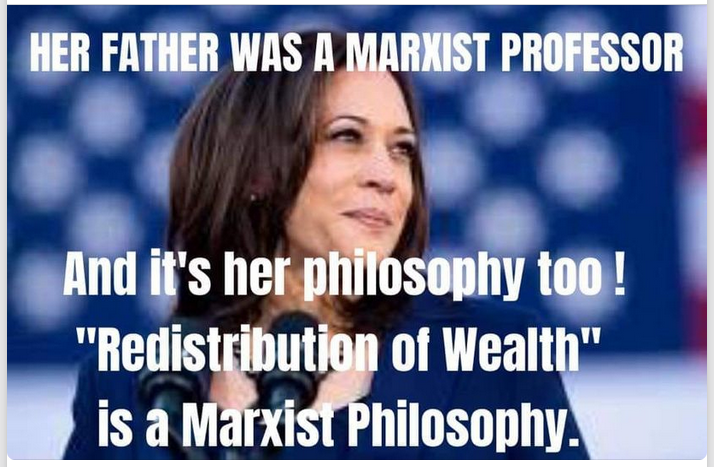
Redistribution of wealth is an anti-marxist technology.

Taxing the super-wealthy and redistributing the proceeds towards education, health care and infrastructure makes it possible for the middle class to survive.

Otherwise, the marxist prophecy will come true.

No sooner is the exploitation of the labourer by the manufacturer, so far, at an end, that he receives his wages in cash, than he is set upon by the other portions of the bourgeoisie, the landlord, the shopkeeper, the pawnbroker, etc.
The lower strata of the middle class — the small tradespeople, shopkeepers, and retired tradesmen generally, the handicraftsmen and peasants — all these sink gradually into the proletariat, partly because their diminutive capital does not suffice for the scale on which Modern Industry is carried on, and is swamped in the competition with the large capitalists, partly because their specialised skill is rendered worthless by new methods of production. Thus the proletariat is recruited from all classes of the population.

Read what Marx had to say about things if you want to avoid the marxist abomination.

Marx’s idea of revolutionary progress was based on the notion that property, hence wealth, must be abolished. Abolished, altogether, and not redistributed!

‘Redistribution of wealth’ means everybody pulling their own weight/contributing their fair share instead of ‘the the already rich taking the lion’s share’.

Redistribution of wealth means preserving the concept of property/wealth and maintaining the functionality of the capitalist free-market.

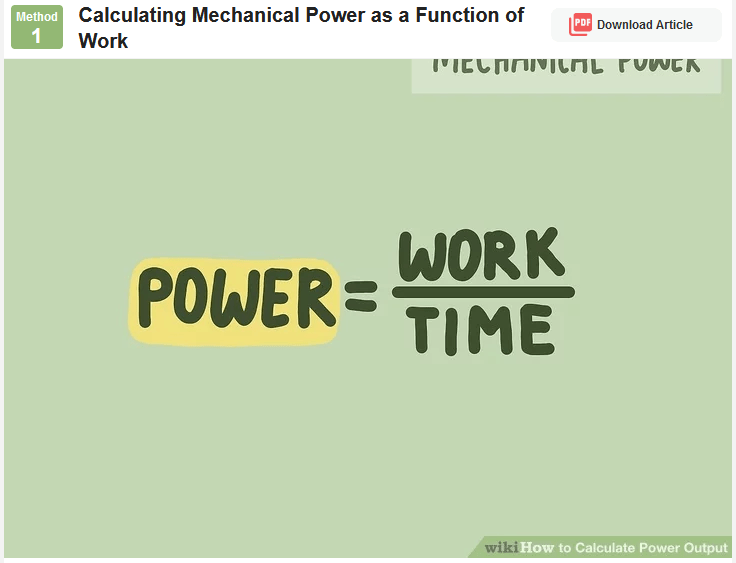
An amount of interaction expressed in the considered amount of time.

Where ever there is power, there is also resistance.
Michel Foucault in the footsteps of Isaac Newton

Michel Foucault used to be a post-Marxist philosopher and sociologist.
As the rest of the Marxists, two of his main subjects were Power and the individual’s (philosopher) duty to put their own convictions into practice. To make a difference, preferably ‘against’ the establishment.

From a Darwinian point of view, Foucault’s insistence that we shouldn’t restrict ourselves to the ‘straight and narrow’ makes perfect sense. The ability to change along with the changes in the environment is paramount to survival. Furthermore, the ability to induce change is paramount to what we call ‘progress’.

On the other hand, life itself demands that we, successive generations of individuals belonging to different evolving species, need to retain a certain congruence.
Succeeding generations share the genetic information needed to preserve the nature of the species.
Species living together evolve in such a manner as to maintain the viability of ‘their’ ecosystem. Or else…

The ‘law of the jungle’ is nothing more than something we believe to have noticed. And then convinced ourselves that we were right when we have formulated our observation in the current form. “The law of the jungle…

“Power” is but a word.
And words have the nasty habit of cloaking more than one meanings. Well, most of them…

“Power” means many.
From a ‘certain amount of work divided by the time in which that work had been performed’ to ‘the influence somebody has over the people happening to live in the vicinity.
And also something very pervasive yet seldom noticed.

Something which ‘permeates everything and “makes us what we are”‘.

Contradictory?
A tool, teleologically yielded by agents, or a fixture of the ‘environment’?
Both a the same time!
Imagine a group of people cavorting in a pool. Each of them using water to splash the others.
Or two ‘teams’ of angry men fighting near a river and using stones retrieved from the riverbed to crack each-others’ skulls.

‘A fixture of the environment’ identified as such and used by agents as a tool with which to further their goals.

Knowledge is power and power creates knowledge...
Both Bacon/Hobbes and Foucault have been right.
By identifying new and increasingly powerful instruments people have transformed knowledge into power while by putting power to work, the powerful have generated new meaning and driven things towards where they wanted them to be.

Having been able to draw from more accrued knowledge (a.k.a. culture) than Hobbes. Foucault is marginally ‘even more right’ than his predecessors.

“People know what they do;
frequently they know why they do what they do;
but what they don’t know is what what they do does.”

This being the explanation for all ‘social arrangements’ where power has been concentrated in a too small number of hands/heads having eventually failed.

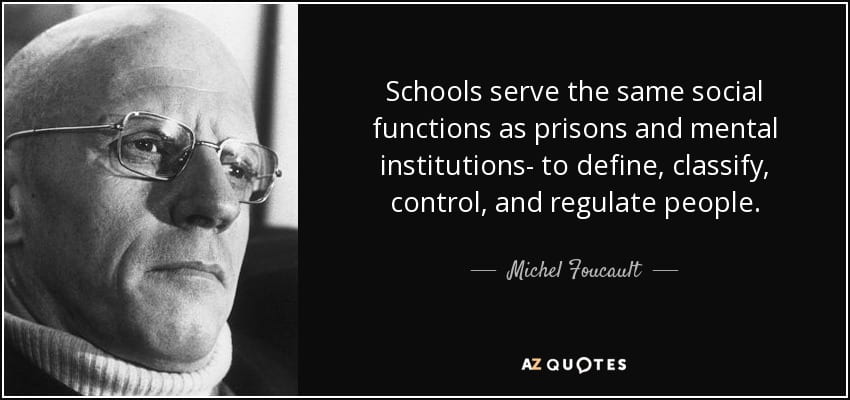
A society where schools and prisons are hard to tell apart – or perceived as such by those who have to spend time in any of them – is sooner rather than later going to reconsider it’s ‘knowledge’ regarding ‘power’. Or else…

“Until philosophers rule as kings or those who are now called kings and leading men
genuinely and adequately philosophize,

that is, until political power and philosophy entirely coincide…
cities will have no rest from evils…
there can be no happiness, either public or private, in any other city.”

Plato, circa 375 BC

The philosophers have only interpreted the world, in various ways.
The point, however, is to change it.

Marx,1845

“God is dead. God remains dead. And we have killed him.
How shall we comfort ourselves, the murderers of all murderers?
What was holiest and mightiest of all that the world has yet owned has bled to death under our knives: who will wipe this blood off us?

Nieztsche, 1882

The Social Responsibility of Business Is to Increase Its Profits
Milton Friedman, 1970

“Real life, says Heidegger, happens when beings become ‘unhidden’,
when we help bring things out of their hiding places
and step out of our own along with them, into the light of being itself.
It happens in rare moments when we see links between
‘beings themselves, the human world, the work of God.’
It can only occur, he says, when you’re disturbed by a sense that real life is elsewhere.”

Peter Holm Jensen, 2023

Wood is the raw material we use to make timber. And paper.
Steel is the raw material we fashion into tools. And weapons.
Words are the raw material we shape into ideas.

We use timber to build houses.
Paper to print poetry.
Tools to transform nature into civilization.
Ideas to make sense of the world we live in. And of ourselves.

When angry, we burn houses. Print lies. Transform tools into weapons and use them to destroy.
When angry, we no longer see eye to eye about meaning.

Almost two and a half millennia back, Plato told us us that “until political power and philosophy entirely coincide…
We had chosen, while ‘angry’, to interpret Plato’s warning as being a ‘blue print’. A ‘boiler plate’ for ‘how to breed appropriate rulers’. https://www.britannica.com/topic/philosopher-king.

Karl Marx, while terribly angry – and not without reason, had chosen to put in practice, tentatively, the generally accepted version of Plato’s work.
The Communists, therefore, are on the one hand, practically, the most advanced and resolute section of the working-class parties of every country, that section which pushes forward all others; on the other hand, theoretically, they have over the great mass of the proletariat the advantage of clearly understanding the line of march, the conditions, and the ultimate general results of the proletarian movement.“.

Nietzsche confessed, publicly, “God is dead. God remains dead. And we have killed him“.
We have chosen to place the onus on him. As if it had been he who killed God. Alone…

Friedman – Milton Friedman the economist, not a word-smith nor a philosopher – had formalized the public opinion prevalent during his ‘tenure’. That corporations should stick to what they were good at – producing things in an efficient manner, hence being profitable – and leave social intervention to those concerned with solving that line of specific problems.
NB. I’m not suggesting Friedman was right. More about ‘being right’ in a short while. I’m only stating that both Friedman’s sycophants and detractors – including me – have been near-sighted.

Heidegger was the guy who brought back into discussion the notion of Aletheia. “the presocratic way to truth, as unconcealment.
Truth as the the ‘politically’ sanctioned expression of reality. “until political power and philosophy entirely coincide…

In a sense, we’ve spent the last two and a half millennia updating Plato’s to Heidegger’s wording of how to make sense of truth.
We haven’t been able to come up, yet, with a convincing version because we’ve chosen to ‘ignore’ Buddha’s “truth that misery originates within the craving for pleasure“. That ‘misery’ originates from our ‘rational’ desire for ‘being right‘.

That misery originates from us being angry, collectively, for not being able to reach ‘the truth’ individually.
That misery originates from each of us, individually, craving to be ‘right’. Each on our own…

The Buddha taught that nothing is permanent and that everything is impermanent.
Therefore, people should avoid getting attached to things as eventually everything will change.
People suffer when they crave and when they get attached to people and objects.

Being right, individually, is both incomplete – as Heidegger pointed out – and temporary. According to both Siddhartha Gautama and Karl Popper.
Being angry about not being right is not helpful. On the contrary…
It compels us to defend our version of truth and it blinds us towards all others. Regardless of how they complement ours.
Renders us incapable to politically sanction a comprehensive version of truth. Renders us incapable to build Aletheia.

My first hand experience has driven me to understand:
That ‘government’ – which is nothing but an instrument – will be hijacked whenever ‘the people’ doesn’t pay enough attention. Or has been incapacitated. One way or another.
That communism is just another pretext used by those yearning to hijack the government. And that those people would use any pretext to ‘prime’ the attention of those they want to use in their quest. In their quest to hijack the government.
That democracy – the kind that works – is not about electing the best man for the job. For the simple reason that there’s no way to determine what that person will have to do! The actual things they will be confronted with! In practice, the really useful kind of democracy is that which makes it simple for the people to remove from power/refuse those obviously unfit for the task.

For instance, what’s currently going on in Venezuela. The people tries to remove Maduro from office and the incumbent president refuses to go.

Sounds familiar?
Happened, tentatively, even where democracy was considered ‘too deep rooted to collapse’?

The third thing I understood living under a communist regime was that reproductive rights are very important. That if you want women to have more children, you have to make them ‘feel good’ about it!
That banning abortion will get you nowhere. That banning abortion – and books – will only show your true nature.

I’m vocal about these three things. Including on FB.
Exposing these ideas on FB made it so that I have friends who love Trump and friends who hate Trump.
As a matter of fact and all things considered, I’d describe myself as a Republican rather than as a Democrat. A never-Trumper Republican…

A couple of days ago, the meme above had been shared by a FB friend of mine. A Democrat.
Yesterday it was shared by a Trump die-hard.

Is this strange?

No, not really. We’re all people. Normal people concerned about the future.
The current situation is the consequence of what we’ve done.
Allowed ourselves to be divided into camps.
By those willing to do anything in order to hijack the government. Even if only temporarily.

How many of you cringe when hearing ‘X party/candidate has won the elections’?
Why do we continue to listen when the talking head/would be influencer makes such a horrible mistake?
An electoral process is about us deciding our fate, not a pageant!
Our collective fate!
We, as a community/people, are supposed to be the winners, not any of the candidates/parties…

If you don’t fight like hell, you’re not going to have a country anymore!
Donald J. Trump, President of the USA, January 6, 2021,
Save America March, Washington DC
“The J6 hostages, I call them.
Nobody has been treated ever in history
so badly as those people nobody’s ever been treated in our country.”

Donald J. Trump, GOP Presidential candidate, January 5, 2024, Iowa.

A group of Colorado voters contends that Section 3 of the
Fourteenth Amendment to the Constitution prohibits for-
mer President Donald J. Trump, who seeks the Presidential
nomination of the Republican Party in this year’s election,
from becoming President again. The Colorado Supreme
Court agreed with that contention. It ordered the Colorado
secretary of state to exclude the former President from the
Republican primary ballot in the State and to disregard any
write-in votes that Colorado voters might cast for him.
Former President Trump challenges that decision on sev-
eral grounds. Because the Constitution makes Congress,
rather than the States, responsible for enforcing Section 3
against federal officeholders and candidates, we reverse.

Read carefully, this means that the Supreme Court of the USA is telling the Colorado Supreme Court:
‘Stand down, this is a matter too important to be decided state by state! This has to be settled at the federal level’!
Nota Bene, the gist of the matter – was Trump involved in insurrection? – remains in limbo!
The Supreme Court says nothing which might enlighten us about this subject.

“In interpreting what is meant by “liberty,” the
Court must guard against the natural human tendency to confuse
what the Fourteenth Amendment protects with the Court’s own ardent
views about the liberty that Americans should enjoy. For this reason
the Court has been “reluctant” to recognize rights that are not men-
tioned in the Constitution. Collins v. Harker Heights, 503 U. S. 115, 125.
Guided by the history and tradition that map the essential compo-
nents of the Nation’s concept of ordered liberty, the Court finds the
Fourteenth Amendment clearly does not protect the right to an abor-
tion. Until the latter part of the 20th century, there was no support in
American law for a constitutional right to obtain an abortion. No state
constitutional provision had recognized such a right. Until a few years
before Roe, no federal or state court had recognized such a right. Nor
had any scholarly treatise. Indeed, abortion had long been a crime in
every single State. At common law, abortion was criminal in at least
some stages of pregnancy and was regarded as unlawful and could
have very serious consequences at all stages. American law followed
the common law until a wave of statutory restrictions in the 1800s ex-
panded criminal liability for abortions. By the time the Fourteenth
Amendment was adopted, three-quarters of the States had made abor-
tion a crime at any stage of pregnancy. This consensus endured until
the day Roe was decided. Roe either ignored or misstated this history,
and Casey declined to reconsider Roe’s faulty historical analysis.

The Constitution does not confer a right to abortion; Roe and Casey are overruled; and the authority to regulate abortion is returned to the people and their elected representatives.

Do I have to remind you that up to 1865 it was legal, in some US states, for people to own other people?
People could be lawfully owned as slaves…
And “the people and their elected representatives” were OK with that. In some states!
So OK that a war had to be won by those who were not OK with “elected representatives” having the power to determine whether people could be owned. Only after the conclusion of that war the 13th Amendment could be adopted!
Enshrining each individual’s freedom to steer their own fate, within the confines of the law!

Fast forward back to our days.

When “elected representatives” – at state level – have been given back the power to determine how wide is the lawful space inside which a woman can dispose of her own body.
When “elected representatives” – at the same state level – are denied the power to ascertain whether a president, after losing an election, has incited his supporters to storm the Capitol.

And who has done that?
Who’s been determining what “the people and their elected representatives” might do at which level?
A team of nine individuals named by various presidents and only vetted by the Senate? Who are judging according to their “own ardent views about the liberty that Americans should enjoy.“?!?

“Weird” is not enough to describe this!