Archives for category: teleology

Sand for the statue and fences for protection.

Not for a particular king!
No.
Not even for kings in general.

Only for all those ‘in charge’!
As a reminder for the fact that their authority is very fragile.
Goes for only as far as it is accepted. Protected by those who respect it.

As a reminder for the fact that fences not only protect but also separate.

The point being that whenever those calling the shots no longer suffer the consequences, the situation becomes extremely fragile.
That whenever a ‘king’ needs to be protected from his subjects instead of by them…

“A priest and rabbi see a child walking down the street.
Priest : Let’s fuck that child.
Rabbi : Out of what??”

Alternativelly

“A priest and a communist pass by a boy.
Priest: lets fuck that boy.
Communist: and blame it on capitalists.”

When I was growing up, fucking was about bringing new life on the face of the Earth.
Or about all those involved reaching orgasm.

Nowadays we find it funny to joke about children being raped.

Then we wonder…

“Who fucked up future?!?”

Art – Esthetics – Philosophy.
Techne – Science – Manipulation.
Skills – Technology – Reality 2.0

Art is, maybe, the first form of interaction between us and the place we inhabit.
The first manner in which we ‘ingest’ that place, only to regurgitate it later. The first manner in which we learn about that place and the first manner in which we express what we have just learned.
Esthetics is how we make sense of art. How we organize our ‘first impressions’ regarding the ‘place’ we live in. How we ‘edit’ those impressions in order to make them more easily understandable.
Philosophy is what we made out during the artistic endeavor to learn. The never finished product put together by our ‘digestive system’ out of the artistic interactions we have had with ‘reality’.

Techne is what we do. The transformations we impose unto things in order to make them capable to satisfy our needs. Or our whims…
Science is the process through which we gather information. The information which becomes more and more necessary as our doings take us further and further away from the original reality.
Manipulation is what we do after we consider to have amassed enough information. After we have developed a certain understanding of the world and have decided that time has come for us to ‘take what’s rightfully ours’.

You know what ‘skills’ are. What we’re ‘good at’.
Technology is how we pass our skills to other people. So that we can work in concert. To coordinate our efforts.
The outcome of which is Reality 2.0. The reality we have brought about. The new reality which constitutes reality 1.0 for those currently alive.

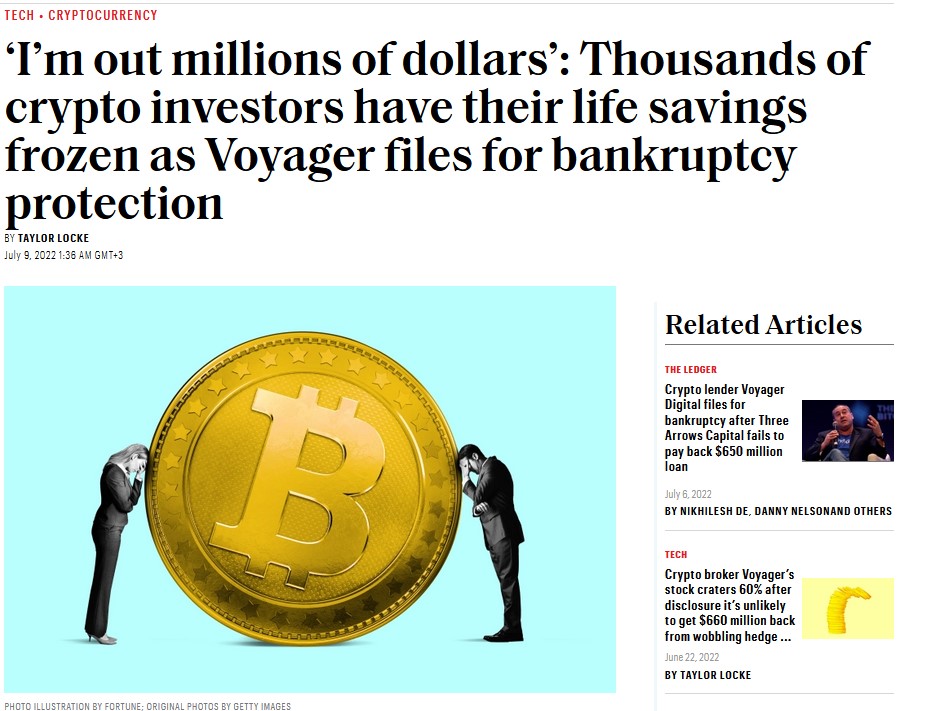
Why on Earth would anybody invest their ‘life savings’ in ‘crypto’?!?
Furthermore, why would anybody who has millions of dollars to invest would use a ‘custodial wallet‘?!?

You buy into something extremely volatile – crypto, then you go for a custodial wallet because the ‘custodians’ offer “an up to 9% annual percentage yield (APY)—much higher than a traditional savings account.”?!?

How did these people lay their hands on that kind of money in the first place?

It claimed to be FDIC (Federal Deposit Insurance Corporation) insured. And being a publicly traded company on the Toronto Stock Exchange, he thought, how bad could Voyager be?

When are we going to understand that money is a wonderful tool but a ‘misleading’ goal?

Quite a large number of people are complaining about how hot it is nowadays.
So uncomfortably hot that they have to stay indoors until late in the evening.

And no, they are not pensioners.
They work from home, earning enough money to be able to have everything delivered to them.

Which reminds me of my first job, right out of university.
A big factory building where water almost froze in winter and temperatures rose to 41-42 degrees Celsius in August.
Inside that building were, among other ‘run of the mill’ machine-tools, 3 top of the art automated Czech-built lathes.
This story goes back to 1986 and happened in communist Romania.
The lathes were very precise but couldn’t be used all the time. In winter they stopped working altogether and in summer they faltered. No amount of fine tuning could bring them back to yielding usable parts.
It took a few years for the brass to figure-out what was going on. The lathes were designed to work in a ‘controlled environment’. The temperature was supposed to hover between 15 and 25 degrees for the lathes to function normally.
Hence the lathes were ‘sheltered’ in an auxiliary building. A shed built inside the factory. And provided with efficient enough ‘temperature control’.

We, the people, had been left on the outside. Outside the shed but still inside the factory…. freezing in winter and sweat-drenched in summer. Still working, because we were sturdier than the top of the line machinery…

This morning I came across a FB post.

This brought about another memory.

Sometime in 1990-1991 I happened to lay my hands on a Newsweek magazine. Or a the Economist… I don’t remember exactly. Anyway… the article I was going to discuss with you was about the hard life endured by the American poor people. And was illustrated with a color picture.
I’m going to make a small break here and inform you that in the 1990 Romania colored magazines – let alone glossy, were hard to get by.
That picture, taken somewhere in the Bronx, contained a color TV and three pre-teen kids. All of them clad in blue-jeans and wearing ‘sports shoes’. You know, the likes of Puma/Adidas/ you name it.
In those times, in Romania, bluejeans or ‘sports-shoes’ could be had mostly on the black market. Where you had to fork out the wage earned in a whole month if you wanted to buy a pair of each. Or you could buy them in a brand store. For twice the price….

You see, the communist regimes have crumbled because the leaders had lost contact with reality.
The brass in the factory where I had started working couldn’t figure out – nor really cared about, the reason for which those lathes didn’t work properly.
And didn’t care about the fact that the workers had a very hard life. On the factory floor and outside its premises.

The liberal-democratic and capitalist regime has created huge opportunities. People used to live incomparably better there than in the rest of the world. And continue to do so.
On the other hand, in many of the ‘affluent’ countries people have lost contact with each other. The haves have no idea about how the poor live. Nor the poor have any idea about what it means to be rich.

We live in different worlds. In different realities.

Each of us on their own ‘tin roof’.

The problem being that all of them are becoming increasingly ‘hot’.
And I’m not thinking ‘global warming’ now…

Communism had crumbled because the rulers couldn’t understand what was going on. Couldn’t react efficient enough to changes brought about by normal evolution. Because the rulers had gradually lost contact with reality. Which inevitably happens in all authoritarian settings.

We are currently living in different realities. In ‘bubbles’. For now, these bubble still have something in common. We are still able to talk to each other. Sometimes we have a hard time understanding what the other has to say – or don’t really care, but the dialog is still possible.

I’m afraid of the day when the dialog will no longer be possible.

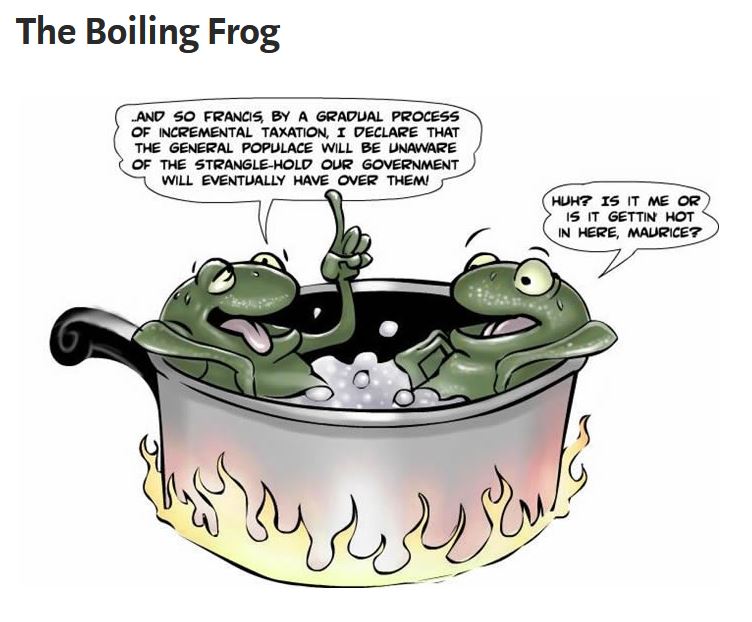
The guys in the pan are so obsessed about the taxes they have to fork out that they actually don’t pay attention to anything else.
The guys attempting to collect those taxes are so obsessed about what they want to do with the money that they actually don’t pay attention to anything else.

Meanwhile, the world is growing apart. The bubbles lose contact with each other. And with the hard core reality…

The cats can always jump down from the roof. Whenever it grows too hot or too cold.
Where are those two frogs going to jump when things will become uncomfortable?

The common sense definition for an inflationary situation is ‘when too much money chase an inherently limited amount of goods and services’.

The ‘limited amount of goods and services’ part is easy. We live on a finite planet, we have a limited capacity to transform whatever resources we are able to identify into usable goods and services … so…
OK, we can always identify new resources and build new capacity but we cannot do any of this ‘on the spot’. We need time. And, even more importantly, we need to put ourselves to it!

Then ‘who does the chasing’?
After all, money is ‘inert’. It doesn’t do anything if let alone in a drawer. On under the mattress…
In reality, we – buyers and investors, are the true ‘inflationary agents’.
‘But it would be completely stupid to sit on a pile of money when inflation rages! You have to buy something otherwise you’ll loose a lot of value! At least, you need to invest that money…’
This is one of the best examples of a self-fulfilling prophecy!
Indeed. Buying or investing during an inflationary bout is the reasonable thing to do! Yet we need to understand that our actions will, temporarily, exacerbate the very inflation we are trying to ‘tame’.

But where does the excess money come from?!?

Until not so long ago, the sovereign was the only one person who could bring new money to the market.
And their ability to do that was severely curtailed by the amount of bullion available for this task.
In fact, the first major inflationary episode in the second millennium had been fueled by the gold brought back to Europe by the Spanish conquistadors. Which bout of inflation brought about the first major change in the European economic thinking.
“To inspect the country’s soil with the greatest care, and not to leave the agricultural possibilities of a single corner or clod of earth unconsidered… All commodities found in a country, which cannot be used in their natural state, should be worked up within the country… Attention should be given to the population, that it may be as large as the country can support… gold and silver once in the country are under no circumstances to be taken out for any purpose… The inhabitants should make every effort to get along with their domestic products… [Foreign commodities] should be obtained not for gold or silver, but in exchange for other domestic wares… and should be imported in unfinished form, and worked up within the country… Opportunities should be sought night and day for selling the country’s superfluous goods to these foreigners in manufactured form… No importation should be allowed under any circumstances of which there is a sufficient supply of suitable quality at home.” Philip von Hornigk, 1684.

After a while, economy had become ‘complicated’ enough to demand ‘paper money’.
The amount of goods and services produced had become so large – and insufficient bullion was added to the money pool, that prices would have had to shrink if the balance was to be maintained.
Unsustainable! Nobody would have bought anything and everybody would have jealously guarded their precious money while waiting for the prices to fall further. This process is known as ‘deflation’ and is considered even more malign than a decent amount of inflation.
We have to note at this point that ‘paper money’ had been made possible by the advent of the ‘nation’.
This is a rather complicated discussion, for the present purpose it’s enough for me to mention that ‘paper money’ being accepted as ‘tender’ means that the general population has enough trust in the issuer of the bills. That the individual user of the paper money trusts/believes he is part of ‘something bigger’.
In those times, it was the issuer of paper money who practically controlled the amount of money which existed on the market.

Which brings us to the present times.

I’m sure all of you are aware of how “fractional reserve banking” works.

‘Yeah, the banks create money out of nothing!’

Wrong!
For banks to be able to ‘create’ new money, they have to extent credit!
For new money to be created in this way, somebody must walk into a bank with a business proposition.
That somebody might want to buy a house, a car or whatever else. Or that somebody might want to start a business. If that somebody convinces the bank that they is solvent or that their idea is worthy enough, then and only then new money is created!
Money doesn’t appear out of the blue! It is born out of trust. That somebody not only trusts themselves but they are convincing enough to determine the banker to extend that much needed credit!

But wait!
We’ve developed yet another mechanism which churns out money.
The stock market.
After developing the business started with the loaned money, the somebody we’ve been talking about above decides to make an IPO. To sell part of his business to investors. To monetize his initial investment.
Depending on the moment chosen for the IPO – and the economic data in the prospect, the IPO can be a huge success. For ‘somebody’ and for the early buyers. You see, each time the price of the stock goes higher, new money is created. Based more on the ‘market’s expectations’ than anything else…

‘But people who put their money on the financial markets are rational agents! They are experts in their field…’

Yeah, right…
You’re talking about the experts who had put together the collateralized debt obligations debacle…
And many others. Too many others…
Also, you’re talking about the experts who had bought those papers! Who had trusted the expertise of the first batch of ‘specialists’!

Thinkers, from Freud to Kahneman and Ariely, have proven than humans are very good at rationalizing and less so at being truly rational.
That for a market to behave in a reasonable manner, it must preserve its freedom.
That it must be free from ‘bullies’ – individual agents who muster a lot of ‘clout’, and free from any mania.

The 1637 Dutch Tulip Mania is a very good example of what might happen when a market gets obsessed with something.
When too many people – not even a majority, forget about the fact that economy (oikonomia) is about making ends meet and that getting rich may be a nice consequence but is a terrible goal.

‘OK, nice try. But what about inflation?’

We have an inherently limited amount of goods and services.
A relentless mechanism which churns out money.
Meanwhile, some of us obsess about their need to conserve the money denominated portion of their stashed away fortunes.

Inflation is nothing but another mechanism.
Which re-balances the market.
Piece-meal – adjusting for daily changes, in normal times. When things evolve ‘freely’.
Suddenly when the market – the people who ‘man’ the market, find out about ‘the dark side of the moon’.

Each of us pretends to be rational.

Being rational – and trusting one’s reasoning powers, leads to being convinced that one’s conclusions are right. True!
Reached at the end of a due process, hence above and beyond any possibility of error.

Each of us belongs.
To a family, to one or more groups, to a nation. To a culture!
The closer we belong to a ‘place’, the closer our thinking conforms to that which is common in that ‘place’.
The closer we belong to a place, the more we assume the conclusions reached in that ‘place’ are correct.

‘But this has nothing to do with being rational!’

Unfortunately, we’re not rational.
In reality, we are mere rationalizers. We use whatever tools ration has invented in order to give our decision a rational shine.
At best, we are reasonable.

Reasonable means finding rational arguments for behaving properly. In a manner which helps longtime survival and does its best to avoid unnecessary ‘pain’.

Reasonable also means finding ways to communicate across barriers.
NB. Attempting to communicate across ‘barriers’ is reasonable only if it’s done with an open heart.
If the message contains a ‘trojan virus’, that communication might be rational but it’s no longer reasonable.

We’re at a cross roads.

We’re split.
On one hand, into ‘activists’ and ‘as yet indifferent’. The difference between the ‘activists’ and the ‘as yet indifferent’ being that the activists are actively preaching their rationally obtained mantra while the ‘as yet indifferent’ have not yet reached that stage.
On the other hand, both ‘activists’ and most of the ‘as yet indifferent’ come in many ‘incompatible flavors’. And the ‘flavors’ being ‘incompatible’, these people cannot engage in meaningful conversation.
The messages sent across the barrier are layered with ‘trojan viruses’. Hence honest conversation – a.k.a. exchanging useful, workable information, is almost impossible.

Until we’ll find a way to do away with ‘activism’, real conversation among us will remain ‘lip service’.
Until we’ll find a way to do away with activism, ration will have killed reasonable.

https://www.simplypsychology.org/defense-mechanisms.html

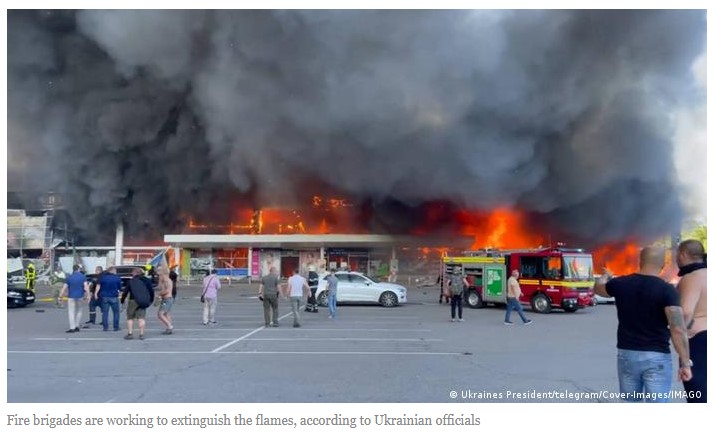
People are dying in Ukraine.

And what takes place there has consequences all over the planet.

The first two world wars had been fought by soldiers from almost every corner of the Earth.
Almost all countries have declared war on each other, even though not all of them have participated in military operations.
The third world war – the Cold One, had been fought ‘virtually’. And was the first to divide the world into three.
The ‘liberal-democratic’ camp, the ‘popular democracy’ camp and the non-aligned camp. As always, World War III had been lost by the least flexible among the combatants. By the more dictatorially run camp. By the camp, which, precisely because of the authoritarian manner in which its decisions were adopted, had failed to mobilize all the resources it had, potentially, at its disposal.

I’ll make a parenthesis.
Any act of aggression is an idiocy.
Regardless of the short-term, medium-term and long-term outcome, the aggressor has more to lose than the victim. This does not need to be demonstrated. The most perfunctory glance at history is eloquent enough.
Here I’m concerned about war as an ‘ongoing phenomenon’, I am not trying to integrate it into the narrative. Any war, any act of aggression, is initiated under certain conditions determined by the history spent until then and will be, at some point, integrated into the history written afterwards. And the way it will be integrated into history will determine the conditions under which the next war will be initiated. Or not…

Let’s go back to the present moment.
This, the fourth one, is the first mixed world war. The first ‘lukewarm’ war.
The consequences are felt around the globe, almost all states take part in it – also divided into three camps, while the act of ‘actual’ aggression is somewhat limited.
The reactions to this act of aggression – the way in which those who have to bear its consequences relate to the conflict, constitute the beginning of the way in which this episode of physical aggression will be integrated into history.
The liberal-democratic camp is helping the victim as much as it can – this could be the subject of a very long discussion.
The authoritarian-populist camp helps the aggressor. As far as it can, lest it shows its true colours…
The self declared ‘non-aligned’ camp claims it is one of the victims and urges negotiations.

Here’s the place where I need to make another parenthesis.
The aggressor is ‘Putin’. A collective character that has at its center the current Kremlin ‘gate-keeper’.
The fact that the collective character known as ‘Putin’ is currently leading Russia’s destinies is a matter of history. It has to do with Russia and the Russian people indeed, but placing all the responsibility for the atrocities which are taking place in Ukraine on Russia’s shoulders would be a mistake. A mis-diagnosis which would lead to a ‘counterproductive’ treatment.
Many of the analysts and commentators who write on this subject are ‘mesmerized’ by the ‘master of disaster’. By Putin. Some ‘highlight’ his actions and others want to distract us from what Putin is doing by trying to argue that Putin was forced to do what he had done because the ‘others’ had acted as they had done. As if the mistakes already committed could provide any justification for future atrocities…

Back to the subject.
The main idea which emerges from the ‘messages’ we are bombarded with – regardless of the motivations attributed to Putin, is that any surrender to the aggressor’s claims will be eventually ‘underwritten’ by all those involved.
For the simple reason that Putin will interpret the smallest crumble ceded by the victim of the aggression as a personal victory. Victory that will be attempted again, sooner rather than later.
Meanwhile, all the other Putins in this world, all those animated by authoritarian whims, will feel encouraged by any shred of victory which Putin will have enjoyed.

‘Are we stupid?!? He pulled it through, didn’t he?
We should try it too!’

Well, so far, so simple.
Putin is not the first dictator to be scrutinized by psychologists. Or by political scientists.
‘Nothing new under the sun’ and no original contribution.
Almost everything Putin had ever ‘accomplished’ has already been analyzed and can be explained away with the help of quotes pulled from more or less famous authors. Sun Tzu, Clausewitz, Marx, Ivan Ilyin.
Unfortunately – or fortunately? – Putin is ‘transparent’.
He becomes more than ‘obvious’ after the briefest analysis. And, in fact, dictators – all dictators, are very ‘simple’. Single minded individuals effectively enslaved by a single thought. Concentrated exclusively on how to obtain and preserve absolute power. Everything else about them is bullshit. Make belief and propaganda.

Personally, I’m interested in something else than ‘what drives Putin to…’
Putin does what he does because he has the opportunity. Because he ‘enjoys’ a set of circumstances in which he can act his ‘fantasies’. And Putin got into this situation because those around him – those who could have done something about ‘this thing’, did not understand at the time what was going on before their eyes.
I can understand that! ‘Temporary blindness’ is not an ‘exceptional’ thing. But still. From a certain point onward – after ‘the milk spilled over’ and after reality had slapped you over your face, to continue with your head buried in sand… to remain ‘temporary blind’ only because you ‘enjoy’ your current position and/or your current paycheck… without realizing that you are being led to the abyss…

‘Putin’ doesn’t take prisoners.
Even if you considered yourself his ally, or his faithful servant, and no matter how many promises he has made to you, when he no longer needs you…. you’re toast!
When he no longer needs you, you become a cost. And in their world, in the world of dictators, costs must be cut! No other arguments will ever be considered.
Aside from the fact that you have a good chance of getting sacked as Putin becomes more and more powerful/callous, associating yourself with this kind of people is dangerous by definition. No matter how strong they seem to be at any given point, all ‘things Putin’ end up badly. The more powerful the Putin becomes, and the higher they get, the worse they fall. They along with those who ‘waited’ on him!….

Does anyone know a dictator who ended up on the throne?
Lenin?Stalin? Khrushchev? Brezhnev? Andropov?
Is this what we want?!?

The conclusion drawn by some observers, “In the end the outcome has only two valences: Putin loses or Putin wins” is valid only for the short term. Very short! In the long run, Putin loses. In the longer run Putin has always lost.
And it was us who had to endure! The ‘excesses’ committed while the dictator was at the helm and the ‘vagaries’ of the ‘transition period’ which followed. The point being that the more we endure ‘it’ – for the sake of momentary comfort or out of fear for what might happen, the more we will have to pull. In the near future!

As for the five dictators enumerated above, yes, four of them did die on their throne. Khrushchev had been deposed and lived for a while under ‘close supervising’. But after each of them had ‘transitioned’, their ‘close associates’ had been thoroughly ‘epurated’.

What happened to Russia during their ‘tenure’?

Whence my question.
Do we really want to take part, any part, in anything even remotely similar?

These people no longer communicate.
As in no longer care to understand what the other has to say…
Mind you, not ‘agree with’, just understand. Just develop a ‘mere’ understanding of what the other feels/thinks/has to say about a subject.

The consequence?

Both sides have become so focused on contradicting each-other on no matter what subject that both of them have lost the ability/exercise to look for the real issue.

The Ukrainians have enough AK-47s. They don’t have any use for any AR-15s. What they need is howitzers. And HIMARSs!
As for the 2nd amendment…

“A well regulated Militia, being necessary to the security of a free State, the right of the people to keep and bear Arms, shall not be infringed”

Given the Ukrainian experience, should we read the 2nd Amendment in such a manner that ordinary people would be able to keep and bear howitzers? Or HIMARSs?

Or should we focus our attention on the notion of ‘a well regulated Militia, being necessary to the security of a free State’…?
Meaning that without a well kept and well trained Army, the State, any state, would soon loose its sovereignty?

After all, the Ukrainians fight, together, against an invader. They cooperate in order to defend their State.
Meanwhile, many of those clamoring about the 2nd Amendment are more preoccupied about using their guns to defend their individual freedom against the State than about cooperating with their fellow citizens towards defending the State against any aggression.

Counter-protesters Kenya Stevens, left, of District Heights, Md., Steve Tidwell, of Arlington, Va., and a protester who asked not to be named, shout their support for gun rights across from a protest of gun control advocates next to Realco Gun Shop in District Heights, Md., on Tuesday, Aug. 28, 2007. The protest of gun control advocates was part of the Rev. Jesse L. Jackson Sr.’s National Day of Protest. The gun store, located very near the border with Washington, is a large source of guns used in crimes in the nation’s capital, according to District officials. (AP Photo/Jacquelyn Martin)


In these circumstances, am I allowed to remind you that Putin – the guy who had initiated/ordered the invasion of Ukraine, is a “genius”?!? According to Trump…

Whence comes nihilism, the uncanniest of all quests?
by Lou Keep

Friedrich Nietzsche was most famously concerned with the problem of nihilism. All societies, in his view, rely on implicit value judgments. If the foundations of these are lost, he predicts terrible consequences: widespread apathy or violent, fanatical attempts to reclaim a sense of purpose, or perhaps both. We talk about values a lot, and we know they do something, but we have little idea how. Compounding this is uncertainty over their loss. Nihilism is not a choice or intellectual commitment, but a thing that comes upon you. As Nietzsche put it in 1885: ‘Nihilism stands at the door. Whence comes this uncanniest of all guests?’

Part of the answer comes from understanding how values connect to knowledge and action. In Seeing Like a State (1998), the political scientist James C Scott classifies knowledge in two ways: epistemic knowledge, which can be quantified, theorised and transmitted in abstract, and metis (from the classical Greek), which concerns knowledge gained from practical experience, such as personal relationships, traditions, habits and psychological states. Metis governs local experience: farming the family’s land, for example, rather than agronomic study. We all recognise it; it’s why we hire for experience. For instance, Jane and Martha have identical diplomas, but if Jane’s first shift was on Tuesday and Martha’s was in 1970, then Martha will have certain tricks and habits to expedite her work. Still, it’s not easy to quantify just what that is: Martha has metis, and metis can’t easily be reproduced. If it were trainable, it would have been in Jane’s training.

Scott’s genius is to compare metis to local traditions. Over a long enough time, habits and behaviours are selected for and passed down, just as evolution selects helpful traits. A successful group will institutionalise an irreducibly complex set of cultural tools that relate to its environment. Since these are metis, and not epistemic, they won’t always be obvious or quantifiable. Scott recounts dozens of examples of customs that might appear backwards, confused, unscientific – yet when they’re banned or discouraged, productivity collapses. He calls this the problem of ‘legibility’.

Epistemic theories rely on isolated, abstracted environments capable of taxonomy, but these are far removed from the dynamic, interconnected systems of nature and human culture. Metis, by contrast, develops within complex, ‘illegible’ environments, and thus works with them. But that also means its application is limited to a specific act, rather than a broader theory. Outsiders want to know why something works, but locals will explain it in a language unintelligible to them.

These practices and traditions are, of course, more than work experience. They’re used to efficiently solve political problems. In The Righteous Mind (2012), the social psychologist Jonathan Haidt describes Balinese rice farmers who needed to coordinate irrigation along a river. Since they were politically divided into small familial units – called subaks – they needed to rely on means older than governance to ensure cooperation:

The ingenious religious solution to this problem of social engineering was to place a small temple at every fork in the irrigation system. The god in each such temple united all the subaks that were downstream from it into a community that worshipped that god, thereby helping the subaks to resolve their disputes more amicably. This arrangement minimised the cheating and deception that would otherwise flourish in a zero-sum division of water. The system made it possible for thousands of farmers, spread over hundreds of square kilometres, to cooperate without the need for central government, inspectors and courts.

This still occurs. A 2017 paper by the economists Nathan Nunn of Harvard University and Raul Sanchez de la Sierra of the University of California, Berkeley mentions gri-gri, a magical powder that witchdoctors manufacture. In 2012, following a period of widespread banditry and state insecurity in the Democratic Republic of the Congo, gri-gri came to a village elder in a dream. Applying this powder made the user bulletproof, and it worked so well that neighbouring communities swiftly adopted it. The reason was simple: groups fight better than individuals, and more people will dare to fight if they believe they are bulletproof. Hence, a village using gri-gri was more likely to survive.

Gri-gri and water temples are kinds of metis, but they require belief in larger structures: respectively, magic and gods. However these structures first developed, it’s critical that they rest on more than mere faith or tradition. Shared values provide conviction for greater actions, but those values are certified by the success of those actions. Gri-gri’s success is an empirical testament to magic, and its utility inclines one towards trusting more activities by witchdoctors. Nunn and Sanchez de la Sierra point out that

many of [the spells] appear to provide individuals with a greater sense of security and confidence, which could serve to … reduce their anxiety and thus improve their performance. For example, most of the spells provide protection, whether it be from drought, disease, attacks on the village or even to harm potential thieves – and thieves also believe in their efficacy, which acts as a deterrent.

In other words: these practices and institutions serve several different roles, all bound up in one another. This intermingling exacerbates the problem of legibility.

When we discuss changing values, we often think top-down: a new and persuasive ideology that took hold for intellectual reasons. What Scott and the adoption of gri-gri suggest is the opposite: the motive force of values requires a degree of certainty that is dependent on action. It was gri-gri’s empirical demonstration that allowed it spread it to neighbouring villages, not its poetry. The inverse to this is also important: we can improve on a specific task, but other roles need time to sediment and evolve. Trade the temples for a government, and you have zero-sum bickering. Explain the game theory behind gri-gri, and no one will fight with it. The utility of a cultural institution first allows adoption, but its maintenance allows metis ample time to tinker and perfect.

If we’ve lost faith in certain values, then I doubt this was because of academic debates. The 20th century profoundly changed labour, technology and social organisation in the Western world. It’s hard to imagine that this didn’t change metis, or render older forms of metis irrelevant. While the values of metis might still be desired – or even identified with – they lack the same certainty they once had. Nothing can prove them and thus justify the higher claims. ‘Faith without works is dead,’ as the Bible said, but faith without metis is unbelievable.

A top-down view of value implies that we can simply create new reasons for living, that the ideology itself is its own proof. But if values come bottom-up, then man’s quest for meaning cannot be separated from his labour. They are the same.

[object Object]

This article was originally published at Aeon and has been republished under Creative Commons.

https://aeon.co/ideas/whence-comes-nihilism-the-uncanniest-of-all-guests

“legible” versus “illegilbe”…

After all, metis remains – for now, illegible simply because we haven’t yet found a way to ‘read’ it.

And to write it back in a teachable form!

Or, to put it in a more concise manner, we haven’t got, yet, to the bottom of it!

The key word here being we.
WE haven’t got to the…
It all boils down, again, to the limited nature of our consciousness!