Amass as much pertinent information as possible and then try to put it together or watch out for questions posed and opinions offered by others on the same subject. And, then again, put them together in your own way, of course.
“Trump’s trick is that he has never run on substance, yet his opponents and detractors attempt to attack the substance of how he is wrong. Because there is no substance, they cannot help but miss.”
Which he gleefully grabbed. And started to position himself as the ‘quintessential anti-Establishment candidate’.
‘I don’t like him, as a person, but by supporting him I’m sending a strong message to the Establishment’.
A ‘loose cannon’ candidate whose supporters are experiencing a double layered frustration. A basic one fueled by the bleak economic perspectives faced by the entire middle class which is exacerbated by the disdain so oftenly felt by Trump’s supporters whenever they express their political opinion.
The point being that we should not forget who brought us here.
As we’ve just seen, the Republican half has failed miserably and the Democratic one is following in their footsteps. Judging by the quality of the candidates, of course.

North Korea supports Trump over “Dull” Hillary
Did you know that Trump was selling shirts over the Internet?
Yes, Trump, the guy that so many Americans are going to vote for simply because they are convinced he will completely change the way America works.
Why?
Because he says so.
He presented himself as the quintessential anti-establishment candidate and they bought it.
OK, something has to be changed so I fully understand their exasperation with the current state of the Union.
But is he “the” guy?
And since deeds are, or should be, more convincing than words, lets see if he is as anti-system as he pretends to be.
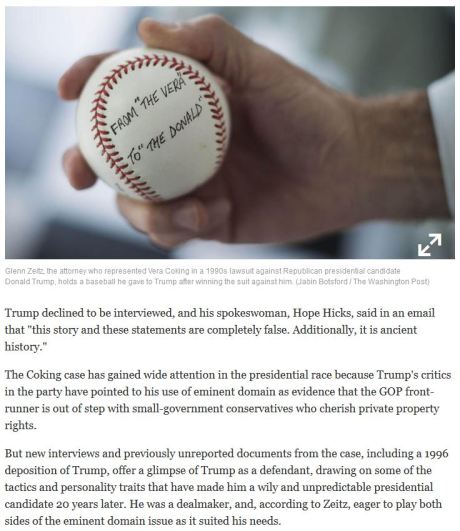
Well… at some point he did try to use the power of the government in order to con an old lady out of her house, didn’t he?

And he did ‘bribe’ Senator Clinton to come to his wedding. Simply because he had the money…
And now this.
The way I see it the real problem is not the fact that he makes his shirts in Bangladesh in spite of being vocal about the need to preserve American manufacturing jobs. After all it’s his job to conduct his business as he sees fit. And if he is comfortable with doing one thing while saying the complete opposite…. that’s his job too.
But how come so many people take his words for real, without at least perfunctorily checking the facts?
How come so many are they so convinced he is ‘the right guy’ when he sells himself so cheap?
Oh, you didn’t know you could buy a “Donald J Trump Signature Collection” shirt for as little as $12.56!
Why is he doing this? Because he is so anti-Establishment that he doesn’t care about money?
You’re already laughing, right?
Or he simply does it because he can get away with it!
Because we don’t really care. Not anymore…
As one of my friends said about Hillary Clinton, Trump’s ‘Democratic’ counterpart:
” Hard to fathom how someone so openly, unapologetically corrupt can be the front runner. I think that says a lot about what we really expect from our politicians.”
I’m afraid she’s absolutely right.
We are the real culprits here.
‘They’ are simply doing what they are good at, grabbing gleefully whatever opportunities are within their reach, but we are the ones providing those opportunities.
Not only in America.
Not so long ago I was asking myself “What’s going on there?“.
Now, that my nightmare is very close to becoming reality – both major American parties are about to nominate unpopular candidates for the 2016 presidential elections, I’m wondering about the current meaning attached to the very concept of ‘politics’.
For an impersonal and very theoretically minded observer ‘politics’ would seem to describe the job of those who make it possible for the rest of us to lead our lives in an orderly fashion.
I believe you are familiar with what a ‘super’ does. ‘Super’ as in ‘superintendent’ for a residential building.
“The super must be conversant with every mechanical and technical system in the building, work diplomatically to solve problems in the building, be responsive to residents and be able to work as a team member with the board and the managing agent.”
Not exactly ‘rocket science’ but a very important role. So important that when poorly played the whole thing might very quickly deteriorate beyond repair.
After all, ‘the government’ should do nothing more, and nothing else, but act as a nationwide ‘superintended’ while ‘politics’ should be nothing more, and nothing less, than what we, all the inhabitants of a country, do in order to make sure that the government, our government, does its job. Properly.
Especially when living in one of the so called ‘democratic countries’.
Then how come I’ve got a growing feeling that ‘politics’ have become just another set of means towards specific goals? Goals that are more often than not detrimental to the society, as a whole?
PS.
This is for those of you who are not familiar with how this site works.
By clicking on the pictures, or the highlighted text, you are automatically linked to the sources of the quoted material. Sometimes they might be interesting, to some of you.
For how many times each of us has moaned, in true disbelief, ‘why is this happening to me?’. Or at all.
“I emerge from this conversation dumbfounded. I’ve seen this a million times before, but it still gets me every time.
I’m listening to a man tell a story. A woman he knows was in a devastating car accident; her life shattered in an instant. She now lives in a state of near-permanent pain; a paraplegic; many of her hopes stolen.
He tells of how she had been a mess before the accident, but that the tragedy had engendered positive changes in her life. That she was, as a result of this devastation, living a wonderful life.
And then he utters the words. The words that are responsible for nothing less than emotional, spiritual and psychological violence:
Everything happens for a reason. That this was something that had to happen in order for her to grow.
That’s the kind of bullshit that destroys lives. And it is categorically untrue.”
In a sense the post that prodded me into writing this (Everything doesn’t happen for a reason by Tim J. Lawrence) is akin to a self supporting fallacy coupled with the kind of honest, well intended error all of us somehow feel is wrong at the very time we are doing it yet we cannot help ourselves to stop doing it.
So, why is all ‘this’ happening to us?
Basically there are three main stances on this.
The staunch believers are convinced that there is a grand scenario that ultimately decides our fates, down to every minute detail. You can find here, mingled together, religiously motivated people, convinced that ‘God’ has preordained their entire lives well before they were even born, rubbing elbows with the scientifically minded who are convinced that everything that had ever happened went on according to an uninterrupted chain of causes and effects which can, only if we were able to find out how, be followed down to the root of all things. To even before the Big Bang?
The amoral ‘happenstancers’ believe that ‘Lady Luck’ is blindly leading us down the path to exactly nowhere, hence ‘it’s up to each of us to make the best of it’. Sometimes up to callously disregarding everything else but their own whims.
The agnostics have figured out that while it is impossible to know/understand the ultimate cause for anything, from time to time it happens that each of us has a glimpse of understanding about something. And that however incomplete, that piece of understanding might prove itself to be useful, even if temporarily.
Most of you have already noticed that the first two positions are at the very extreme ends of the spectrum and are held, in earnest, by relatively few people.
And that most of us – despite our professed affiliations, belong, in reality, to the third category.
Before proceeding any further I’m going to make a small detour here and note that ‘science’ itself was invented by Christian scholars trying to make sense of God’s ways. Hence no wonder that the ‘scientific minded’ cannot see eye to eye with the ‘believers’ – new converts are looking down in disdain to their old religion, and that both partake in the conviction that ‘there must be something behind what is readily visible’.
The link between all these three categories, between the first two who already have a strong conviction about things and us, the run of the mill people who are sometimes taken aghast by what is happening in our close vicinity, is that all humans need to make at least some sense of things before learning to live with them. And with their consequences.
And since no two normal people are alike there never was a one size fits all narrative able to cover, efficiently enough, all situations that ever occurred to us.
That’s why I simultaneously agree with Tim that the best thing to do when something happens to somebody I care about is to simply say ‘I acknowledge your pain. I am here with you.“ and disagree with him when he says that all other things that get said in times like those are wrong.
The fact that my experiences/opinion on the matter happen to fit his doesn’t mean that we are both right, nor that our take on things that already happened to us might fit all other things that might happen to all other people. So I find it just a little presumptuous to discard all other opinions simply because they are different from ours.
Now, that I’m nearing the end of this post, let me discuss a little the pretext shared by both our posts: ‘Is there a reason for anything?’
Well, the answer for this depends heavily on what you mean by ‘reason’.
Is there a cause for anything? Most certainly ‘yes’, regardless of whether you believe that that cause to be divine, completely aleatory or any combination of these two.
Or is it that we’d better ask ourselves if there’s a ‘motive’ behind what’s happening to us?
Another thing that is common to most people is their tendency to blame others when thinks go bad and to claim more merit than it’s their due when things go well.
That’s why so many of us find it difficult to assume individual responsibility for our own mistakes and for putting ourselves in harms way – even when that responsibility is only partial.
Along the same psychological mechanism many of us cannot accept the very notion of ‘blind’ bad luck. While cashing a lucky lottery ticket is accompanied by nothing more than a self congratulatory slap on the back, and no soul searching questions get to be asked on the occasion, every time we as much as catch a cold in a very bad moment we wrench our hands in self deprecation: ‘what was it in my head that drove me to go in such a germ infested environment?’.
So, while I cannot rule out the existence of the famous Grand Design that I mentioned earlier, it seems obvious to me that only some things happen for a motive. Or that sometimes there are one or more motives which tilt the table in a direction or other. On the other hand what each of us does in each circumstance might have a huge importance. And sometimes both our efforts and the ‘motive’ responsible for the general set-up are rendered inconsequential by some haphazardous occurrence.
For instance Romania endured the Soviet yoke simply because of its geographic position, because Stalin-ism was an aggressive creed and because the West was too tired shortly after the WWII to do something really meaningful about the Soviets extending their influence beyond where it was welcomed. At the same time the manner in which communism had influenced our destinies depended a lot on individual decisions – ‘theirs’ but also ours – and on pure luck.
That’s why I fully endorse Tim when he says that it’s extremely important for us to act appropriately whenever something nasty happens to those living inside our reach and that we should carefully select those whose presence we accept around us when something nasty happens to us, while I cannot accept his insistence that there is a single ‘appropriate’ behavior in all circumstances.