Archives for category: Mutual Respect

I sketched earlier a brief description of how we got here.

Now I’ll attempt to offer an ‘alternative’ understanding of inflation. Not what it is – we all know that, but what it does.
It will be a functionalist view of the matter. Evolutionary, even.
As in ‘why do we still have inflation’. Why inflation continues to ‘survive’.

For most of our history, economy had been about solving needs.
Regardless of the market being momentarily free or not, for things to go on a balance had to be struck.
Demand had to be balanced by supply. Hence ‘price’.

Demand was mostly driven by the number of people needing something while supply was driven by the available natural resources AND by our ability to transform those resources into actual commodities.
For example, the price of wheat was influenced by the number of people living in a certain area, by the amount of arable land AND by the agricultural technology used at any given time. OK, the weather also had an impact but it was mitigated by the technology.

‘But how about imports? After all, ‘international’ grain trade is three millennia old. Ancient Athenian ships had been distributing ‘Ukrainian’ wheat all around the Aegean sea since before the Trojan war…’

Yeah, and how about emigration… the Irish had gone to America to escape famine, didn’t they?
We’ll get there. ‘Baby steps’, otherwise we may trip!

When population increased, they tried to add more arable land. If they could. If not – and/or in parallel, they tried to increase yield.
But the process was not linear. They could not ‘fine tune’ the increase of yield – by either method, exactly to the population growth. Hence the variation of price. Hence the ‘secondary mitigation measures’ – import/export and emigration.

‘OK, I understand. But prices can go both ways. Up AND down! Inflation only goes up…’

You’re speaking about individual prices. Which, indeed, go both ways.
And, yes again, inflation goes – in medium to longer time frames, only up!

You see, we have ‘price adjustments’ and (compounded) inflation.

Price adjustment is the mechanism through which the market – free or otherwise, balances the market for individual ‘items’. Encourages the consumption of wheat when the price is low and encourages the farmers to plant more wheat when the prices are high. Same thing for, say, shoe-shinning!
Meanwhile, (compounded) inflation is the mechanism through which the market – again, free or otherwise, balances itself.

‘Huh?!?’
For example, if wheat becomes too expensive, consumers (and suppliers) might decide to replace it with something else. Rice. Or potatoes.
Or, when grain prices become prohibitively low, farmers might abandon their plows and buy, say, shoe-shining tools.

‘But if rice – or anything else – would yield a lot more than wheat per the available arable land, the over all prices for food – and everything else, should go down, right? Not up…’

Well… in a rational world… maybe. That’s another long discussion.
The short version being that we usually wait for too long before making the necessary changes. Which is not necessarily wrong but that’s yet another long discussion. Only hindsight is 20/20…

Let’s say it would be possible to grow wheat and rice on the same plot of land without making any technological adjustments. If the growers would know what kind of weather would come in the next season, they would be able to plant the right crop. But they don’t. And it takes time for people to grasp the weather patterns have changed – and adjust the pertinent technology. On top of that, adjusting technology requires money.
Investment. Fresh ‘inputs’.

And who would do such a thing – plowing money into the ground, literally – without expecting an increased return? Something ‘extra’ for their effort?

In economic terms, nobody invests their money in a deflationary environment.
Why would anybody do such a thing?
Buy now when waiting till ‘tomorrow’ would make it possible to buy more for the same money?!?

That’s why inflation goes up. Period.
Cause otherwise the whole economy would become obsolete. We’d all be waiting for ‘tomorrow’.

NB.
This was a gross ‘simplification’.
A bare sketch.
Even in a deflationary environment, some prices do go up. For years overall prices have gone down – because of our increased technological prowess – while housing, education, healthcare and insurance have become more and more expensive. ‘Tilting’ the whole market.
More about this in the next post on the subject.


We need to eat.
At some point, we discovered that by cooking it we got more out of the food we had at our disposal.
Then we learned to cook tastier and tastier meals.

Nowadays, more and more of us wonder

Why Do We Love Unhealthy Foods So Much?

Because we’ve some how convinced ourselves that being happy trumps being alive.

Evolutively speaking, pleasure is a ‘heads up’. It tells us that we do ‘the right thing’. That the food we eat is suitable for us. Nourishing.
Evolutively speaking, happiness is a heads up. That we’re on the right track. That we’re doing nothing to jeopardize our survival.

Those ‘heads – up’ were valid. Once…
And they still are. When ‘used with discretion’.

The problem being that we’re currently harnessing the horse behind the cart.

We’re no longer pursuing life as a wholesome experience.
We just want to be happy!
We no longer eat to remain alive.
We just want to have a better experience! An even better experience than the previous one…

Should we return to the Stone Age?
When so many of us died of hunger? Of illness?
Should we give up the ‘pursuit of happiness’ as a legitimate goal?!?

How about being happy while pursuing a meaningful life?

I’m going to discuss four things in this post.

The difference between a scientific paper and a piece of ‘mere’ literature.
And what can be learned by analyzing a message.

I’ll start with the second.

A message has two layers of meaning.
The ‘prima facie’ and the ‘deeper levels’.

When somebody asks ‘What time is it, please!’, the first thing you do is to check your watch.
Most of the time, it’s the proper way to react in this situation.
But not always! Sometimes, the guy only wants to find out what kind of watch you’re wearing. To determine if it’s worth the effort. To steal it from you!

If looked at from the proper angle, most messages speak volumes.
The first volume is always about what the ‘speaker’ wants to convey to their audience.
The next ones are about the speaker. About their ability to speak, about their manner of thinking… and so on.
When speaking, the speaker wants to convey a limited amount of information. The intended message. When listening, an attentive listener may learn more about the speaker than about the issue at hand!

A scientific paper starts by stating a conclusion.
And continues by listing the arguments.
An ‘ordinary’ piece of literature builds a ‘scaffolding’. Introduces a series of ‘things’ and leads the reader towards a conclusion. Which is more likely suggested rather than imposed.

Should I continue?
About what I learned by reading the Amnesty International report?

The most important issue here – for Amnesty International, being the fact that “Ukrainian fighting tactics endanger civilians”.
As if Ukraine was the big bully. Who had enough resources to carefully select ‘tactics’!

“Attacks launched from populated civilian areas”.
Hello!!! Ukraine itself is a populated country! Mostly by civilians…
This is not a joust. Which may be organized ‘out there’, on an open field. If both sides agree…
This war, like almost all others, is about conquering, and defending, populated areas!

Such violations in no way justify Russia’s indiscriminate attacks, which have killed and injured countless civilians
Finally!

But shouldn’t this be the ‘main course’ of the Amnesty International report?!?
After all, it was Putin who had ordered the Russian army to invade Ukraine…
It had been his orders which had started this mayhem!

I will wrap up this post by introducing the third concept.
The phrase useful idiot designates a naive or credulous person who can be manipulated or exploited to advance a cause or political agenda.

Instead of any conclusions, I’ll be asking you a question.
What is the real importance of studying ‘humanities’?

Formally, availability of education for children has increased around the world over the last decades. However, despite having a successful formal education career, adults can become functional illiterates. Functional illiteracy means that a person cannot use reading, writing, and calculation skills for his/her own and the community’s development. Functional illiteracy has considerable negative effects not only on personal development, but also in economic and social terms.

I’m getting old. Old enough, as a good friend of mine had noticed, to have a way closer relation with sex than ever before.

I am a sexagenarian!

Which gives me certain bragging rights.
You see, everything around us has been made – or started – during my watch. Or earlier…

There is a small catch, though.
Not everything around us is good. In working order. Sustainable!
Some 50 years ago, humankind had developed the means to destroy itself. Remember MAD?
We – our fathers, actually, took a step back. And took the necessary steps. In the end, nothing happened. We’re still here, in spite of having the possibility to spoil everything.
Nowadays, we’ve reached another inflection point. And no, I’m not speaking about ‘global warming’. Not exclusively, anyway.

Global warming is only one of the many things which may go wrong.
One of the many ways in which we may fuck everything up!

My point being that it’s not the first time in history that we are able to fuck everything up.
It’s the first time in history that we are fully aware of the many ways in which things might go totally wrong and we’re practically doing nothing!

Why?!?
Because we have grown old!

When I grew up, there were relatively few old people around.
A lot more than when my parents had grown up but a lot less than now.

When apes had become human – when humanoids learned to speak – old people were precious assets.
Having lived a lot – and being able to share their experience, in detail – they had become depositories of knowledge. The go-to place for when you wanted to learn about something. When you needed a certain piece of information.
Hence the old-timers had, gradually, accrued a lot of respect. As a category.
Add the fact that in order to grow old – to survive for long enough, it helps to make ‘the right calls’. OK, you also need to be lucky… but being smart does come in handy…

Are you done yet? Adding these two? Being looked up to because you are old with thinking good about yourself?

Did you get ‘confirmation bias‘?

In the ‘good old days’, people who had reached my age had their ‘confirmation bias’ tempered by ‘impotence’.
No, not only sexual impotence…
In those days, individuals were a lot more aware than we are today of how much we depend on each other. Of the fact that individually we are impotent! The old ones knew they were going to starve if the young ones would cease providing for them while the young ones were aware of how useful the old ones could be.
Nowadays… We, the oldies, continue to believe we know everything – we survived, didn’t we? – while the young bucks believe they can find out whatever they might need from the internet…
Meanwhile, we – the oldies – no longer need the youngsters to provide for us.

We are wealthier than ever before, we have pension plans and we vote as a team… the world is ours, as it should be!
And since we don’t have so much more to live…

But how sustainable is this situation?
For the shortest of the imaginable time-frames…

“Faced with reckless U.S. disregard of China’s repeated and serious representations, any countermeasures taken by the Chinese side will be justified and necessary, which is also the right of any independent and sovereign country,” foreign ministry spokesperson Hua Chunying told a daily briefing in Beijing.

‘Repeated and serious representations…’

‘I told you how I see things.
Hence if you do what I warned you not to, I’ll be free to punch you in the nose!’

Is this the epitome of ‘bullying’?

Or, rather, of pushing yourself into a corner?!?

Now, if Pelosi actually lands in Taiwan, how far will Xi go in order to ‘save face‘?
Let it go… he would lose too much of it. Too much ‘face’. Any threat he would utter from then on, would be met by deaf ears.

Do anything foolish…

On the other hand, China is the world’s biggest importer of food! And energy…

Sand for the statue and fences for protection.

Not for a particular king!
No.
Not even for kings in general.

Only for all those ‘in charge’!
As a reminder for the fact that their authority is very fragile.
Goes for only as far as it is accepted. Protected by those who respect it.

As a reminder for the fact that fences not only protect but also separate.

The point being that whenever those calling the shots no longer suffer the consequences, the situation becomes extremely fragile.
That whenever a ‘king’ needs to be protected from his subjects instead of by them…

Interesting enough.

And yes, what you think about me is more about you than about the real me.

Nevertheless, the point of this post is:

For me,

You are what I think you are!

‘So you’d better stop trying!
Why don’t you just enjoy life as it is?’

‘What about Copernicus?
Did he change the world?’

No, he only offered us an ‘alternative’ interpretation of it!
It was us, those who had accepted his interpretation, who did the actual change. By acting as if Copernicus’ teachings were true.

‘But Copernicus hadn’t been the first to utter those ideas!’

Indeed!
But until Copernicus, the world didn’t actually need that version of the facts.
Up until those times, for ‘regular Joe’ it made no actual difference whether the Sun circled around the Earth or the whole shebang moved the other way around.
The Sun dawned as advertised and spring always came as it was supposed to.
Which circled around who made no difference but for the academics!

Only when ‘regular Joe’ had started to sail around the Earth – and needed to accurately plot the course of his ship on a map, the relative motion between Earth and Sun had become relevant. For those belonging to/living in the ‘real’ world!

For the last 15 last years or so I have pushed myself to understand what was going on around me.
Each time I had the impression that I had discovered anything new I was soon disappointed. Very shortly afterwards I most often found out that somebody else had written about the subject. Describing it more or less in the same way as I understood it. Not to mention the fact that the vast majority of the answers I had found had been reached by reading.
My quest changed accordingly.

‘Why has this trove of knowledge been left aside for so long?’

Because regular Joe didn’t have any use for it? Until now, that is…

But, surely, the elite should have done something about this!
After all, ‘understanding’ – a.k.a. ‘making sense of things’ – is our only reason to be, right?

Not so fast!
The elite did something about ‘it’. As I’ve already mentioned, there’s nothing much to add to the things already understood by others and passed along to us from the depths of history. The very fact that all these pieces of information have been carefully preserved by countless generations of scribes and ‘book keepers’ is the living proof that the elite fulfilled its calling.
It’s up to us to make good of their dedicated work.
For our own sake.

And for that of our children!

So yes, I cannot change the world.
Neither can either of you!
Alone.

But together….

Quite a large number of people are complaining about how hot it is nowadays.
So uncomfortably hot that they have to stay indoors until late in the evening.

And no, they are not pensioners.
They work from home, earning enough money to be able to have everything delivered to them.

Which reminds me of my first job, right out of university.
A big factory building where water almost froze in winter and temperatures rose to 41-42 degrees Celsius in August.
Inside that building were, among other ‘run of the mill’ machine-tools, 3 top of the art automated Czech-built lathes.
This story goes back to 1986 and happened in communist Romania.
The lathes were very precise but couldn’t be used all the time. In winter they stopped working altogether and in summer they faltered. No amount of fine tuning could bring them back to yielding usable parts.
It took a few years for the brass to figure-out what was going on. The lathes were designed to work in a ‘controlled environment’. The temperature was supposed to hover between 15 and 25 degrees for the lathes to function normally.
Hence the lathes were ‘sheltered’ in an auxiliary building. A shed built inside the factory. And provided with efficient enough ‘temperature control’.

We, the people, had been left on the outside. Outside the shed but still inside the factory…. freezing in winter and sweat-drenched in summer. Still working, because we were sturdier than the top of the line machinery…

This morning I came across a FB post.

This brought about another memory.

Sometime in 1990-1991 I happened to lay my hands on a Newsweek magazine. Or a the Economist… I don’t remember exactly. Anyway… the article I was going to discuss with you was about the hard life endured by the American poor people. And was illustrated with a color picture.
I’m going to make a small break here and inform you that in the 1990 Romania colored magazines – let alone glossy, were hard to get by.
That picture, taken somewhere in the Bronx, contained a color TV and three pre-teen kids. All of them clad in blue-jeans and wearing ‘sports shoes’. You know, the likes of Puma/Adidas/ you name it.
In those times, in Romania, bluejeans or ‘sports-shoes’ could be had mostly on the black market. Where you had to fork out the wage earned in a whole month if you wanted to buy a pair of each. Or you could buy them in a brand store. For twice the price….

You see, the communist regimes have crumbled because the leaders had lost contact with reality.
The brass in the factory where I had started working couldn’t figure out – nor really cared about, the reason for which those lathes didn’t work properly.
And didn’t care about the fact that the workers had a very hard life. On the factory floor and outside its premises.

The liberal-democratic and capitalist regime has created huge opportunities. People used to live incomparably better there than in the rest of the world. And continue to do so.
On the other hand, in many of the ‘affluent’ countries people have lost contact with each other. The haves have no idea about how the poor live. Nor the poor have any idea about what it means to be rich.

We live in different worlds. In different realities.

Each of us on their own ‘tin roof’.

The problem being that all of them are becoming increasingly ‘hot’.
And I’m not thinking ‘global warming’ now…

Communism had crumbled because the rulers couldn’t understand what was going on. Couldn’t react efficient enough to changes brought about by normal evolution. Because the rulers had gradually lost contact with reality. Which inevitably happens in all authoritarian settings.

We are currently living in different realities. In ‘bubbles’. For now, these bubble still have something in common. We are still able to talk to each other. Sometimes we have a hard time understanding what the other has to say – or don’t really care, but the dialog is still possible.

I’m afraid of the day when the dialog will no longer be possible.

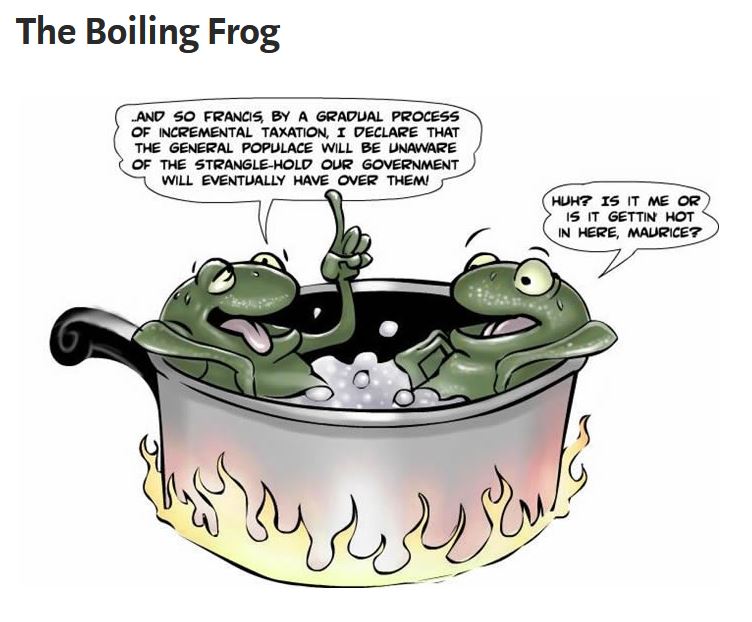
The guys in the pan are so obsessed about the taxes they have to fork out that they actually don’t pay attention to anything else.
The guys attempting to collect those taxes are so obsessed about what they want to do with the money that they actually don’t pay attention to anything else.

Meanwhile, the world is growing apart. The bubbles lose contact with each other. And with the hard core reality…

The cats can always jump down from the roof. Whenever it grows too hot or too cold.
Where are those two frogs going to jump when things will become uncomfortable?

The common sense definition for an inflationary situation is ‘when too much money chase an inherently limited amount of goods and services’.

The ‘limited amount of goods and services’ part is easy. We live on a finite planet, we have a limited capacity to transform whatever resources we are able to identify into usable goods and services … so…
OK, we can always identify new resources and build new capacity but we cannot do any of this ‘on the spot’. We need time. And, even more importantly, we need to put ourselves to it!

Then ‘who does the chasing’?
After all, money is ‘inert’. It doesn’t do anything if let alone in a drawer. On under the mattress…
In reality, we – buyers and investors, are the true ‘inflationary agents’.
‘But it would be completely stupid to sit on a pile of money when inflation rages! You have to buy something otherwise you’ll loose a lot of value! At least, you need to invest that money…’
This is one of the best examples of a self-fulfilling prophecy!
Indeed. Buying or investing during an inflationary bout is the reasonable thing to do! Yet we need to understand that our actions will, temporarily, exacerbate the very inflation we are trying to ‘tame’.

But where does the excess money come from?!?

Until not so long ago, the sovereign was the only one person who could bring new money to the market.
And their ability to do that was severely curtailed by the amount of bullion available for this task.
In fact, the first major inflationary episode in the second millennium had been fueled by the gold brought back to Europe by the Spanish conquistadors. Which bout of inflation brought about the first major change in the European economic thinking.
“To inspect the country’s soil with the greatest care, and not to leave the agricultural possibilities of a single corner or clod of earth unconsidered… All commodities found in a country, which cannot be used in their natural state, should be worked up within the country… Attention should be given to the population, that it may be as large as the country can support… gold and silver once in the country are under no circumstances to be taken out for any purpose… The inhabitants should make every effort to get along with their domestic products… [Foreign commodities] should be obtained not for gold or silver, but in exchange for other domestic wares… and should be imported in unfinished form, and worked up within the country… Opportunities should be sought night and day for selling the country’s superfluous goods to these foreigners in manufactured form… No importation should be allowed under any circumstances of which there is a sufficient supply of suitable quality at home.” Philip von Hornigk, 1684.

After a while, economy had become ‘complicated’ enough to demand ‘paper money’.
The amount of goods and services produced had become so large – and insufficient bullion was added to the money pool, that prices would have had to shrink if the balance was to be maintained.
Unsustainable! Nobody would have bought anything and everybody would have jealously guarded their precious money while waiting for the prices to fall further. This process is known as ‘deflation’ and is considered even more malign than a decent amount of inflation.
We have to note at this point that ‘paper money’ had been made possible by the advent of the ‘nation’.
This is a rather complicated discussion, for the present purpose it’s enough for me to mention that ‘paper money’ being accepted as ‘tender’ means that the general population has enough trust in the issuer of the bills. That the individual user of the paper money trusts/believes he is part of ‘something bigger’.
In those times, it was the issuer of paper money who practically controlled the amount of money which existed on the market.

Which brings us to the present times.

I’m sure all of you are aware of how “fractional reserve banking” works.

‘Yeah, the banks create money out of nothing!’

Wrong!
For banks to be able to ‘create’ new money, they have to extent credit!
For new money to be created in this way, somebody must walk into a bank with a business proposition.
That somebody might want to buy a house, a car or whatever else. Or that somebody might want to start a business. If that somebody convinces the bank that they is solvent or that their idea is worthy enough, then and only then new money is created!
Money doesn’t appear out of the blue! It is born out of trust. That somebody not only trusts themselves but they are convincing enough to determine the banker to extend that much needed credit!

But wait!
We’ve developed yet another mechanism which churns out money.
The stock market.
After developing the business started with the loaned money, the somebody we’ve been talking about above decides to make an IPO. To sell part of his business to investors. To monetize his initial investment.
Depending on the moment chosen for the IPO – and the economic data in the prospect, the IPO can be a huge success. For ‘somebody’ and for the early buyers. You see, each time the price of the stock goes higher, new money is created. Based more on the ‘market’s expectations’ than anything else…

‘But people who put their money on the financial markets are rational agents! They are experts in their field…’

Yeah, right…
You’re talking about the experts who had put together the collateralized debt obligations debacle…
And many others. Too many others…
Also, you’re talking about the experts who had bought those papers! Who had trusted the expertise of the first batch of ‘specialists’!

Thinkers, from Freud to Kahneman and Ariely, have proven than humans are very good at rationalizing and less so at being truly rational.
That for a market to behave in a reasonable manner, it must preserve its freedom.
That it must be free from ‘bullies’ – individual agents who muster a lot of ‘clout’, and free from any mania.

The 1637 Dutch Tulip Mania is a very good example of what might happen when a market gets obsessed with something.
When too many people – not even a majority, forget about the fact that economy (oikonomia) is about making ends meet and that getting rich may be a nice consequence but is a terrible goal.

‘OK, nice try. But what about inflation?’

We have an inherently limited amount of goods and services.
A relentless mechanism which churns out money.
Meanwhile, some of us obsess about their need to conserve the money denominated portion of their stashed away fortunes.

Inflation is nothing but another mechanism.
Which re-balances the market.
Piece-meal – adjusting for daily changes, in normal times. When things evolve ‘freely’.
Suddenly when the market – the people who ‘man’ the market, find out about ‘the dark side of the moon’.