Archives for category: Mindset

Tallow = “the white nearly tasteless solid rendered fat of cattle and sheep used chiefly in soap, candles, and lubricants“.

bite-the-bullet

The mutiny (India, 1857) broke out in the Bengal army because it was only in the military sphere that Indians were organized. The pretext for revolt was the introduction of the new Enfield rifle. To load it, the sepoys had to bite off the ends of lubricated cartridges. A rumour spread among the sepoys that the grease used to lubricate the cartridges was a mixture of pigs’ and cows’ lard; thus, to have oral contact with it was an insult to both Muslims and Hindus. There is no conclusive evidence that either of these materials was actually used on any of the cartridges in question. However, the perception that the cartridges were tainted added to the larger suspicion that the British were trying to undermine Indian traditional society. For their part, the British did not pay enough attention to the growing level of sepoy discontent.

tallowed-five-pounder

The new £5 notes contain tallow, a substance made from animal fat Credit: AP

“…a trace of tallow in the polymer pellets used in the base substrate of the polymer…”
“As the tweet was shared, social media users expressed their disgust at the news.
“New £5 note isn’t vegan. Was everyone’s 2016 New Year’s resolution to do ridiculously insane stuff like adding meat to money?” “

What are we to learn from these two (separate ?!?) incidents?

That we have not yet learned how, or when, to use tallow?

Or that we have reached, again, such a level of generalized discontent that people might use whatever plausible pretext in order to vent their accumulated grievances?

The essence of spin doctoring is to present a sequence of true facts in such a manner that will compel the audience to reach the conclusion desired by the ‘good-doctor’. The really skilled ones don’t even need to lie in order to achieve their goals. At most they ‘shave’ some of the rough edges so that the truths they choose to mention fit smoother into their narrative
In fact it doesn’t matter much whether the conclusion they mesmerize their audience into is ‘true’ or not – truth is relative, anyway. The only thing that’s important here is that ‘the’ conclusion fits the intentions of the spin doctor.
Also, it even doesn’t matter what those intentions are. Good, bad… the end is always the same.

Because of the manner in which all this works.

The principle involved here is the same as that used by the magicians who entertain the crowds of circus goers.
They first concentrate the attention of their audience to a single point and then direct it in such a way that the people are no longer able to see anything but what they are allowed to by the magician.
Or by the spin-doctor.

Unfortunately the similarities between magicians and spin-doctors end here.
While most of the circus goers have a nice experience, albeit a relatively short one, most victims of the spin-doctors have to endure long lasting trauma and/or substantial material loss.

Again, irrespective of the spin doctors’ intentions. It doesn’t matter whether the method is used by a (well wishing socialist) utopian or by a callous Nazi.  In my previous post I mentioned how ‘political hyenas’ spring up and monopolize all the situations in which their ‘dark talents’ cannot be kept in check by the rest of the society.
Here we have the explanation for why the otherwise reasonable members of the society are unable to perceive the mortal danger they find themselves in.

Because the spin doctor had skilfully overloaded their attention.
Because after living for so long ‘under the spell’, too many people have become accustomed to let others think for them and in their name.

Was that clear enough?
The spin doctor doesn’t have to be malefic in order for the tragedy to take place. It is enough that they have occupied the attention of the people and have exhausted the ability of too many of the individuals involved to think with their own heads.
In these conditions the ‘political hyenas’ will undoubtedly make their appearance and attempt to gain control over the society.

And, undoubtedly again, those attempts will be extremely detrimental for the entire society.

ballancing-act

As long as we haven’t yet managed to find alternative energy sources to cover all our needs we still need to transport oil and natural gas from one place to another.
How we do this is the result of the continuous struggle between the ‘tree huggers’ and the ‘global warming deniers’.
north-dakota-protest1
Without the tree huggers our planet would be a lot dirtier that it already is
shutterstock-133485692jpg-0443e596dea017ff
while without the ‘deniers’ it would offer us a life a lot less comfortable than the one with which we have already been accustomed.
uncomfortable
It’s our job – yes, ‘ours’, the ones whose asses are still comfortably glued to the proverbial fence – to maintain a reasonable equilibrium.
vaideeni_interior

A sizeable number of Americans, Republicans even, have understood that Bush 43 wasn’t such a great President. When leaving office he had the lowest approval rate “of any president in modern times”.

Yet he is a man who knows to atone for his mistakes.
He knew how to apologize after blurting, ‘under influence’, “how is sex after 50?” to his female neighbor when seated at his parents dinner table in Maine and he effectively extracted himself from politics at the end of his not so glorious mandate, even though he had started it “believing he was God’s agent here on Earth to rid the world of evil.”
By the end of it, Bush “had become much more aware of the limitations of the office and his own shortcomings” and had started to take actions “contrary to his deepest beliefs“.

Actually Bush’s excesses constitute, in part, the explanation for the huge number of people who showed up to ‘landslide’ Obama into the Oval Office.

Then why are so many Americans still endorsing Trump?
After failing to offer a plausible apology for the ‘locker room banter’ that had surfaced recently.
For implying that a woman was  ‘not attractive enough’ for him to ‘grab her by the pussy‘.
After accusing the press for “rigging the system” against him when all they did was to publish his own words…

The media could indeed do a better job at covering the entire spectrum – a lot of interesting things about Clinton are hardly mentioned while Gary Johnson is all but absent – only this doesn’t explain the insistence with which some of the Republicans keep obsessing about Trump.

Even after some of their own party bosses have started to ‘see the light‘.

Their hoping that  ‘he will defend the Supreme Court’ resides on assuming that ‘The Donald’ would act, if elected, as a bona-fide Republican.
What in Trump’s behavior ever made them believe such a thing?

Do they really want to relieve the Bush experience, only at a different – a lot lower, that is – level?

Specially after more of his antics have came to light…

I couldn’t find any current data so I’ll have to make do with what the Atlantic had published a month ago.

trumps-base

So, a little over 12% of his votes come from college, or higher, educated women while the total is no less than 48%.

Now, would you care to guess which of these women will continue to disregard his being ‘automatically attracted to beautiful’ and keep rooting for him?

Would you even consider Hillary Clinton as a likely candidate?

“Even though she found the job distasteful, Rodham mounted what she felt was her strongest possible defense of Taylor. As Newsday reporter Thrush wrote in 2008, “Her approach, then and now, was to immerse herself in even unpleasant tasks with a will to win.””

At that time Clinton had been ordered by a judge to defend a rapist – which all practicing lawyers can expect to be asked to do.
“Once she no longer had a choice in the matter, Clinton said in a 2014 interview that she had a professional obligation to give Taylor the strongest possible defense.

“I had a professional duty to represent my client to the best of my ability, which I did,” she said.

Gibson (the prosecutor who tried the case)  recalled that the young lawyer worked overtime on the case in hopes of impressing the court, which might them help establish the reputation of her new legal aid clinc.”

Further more:
“Despite her discomfort with the case, Clinton aggressively defended her client. In an affidavit to the court, she said a child psychologist had told her that children “from disorganized families,” such as the victim, “tend to exaggerate or romanticize sexual experiences.” “

In this sense is it possible that even a college educated woman, like Hillary Rodham Clinton, might vote for somebody like Trump, simply because she might consider other things to be more important than his bragging about ‘grabbing beautiful women, who allow him to do it because he is a “star”, by their pussies’?

OK, you’ll tell me that in the voting booth each of us should behave in a ‘personal’ rather than a ‘professional’ manner.

I’ll up the ante and ask you what kind of person is able to efface his/her personal self so efficiently, simply in order to ‘help establish his/her professional reputation’?

Or accept a gleeful ‘pussy grabber’ as the most powerful person on Earth?

After someone opened up our eyes, that is!

-Radio DJ: If you’re sick of being broke, for $108.3, which month has 28 days?
-All of them.
-Woman: I actually know this one! Uh, February?
-Radio DJ: We have a winner!
-Idiots.”

You never saw it this way, did you?
Neither did I.
Not before watching the first episode of Scorpion, anyway.
No excuse to continue to do so afterwards, now that we’ve been told.
For an additional training session, click here.
The whole point being ‘what’s the use of having geniuses among us if we don’t pay proper attention to what they have to say to us?’

“There are known knowns. These are things we know that we know. There are known unknowns. That is to say, there are things that we know we don’t know. But there are also unknown unknowns. There are things we don’t know we don’t know.”

Donald Rumsfeld (b.1932)

“Of all things the measure is man, of the things that are, that [or “how”] they are, and of things that are not, that [or “how”] they are not.”

Protagoras of Abdera (c.485 – 415 BCE)

“Making (political) decisions requires judgement and skill. It should, Plato urges, be left to the experts.”

Plato (c.425 – 348/347 BCE, ‘translated’ by Johnatan Wolff in
An Introduction to Political Philosophy, 2006)

“The Prime Mover causes the movement of other things, not as an efficient cause, but as a final cause. In other words, it does not start off the movement by giving it some kind of push, but it is the purpose, or end, or the teleology, of the movement. This is important for Aristotle, because he thought that an effective cause, giving a push, would be affected itself by the act of pushing. Aristotle believed the prime mover causes things to move by attraction in much the same way that a saucer of milk attracts a cat. The milk attracts the cat but cannot be said to be changed in the process! “

Aristotle (384 – 322 BCE)

“Give me a place to stand and I’ll move the Earth”

Archimedes (c.287 – 212 BCE)

“For every action there is an equal and opposite re-action”

Sir Isaac Newton (1642 – 1727)

“As many more individuals of each species are born than can possibly survive; and as, consequently, there is a frequently recurring struggle for existence, it follows that any being, if it vary however slightly in any manner profitable to itself, under the complex and sometimes varying conditions of life, will have a better chance of surviving, and thus be naturally selected. From the strong principle of inheritance, any selected variety will tend to propagate its new and modified form”

Charles Darwin (1809 – 1882)

“The Communists, therefore, are on the one hand, practically, the most advanced and resolute section of the working-class parties of every country, that section which pushes forward all others; on the other hand, theoretically, they have over the great mass of the proletariat the advantage of clearly understanding the line of march, the conditions, and the ultimate general results of the proletarian movement.

The theoretical conclusions of the Communists are in no way based on ideas or principles that have been invented, or discovered, by this or that would-be universal reformer.
They merely express, in general terms, actual relations springing from an existing class struggle, from a historical movement going on under our very eyes.”
Karl Marx (1818 – 1883)

“Einstein deduced that there is no fixed frame of reference in the universe. Everything is moving relative to everything else….
… space has three dimensions, and the fourth dimension is time.
Space-time can be thought as a grid or fabric. The presence of mass distorts space-time.”

Albert Einstein (1879 – 1955)

“”Heidegger’s analysis of Plato attempts to show that a transformation occurs in the nature of truth in Plato’s philosophy, as a consequence of which Being is subordinated to the correct perception of beings. This subordination, Heidegger maintains, characterizes the history of Western philosophy as metaphysics.
The allegory of the cave is, for Heidegger, an illustration of the nature and process of paideia. At each level of ascent — within the cave to the light, and out of the cave to the sun — the individual experiences a painful blinding. Each stage requires an adjustment and transformation in vision. This transformation in vision expresses the turning of the soul from what is disclosed in one region to what is disclosed within another. This is paideia, according to Heidegger. The relationship of paideia, in this new sense, to alétheia is not apparent because, as Heidegger sees it, we have not only misunderstood the nature of education but, more importantly, have misconceived the nature of alétheia by conceiving it as “truth.” If paideia is a transition from one abode to another, affected by the soul’s receptivity to what is disclosed within each region, then alétheia is disclosure itself: “At first truth meant what was wrested from a concealment. Truth, then, is just such a perpetual wresting-away in this manner of uncovering.
Heidegger indicates that what “truth” means is not so much a correspondence as it is a disclosure.”

Martin Heidegger (1889-1976)

The depth of the uncertainty principle is realized when we ask the question; is our knowledge of reality unlimited? The answer is no, because the uncertainty principle states that there is a built-in uncertainty, indeterminacy, unpredictability to Nature.

Werner Heisenberg (1901 – 1976)

“Contrary to the tenets of classical economics, Simon maintained that individuals do not seek to maximise their benefit from a particular course of action (since they cannot assimilate and digest all the information that would be needed to do such a thing). Not only can they not get access to all the information required, but even if they could, their minds would be unable to process it properly. The human mind necessarily restricts itself. It is, as Simon put it, bounded by “cognitive limits”.

Herbert Simon (1916-2001)

‘Evolution is not as much about the survival of the fittest as it is about the demise of the unfit’

Ernst Mayr, (1904 – 2005, What Evolution Is)

“We human beings can reflect on ourselves, on what we do as well as on what we do not do, on what we imagine and on what we do not imagine, that is, we are self-conscious beings. Yet, how do we do this has been, and still is a mystery for many philosophers, scientists, and mystics that reflect on the matter. So, the search for an explanation continues, with some people hoping to Þnd some unique entity, different from what we connote or intend to connote as we speak of our self, that by itself may provide us (that which we are without it?) with this ability. Others look for some property of the operation of our brain that realises in us the ability that we call our self-consciousness. The old dilemma entailed in these and other different attitudes can be stated as follows: Is our operation as self-conscious beings a property of our brain, the gift of some external agent, or does it consist in some particular manner of our operation as organisms in our interactions?”

Humberto Maturana (b. 1928)

” “Consider a turkey that is fed every day,” Taleb writes. “Every single feeding will firm up the bird’s belief that it is the general rule of life to be fed every day by friendly members of the human race ‘looking out for its best interests,’ as a politician would say.

“On the afternoon of the Wednesday before Thanksgiving, something unexpected will happen to the turkey. It will incur a revision of belief.” “

Nassim Nicholas Taleb (b. 1960)

It seems rather obvious that humankind has ‘consistently’ oscillated between two opposing views on things.

Some of us are convinced that the (whole) truth can be achieved (and that ‘they’ had already done that) while others have reasons to believe that while ‘individual efforts’ are indeed the source of everything that exists, the final results of those efforts are always being shaped/conditioned/reacted to by the medium where they are exerted and by those who bear the consequences.

Coming back to Rumsfeld’s words it seems that the most important (dangerous?) category is, contrary to our first impression, the (presumptive) ‘known – known’.
We cannot do anything about the unknown-unknowns, except for preparing ourselves in a ‘general manner’, and we can always ‘dig up’ something fresh about the known-unknowns but it seems that nothing can convince us that what we consider to be the known-known is but a thin layer of ice floating on a very deep lake.

So the real question that awaits our response is ‘What are we going to do, now that so many have told us what’s been going on?’

Quite a lot of things are currently going on on our Earth.
Many of them have a planetary importance and some of them make it into the news bulletins.
The manner in which they are selected by the editors speaks volumes about our, collective, mind set.

So let’s see what BBC, one of the most important news outlets, deemed as being important enough to make the cut this early morning – September 8, 2016.

news

US elections, Technology, A peek into how the Chinese Government manages its country, A little ‘human touch’ – an Australian family caving in to mental illness, A short but heated discussion about ‘ugly buildings’

An so on…

The Middle East Crises is buried somewhere in “More World News” but still only two clicks away from the main page while if you want to find out more about the “Worst SE Asia Haze for 20 Years” you have to specifically search for it despite BBC itself wondering, only three short days ago: “Could air pollution cause brain damage?”

OK, but what about those ‘damned phones’?

So don’t you find it rather strange that ‘Apple’s new IPhone ditches headphone socket‘ makes it to the ‘first page’?


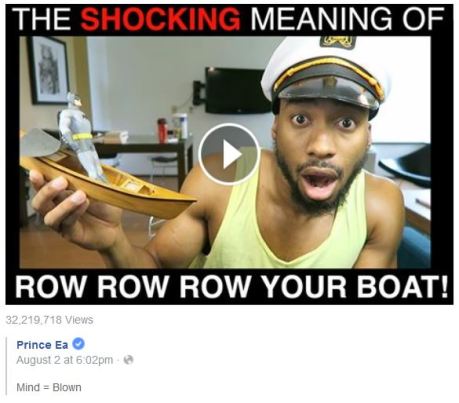
row your boat

While discussing with a FB friend the last video posted by Price Ea – you can watch it by clicking on the picture above – something hit me.

We were exchanging ideas about how much control each of us has over his own life when I realized that our very insistence on using precisely this term is what causes a lot of trouble.

The notion of control divides the world in two.
The controller and the controlled.

And since we are social animals, things become very quickly very complicated.

Being ‘animals’ means we that we have ‘animalic’ needs. Air to breathe, water to drink, food to eat, shelter from the elements… The first floors of Maslow’s pyramid, as you surely remember.
Being ‘social animals’ means that we not only depend on having access to enough physical space and resources but also on the cooperation of the people who happen to be in our vicinity.

The control hypothesis ‘leads’ us into a competition for both space and authority above those around us.
Our world becomes divided into what ever space we already control and the rest. Meaning the (yet) uncontrolled areas from where it is very possible that a challenger might spring up anytime so that the controller must somehow extent his control over those areas as well, as soon as possible.
Our neighbors become divided into our ‘slaves’ and our direct competitors. Who have to be, sooner or later, subdued into slaves – lest they do the same thing unto us.

In conclusion, the ‘control hypothesis’ sees the world as a constantly busy battlefield where each of the dwellers is in constant conflict with everybody else.

Luckily, even the most perfunctory  glance down the history teaches us that human success is more about cooperation than about conflict.

Only the conspiracy theorists believe that most wars are started by business people trying to sell their wares to the warring parties. The reasonable business people know that while a certain amount of tension is good for their business – tension sells guns, among other things – an actual war exhausts both parties and destroys solvent demand.
While it is possible that some callous business people or political actors might try to foment war, for various reasons, that doesn’t mean they are behaving reasonably.

Which brings us to the alternate hypothesis.

How about we replace the concept of ‘control’ with the idea of ‘autonomy’?

How about we give up the ‘tiresome’ notion of control and replace it with the peaceful concept of cooperation?

Since we have already figured out that we depend on both those around us and on whatever resources we can identify, how about we enroll the cooperation of as many of the like minded that surround us as possible and search together for those resources?
Instead of each of us simultaneously trying to run faster than everybody else and to hold back as many as possible – the true meaning of generalized conflict?

Which brings me to the notion of ‘autonomy’.
Being autonomous means being engaged in a special kind of relationship. It means being part of a flexible structure. One that is strong enough to resist but flexible enough to allow a variable amount of leeway for each of its components.
The very concept of autonomy recognizes the mutual dependency that exists between the autonomous members of the said structure and also the fact that the very strength of the structure comes from each of the members being able to solve problems on his own.

Autonomously, that is.
Drawing resources from the structure, sometimes enrolling the negotiated cooperation of some other members but, on the whole, most of the problems get to be resolved ‘under the radar’. To the great benefit of the entire structure.
The vast majority of the structure not even noticing the huge numbers of situations that get solved this way.

Compare this situation to the one described in the first scenario, the one where everybody fights, openly or covertly, with every body else and tell me what you prefer.

“Control” or “Autonomy”?

An all out incessant war for ultimate control or a continuous process of negotiation?


quote-we-learn-from-history-that-we-learn-nothing-from-history-george-bernard-shaw-52-49-23

Funny, isn’t it?

Or yet another reminder that constantly cracking jokes about everything and everybody is not exactly the best thing to do… Let’s compare the relative importance of the British Empire during Shaw’s coming of age – the period when he developed his habit of cracking jokes about everything, no matter how serious the subject, with the fact that Scotland is seriously planning a second independence referendum.

Or let me remind you of another Brit who enjoys cracking annoying jokes:

3727584669

Not funny anymore?

OK, let me try another tack.

What if

caaf122f196e61ec72335fd6ee6b0981

Could it be that the problem resides with us?

That this is basically a matter of what we do with whatever (history) has been passed to us by our forefathers? That what has been passed to us does have its own importance but that we can’t do very much about it?
History can only be rewritten but never changed…
We, on the other hand, can and should learn to deal with the dynamics of this world.


learning_from_history

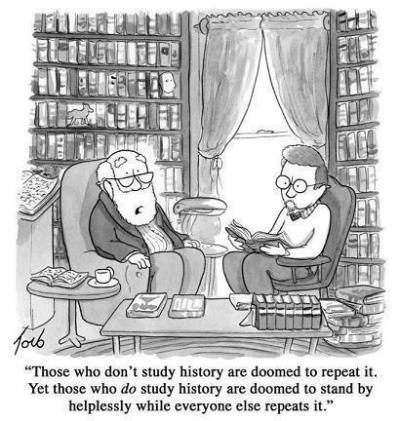
How come ‘those who do study history are doomed to stand by helplessly while everyone else repeats it’?

Could it be that some of the ‘students of history’ are doing something wrong?
Misunderstand the very lessons they try to impose on the others?

Cracking annoying jokes about the matters at hand instead of honestly helping others to reach intellectual autonomy and then respectfully allowing them to develop their own interpretations of things?