Archives for category: Mindset

How many apples had fallen?
Before one of us noticed?
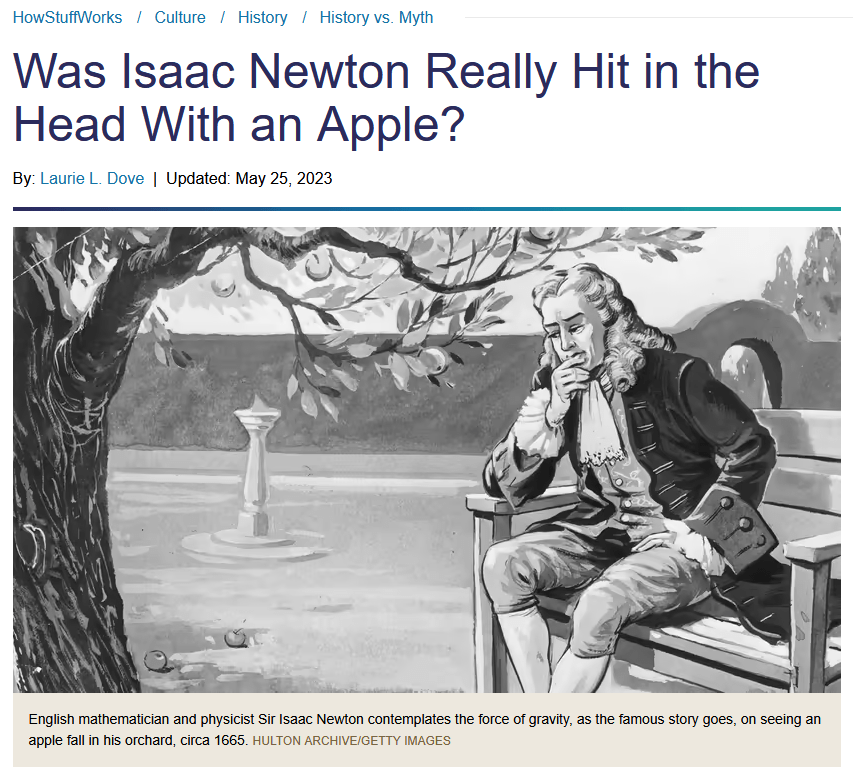
I really don’t care whether the story is true or not.
All I’m interested in is ‘why it took us so long’?
After all, things had fallen towards the center of the Earth since always. Eratosthenes had already calculated the circumference of the obviously round Earth back in 240 BC. And “By the 1st century AD, the spherical model was widely accepted, and Ptolemy developed maps based on a globe with systems of longitude and latitude.” According to the currently famous internet, obviously …

The way I see it, the world was not ready for it. Before Newton.
We didn’t have the ‘language’ in which to spell this new reality. And nobody really cared about the matter. Really invested into the matter, as opposed to interested about the subject…

But things change.
1492 Christopher Columbus discovered America. Trying to go to India but steering into the ‘wrong’ direction. Inaugurating the era of sailing into the unknown.
1524 The posthumous publication of Johannes Werner’s method of determining longitude and latitude by measuring the angular distance between the moon and other astronomical objects. The method was not usable at the time because the necessary data, ‘tables of ephemerides’ had not yet been published.
1543 Nicolaus Copernicus. a priest, published his famous book about how the planets circled the Earth.
1600 Giordano Bruno was burned at the stake for defending and promoting Copernicus’ ideas. The world was still not ready.
1595 – 1627 Johannes Keppler published a series of works detailing Copernicus’s heliocentric model of the Universe and elaborating mathematical tools for the job. Including a set of Ephemerides, in 1617. His work was met with mixed reactions, the opposition being mitigated by the fact that Keppler, a very religious person, never crossed any of the significant figures he came in contact with.
1687 Isaac Newton published his Principia Mathematica. Integrating and formalizing the work of many, Newton’s synthesis filled the ‘need to know’ of those concerned. While his theory was met with some philosophical opposition – Huygens and Leibniz, among others, on the practical side no one had raised any objections. Until Einstein, but that is another subject.

What happened?

People had been already sailing for some 2000 years.
But until then, it used to be a ‘craft’. Something passed on from father to son and kept, more or less, into the family.
The ‘Sea People’…
Vasco da Gama, the first European to reach India by sailing around the Cape of Good Hope, 1498, was the last of the ‘craftsmen’ who ‘discovered’ places. By sailing there using ‘the good old, time sanctioned, manner’.
Christopher Columbus, by sailing the other way around, was the first to transform this craft into an industry.
He also started the process which transformed the whole world.

Sailing and trading on an industrial scale demands a different kind of people. And transform those who embark unto the adventure.
Ancient Athens, heavily involved in sailing and trading, had invented democracy. The city continues to exist while we consider democracy to have been invented by the Ancient Greeks.
Ancient Sparta, Athens’ fiercest domestic competitor, a quintessentially agricultural society, was run as a dictatorship. Only ruins survived. And a myth…

Isaac Newton, and his readers, were able to understand gravity because they needed that knowledge.
Which was but a step in the road they were opening. For themselves and for those who followed.
Basically, what they did was to spin a new story, read ‘narrative’ out of information which was already floating around.

Are we capable of following in their steps?

For ‘only God knows what reason’ this very morning I was reminded by ‘the FB algorithms’ about a comment I made some 7 years ago.
“Democracies fend off challenges when participants value the preservation of the system—its norms and ideals and values—over short-term political gain.”

https://nonprofitquarterly.org/understanding-death-democracy-not-really-trump/


And the Lord God said,
Behold,
the man is become as one of us, to
know good and evil.
Gen 3:22

Why are we doing all this?

?!?

You heard me. ‘Why are we doing all this?’
Everything that we do.

Is anything wrong with you?

No. Not anything that I know of.
Only this question which has arisen on it own.
Why don’t we just stop?
Stop doing everything that we do…

But doing what we do is the reason for our existence…
Otherwise we would not exist. At all!
The world itself would have been different.
Completely different!

So what?!?
Do you really care about the world?
What’s in it for you? For us…
What benefit do we have from the world being as it is?
Or at all…

Click here if this post doesn’t make any sense.


I’ve been watching this, on and off, for three days now.
And I still can’t make up my mind. Whom to admire more.

The one who performs what he believes to be normal. And somehow manages to include, into that
normalcy, the negative feedback he is been dished out by the most powerful agent in his world.
Or the other one.
Who pursues his side of normal. Who finds in him to investigate when he realizes the
two normals don’t fit. And the courage to make amends.

Thank you Elvis Naçi for this conundrum.
I’m a better person now.
Now that I’ve stated my impotence.

“I can’t make up my mind on this one!”

But maybe I don’t have to.

‘After a trip abroad, the Thinker from Cernavoda and the Sitting Woman will be available for the locals.’

What makes us think that the Thinker is thinking while the Woman is just sitting?!?

Is there any meaning in this?

Newton had only described gravity, he didn’t invent anything. Noticed it – like many others before him, thought about it – more (better?) than all those before him, and came up with a deeper meaning for the whole ‘falling thing’.
Nobody cared to contradict him. Because everything, once exposed, was so obvious!

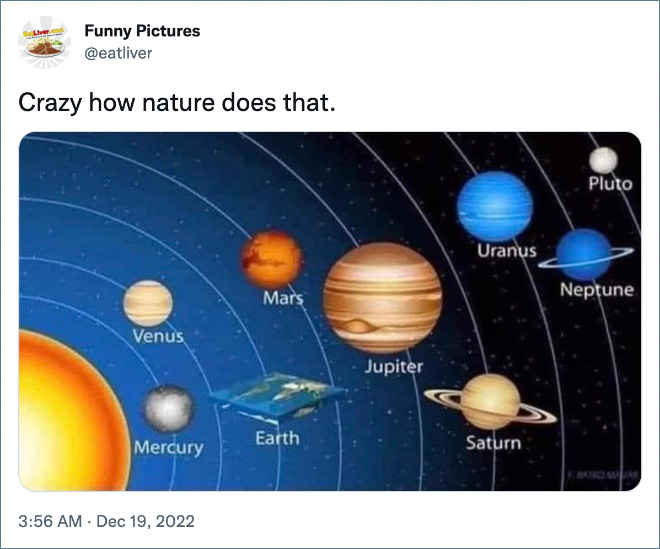
I’ll make a break here and wonder… what does the Flat Earth Society think about gravity?

Had your laugh?
OK, let’s move on.

Darwin had also noticed things. Thought about them. Really hard. And put together a theory.
Which continues to be considered a theory because not everybody is yet convinced…
OK, things are a little harder to swallow. Specially the part with us being relatives, no matter how distanced, with Judy…

Furthermore, the evolution thing is not as obvious as the gravity thing… most of us would have to take Darwin’s word for it… something we don’t do that easily, specially if/when we dislike – for what ever reason, the outcome.

Then why do we ‘swallow’ – line, hook and sinker, however implicitly, the names affixed on those two prehistoric figurines?!?
Because they are obvious?
Just as obvious as gravity?

The guy must be thinking and it’s obvious that the woman is just sitting?!?

Or is it that we believe what we want to believe?
We attribute meaning according to our own standards. Then stick to our opinion. Almost no matter what…

How about He nursing a hangover and She guarding him against predators?

Isn’t it rather funny that something called “crypto” is run on a completely transparent platform?
So transparent that all the tracks are apparent but many of the ‘access points’ remain cloaked?

“The thing is, once smart-contract code is live on a blockchain, you can’t update it. If you discover a bug, it’s too late: the whole point of blockchains is that you can’t alter stuff that’s been written to them. Worse, code that’s hosted on a blockchain is publicly visible—so black-hat hackers can study it at their leisure and look for mistakes to exploit.”

People are promised:

Do ‘this’ and you’ll be happy.
Follow these rules and you’ll reach ‘nirvana’.

Some of us heed to this advice.
Only to discover that the only happiness they reach following this path is that produced by a dutifully fulfilled task.
That of following rules…

The catch being that following rules – the right ones, is required but never enough.
Following rules – the right ones, again – is helpful towards survival. Nothing more.

Drive safely and you’re more likely to get there.

Where?

That’s up to you.
There’s no rule about that!

Third-World Country? No. Sorry, it’s Seattle…

There are so many of us who consider that ‘if you can’t pull your weight, you don’t deserve to live’…

On the other hand, there was a moment in time when the Brits had abolished the institution of debtor’s prison… And a second moment, no less significant, has been the Marshall Plan.

You see, for whatever reason, an individual or a business might fail. Sometimes, even a whole continent might fail…

Until recently – historically speaking, debtor’s prison was abolished in 1869 and the last war reparations had been extracted after WWI – it was a matter of ‘one strike, you’re out’. One mishap, for what ever reason – bad luck was enough – and you were practically reduced to ‘servitude’. If somebody else didn’t bail you out, your chances of getting out ‘alive’ were very slim. No matter whether you were an individual, a business or even a country.

Interestingly, the first who was allowed the protection of bankruptcy was the business sector, countries came next – but only if they were sovereign states, while individuals are not yet completely out of the woods.

Now, where would any of you prefer to live? In the XIX-th century Britain or in the XXI-st century Britain? Ceteris paribus. As in ‘conserving all other ‘variables’ ‘. Given the fact that hot water was practically absent in XIX-th century Britain, I’d prefer the present century anytime.

Was ‘bankruptcy’ the only explanation for the economic take-off which happened after the second half of the XIX-th century?
Probably not but it surely helped. Just as the present day Europe owns a lot to the Marshall Plan.

Then why aren’t we extending a more helpful hand to more of those who have ‘stumbled’?

https://www.thegazette.co.uk/all-notices/content/100938

There’s chess and there’s bridge.

There’s managing your resources – on your own, while trying to outsmart – out, in the open, your opponent.

And there’s team-work. An attempt to make the most of what lady-luck had put on the table by exchanging information. With your partner and in the presence of the competing team. This time only the conversation is out in the open, the resources themselves remain hidden. During the initial phase of the competition and, partially, during the end game.

Until WWI, war was more like chess than anything else. Resources were, more or less, out in the open. The soldiers had no other role but to do and die. The whole responsibility belonged to the guys who called the shots. One for each side…

WWI had ended indecisively. Hence WWII.

Each of the winning parties – there had been two victors, had learned something different from the experience.
The Western allies had learned the value of cooperation while the Eastern ‘block’ had reached the conclusion that brute force trumps everything.

The Americans had started playing bridge with the Brits and taught the game to the rest of the world.
The Russians had honed their skills at playing chess. Something they were already very good at.
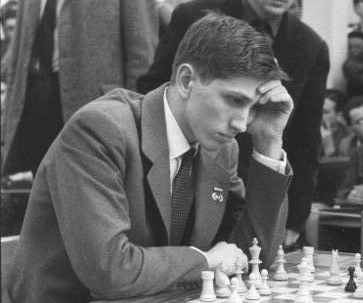
For a while, the Americans have tried to compete with the Russians. Remember a guy named Fischer? Bobby Fischer?

Soon, too soon, the Americans had given up.
After building a computer smart enough to outsmart all human chess players…

The even worse part was that the Americans had given up bridge too!
And forgot the most important lesson of WWI and WWII. That the victor needs to take care of the vanquished if they want to enjoy peace. To actually win the peace process after they had already won the war.

Which brings us to the end of the Cold War.

Communism – and practically all communist states, had crumpled under its own weight.
The westerners assumed it was something they had done themselves. Declared victory.
And the end of history

Having already given up bridge, they forgot to take care of the vanquished… and allowed Russia – the party who had taken most of the blame over their shoulders, for reasons to be discussed some other time, to slide down the slope inaugurated by post WWI Germany.
Did I mention that Russia was still fond of chess? Very much in love with brute force? And not very fond of respectful cooperation?

Now, that we all try to peek into the future – attempting to figure out how the current aggression ordered by Putin will end up, we need some people to learn about bridge.

Putin cannot launch by himself the nuclear missiles he had been brandishing lately.

Now, can those around him reset the chess board on which they are but pawns into a bridge table?
And invite the rest of the world into the game?

Will the rest of us understand the invitation?
If, and when, it will come?

The way I see it, it makes more sense to tax those who don’t want to get a jab than to bribe people to accept the vaccine.
The vaccinated individual enjoys the benefits, the jab is already paid for by the community… and the community, as a whole, is safer.
You don’t want to be jabbed, for whatever reasons, you should pay for the privilege.

After all, this is a matter of personal choice.

There are three kinds of personal choice which impact the wider community. Regardless of who covers the financial costs of healthcare, people being sick is a burden shouldered by the entire society.

Eating too much.
It can have a whole series of consequences but most of them are of a ‘personal’ nature. You can be a bad example for your kid but that’s about all you can do to negatively impact the health of others through eating too much. Except for the financial implications, of course.

Smoking.
Still a personal choice. But the consequences of your bad habit directly affect those who happen to be around you when you exercise your ‘right’. Smoke travels freely…

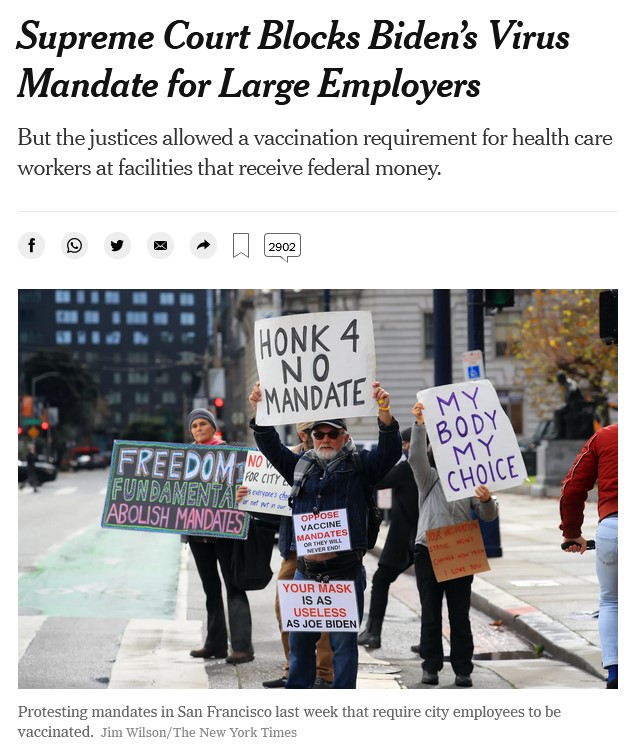
“My body, my choice.”
Refusing to ‘put experimental substances into my body’ is, again, a personal choice.
But getting sick with Covid has far wider consequences for the wide community than smoking. Let alone the fact that smoke is visible while the virus is not.
Smoking in a plane won’t give a lung cancer to each of the passengers present but a person infected with Covid breathing inside such a cramped place can directly infect many. And god only knows how many more after the passengers reach their final destinations …

Since the above mentioned decision of the Supreme Court – that government should not tell ‘the people’ what to do with their bodies (unless federal money is involved) – things are getting murkier.
Smoking seats might return on planes. Smoking tables in pubs.
And who knows what else…

Let’s face it!

Santa is a lie.
A white one, indeed, but still a lie.

Then why do we continue to ‘confuse’ our children?
Because for as long as they will remain convinced that it was Santa who brought their presents, they will not pester us with their demands?
It’s easier for us to tell them ‘Santa didn’t consider you worthy enough’ than ‘we didn’t have enough dough’?
It’s a ‘subtle’ manner for them to learn that deception is acceptable? If driven by ‘noble goal’? And who gets to determine how low the benchmark for ‘noble’ must be set for a deception to become acceptable?

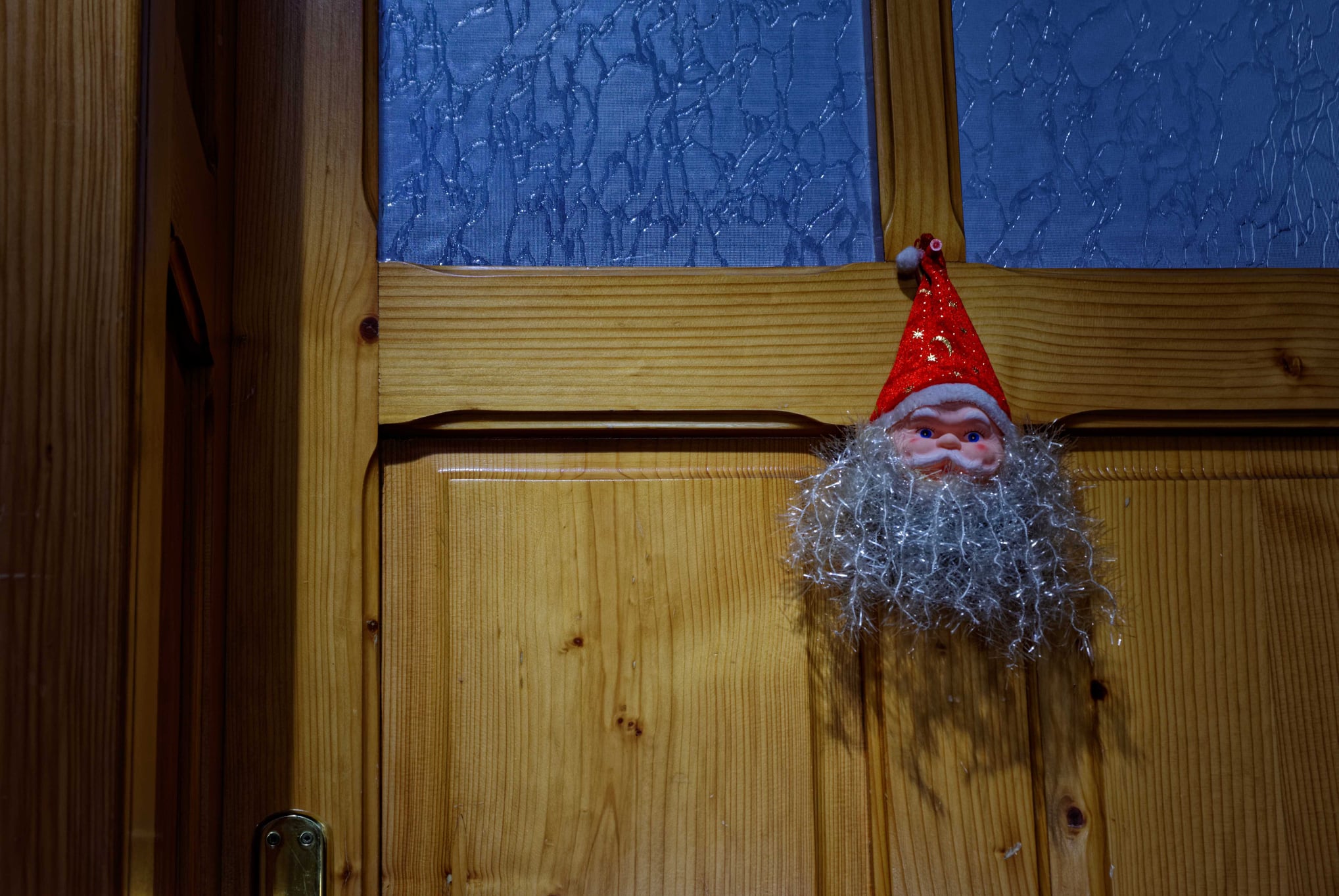
But the strangest thing pertaining to this habit of ours is the number of fake Santas hanging in the most peculiar places.
The one above, for instance…
Why would a sensible person – me, drill a hole in the middle of an otherwise pristine wooden door just because his wife loves to hang bearded figurines?

Meanwhile, this guy has become a permanent fixture. He’s been there for years …