Archives for category: freedom

Things – every’thing’, actually – are/is relative.
Relative to the agent evaluating each of those things
.
Accordin’ to Einstein, that is.
He was the one who taught us to use whatever reference frame suits our needs.

Do you reckon anybody wasted any time or energy thinking about freedom before the advent of slavery?
Me neither.
Forget about the fact that, in those times, people didn’t have much time left for abstract thinking. Finding food and enjoying it with friends kind of drains your energy when you have to do it yourself… The point being that, in those times, everybody was free. Hence ‘had’ nothing to compare freedom with… No lack of freedom, no reason to speak/think about it.
No reason to notice the thing and no reason to coin the concept…

Hunter-gatherers have no use for ‘property’. Personal objects are just that and everything else either belongs to Mother Nature or to the entire group. And this goes without saying. Or thinking about it. People share everything as a matter of fact and common sense discourages the others to use anybody’s personal objects unless in an emergency.
Agriculture – either herding animals or growing crops – changed everything. Property, both as a concept and as an everyday manner of dealing with ‘things’, was invented and introduced in daily use. Productivity increased dramatically. Which made it possible for people to have ‘spare time’. For thinking.
And for planning…

‘The neighbors have better crops. Let’s go take some for us. And while we’re at it, let’s take some of their women too’.
The first slave was probably the first person to long for freedom…

‘Cheap’ slave work coupled with the increased social productivity induced by a markedly improved technology for obtaining food meant that some individuals could afford the luxury of thinking.
The Ancient Athenians had both slaves and philosophers. The slaves did whatever was needed to be done while some of the ‘beneficiaries’ had enough time, and energy, to let their minds ‘free’. To roam free in search for meaning.
To coin the concept and to explore freedom…

Relative “To whom”? To us!
We’re responsible for freedom and freedom is relative to us.
We have invented it. We’re the ones using it. In the sense that we’re the ones who need to notice that freer communities fare a lot better than the less free.

So freedom is relative both to those thinking about it and to each particular community.
To each particular community which puts freedom into practice!

And the Truth shall set you free.

Heidegger, the philosopher, has an interesting take on this ‘truth’ thing.
Nobody does, and never will, know everything about anything. Lest of all about ‘everything’. Hence nobody has access to a ‘true’ piece of knowledge.
Furthermore, ‘truth’ is about communication. About a message. An expressed piece of knowledge. And since there is no language precise enough to allow a communicator to cram into a message all they want to express… nor precise enough to allow a ‘reader’ to figure out everything the communicator had attempted to express…
Which drives Heidegger to posit that truth depends on intent. On a communicator sharing honestly everything they know about a subject. On a communicator allowing the receiver of the message to reach their own conclusion.

I ended my previous post by mentioning the ‘fairy tales’ our ancestors have spun in order to ease their ‘passage into the great unknown’. Thus making their lives bearable. Enjoyable, even.
In those times, ‘the truth’ – the unconcealed truth, in Heidegger’s terms – was that nothing made sense. That life itself was a meaningless joke. As a Romanian saying goes, ‘life resembles a hair from the private parts of the body. Short and full of shit…’
I’m not going to make a historical inventory of the various fairy tales the humankind has used to lullaby itself into accepting life as it used to be. Enough to say that they, the fairy tales, did the trick. Helped us reach the present stage.

I’m going to make a break here.
And notice that any, or even all, of those fairy tales might, eventually, be proven as being true. No matter how improbable this might be. I’m not an atheist. I just don’t know whether a god, or more, do exist.
What I do know is that, by their own admission, all of those stories have been spun by people.
Each of those stories is about what the original ‘spinner’ saw fit to communicate on the subject.
And the better stories, those who made more sense in the particular circumstances where they had survived, made it up to the present.
Helped the respective believers to survive. Helped some of them to thrive, even.

Now, today, we need to make up our minds.
Accept that our consciences are works in progress.
That consciousness is a space caught up in an accelerating evolution. A cauldron of sorts.
That each of those ‘fairy tales’ was useful in its own time. That the need to mitigate our cognitive dissonances continues to exist.
That we’re responsible for our future. Nothing new here.
And that there’s no one to save us. Not now. Or after we will have fucked up everything.


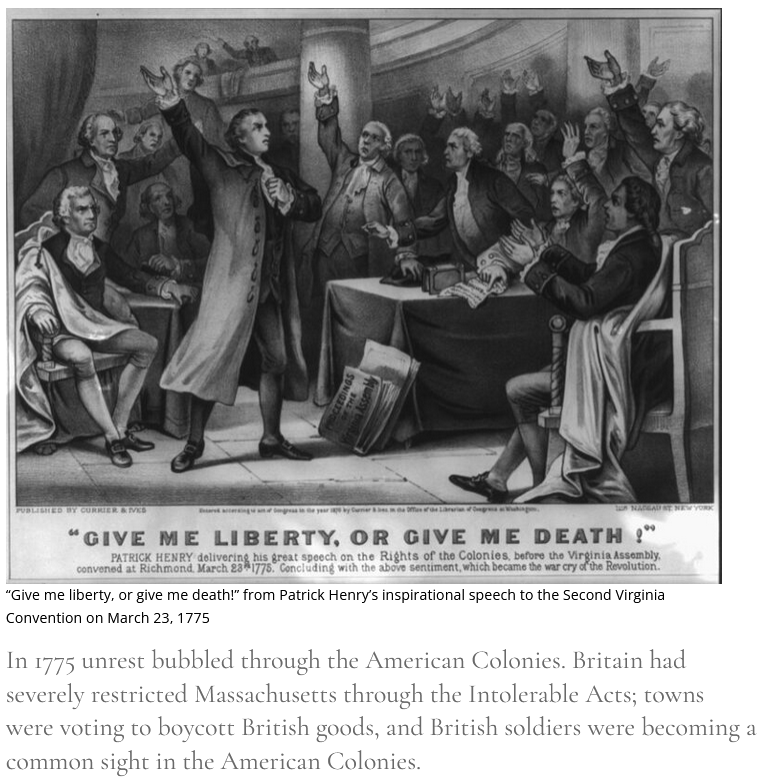
The ‘Truth’ being that ‘Give me Liberty or give me Death’ was a very effective call at arms.
On the face of it, on the ‘logical front’, it doesn’t make much sense.
‘Death’ was, and continues to be, inexorable. Why, for the sake of ‘liberty’, jeopardize the few precious moments left to be experienced as a living creature? Specially when, according to the lore considered valid when Patrick Henry had uttered the words, a second life was going to open just ‘after’…
‘The Devil is in the details’!
The belief in the ‘after-world’ works both ways. It encourages the freedom-fighters to take risks – believing they will get their reward ‘afterwards’ – and encourages the prudent to endure. Believing that they will get also get their reward ‘afterwards’.

Now, that I’ve ‘spilled it out’, I must confess that I’ve successfully convinced myself.
I’ve rationalized, according to my standards, my belief that it’s our responsibility.
To understand and accept that we’re responsible for the consequences we’re leaving for those coming after us.
I don’t know what we should do. I’m no prophet.
But I do know what we shouldn’t.
You do too!

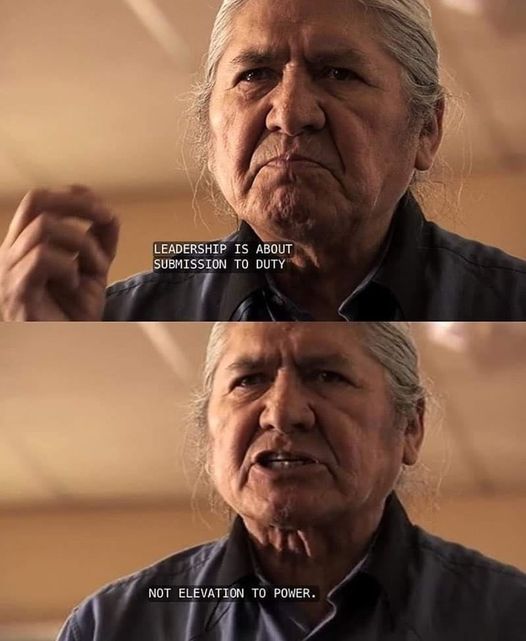
Kiss an ass for long enough, its owner will become god.
And start behaving accordingly…

We all know that no communist regime has ever worked. For long…
Some of us have noticed that all empires, all imperial regimes, eventually collapsed. Under their own weight. Under the weight of accumulated errors…

The mechanism is simple.
Lord Acton was convinced that “Power corrupts and absolute power corrupts absolutely”.
Frank Herbert, looking from the other direction, argued: “It is not that power corrupts but that it is magnetic to the corruptible”.
My experience suggests that both were right. Power is magnetic to the corruptible and when enjoying it those in power are subjected to innumerable ‘temptations’. Already corruptible, most of them indulge themselves…

Democracy is nothing but a weeding mechanism. “The People”, realizing that (some of) those in power have become too corrupted, have the necessary tools to weed them out. To replace those corrupted politicians peacefully.
With other politicians, not – as yet, anyway – as corrupted as those sent away.

Imperial regimes, the communist ones included, do not have such mechanisms.
The already corruptible, once in power, sink deeper and deeper into corruption. Become more and more impervious to any advice. More and more confident in their own infallibility. More and more prone to making bigger and bigger errors.
The consequences of which errors keep pilling one on top of the other.
Until nothing works anymore…

Which is why all reasonable political regimes have limits.
Elections are organized on a timely manner.
And no more than two presidential mandates, for example.

Given all of the above, I’m afraid. Petrified, actually.
Two people are going to meet, in a short time, pretending to solve…
The entire planet seems mesmerized!
Two people are going to determine the fate of billions!?!

Are we nuts?


There’re no blinder people
than those who don’t want to see…

Attempting to determine who ‘made that’ is similar to trying to find out which came first.
The chicken or the egg…
As if one was possible without the other…

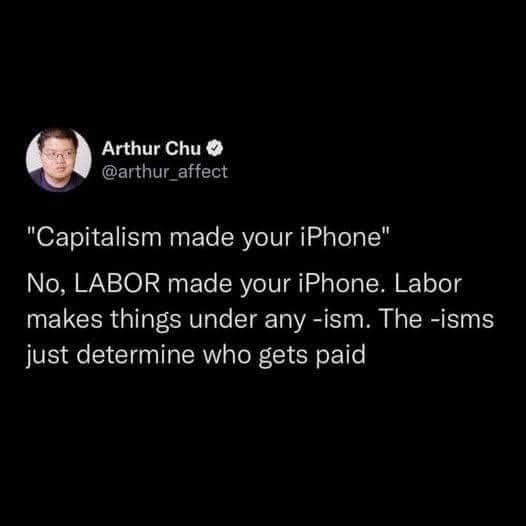
Yeah, it’s labor which makes each thing.
And it’s capitalism which makes things possible…

Capitalism is a setting. A way of doing business.
Labor is a process. Through which some things – ideas included – are transformed into solutions.

If you want to plant a tree, you have to dig a hole.
If there was no shovel around – no capital available – you’d have to dig the hole using your bare hands. And dig the sapling out from the forest. Still bare handed.
If you happen to live in a capitalist setting – you may borrow a shovel and a sapling, if you didn’t have them already. And start an orchard.

The interest is too high? Capital has become too concentrated/expensive?
It happens from time to time. Usually just before a major crises.

Is there anything that might be done? To mitigate this boo-bust cycle?
Make sure the market remains actually free. That no one becomes too powerful.
Too powerful for our own good.

The Sherman Antitrust Act “makes it illegal to monopolize, conspire to monopolize, or attempt to monopolize a market for products or services“.
The Clayton Act “aims to promote fair competition and prevent unfair business practices that could harm consumers.

Actually simple… if dully implemented …

And don’t fool yourself.
Socialism is nothing but state-run capitalism. A bunch of con-men take over the government and make all the decisions. Everything of value – all capital – theoretically belongs to the people and all the meaningful shots are called exclusively by the big shots who control the government.
Fascism, the other ‘alternative’ experimented during the XX-th century, is very much similar. Property remains, theoretically, private but the major calls are also called by the big shots who control the government.


Congress shall make no law respecting an establishment of religion,
or prohibiting the free exercise thereof;
or abridging the freedom of speech, or of the press;
or the right of the people peaceably to assemble,
and to petition the Government for a redress of grievances.

Doesn’t make much sense?
Mentioning ‘God’ on money is the first step towards the establishment of an officially sanctioned religion?

Well…

In my previous post I posited that property, the concept, is the stepping stone for social order.
I’ll add to that a simple observation. Whenever too much property gets hoarded by a too small number of people, the community which had allowed that to happen is in great danger.

Same thing here.
We have religion – a social phenomenon – and religions.

We have a certain understanding of the world, shared by the members of a community – which allows the community, as a whole, to behave in a coherent manner. Not that much different from what happens when people use a common language. They can communicate. Same thing happens with people partaking in a religion. They ‘see’ things in a coherent manner. Hence can coordinate their efforts.

And we have religions…
To reach the ‘certain understanding of the world’ I mentioned before, each community had traveled a road. A particular road through the particular circumstances in which each cultural community – currently known as ‘nation’ – had had to build their culture. Their identity.
Some communities had put together certain scenarios to accompany them along this road. To help them make sense of what was happening to them.
Some communities have used more than one scenario during that journey while others use more scenarios simultaneously.

Sociologically speaking, all that matters is social coherence.
All is well as long as the community conserves its ability to function. To survive.
As long as the individuals who compose that community continue to have a common enough understanding of the world in which they live.

For the simple reason that they, we, live in the same world!
And if we, individually or in small ‘gangs’, start behaving as if the world is different for each of us…

The Founding Fathers had a common understanding of the world. They belonged to the same (functional) religion despite belonging to different ‘denominations’. For them, the First Amendment was about reigning in the powers of the Government. They had realized that a Government able to impose a certain religion – a certain scenario – upon the entire community would eventually bring destitution.
The Founding Fathers could not foresee a situation in which a few of us would deny the practical daily realities of this world. Invoking their particular scenario as an argument… As the supreme argument for refusing to see the reality.

The reality as it is.
And as it is seen by a majority of us.

I mentioned earlier that some communities have changed their scenario along their history.
They did it when they have found new meanings. They have seen new things about the reality and they have integrated those new things into their newer scenario.
By changing the scenario they have actually built a new reality.
Societies which have clung to their scenario to the bitter end… are no longer with us.
Societies which have somehow found it in their collective minds to adapt their scenarios to the reality changed by their own efforts continue to survive. To thrive, even.

“Hoarded by a too small number of people” means controlled by a handful of people.
Sometimes coordinated.
As it happens in any dictatorial regime. It doesn’t matter who formally ‘owns’ something if the use of that something is tightly controlled by somebody else.
Furthermore, a certain ideology may end up having a lot of clout without being imposed by an authority. Nevertheless, the fact that an ideology dominates, for a while, makes it so that the community which allows this to happen to experience a dictatorial regime.
For whatever reason, some people were convinced that witches were real. And burned them at the stake.
For whatever reason, a lot of people continue to believe that communism might be a good thing.
For whatever reason, some people continue to believe that they are entitled to determine whether a woman may or may not abort a fetus.

What is the difference between an ideology and a scenario?
The manner in which people relate to it.

Having been told that they were the children of the same God made it possible for the believers to stick together. To act like brothers. To respect each-other. To invent and implement capitalism and democracy. Both relying on trust. On mutual trust and on the freedom of the market. Both the market where goods and services are traded and the public forum. Where ideas are traded…

Being told that only one particular understanding of a certain text/idea/concept is correct some people remove themselves from the ‘general population’. Which ‘general population’ becomes ‘the others’.

‘The others with whom we don’t have anything in common’.

Quite an untenable situation, given the fact that the world is becoming smaller and smaller.

The Polish state broadcaster on Saturday suspended
a television journalist who, during the Olympic Games opening ceremony,
reacted to a performance of John Lennon’s “Imagine” by saying it was a “vision of communism.”

Communism is perfect!
Communism is the perfect lie…

Communism was ‘invented’ by Marx and proposed as the only solution to a real problem.

The problem with communism as a practical solution is that it cannot be put into practice!

Humans, both at individual and social level, need freedom.
Without individual and social freedom, individuals regress to an animalic state and societies fail. Abysmally!

According to Marx, communism was the only solution for what he had perceived as a problem.
According to Marx, when a critical mass of people belonging to the middle class will become destitute, they will accept to be led out of their predicament by ‘the communists’. But since the rest of the society continues to enjoy their perks or to ignore the dangers ‘lurking in the future’, in order to achieve their goal – communism for everybody, including for the unwilling, the communists will have to institute the socialist dictatorship. As a transition phase to communism. A phase in which the unwilling will be convinced.
According to history, no dictatorship – including the socialist – has ever survived. Has ever achieved its goal.

Communism, at least for now, is unattainable. For the simple reason that humankind has not yet learned how to survive dictatorship. How to live without freedom.

On the other hand, communism is very alluring.
For the idealists amongst us…
Communism is a very suitable subject for dreaming. A very nice thing to have, albeit impossible to achieve…

Since the idealists are hard to convince, let me speak to the practical minded amongst you.
John Lennon invited us to dream. To dream a world with ‘no possessions’ and with ‘no need for greed or hunger’. What’s not to like in this dream, except for the fact that it can’t be put in practice?
Hunger is natural. Why eat if not hungry?!?
Greed is also natural.
Who doesn’t like/want more of what they consider to be pleasant?!? The wise amongst us?
How do we become wise? As wise as each of us is able to become…
By interacting with others? By learning from them? And from the consequences of those interactions?

Property – possessions – is a tool.
A tool society uses to make order. If each of us knows what they are able to use for what purpose things go smooth. There’s no need for outside intervention. Granted, this is valid for only as long as each – well, at least most – members of the society have enough to eat, where to sleep and what to protect their backs with.
Without the order construed by the society, collectively, using the tool known as ‘property’, how are the people going to cooperate?!? To interact? To learn, even…

How about we wake up?
Sleep is essential and dreaming a normal part of it.
But we also need some wake up time!
Pun intended…

Conserving the subjective self-perception

“Objective through shared subjectivity”

‘Popular belief’ posits that ‘objective’ is based on facts while ‘subjective’ is based on whim.
True enough but facts need to be identified as such first and then agreed upon before they become ‘facts’. Before they are recognized as facts by the interested parties. Before they become the foundation for objective knowledge.
On the other hand, ‘subjective’ is indeed personal. A personal ‘take’ on something which has happened inside the same reality where facts take place. In fact, all the facts we agree upon have started their lives as subjective impressions. Which had been shared with other people and eventually stated as facts after ‘negotiation’.
Furthermore, no matter how subjective a perception, all perceptions are perceived using the same senses. And ‘processed’ using the same brains. According to culturally accrued ‘habits’.
Even a hallucination will conserve some degree of normalcy. If of a visual nature, for example, the hallucinatory perception will be experimented and described in visual terms. Pondered upon and discussed with others using the same brain which usually deals with facts. Shared with others using language and evaluated according to ‘customs’.

Self-preservation

According to the Cambridge Dictionary, a rationalization is “an attempt to find reasons for behaviour, decisions, etc., especially your own“.

According to my research, all conscious agents will first attempt to arrange all information at their disposal in such a manner as to conserve the subjective impression they have already acquired about themselves.

Salvation

According to Merriam-Webster, salvation is “deliverance from the power and effects of sin
Having to do with religion, some people will say salvation is subjective by its very nature.
Being understood in the very same way across various cultures and religions, salvation becomes objective.
Not real in the materialistic sense of the word but real in the sense that belief in salvation has very real consequences. Real enough to become material. Set in stone!
Shared belief in Christian salvation has driven people to build churches while shared belief in Buddhist salvation has driven people to build monasteries. The fact that people involved in so different religions as Christianity and Buddhism share their faith in salvation makes salvation an objective ‘thing’.
Makes salvation something ‘natural’.

Self-actualization

According to Abraham Maslow, an American psychologist, for a person to be able to attempt self-actualization that person must have fulfilled all other needs they might have had.
Having fulfilled those ‘previous’ needs is no guarantee for self-actualization being a success, only a prerequisite.

Copernican Revolutions

In a sense, each Copernican revolution humankind has sailed through – of which there have been many – has been a self-actualization.
I’m going to mention three and wrap up this post.

Instrument and possession

Many animals – relatively speaking, are able to use tools. To purposefully alter pieces of matter in order to be more useful towards the intended goal. But nobody except us carry them around.
Furthermore, a lion will defend its pray. And its hunting ground. In a sense, a lion behaves as if it defends its possessions. But only us, humans, talk about possession.
It was us who have conceptualized possession. Who have instrumentalized the notion of property.
This has happened more or less simultaneously with the advent of organized agriculture. Which needs instruments and order. Tools to work the land and the expectation to be able to enjoy at least some of the end-results of your work.

Money and nation

Systematic agriculture has thoroughly transformed human society.
Or, more exactly, the humans who had invented systematic agriculture had to adapt themselves to the new reality brought upon their heads by their own invention.
The spoils of systematic agriculture – abundant food – have created vast opportunities. Some of the people involved in the process were ‘free to do other things but toiling the fields. Hence specialization of work and social division. ‘Professional people’, priests, soldiers.
The source of this new found abundance, and the spoils themselves, had to be protected. And organized…. a.k.a. taken advantage of! Hence ‘rulers’. Arable land had been taken into possession along with the people working the fields. Nation building had begun.
The hoarded produce could be traded. Hence they were. Along with the ‘things’ produced by the ‘professionals’ fed with the accumulated ‘excess’ food.
Trading would have been easier if money was available. Hence it was invented. And used. By traders as a tool for trading merchandise and by rulers as a tool for ruling ‘their’ nations. Which weren’t yet called as such. Only functioning as such…

Rights and reason

Systematic agriculture and trading had been the stepping stones for the advent of ‘industry’. For professional people producing things for sale.
Oekonomy – the art of making ends meet on a yearly bases, as understood by the Ancient Greeks – had become ‘the Economy’. The engine moving society along the passage of time. A process so complicated that a single agent was no longer able to control it. L’etat had become so complex that even Louis XIV could no longer claim it as his own. For the ‘system’ to maintain its ability to function, to go forward, individual agents had to be freed.
Hence the freedom of the market and the human rights.
Hence individual human beings indulging in the habit of thinking for themselves…

Salvation no longer came in an organized manner. According to rules.
To each their own. Reason had been freed once and for all.
Each of us has assumed the freedom to rationalize according to their own wish.
To their own purposes.

To which end?
Only history will tell…
But before proceeding we’d better remember Ernst Mayr’s words.
‘Evolution has nothing to do with the survival of the fittest.
There’s no such thing as ‘the fittest’! The fittest to what since everything changes all the time?!?
Evolution is about the demise of the unfit.’

Until now, evolution has been ‘blind’.
Increasingly, some have become cocky enough to consider they know better. To consider they know where they should lead ‘their subjects’. Lenin, Hitler and Stalin are but a short selection from a long list.
Those who have followed the advice and have facilitated the ‘pestilence’ put in practice by this kind of people are those who have forgotten the deeper meaning of “You must not make any idols. Don’t worship or serve idols of any kind, because I, the LORD, am your God”.

Which ‘God’ brings us back to where we started.
To ‘objective as something agreed upon by many subjective agents’.
You see, I quote the Bible and I mention God quite a lot. And still define myself as being ‘agnostic’.
The fact that I don’t know whether God had actually created the world doesn’t alter the fact that the Bible is a trove of knowledge. As for God’s very existence… things are complicated!
How do you determine whether something exists? You check for the consequences of its existence, right?
A table exists only if you can ‘touch’ it. Since you cannot touch something which doesn’t exist, the fact that you can touch it is a consequence of its existence.
Same with God. Irrespective whether it has actually created the world – or anything else, as a conscious agent – God does exist. People acting as if God was real – people’s faith in God – had and continue to have consequences.
People acting as if God was real have brought God to life. The God we know, talk about and have faith in…

My last affirmation is rather hard to swallow?
Then how about money?
What makes them so valuable? Except for our ‘faith’ in them? Except for our belief, our shared belief, in the ‘fact’ that we are able to get things by paying for them?
And how about ‘rights’?
Do we respect human rights because we believe in them? Or only because ‘that’s the law and there is no other alternative, at least in public’?

See what I mean?
We live in the reality of our own making. And we tinker with it incessantly.
Attempting to make it more and more comfortable. To us!
Each of us tries to make the world ‘a better place’. Each of us working for themselves, each of us according to their ‘own advice’.

Which brings us to ‘how things work’.

Time and time again, reality has told us that we cannot survive, let alone thrive, individually.
That everything we have done is the consequence of us working in concert.
It was our shared belief in ‘money’ which has given us capitalism. Economic effervescence and elevated life standards.
It was our shared belief in God which had convinced us that ‘we were brothers’. And, as brothers, that we should respect each-other. That we should respect each-other’s rights.

Now, that ‘God is dead’ and it has become obvious that ‘capitalism is no better than those who put it into practice’, we have arrived at an inflection point.
Are we able to preserve the true nature of the things which have brought us here?
Or are we going to transform them into idols?

Truth used to be based on reason.”
J.P.Moreland, Introduction to
Escape From Reason 2006
by Francis A. Schaeffer

Etymologically speaking, reason comes from ratio.
‘Reason’ in Latin but also having to do with ‘reckoning’.
With dividing the ‘big picture’ into easier to understandable slivers. Slivers meant to be analyzed and later assembled back into meaning. Into ‘truth’.

Currently we understand reason as “the intellectual faculty that adopts actions to ends“.

Now, which of the two reasons gives birth to the ‘genuine’ truth?

The analytical/synthetic one which attempts to develop reality into meaning or the one which defends and embellishes the already known truth? The revealed truth?

The whole thing depends on the “ends” of the reasoning agent?

Reason, hence truth, depends on the intention of the individual performing the act of reasoning?!?

Quite unreasonable, don’t you think?
Truth was supposed to be anchored in reality, right?!? Not on ‘intention’….

Truth as unhiddenness… is a concept developed by Heidegger.
Basically, this whole thing is about individuals being unable to discover nor formulate the ‘entire’ truth so a ‘bigger’ truth may be reached only through cooperation. Everybody ‘says’ – unhides – everything they know about a subject and that’s how the most complete truth available at that moment is ‘uncovered’.

‘But this means the Truth becomes fluid.
No longer ‘fixed’. Unreliable!’

I’m afraid you’re right!
Except for the ‘unreliable’ part.
As long as enough people do their part, and honestly speak up their minds, the most reliable truth knowable at any given moment will become apparent to everybody.
To everybody who cares to look for it!
To everybody who accepts that their reason, while imperfect, can and should contribute to the common effort to get closer to truth.
To everybody who accepts that other people’s reason, while imperfect, can and should be listened to in the common effort to get closer to truth.
To everybody who accepts to continue this effort knowing very well that no matter how hard they will try, people will never find the entire truth

‘Things’ “did not happen in a vacuum“.

For ‘man made’ things to happen – for anybody to do anything – three requirements must be met first.
‘Circumstances’, ‘determination’ and ‘opportunity’.

To serve a meal, the chef needs ingredients and tools, willingness to do it and a hungry client.
To engage in an act of terrorism, the terrorist needs a certain set of circumstances, the ‘determination’ to do ‘it’ and a ‘trigger’.

Is it far-fetched to compare these two things?
Feeding people and killing them?

From a ‘deterministic’ point of view, there’s no difference between deciding to serve a bowl of pasta and deciding to deliver a bomb.
The consequences are, obviously, completely different.
Supporting life versus taking it away.

There are more differences.
Nobody has yet seriously considered banning restaurants and everybody hates terrorism.
When subjected to acts of terrorism! Otherwise…

Meanwhile, PKK continues to remain a terrorist organization!

So…
Just as food tastes vary enormously, so does various people’s interpretations on what constitutes a terrorist act.
The first constant being the fact that food sustains life while terror tends to make it difficult.
And the second one being the fact that both restaurants and terrorist acts are community based phenomena.

A restaurant depends on the people who deliver the goods, on those who operate it and on the paying customers who keep the business afloat.
A terrorist depends on those who help and facilitate. And a terrorist depends on the rest of the community turning a blind eye towards what’s going on. For no matter what reasons! Until they realize how foolish they have been…

‘But who is a terrorist?’

That’s a very good question!
There are up to three types of ‘associates’ in any act of terrorism.
The ‘direct operator’, the ‘first hand facilitators’ and the ‘people behind’.
While it is quite simple to understand the roles played by the ‘direct operators’ and by the ‘first hand facilitators’, things become murkier when it comes to the ‘people behind’.
For some – including for me, the current Iranian leadership are among the ‘people behind’ the Hamas terrorist organization. But what about those who, willingly or unwittingly, make it so that whole communities become ‘restless’?
Restless enough to generate terrorists and careless enough to turn a blind eye towards terrorist acts being prepared in their midst?

My point being that just as nobody becomes a celebrity chef overnight, it’s almost inconceivable that anybody might engage in major acts of terrorism without being helped by some and noticed by many.
And just as a chef has to be talented to become noticed, a ‘direct operator’ needs to be in a ‘particular’ state of mind in order to operate. But just as an untalented cook is, eventually, ‘set aside’ by a run of the mill community, a willing ‘direct operator’ ends up, literally, being embraced by a ‘triggered’ community.
Or is eventually ‘sent away’ by a normal one. By a properly functioning society!


Just before starting this post, I heard somebody commenting on Antonio Guterres’s words: ‘Even if he will not have to resign, he won’t get another mandate’…
Now, as a coda, I feel the need to share that comment with you.

Everything flows and nothing abides.

“You have to flow with the river. There is no other way. You can swim against it, and pretend not to be flowing with it. But you still flow with the river.” – Alan Watts

“Only a dead fish flows with the river”

A dead fish is ‘flowed’ by the river.
Flowing with the river is a choice!
Give me the power to change what needs to be changed, the power to accept what needs to be accepted and the wisdom to choose between them‘.